Feeds:
Posts
Comments

Archive for September, 2011


The wolf hunts are underway and Idaho plans to assassinate over 800 wolves, including pups and pregnant females.

PBS reports, “For the first time in years, hunting season for the once-endangered gray wolf is underway in Idaho and Montana to reduce the predator’s population. Cattle ranchers say the hunts are necessary to protect their herds, but environmentalists disagree. Science correspondent Miles O’Brien reports.”

Click on the link below to watch the video:

http://www.pbs.org/newshour/bb/science/july-dec11/wolves_09-19.html

*Special thanks to PBS News Hour for providing this information!

Read Full Post »

 Friday, September 23, 2011 6:12 pm (information provided by http://wallowa.com/free/odfw-to-kill-two-more-imnaha-pack-wolves/article_c3c8d792-e64a-11e0-bb05-001cc4c002e0.html)

“ODFW to kill two more Imnaha pack wolves 2 comments Oregon Department of Fish and Wildlife staff will kill two wolves from the Imnaha pack after confirming they were involved in another livestock loss.

The two wolves that will be targeted are the alpha male and an uncollared wolf in the pack. Data from the alpha male’s GPS collar confirm he was at the scene where the calf was killed earlier this week.

 Removing two wolves will reduce the size of Imnaha pack to two—the adult/alpha female and a pup born in spring 2011. Other wolves from the Imnaha pack moved to new areas earlier this year. “Today’s decision was not made lightly,” said ODFW Director Roy Elicker. “We’re working hard to conserve wolves in Oregon, yet be sensitive to the losses suffered by livestock owners.”

Yesterday’s investigation brings to 14 the number of livestock animals confirmed to be killed by the Imnaha pack in the past year and a half. ODFW or U.S. Fish and Wildlife Service confirmed seven losses this year (two in February, and on April 30, May 4 and 17, June 5, and Sept. 22) and seven last year. The 2011 losses are repeating a pattern similar to 2010, when the Imnaha pack wolves killed livestock April through early June and again in the fall (September). An additional two losses were determined to be probable wolf kills by this pack, including one on Sept. 7, 2011. ODFW assumed responsibility for wolf management in the eastern third of Oregon May 5, 2011, after wolves in this area were delisted from the federal Endangered Species Act. After four confirmed livestock losses in spring 2011, ODFW killed two wolves from the Imnaha pack in mid-May. Under the Wolf Conservation and Management Plan, ODFW kills wolves after chronic livestock depredation. Yesterday’s investigation scene showed clear evidence of a wolf attack. The large spring calf had been dead less than two days, yet was almost completely consumed, suggesting the entire pack had fed on it. The alpha female was observed near the investigation site the following day, and GPS collar data indicates the alpha male was with her at the time. This latest confirmed depredation occurred in the same area where livestock losses had been confirmed in May and June 2011, on private property with livestock operations near Joseph. Landowners in this area have been using numerous non-lethal measures to avoid wolf-livestock problems.”

Read Full Post »


Santa Fe Reporter, September 21, 2011  Wren Abbott
 
“There’s no gray in this issue,” Cerrillos activist Cindy Roper told attendees at a panel on animal trapping held in Albuquerque last week. “It’s very black and white.” No gray, that is, except the Mexican gray wolf, a federally listed endangered species barely hanging on to its southern New Mexico habitat. The wolf was the beneficiary of a 2010 ban on trapping in its territory enacted by former New Mexico Gov. Bill Richardson—and the victim of that regulation’s recent reversal under a vote by the state Game Commission. As far as the People’s Forum on Public Lands Trapping attendees were concerned, the issue was every bit as clear-cut as Roper described. The 30 members of the public who signed up to speak at the Sept. 14 event were all in favor of overturning state regulations that currently allow trapping on public lands, including wolf territory. State law allows use of steel-jawed leg traps at least 25 feet away from trails on public land in New Mexico for catching and killing “furbearer” animals including bobcats, coyotes, badgers, weasels, raccoons and other native mammals. The regulation has drawn fire because of the traps’ penchant for catching (and often injuring or killing) nontarget animals, including domestic dogs. In fall 2010, Richardson temporarily banned trapping in the southwestern part of the state, where Mexican gray wolves were introduced in a pilot program to bolster dwindling wild populations. The wolf has been listed as endangered since the 1970s, and the federal program to assist in its recovery also began at that time. The Game Commission lifted the wolf territory trapping ban on July 21 at a meeting held in Clayton, in the far northeast corner of the state. Activists complained at the forum that the meeting was deliberately held in a noncentral location; nevertheless, the commission received letters and emails from 12,000 New Mexicans who argued to leave the ban in place. Just 2,000 weighed in on the opposite side of the argument, but the commission voted in the minority’s favor. The seven-member commission is appointed by the governor; … Martinez has voiced concern that the wolf introduction program could hurt cattle ranchers, even though US Department of Agriculture statistics show that depredation by any animal, let alone endangered wolves, accounts for a tiny fraction of cattle losses Although only approximately 50 of the wolves are left in the wild, their current status is less restrictive than a full “endangered” designation, US Fish and Wildlife Service spokesman Tom Buckley tells SFR. … According to a recent federal report on the effect of trapping on the Mexican wolf population, traps have killed at least two of the wolves in New Mexico and injured seven. Two of those each had a leg amputated. Activists argue that those seemingly small numbers are substantial in proportion to the total gray wolf population. In addition, the death of an individual wolf can have larger effects because of wolves’ complex social order, causing a pack to fracture and decreasing its chances for survival, Sierra Club Rio Grande Chapter activist Mary Katherine Ray says. “It is such a small population that I think Richardson felt like we can’t afford any losses,” Ray says. “Any loss that we can do something about, we should do something about until this population gets better on its feet.” The Mexican Wolf Recovery Program set a goal of boosting the Mexican wolf population to 100 by 2006, and since the population is still just half that, the reasons for reversing the trapping ban are unclear. None of the Game Commission members returned calls for comment before press time. But retired New Mexico wildlife biologist John Klingel didn’t pull any punches when he told the forum what he thinks. “The Game Commission’s decision to open trapping in the Mexican wolf recovery area is illogical, irresponsible and unethical,” Klingel said.”

**Special thanks to “Lobos of the Southwest” for providing this information! (http://www.mexicanwolves.org/index.php)

Read Full Post »


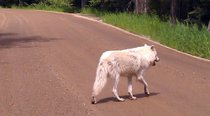
“When Mark Earls saw a shaggy, white wolf crossing a road in North Idaho’s Hoodoo Valley, he pulled out his cellphone to snap a picture of it. “What boggled him was that the wolf didn’t run away,” said his wife, Chelsea. “It didn’t appear to be afraid of him.” The wolf escaped from Wolf People, which operates a retail store on U.S. Highway 95 near Cocolalla, Idaho, and keeps captive wolves for viewing and filming, according to the Idaho Department of Fish and Game. The wolf apparently got out by digging underneath the fence, said Chip Corsi, Fish and Game’s regional manager. By some neighbors’ accounts, it has been seen in the area since June, acting like a stray dog. A captive wolf on the lam is a concern because it’s used to being around people. “It’s a habituated Canis lupus and it’s potentially dangerous,” Corsi said. “This thing either needs to go back into captivity or it needs to be euthanized.” Fish and Game officials have told the Bonner County Sheriff’s Department and neighbors in the Hoodoo Valley that it’s OK to shoot the animal on sight. Since it’s not a wild wolf, it’s not regulated under Idaho’s wolf season, which requires hunters to purchase a hunting license and wolf tag. A Fish and Game officer took the wolf’s picture to Wolf People owner Nancy Taylor, who confirmed that the wolf belonged to her, Corsi said. She also said that she had previously reported the wolf as dead, he said. “This was not reported to us like it was supposed to be,” Corsi said. “That’s a problem … I believe she’s required to report escapees pretty quick.” Neighbors said that a Wolf People volunteer had been taking fliers around, advertising a “lost dog” that looked like a wolf. Taylor has a state permit to keep captive wolves, and Wolf People’s website said the facility has 18 wolves. Several white wolves are pictured on the site, including a 135-pound male described as an arctic/timber wolf cross, and a 75-pound male. Some of the wolves are taken to a visitor center at the store on a daily basis, but others are kept in large enclosures at another site near Lake Cocolalla, the website said. Wolf People has been in operation for 21 years, Taylor said Wednesday, but she declined to discuss the incident. “I don’t feel free to comment at this time,” she said. “I can’t comment without knowing the facts, and I haven’t had a chance to investigate the situation.” Teresa Gavin lives in the Hoodoo Valley, about 8 miles southeast of Priest River. The picture of the white wolf was snapped on a road adjacent to her property. She keeps a sharp eye on her 4-year-old twins when they’re playing outside but thinks the wolf poses more danger to her dogs and her horse. “Let’s hope that someone finds him before any harm is done to anyone or their animals,” Gavin said of the wolf. She thinks Wolf People would have had a better chance of getting the animal back alive if the escape had been reported immediately. Chelsea Earls keeps a gun handy when her children are playing outside. She said that she and her husband have been vigilant about predators since a coyote killed the family dog last winter. “It’s not reassuring knowing there’s a wolf around,” she said. “It may be used to people, but it’s still a wild animal.” **Special thanks to Becky Kramer The Spokesman-Review for providing this information.

Michael Heath of Wolf Preservation states, “they have a duty and obligation to safely capture this animal.  Residents should report any sightings to proper authorities and guarantee it’s protection from human threats.  Authorities should properly educate residents regarding factual information about wolves and take pro-active measures to co-exist with them, not to hunt or destroy this important species.”

Read Full Post »


“They think we’ve gone away…… ………the governor’s offices and the tourist departments, that is. They predicted, and said as much, that our phone calls would die down, our interest would wane, and we would eventually give up on the wolves and let them have their massacre in peace. They don’t know us wolf sisters and brothers very well at all…….. Let’s all vow to call at least twice a week: GOVERNOR ‘BUTCHER’ OTTER (IDAHO) – 208-334-2100, GOVERNOR BRIAN SCHWEITZER (MONTANA) 405-444-3111, GOVERNOR MATT MEAD (WYOMING)  307-777-7434.   LET US TELL THEM WE WILL CONTINUE TO HAVE AN ECONOMIC AND TOURIST BOYCOTT OF THEIR STATES UNLESS AND UNTIL THEY CALL OFF THE WOLF HUNTS AND STOP PERSECUTING WOLVES!!! COMPLAIN, TOO, ABOUT INDIVIDUALS POSTING HOW THEY WANT TO BRUTALIZE WOLVES AND TELL THEM OF YOUR OBJECTIONS TO THIS NASTY BOW HUNTING AND THE UNDUE SUFFERING THAT CAUSES; THESE HUNTERS ARE TAKING SHOTS THAT THEY KNOW ARE NOT IMMEDIATELY LETHAL. TELL THEM THE SUFFERING OF BOW HUNTING AND TRAPPING IS EQUIVALENT TO ANIMAL ABUSE! Caution, Otter’s secretary likes to fight and some have hired professional public relations people to talk you down on this subject!! Keep howling!”

**Special thanks to Linda Camac, creater of this bulletin from the cause:  “Good Wolf” for providing this information!

Read Full Post »


“BILLINGS, Mont. — Wildlife advocates are urging a federal appeals panel to restore endangered species protections for wolves.

The Alliance for the Wild Rockies, WildEarth Guardians and other groups argue the judicial branch needs to “zealously guard” against a move by Congress that lifted protections in defiance of earlier court rulings.

They sued the government after Congress in April approved a budget rider taking wolves off the endangered list in five states.

The filing of their briefs in the case comes as wildlife agencies on Friday reported hunters have killed 11 of the predators since wolf seasons opened in Idaho and Montana last week.

Initial attempts to stop the hunts were denied last month by a three-judge panel of the 9th Circuit Court of Appeals. A November hearing in the case is expected.”

**Special thanks to KTVB.com for providing this information (http://www.ktvb.com/news/Wildlife-groups-ask-court-to-restore-wolf-protections-129546103.html)

Read Full Post »


“This week in Montana, hunters are allowed to shoot wolf puppies. Yes, puppies.

And tthey can shoot them in the most agonizingly cruel way of all, using bow and arrow.

And it’s all ‘legal’.

Whether you agree with arguments that support hunting for sport or not, most so-called ‘ethical’ hunters would agree a clean, fast kill is the goal – no matter what species is in the cross-hairs, and only in a ‘sportsmanlike way’ that gives the hunted animal a fair chance of escape.

While we won’t discuss the ethics of hunting per se, I do offer this video to consider – especially for those of strong Christian faith.

Whatever your personal take on hunting, what is ‘sportsmanlike’ in arrowing puppies?

Is it OK to kill babies using one of the slowest and most painful of hunting methods?

Dying from an archery wound can take – up to two WEEKS, according to Benke, and then only as a result of massive infection.

Watch the video. Please watch it now.

Does a puppy deserve to die this way? For that matter, does a deer, elk or any animal deserve to be sentenced to a long, agonizing death for the purposes of human ‘sport’?

Since the controversial politically-motivated delisting of endangered grey wolves resulted in open-season on wolves in several US states, including bow-hunting season beginning Sept. 3 in Montana, wolves have intentionally – and legally – been shot and killed – Although the actual statistcs and the numbers reported keep changing.

Bowhunting season is considered legal and is permitted – although perhaps not for much longer now that this video has been released.

And yes, unfortunately, certain backwards states are legalizing – even encouraging – the hunting of newborn wolf puppies as ‘Trophies’.

Even if you think it’s OK to hunt and kill truly helpless baby animals -puppies- for sport, is it OK to torture them first?

For some reason the general public seems to feel that bow-hunting is somehow more noble, more challenging, fair or more humane than hunting with firearms.

In this video a veteranarian describes the actual, prolonged and agonizing death these bow-shot animals actually experience.

Warning – This is graphic video. It was taken over the shoulder of a hunter – documenting his legal kill using a bow and arrow.

How many feel this kind of death is justifiable in the pursuit of ‘pleasure’? And what about for baby animals?

Should bow hunting remain legal?”

**Special thanks to Cathy Taibbi is based in Atlanta, Georgia, United States of America, and is Anchor for Allvoices for providing this information.

Read Full Post »


Jay Mallonee is a research biologist with a master’s degree in neurobiology/animal behavior. Through

his business of Wolf & Wildlife Studies, he has researched wolves in various states since 1992, along

with a 9-year study of the Fishtrap pack in northwest Montana (Project HOWL). Previous research has

included the documentation of traumatic stress displayed by a wild wolf placed into captivity, and

behavioral studies on rodents, primates, and a variety of cetaceans, such as gray whales and bottlenose

dolphins. Details of his studies can be found at

http://www.wolfandwildlifestudies.com. He also authored the book

Timber – A Perfect Life, that chronicles the profound 16 year journey with his canine companion.

Mallonee is a college professor and has taught a wide range of science classes for Michigan Tech

University, U. C. Santa Barbara, San Francisco State University, and several community colleges.  Below is a revealing article about how no sufficient data supports the wolf hunts!  Click on the link at the bottom to read the rest of his article and special thanks to the multiple sources he uses:


“Abstract

Management agencies have claimed that the recovery and public hunting of wolves is based in science.

A review of their statistics demonstrated that data collection methods did not follow a scientific protocol

which resulted in flawed and often blatantly incorrect data. Consequently, agencies do not know the

total number of wolves in Montana, a major reference point used by wolf managers. Therefore, the

quotas proposed for public wolf hunts are completely arbitrary, and management decisions in general

have not been based on facts. Management methods, and now hunting, contribute to the current

ecological crisis produced by the elimination and manipulation of predator species, which form the top

of food chains. These consumers produce a powerful “top-down” influence throughout ecosystems

which can even determine the surrounding vegetation species. Also reviewed were public attitudes

toward wolves, along with political approaches to solving the “wolf problem.” The total effect of these

processes has produced a wolf management system that lacks scientific perspective and does not utilize

what is known about the wolves’ role in sustaining healthy ecosystems. Instead, the data demonstrates

that management decisions have been based on agenda and propelled by opinion, bigotry, and politic.”  He adds, ”

Ultimately we have the greatest influence on how many deer, elk, wolves, and other predators are

present in our ecosystems. Until the current management paradigm changes, along with public attitude,

there is no permanent solution to the apparent “wolf problem.”

I can appreciate how hard FWP works to

obtain data on wolves and I know they do their best. Their best, however, is not science as they have

claimed.

Future solutions will have to take into account the full range of what science knows about

wolves. Until that happens, agendas, opinions, and politics will guide wolf management over problems

that are either mostly unknown (effects on prey populations) or rarely happen (depredations). This is a

social issue, not a biological one.”

http://www.wolfandwildlifestudies.com/downloads/huntingwolvesinmontana.pdf

Read Full Post »


“The resumption of wolf-hunts in Idaho, Montana and Wyoming illustrates why citizens must continue to oppose such unnecessary and senseless slaughters.

The wolf-hunts are predicated upon morally corrupt and inaccurate assumptions about wolf behavior and impacts that are not supported by recent scientific research.  State wildlife agencies pander to the lowest common denominator in the hunting community—men who need to bolster their own self esteem and release misdirected anger by killing.

Wolf-hunts, as Montana Fish and Game Commission Chairman Bob Ream noted at a public hearing, are in part to relieve hunters’ frustrations—frustration based on inaccurate information, flawed assumptions, and just plain old myths and fears about predators and their role in the world.

Maybe relieving hunter frustration is a good enough justification for wolf-hunts to many people. However, in my view permitting hunts to go forward without even registering opposition is to acquiesce to ignorance, hatred, and the worst in human motivations. Thankfully a few environmental groups, most notably the Center for Biodiversity, Wildearth Guardians, Friends of the Clearwater, Alliance for Wild Rockies and Western Watersheds had the courage and gumption to stand up to ignorance and hatred.

All of the usual justifications given for wolf-hunts are spurious at best.  For instance, one rationale given for hunting wolves is to reduce their presumed effects on big game populations. Yet in all three states, elk and deer populations are at or exceed population objectives for most hunting units.

For instance in Wyoming, one of the most vehement anti wolf states in the West, the 2010 elk population was 21,200 animals over state-wide objectives, and this did not include data for six herds, suggesting that elk populations are likely higher. Of the state’s elk herds most were at or above objectives and only 6 percent were below objectives. Similar data are found for Idaho and Montana elk herds as well.

However, you would not know that from the “howls” of hunters who characterize the elk populations as suffering from a wolf induced Armageddon.  And Fish and Game departments are loath to counter the false accusations from hunters that wolves are somehow “destroying” hunting throughout the Rockies.

Experience in other parts of the country where wolves have been part of the landscape longer suggests that in the long term, wolves – while they may reduce prey populations in certain locales – generally do not reduce hunting opportunities across a state or region.  Despite the fact that there more than double the number of wolves in Minnesota (3000+) as in the entire Rocky Mountain region, Minnesota hunters experienced the highest deer kills ever in recent years, with Minnesota deer hunters killing over 250,000 white-tailed deer during each of those hunting seasons – an approximate five-fold increase in hunter deer take since wolves were listed under the ESA in 1978.

Another claim made by wolf-hunt proponents is that hunting will reduce “conflicts” with livestock owners. Again this assertion is taken as a matter of faith without really looking into the veracity of it. Given the hysteria generated by the livestock industry one might think that the entire western livestock operations were in jeopardy from wolf predation.  However, the number of livestock killed annually by wolves is pitifully small, especially by comparison to losses from other more mundane sources like poison plants, lightning and even domestic dogs.

For instance, the FWS reported that 75 cattle and 148 sheep were killed in Idaho during 2010. In Montana the same year 84cattle and 64 sheep were verified as killed by wolves. While any loss may represent a significant financial blow to individual ranchers, the livestock industry as a whole is hardly threatened by wolf predation. And it hardly warrants the exaggerated psychotic response by Congress, state legislators and state wildlife agencies.

In light of the fact that most losses are avoidable by implementation of simple measures of that reduce predator opportunity, persecution of predators like wolves is even more morally suspect. Rapid removal of dead carcasses from rangelands, corralling animals at night, electric fencing, and the use of herders, among other measures, are proven to significantly reduce predator losses—up to 90% in some studies. This suggests that ranchers have the capacity (if not the willingness) to basically make wolf losses a non-issue.

However, since ranchers have traditionally been successful in externalizing many of their costs on to the land and taxpayers, including what should be their responsibility to reduce predator conflicts, I do not expect to see these kinds of measures enacted by the livestock industry any time soon, if ever. Ranchers are so used to being coddled they have no motivation or incentives to change their practices in order to reduce predator losses. Why should they change animal husbandry practices when they can get the big bad government that they like to despise and disparage to come in and kill predators for them for free and even get environmental groups like Defenders of Wildlife to support paying for predator losses that are entirely avoidable?

But beyond those figures, wolf-hunting ignores a growing body of research that suggests that indiscriminate killing—which hunting is—actually exacerbates livestock/predator conflicts. The mantra of pro wolf-hunting community is that wolves should be “managed” like “other” wildlife. This ignores the findings that suggest that predators are not like other wildlife. They are behaviorally different from say elk and deer. Random killing of predators including bears, mountain lions and wolves creates social chaos that destabilizes predator social structure. Hunting of wolves can skew wolf populations towards younger animals. Younger animals are less skillful hunters. As a consequence, they will be more inclined to kill livestock. Destabilized and small wolf packs also have more difficulty in holding territories and even defending their kills from scavengers and other predators which in end means they are more likely to kill new prey animal.

As a result of these behavioral consequences, persecution of predators through hunting has a self fulfilling feedback mechanism whereby hunters kill more predators, which in turn leads to greater social chaos, and more livestock kills, and results in more demands for hunting as the presumed solution.

Today predator management by so called “professional” wildlife agencies is much more like the old time medical profession where sick people were bled.  If they didn’t get better immediately, more blood was let. Finally if the patient died, it was because not enough blood was released from the body. The same illogical reasoning dominates predator management across the country. If killing predators doesn’t cause livestock losses to go down and/or game herds to rise, it must be because we haven’t killed enough predators yet.

Furthermore, most hunting  occurs on larger blocks of public lands and most wolves as well as other predators killed by hunters have no relationship to the animals that may be killing livestock  on private ranches or taking someone’s pet poodle from the back yard. A number of studies of various predators from cougars to bears show no relationship between hunter kills and a significant reduction in the actual animals considered to be problematic.

Again I hasten to add that most “problematic predators” are created a result of problem behavior by humans—for instance leaving animal carcasses out on the range or failure to keep garbage from bears, etc. and humans are supposed to be the more intelligent species—though if one were to observe predator management across the country it would be easy to doubt such presumptions.

Finally, wolf-hunting ignores yet another recent and growing body of scientific evidence that suggests that top predators have many top down ecological influences upon the landscape and other wildlife. The presence of wolves, for instance, can reduce deer and elk numbers in some places for some time period. But rather than viewing this as a negative as most hunters presume, reduction of prey species like elk can have many positive ecological influences. A reduction of elk herbivory on riparian vegetation can produce more song bird habitat. Wolves can reduce coyote predation on snowshoe hare thus competition for food by lynx, perhaps increasing survival for this endangered species. Wolves have been shown to increase the presence of voles and mice near their dens—a boon for some birds of prey like hawks. These and many other positive effects on the environment are ignored by wolf-hunt proponents and unfortunately by state wildlife management agencies as well who continue to advocate and/or at least not effectively counter old fallacies about predators.

Most state agencies operate under the assumption that production of elk and deer for hunters to shoot should have priority in wildlife management decisions. All state wildlife agencies are by law supposed to manage wildlife as a public trust for all citizens.  Yet few challenge the common assumption that elk and deer exist merely for the pleasure of hunters to shoot.

I have no doubt that for many pro wolf-hunt supporters’ predators represent all that is wrong with the world. Declining job prospects, declining economic vitality of their rural communities, changes in social structures and challenges to long-held beliefs are exemplified by the wolf. Killing wolves is symbolic of destroying all those other things that are bad in the world for which they have no control. They vent this misdirected anger on wolves– that gives them the illusion that they can control something.

Nevertheless, making wolves and other predators scapegoats for the personal failures of individuals or the collective failures of society is not fair to wolves or individuals either.  The premises upon which western wolf-hunts are based either are the result of inaccurate assumptions about wolf impacts or morally corrupt justifications like relieving hunter anger and frustrations over how their worlds are falling apart.

I applaud the few environmental groups that had the courage to stand up for wolves, and to challenge the old guard that currently controls our collective wildlife heritage.  More of us need to stand up against persecution of wildlife to appease the frustrations of disenfranchised rural residents. It is time to have wildlife management based on science, and ecological integrity, not based upon relieving hunter frustrations over the disintegrating state of their world. And lastly we need a new ethnics and relationship to wildlife that goes beyond a simple utilitarian view of whether any particular species benefits or harms human in real and/or imaginary ways.”

**Special thanks to George Wuerthner, ecologist and former hunting guide with a degree in wildlife biology, for providing this information!

Read Full Post »