The wolf kills to eat. And it is the wolf’s status as a predator that has resulted in the deaths of thousands of wolves at the hands of humans. The two prime areas of conflict are the wolf’s status as a habitual predator of big game and as an occasional predator of livestock.
In the United States, federal Animal Damage Control guidelines define predator control as “control…directed toward less desirable species which are depressing populations of more desirable species.”
CLEARLY MAN HAS DEEMED THAT THE WOLF BE OFFICIALLY CERTIFIED AS “LESS DESIRABLE.”
It is unfortunate that both Canis Lupus and Homo Sapiens sometimes seek the same prey. It is even more unfortunate that the wolf has often been WRONGLY BLAMED for depleting ungulate populations, populations equally sought by both subsistence and sport hunters.
Large-scale wolf kills by humans assume that wolves are the primary limiting factor to a hooved game population. All too often, the wolf is just a convenient and visible scapegoat, the final product of years of prejudice. And all too often insufficient studies have been undertaken to determine the true role of the wolf in controlling the prey population.
Various studies have shown that in fact wolves my control an ungulate population, extirpate the population, have no effect upon it, increase it, or decrease it. Other important factors include the prey/predator ratio, habitat loss, overhunting by humans, and the effects of severe winters.
As wildlife biologist Chris McBride has written in The White Lions of Timbavati, “The very fact that any species of predator still exists today is proof that is has evolved in such a way that it cannot seriously limit the numbers of its prey. If it did, it would have become extinct.”
Overhunting by humans is often a major factor in ungulate declines. In one study of Alaskan wolves, it was found that humans had killed forty four percent of the Nelchina caribou herd in 1971/1972, a decrease that had previously blamed on wolves. One year when caribou strayed too close to the city of Yellowknife in the Northwest Territories and were slaughtered by its residents by the hundreds, outsiders immediately blamed wolves for the kills.
It is ironic that many fish and game departments exist to support the hunters and fishermen who fund them through the sale of tags and licenses. The irony turns to tragedy, though, when these departments kill wolves to appease hunters.
In 1983, the British Columbia Wildlife Branch announced plans to kill eighty percent of wolves in the northeast Peace and Omineca districts in order “to support moose and deer numbers.” However, the close ties between the department and the hunting lobby quickly became evident. To fund the wolf kill, the government stated their intention to hold a lottery, first prize being a hunting trip to Zimbabwe. Despite a government report that the moose and deer numbers had decreased primarily because of loss of habitat, overhunting, and a series of severe winters, the wolf was the one put in the crosshairs.
A more recent Canadian wolf kill was the plan to kill 150 wolves in the Yukon in 1993 in an area adjacent to Kluane National Park. The purpose of the kill was to support the Aishihik caribou herd, which was declining in number. After much public pressure, the Yukon government admitted that the slaughter was a “scientific experiment” using living animals. In early 1993, about seventy wolves were killed, and it was discovered that the wolf population in the area was about forty percent smaller than expected. Despite this finding, the Yukon goverment planned to continue the killing! The cost of the initial year of killing was an incredible $2,500 per wolf.
In the IUCN Manifesto on Wolf Conservation, it states that where wolf kills must be carried out, “the methods must be selective, specific to the problem, highly discriminatory, and have minimal adverse affects on the ecosystem.” It concludes that “alternative ecosystem management, including alteration of human activities and attitudes and non-lethal methods of wolf management, should be fully considered before lethal wolf reduction is employed.”
According to the World Wildlife Fund of Canada, “the only safe conservation route is to stop large-scale wolf killing programs altogether.” And as wolf biologist Lu Carbyn has noted, wolf control “has become socially unacceptable.”
**Special thanks to The Wolf Almanac by Robert Busch for providing this information!
Archive for March 21st, 2012
The Wolf as a Predator: Wolf Control
Posted in Facts and Figures on March 21, 2012| 2 Comments »

Wolves and Ravens; A Fascinating Relationship
Posted in Facts and Figures on March 21, 2012| 1 Comment »
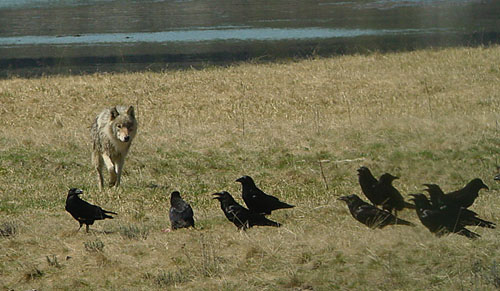
So what do Ravens and Wolves have in common you say? The following information comes from “The Wolf Almanac,” a celebration of wolves and their world, 1995/1998 by Robert Busch. He explains the relationship and proves once again one of the many contributions wolves give to the environment.
One of the most fascinating relationships between animals is the one that seems to exist between wolves and ravens. The raven, scavenger of food of all types, will often follow wolf packs in hopes of morsels of food. And wolves have learned to watch for circling ravens as a sign of of possible food below. But there seems to be more than just a symbiosis based on food between the two species; many observations have been made that can only be described as a friendship between the big predator and the wily bird.
In Arctic Wild, Lois Crisler states her belief that “ravens and wolves just like each other’s company.” She described one play session between the two species, with the raven diving at the wolves and jumping around just out of reach. “He played this raven tag for ten minutes at a time. If the wolves ever tired of it, he sat squawking till they came over to him again.”
L. David Mech, in The Wolves of Isle Royale, described the “peculiar relationship” between a flock of ravens and a large wolf pack, and wrote that wolves and ravens “often seem to play together.”
Technical Information on Wolf Ecology and Wolf/Prey Relationships
Posted in Facts and Figures, Wolf Research on March 21, 2012| Leave a Comment »
| This article was previously written by: Dr. Victor Van Ballenberghe / U.S. Forest Service / Wolf Song of Alaska Advisor
Wolves can be a factor in controlling populations in certain areas BUT not the primary or only factor. Hunters, disease, weather, and other predators play key roles. Special thanks is given to “Wolf Song of Alaska” for providing his article. |
|
| “The following questions and statements represent a brief summary of biological information on wolf ecology and wolf/prey relationships distilled from numerous scientific studies conducted in North America during the past 50 years. I have selected topics that I feel represent some of the key biological issues that impact wolf management. By necessity, this discussion is brief and worded so that those with little technical background can assimilate the information. I have tried to accurately summarize and interpret a large volume of data while adhering to constraints of brevity and simplicity.
1. Can wolves kill any animal they choose? Numerous studies across North America on virtually every species of wolf prey from the smallest (deer) to the largest (bison) have shown that wolves generally kill only certain kinds of animals. These include young, old, and infirm animals. Generally, animals in their prime (for example, moose aged 1-6) escape predation. However, during deep snow conditions that favor wolves, prime-aged animals may fall prey, but these conditions are uncommon. These findings have been misinterpreted by some to mean that wolves only kill “sick” animals or that because they generally kill the young, old or infirm wolves can’t impact prey populations. Biologists have never claimed wolves kill only the sick and have stressed that predation on young may impact prey populations. Studies have also shown that prey animals often escape predation by a variety of methods. An early study of moose and wolves at Isle Royale, Michigan, indicated that during winter only 8% of moose encountered by wolves were killed. The rest outran the wolves or stood their ground and the wolves left. During summer, moose often escape by entering water where wolves aren’t effective. Certain prey, including goats and sheep, inhabit terrain where they are often protected. All prey species have evolved numerous anti-predator adaptations. 2. Do wolves kill in excess of their needs? Studies have shown that wolves generally consume the animals they kill, often returning to kills over a prolonged period. They also commonly scavenge animals that die or are killed by other predators or humans. On occasion, wolves starve because they cannot find or kill enough prey, or their reproduction is reduced due to food shortage. During deep snow conditions that occur rarely, wolves may kill more than they consume. They may also kill more young than they consume when young are very abundant, for example in large herds of caribou. However, this “surplus” killing has generally not been shown to have significant effects on prey populations. 3. At what rate do wolves kill prey? Research has shown that kill rates vary greatly depending on snow depth, prey size, prey abundance, pack size, and many other factors. Wolves rarely kill only one species for extended periods; most packs in Alaska have access to several species. During summer, beaver, fish, berries, and numerous small mammals and birds supplement their diet. During winter, for wolves that kill only moose, an average-sized pack (6-10) may eat one moose per 4-5 days, but this can vary from about 2-10 days per moose per pack. Some of these animals may be scavenged. Summer data are less reliable and difficult to compare to winter because nutritional needs vary as does prey size (many calves are killed) and composition. However, several studies suggest that summer kill rates are lower than during winter. For smaller prey, kill rates are necessarily higher. In Minnesota where wolves kill mainly white-tailed deer (also beaver and moose) annual kill rates per wolf have been estimated at 15-19 deer, including summer fawns. 4. What factors control wolf populations? In Alaska (and elsewhere) wolf populations are mainly controlled by hunting and trapping, prey abundance, and social interactions among wolves. Virtually every pack in Alaska is subject to hunting and trapping, legal and illegal, but the impact of this varies. Some packs are exploited lightly because of their inaccessibility; others are kept at low numbers by hunters and trappers. Some packs have been eliminated by humans. Generally, wolves on the northern and northwestern arctic coasts are rare and kept at a low density by people. Wolves in southcentral Alaska are heavily exploited but in much of the interior they are not. Wolves generally declined in the late 1970’s and early 1980’s, apparently in response to decline of moose and caribou that began in the mid-1960’s. As moose and caribou increased in some areas (including the Nelchina basin) wolves were prevented from increasing by hunting and trapping. 5. What impact has land-and-shoot (LAS) wolf hunting had on wolf numbers? The impact of LAS has varied from place to place. In some areas that are heavily timbered with few lakes or rivers, LAS has been ineffective in reducing wolf numbers. In other areas (including the Nelchina basin) wolves have been kept low by this practice. Large areas of southcentral including GMU’s 9, 16, 11, and 13, are ideally suited to LAS are northern areas in or near the Brooks Range. It is clear that where the terrain allows hunters to be efficient, LAS has kept wolf numbers lower than they
would have been with hunting and trapping by other methods. 6. Will wolves increase indefinitely if they are not “controlled”? Because hunting and trapping are generally effective controlling factors, wolves will increase if exploitation stops. However, wolf populations will not increase without limit in the absence of exploitation. For example, after the wolf control in GMU-20A stopped, moose numbers more than tripled but wolf increased to only about their pre-control numbers. 7. What rolls did hunting, weather, food supplies, and predation play in the moose and caribou declines of the 1960’s and 1970’s? Moose and caribou populations in many areas of Alaska increased during the 1950’s and early 1960’s and declined into the 1970’s. Research suggests that for moose, food supplies declined as populations increased. Deep-snow winters aggravated reduced food conditions and started the moose population declines. Hunting regulation changes did not respond in time and hunting further accelerated the declines as it did for the caribou, especially the Nelchina and Western Arctic herds. For some moose populations (GMU-20A), wolves did not start the declines, but acted after they were well underway to drive moose to lower levels than they would have reached in absence of wolves. 8. Is habitat (food) currently limiting moose and caribou populations in Alaska? Probably so in portions of southcentral including the lower Susitna valley where large numbers of moose starved in 1989-1990 and the Kenai Peninsula where plant succession has reduced habitat quality since the mid-1970’s. Caribou herds including the Nelchina and Western Arctic herds, are also thought to be approaching the carrying capacity of the ranges. Probably not in portions of the interior where moose densities are low and food seems abundant. Maybe in other areas where few data are available on food quantity and quality in relation to moose and caribou numbers. It is difficult to quantify these relationships over vast areas. 9. What about bear predation? Studies have shown that both black and brown bears (especially the latter) can be efficient predators on young moose calves. In some areas (for example, the Nelchina basin) brown bears were a more significant source of calve mortality than wolves. Bears may also kill adults in the spring and fall when they are more vulnerable. 10. a) Can wolves and bears keep prey densities low for long periods?
b) Can prey increase from low densities if wolves and bears are not reduced by people?
There is evidence that wolves and bears acting together can keep moose at low densities for long periods in places where people have no or little impact on predator numbers. For caribou, it appears that this is not the case; caribou can periodically increase if alternate prey for wolves is scarce and they too fall to low densities. Moose also follow this pattern if bears are absent. At Isle Royale National Park where bears are absent and people do not exploit either wolves or moose, moose have increased periodically and reached high densities without any form of wolf control. 11. Do we need to “control” wolves in order to harvest prey? Biologists do not dispute the idea that moose populations will produce a higher yield for people if wolves are few or absent. However, people can still hunt and shoot moose if wolves are present as demonstrated in Alaska for many years. As indicated in question 4 (above), hunting and trapping impacts wolf populations in many areas and may keep wolf densities low. Moose abundance may be high in these areas, as it generally is now in southcentral Alaska, and hunting by people may produce high yields. In other areas where wolves and bear reach higher densities it may still be possible for people to hunt, but they may be restricted to bulls only. Moose harvest in many areas of Alaska have increased in recent years without wolf control programs. 12. Does reducing wolf density result in more moose and caribou? Clearly, wolf control in GMA-20A during 1975-79 resulted in an increase of moose on Tanana flats. This is probably the best known example of a wolf control program in Alaska. However, wolf control in other areas where wolf:moose ratios were higher or where bears were the problem had less success. As discussed above, deep snow, reduced food, hunting or bear predation may be more important than wolf predation in controlling moose numbers. If so, wolf control is not likely to yield benefits. 13. What is the importance of predator/prey ratios? One of the primary factors in determining the impact of predation on prey numbers is the ratio of predators to prey. If predators are few in relation to prey, predation may have little controlling effect on prey numbers. However, controlling effects may be extreme if there are many predators in relation to prey. For wolves and moose, ratios of less than 1;30 may often result in moose population declines if wolves have little alternate prey. If bears are abundant, they may elevate this ratio considerably. When wolf:moose ratios are 1:60 or higher, predation likely has little effect. 14. Do wolf populations rapidly rebound from control programs? Wolves have a high reproductive rate and may disperse long distances to fill “voids”. Studies in Alaska have shown that populations may increase rapidly following control programs and pre-control numbers may be reached in 3-4 years. However, wolves in some areas (including the north slope) have not recovered after being reduced to low densities because hunting and trapping removes them as they re-colonize. 15. Is the “balance of nature” a valid concept? Different definitions of the balance of nature concept have emerged in recent years. If this concept means that wolves and prey exist for long periods at high and stable numbers, then the results of recent studies suggest this is simplistic. Numbers often fluctuate up as well as down and local extinction of prey is possible. However, if the concept means that wolves and prey coexist over time in large areas, clearly this is the case. Wolves and their prey co-evolved over thousands of years with little intervention from humans. Wolves are efficient predators that at certain times under certain conditions may exert powerful controlling effects on prey populations. But, for their part, prey animals have evolved the ability to survive and reproduce. The effects of humans on both wolves and prey and their habitat in the modern world are often the primary factors determining the “balances” that now result.” |

 The Wolf Preservation Blog