Feeds:
Posts
Comments

Archive for April 7th, 2012


  Nez Perce National Forest employee Josh Bransford poses with a wolf trapped in north Idaho

“Footloose Montana,” a grassroots, non-profit organization that promotes trap-free public lands for people, pets and wildlife, received death threats for releasing this photo.  Humans have the ability to show compassion towards animals, yet Josh Bransford chooses to inflict unnessesary amounts of pain on this animal.  Just look at the enormous amounts of blood in the snow and he appears very proud of it. 

“Less than a year after Congress took gray wolves off the endangered species list, a Forest Service employee has come under fire for trapping a wolf in Idaho and snapping a photo of the wounded animal before killing it.

Josh Bransford posted a photo on the website www.trapperman.com last month of himself smiling as the wolf he trapped — which was still alive — limped on the bloodied snow behind him. The photo has since been taken down (It can be viewed here, but warning, the images are graphic).

The incident, which came shortly before the end of Idaho’s first-ever wolf trapping season, drew protests from environmentalists. Gray wolves in the northern Rockies were taken off the endangered species list on April 2, 2009, a decision that was reversed in federal district court in August 2010. Congress took them off again as part of last year’s budget deal on April 14, 2011, and the Fish and Wildlife Service formally delisted the wolves on May 4.

Both the Forest Service and the Idaho Department of Fish and Game have described the incident as unfortunate, but not illegal.

“The Forest Service does not condone animal cruelty in any circumstance and holds employees to represent agency standards both on and off the job,” wrote Forest Service spokesman Larry Chambers in an e-mail. “While the Forest Service continues to review the case, it has been determined that the employee in question was on his personal time on private land. The Idaho Department of Fish and Game has jurisdiction on such cases.”

In an interview, Idaho Department of Fish and Game spokesman Mike Keckler said the agency’s conservation officers determined that Bransford “had all of the necessary licenses and permissions to trap wolves,” and had undergone a trapper education course.

“According to the conservation officers he did nothing illegal, but we would have preferred that he had dispatched it himself before photographing himself with it,” Keckler said. “We ask that animals be dispatched humanely and immediately.”

Bransford could not be reached for comment.

Michael Robinson, conservation advocate with the group Center for Biological Diversity, said state officials had only done a cursory review and needed to examine the matter further.

“If this is what passes as compliance with the Department of Fish and Game’s rules, there’s a serious problem with the adequacy of state regulation,” Robinson said. “Idaho Department of Fish and Game or the state’s attorney general need to take a harder look. Trapping a wolf where it can be shot at by others, shooting at the wolf, and then letting the injured animal suffer while posing for pictures all constitute animal cruelty and reflect the free-for-all mentality on wolves prevailing in Idaho in the absence of Endangered Species Act protection.”

Wolf hunting and trapping season is almost over in Idaho. The trapping season began Nov. 15 and ended March 31, while the hunting season started Aug. 30, 2011 and ended in all but two areas by the Montana border on March 31.

The wolf population in Idaho was estimated at roughly 1000 before the hunting season began. The state fish and game department website showed 377 had been hunted, trapped or snared as of Thursday.

Keckler said the state had issued more than 40,000 “wolf tags” that allow wolves to be taken by hunters. The large number came because deer hunters and others obtained the tags in case they encountered wolves while hunting other game.

“Wolves are very difficult to hunt,” he said.”

**Special thanks to Juliet Eilperin for The Washington Post for providing this information.
Read Full Post »


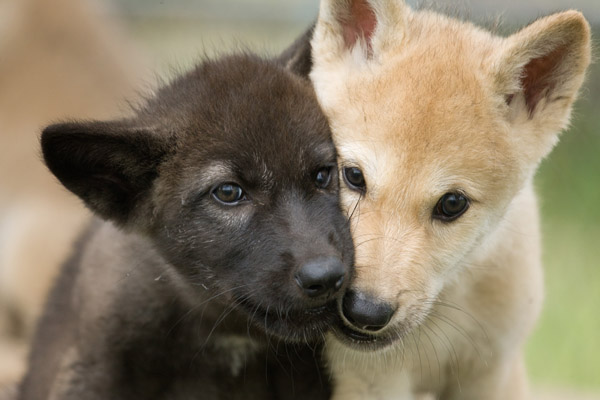
“Wolf Park is pleased to announce that Dharma, of the park’s main pack, has given birth to puppies on April 6, 2012. (Dharma is blocking our view of them at the moment – we will know how many there are when Dharma leaves the den!) The pups’ lineage traces back to Wolf Park’s first female wolf, Cassie. With their birth the Wolf Park wolves’ bloodline has added a new generation. Like all our pups, these will be socialized to humans as well as to wolves; visitors will have opportunities to watch them grow up and become acquainted with their world this summer at Wolf Park. Puppies at Wolf Park are taken out of the den when they are around 10 days old to undergo the socialization process. In order to fully socialize the puppies to humans, the pups have contact with humans 24 hours a day for the first 5 months or so of their lives, for a total of over 2,000 contact hours. For this reason, we have Puppy Mothers that live onsite to help raise the puppies. They work in shifts to provide 24-hour a day human contact. The puppies will also get to spend time socializing with wolves once they about 6 weeks old, so they learn how to be part of a pack as well. Sponsor a Puppy! Click here to adopt one of our newest arrivals! [link sentence to gift shop puppy adoption page] Puppy sponsors will be able to visit their adopted puppy in person! When you schedule your appointment, we will let you know when the puppies tend to be most active, but we cannot guarantee that they will be awake. (Please note that we have very strict guidelines for puppy visits. We do not wake up sleeping puppies, so be aware that your visit may only include you watching your puppy sleep! Your visit may also have to be cut short based on the needs of the puppies or if we are conducting research.) Puppy Sponsors receive all of the benefits of wolf sponsorship, including a yearlong subscription to our newsletter and updates on your sponsored animal.

Puppy Photo Shoots!

Monty Sloan, our world-renowned staff photographer, leads all of our puppy photo shoots. Click here to see examples of his puppy shots. Photo shoots run from 6 pm until either dark or the puppies get tired. Typically shoots last around 2 hours. Please note that we may need to cancel a puppy photo shoot if the puppies are not feeling well. Digestive issues are very common, and are the most frequent reason for having to cancel a shoot.

Availability for these special photography sessions is very limited. The cost of these shoots is $150 per person, with a 2-3 person maximum. To sign up, please call our administrative office at (765)567-2265.

Donate to the Puppies!

Puppies need a lot of care. Help us raise the puppies by purchasing items that they need in our online gift shop or by making a general donation towards their care today!

Name the Puppies!

You can help Wolf Park name the puppies! Send an email with your suggestions (maximum of 5 names per person, please) to puppynames@wolfpark.org. The top names will be chosen by our staff. The final vote will be up to you! The names with the most votes will win and become the names of the new puppies. In May, the public will be invited to vote for the top names, so check back soon!”

**Special thanks to Wolf Park, http://www.wolfpark.org/index.html, for providing this information!


Read Full Post »


This article seemed appropriate and thanks to Diane Nelson for the idea : )

 Thursday, March 29, 2012

“If you want healthy elk populations, the key is more aggressive killing of predators, especially wolves.

At least that’s the message from the Rocky Mountain Elk Foundation, which announced last week that it will be putting up $50,000 to help fund efforts to kill more wolves. The money would go to the Montana Department of Fish, Wildlife and Parks to help pay U.S. Wildlife Services, the agency contracted to kill wolves when they get into trouble with livestock.

The foundation also said it would ask for donations for the wolf killing, and the money wouldn’t pull from the group’s other conservation efforts. But it’s just the latest effort to blame wolves, which it turns out can be pretty lucrative as a fundraiser.

And the foundation isn’t limiting its ire to wolves.

David Allen, RMEF president, said his group wants fewer black bears, mountain lions, wolves and coyotes. And he said the state needs to look at killing grizzly bears — which remain on the federal Endangered Species List — because they prey on elk calves.

“We can’t have all these predators with little aggressive management and expect to have ample game herds and sell hunting tags and generate revenue that supports (the Montana Department of Fish, Wildlife and Parks) nearly

100 percent,” Allen told the Missoulian newspaper.

What a sad statement from a once-proud conservation organization. But this isn’t Allen’s first time joining the predator-bashing chorus.

For several years now he’s used terms like “annihilation,” “decimation” and “wildlife disaster” when describing elk herds where wolves are found. It’s the same rhetoric I’ve grown accustomed to hearing from kooks on the Internet. The problem is it has no basis in fact — at least according to the elk foundation’s 2011 hunting forecast.

Based on state game agency data, it estimated there are nearly 1.2 million elk in North America. That same forecast blasted animal rights activists saying they had “cherry-picked, manipulated and misrepresented” the numbers in an effort to keep wolves on the ESA perpetually. It also said wolves had “decimated” some of the northern Rockies’ great herds and for hunters to expect “tough hunting” in those areas.

That contradicts statements the foundation made three years ago, when it issued a press release touting its role over 25 years in helping boost elk herds. Allen stated that “growth in elk populations is one measure of our success.” The number of elk in 2009

was 1.03 million across the continent.

I’d say it’s speaking out of both sides of your mouth to pat yourself on the back when elk reach 1 million continent-wide and turn around and blast predators for killing too many elk when we have

1.2 million. In Montana, the herd estimate held steady at 150,000 animals from 2009 to 2011.

I’m sure the foundation would say losses to wolves are localized and in some cases severe. Often, the wolf haters point to the elk herd in northern Yellowstone National Park that migrates into Montana near Gardiner as an example of one that’s suffered from wolves. It’s been reduced from 19,000 animals in 1992 to about 4,100 today.

But that herd was grossly overpopulated. And at more than 4,000 animals, it’s still healthy.

Maybe what the foundation wants are the good old days, when hundreds of elk poured out of the park’s northern boundary into a firing line of hunters. That wasn’t an elk hunt – it was a disgrace.

As anyone who gets out of his or her vehicle and actually hunts knows, Montana has abundant elk. The hunting is a little harder in areas where wolves are. But when isn’t elk hunting tough?

The foundation also left out a major source of predation on elk in Montana — the 2003 Legislature. It mandated that FWP reduce numbers and since then we’ve been pounding elk with second tags, extended seasons and liberal regulations. Where’s the outrage about that over predation?

Clearly, the elk foundation’s use of predator-hating rhetoric is good for the bottom line.

Last month the group boasted of its “record-high membership” and “strong fiscal performance.” The same news release talked about the upcoming predator campaign and said “wolf, bear, lion and coyote populations are well above science-based objectives in many areas.”

When asked, the foundation cited itself as a source. Yet I had no idea the group has the staff biologists to count predator populations and authority to set seasons.

And it’s not like these species aren’t already managed. We’ve been hunting mountain lions and black bears for years. Coyotes can be shot on sight. And grizzly bears, while doing well, remain under federal protection.

Then there’s the hated wolf. We’ve only hunted this predator two years since its reintroduction. It takes time for wildlife professionals to craft a hunt that meets objectives, especially with a new species. To decry this year’s hunt as a failure because we didn’t reach the 220 wolf total quota is ridiculous.

Instead of bashing wolves, the foundation should take pride in their recovery. After all, the only reason wolves can live in the northern Rockies is the abundance of prey – including elk – and the foundation has played an important role in those species larger numbers through habitat acquisition and improvement.

In fairness, the foundation isn’t the only group to get on the wolf gravy train. Who could forget 2009, when Defenders of Wildlife used images of cute wolf puppies while decrying the “slaughter” of wolves in Montana’s first-ever hunt.

But the argument that they did it first doesn’t justify exploiting wolves as a money maker.

I expect a higher standard from the Rocky Mountain Elk Foundation.”

**Special thanks to Reporter Nick Gevock, for providing this information. He may be reached at nick.gevock@mtstandard.com

Read Full Post »