Feeds:
Posts
Comments

Archive for May, 2012


The following article is written by Beckie Elgin, Freelance Writer and Author on “Wolves and Writing, Writing inspired by wolves and other sentient beings.”

Please visit her wonderful site and see her articles: http://wolvesandwriting.com/2012/05/29/update-on-journey-and-the-rest-of-the-pack/

“I tend to worry when I don’t hear about Oregon 7. My fears are of poachers, speeding cars, leg-hold traps, and cyanide poisoning. And there are more natural threats too, injury sustained while hunting, disease, or starvation, like the Alaskan wolf whose radio collar tracked his 2,000 mile travels then served to locate his emaciated body beneath a spruce tree.

But Journey is alive and apparently well. The California Department of Fish and Game (CDFG) has devoted a website to him and provides an update on his whereabouts nearly every day. Journey has of late moved south from Modoc County into western Lassen County, near Nevada. While there are still no wolves in this location there are tons more humans. Modoc County boasts the lowest population in the state with just under 10,000 counted in the last census, while Lassen County has over 30,000. More potential for conflict, but on the other hand, perhaps there are more folks who see Oregon 7′s arrival on a positive note.

Oregon Wild is a non-profit that does so much to support wolves and was the group that sponsored the contest that won Journey his name. Their intern, Elizabeth Medford, reported on Journey on the Oregon Wild Wolfpack website last week. She discussed the recent doings of Oregon 7, including his feasting on a deer carcass that may have been killed by a cougar, his consorting with coyotes, and the much shared photo of him taken by a CDFG biologist.

It’s nearly summer and at first glance, it appears the wolf-wars are in a cease fire in celebration of the warm sun, the birth of new creatures, and the sudden greening of our surroundings. The wolf slaughter in Montana has ended after 166 wolves were killed, and Idaho’s season is closed except in the Lolo and Selway units, with 379 wolves already killed. The order to destroy two members of the Northeast Oregon Imnaha wolf pack is still on hold.

However, behind the scenes, much is going on and most of it puts wolves on the chopping block. Plans are finalizing for the first wolf “harvest” in Wisconsin to begin in the fall with a plan that “keeps wolf numbers above the recovery goal.” Wyoming hopes to kill 52 wolves in the flex zone around Yellowstone National Park, meaning any wolf stepping foot out of the park can be legally killed. Wolves in the rest of the state would be classified as predators that could be shot on sight year-round. The owner of the Flat Top Ranch in Idaho allowed his sheep to lamb unguarded in the open fields, and of course, predation occurred. Wildlife Services is now on the hunt, flying over the ranch in their Killer Bee Super Cub, hoping to kill the wolves that did what was natural but what was also preventable.

The news of impending fall hunts and the unnecessary killing of wolves due to the unwillingness of some humans to understand them is discouraging. But I believe our diligent efforts to speak on behalf of the environment and its inhabitants will, in the long run, be heard. Small victories are being won, Journey is still alive and traveling, the first wolf in California for 90 years. And wolf advocates are a committed group, giving up is simply not an option.”

  • Small Photo
  • Small Photo


Beckie Elgin, Freelance Writer

Ashland, Oregon

Beckie Elgin is a writer and an RN living in Southern Oregon. She studied English and Creative Writing at Southern Oregon University, has a degree in Environmental Studies from Simpson College and an ADN in Nursing as well. She graduated with an MFA in Creative Writing from Pacific University in June of 2010. Her father was director of a zoo in Iowa when she was growing up, allowing her to live with wolves and other animals. She is working on a novel about this life, melding fact and fiction to portray the intricate relationships between people and animals, as well as between people and people.

Read Full Post »


“Minnesota will see two wolf seasons this fall, not just one.

In its first hunt since assuming wolf management from the federal government, the Minnesota Department of Natural Resources has proposed an early wolf hunting season that would coincide with the state’s firearms deer season, opening Nov. 3. A late wolf hunting and trapping season would open Nov. 24. It would close Jan. 6, 2013, or whenever a total harvest of 400 wolves in both seasons combined is reached, if that comes sooner.

The first season would be open only in the areas of the state open to rifle deer hunting, which are the northern and central zones. The late season will be open statewide.

The Minnesota Legislature passed a law in its 2012 session requiring that a wolf season begin concurrently with the firearms deer season, but legislators gave the DNR authority to structure the season.

“The first season was at the direction of the Legislature and the governor,” said Steve Merchant, wildlife populations program manager for the DNR. “That one is a given for us. We said all along that we’d like to provide a hunting and trapping season for people who want to take wolves in that dedicated season (after deer hunting).”

Preparations for the state’s first formal wolf season have proceeded with little public opposition, although some residents testified against such a season before the Legislature. In contrast, removing the wolf from protection under the federal Endangered Species Act was fraught with controversy. So-called delisting was first proposed for wolves in the western Great Lakes region in 1998 but has been in and out of court ever since.

So far, no groups have offered a legal challenge to Minnesota’s proposed wolf season.

“In the past we have challenged delisting of wolves, but we have no plans to do that this time. In the same vein, we have no plans to challenge the hunting season,” said Collette Adkins Giese, an attorney for the Center for Biological Diversity.

The DNR is seeking public comments on details of this fall’s proposed seasons. The complete proposal is available on the DNR website at http://www.mndnr.gov/wolves, where comments are being taken through an online survey.

A total of 6,000 licenses would be offered, with 3,600 available in the early season and 2,400 in the late season. Late-season licenses will be further split between hunting and trapping, with a minimum of 600 reserved for trappers. The target harvest quota will be 400 wolves for both seasons combined, and will initially be allocated equally between the early and the late seasons.

Wolf hunting licenses will be $30 for residents and $250 for nonresidents. Nonresidents will be limited to 5 percent of total hunting licenses. Wolf trapping licenses will be $30 (limited to residents only). A lottery will be held to select license recipients. Proof of a current or previous hunting license will be required to apply for a wolf license. The lottery application fee will be $4.

The early hunting-only season will be open only in the northern portions of Minnesota. It will start on Nov. 3, the opening day of firearms deer hunting. It will close either at the end of the respective firearms seasons in the two northern deer zones (Nov. 18 in Zone 1 or Nov. 11 in Zone 2), or when a registered target harvest quota of 200 is reached, whichever comes sooner.

If fewer than 200 wolves are taken during the early season, the remaining portion of the quota will be added to the quota for the later season, said the DNR’s Merchant.

“The DNR is taking a very conservative approach to this first season,” Merchant said. “It’s designed to help us learn about hunter and trapper interest and what kind of hunter and trapper success we’ll have.”

The proposed season is consistent with the goal of the state’s wolf management plan to assure the long term survival of the wolf and address conflicts between wolves and humans, he said.

Merchant said wildlife experts took into account the number of wolves killed in damage-control efforts when setting the harvest number. Typically, about 80 farms have verified wolf depredation complaints each year, according to the DNR. Over the past several years, an average of 170 wolves have been captured or killed each year by federal trappers in response to verified livestock depredation. About 70 wolves have been trapped and killed so far this spring following verified livestock damage complaints, primarily on calves, DNR officials said.

No American Indian bands or tribes in Minnesota have announced wolf hunting seasons. The Fond du Lac Band of Lake Superior Chippewa will not hold a season, said Mike Schrage, wildlife biologist with the Fond du Lac band.

“A lot of band members feel a strong spiritual and/or cultural connection to wolves,” Schrage said. “Part of that spiritual and cultural connection is that wolves are part of the Ojibwe creation story.”

The 1854 Treaty Authority, representing the Bois Forte and Grand Portage bands, also will not hold a wolf season this fall, said Sonny Myers, executive director of the authority.

Nancy Gibson, co-founder of the International Wolf Center, expressed concern that the DNR’s public comment period is being offered only online. But she is pleased with details of the season.

“I think it’s a good, cautious approach. I hope it coincides with some good research and social science,” Gibson said. “This is new for Minnesotans. … I hope we get some questions answered in this first season.”

Wolves were returned to state management in January when they were removed from the federal Endangered Species list. Before their protection under federal law in 1974, wolves were unprotected under state law and the DNR had no wolf management authority. This proposal marks the first regulated harvest season for wolves in state history.

The state has an estimated 3,000 wolves, according to the DNR.

Wolf numbers and their distribution have remained relatively stable for the past 10 years and have been well above the federal wolf recovery population goal since the 1990s.”

Special thanks to Sam Cook, Bemidji Pioneer, for providing this information! (http://www.bemidjipioneer.com/event/article/id/100040173/)

Read Full Post »


George Wuerthner is an ecologist and former hunting guide with a degree in wildlife biology and writes the following:

“I recently attended the wolf hearings held by the Montana Department of Fish, Wildlife and Parks Commission in Helena.

The commission is considering initiation of a trapping season, as well as eliminating quotas on the number of wolves that may be killed. The goal is to significantly reduce the state’s wolf population which currently numbers somewhere in the vicinity of 600 animals.

The commission will make a final decision on the matter by July.

At the hearing I felt like I was witnessing a modern day version of Harper Lee’s famous book To Kill a Mockingbird. In that novel the mockingbird is symbolic of innocence animals and by extension, innocence citizens destroyed by thoughtless and ignorant people.

In Lee’s novel the main character, lawyer Atticus Finch, is one of the few residents of the southern community of Maycomb committed to racial equality and fairness. He agrees to defend a black man (a mockingbird in human society) wrongly accused of raping a poor southern girl. For his efforts both Atticus and his children suffer abuse and ridicule from the community. Worse, in the end, Atticus is unable to overcome the racial prejudice of his community members and win acquittal for the black man who was convicted by public opinion rather than facts.

Even the otherwise descent people of that community were unable to put aside the cultural biases they had grown up with.

In a similar way I believe the wolf has become a symbolic scapegoat for many otherwise descent Montanans who, for whatever reason, cannot overcome the cultural biases against wolves.

I do not want to overstate this analogy. Wolves can and do kill elk and deer as well as livestock. They can sometimes even depress elk and deer populations. Yet for many who testified at the commission hearings, it is clear that killing wolves symbolizes more than just a predator that may occasionally create conflicts with human goals. When one can’t lash out at the real and/or imaginary forces that are creating fear or anger, someone or something else is punished. What was termed in my college animal behavior classes as “displaced” aggression.

In Montana there is displaced aggression being heaped upon the wolf. For some with the most extreme opinions in Montana, the wolf actually represents the distance federal government or worse a UN global plot to subjugate rural America that they fear is controlling their lives. When they kill wolves, they are lashing out at these institutions they fear.

And like the mythical towns people in Maycomb Alabama whose racial prejudice and lynch mob mentally convicted the black man Tom Robinson of imagined crimes based on dubious evidence, the wolf has been convicted and sentenced in the court of public opinion—at least the portion of the public I observed at the hearings.

There is no other way to explain the depth of hatred and fear I witnessed. Any rational examination of the evidence against the wolf would not justify the death penalty that I fear will be imposed by the Commission.

Over and over again I heard many of the same old inaccurate and often exaggerated justifications for wolf reductions. Among them is the assertion that wolves are decimating the state’s elk and deer herds and destroying hunter opportunity.

Yet in 1992 when the state completed its elk management plan, and three years before wolves were reintroduced, there were an estimated 89,000 elk in Montana. By 2007 an article in Montana Outdoors proclaimed there may be as many as 150,000 elk in the state. And a recent communication I had with Fish, Wildlife and Parks biologist put the current number at around 140,000 animals.

Even as I write this commentary, the headlines in today’s papers proclaimed “FWP: Surveys Show Big Game Populations Bouncing Back.”

Any reasonable person looking at those numbers would conclude that the presence of wolves is not a threat to hunting opportunities. Indeed, if I wanted to be as irrational as many of the hunters I heard at the hearing, I could suggest a correlation where the presence of wolves appears to increase elk numbers and hunting opportunities across a state.

Similarly, accusations that wolves are a threat to the state’s livestock industry are equally as dubious. Last year according to the Montana Dept of Livestock, more than 140,000 cattle and sheep died from various causes including poisonous plants, disease, and other factors. Out of these 140,000 animals, wolves were responsible for less than a hundred deaths.

This is not to suggest that the loss of any livestock is not an economic blow to the individual rancher, but can anyone seriously argue that wolves are a universal threat to the livestock industry that justifies state-wide persecution?

And there are many positive benefits to the presence of a large wolf population that were rarely mentioned or acknowledged at the hearing. For instance, temporary or even sustained decrease in elk numbers can lead to a reduction in browsing on riparian vegetation like willows and cottonwood along streams. Healthy riparian areas create more food for beaver. Beaver ponds improve water storage and stream flow, reducing floods—which may be a huge net economic benefit to society.

Healthy and functioning streams also equal more trout and other fish, improving fishing opportunities and of course the bottom line for businesses that depend on serving the fishing public.

Predation by wolves can also reduce the occurrence of diseases that are a potential threat to both livestock and wildlife. For instance, the spread of disease like chronic wasting disease and brucellosis can have economic consequences to the livestock industry as well as elk and deer hunting. Wolves by their presence tend to reduce disease across a herd by dispersing elk and deer as well as by preying on sick animals.

Collectively these positive economic benefits to society and even to the livestock industry may far outnumber any negative costs associated with wolf livestock losses. If we are going to manage wolves so they full fill their ecological function as top predators, one can’t kill the majority of wolves off and expect to maintain these positive ecological benefits.

Even more troubling to me is that Montanans seem to want to use brute force instead of their brains to deal with wolf conflicts. A great deal of recent science on the social ecology of wolves as well as the positive benefits of predators on ecosystems is largely ignored by current management policies.

There is a growing body research that suggests increased persecution of predators is likely to increase, not decrease, human conflicts. Even if you lower the wolf population, you may actually increase the human conflicts.

Widespread and aggressive indiscriminate killing of wolves or any other predator may have unintended consequences. Hunting and trapping tends to skew predator populations towards younger age classes; Younger animals are less skillful hunters. They are the very animals most likely to wander into the backyards of people’s homes or come into a ranch yard to nab a young calf or lamb. Due to their inexperience and lack of hunting skill, younger animals are more inclined to seek out livestock as prey.

In addition, a wolf population suffering from heavy mortality leads to break up of packs where breeding is usually limited to the dominant male and female. Fragmenting the population into many smaller packs can result in more breeding females and often results in a higher survival of pups. In a very short time the population rebounds, prompting endless calls for more persecution.

Predator control can even potentially lead to greater kill of elk and deer. Smaller packs with many pups to feed are unable to guard their kills against other scavengers. When an adult kills an elk or deer, by the time it can carry meat back to the den and return, much of the carcass may be stripped of any remaining meat, leaving that animal no choice but to kill another elk or deer. Smaller packs may in the end also produce more pups—and like teenagers everywhere—the greater food demands of growing pups may lead to the killing of more prey and/or livestock.

And since many wolves co-exist with livestock, the indiscriminate and random removal of wolves by hunting and trapping can actually create a void that may be filled by other wolves that may be more inclined to prey on livestock.

There are definitely conflicts that sometimes arise between wolves and people. However, the intelligent way to respond is through the surgical removal of individual animals or packs and adoption of non-lethal animal husbandry practices.

For instance, after California passed a state-wide ban on use of traps and poison to control predators, Marin County Commissioners voted to replace lethal measures with non-lethal methods. The tax payer funds that previously went to lethal control were used instead to build fences, purchase guard dogs and lambing sheds. In the end there was a reduction in predator losses while at the same time, the county spent less funds than what it had previously spent on lethal predator control. A similar effort in Montana’s own Blackfoot Valley where dead carcasses which serve as an attractant for predators are promptly removed has also lead to a reduction in livestock /predator conflicts.

Such changes in policies demonstrate what is possible when people use their brains instead of their guns.

In the novel to Kill a Mockingbird, the indiscriminate killing of mockingbirds represented the unnecessary and thoughtless destruction of animals and humans based on old biases. The sad truth is that in Montana we are still killing symbolic mockingbirds by our archaic and irrational attitudes towards predators like the wolf.

George Wuerthner is a hunter, former Montana hunting guide and ecologist living in Helena, Montana.”

**Special thanks to http://www.thewildlifenews.com/2012/05/15/to-kill-a-mockingbird-2/ for providing this information!

Read Full Post »


Posted: Sunday, May 13, 2012 12:15 am JODI HAUSEN, Chronicle Staff Writer

“Dissatisfied with state and federal agencies’ wolf management policies, Montana politicians are taking steps to ensure they have a say in those practices. Madison County commissioners recently passed a law placing a $100 bounty on any legally killed wolf. Jefferson and Ravalli counties passed resolutions obliging wildlife agencies to notify commissioners when considering changes to predator management policies in or near their jurisdictions. And now Gallatin County commissioners may follow suit. Some county residents, particularly livestock producers and hunting-related business owners, say they are losing money because of increased wolf populations preying on stock and game animals. Others argue that tourists come to Montana to see the wolves, benefiting the state economically, and that the predators control an elk population whose foraging has nearly depleted some riparian habitats. Caught in the middle are managers with Montana Fish, Wildlife & Parks, who have been criticized for not keeping wolves at bay. Gallatin County Commissioner Joe Skinner decided to explore the issue after hearing years of complaints about livestock depredation and reduced elk, deer and moose numbers. He insists the public meetings he’s leading in Gallatin County are designed to inform commissioners and are not a “witch hunt” for wolves or an attack on the state wildlife agency. “It’s not about challenging FWP,” Skinner said last week. “It’s about finding balance between predator and prey and predator and livestock producer. I think we can have both — some wolves on the landscape and hunting at the same time. But it doesn’t look like that’s happening the way it’s being managed right now.”

LOCAL LAWS

 The drive to pass local predator resolutions began after Montana legislators amended predator management laws in 2011. Republican State Sen. Debby Barrett, a rancher from Dillon, introduced the amendment that ensures state and federal agencies consult local governments in areas with large predators before making policy decisions. Though the National Environmental Policy Act and the Montana State Constitution already provide local governments with that opportunity, Barrett said her intent was to bring the issue to the forefront. “I wanted no doubt that the federal agencies that manage wildlife need to consult with” local authorities, she said. NEPA grants state and local governments “coordinating agency status” with federal agencies after local officials define their own management policies. Additionally, state agencies must take public comment when making policy decisions. “This just gives county government more input than just public comment,” Barrett said last week of her amendment. “It puts counties in front of agencies to listen to them so they can make meaningful decisions. When they make a decision, they will know how it will impact the county’s citizens.” Skinner admits the opportunity to coordinate with wildlife agencies has always existed and that the county has never done so. “But they’ve never sat down with us and explained to us what they were doing,” he added.

TOO MANY WOLVES 

After gray wolves were delisted in 2008, FWP was tasked with managing an annual hunt. “Montana agreed to 150 wolves or 15 breeding pairs, and we were supposed to write a wolf-management plan for when they were delisted,” Barrett said. “But before we could write it, the wolf population grew beyond the management amount.” Montana lawmakers say the state agency’s nascent management program has not done enough to cull canine predator numbers. “Granted FWP has only been at this a couple of years,” Skinner said. “But in a lot of people’s minds, they’re not being aggressive enough.” To address those concerns, FWP on Thursday tentatively approved a no-quota wolf-hunting season that will also permit trapping. Public comment on the proposal is being accepted until June 25. “It’s not an easy issue,” FWP wildlife manager Howard Burt said after the well-attended FWP commission hearing last Thursday. “It’s a situation where it’s really hard for anybody to be patient to see how this is going to play out,” he said. “This is a fairly new creature in our generation on the landscape again. How that animal is going to impact elk, moose and deer and how we’re going to manage that, we don’t have all the answers yet.”

NEWER THINKING

Meanwhile, one Idaho county is attempting to reduce wolf-livestock interactions with non-lethal methods. A full 82 percent of Blaine County falls under federal jurisdiction, and local County Commissioner Lawrence Schoen said his commission has been coordinating with federal wildlife agencies for years. However, when federal wildlife managers reintroduced wolves in 1995, they did so without notifying local governments, he said, perhaps because they knew how fierce the opposition would be. Schoen has been working with federal authorities and environmental groups to teach ranchers new ways to raise livestock while coexisting with wolves. Guard and herding animals, radio collaring with alarms, electric fencing, lights and cracker shots are being employed in Blaine County with the help of grants from Defenders of Wildlife and federal coffers. “When the tools are deployed properly, depredation is avoided,” Schoen said. But stock producers don’t exactly embrace the new methods, which cost money. Schoen counters that — like the adoption of GPS for farming — ranching practices change over time. And prevention is cheaper than losing cattle. “Ranchers’ first reactions are if the wolves weren’t here, we wouldn’t be having this conversation,” he said. “It’s already a bad situation if you have a loss. Why wait until you have a loss” to use a lethal deterrent when other wolves will just take that wolf’s place? Defenders of Wildlife Rocky Mountain regional director Mike Leahy said the feds should have a more significant role in helping ranchers, not county governments. “I think the federal government has a greater responsibility to help livestock producers to learn to live with large predators,” he said. “Because they have many years without wolves and grizzly bears on the landscape, and this is a transition period.”

STRANGLING A GOLDEN GOOSE 

Leahy believes Montana’s county commissioners are off track. “The commissioners are sending the wrong message to wildlife lovers,” he said. “Commissioners are threatening to strangle one of the golden gooses of this economy. “I don’t think the county needs the (county) government to protect us from large predators,” Leahy continued. “If they want to get involved in wildlife management, they should do it in a constructive way and work with county residents to reduce conflicts with wildlife.” But county commissioners, buoyed by Barrett’s legislative amendment, continue their efforts to have a say. Madison County Commissioner Dan Happel said he’s been working with other county commissioners and the Montana Association of Counties to create a statewide wolf management policy. “We’re doing it because we’re trying to show solidarity with Jefferson County and others that are trying to pass those sorts of policies,” he said. Barrett, who spoke of her ranching grandfather shooting wolves that were killing his horses, said FWP isn’t “keeping up with their end of the bargain.” “I believe our ancestors killed wolves for a reason,” she said. But even Barrett believes there’s a place for wolves in the West. “I don’t believe in a world without wolves,” she said. “You just need them in the right places at the right times. Montana is a huge state. There are places in Montana where we can have wolves and there won’t be conflicts. That’s what we agreed to.” Skinner said he’s trying to achieve a level of equilibrium, though it’s complicated. “I admit that isn’t just an environmental balance,” he said. “It’s also a political balance – what the people here are willing to put up with.”

*Special thanks to Bozeman Daily Chronicle for providing this information!

Read Full Post »


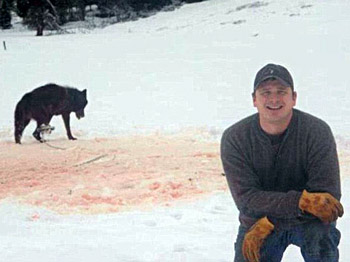
THIS PHOTO IS OF JOSH BRANSFORD, PLEASED WITH THE SCENE GOING ON BEHIND HIM. Feel free to contact him at 23 HC 1 #23 Elk City, ID 83525, 208-842-2925, jbransford@fs.fed.us (however, do not threaten him, as we don’t want to stoop that low).

“Photos of dead and maimed wolves recently posted online have started a firestorm of controversy over renewed hunting and trapping of the once federally protected animals.
 
Environmental Action, a national environmental organization founded in 1970 that helped push for passage of the Endangered Species Act decades ago, has been leading an online campaign to build support for protecting wolves again. But this week they took their campaign, including grisly photos of bloodied and trapped wolves, to the streets of Washington, D.C., to provoke a response from politicians and regulators.
 
“Letting wolves be hunted and killed again was a political decision made by shallow political interests,” explained Director Drew Hudson. “We need to confront shallow politics with the real, gut-wrenching photos of what this policy means—that an iconic American species important to our ecosystems and our vision of the west  is being brutally hunted to extinction, again. Anyone who can look at these photos and do nothing is a coward, or worse a politician.”
 
The advertisement was funded by dozens of small donors who chipped in online after signing a petition to the President and Congress asking them to re-list the wolf as an endangered species.”

*Special thanks to Environmental Action for providing the text in this posting!

Read Full Post »


“The truck’s plates say it all: “4WOLVES.” Inside are an Iowa couple who return to the Yellowstone country year after year to be campground hosts in the nation’s first national park. They return for the stunning scenery, for the wide open country that is the Lamar Valley, for herds of elk, for shaggy bison and for wolves.

Today’s Yellowstone is a different place than 1995′s Yellowstone. Biologists and ecologists can see it on the ground. Outdoor educators see it in their businesses. And visitors see it on the roads.

Travel the road from Cooke City into the Lamar Valley and you’ll see it too. At pullouts all up and down the valley will be dozens of people standing, pointing, quietly observing. They are there for Yellowstone’s wolves.

Jim Halfpenny is an outdoor educator who specializes in large carnivores. He lives in Gardiner, Montana, a town on the northern edge of the park and from there, he runs classes in wolf ecology. In 1995, he taught one class. Since that time, he has seen the wolf education business spring to life.

“There were fifty-four classes on wolves taught in the first half of 2000 from eleven different organizations. From an educational standpoint, this has just been monstrous in the way it has developed,” said Halfpenny.

Economically, the story has been extremely bright. In 1992, before wolves were reintroduced into the park, a University of Montana economist named John Duffield co-authored a study entitled “The Economics of Wolf Recovery in Yellowstone National Park.” That study predicted a loss to the hunter/outfitter business on the high end of about $500,000 per year. This would be a direct loss to hunting outfitters due to the fact that a declining elk population due to wolves would mean less elk to hunt, which would mean less clients. On the flip side, the benefits to wolf recovery in terms of tourism dollars, educators, and outfitters who specialized in wildlife observation, not hunting, were predicted in the $7-10 million annual range, a gain many times greater than the loss.

A follow-up study to check the accuracy of the predictions is about a year away from publication, but the preliminary numbers look very similar, said Duffield. People want to see wolves, and they come from all over the world to do so. And they bring money.

For a motel owner who struggles during the dreaded “shoulder-season”-those months between the peak tourist seasons-wolves have been extremely good news. Three years ago, Gerlie Weinstein left her life in New Orleans as an English teacher to come to Cooke City to run a business and watch wildlife. Today, she owns the Alpine Motel in Cooke City.

“My business has increased yearly, and increased from the business that the former owners did,” said Weinstein. “I came here because I watch wildlife and that’s what a lot of my clients do.”

The months of April, October, and November can be hard times for motel owners, but with the addition of wolves into the park, businesses like the Alpine Motel don’t need to close up shop during these times.

“We had our best November and best October ever last fall, that would be people coming to see the wildlife,” she said. “They are coming for the wolves and they are coming for the bears.”

What’s more, the potential is just barely being tapped, according to some observers.

“Over time, I think this is really going to be considered as a world class opportunity for people to see wolves in the wild,” said Rick McIntyre, who works for the National Park Service to provide help educate wolf watchers. In terms of the economic impact, there’s just tremendous potential for local business people. To me that’s just a tremendously positive potential, having the wolves here.”

Halfpenny has made an attempt to quantify and compare the economic returns of wolf watching to elk hunting.

“One exercise that I do in my wolf classes is I put up a blackboard and I have the people go through and make some sort of evaluation of what wolf watching brings into the northern Yellowstone ecosystem in dollars and what hunting brings,” said Halfpenny. “There’s a lot of assumptions in such an exercise, but the bottom line is in the northern (Yellowstone) ecosystem, wolf watching brings in four times what hunting is bringing in.

“We have counted 100,000 visitors as of June of last year that have been out and watched wolves and then you make assumptions about what they spend in the filling station, the restaurants, etcetera, and what the hunters spend,” said Halfpenny. “You know Montana’s own statistics show the average late-hunt hunter spends $39 a day up here.”

Halfpenny figures that wolf watchers spend about $160 per day in the area. And there’s tremendous potential for growth.

“It’s obvious that wolves are one of the most charismatic animals in the world and there’s no end to how many people would like to see a wolf in the wild, so Yellowstone is one of the most unique opportunities in the world where an average person can and does have a real excellent chance of having that experience,” said McIntyre.”

*Special thanks to http://www.yellowstonepark.com/2011/06/yellowstone-wolves-bring-estimated-7-10-million-in-annual-tourism-revenue/ for providing this information!

Read Full Post »


Written by By Tom Robertson Minnesota Public Radio,

“Some Ojibwe in Minnesota are worried about the fate of the state’s wolf population as state lawmakers consider a hunting and trapping season for the animals.
Wolves were removed from the federal endangered species list last year, and that upsets some tribal members. For many Ojibwe, wolves are important to traditional culture. Some believe wolves are sacred, and they want to see protections continue.
A painting of two wolves hangs prominently on the living room wall in Mary Favorite’s home in Wauben on the White Earth Indian Reservation.
Favorite is a tribal elder and a member of the wolf clan. That means many in her large, extended family associate themselves very closely with the animal. Favorite considers wolves among her relatives.
“It’s very special to me. When I read that in the paper that they were thinking about… passing a law about killing the wolves,” Favorite said. “It broke my heart.”
Favorite remembers decades ago when gray wolves nearly disappeared. Now there are an estimated 3,000 gray wolves in Minnesota.
The Department of Natural resources proposes to let hunters and trappers kill 400 wolves this fall. Favorite hates the idea.
“I thought, ‘Oh my God,'” she said. “It’s like they want to come in here and they want to shoot my brothers and my sisters.”
It’s not just members of the wolf clan who are upset about a possible wolf hunting season. Favorite’s husband, Andy, is a historian and retired tribal college teacher. For traditional Ojibwe across the upper Midwest, wolves are sacred, Andy Favorite said.
“In our creation stories and a lot of our other legends, the wolf is very prominent. A lot of our spirits come in the form of these creatures, so it’s a very spiritual thing,” he said. “If the tribes have the spiritual moxie, they will step in and do something to protect the wolves.”
Some Minnesota tribes have already done that. In 2010, the Red Lake Band of Ojibwe was the first to adopt a wolf management plan. They designated the band’s 843,000 acres of land as a wolf sanctuary.

Red Lake is unique because it’s considered a closed reservation. That means most of the land is owned and controlled by the tribe.
In most of Minnesota’s other reservations, regulating hunting is more complicated because there’s a checkerboard of land ownership. Those tribes regulate what happens on tribal land, but the state regulates hunting licenses for state land or land owned by non-American Indians.
In February, tribal officials at White Earth passed a resolution banning hunting and trapping on tribal lands. The tribe will only allow a wolf hunt for specific ceremonial purposes, or if wolves are causing problems with livestock or humans. Tribal natural resource managers said it’s unclear how many wolves are on the reservation, but there are only a few known packs.
Other Minnesota tribes are drafting their own wolf policies.
Tribal activist Bob Shimek has been involved in the politics of wolves since the 1980s. He said many Ojibwe people believe there is a strong historic parallel between wolves and Indians that has been foretold in tribal legends‚ “what happens to one, happens to the other.” He compares bounties on wolves to government policies of the past that tried to exterminate American Indians.
“Indians and wolves have always been a political sore point here in America,” he said. “It has always been about clearing the howling wilderness of those savages and those wolves and making it safe for pilgrims and settlers.”
Shimek and others are unhappy the state has not consulted with the tribes about managing wolves.
DNR officials say they plan to talk with the tribes once the Legislature establishes a framework for a hunting season. Dan Stark, a large carnivore specialist for the DNR, said the goal is to balance wide-ranging interests in wolves. Farmers and ranchers who lose livestock to wolves support keeping the wolf population in check. In 2011, there were more than 100 verified complaints of wolves attacking livestock or pets.
There are also sporting groups that want a chance to hunt or trap wolves for recreation, Stark said.
“It’s a pretty emotional topic for a lot of people,” Stark said. “But I think that the wolf population in Minnesota is secure and we’re going to make sure that however this develops, that we have wolves in the state and that wolves continue to thrive.”
For Shimek, convincing the state to scrap plans for wolf hunting and trapping is an uphill battle.
“I honestly believe that a thousand Indians could show up in St. Paul to testify against this wolf legislation and it would not matter one single bit in terms of the outcome,” Shimek said. “That’s just the nature of politics.”
In March, Shimek and others at White Earth began a series of public education “wolf talks” on the reservation, although opposition to a wolf hunting season has not seemed to slow the bills that are advancing through the Legislature.”

*Special thanks to “The Circle Native American News and Arts” for providing this information!

Read Full Post »


By On May 7, 2012

“The Wildlife News has finally obtained all of the records of documented mortality for wolves from April 1, 2011 up to April 1, 2012. This information tells a grim story about what the toll of handing over management to the State of Idaho has been on the Idaho wolf population. All told, based on some estimates made using the data, under state management, 721 wolves, or 59% of the wolves, were killed in the year running from April, 2011 – April, 2012. Even if you use only documented mortality, without estimating additional, unreported illegal take or other causes of mortality, then 492 wolves, or 48% of the wolves, in Idaho were killed.

I have made previous, and very similar posts based on preliminary information but this post is based on all of the wolf mortality information that the Idaho Fish and Game has for the period of time. The information contains critical information about the number of wolves killed which had radio collars. Using the official estimate of 746 on December 31, 2011 as a benchmark I was able to make some educated guesses about the full extent of undocumented mortality.

Using only the documented mortality it appears that, at the beginning of April, 2011 when pups were born, there were 1030 wolves and by the same time this year, before pups were born, there were 539 wolves in Idaho.

Undoubtedly there was more undocumented mortality than what is reported here. Using numbers estimated by comparing the proportion of wolves killed in the hunt that were wearing radio collars to the number of wolves killed wearing radio collars, I estimate that, rather than the 16 wolves reported to have been illegally killed, there were actually 100 wolves killed illegally because 6 of those were wearing radio collars. The number of wolves that died (9) from unknown causes contained 5 radio collared wolves which, using the same ratio, would have resulted in an additional 80 wolves. The number of wolves that died from natural causes (5) consisted of 4 collared wolves, which, using the same ratio, would have resulted in an additional 66 wolves. Under this estimate it appears that, at the beginning of April, 2011 when pups were born, there were 1217 wolves and by the same time this year, before pups were born, there were 496 wolves in Idaho.

The wolves killed under the “Control by Government” (75) label included those killed by IDFG (20), USDA Wildlife Services (48), and by Idaho County Deputies (7).

Meanwhile, Idaho Fish and Game Commission Chairman, Tony McDermott still has not retracted his claim that there are 1,200 – 1,600 wolves in Idaho and the Commission set more liberal hunting rules for the upcoming year. Rocky Barker also weighed in criticizing Defenders of Wildlife for complaining about the toll that Idaho’s management has had on wolves. He seems not to understand the meaning of the word “decimate”.”

*Special thanks to “The Wildlife News” for providing this information!

Read Full Post »


By
Published: March 12, 2012

“Once again, science, religion and politics have become entwined in a thorny public policy debate. This time, however, the discussion is not about abortion, birth control or health insurance mandates.

It’s about wolves.

Specifically, a bill in the Wisconsin Legislature to authorize a hunting season on wolves. The State Senate has approved it, and the Assembly is set to consider the bill on Tuesday.

Hunters approve of the season, and Republicans are all for it, as are some Democrats. Wildlife biologists have a number of criticisms and suggestions about the bill involving how, when and how many wolves should be killed.

But the Great Lakes Indian Fish and Game Commission, which represents 11 tribes of the Ojibwe (also known as the Chippewa, or Anishinaabe) in Wisconsin, Minnesota and Michigan, opposes the hunt on the basis of religious principle and tradition.

In written testimony presented to both legislative houses, James Zorn, the executive administrator of the commission, said, “In the Anishinaabe creation story we are taught that Ma’iingan (wolf) is a brother to Original man.” He continued, “The health and survival of the Anishinaabe people is tied to that of Ma’iingan.” For that reason the tribes are opposed to a public hunt.

Joe Rose Sr., a professor emeritus of Native American studies at Northland College in Ashland, Wis., and an elder of the Bad River Band, said in an interview that he saw a collision of world views. “We don’t have stories like Little Red Riding Hood, or the Three Little Pigs, or the werewolves of Transylvania,” he said. Wolf, or Ma’iingan, is a sacred creature, and so even keeping the population of wolves to minimum levels runs counter to traditional beliefs.

The opposition of the Ojibwe to the hunt may not swing a vote, but it is not a small matter. The Ojibwe have significant rights in lands that were once theirs, lands that, in Wisconsin, amount to about the northern third of the state. That, of course, is where most of Wisconsin’s wolves live.

Peter David, a conservation biologist with the Indian Fish and Game Commission, said that court settlements on treaty rights mean that the tribes must be consulted about decisions like the wolf hunt, and they were not. Also, he said, “the tribes can legally lay claim to half of the biological harvest.” What that could mean for a wolf hunt that the tribes oppose is not clear.

What is clear is that the opposition of the Ojibwe is more like objections to funding for abortions or birth control than it is the calculations of scientists, not in political tone, but in its essence.

All the other arguments center on numbers, practicality and consequences. How much damage do wolves do to livestock? How effective is this kind of hunt in reducing those depredations? How many wolves should be killed?

The original goal, set once it was clear that wolves were coming back in the state, on their own, was 350 wolves. With protection, the wolf population has grown to about 800. Adrian Treves, an associate professor of environmental studies at the University of Wisconsin-Madison, says that the carrying capacity of the state is probably about 1,000.

Dr. Treves has also testified about the bill. He would like to see fixes — for instance, ruling out hunting with dogs. But he sees the issue as one of wildlife management.

Mr. Zorn said in his testimony that for the Ojibwe, “wolf recovery does not hinge primarily upon some minimum number of animals comprising the current wolf population.” Rather, he said, the goal is “the healthiest and most abundant future for our brother and ourselves.”

Mr. Rose put it this way: “We see the wolf as a predictor of our future. And what happens to wolf happens to Anishinaabe.” And, he said, “whether other people see it or not, the same will happen to them.”

**Special thanks to The New York Times http://www.nytimes.com/2012/03/13/science/science-faith-and-politics-clash-over-wolves-in-wisconsin.html?src=tp&smid=fb-share for providing this information!

Read Full Post »

Posted on May 1, 2012 by Bob Berwyn

Feds nearly ready to accept state management plan

By Summit Voice SUMMIT COUNTY

 “Wyoming officials are pressing ahead with their plan to kill most wolves living outside Yellowstone and Grand Teton national parks. The state recently passed legislation and an amendment to its wolf management plan that’s close to gaining approval from the U.S. Fish and Wildlife Service, triggering the final removal of Endangered Species Act protection for the predators. The new law and plan would take effect later this year when wolves are removed from the federal endangered species list. The state wants to increase the area where wolves would be designated as predators and could be killed without limit; they also keep in place a trophy game management area, where hunting will be allowed to dramatically reduce wolf populations. What federal officials are acquiescing to is to confine wolves to the northwest corner of the state … They’re presenting to the public the new plan as a fait accompli,” said wolf advocate Michael Robinson, with the Center for Biological Diversity. Robinson said Wyoming’s wolf-management plan is “a recipe for wolf slaughter that will only serve to incite more of the prejudice against wolves that led to their destruction in the first place.” He said the federal government is not living up to the Endangered Species Act requirements that call for species to be recovered across significant portions of their former range. Instead of piece-mealing the delisting and recovery effort, Robinson said the federal government should look at wolf populations holistically and develop a national recovery plan that lives up to the letter and spirit of the Endangered Species Act. “Removal of federal protections for wolves has been a disaster in Idaho and Montana and will be even worse in Wyoming,” he said. While wolves would remain fully protected within Yellowstone and Grand Teton national parks, elsewhere in Wyoming they would be subject to shooting, trapping and snaring. Wyoming proposes designating wolves as predators across 83 percent of the state, where there would no limits on their killing. The remaining portion of the state would be considered a “trophy game management area,” where killing wolves would be permitted, with the goal of reducing the population from approximately 29 packs to around 10. “Along with the killing of wolves in Idaho and Montana, which had their protection taken away last year through a back-door congressional rider, this planned persecution of wolves in Wyoming could be devastating to the beautiful animals’ survival in the northern Rocky Mountains,” said Robinson. “Killing most of Wyoming’s wolves will hurt wolves in Colorado, too, where they’re only starting to return by way of Wyoming.” Since wolf hunting and trapping seasons opened last fall, 378 wolves have been killed in Idaho, which has no cap on killing and several ongoing open seasons. An additional 166 wolves were killed in Montana, which has now closed its season. Contrary to promises, hunting and trapping have appeared to inflame anti-wolf sentiment, with comments and pictures appearing on the Internet that boast of wolf killing and call for more slaughter. The Fish and Wildlife Service has reopened a two-week comment period, during which feedback is sought from the public before the agency finalizes the delisting rule. Background In October 2011 the Obama administration announced finalization of an agreement between the Fish and Wildlife Service and Wyoming Gov. Matt Mead whereby the agency would remove wolves in Wyoming from the federal endangered species list and the state would only be required to keep alive 100 wolves or 10 breeding pairs outside Yellowstone and Grand Teton national parks (which together provide habitat for a few dozen wolves that would remain protected while in the parks). After pups are born within the next few weeks, it is likely that more than 500 wolves will live outside the national parks in Wyoming. The state plan will allow their unregulated killing throughout most of the state.”

**Special thanks to http://summitcountyvoice.com/2012/05/01/wyoming-plans-to-kill-most-wolves-outside-yellowstone/ for providing this information!

Read Full Post »