
“A necropsy revealed that the alpha female sat in Coke’s trap for 10 days to two weeks, eating dirt and rocks. She lost 15 percent of her body weight and broke all of her teeth.
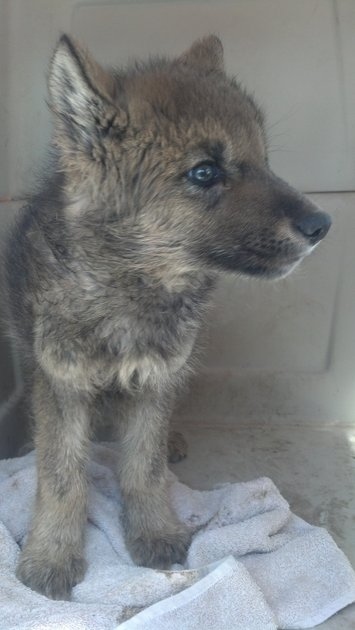
The puppies didn’t know they were being hunted.
On a hillside above the Teklanika River, they pounced on their mother, nuzzled their father, and wrestled each other, chewing on snouts and tails. Through the heat of the day, they slept in the forest, curled up in the filtered light. When evening came, they edged out of the tree wells, skimming the roots with their bellies, and played on the brown grass.
It was June, and silver-gray clouds hung over the wide green valleys of Denali National Park. Beneath Sable, Polychrome, and Eielson Peaks, waves of tundra fanned out like carpet. Beyond the tundra, no people. Only mountains, anchored in glaciers, tearing into the sky.
Pups born into the world-famous Toklat pack cavort without fear in the safety of the 6-million-acre park. Protected since 1952, they roam Denali boldly, brushing up against tourist buses, stealing backpackers’ shoes.
But when food is scarce, they follow the Denali caribou herd past the park’s northeastern boundary and across a narrow no-hunting zone into a windswept valley rich with lichen. Waiting there, just 14 miles from their den site, is an army of hunters that targets the trusting Denali wolf.
One of them, a guide named Coke Wallace, makes no apologies for killing Denali’s wolves. Not only is it legal, he argues, it’s essential to safeguard moose and caribou populations, which hunters kill for sport and food.
The only thing stopping Wallace from decimating the pack is the no-hunting zone, a controversial 90-square-mile buffer fiercely defended by his longtime nemesis, wildlife scientist Gordon Haber. A student of the Toklat for 43 years, Haber has spent thousands of days in Denali recording pack behavior. He insists the safety zone is far too small, and bitterly contests any call to roll it back. But that is exactly what could happen in March 2010, when the buffer comes up for renewal. Already, advocacy groups are gearing up for a battle that will pit hunters against hikers, state biologists against national park officials, and two obdurate, obsessive men against each other.
For Wallace, the next year is a chance to preserve traditional ways. For Haber, it’s a fight to save the world’s most beloved family of wolves. For the pups I saw frolicking above the Teklanika, it’s life or death. The clock is ticking.
Toklat. If you’ve been to Denali, you know this pack, these wolves. Adolph Murie came here in 1939 to study their impact on Dall sheep, and biologists–and tourists–have been watching them ever since. The subject of Murie’s book, The Wolves of Mount McKinley, the Toklat (or East Fork) pack is the longest-studied group of large social vertebrates in the wild, outdating Jane Goodall’s chimps by 30 years.
I saw them often when I worked in Denali as a backcountry ranger in the late 1990s. It was a difficult time for wolves across the park; hunters and trappers were targeting them more aggressively, often setting snares and traps just inches from park boundaries, and shooting them on sight.
Wolf hunting itself wasn’t new–Eskimos baited wolves with whale blubber 10,000 years ago–but it was getting noticed. Protests poured in about Alaska’s bounties and lax regulations. Questions were being raised about the sanctity of Denali’s wildlife. Concerned about the wolves–and the tourism dollars they generated–the Denali Citizens Council asked the Alaska Board of Game to establish safety buffers where the Toklat and Savage wolf groups left federal land.
The board initially balked, but in November 2000, with controversial predator-control programs on tap elsewhere in the state, it conceded a 19-square-mile corridor along the park’s northeastern boundary. In the years since, the zone has grown and shrunk, depending on which political party held sway. At 90 square miles, the current buffer covers half of the windswept valley where the Toklat and other wolf packs congregate to prey on wintering caribou. Called the Wolf Townships, it is the epicenter of Alaska’s wolf wars.
Coke Wallace and Gordon Haber first locked horns over the Toklat in 2001. Bitter enemies who frequent the contested buffer, they’ve been sparring ever since.
“I remember the day Gordy became a nuisance to me,” says Coke, 44, whose face is a smashup of Woody Harrelson and Sean Penn. Alaska-raised and proud of it, Coke lives with his wife and son in the Wolf Townships, where he’s been laying his traps and snares for more than 20 years.
“There were wolves over here and wolves over there,” says Coke, remembering the brisk October day his buddy Brent Keith called him to say it sounded like every wolf in central Alaska was carrying on in his backyard. “It was, as we say in the guide-hunting business, a target-rich environment.”
Heading out, Coke and Brent found 12 wolves sunning themselves on an outcropping, their distended bellies full of moose. The men crawled up and opened fire, killing seven.
Almost immediately, Haber, who monitors multiple wolf packs from the air using radio telemetry, zeroed in on the carnage. “A couple days later,” Coke recalls, “people were calling me at home inflicting me shit over something I do that’s completely legal: state land, state license, state-sanctioned season, state animals.”
Coke also claims that Haber buzzed his house several times a week in a small plane: “It got so bad my 4-year-old wouldn’t go outside because of the scary man in the sky.”
Tensions between the men ran high for weeks, then settled into an uneasy détente. But the word was already out. In 1992 and 1993, Friends of Animals had taken out full-page ads calling for a tourism boycott until aerial wolf killing stopped. Little came of them, except to put the Board of Game on notice that it could no longer operate in a vacuum.
Thanks to Haber, the scrutiny increased again. Nothing happened immediately, but in March 2004 the board surprised everyone with a decision to maintain–rather than reduce–the buffer’s boundaries. At least one member admitted to the Associated Press that the vote was motivated by a desire to make wolf hunting elsewhere in Alaska more palatable.
Coke and other hunters roared in protest, but this time Coke’s anger was directed at Governor Frank Murkowski, who he accused of capitulation to “ecoterrorists,” and at animal lovers who fell for what he calls Haber’s “false biology.”
The fragile peace between Wallace and Haber held until the bitter-cold morning of February 11, 2005, when Coke had had enough. With his buddy Adam, he was out in the Wolf Townships checking the wire snares and metal leg traps he had scattered in the willow around a frozen horse carcass. The snares hung snout-high on a wolf, and the leg traps lay concealed in the snow beside Coke’s snowmobile trail.
Coke didn’t know he had a wolf in his trap that morning, but he’d brought his trailer anyway. If he had gotten lucky, he’d need to get the wolf–or lynx or moose or caribou–back to the small outbuilding on his property where he skins what he catches, the place he calls “the petting zoo.” But he did have a wolf, an adult the color of river stones that happened to be the Toklat’s alpha female, easily identified by her park- service collar. And he shot her, swiftly and cleanly, just like he always does, with his favorite gun, a Ruger MK II.
Then Coke did something he’d never done. Haber’s Cessna 185 came into view, and Coke acted out. Maybe it was frustration, or hatred, or overheated rivalry. As Haber circled, Coke pulled his black balaclava over his face, put on his sunglasses, and stuck the barrel of his pistol in the dead wolf’s mouth. “When I saw Gordy up there with his camera, I said, ‘This is gonna cost me a shitload of grief,'” says Coke. “‘So I’m gonna make it worth it.'”
Coke knew that within days, animal rights activists would be calling his home, threatening to poison him and his family if he didn’t stop killing park wolves. He knew the hostile letters would arrive, calling him an “asshole dirtbag murdering son-of-a-bitch,” from people threatening to hunt him.
With his free hand, Coke gave Adam his camera, telling him to take a picture. Then they coaxed their Ski-Doos to 20 miles per hour, pulling the dead wolf down the Stampede Road. Back at the shed, Coke unloaded the wolf’s body; he’d remove her collar later and turn it in to the park service biologist, following federal regulations, like he always did. But first, he had a call to make–to a T-shirt company.
Coke still smirks when he thinks about the message he had silk-screened above the picture of himself, looking like an Alaskan Sandinista, holding Gordon Haber’s prized Toklat wolf by the throat. He likes to imagine the gash it must have torn in Gordon’s oozy, wolf-loving heart. “Haber has violated my civil liberties,” he declares, “and I can’t get the government to do anything about it because he has a herd of attorneys behind him.”
Coke’s T-shirts come in heather gray and olive green, in a full size run, so you can buy one for your kid. The slogan, printed in square black letters, reads: Visit Alaska This Summer or the Wolf Gets It!”
**for more on this story, please visit http://www.backpacker.com/dogs_of_war_the_battle_over_denalis_toklat_wolf_pack/nature/12719
Read Full Post »




 The Wolf Preservation Blog