Feeds:
Posts
Comments

Archive for December, 2012


woman riding wolf

As 2012 comes to an end, I’ve put together a few wolf sayings and poems.  As you read through them, please share one of your own or favorites with Wolf Preservation and all it’s viewers.  Thank you for ongoing support of  WOLF PRESERVATION!

“They’re throwing me to the wolves early, huh? I feel as though I can run with all those guys. All I need to do is go out and focus on my assignment, and I’ll be all right.”

 Mike Adams

“A Native American grandfather talking to his young grandson tells the boy he has two wolves inside of him struggling with each other. The first is the wolf of peace, love and kindness. The other wolf is fear, greed and hatred. “Which wolf will win, grandfather?” asks the young boy. “Whichever one I feed,” is the reply.”

 Native American Proverb

“Let’s not let the Farm Bureau ruin a good thing. The wolves are doing great. They’re staying away from livestock except in a few cases where Defenders compensates for any losses. The ecosystem is returning to a more healthy, natural state. Tourism is up and the wolves are adding to the region’s economy. Why negate 20-some years of work and lots of money just to start over?”

 Bob

The wolf changes his coat, but not his disposition.”

 Proverb

For the strength of the Pack is the Wolf…
And the strength of the Wolf is
the Pack

“Wolves are mirror images of our soul”

“A Wolf, it is said, can hear a cloud pass overhead”

“He who cannot howl, will not find his pack.”

“We have doomed the Wolf not for what it is, but for what we have
deliberately and mistakenly perceived it to be..the mythologized epitome of a
savage, ruthless killer..which is, in reality no more than a reflexed images of
ourself”-Farley Mowat

The difference between men and Wolves is that Wolves are more humane.

While we call ourselves civilized, we kill our own. The Wolf is content to lay
at our feet, with the rank of the uncivilized, yet they will not destroy their
own.

Wolf Prayer
Follow me down the path
I will walk beside you
Guiding and
showing you the way
I will not leave you
I will be standing on the path
watching you
If you ever feel alone
Close your eyes
You will see 6 sets
of foot prints
2 belonging to you, 4 to me
Then you will know that I have
not left you.

**Some of these quotes were provided by http://www.angelfire.com/tx2/wolveswithin/Quotes.html so special thanks!


Read Full Post »


Members of Footloose Montana, from left, Anja Heister, Dave Taylor and Connie Poten, spent a frigid Saturday on Higgins Avenue in downtown Missoula protesting the opening day of wolf trapping season and trapping in general.


“Montana’s 2012 wolf hunt shifted to a new gear on Saturday as trapping became a legal way to take the predators.

However, state Fish, Wildlife and Parks officials don’t expect a rush of activity over the weekend. Trappers could not place traps before Saturday, and may leave them unchecked for up to 48 hours. They must report any kills within 24 hours.

Experienced trapper Mike Day of Missoula said he didn’t expect much success at all from the state’s new trapping program. Between the unhelpful weather and the difficult rules, he doubted the wolves had much to fear.

“We’re going to have a bunch of dingbats running around with great big traps not knowing what they’re doing,” Day said on Friday. “It’s designed to fail.”

FWP rules prohibit setting traps within 150 feet of a road or trail, as well as 1,000 feet from trailheads and campgrounds. Day said because wolves tend to travel on the same roads and trails humans do, they’ll never encounter the traps.

“It’s just like real estate – location, location,” Day said. “If your location’s wrong, you’re not going to catch nothing.”

*****

About 10 members of Footloose Montana braved the December wind to stage a protest on the Higgins Avenue on Saturday. The group’s director, Filip Panusz, said members in Helena, Great Falls and Bozeman planned similar demonstrations.

“Myself, I’m a strong supporter of fair-chase hunting and bow-hunting,” Panusz said on Saturday. “But trapping is not fair chase. It’s not a clean kill. The animal suffers, maybe for days. You don’t know your target, so you could catch all kinds of other, non-target species. And you’re using bait, which is an unfair advantage that’s not allowed in any other kind of hunting.”

Panusz said Footloose Montana members were widely divided on the issue of killing wolves, but were unified in opposition to using traps. In addition to injuring or killing pet dogs and hunting dogs, trapping hurts Montana’s image and economy, he said. While U.S. Fish and Wildlife Agency surveys report the Montana economy annually brings in $310 million a year from hunters and $376 million from wildlife watchers, Panusz said trapping produces barely 1 percent of that amount.

Montana’s rifle season for wolves continues through Feb. 28. But big game hunters took only 93 wolves during the regular October-November season. The state set a quota of 220 wolves in its 2011 hunting season but recorded only 166 kills. This year, FWP opted to forego a quota but monitor kills to ensure the state did not get close to a low threshold of 150 wolves. Going below that figure could trigger resumption of federal Endangered Species Act controls in Montana. More than 600 wolves are estimated to live in Montana.

In Idaho, rifle hunters have killed 116 wolves while trappers have taken another seven, according to Idaho Fish and Game reports. During the 2011-12 season, Idaho reported 255 wolves shot and 124 trapped. The state has no upper quota for wolf kills. Its season runs through March 31, 2013, in most parts of the state except in remote areas west of Montana’s Bitterroot Mountain Range, where hunters can remain active until June 30.

Wyoming, which added a wolf hunt this year after gaining state control of its wolf population in early 2012, has reported at least 58 kills . The state has a quota of 52 wolves in a “trophy zone” around Yellowstone and Teton national parks, and hunters there have reported taking 39 animals. The rest of the state has no quota. Hunters have reported killing 19 wolves in that “predatory zone.” The Wyoming wolf season lasts through Dec. 31.”

**Special thanks to Missoulian (http://missoulian.com/news/state-and-regional/wolf-trapping-season-begins-protest-held-in-missoula/article_188067f4-470d-11e2-aa57-0019bb2963f4.html) for providing this information.

Read Full Post »


Center for Biological Diversity

For Immediate Release, December 10, 2012

Contact: Michael Robinson, (575) 534-0360

Lawsuit Filed to Protect Mexican Gray Wolf as Endangered Subspecies

Bureaucratic Limbo Threatens 58 Wolves Left in Arizona, New Mexico

“SILVER CITY, N.M.— The Center for Biological Diversity sued the U.S. Fish and Wildlife Service today over the agency’s rejection of a 2009 scientific petition from the Center that sought classification of the Mexican gray wolf as an endangered subspecies or population of gray wolves. Mexican wolves are currently protected as endangered along with all other wolves in the lower 48 states, with the exception of those in the northern Rocky Mountains and Great Lakes region. In filing today’s suit, the Center said specific protection for Mexican wolves is needed to ensure their recovery.

“Mexican wolves are the smallest, most genetically distinct of all gray wolves in North America, uniquely adapted to the dry lands of the Southwest,” said Michael Robinson, the Center’s wolf specialist. “We’re filing our second lawsuit in three weeks on their behalf because these very rare animals are on the razor edge of extinction due to federal mismanagement, persecution and neglect. We don’t want to look back in 10 years and wonder if there was anything else we could have done to save them.”

Both lawsuits aim to help Mexican wolves recover. In November the Center sued the Fish and Wildlife Service to compel it to reform its ongoing wolf-reintroduction program in accordance with recommendations made by its own scientific panel in 2001. More than 10 years ago the agency promised to consider the reforms, and then, in 2007, it renewed this promise to a court; but it has never followed through. In seeking separate recognition of Mexican wolves through today’s lawsuit, the Center hopes to force the agency to implement the reforms and complete a new recovery plan, in the works since as far back as 1995.

“Fish and Wildlife has consistently failed to take action to ensure the survival and recovery of the Southwest’s one-of-a-kind wolves,” said Robinson. “The government’s stubborn refusal to follow the best science on wolf recovery is pushing the last Mexican gray wolves we have left way too close to the cliff of extinction.”

Nearly 15 years after Mexican wolves were first reintroduced to the Southwest, there are only 58 wolves in the wild; it has been four years since a new wolf was released from captive-breeding facilities. Scientists believe Mexican wolves may be suffering from genetic inbreeding, with reduced litter size and pup survivorship.

Following a lawsuit by the Center, reintroduction of Mexican wolves began in 1998. The reintroduction has been hampered by rules that require recapture of wolves who set up territories outside the narrowly defined recovery area and that do not allow release of captive wolves into New Mexico’s Gila National Forest, where there’s extensive suitable habitat. The reintroduction has also been hurt by an out-of-date 1980s recovery plan that does not specify a target for recovery. The Center’s two lawsuits seek to remedy both of these failings by getting the agency to enact reforms and protect Mexican wolves as a specific subpopulation. ”

The Center for Biological Diversity is a national, nonprofit conservation organization with more than 450,000 members and online activists dedicated to the protection of endangered species and wild places.

Read Full Post »


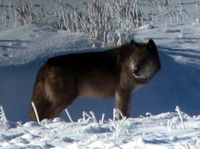
wolf hunted

Hunted. This male wolf, which was part of a study of wolf behavior in Yellowstone National Park, was killed by a hunter earlier    this month after it left the park.
Credit: Doug McLaughlin/Courtesy William Ripple
by    Virginia Morell    on 26 November 2012,  3:30 PM

“An estimated 10 wolves from Yellowstone National Park have been killed by hunters this month, adversely affecting the park’s wolf research program, one of    the longest studies of its kind.

“Losing the wolves has been a big hit to us scientifically,” says wildlife biologist Douglas Smith, leader of Yellowstone’s wolf project, which has tracked    the wolves since their reintroduction in 1995. The killings came just as researchers, who are partly funded by a 5-year U.S. National Science Foundation    grant, were set to begin the wolf project’s annual winter survey of the canids’ predatory habits.

The wolves were shot by licensed hunters outside the national park during the legal wolf hunting season that opened this fall in Montana, Idaho, and    Wyoming. Seven of the wolves were wearing radio-collars that help scientists track the wolves. Two “were the only collared members of their packs,” Smith    says. “So, now we can’t track those packs.” In addition, two of the wolves had specialized GPS collars that collect data every 30 minutes, which has helped    researchers better understand wolves’ movements and predatory behaviors. Only one wolf in the study program is now left with such a collar.

Smith says that all seven radio-collared wolves were within 1 to 3 miles of the park’s unmarked boundary when killed. “We don’t know why they left; one had    never gone outside before, and three of the others did so only infrequently,” he says. The wolves may have been in pursuit of prey, since the park’s elk    also migrate out of the park at this time of year; or they may have been enticed by the gut piles hunters leave behind after shooting and dressing out an    elk. Many professional hunting camps are set up around the park’s boundaries close to known elk migration routes. The wolves, too, are used to humans,    “which could make them more vulnerable to hunting,” Smith says.

The wolves’ deaths mark the second time in 3 years that collared Yellowstone research wolves have been shot by hunters. Some worry that hunters are    targeting the radio-collared animals. The hunters returned the collars to the park’s wolf project.

Although Yellowstone’s wolves are protected while they roam inside the park, they now can be legally shot as soon as they set foot outside. Wolves in    Montana and Idaho were removed from the federal endangered species list in May 2011; those in Wyoming were downlisted on 30 September. The Wyoming wolf    hunting season opened the next day.

While lamenting the loss of the wolves, some of whom were well-known to park visitors, park officials stressed that Yellowstone’s wolf population remains    healthy, with approximately 88 individuals. “These were loved, iconic wolves,” says Dan Hottle, a park spokesperson, but their loss does not “adversely    affect our ecosystem.” But the wolves’ social structure and stability may be affected, Smith says. There could also be an impact on tourism, observers say:    A 2006 University of Montana study estimated that the wolves draw in $35 million a year in tourist dollars to the park and surrounding areas.

Scientists predict that the loss of the collared wolves will have a big impact on both the park’s research project and numerous other independent studies    investigating a variety of issues, such as elk management and ecology. The collars collect data intended to help wildlife managers better understand wolf    behavior, particularly the canids’ effect on elk. And unless a wolf is wearing a collar, researchers say they can’t be sure that it is an animal that uses    the park. The killings are “very unfortunate, because of the harm it does to the research,” says Bob Ream, a retired wolf biologist from the University of    Montana, and chair of the state’s Fish, Wildlife & Parks Commission, which oversees the hunts. “I would like to think this was not done intentionally.”    Intentional or not, Smith notes that of the killed wolves that were known to have used the park, an estimated 70% were wearing collars.

Smith and others, including park officials and conservationists, have lobbied officials in the three states to establish buffer zones around the park to    protect the wolves from hunting. Only Montana, however, has made an effort to do so. It has reduced the quota in one hunting district north of the park    from 15 wolves to three.

Smith has teams out now in search of the two packs that no longer have collared individuals. “Scientifically, our goal was to study a population of wolves    that was not exploited by people,” he says. “Unfortunately, that is no longer the case.”

**Special thanks to Science Insider,  http://news.sciencemag.org/scienceinsider/2012/11/yellowstone-park-research-wolves.html?ref=hp, for providing this information!

Read Full Post »