Feeds:
Posts
Comments

Archive for March, 2013


Arizona Republic, March 20, 2013 (posted 3/21/13) Letters to the Editor Needed!

By Brandon Loomis

“The Arizona Game and Fish Commission on Wednesday voted to back an effort by Western lawmakers to remove gray wolves from the endangered-species list.

The commission unanimously supported a letter by Sen. Orrin Hatch, R-Utah, and Rep. Cynthia Lummis, R-Wyo., asking the U.S. Fish and Wildlife Service to drop federal protections for wolves nationwide.

That would include Mexican gray wolves, which have struggled to find a foothold in the Southwest since reintroduction in 1998, though the commission reasserted its support for at least 100 “wolves on the ground.”

That’s a number that wolf supporters find unacceptable, and they don’t trust the state to nurse the animals to a fully recovered population.

But Hatch and Lummis, in their March 15 letter to Fish and Wildlife Service Director Dan Ashe, said that wolves are not endangered and that states don’t need federal meddling on the predators’ behalf.

“Unmanaged wolves are devastating to livestock and indigenous wildlife,” they wrote. “Currently, state wildlife officials have their hands tied any time wolves are involved.”

Commission Chairman Jack Husted said wolves in the northern Rocky Mountains — reintroduced in the 1990s, just like Arizona’s — have thrived to the point that they are damaging prey populations such as elk. Idaho, Wyoming and Montana have hosted more than 1,000 wolves between them for years. “We’ve time and again voiced our support for wild wolves on the ground (in Arizona),” Husted said, “but not in unlimited numbers.”

When federal officials released Mexican gray wolves from captive breeding programs into the mountains of eastern Arizona and western New Mexico, they discussed an initial goal of 100 animals.

They were unsure how many might actually be needed to support a perpetual population and left that prescription to be determined in a recovery plan that still has not been completed.

Although federal biologists this year reported a record number of wild Southwestern wolves — 75, split about evenly between the two states — wolf proponents say it’s nowhere near a safe number. They’re awaiting the recovery plan, which could designate new areas for reintroduction, such as the forests around the Grand Canyon.

Gray wolves’ legal status is complicated. Alaska’s plentiful packs have long been state-managed. Wolves brought from Canada to the northern Rockies, like those rebounding naturally in the upper Great Lakes states, have thrived to the point that federal officials have already dropped them from the endangered list.

But any that take up residence outside their official recovery zones — in eastern Utah, for instance — would enjoy full federal protection.

The Southwest’s wolves are physically the smallest North American subspecies and numerically the smallest population, and they remain legally protected from such actions as sport hunting.

Hatch and Lummis seek a blanket removal of federal oversight.

Sandy Bahr, director of the Sierra Club’s Grand Canyon chapter, said the commission would have more credibility in backing that move if the state had ever seriously supported wolf recovery.

“There’s no demonstration of commitment,” she said. Seventy-five animals don’t add up to success, she added. “Common sense tells you these are endangered animals.”

Defenders of Wildlife also condemned the commission’s vote, saying it defies polls that have shown that most Arizonans support wolf recovery.

This article was published in the Arizona Republic.
****************************************************************************************************************
Please write a letter to the editor today, thanking the paper for this article and opposing AZ Game and Fish Commission’s irresponsible position of support for delisting gray wolves nationally.
The letters to the editor page is one of the most widely read, influential parts of the newspaper. One letter from you can reach thousands of people and will also likely be read by decision-makers.  Tips for writing your letter are below, but please write in your own words, from your own experience.

Letter Writing Tips & Talking Points

Below are a few suggestions for ensuring your message gets through clearly-your letter will be most effective if you focus on a few key points, so don’t try to use all of these. If you need additional help or want someone to review your letter before you send it, email it to info@mexicanwolves.org.

Start by thanking paper for publishing this article. This makes your letter immediately relevant and increases its chances of being published.

Convey your outrage that once again the AZ Game and Fish Commission is attempting the undermine the survival of the Southwest’s native Mexican gray wolf. The Commission has a public trust responsibility to protect all of Arizona’s wildlife, especially endangered animals like the lobo. The Commissioners have betrayed that trust by advocating the removal of endangered species protections for wolves in all of the lower 48 states. It’s time they stopped trying to hinder the wolves’ recovery.

Remind readers that, at last count, just 75 Mexican gray wolves, including three breeding pairs, survived in the wild. These native wolves are critically endangered. New releases and additional populations of these wolves are desperately needed for them to thrive. Endangered species protections are critical to their survival. But AZ Game and Fish has consistently tried to undermine the wolves and will continue to do so if lobos become subject to state management.

Tell readers why you support wolves and stress that the majority of Arizona residents support wolves and understand their importance.   Polling done by Research and Polling, Inc. found 77 percent of Arizona respondents support the reintroduction of Mexican gray wolves. The poll also showed strong majority support for giving wolves greater protection under the Endangered Species Act. The Commission’s decision is an affront to the majority of Arizonans who value wolves and welcome the economic and ecosystem benefits they bring.

Convey how urgent it is for people to contact their elected officials in congress now to urge them to oppose national delisting of wolves. As the majority, we can make our voices heard above the commission if we reach out to our members of congress. Arizona letters can specifically thank Representatives Grijalva, Sinema, and Barber for their opposition to national delisting; they can also urge, by name, the other AZ Senators and Representatives who have not yet done so to step forward for wolves. Click here for information about members of Congress.

Talk about your personal connection to wolves and why the issue is important to you. If you’re a grandmother wanting your grandchildren to have the opportunity to hear wolves in the wild, or a hunter who recognizes that wolves make game herds healthier, or a businessperson who knows that wolves have brought millions in ecotourism dollars to Yellowstone, say so.

Describe the ecological benefits of wolves to entire ecosystems and all wildlife. Wildlife biologists believe that Mexican wolves will improve the overall health of the Southwest and its rivers and streams – just as the return of gray wolves to Yellowstone has helped restore balance to its lands and waters. Science has repeatedly demonstrated that wolves are keystone carnivores who help to keep wildlife like elk and deer healthy and bring balance to the lands they inhabit.

Keep your letter brief, between 150-200 words.

Provide your name, address, occupation, and phone number; your full address, occupation, and phone number will not be published, but they are required in order to have your letter published.”

**Special thanks to Brandon Loomis, http://www.mexicanwolves.org/index.php/news/937/51/In-the-News-Arizona-commission-backs-request-to-remove-wolves-from-endangered-list/d,News2) for providing the information in this article!

Read Full Post »


wolf hunted

“HAMILTON – There were at least 625 wolves in 147 packs with 37 breeding pairs roaming Montana’s wild lands at the end of 2012, according to figures released Thursday.

That’s the number of wolves that state wildlife managers were able to verify for certain for the federally required annual wolf conservation and management report.

The state’s annual minimum wolf count dropped by 4 percent in 2012. It was the first time that has happened since 2004.

The count doesn’t include 95 wolves killed statewide by hunters and trappers from Jan. 1 to Feb. 28 this year.

While the overall wolf count dropped statewide, the number of packs and breeding pairs increased slightly.

That’s what FWP wolf specialist Liz Bradley documented this year in the Bitterroot area as well.

“The overall numbers are down slightly from last year in the Bitterroot, but we are seeing a few more packs,” she said. “The pack sizes are smaller, which is what you might expect with hunting and trapping.”

The numbers in this report are a minimum count and don’t take into account all the wolves on the landscape, Bradley said.

“You should look at it for a trend,” she said. “It gives us an idea of what’s going on out there.”

Bradley documented 13 packs in the Bitterroot in 2012. That was up from 11 the year before.

At the same time, the annual minimum count dropped from 68 in 2011 to 59 in 2012.

Part of the decline in overall numbers could come from the loss of the Welcome Creek Pack in the northern reaches of the Bitterroot.

“It’s no longer there,” she said. “It got old and died and dispersed.”

Wolf numbers continue to hold steady in the East and West Fork areas, Bradley said.

***

This was the first year that Montana allowed people to trap wolves, which increased the annual harvest. Hunters took 128 wolves statewide and trappers killed another 97.

In Ravalli County, trappers took eight of the 14 wolves killed during the season that ended on Feb. 28.

“We’re making some progress,” said FWP Director Jeff Hagener. “Confirmed livestock loss has been on a general downward trend since 2009, and we have more tools now for affecting wolf populations.”

“In some areas, where hunting, trapping and livestock-depredation removals have been effective, it looks like the wolf population’s growth has been curbed this year,” he said. “In other areas, the population may be leveling off, but we have more work to do. There are still places where we need to manage for a better balance among other Montana wildlife and with Montana’s livestock populations.”

A total of 108 wolves were removed through agency control efforts in 2012 to prevent livestock loss. In 2011, 64 wolves were killed in similar actions.

Cattle losses from wolves were the lowest they’ve been in six years. Confirmed livestock depredations due to wolves were 67 cattle, 37 sheep, one dog, two horses and one llama in 2012.

The minimum federal recovery goals for wolves in the northern Rocky Mountains was set at a minimum of 30 breeding pairs and minimum of 300 wolves for three consecutive years. That goal was met in 2002.

The 2012 wolf population estimate for the Northern Rockies – which includes Wyoming, Idaho and Yellowstone Park – is expected to be available the second week of April from the U.S. Fish and Wildlife Service at westerngraywolf.fws.gov.”

**Special thanks to Missoulian for providing this information!


Read Full Post »


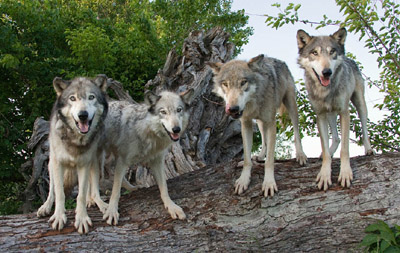
wolf gang (Photo from Wolf Park, www.wolfpark.org)

“Wolves live in groups of between two and twenty (averaging about six to eight) animals.  These groups are called packs.  Each pack of wolves maintains an area, called a territory, which belongs to it and which it defends from other wolves.  Within this territory, the pack hunts, sleeps, plays, and raises pups.  Territories range in size from 50 to 1,000 square miles, depending on how much prey is available.  Packs also vary in size depending on what kind of prey is available.  Wolf packs which hunt deer as a primary source of food will have fewer wolves than packs which hunt bison or moose.  These large animals are harder to catch and kill, and can also feed more wolves once caught.

Wolves have a linear rank order, or hierarchy, which helps keep peace within the pack.  There is a separate line of rank for each sex: one for males and one for females.  At the top of the rank order is the alpha male and female.  The beta male and female are next highest in status.  At the bottom of the rank order is the omega “scapegoat” wolf, which may be either male or female.  In the rank order, each wolf has a set place.  When two wolves from the same pack cross paths, one is always dominant to the other, or higher in status than the other wolf.  The lower-ranking wolf is said to be submissive to the higher-ranking, dominant wolf.

The alpha wolves are not necessarily the strongest, the fastest, or the smartest.  High rank has more to do with attitude and confidence than size or strength.  Dominance also does not favor gender — either the alpha male or the alpha female may be the overall “leader of the pack”.

While dominant wolves generally act more self-confident than lower-ranking ones, wolves do not walk around constantly displaying their status.  They most often adopt a neutral pose, changing their expression towards dominance or submission depending on which other wolves are around.  (A wolf will show dominance to a lower-ranking animal, and submission to a higher-ranking one.)  A wolf displaying dominance stands up tall, looks directly at the other wolf, puts its ears forward, and will lift its tail (usually not much higher than its back, unless it is very excited).  A wolf displaying submission crouches down to look small, lowers or even tucks its tail, looks away from the other wolf, and puts its ears down and back.  This is usually all that happens when two wolves meet: wolves cannot afford to spend all their time fighting, and these subtle displays are all that is needed to maintain social stability.

Wolf communication involves a lot of signals like these.  The postures and facial expressions used will vary in intensity, or strength, depending on the context: an alpha wolf will often simply look hard at a wolf to send it a dominance message, and a submissive wolf will often just look away from a dominant wolf to give the appropriate response.  An excited alpha may give a stronger dominance message, and growl at a lower-ranking wolf or even hold it down.  Stronger submission signals include whining and pawing at the dominant wolf.  Mostly, signals just get louder and stronger the more excited the wolves get, and fighting rarely occurs.

The alpha wolves are not necessarily “in charge” or “leaders of the pack” at every moment.  They may decide where and when to hunt or they may not.  An alpha wolf is not always a leader so much as a wolf who has the right to do whatever it wants, whenever it wants.  Since they have so much social freedom to do what they like, alpha wolves often have more opportunity than lower-ranking wolves to start hunting or to choose a resting place.  The rest of the pack will then often follow and join in.  But when in home range, often younger wolves will take the lead on an outing.

The omega wolf ranks lower than any other wolf.  It usually sleeps away from the other pack members and may not engage in much social behavior, like howling or greeting.  The other wolves may make a “game” of picking on the omega wolf, biting it and driving it away from food.  At other times, the omega may be tolerated or even accepted into group activities.  This wolf may be able to eventually work itself back higher in the rank order or it may eventually choose to leave and form a new pack.

Rank order is not always linear and may be somewhat flexible in certain circumstances.  Puppies and yearlings, for example, have a rank order, but this order may change from month to month, week to week, or even from day to day in the case of young puppies.  (The rank order for adult wolves is usually more stable.)  “Playing” wolves, who are engaging in behaviors such as chasing and running for fun, may “switch” rank temporarily, and a lower-ranking wolf will be allowed to mock-dominate a higher-ranking one.  Some rank orders may be circular, with wolf A dominating wolf B who dominates wolf C who dominates wolf A, but this is rarely permanent.  Also, low-ranking wolves of one gender may be able to dominate high-ranking wolves of the other, without changing their rank in the social order of their respective sex.”

**Special thanks to Wolf Park for providing the information in this post! (http://www.wolfpark.org)

Read Full Post »