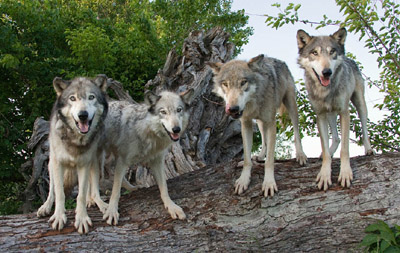
“How do wolves live together?
Wolves live in groups of between two and twenty (averaging about six to eight) animals. These groups are called packs. Each pack of wolves maintains an area, called a territory, which belongs to it and which it defends from other wolves. Within this territory, the pack hunts, sleeps, plays, and raises pups. Territories range in size from 50 to 1,000 square miles, depending on how much prey is available. Packs also vary in size depending on what kind of prey is available. Wolf packs which hunt deer as a primary source of food will have fewer wolves than packs which hunt bison or moose. These large animals are harder to catch and kill, and can also feed more wolves once caught.
Wolves have a linear rank order, or hierarchy, which helps keep peace within the pack. There is a separate line of rank for each sex: one for males and one for females. At the top of the rank order is the alpha male and female. The beta male and female are next highest in status. At the bottom of the rank order is the omega “scapegoat” wolf, which may be either male or female. In the rank order, each wolf has a set place. When two wolves from the same pack cross paths, one is always dominant to the other, or higher in status than the other wolf. The lower-ranking wolf is said to be submissive to the higher-ranking, dominant wolf.
The alpha wolves are not necessarily the strongest, the fastest, or the smartest. High rank has more to do with attitude and confidence than size or strength. Dominance also does not favor gender — either the alpha male or the alpha female may be the overall “leader of the pack”.
While dominant wolves generally act more self-confident than lower-ranking ones, wolves do not walk around constantly displaying their status. They most often adopt a neutral pose, changing their expression towards dominance or submission depending on which other wolves are around. (A wolf will show dominance to a lower-ranking animal, and submission to a higher-ranking one.) A wolf displaying dominance stands up tall, looks directly at the other wolf, puts its ears forward, and will lift its tail (usually not much higher than its back, unless it is very excited). A wolf displaying submission crouches down to look small, lowers or even tucks its tail, looks away from the other wolf, and puts its ears down and back. This is usually all that happens when two wolves meet: wolves cannot afford to spend all their time fighting, and these subtle displays are all that is needed to maintain social stability.
Wolf communication involves a lot of signals like these. The postures and facial expressions used will vary in intensity, or strength, depending on the context: an alpha wolf will often simply look hard at a wolf to send it a dominance message, and a submissive wolf will often just look away from a dominant wolf to give the appropriate response. An excited alpha may give a stronger dominance message, and growl at a lower-ranking wolf or even hold it down. Stronger submission signals include whining and pawing at the dominant wolf. Mostly, signals just get louder and stronger the more excited the wolves get, and fighting rarely occurs.
The alpha wolves are not necessarily “in charge” or “leaders of the pack” at every moment. They may decide where and when to hunt or they may not. An alpha wolf is not always a leader so much as a wolf who has the right to do whatever it wants, whenever it wants. Since they have so much social freedom to do what they like, alpha wolves often have more opportunity than lower-ranking wolves to start hunting or to choose a resting place. The rest of the pack will then often follow and join in. But when in home range, often younger wolves will take the lead on an outing.
The omega wolf ranks lower than any other wolf. It usually sleeps away from the other pack members and may not engage in much social behavior, like howling or greeting. The other wolves may make a “game” of picking on the omega wolf, biting it and driving it away from food. At other times, the omega may be tolerated or even accepted into group activities. This wolf may be able to eventually work itself back higher in the rank order or it may eventually choose to leave and form a new pack.
Rank order is not always linear and may be somewhat flexible in certain circumstances. Puppies and yearlings, for example, have a rank order, but this order may change from month to month, week to week, or even from day to day in the case of young puppies. (The rank order for adult wolves is usually more stable.) “Playing” wolves, who are engaging in behaviors such as chasing and running for fun, may “switch” rank temporarily, and a lower-ranking wolf will be allowed to mock-dominate a higher-ranking one. Some rank orders may be circular, with wolf A dominating wolf B who dominates wolf C who dominates wolf A, but this is rarely permanent. Also, low-ranking wolves of one gender may be able to dominate high-ranking wolves of the other, without changing their rank in the social order of their respective sex.”
**Special thanks to “Wolf Park, http://www.wolfpark.org/aboutwolves.shtml, for providing this information!
 The Wolf Preservation Blog
Leave a comment