Wolf-relocation project struggles as lobos fall prey to guns and cars…
By Brandon Loomis The Republic | azcentral.com, Sat May 25, 2013 11:25 PM
“ALPINE — A brown-streaked wolf — named Ernesta by her admiring captors — bounded from a crate and onto Arizona soil. She carries in her womb the newest hopes for a rare native species that is struggling to regain a footing in the Southwest.
Her government-sponsored April 25 relocation with her mate, from New Mexico’s Sevilleta National Wildlife Refuge to a mountain south of Alpine, was the first in the state for a captive-bred pair of Mexican gray wolves in more than four years.
The last time a new canine couple sniffed freedom in these mountains, in fall 2008, they didn’t last the winter. Someone shot the female almost immediately, and the male disappeared by February.
“It’s a tough life for wolves in the wild,” Endangered Wolf Center animal-care director Regina Mossotti said after watching the latest pair bolt from their crates last month in the Apache-Sitgreaves National Forests. The Missouri non-profit center is part of a breeding program and has nurtured both of the transplanted wolves at times. Mossotti felt a special kinship with the female she helped raise, and she was a little anxious.
“It’s like seeing a child graduate from high school and go off into the world,” Mossotti said.
There is reason to worry.
Fifteen years after America reintroduced lobos to the Southwest, only 75 ran wild at the end of 2012. Officials celebrated that record high as a small victory, but it’s a tenth of what scientists on a 2005 panel proposed as a recovery goal. Humans have killed dozens of reintroduced wolves, mostly through illegal shootings and vehicle collisions.
As of 2011, the federal, state and tribal agencies involved estimated they had spent about $26 million studying, breeding and restoring Mexican wolves over about 20 years. The U.S. Fish and Wildlife Service paid the biggest share, nearly $17 million. The Arizona Game and Fish Department paid $2.5 million and used another $3 million in federal funds.
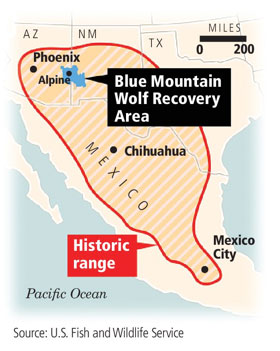
Wolf advocates fear the animals’ extinction unless the government increases the frequency of the releases, adopts a population goal and extends the wolf a welcome mat beyond the current recovery area in far eastern Arizona and western New Mexico — perhaps to the Grand Canyon’s North Rim. Those are long-sought wishes that have languished as ranchers and hunters pushed back and the government stuck with a plan that limits wolves to the Blue Mountains.
“The Mexican wolf’s fate really hangs in the balance between the promise that we’ve long heard of scientific management and the reality that we’ve long experienced of politicized management,” said Michael Robinson, New Mexico-based wolf advocate with the Center for Biological Diversity.
Conflict in cattle country
John Hand has raised cattle across the state line in Catron County, N.M., since 1953. He said the Fish and Wildlife Service made a mistake bringing wolves back. It’s ranch country, he said, and the unavoidable conflicts mean the restoration is “doomed to fail.”
Wildlife agents confirmed wolves killed 18 cattle and one mule last year. The previous year’s toll was 20 cattle, a horse and a sheep. An interagency compensation fund helps offset losses.
Although wolves enjoy federal protection as an endangered species, their status here as an experimental population gives ranchers a right to defend cattle. They can legally shoot wolves that are attacking their stock on private land, and can report them to government officials for potential agency-directed trapping or killing after repeated offenses on public lands.
“I don’t want them on (our ranch),” Hand said. “If they come here, it’s not something we’ll tolerate. We’d probably shoot them. Our neighbor shot one not too long ago.”
That means Ernesta and family are endangered in more than just the legal sense.
Since she was relocated near Alpine, Ernesta, also known as F1126, is thought to have whelped an unknown number of pups and nursed them in a wooden denning box inside a fenced enclosure with a 473-foot perimeter. There the animals are getting acclimated and nervously accepting road-kill offerings until early June, when biologists will swing open the gates and leave the wolves to the forest. The pair are the 93rd and 94th captive-reared Mexican wolves released by federal biologists.
If they avoid bullets, bumpers, snakes, lightning and every other hazard that has prematurely killed 92 lobos since their 1998 reintroduction, they will form what biologists are calling the Coronado Pack. They also must avoid killing livestock and keep their distance from homes, or they could face the management actions that have killed another 12.
It’s a big “if” for the Mexican gray wolf, a subspecies of gray wolves that has not rebounded from the brink the way its larger cousins did in the northern Rockies after they were reintroduced in the 1990s. Canadian transplants there have produced thousands of offspring in the Yellowstone and central Idaho wildernesses.
Arizona lacks the vast, roadless forests of the north. Yellowstone National Park alone is half the size of the Mexican wolf’s currently designated recovery zone.
Another difference, according to Mexican wolf recovery coordinator Sherry Barrett, is that the northern wolves were transplanted from the wild and not from captivity. Biologists and veterinarians try to minimize human contact in captivity, but the animals are comparatively naive when released.
The Southwestern lobos also are smaller than their cousins — about 60 to 80 pounds — and are not impervious to elk hooves and antlers.
Then there’s the shooting.
“All of these wolves are relatively accessible,” Barrett said. “Whether it’s malicious or mistaken identity, we do experience regular mortality.”
Illegal shootings — 46 so far and four prosecutions — are an echo of an eradication program earlier in the 20th century, when ranchers and government trackers shot and poisoned Mexican gray wolves almost to extinction.
By the early 1980s, the species was down to seven genetically distinct animals to start a captive breeding program.
From those, dozens of wildlife centers have bred and maintained up to 300 at a time in captivity (currently 258). Attitudes toward wolves softened as ecologists stressed predators’ role in maintaining natural ecosystems, and former Arizona governor and U.S. Interior Secretary Bruce Babbitt oversaw the wolf’s initial return during the Clinton administration.
A controversial return
The return was controversial, especially in the small towns most affected. Travis Udall, an Eagar school superintendent and a hunter, said wolves have struck the deer population and sometimes have struck fear in people.
“We’ve had a couple wolves follow us when we were hunting,” Udall said. “They say it’s curiosity, but it’s kind of unnerving.”
The recovery program generates hard feelings, he said. Locals feel imposed upon in a way they might not if wolves were left to recover or fade on their own.
“It feels forced,” he said.
Arizona has at times been a wary partner in the restoration. The Arizona Game and Fish Department in March said it wanted to hold the line at 100 wild Mexican wolves and remove endangered-species protections. A 1980s plan mentioned 100 as a first target, but wolf allies say that’s only because 100 seemed such a lofty goal from zero.
Managing for both hunters and animals can be tricky, and each release is made in consultation with the state.
“Wolves like to hunt elk and deer,” Game and Fish field team leader Chris Bagnoli said, “but so do people. So we want to make sure we have a good balance of all uses of the landscape.”
It would help, he said, if the program were permitted to spread beyond the Blue Mountains to dilute the local effects. But he said he believes the wolves are slowly breeding success. Their numbers grew by 15 in the last year. “I think we’re progressing,” he said.
Many conservationists hope that a new recovery plan will include two new wolf zones: one north of the Grand Canyon and one in southern Colorado and northern New Mexico. These would help disperse wolves to reduce in-breeding — which reduces litter sizes — and protect against extinction during disease outbreaks.
“All of the science done to date points to the fact that there’s good habitat for wolves and good prey in northern New Mexico, southern Colorado and the Grand Canyon eco-region,” said Eva Sargent, Southwest program director for the non-profit Defenders of Wildlife. “The (Fish and Wildlife) Service really needs to be paving the way for all of that to happen. But instead of paving the way, I can tell you that the recovery team hasn’t met since 2011.”
That year, Utah’s governor and wildlife chief learned that the Fish and Wildlife Service was considering adding southern Utah to the wolf-recovery zone. Utah’s forests could offer spillover habitat for wolves released around the Grand Canyon. They wrote a letter to Washington in protest.
No detailed recovery plan
The program is operating under a 1982 plan that didn’t spell out conditions to meet before removing Endangered Species Act protections. The Fish and Wildlife Service had said it would produce a detailed plan last year, but it hasn’t. Barrett declined to say when it would be completed, and said discussions about potential recovery zones are internal.
The wild population needs more new blood like Ernesta and her pups, Sargent said. But without a science-based plan, the creature faces “extinction by bureaucratic delay.”
Barrett and Arizona officials say there are reasons not to rush releases, especially in family groups. First, the wolves must be monitored together to ensure that they bond and that they are wary of humans. They are conditioned against cattle predation with a nauseating substance fed to them in ground beef. There also has to be a promising, unoccupied range available for a new pack, and by rule the government can only release captive-bred wolves on the Arizona side of the recovery zone.
“We’re learning as we go,” Barrett said.
“It has been very, very slow,” said Phil Hedrick, an Arizona State University conservation biologist and geneticist. He twice served on Mexican wolf recovery planning teams that the Fish and Wildlife Service shut down without writing guidelines or population goals. He fears federal and state biologists have missed their window of opportunity for maximizing genetic diversity.
“The reasons why the numbers haven’t gone up are based on the killing,” Hedrick said, “and lack of active management.”
His last participation was in 2005, when he and other scientists recommended 750 wolves in three distinct populations. After that meeting, silence. The Bush administration never codified that plan and never explained why.
In the meantime, the Coronado Pack is getting the best start possible.
In New Mexico, a veterinarian vaccinated the parents and poured alcohol on their foot pads to help them cool down after a wall of 22 volunteers and agency workers closed in and spooked them into a box where they could be pinned by steel bars and blindfolded for safe transport.
In Arizona, they emerged into daylight just down a gravel road from the ignition point of the massive 2011 Wallow Fire. The largest wildfire in state history torched trees but recharged grass and shrub growth that should feed lots of elk and deer. The elements of a good life are all there.
Now it’s on Ernesta to live or die.”
**Special thanks to By Brandon Loomis The Republic | azcentral.com, for providing this information!
Read Full Post »


 The Wolf Preservation Blog