Feeds:
Posts
Comments

Archive for August, 2013


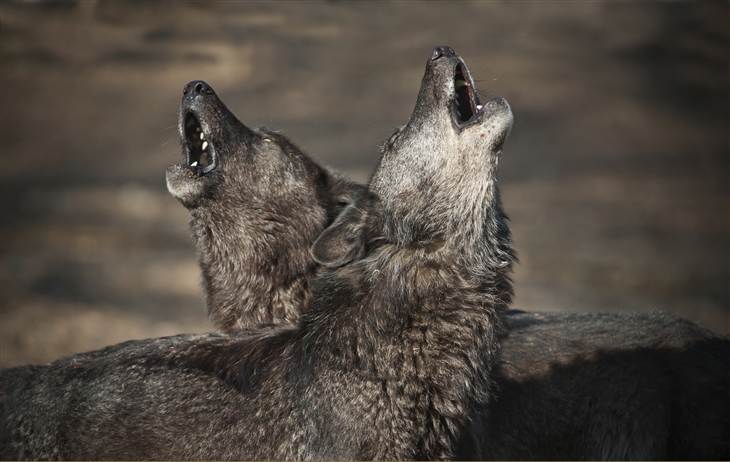
Two Wolves Howling

(Photo by Francesco Mazzini) Researchers found that wolves tend to howl more frequently when a leader or a partner leave the pack, as opposed to a less valued packmate.

“Wolves are skilled and ferocious hunters, but when it it comes to relationships, they’re real softies. When a playmate or partner leaves the pack, the wolves that are left behind will howl and howl and howl.

In a new study, researchers report that wolves will give their leaders and their closest allies a longer and stronger serenade if they leave. Those howls could be sonic breadcrumbs, meant to help a lone wolf find its way back to the pack. They could also be a long-distance message that simply says: “I miss you.”

“What exactly their motivation is, we will never know,” said Friederike Range, an animal behavior researcher at the University of Veterinary Medicine in Vienna and one of the authors of the study in Current Biology. But “there is an emotional response in there, for sure,” she told NBC News.

How much howling? Range and her colleagues have been studying the group dynamics of timber wolves for years. In the newly published study, they observed how nine wolves from two packs living at Austria’s Wolf Science Center changed their howling, depending on which member of the pack was absent from the group.

The researchers took each member of the pack away from the rest for a walk, and counted the howls from the remaining members for 20 minutes.

The howling would begin as soon as the departing wolf went out of sight. Wolves are social animals with a strict hierarchy. So if the wolf was a leader, more howls were recorded. And if the departing wolf was friendly with another member of the pack, its pack buddy sang a lengthy song.

The calls are similar to “children calling for their parents when the parents leave,” David Mech, an adjunct professor at the University of Minnesota who has been studying wolves since the late 1950s, explained in an email to NBC News. “To me it is communication.”

Socially savvy Dogs, the cuddlier relatives of the wolves, also howl. But wolves are more socially savvy, and their howling serves more strategic functions.

Mech, who was not involved with the new study, once observed howling behavior in 15 wild wolves that were separated during a hunt. He described the phenomenon in his 1966 book “The Wolves of Isle Royale.”

“After howling, the pack was then able to assemble again,” he explained. Mack said the newly published study provides “experimental evidence” supporting his view that the wolves’ howls helped them regroup.

Sometimes, wolves howl when they are stressed. Not these wolves. Range’s colleague, Francesco Mazzini, tested the saliva of the howlers for cortisol, a hormone that’s abundant in stressed-out animals. He found a slight increase in cortisol levels when a leader left, but no increase when the wanderer was a “preferred partner.”

Wandering wolves who are leaders will often call back to their pack, but Range’s wards didn’t. While they were out and about, they ignored their packmates and just enjoyed the walk, she said. ”

More about animal communication: 

Francesco Mazzini, Simon Townsend and Zsófia Virányi join Friederike Range as authors of “Wolf Howling Is Mediated by Relationship Quality Rather Than Underlying Emotional Stress,” published online Thursday by Current Biology. The study appears in the Sept. 9 issue of the journal.

**Special thanks to  Nidhi Subbaraman, NBC News, http://www.nbcnews.com/science/lonely-wolf-wolves-howl-when-they-miss-their-friends-6C10963185, for providing this information!
Read Full Post »


Minnesota Wolf
As we have seen in our country’s history, cattlemen and trophy hunters decimated entire wolf populations throughout the lower 48 states.
Nicole Hendrickson, Educator, 04/01/2013, reports the following:

“I was appalled after seeing one-fourth of Minnesota’s wolf population killed in 2012, shortly after federal de-listing from Endangered Species status.

I have three primary concerns in regard to the wolf issue:

  • Public input was not acknowledged.
  • The Department of Natural Resources (DNR) failed to live up to its promise — as outlined in its Wolf Management Plan — to follow a 5-year wait after federal de-listing.
  • We need to be more careful when considering the longevity of the wolf.

In our democracy, prevailing public attitudes usually shape public policy. With the wolf hunt, it is small interest groups of trophy hunters and cattle raisers that are getting their way. In every poll that I have seen, the majority of Minnesotans do not want a wolf hunt. As Sen. Chris Eaten has pointed out, we’ve pumped a lot of money into wolf survival, and as soon as protection is removed that money is down the drain.

The International Wolf Center sponsored a study in 1999 by Stephen Kellert, Ph.D., of Yale University, to measure public attitudes toward wolves in Minnesota; and the DNR published a poll in 2012 to assess public attitudes on wolves. Dr. Kellert’s study concluded:

“The wolf is especially appreciated by Minnesota residents for its nonconsumptive value. By contrast, a majority of both northern and non-northern Minnesota residents remain skeptical about harvesting the animal for either fur or for sport, and are concerned that these forms of consumptive use could result in excessive and unsustainable mortality.”

The DNR’s 2012 poll had similar findings:

“79% of respondents oppose wolf hunting.”

So why aren’t our voices being considered? The majority of Minnesota’s residents value wolves.

‘Primary clients, hunters and trappers’

Last month, I became aware that the DNR feels that its primary clients are hunters/trappers and livestock producers. This was confirmed through an Internal email that the organization Howling for Wolves commissioned through the Data Practices Act. In the email DNR officials state that, “we owe it to our primary clients, hunters and trappers, and to livestock producers as secondary clients, to do what we can to establish a legitimate harvest opportunity now that the wolf is under our management authority.”

Now I understood why the hunt came to fruition so quickly.

Are we really leaving the protection of wolves up to hunters/trappers and cattle producers (the DNR’s primary clients)? It doesn’t look like a sound or logical plan to me. As we have seen in our country’s history, cattlemen and trophy hunters decimated entire wolf populations throughout the lower 48 states. I am confident that history often repeats itself.

Decline of the moose

Elk, moose, bison, caribou and wolves used to occupy most of Minnesota. Based on my knowledge about the DNR’s management of moose in Minnesota and their sudden population decline for reasons outside of our control, there is good reason to believe the wolf population is at stake. This has been evident in the DNR’s management of moose. According to the DNR Moose Management Plan, “Minnesota’s moose (Alces alces) population, currently concentrated in the northeast corner of the state, is facing a decline where the cause is not understood.”

In 2012, there are 4,230 moose; in 2005 there were double that at approximately 8,150 (2012 Aerial Moose Survey.) The balance of life is fragile, and we can’t always rely on mathematical population models to determine success.

In every argument, I believe that one should acknowledge the other side’s position and a solution should be addressed. Without the protection from the law, I fear for the longevity of the wolf. History has shown me that hunters and cattle raisers are not responsible stewards of wolves. I am even more fearful because the agency that is supposed to work without bias has demonstrated its preference in aligning with hunters/trapper and cattlemen.

Poor process

If the DNR had come up with some sound baseline data and research, considered public comment, abided by their wolf management plan, and consulted with tribal nations on the sacredness of wolves, maybe I would have just bit my tongue in opposing the wolf hunt.

For the sake of meeting in the middle, a more sustainable number — like 5 percent, as suggested by one biologist I spoke to during my research — would have been more appropriate.

So the battle goes on. Minnesotans are needed to take action and contact Sen. David Tomassoni, chair of the Environment, Economic Development and Agriculture Committee, and Gov. Mark Dayton to be the voice to help preserve Minnesota’s wolves and the future of our state.

WANT TO ADD YOUR VOICE?

If you’re interested in joining the discussion, add your voice to the Comment section below, or consider writing a Community Voices commentary. For more information about Community Voices, email Susan Albright at salbright@minnpost.com.”

**Special thanks to Nicole Hendrickson, educator and resident of Brooklyn Park, and a volunteer for Howling for Wolves and Northwoods Wolf Alliance.  She is an enrolled member of the Sokaogon Ojibwe community (http://www.minnpost.com/community-voices/2013/04/are-we-really-leaving-future-minnesotas-wolves-hunterstrappers-and-livestock).

Read Full Post »


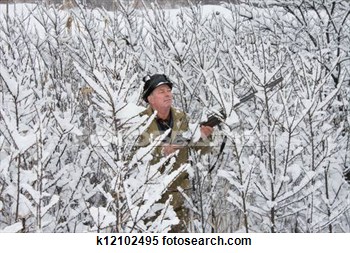
HUNTER

Wildlife Poachers Immune from Prosecution Contact: Wendy Keefover (303) 819-5229

“Tuscon, AZ. WildEarth Guardians and the New Mexico Wilderness Alliance late last week filed an amended complaint alleging that the U.S. Department of Justice (DOJ) has failed to prosecute individuals who have killed animals protected by the Endangered Species Act (ESA) because of its secretive “McKittrick Policy.” Under this policy, the DOJ will only prosecute cases for the illegal killing of ESA-protected species when it can prove the impossible: the mental state of the killer and that he knew the identity of the species at the time he pulled the trigger. This policy is plainly inconsistent with both the intent of Congress in enacting the ESA’s criminal provisions and with the U.S. Fish and Wildlife Service’s (FWS’s) interpretation of the ESA. In the amended filing, the groups ask the federal court to require that the DOJ “consult” with the FWS on this policy under the provisions of the ESA.
“The McKittrick Policy has become the ‘poacher-protection act,’ with devastating results, especially for exceedingly rare Mexican wolves,” said Wendy Keefover, Director of Carnivore Protection for WildEarth Guardians.
During the tenure of DOJ’s policy, 48 Mexican wolves were illegally shot in the wild.  Only two of these incidents resulted in a federal prosecution for illegal “take” (harm or killing) under ESA. The groups believe that the McKittrick Policy has emboldened individuals who are opposed to the conservation of endangered species to disregard the law, as they know that an illegal shooting will almost certainly not lead to federal prosecution. For the Mexican wolf, the effects of the Policy have been cataclysmic:  illegal shooting is by far the highest source of mortality for the free-roaming Mexican wolf population.
Plaintiffs obtained additional new information since the first filing that shows that both state and federal wildlife officials have been critical of the McKittrick Policy, including then director the U.S. Fish and Wildlife Service, Jamie Rappaport Clark, who wrote that the policy “will result in little to no protection for this Nation’s most critically endangered species,” and former U.S. Attorney for the District of Wyoming, David Freudenthal (who later served as Wyoming’s governor), who stated that the policy should be rescinded because a hunter should never pull a trigger unless the target has been positively identified.
“The McKittrick Policy is a literal get out of jail free card provided by the very agency charged with prosecuting wildlife crimes,” said Judy Calman, Staff Attorney with the New Mexico Wilderness Alliance, “and unfortunately, without enforcement, some endangered species will just be live targets to those who shoot illegally.”
The groups seek to get the policy rescinded as it would send a clear message that shooting Mexican wolves and other federally-protected animals will not be tolerated by the U.S. government.”

**Special thanks to “WildEarth Guardians,” http://www.wildearthguardians.org/site/News2?page=NewsArticle&id=8781&news_iv_ctrl=1194#.Uh06OkbD_IU, for providing this information!
Read Full Post »


Wolf Haven

Photo credit to Pete Caster / pcaster@chronline.com

Wolf Haven Midsummer Night

This picture above shows Ladyhawk, a 13-year-old gray wolf, howls in response to the Wolf Haven International’s Midsummers Night audience on Saturday evening at the Tenino sanctuary.

STAYING UP LATE TO HOWL WITH 50 WOLVES, By Sara Potter Nisqually Valley News correspondent:                                                                                    

“It is 5 a.m. and I am awoken in my tent by a sound that few others have, or will ever experience in their lifetime — a 20-minute serenade of 50 wolves, a dozen of which I had met the evening before.


That experience is what makes Wolf Haven’s new event, A Midsummer’s Night, truly special. Diane Gallegos, executive director of Wolf Haven International, says at this gathering no more than 25 individuals get to camp out with the wolves.


“It is a very intimate experience, and really shows our mission here which is to give the wolves the space and ability to live as free and non-domesticated lives as possible, while at the same time teaching and allowing visitors to meet them without stressing the wolves out,” Gallegos said.

This is the first year Wolf Haven has offered such an event, replacing their previously held howl-ins.

“The howl-ins were less intimate, with larger groups which changed the amount of time visitors got to spend asking questions and meeting the wolves,” shared Gallegos. “We want to offer the wolves the most authentic life in captivity we can, and by giving visitors the extended time to view the sanctuary more than once really allows for a truer experience than just a quick tour and then they leave.”

A Midsummer’s Night includes a catered dinner, an extended enrichment tour through the sanctuary with animal care staff, songs and s’mores by the campfire, overnight camping, a continental breakfast, and a morning visit through the sanctuary.

“To get to sleep near the wolves and hear them all night was really surreal,” said Cassie Carroll, who recently moved to the Northwest from the East Coast. “There is nothing like this where we are from and for us to share this experience with our daughters is amazing.”

Carroll’s daughters, Avie, 10, and Callie, 8, both adopted wolves after their first visit to Wolf Haven International a year ago.

“I adopted Noel,” Callie said. “I thought it was so neat that she was born in 2005 just like me, and it was so cool and funny that they sang Christmas carols to her and she responded; that is how she got her name.”

Noel, a Mexican Gray Wolf, had just a number when she arrived at Wolf Haven in 2010. Avie’s adopted wolf is a wolf-dog hybrid, Juno, who was rescued after her caregiver couldn’t succeed in domesticating her.

 “She was really special, and a very beautiful wolf,” Avie said. “Next year I hope to do a presentation about her and teach my class about the wolves. Maybe somebody else will adopt another wolf, too.”

Wendy Spencer, director of animal care for the past 15 years, shares the importance of spreading knowledge and education about wolves and wolf-dogs, especially since the latter are more likely to be bought and raised in an effort to make domesticated, which few succeed at.

“They are naturally wild animals, with personality traits that are engrained in them,” shared Spencer, as she introduced the small group on the sanctuary tour to Juno. “Wolves mature around 2 or 3 years old, and their personalities and activities can dramatically change. For owners of wolf-dogs, during this time they can become desperate and, unfortunately, can mistreat the animal due to the fact that people don’t know what else to do.”

Awareness and knowledge, says Gallegos, are the main goals of Wolf Haven International and eventually, she says, her wish would be for them to be there for the purpose of learning and education, and not a sanctuary at all.

“Our overall goal is to provide to the population of the red, gray and Mexican wolves so that they grow and thrive in population, as well as, for wolf-dogs to be free without having any reason to live in any sort of captivity,” Gallegos said. “But, for now, the care that Wendy gives each one of our animals is something special. I joke around that in my next life I want to come back as one of Wendy’s animals.”

The dedication of the employees and volunteers is something the Carroll family also shared in.

“The whole experience was immensely enriching and we were impressed by all of the ways the staff and volunteers are working to ensure that the wolves are more accepted and protected, especially in the cases of the Mexican and reds, and their reintroduction back into the wild.  My husband and I had spent five days in Yellowstone last summer and heard and saw the wolves howling, but not during the night,” shared Carroll.

“The girls have already insisted that we do it again next year, and they are eager to return even sooner to check up on their wolves.”

This summer’s event sold out quickly and Gallegos says to be sure and keep a look out for the posted dates for next summer’s event.

“We want to analyze this year’s results and make sure the repeated weekends did not stress out the wolves. We may decide to spread out the weekends next year, but either way we will surely post the dates by early this fall,” she assured.”

**Special thanks to Sara Potter,  a freelance journalist living in Southwest Washington, for providing this information!  http://www.yelmonline.com/news/local_news/article_bbceae14-0b59-11e3-ac34-001a4bcf887a.html

Read Full Post »


Close up of Mexican Gray Wolf

**To take action for Mexican Wolves, please use this linkhttp://www.mexicanwolves.org/index.php/news/1046/51/Take-Action-Comments-Needed-to-Ensure-Mexican-Wolves-Future and send your comments!!  WOLF PRESERVATION supports Lobos of the Southwest and their efforts!

Proposed USFWS Rule changes regarding reintroduction into the wild of the Mexican Gray Wolf:

“Recently the U.S. Fish and Wildlife Service (USFWS) proposed changes to the rules guiding the Mexican gray wolf reintroduction. The proposed rule is very important to the future of Mexican wolves in the wild. Please comment, using the following points:

One very good and many very bad changes are proposed:

The good change is to allow direct releases of Mexican wolves into parts of New Mexico and additional areas in Arizona.  This change has been recommended by experts for over 10 years and can be made faster and with less bureaucratic delay than any other part of the proposed rule

  • TELL USFWS TO PUT THE REST OF THEIR PROPOSED RULE ON HOLD AND SPEED UP APPROVAL FOR MORE DIRECT RELEASES INTO ADDITIONAL AREAS.
The bad changes include:

By labeling all of the wild wolves as “nonessential” the USFWS ignores science and the reality of 15 years of experience with reintroducing wolves
The USFWS claims that even if all of the 75 wolves in the wild are wiped out this is not “likely to appreciably reduce the likelihood” of recovery of Mexican wolves in the wild.
When the current rule declared wolves in the wild “nonessential” there were only 11 wolves, recently released from a captive breeding program and they made up only 7% of all Mexican wolves in the world.
Now the 75 wolves in the wild have up to four generations of experience in establishing packs and raising pups and are over 22% of all of the Mexican wolves in the world.
After four more generations of captive breeding with few releases (only one in the last five years), scientists warn that there may be serious genetic problems making captive wolves less able to thrive in the wild.

  • TELL USFWS THAT THE FOURTH GENERATION WILD LOBOS ARE NOT EXPENDABLE AND ARE AN ESSENTIAL PART OF RECOVERING THIS UNIQUE SUBSPECIES OF WOLF

The proposed rule puts the cart before the horse and should come with or after – not before – an updated recovery plan
USFWS admits that their present, typewritten, 1982 recovery plan is not scientifically sound and does not meet current legal requirements – yet in its proposed rule USFWS continues to emphasize a woefully inadequate population of only 100 wolves in the wild
When USFWS published the current rule in 1998 they said they expected to put out a new recovery plan for the public to comment on later that year; 15 years later, there still is no scientific or legally adequate recovery plan!

  • TELL USFWS TO QUIT STALLING AND COMPLETE A COMPREHENSIVE RECOVERY PLAN – AND LET THE PUBLIC SEE IT – BEFORE DOING ANY TINKERING WITH THE CURRENT RULE (except for allowing wolves to be reintroduced into additional suitable places)
USFWS’s decision on the proposed rule can help Mexican wolves finally thrive or can push them closer to extinction. Please submit your comments here and ask others who care about Mexican wolves to do the same.
Thank you!”
**Special thanks to “Lobos of the Southwest,” http://www.mexicanwolves.org/index.php/news/1046/51/Take-Action-Comments-Needed-to-Ensure-Mexican-Wolves-Future, for providing this information!

Read Full Post »


mexican gray wolf

Comments needed on proposed Rule changes regarding reintroduction into the wild of the Mexican Gray Wolf.

“Recently the U.S. Fish and Wildlife Service (USFWS) proposed changes to the rules governing the Mexican wolf reintroduction. The proposal, with one very good and many very bad changes, is very important to the future of Mexican wolves.

Please comment on the proposed changes and include the following key points:

1. The good change is to allow direct releases of Mexican wolves throughout the Blue Range Wolf Recovery Area.  The USFWS should put the rest of their proposed rule on hold and speed up approval for more direct releases in expanded areas.

This change has been recommended by experts for over 10 years and can be made faster and with less bureaucratic delay than any other part of the proposed rule.

2. The proposed rule effectively prevents wolves returning to the Grand Canyon region, including northern Arizona and southern Utah, or to northern New Mexico and southern Colorado. The USFWS should eliminate boundaries to the wolves’ movement.

Scientists say some of the last best places for wolves are in these areas, but currently wolves who set up territories outside the Blue Range Wolf Recovery Area are recaptured and moved back. Under the proposed change, the USFWS will recapture Mexican wolves just for going outside of the Mexican Wolf Experimental Population Area whether they establish territories or not. Additional populations of Mexican wolves are necessary to their recovery and genetic health, as is the ability for wolves to move between populations.

Capturing and moving wolves is always a risky business that can result in death or trauma to the wolf. And a bigger box is still a box.

3. The USFWS should not re-designate Mexican gray wolves as experimental, non-essential. By labeling all of the wild wolves as “nonessential” the USFWS ignores science and the reality of 15 years of experience with reintroducing wolves.

The USFWS claims that even if all of the 75 wolves in the wild are wiped out this is not “likely to appreciably reduce the likelihood” of recovery of Mexican wolves in the wild. When the current rule declared wolves in the wild “nonessential” there were only 11 wolves, recently released from a captive breeding program, and they made up only 7% of all Mexican wolves in the world.

Now the 75 wolves in the wild have up to four generations of experience in establishing packs and raising pups and are over 22% of all of the Mexican wolves in the world. And after four generations of captive breeding with few releases, scientists warn that there may be serious genetic problems making captive wolves less able to thrive in the wild.

The fourth generation wild lobos are not expendable and are essential to recovering this unique subspecies of wolf.

4. The USFWS needs to quit stalling and complete a comprehensive recovery plan – and let the public see it – at the same time as or before changing the current rule (except for allowing wolves to be reintroduced into additional suitable places).

USFWS admits that their present, typewritten, 1982 recovery plan is not scientifically sound and does not meet current legal requirements – yet in its proposed rule USFWS continues to emphasize a woefully inadequate population of only 100 wolves in the wild.

When USFWS published the current rule in 1998 they said they expected to put out a new recovery plan for the public to comment on later that year; 15 years later, there still is no scientific or legally adequate recovery plan!

The proposed rule puts the cart before the horse and should come with or after – not before – an updated recovery plan

USFWS’s decisions on the proposed rule can help Mexican wolves finally thrive or can push them closer to extinction.   Please comment today, and ask others to do the same.

You can submit your comments online here: http://www.regulations.gov/#!submitComment;D=FWS-R2-ES-2013-0056-0001
Or by mail addressed to: Public Comments Processing, Attn: FWS-R2-ES-2013-0056; Division of Policy and Directives Management; U.S. Fish and Wildlife Service; 4401 N. Fairfax Drive, MS 2042-PDM; Arlington, VA 22203

Letters received by July 29 requesting public hearing locations can be mailed to: Mexican Wolf Recovery Program, U.S. Fish and Wildlife Service, New Mexico Ecological Services Field Office, 2105 Osuna Road NE., Albuquerque, NM 87113. If you request a hearing location, please also ask for at least three weeks advance notice of the hearing.

Thank you for giving these special wolves a voice in their future.”

**Special thanks to “Lobos of the Southwest,” http://www.mexicanwolves.org/index.php/news/1059/51/Act-Now-to-Ensure-Wolf-Recovery for providing this information!

Read Full Post »


National Rally for Wolves

“Dear Rally attendees and supporters,

As a grassroots led and organized endeavor, we at The National Rally to Protect America’s Wolves! need your help.

The National Rally to Protect America’s Wolves! has reserved an area, just for OUR event, adjacent to the Washington Monument in Washington DC on Saturday, September 7, 2013. This historic and beautiful area is within sight of the South Lawn of the White House and the US Capitol building.

So far, we have 15 wonderful Rally Partners, they are all listed on the bottom of the Rally website, and seven excellent Rally speakers, including two Native Americans who are fighting hard to protect wolves in Minnesota. We will release the names of our first wave of speakers later this week. Additional inspiring and exciting speakers are on the way.

BUT, now we need YOU to come through for the Rally. We need funds to pay for OUR Rally for America’s wolves.

Together, we must pay for staging, podium, audio speakers, press area, trash service, portapotties, etc  along with a professional videographer who will be filming the Rally and creating a highlights DVD to post on YouTube and elsewhere and for distribution to the media. The total cost comes to approximately $10,000.

This is very doable within our devoted wolf defender community. If 500 wolf friends donate just $10 each, that equals $5,000. If twenty more wolf defenders, donate $250 each, that takes care of the remaining balance.

We are asking that you give: $500, $250, $100, $50, $25, $10, $5… whatever you can afford.

Please put your money where your heart is for wolves and help us pay for The National Rally to Protect America’s Wolves! As soon as we have the funds we need the donations page will be turned off.

Read Full Post »


Mexican Wolf on log

“As the Arizona Daily Sun’s recent editorial, “Wolf expansion plan needs more details” points out, Flagstaff residents can provide a significant voice in restoring this ecologically critical, charismatic creature to its rightful place in northern Arizona.

The potential for wolves to return, as the Daily Sun reported back in 2007, has been considered for well over a decade.

The Mexican wolf is one of America’s most endangered mammals. With only an estimated 75 of these wolves in the wild, several management actions are urgently required for its survival. In mid-June, the U.S. Fish and Wildlife Service (USFWS) proposed to remove the gray wolf from the list of threatened and endangered species, except the Mexican wolf, which will remain an endangered subspecies subject to certain provisions that have proven problematic in the past.

Because the entire existing Mexican wolf population is derived from only seven survivors rescued from extinction, the agency’s proposal to allow direct releases of Mexican wolves throughout the existing Blue Range Wolf Recovery Area is absolutely critical. This action can and should be done immediately.

Twelve years ago a panel of four imminent carnivore scientists urged a revision of the Mexican Wolf Recovery Plan, laying the scientific foundation and imperative to enlarge the recovery area. The USFWS needs to quit stalling and complete a comprehensive recovery plan addressing the current plan’s shortcomings — and let the public see it — and at the same time allow wolves to be reintroduced into additional suitable locations as described above.

The Daily Sun’s editors brought up a good question: Why stop northern wolf migration at Interstate 40 as the USFWS proposes? There is nothing sacred and nothing scientific about the I-10 southern recovery area boundary, nor I-40 to the north. In fact, the USFWS suggests extending the recovery area south of I-10 to the Mexican border. However, the agency completely ignores the recommendations of its own Mexican wolf science team, who emphasize the wolf’s long-term survival requires connected habitats north of I-40, including the Grand Canyon region and portions of southern Utah and Colorado.

Wolves are legendary wanderers. While highways present serious hazards to all wildlife, wolves are capable of finding a way across. For example, one female traveled a circuitous route of more than 3,000 miles from Yellowstone to Colorado. She successfully crossed I-80 three times before she was poisoned in 2009. Closer to home, a female Mexican wolf traveled more than 200 miles and successfully crossed I-40. Sadly, a vehicle later struck and killed her in the fall of 2000, 12 miles north of Flagstaff on U.S. 89.

Wolves are social, family-oriented creatures that play a critical role in healthy, resilient ecosystems by affecting the behavior and numbers of prey species. The overabundance of grazing and browsing wildlife often results in degradation of forests, streams and grasslands.

For example, the wholesale slaughter of carnivores, including wolves, in the early 20th century on the North Kaibab forest and Grand Canyon National Park, precipitated an explosion of mule deer populations that dramatically reduced forbs, grass, aspen saplings, and other native vegetation. Elk, a recent migrant to Grand Canyon National Park and the Kaibab and Coconino national forests, continue to damage riparian vegetation as well as aspen and other native plants.

The recovery of viable wolf populations can dramatically improve the health and resilience of forest, stream, and grasslands. For example, the return of the wolf to Yellowstone discouraged elk from lounging and trashing streamside willow and cottonwood vegetation.  Now, increased vegetation stabilizes stream banks while shading and cooling many sections of creeks and rivers. Increased willow and other native vegetation allowed beaver to return and create numerous ponds providing sanctuary for fish and other wildlife.

Wolves kill and harass coyotes, benefiting hawks and foxes that depend on rodents hunted by coyotes. By killing and scaring off coyotes that otherwise prey on pronghorn antelope, pronghorn fawns are much more likely to survive in areas dominated by wolves. That’s because wolves favor larger prey and generally leave pronghorn alone.
As the most recent polls confirm, most Arizona residents recognize the critical role wolves play in nature, and believe they belong in northern Arizona.  While the deadline for requesting locations for public meetings has passed, you can submit your wolf recovery comments online at: http://www.regulations.gov/#!submitComment;D=FWS-R2-ES-2013-0056-0001

**Special thanks to “Lobos of the Southwest” and Kim Crumbo, a conservation director at Grand Canyon Wildlands Council in Flagstaff, for providing this information!  www.grandcanyonwildlands.org or (928) 606-5850.

Read Full Post »


mexican wolf

“SILVER CITY – A yearling Mexican gray wolf died over the weekend in the Apache-Sitgreaves National Forest in Arizona during what Fish and Wildlife called “routine handling,” according to a news release from them. Members of the Mexican wolf interagency field team from the Arizona Game and Fish Department were conducting an intentional capture effort using the approved protocol to fit radio-telemetry collars on members of the Bluestem Pack that remained uncollared, when f1289, a previously collared animal, was captured in a padded foot trap.

The trap sent a signal when it sprung and experienced team members were on site within 15 minutes. The animal moved the trap into rocky terrain on the edge of a slope, making it difficult for the team to process the wolf. Using a catch pole and Y-pole (like those used for capturing and restraining domestic dogs), the team removed f1289 from the trap and during processing found that she was no longer breathing. Emergency treatment including CPR was unsuccessful in reviving the wolf.

The team on site had years of wolf capture experience and had just completed a refresher capture training course the week prior, the release states. The death was the third capture-related mortality in the wild in the 15-year history of the Mexican wolf reintroduction project, according to Fish and Wildlife.

“The loss of this wolf is a very unfortunate and unusual outcome to a routine management activity that is necessary to the recovery of the Mexican wolf,” said Chairman John Harris of the Arizona Game and Fish Commission. “Radio collars are the best method for tracking wolves and knowing where the wolves are is critical for effective management.”

The Service will be conducting a necropsy at a veterinary diagnostic lab in Albuquerque, to determine the cause of death.

The Mexican gray wolf was added to the federal endangered species list in 1976 after it was nearly wiped out by government trapping and poisoning designed to help cattle ranchers.”

**Special thanks to The Associated Press for their contribution of this article and reposted through “Lobos of the Southwest,” http://www.mexicanwolves.org/index.php/news/1082/51/Young-Mexican-gray-wolf-dies-during-handling-in-Arizona

Read Full Post »


National Rally for Wolves

“A UW researcher is growing increasingly concerned about the plight of the gray wolf on Wisconsin’s landscape.

For 15 years, environmental studies associate professor Adrian Treves has studied the ecology of the carnivore’s interactions with people and has surveyed Wisconsin residents on wolf policy and management.

Treves predicts Wisconsin’s wolf hunts, at their current levels, are not sustainable. More than 250 gray wolves are expected to be slain in the state’s upcoming second annual wolf hunt season, which starts on October 15.

Treves says that number represents “a little more than 30% of the late winter wolf count,” which means Wisconsin has the highest or second highest wolf quota on the record in North America. Treves calls it an undeniably “aggressive wolf hunt.”

Treves says there is a high likelihood that by April 2015, the wolf hunt will have to be closed due to such a steep decline in the wolf population. That decline may result in the gray wolf being re-listed in Wisconsin as a threatened and endangered species by 2016.

He also warns that there’s real risk that the wolf population could be driven so low that it cannot recover, and the federal government would “have to step in, again, under emergency re-listing rules of The Endangered Species Act.”

It’s an interesting finding,  given the U.S. Fish and Wildlife Service announced plans earlier this summer to lift the creature from the threatened and endangered species list throughout the country. That’s already happened in Wisconsin, even as pro-wolf groups are trying to overturn the decision to delist the gray wolf in the Great Lakes region.

Treves – along with colleagues at Michigan Tech and Ohio State University – co-authored a scientific criticism of U.S. Fish and Wildlife Service plan.   The agency has stated that tolerance for wolves is higher within current wolf range.  Treves says that statement flies in the face of data gleaned from more than 100 scientific studies.  The researcher says, in general, the U.S. public supports gray wolf recovery in appropriate environments.  Further, Treves says, public tolerance of wolves is lower within currently existing wolf range.

Back at the state level, Treves this week is releasing public opinion results on the state’s first wolf hunt, held last year.

Treves says not only are the state’s wolf hunt practices not sustainable, they also contradict public opinion. His team’s  report found a five to seven percent increase in people opposing particular ways of hunting wolves. According to Treves, a majority of the Wisconsin public, outside the wolf range, do not support the current wolf hunt.

But Treves says public opinion is not carrying the weight it should. Instead, he says the proposal to eliminate federal protection for wolves seems “politically motivated” and “excessive,” while contradicting scientific evidence.

Treves and Masters candidate Jamie Hogberg will be sharing the results of their public opinion survey on Wisconsin wolf policy with a DNR advisory committee Thursday in Wausau.

The public can weigh in on the U.S. Fish and Wildlife Service proposal to remove the gray wolf from the national threatened and endangered species list – deadline Sept 11, 2013.”

**Special thanks to  and Gaby Magallanes, http://www.wuwm.com/post/researcher-state-wolf-hunt-unsustainable, for providing this information!

Read Full Post »

Older Posts »