Feeds:
Posts
Comments

Archive for August, 2013


Kentucky Wolf

This photo posted on KentuckyHunting.net shows the first wolf to wander Kentucky in over 150 years, dead and exhibited as a trophy.

“According to a recent announcement by state wildlife officials, a 73-pound, federally endangered female gray wolf was shot dead by a hunter in Munfordville, Kentucky earlier this year. Were it Alaska or Idaho this wouldn’t be news, but Kentucky has not seen wild roaming wolves since the mid 1800s. The gray wolf was shot in March —but state officials were skeptical that it was even a wolf, believing that it was more likely someone’s German shepherd.  But following months of DNA analysis, scientists confirmed it was indeed Kentucky’s first wolf in over a century and also its last.

DNA from the wolf was analyzed by the U.S. Department of Agriculture’s National Wildlife Research Center in Colorado. According to the analysis, the Kentucky gray wolf had genetic traits akin to wolves in the Great Lakes Region. The U.S. Fish and Wildlife Service Forensics Laboratory in Oregon carried out independent analysis and confirmed the USDA’s findings.

How the wolf came to be in Kentucky is a mystery.

Wildlife officials identified the man who killed the wolf as Hart County resident James Troyer, who shot the animal believing it to be a coyote.

Its unlikely that charges will be brought against Troyer as, until now, there would have been no reason to believe that a wolf existed in Kentucky. However, state and federal law prohibits the possession of gray wolves, live or in parts, so officials took the pelt from Troyer.

Gray wolves are on the federal endangered species list, but following a controversial proclamation that wolves are “recovered” by the US Fish and Wildlife Service, the agency has proposed to remove wolves from the list.”

**Special thanks to Russ McSpadden / Earth First! News, http://earthfirstnews.wordpress.com/2013/08/19/wild-wolf-in-kentucky-first-in-150-years-killed-by-hunter/, for providing this information!

Read Full Post »


Royale Isle Wolves

“The wolves of Michigan’s Isle Royale National Park have not been doing well, but there’s some unexpected good news.

Earlier this year, researchers from Michigan Technological University who study the wolves reported there were just eight wolves left – and they reported they were unable to find any evidence of pups born to those wolves.

But now, that has changed. Michigan Tech researcher Rolf Peterson heard two or three wolf pups in July.

Peterson doesn’t have phone access on the island. But by email, he told me he thinks the pups were born this spring, and they were probably born to a pack called the West End Trio. Here’s an excerpt from his email:

“The pups born this year mean that the wolves have not completely lost all genetic viability, but it doesn’t mean they’re about to recover, and it doesn’t mean that they have somehow escaped from genetic problems.  Twenty years ago the population was in approximately the same situation, with a dozen wolves present (the difference now is that the population is lower, because of the mortality from the mine shaft incident) – only two of the three packs present were reproducing, and litter size was small.  Now we have one of two packs that reproduced (this year, no packs reproduced last year), and litter size was small.  In the early 1990’s the situation was resolved by the arrival of an immigrant male with some more competitive genes, and the wolf population was strong for another 15 years.”

The National Park Service is in the process of figuring out what to do about the island’s wolves.

Park Superintendent Phyllis Green says the pups’ birth might buy the NPS a little more time to make that decision.

“We are excited that there are pups this summer and in that sense the wolves of Isle Royale continue to surprise us with their resiliency. And I think that’s one of the questions that we have, is whether we disrupt the current pack orders or whether we let them live their lives there until such time as it passes. So at this point in time we’re still in the deliberative stage. We’re happy to hear there’s an addition to the wolf population but they’re still tenuous and it’s still a significant decision,” she says.

The three main options on the table are:

  • Let the current population go extinct, and do nothing.
  • Let the current population go extinct and then reintroduce wolves to the island.
  • Attempt to genetically rescue the current population by bringing in some new wolves.

Green says the NPS might add one or two more options. They’re preparing material for the “scoping process,” which is when the public gets a chance to weigh in.

Isle Royale is mostly wilderness. I asked Green how difficult it is for the Park Service to consider stepping in to help the wolves in this situation:

“Wilderness is a factor but it doesn’t preclude action, is what I would tell you. It’s a combination of a number of policies. I think most of the American public does want their parks to be relatively hands-off with nature taking the lead in how change occurs at a park. For the most part, that’s what happens at Isle Royale. The question that is raised of course is the fact that with climate change and the potential loss of this ice bridge being frequent enough for genetic replenishment – should you make a change in policy at this point in time? And that’s why we’re taking the time to discuss it pretty thoroughly,” she says.”

You can let the Park Service know what you think should be done about the island’s wolves by emailing:  isro_wildlife@nps.gov

**Special thanks to , http://michiganradio.org/post/wolf-pups-good-sign-struggling-population-isle-royale, for providing this information!

Read Full Post »


Wolf Hunt Sabotage

“And in that case, we choose to be saboteurs for the wild.”

The following text is from a press release of the Earth First! Media office, which provides correspondence to news outlets around the world.

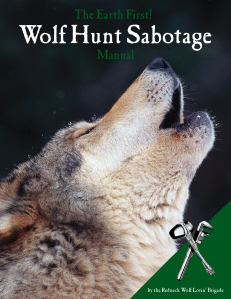
“Earth First! Media has released a manual which provides detailed information for disrupting wolf hunting in those states that allow it. Titled The Earth First! Wolf Hunting Sabotage Manual, the text, complete with step-by-step graphics, explains how to find and destroy wolf traps, handle live trapped wolves in order to release them, and various methods, including the use of air-compressed horns and smoke-bombs, for stopping wolf hunts.

The authors of the manual describe themselves as,  “hunters and proud of it,” adding, “But we aren’t proud of what passes for hunting these days and especially for what passes as ‘sportsman’ hunting. Somehow, the National Rifle Association, yuppie trophy hunters, cattle barons, and the Obama Administration are in cahoots in an effort that promises to wipe wolves clean off the planet. And in that case, we choose to be saboteurs for the wild.”

The manual, which was sent to Earth First! Media by unknown persons calling themselves “the Redneck Wolf Lovin’ Brigade,” is being published electronically at Earth First! News and is being offered for others to print and distribute.

Panagioti Tsolkas, a correspondent with Earth First! Media, says the manual is being published in light of regional delistings of wolves in the Great Lakes region and the Northern Rockies since 2011 where subsequent wolf hunts have accounted for over 1,500 wolves hunted or trapped. “According to several wildlife agencies’ reports, there are fewer than 6,000 wolves left in the lower 48 states where wolves once numbered in the hundreds of thousands,” Tsolkas added.

In June of this year, the Obama administration announced that it plans to push for nearly all wolves, excepting those in the U.S. Southwest, to be stripped of Endangered Species Act protections despite compelling evidence from numerous scientists that wolves have not recovered as a species. “We are coming into a new era of wolf genocide,” said Tsolkas, adding, “It will be important for individuals and groups with a passion to protect wolves to take this manual into consideration. It will surely save lives, but it is also a very dangerous undertaking. Wolf hunters have guns and obviously little morals when it comes to what they shoot.”

Over its 33-year history, Earth First! activists have used hunt sabotage to disrupt hunts across the country. “This wolf hunting manual could very well spark a new version of Whale Wars. It’ll be called Wolf Wars.””

Earth First!,  an international radical environmental movement, for providing this information! The movement also publishes a quarterly magazine and online newswire (http://earthfirstnews.wordpress.com/2013/08/12/manual-for-sabotaging-wolf-hunts-released/)

Read Full Post »


National Rally for Wolves

“Dear Rally attendees and supporters,

As a grassroots led and organized endeavor, we at The National Rally to Protect America’s Wolves! need your help.

The National Rally to Protect America’s Wolves! has reserved an area, just for OUR event, adjacent to the Washington Monument in Washington DC on Saturday, September 7, 2013. This historic and beautiful area is within sight of the South Lawn of the White House and the US Capitol building.

So far, we have 15 wonderful Rally Partners, they are all listed on the bottom of the Rally website, and seven excellent Rally speakers, including two Native Americans who are fighting hard to protect wolves in Minnesota. We will release the names of our first wave of speakers later this week. Additional inspiring and exciting speakers are on the way.

BUT, now we need YOU to come through for the Rally. We need funds to pay for OUR Rally for America’s wolves.

Together, we must pay for staging, podium, audio speakers, press area, trash service, portapotties, etc  along with a professional videographer who will be filming the Rally and creating a highlights DVD to post on YouTube and elsewhere and for distribution to the media. The total cost comes to approximately $10,000.

This is very doable within our devoted wolf defender community. If 500 wolf friends donate just $10 each, that equals $5,000. If twenty more wolf defenders, donate $250 each, that takes care of the remaining balance.

We are asking that you give: $500, $250, $100, $50, $25, $10, $5… whatever you can afford.

Please put your money where your heart is for wolves and help us pay for The National Rally to Protect America’s Wolves! As soon as we have the funds we need the donations page will be turned off.”

**Special thanks to The National Rally to Protect Wolves, http://rallyforwolves.org/donate/, for providing this information!

Read Full Post »


Idaho Wolf

As a society, how far are we willing to go and what are we willing to sacrifice to preserve the wild?

“When the U.S. Fish and Wildlife Service reintroduced 66 gray wolves into Yellowstone National Park and adjacent wilderness areas in Idaho back in 1995-’96, conservationists and ranchers squared off across a fence and hurled insults at each other for months.

By then, both sides had had plenty of practice in the art of verbal warfare from previous battles over buffalo harvests and the ever-popular “elk shoots,” wherein surplus animals were herded by helicopters into a funnel of “hunters,” who thinned the herd back to manageable numbers in a hail of lead.  To call that a hunt would be akin to calling Wounded Knee a fair fight.  I never met anyone who participated in one of those culling events who wasn’t sickened by the slaughter.

When wolves began again to hunt prey in Yellowstone, many ranchers argued that Canis lupus would soon be lining up at their livestock operations like teenagers at a takeout window.  Here, for the taking, was an endless supply of Happy Meals.

As mitigation for those meals, the conservation group Defenders of Wildlife has spent $1.5 million (and counting) since 1987 compensating ranchers for their losses — though this has failed to mollify ranchers.

The argument for restoring wolves, however, was unassailable. When the last wolf was finally killed in Yellowstone back in 1926, the elk population soared and the ecosystem fell out of balance. The park’s riparian areas and aspen stands were devastated by the 8,000-plus elk herds, and an inventory of the park’s wildlife in the early 1970s failed to turn up more than a handful of deer. These, and dozens of other critters, could not compete with the elk.

By the mid-1990s, alarmed biologists told Congress that something had to be done. According to William J. Ripple, a leading researcher on the effect of wolves on the Yellowstone ecosystem who is based at the University of Oregon, bringing back wolves, the alpha predators, was the right move.

Since 1996, Yellowstone’s elk population has been cut by two-thirds. The number of beaver and birds has increased, along with deer and red foxes, and the aspen and riparian areas once devastated by overgrazing are making a slow but steady recovery.

But Ripple cautions: “We think this is just the start of the restoration process.  We have to sit back and wait for the ecosystem to continue responding.  We call this ‘passive restoration,’ because the ecosystem, with the wolf as a key component at the apex of the predator pyramid, is only now emerging.  The aspens, the berry-bearing bushes, the riparian areas, they all seem to be responding, but we went 70 years without the wolves in Yellowstone. … It’s much too early to draw conclusions.”

For those and many other reasons, the federal government’s decision this summer to remove the gray wolf from the endangered species list was not roundly applauded. Though Dan Ashe, director of the Fish and Wildlife Service, declared the decision to be “the next step forward in wolf conservation,” many questioned its wisdom.  Anticipating the inevitable storm of controversy, the agency invited the public to weigh in on whether wolves should be removed from the endangered species list. The deadline for comments is Sept. 11.

When Congress removed the Endangered Species Act protections from the gray wolf in 2011, it turned wolf recovery projects over to the states.  In minutes, Idaho legalized the hunting of wolves.  In two years, 1,175 wolves have been killed by hunters, including 10 “research wolves” that wandered out of protected zones in Yellowstone National Park.

Battles over restoring and protecting salmon and other endangered species have shown — time and again — that politicians can be quick to sacrifice science to political self-interest.  At the very least, many conservationists argue that wolves need a large “no-hunting” buffer around Yellowstone Park.

“If the packs are persecuted,” Ripple asks, “what will happen to the social structure of those remaining?  Do they still provide an ecologically beneficial function? We don’t know. This research is in its infancy. We need to err on the side of caution until we learn more about the role of the wolf in these ecosystems.”

The basic question remains: As a society, how far are we willing to go and what are we willing to sacrifice to preserve the wild?”

**Special thanks to Paul VanDevelder, a contributor to Writers on the Range, a service of High Country News for providing this information!

Read Full Post »


Center for Biological Diversity

Agency  Backtracks on Attempt to Exclude Wolf Experts From Review of Delisting Proposal

“WASHINGTON— The U.S.  Fish and Wildlife Service today announced that it will put on hold the  scientific peer review of its proposal to remove protections for gray wolves  across the country while it reviews its own actions leading to the  disqualification of three scientists from the review panel.

Last week it was revealed  that three scientists were excluded from the peer review because they signed a letter calling into question some of the science behind the proposal to delist the  gray wolf. While the Service initially claimed that it had not asked for the  three scientists to be removed, emails between the contractor supervising the  peer review process and the scientists themselves confirmed that the Service  had in fact done exactly that.

“We’re glad to see the Fish and Wildlife Service  admit this mistake and hope this means there will be a true independent review  of this deeply flawed proposal to remove protections for gray wolves,” said  Brett Hartl, endangered species policy director with the Center for Biological  Diversity. “Unfortunately, this is but one example of how the Fish and Wildlife  Service has been twisting the scientific process to get the desired political  result of no more protections for wolves.”

Peer review, a step required  by the Endangered Species Act, is critical in ensuring that federal protections  are not lifted before a species is fully recovered. In the case of the wolves,  the Fish and Wildlife Service is contracting with a private company to conduct  the peer review. Recognizing their scientific expertise, the private contractor  hired for the review contacted several of the signers to the letter to  participate in the review, including Dr. John Vucetich, Dr. Robert Wayne and  Dr. Roland Kays.  As part of its  contract, the outside contractor was required to submit the résumés  of each peer reviewer to the Service with the names redacted. However, because  each of these scientists has published hundreds of articles, it was easy for  the Service to deduce who the contractor had selected. The Service then sent  the contractor a copy of the letter asking that any signers be removed.

“The Service should take a moment to reflect on why  it felt it was necessary to go to such lengths to control the peer review  process of this proposal,” said Hartl. “Perhaps it’s because the decision to  delist the gray wolf is based on politics, not solely on the best available  science.”

This is the first time the Fish and Wildlife Service  has imposed restrictions at the outset for whether scientists could be involved in peer review based on  what it termed an “affiliation with an advocacy position.” In contrast, during  the review of the 2012 proposal to designate critical habitat for the northern  spotted owl, the agency invited 40 scientists to participate, a number of whom  had spoken out for stronger protections for the owl, to review the proposal and  none were preemptively disqualified from the review. In what was a clear  attempt to limit meaningful scientific comment, the peer review process was put  in jeopardy.

The Service also appears to have circumvented proper  scientific channels in concluding that there are two different wolf species in  the United States, the gray wolf (Canis  lupus) and the eastern wolf (Canis  lycaon), a determination that formed a primary basis for removing  protections. Rather than attempting to publish their taxonomic findings in an independent,  outside journal subject to normal peer review processes, the Service revived North American Fauna, an internal agency  publication that had been dormant for more than 20 years, just to publish this  one taxonomic proposal on wolves.

The letter from the scientists and another from the American Society of Mammalogists raised a number of scientific  questions about the agency’s proposal to remove protections for wolves, which  today survive in just 5 percent of their historic range in the lower 48. In  particular, they questioned how wolves could be considered recovered when the  species is absent from significant portions its range, and a determination by  the Service that there are two species of wolves in the United States, the gray  wolf (Canis lupus) and the eastern  wolf (Canis lycaon). These are  important questions that should be thoroughly vetted.

Background  on Scientists Excluded from Review:

The following scientists were excluded based on the  Service’s new restrictions on peer reviewers:

  • Dr. John  Vucetich of Michigan Technological University. Vucetich has been studying the  wolves of Isle Royale National Park for the past 20 years and is one of  nation’s leading wolf researchers. Vucetich was a member of the Mexican wolf  recovery team and in 2011 participated as a peer reviewer of the Service’s  decision to drop federal protections for the gray wolf in Wyoming.
  • Dr. Robert Wayne  of the University of California, Los Angeles. Wayne is a leading wildlife  geneticist and has studied the evolutionary and ecological relationship between  wolves and other canine species in the United States and around the world.
  • Dr. Roland Kays  of North Carolina State University. Kays is a zoologist whose research focuses  on the ecology and conservation of mammals. Kays’ research has focused on the  genetic relationship and evolution of wolves and coyotes in North America.”

**Special thanks to Center for Biological Diversity, http://www.biologicaldiversity.org/news/press_releases/2013/wolf-08-12-2013.html,  for providing this information! 

Read Full Post »


Wolf Walk

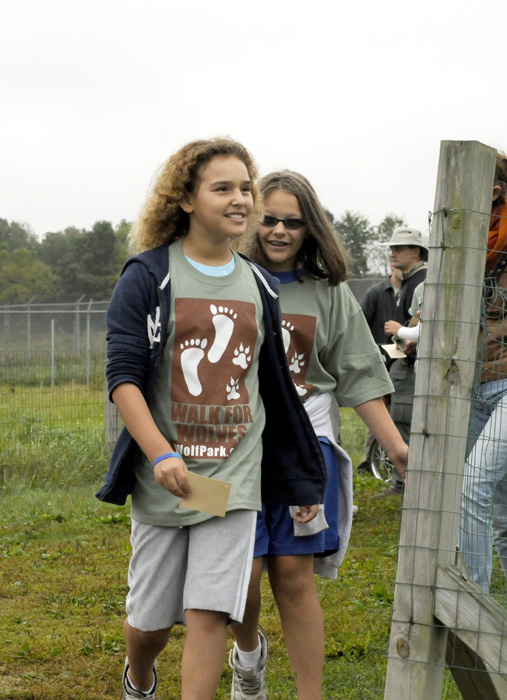
Photo provided by Wolf Park

“Each year, Wolf Park hosts its annual Walk for Wolves event; our largest fundraiser of the year. Wolf Park’s annual grassroots fundraiser event, Walk for Wolves, which was developed as a way to both further involve the community in our mission of research, education and conservation, and as a way to help sustain our facility during the off season. Our supporters form “packs” (1-5 people on a team) to help raise funds for the event.  On the day of the Walk, one of our ambassador wolves leads the way around the loop trail.  Local celebrities host this event; there is live music, food, fun contests and prize giveaways. Every “pack” receives an armband that lets them tour Wolf Park during open hours and come back for Howl Night that evening as our guests.

Area businesses support the Walk for Wolves through corporate sponsorships.  In exchange, the businesses are advertised on the walk t-shirts, posters, on our website, and in our newsletter.  Businesses also support the Walk for Wolves by giving to a matching donations campaign for their employees that participate.  Wolf Park needs your support for Walk for Wolves to help us reach our targeted goal this year. Your help and support can make a huge impact on Wolf Park!

Those interested will form “packs” and become a helping hand in our ability to continue our mission of Research, Education, and Conservation. This opportunity is ideal for you to support Wolf Park’s efforts. All “packs” receive a Walk for Wolves t-shirt if registered by August 31st! Must be present at Bank Night or the Walk for Wolves to pick up your t-shirt (we do not mail them out).

With YOUR help, our ambassador wolves can make a difference!

Download these PDF files and fax, e-mail or mail back to Wolf Park for the Walk for Wolves fundraiser! T-shirt sizes must be turned in to Wolf Park by August 29th!

You can sign up and submit your T-shirt sizes here!

You can register a Pack until 7:00pm EST on Friday, September 20th. All pre-registered Pack members get in free to the event. If you miss the deadline or do not wish to form a Pack, please feel free to join us as a walk-in the day of the event! Adults are $20, kids 5-13 $15, and kids under 5 are free. All Walk participants (including walk-ins) can join us free of charge during our regular open hours at the Park for guided tours from 1-5pm and for Howl Night at 7:30pm on September 21st!

Get your pack together for Wolf Park’s annual sponsor-based fundraiser! Our success depends on everyone joining in on the fun — clubs, school classes, church groups, businesses, organizations, individuals and most of all YOU!

Our success depends on everyone joining in on the fun — clubs, school classes, church groups, businesses, organizations, individuals and most of all YOU! All packs need to fill out a Walk Packet in order to register.

Participants will form Packs and collect donations, and then on the big day come out and present their donations to Wolf Park.  Then we spend the day celebrating wolves, and our commitment to save our natural world.  All morning walkers will stroll around this beautiful, unique park seeing th…e wolves, foxes, coyotes and bison up close and personal — right here in Battle Ground, Indiana. One of our resident wolves will join us for one lap!

Donations are fully tax deductible! Every registered walker will get a Walk for Wolves T-shirt if registered by August 31st! All registered packs will have a chance to win fabulous prizes. ‘Virtual’ participants  will have a chance for some fabulous prizes too!  Packs that raise $1,000 or more will be entered to win a Wolf Park Get A Way Weekend for two! Any individual or Pack that raise $1,000 or more will get to meet a WOLF and have their Pack picture taken by world renown photographer Monty Sloan!

The Walk begins at 9 am on September 21st! All participating walkers will receive FREE ADMISSION to Wolf Park for the remainder of the day, including regular hours from 1:00-5:00 pm and Howl Night 7:30-9:00 pm!”

**Special thanks to Wolf Park, http://wolfpark.org/support/walk/,  for providing this information!

Read Full Post »


Idaho Wolf

Photograph by Jim and Jamie Dutcher, National Geographic.

New method lets scientists ID howling wolves with total accuracy.

“If any gray wolves are howling their discontent with a recent proposal to remove what remains of their U.S. federal protection, scientists can now identify the outspoken.

A new, more sophisticated method for analyzing sound recordings of wild wolf howls can, with absolute accuracy, tell individual wolves apart-and may even help save the old dog, according to a new paper in the journal Bioacoustics.

Study leader Holly Root-Gutteridge and colleagues at Nottingham Trent University in the U.K., working with recordings of wild wolves mostly from Algonquin Provincial Park (map) in Ontario, Canada, also found the technique can distinguish a single animal from a chorus of howlers with 97.4 percent accuracy. The team had previously used the method with captive wolves, but this is the first time it’s worked with wild wolf songs and all the ambient sounds that go with them.

Specifically, the team’s more thorough howl analysis looks at pitch—also considered by previous howl-analyzing tools—but also at amplitude, or the acoustic energy, of recorded howls.

“This is like trying to describe the human voice by saying ‘Sandra has a high voice, and Jane has a high voice,'” said Root-Gutteridge, “then refining it by saying ‘Sandra has a soft-spoken voice, but Jane has a loud voice.’ The highness still matters, but if you add the detail about vocal intensity, you’re less likely to confuse Sandra and Jane.”

What’s more, the technology is able to scrutinize howl recordings and throw out extra, unneeded noises like wind and water that might otherwise confuse the data.

Tracking Wolves a Challenge

These majestic canids—which once roamed most of the northern Rockies of the United States and Canada and the forests along the Great Lakes—nearly went extinct in the early 1960s, when they were considered vermin and all but eradicated by hunters. After the shooting stopped, only about 300 gray wolves remained, skulking through the deep woods of upper Michigan and Minnesota.

With protection under the Endangered Species Act, gray wolves have come back from the brink—one of the biggest success stories in U.S. conservation history. (Related: “Wolf Wars” in National Geographic magazine.)

Though nowhere near the historical estimate of more than 400,000 gray wolves in the United States, now as many as 5,000 live in Michigan, Wisconsin, and Minnesota, with another 7,000 in Alaska. Smaller numbers of reintroduced wolves live in Montana, Idaho, and Wyoming.

But monitoring their populations, which remains a vital part of management, has always been an inexact and labor-intensive science.

Methods include tracking the animals based on pawprints and other marks in the snow, which works quite well-when it snows. GPS collaring lets you know where an individual is, but not with whom it spends its time.

Plus, collars are expensive and collaring requires capturing wolves first-a huge and stressful undertaking for all involved, said Root-Gutteridge. (See an interactive on the return of the wolf.)

Finally, you can play howl recordings to wolves and listen to their replies-which can carry six miles (ten kilometers)-but you can’t identify individuals and don’t know when one animal is repeating itself or when a new howler has joined in.

DNA analysis of scat has its place, but it is costly and requires finding the wolves first.

Wolves Out of the Woods?

Now that the new technique has been shown to succeed with wild animals, the team sees it as a tool to help conserve wolves in their natural habitats. (See more wolf pictures.)

For instance, tracking howls accurately could make future wolf counts and monitoring of individuals much more precise. If plans go forward to fully drop the gray wolf from the U.S. Endangered Species list and let states do as they please regarding hunting, better monitoring could over time help determine if it was too soon to strip away those last protective rules, as many conservationists argue.

The technology could also be put to use with other canids like African wild dogs and Ethiopian wolves, both of which are endangered in their habitats, said Root-Gutteridge.

“If it howls, the code can extract it and we can identify it.””

**Special thanks to Jennifer Holland, http://news.nationalgeographic.com/news/2013/07/130730-wolves-howling-science-animals-environment/, for providing this information! Follow Jennifer S. Holland on Twitter or check out her website at cuttlefishprose.com.

Read Full Post »


National Rally for Wolves

“Never doubt that a small group of thoughtful, committed citizens can change the world: indeed it’s the only thing that ever has. – “Margaret Mead

It is happening. This is your personal invitation to attend:

The National Rally to Protect America’s Wolves! to be held in Washington DC on Saturday, September 7, 2013 from 9AM to 4PM. We will come together in an area adjacent to the Washington Monument on the National Mall, to meet and network with each other, to hear from an impressive and inspirational line-up of speakers and to march peacefully between the Lincoln Memorial and the US Capitol building.

Here’s a link to the official rally website:  http://www.rallyforwolves.org

You can register for the Rally on this website. We will post details of the day’s intinerary, including the excellent speaker line-up, as it evolves. Frequently Asked Questions, regarding getting there, lodging, etc will be posted on the site as well. Please be patient as we fill in the details and answer your questions through the website.

This Rally is for America’s vital and beautiful wolves and other native wildlife under siege. This is our rally, your rally. It is being organized by a small team of grassroots wolf defenders and is open to all wolf and wildlife defenders.

The Rally’s mission is to unite wolf and wildlife defenders from around the country and demonstrate to our nation’s leaders that a respectful and humane majority of American citizens demand federal protection for America’s wolves, under the Endangered Species Act, in every state throughout their historic range.

We are going to Washington to demand that the unethical, cruel and unjust persecution and slaughter of America’s wolves in Idaho, Montana, Wyoming, Minnesota, Wisconsin, Alaska and elsewhere, be brought to an end, now and permanently. Our message is a public appeal for a better America that respects honest science and ecology, that truly reflects the humane and ethical values of the majority; a country where decency, respect and co-existence with America’s wolves and all native wildlife prevails, in every state.

Who’s invited? All wolf, wildlife and earth defenders in every state. Grassroots wolf defender activists. Non-profit groups, large and small, dedicated to defending wolves and other wildlife. All people young and old who love animals, respect ecology and who oppose animal abuse and cruelty wherever it exists. Native people including those who are helping lead the fight to protect America’s wolves. People of faith who are awakening to Creation care. Veterans opposed to violence and animal abuse. Wolf and wildlife defenders from around the world. Everyone with a good heart who wants a better and kinder country based on decency, compassion and respect for America’s wolves and all native wildlife and the wild places they need to survive and thrive.

Bear with us as we create and refine the day’s intinerary, including the wonderful line-up of speakers.

Please come to The National Rally to Protect America’s Wolves! and help spread the word.

Thank you on behalf of America’s vital and beautiful wolves, The National Rally to Protect America’s Wolves!

Register at: http://www.rallyforwolves.org

**SPECIAL THANKS TO PROJECTWOLF, http://rallyforwolves.org/, FOR PROVIDING THIS INFORMATION!

Read Full Post »


White Wolf

Are wolves eating all the elk?

“Answer: There is no shortage of elk where wolves live in the Rocky Mountains.  According to state game agencies, in 2010 in Idaho, Montana and Wyoming, there are 371,000 elk, 21,000 more than the previous year.  In Wyoming, the elk population is actually 50% above management objectives set by the Wyoming Department of Game and Fish.  In Idaho, Montana and Wyoming, there are at most 1,700 wolves, which are far outnumbered by bears and mountain lions.  Certainly, with 371,000 elk and many more deer, there is plenty of prey.

However, in some areas, the success of big game hunters has declined a bit, but not due to a general lack of elk.  With wolves back, elk habits have changed, reverting to behavior honed by time as the two species co-evolved in a predator/prey balance.  Now elk are once again more alert and spend much of their time on the move.  They find security in thick timber and maintain vantage points by spending more time on ridgelines rather than lingering down in open meadows and streambeds.  From the ridges, they can see threats approaching and have many directions to flee.

All these factors lead to heightened challenges for hunters.  Some concerned hunters point to specific herds, claiming that the elk are being decimated but, overall, population trends clearly dismiss that claim.

While only a few elk herds are in decline, local and regional fluctuations of herd populations are normal, according to the historical record.  Population trends are influenced by many factors.  Forest fires, for example, actually benefit elk by creating prime habitat.  When trees burn, verdant meadows, rich in nutritious grasses, replace the dead trees, and elk numbers increase.  But eventually, the trees grow back, thick shade decreases underlying grasses, and the elk population drops again.

Wolves keep the elk gene pool strong.  When wolves hunt, their technique is based not only on strategy, but also on opportunity.  They wear their prey down in a chase, singling out the weak, which are usually the sick, injured, old, or young.  The survivors are most often the healthiest, fastest and strongest elk, which live on to reproduce and perpetuate the best genes of their species.  This predator-prey relationship is good for both the health of the elk, and the health of the land.”

**Special thanks to “Living With Wolves, http://www.livingwithwolves.org/AW_question2.html, for providing the information in this article!

Read Full Post »

« Newer Posts - Older Posts »