It’s easy to see why he is so highly regarded. Every day, as dawn breaks over the 25 acres of the Werner Freund Wolfpark, the still air is split by the howling of Arctic, timber, grey and Mongolian wolves – the latest addition to the Freund family.
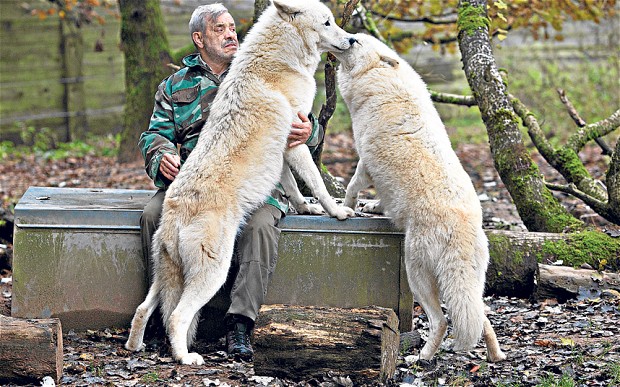
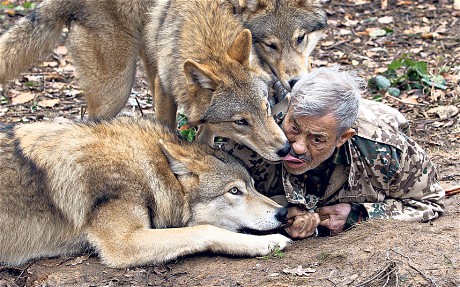
The wolves smell him before they see him. Then they howl – first one, then another and another – the woodland echoing to a visceral sound that would instill fear in many, but not in Werner. For these are the cries of animals he has devoted his life to. As he approaches the Arctic wolf enclosure, he bays in return and they answer him, tails wagging like labradors about to go walkies. He enters their domain clutching chickens and lamb chunks – breakfast – and is rewarded with affectionate licks. Never mind that their jaws can exert 1,500lb of pressure.
One wolf that has kept its distance finally comes over. It is at least 100lbs in weight and more than six feet high when it rears up on to its hind legs. It is a creature with an air of unmistakable authority, the alpha male of the pack. But when Werner is around, it seems to shrink back, clearly recognising its master.
For Werner there is nothing remotely evil about the wolf. “Fairy tales, that’s what gave them a bad name,” he says gruffly. “Red Riding Hood and all that. These are beautiful animals and the person who says they shouldn’t be in the wild might as well not care about what happens to the elephant on the plains of Africa. We are all enriched by their presence, by the simple fact that they are among us.
“There will always be farm animals taken by them. There will always be ‘incidents’ because of their proximity to man. But truthfully? You are more likely to die from meeting a werewolf than a real one. They don’t want to know about humans. They want to do their own thing.”
Several years ago this small man of modest demeanour and irrepressible enthusiasm walked into the mayor’s office in Merzig to tell him of his plans: a wolf park that would be free to everyone and where the creatures could live out their days as nature intended.
The pitch worked, and now Werner’s wolf park, built on land donated by the local authority, is a major attraction in Merzig. The packs roam in their segregated enclaves in a huge forested area, fed by local slaughterhouses that donate meat, supplemented by the odd deer shot by a hunter, or a roadkill wild boar.
“I battle to strip away the myth of the ‘dangerous wolf’. Look, dogs around the world kill plenty of people a year and bite millions more. Dogs have lost their fear of humans, the wolf hasn’t. I only get close to them because they know me; a stranger couldn’t do what I do.
“Wild wolves are rarely aggressive towards people. If there are attacks, they get big play in the press precisely because they are so rare. No, there is far more danger to wolves from man than the other way around. That is why the release of them into the wild will always have its limitations. There is a limit to habitat and prey, which is why farmers will always lose some sheep to them, and road traffic will take an annual toll on them.”
Werner wasn’t always a wolf man. Born in Germany in 1933, in the same month that Hitler came to power, he grew up in the wolf-denuded countryside near Frankfurt to a family of foresters and shepherds. “I got my love for animals from my mother,” he recalls. “To her all animals were good and so I never had any fear of them. She never told me stories about the big bad wolf.”
He trained as a gardener but in 1950 his love for animals drew him to the zoo in Stuttgart where he became a keeper for the larger predators. As well as wolves, Werner became a great fan of bears and was photographed cuddling a lion, getting up close to a hyena and befriending a puma for the local newspapers.
He had a spell in the border police before switching to the newly formed Bundeswehr (army) of West Germany, where he spent the next 20 years as a career soldier.
The army gave him time off to join expeditions abroad, 15 of them in all, to some of the most remote spots on the planet. On one of them he ingested a parasite from eating raw snake, necessitating an emergency operation to save his eyesight at a London hospital.
In 1962 he married Erika, aka “Mrs Wolfman”, who has been his life partner and passionate supporter of his animal causes. The first wolves they acquired, in the Seventies, were cubs from zoos and animal parks. Most of them were hand-reared by the couple, providing a unique bond that turned them both into the “parents” of the youngsters. “I had to become a wolf to bond with the wolves,” says Werner. “That is the only way to gain their trust.”
As the day began, so it ends. For wolves, darkness is the time for hunting, for killing. Sometimes Werner will dress their meat ration up in the form of a papier mâché sheep that the animals can tear to pieces as if it were real.
He stops at a small enclave next to his log-cabin home, where two female Arctic wolves howl in anticipation at his arrival. They had to be separated from the pack because there were too many females and the alpha male was becoming aggressive towards them.
“They need a man,” says Werner, as they lick his face and scramble for his affection. “They look nice, eh? But never be entirely fooled into thinking these are just big dogs. They are wild animals and always will be.”
**Special thanks to Allan Hall, “The Telegraph,” for providing this information!
“The Telegraph”
 The Wolf Preservation Blog