Feeds:
Posts
Comments

Archive for November, 2013


MALAMUTE
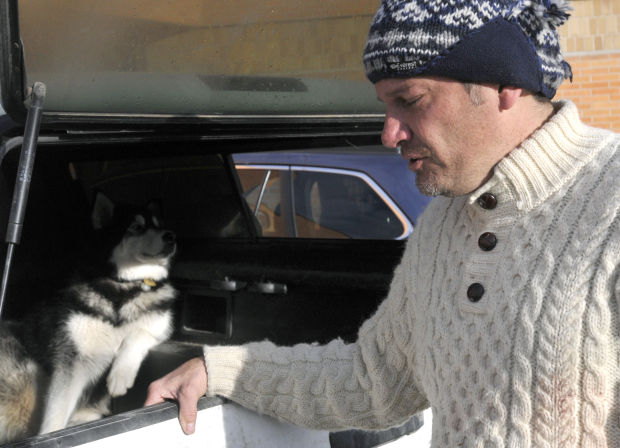
Photo courtesy of ARTHUR MOURATIDIS/for the Missoulian
Layne Spence pauses as he describes to the Missoulian the moments leading up to the death of his Malamute Little Dave, 2, while skiing at Lee Creek near Lolo Pass on Sunday. Spence reported that a hunter carrying an assault rifle allegedly shot Little Dave, one of his three Malamutes, multiple times as the group was cross-country skiing, claiming he thought the canine was a wolf.
“Layne Spence’s pet malamute, Little Dave.

Here’s the Great Falls Tribune article in its entirety:

Written by John S. Adams

Tribune Capital Bureau

http://www.greatfallstribune.com/apps/pbcs.dll/article?AID=/201311200500/NEWS01/311200023

HELENA –  Layne Spence went out into the woods west of Missoula on a Sunday afternoon to do what he loves to do best: recreate in Montana’s outdoors with his three beloved malamutes.

Spence, an avid outdoorsman, drove to the Lolo National Forest’s Lee Creek campground, an area the agency touts on its website for its “winter recreation opportunities such as cross-country skiing and snowmobiling.”

The area also is popular with hunters and trappers.

Spence parked his truck, turned on his dogs’ lighted collars, clipped into his cross-country skis and set off down the snow-covered forest road.

Within minutes of starting out on his trek with his dogs Rex, Frank and Little Dave, Spence said he heard a gunshot from up ahead. Spence said he looked up from road just as Little Dave’s hind leg was struck by a bullet. Spence said a man, dressed mostly in camouflage, was standing on the road approximately 30 yards ahead of him and was aiming a semiautomatic assault rifle in his direction.

Merriam-Webster defines an assault rifle as “any of various automatic or semiautomatic rifles with large capacity magazines designed for military use.”

“I started screaming at the top of my lungs, ‘No! No! Stop! Stop! You’re shooting my dog!,” Spence recalled, his voice still hoarse from yelling three days after the alleged incident.

Spence, a licensed emergency medical responder, said even though his dog was gravely wounded, he thought he had a chance to save him after the first shot. Even with a missing leg, Little Dave could live a full and happy life, Spence said later.

“I started running toward Little Dave, screaming the whole time and then I heard this ‘tat, tat, tat’ five or six more times,” Spence said. “Then Little Dave’s head just tilted over and he was dead.”

As Spence huddled over the body of his dead pet, the unidentified shooter approached him and told Spence he thought the dog was a wolf. According to Spence, the man asked if there was anything he could do. Spence he was distraught and screamed at the man to leave him alone.

“I was sitting there screaming, I was covered in blood, and I was trying to find my dog’s leg,” Spence recalled.

Spence said any responsible wolf hunter should have known his domestic dogs aren’t wolves. Spence said Little Dave bears a resemblance to the Ewok characters from the “Star Wars” films.

Local law enforcement authorities, state wildlife officials and U.S. Forest Service officials announced Tuesday that they spoke to the hunter involved in the incident.

According to a joint statement issued by the Missoula County Sheriff’s Office, the hunter broke no criminal or wildlife laws in the incident. Authorities said they are withholding the man’s name for his own safety.

“Based on the statements provided by both parties, it was determined that there was no malicious or purposeful intent to cause harm or injury to a domesticated animal on behalf of the hunter,” the statement read. “The Missoula County Attorney’s Office concurs with the Missoula County Sheriff’s Office that the facts of the incident do not fit the elements of any criminal statutes contained in Montana law …”

The Montana Department of Fish, Wildlife and Parks said the circumstances do not “constitute any egregious violation of Montana hunting regulations.”

“The incident was not enforceable by their agency because it involved a domesticated animal, rather than a game animal,” the statement read.

Debate ignites

Although authorities say no laws were broken, widespread news of the incident has outraged many outdoor enthusiasts and sparked debate over who is responsible for the safety of the nonhunting public and their pets on public lands during open hunting seasons.

Wolf hunting and trapping is legal in Montana, and so far 85 wolves have been killed during Montana’s 2013-2014 hunting and trapping season.

Hunters can hunt wolves with guns from Sept. 15 to March 15, and trapping runs from Dec. 15 to Feb. 28. Wolf hunters are only required to wear “hunter orange” during the five-week general rifle season. After Dec. 1, they can hunt until mid-March without wearing orange.

Matthew Koehler, executive director of the Missoula-based WildWest Institute, said as an environmentalist and a big-game hunter, he is deeply troubled by the reported actions of the hunter who allegedly shot Spence’s dog.

Koehler said state wildlife and law enforcement officials appear to be applying a different set of rules for wolf hunters than other big-game hunters.

“The first rule for any ethical hunter is to know your target,” Koehler said. “If FWP or law enforcement found out a hunter mistakenly shot a bull elk when the regulations only allowed the taking of antlerless elk, they would fine the hunter and perhaps even take away his license. It blows me away that in this case, authorities are apparently saying it’s OK for wolf hunters to shoot people’s pets on public lands and there are no consequences for those actions.”

Jerry Black is an anti-wolf hunting advocate who said Montana’s liberal wolf hunting laws put unreasonable onus on unarmed citizens to protect themselves and their pets from injury or death while recreating on public lands.

“What’s screwed up is this tragic incident shows that we as citizens out walking with our dogs, or out there hiking, fishing or skiing on public lands, it’s now our responsibility to not get shot,” Black said. “For six months out of the year, we’re under siege by wolf hunters who say it’s our responsibility to wear blaze orange.”

Changes coming?

Spence said he believes the man who shot Little Dave should lose his hunting privileges and have his guns taken away.

Spence said  the hunter violated hunting regulations, including shooting from a public roadway.

According to the 2013-2014 Montana wolf-hunting regulations, “it is illegal for anyone to hunt or attempt to hunt any wolf from, on or across any public highway or the shoulder, berm, barrow pit or right-of-way of any public highway …”

“I don’t want anything bad to happen to the guy. I just want an apology,” Spence said. “He has to be held accountable. I’m lucky to be alive. He was shooting right at me.”

Spence said he believes there needs to be stiff penalties on the books for hunters who endanger nonhunters or their pets through irresponsible actions. He said he hopes if anything good comes from the death of Little Dave, it will prevent future incidents like this from occurring.

“It could have happened to anyone. I could have had a child out there with me,” Spence said. “People need to be aware. I don’t want this to happen to anybody else.”

One state lawmaker is already talking about taking action in the 2015 Legislature.

Rep. Ellie Boldman Hill, D-Missoula, said on her Facebook page that she is considering proposing legislation making what happened on Sunday a crime. Hill is up for re-election in 2014.

Spence said he’s not opposed to hunting and has hunted in the past. However, Spence said he believes the use of a semiautomatic rifles should not be allowed for hunting.

Semiautomatic rifles are legal in Montana and no special permit is required to own them or hunt with them.

“Everybody has their Second Amendment right to bear arms, but irresponsibility and those kinds of weapons that allow you to fire off a bunch of rounds with a few quick squeezes of the trigger should be banned,” Spence said. “Assault weapons are not hunting rifles.””

**Special thanks to “Exposing the Big Game, http://exposingthebiggame.wordpress.com/2013/11/21/new-article-outdoorsman-seeks-action-after-pet-malamute-shot-killed-by-wolf-hunter/) for providing this information!
Read Full Post »


Red Wolf

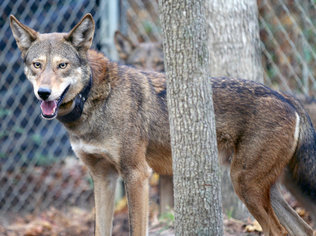
Photo courtesy of Ryan Nordsven – U.S. Fish & Wildlife Service
This young red wolf was born on St. Vincent Island, Fla., where the U.S. Fish & Wildlife Service keeps a breeding pair. It was fitted with a radio collar in preparation for release to the wolf recovery area in North Carolina.

“Wolves have a terrible public relations problem that dates back many centuries.

In old fables, they’re constantly up to no good, stalking Little Red Riding Hood and blowing down the houses of the Three Little Pigs. Their storied reputation might explain why people are quick to put a price on their heads for killing livestock or simply showing their faces.

But recently in North Carolina, wildlife biologists flipped the script. They are offering a bounty of sorts for information leading to the capture of whoever who shot to death two rare red wolves.

That species of wolf is one of the world’s most endangered wild canids — a group that includes jackals, coyotes and dogs. The $21,000 reward was raised by animal rights organizations after the dead wolves were found Oct. 28 and Oct. 30 on the flat plains of Washington County, on the central Carolina coast.

Accelerometers pinging in the wolves’ tracking collars informed U.S. Fish and Wildlife Service officials that the animals’ hearts had stopped beating and led them to the dead bodies. The wolves were among 66 that authorities have tracked since they were old enough to wear collars.

The animals are monitored as part of the government’s Red Wolf Recovery Program, to reestablish them in the Southeast after federally sanctioned bounties nearly wiped them out.

Today, only 90 to 100 live in the wild, and each death is a major blow to the federal government’s effort to restore red wolves in their native habitat.

Authorities said the dead wolves were of breeding age, making their demise especially upsetting since there are too few adults to produce enough litters to reestablish the species.

“When we lose an animal, that obviously has an impact on a very small population,” said David Rabon, recovery coordinator for the Fish and Wildlife program. While there are 90 wolves in the wild, that doesn’t mean 45 of them have coupled. “About 13 pairs are breeding,” Rabon said.

Red wolves were once a lot more common in the Southeast, biologists say. Their numbers were reduced by predator control programs that put prices on the heads of native wolves as people encroached on their range. By the 1960s, they were on the brink of surviving only in zoos and museums.

The Fish and Wildlife Service listed the wolves as endangered in 1967 and frantically attempted to rebuild the population. Seventeen remaining red wolves were captured by biologists, and most went into a program that preserves their gene pool and breeds them.

With no more red wolves in the wild, they were declared extinct in the Southeast in 1980. It took seven years to breed enough of them to start a restoration program on theAlligator River National Wildlife Refuge in North Carolina’s rural northeast.

About 100 wolves roam an expanded range that includes three wildlife refuges on nearly 2 million acres. An additional 200 red wolves are in breeding, part of a Species Survival Plan in locations across the United States.

There is another species in North America: the gray wolf, or Canis lupus, with an even more fearsome and, many say, unearned reputation. In an ongoing battle with encroaching ranchers, gray wolves killed more than 250 sheep and about 90 cattle last year in Idaho alone.

In response, hunters in the state killed 330 wolves in 2012, and about 200 in 2011, according to the Agriculture Department.

Red wolves, or Canis rufus, are slimmer and slightly smaller than their gray cousins. They are sometimes mistaken for coyotes, which is problematic because that more plentiful group isn’t native to North Carolina and can be shot any day but Sunday, Rabon said.

Coyotes bow to bigger red wolves. If a red wolf wants a coyote’s territory, it takes it. Adult red wolves weigh up to 80 pounds, stand about 26 inches tall and measure four feet long, from nose to tail. But calling them red is a bit of an overstatement. The wolves “are mostly brown and buff colored with some black along their backs,” according to a Fish and Wildlife description.

Rabon doesn’t know why anyone would want to kill them. There are few documented cases of a healthy wolf or coyote attacking a person, he said.

“We have documented less than a dozen cases where a red wolf took livestock in 27 years,” Rabon said. Most of the time the culprit is man’s best friend — a dog. Or coyotes.

Red wolves eat white-tail deer, rabbits, rats, mice and the invasive nutria, also known as the invasive swamp rat from South America.

On the coastal Carolina plain where the wolves were reintroduced, there are no livestock to protect. The land is planted with corn, soy, wheat, cotton and pine grown on plantations, Rabon said.

Six red wolves were killed this year by gunfire, three were hit by vehicles, and one died by some other circumstance, perhaps caught in a trap, Rabon said. In the three previous years, 21 were shot.

Rabon said the motive could be the fearsome reputation of wolves, spread through fables or stories of gray-wolf hunting packs out West that are strong and smart enough to bring down enormous prey such as bison.

The bounty raised by several organizations, including the Humane Society of the United States, the North Carolina Wildlife Federation and the Center for Biological Diversity, reflects the outrage over the killings.

In a statement, Fish and Wildlife officials hoping to bring them back extolled the red wolf’s good looks. “As their name suggests, red wolves are known for the characteristic reddish color of their fur most apparent behind the ears and along the neck and legs.”

**Special thanks to “The Charlotte Observer” for providing this information!  (http://www.charlotteobserver.com/2013/11/13/4462716/a-wolf-bounty-not-in-nc-in-a-switch.html#.UoWNf0Yo7IV)

Read Full Post »


Photo courtesy of PhotoBucketSnow Gray Wolf

“HOUGHTON — This month Isle Royale National Park will hold a series of public meetings to discuss the status of wolf management on the island. During the meetings, the Natural Resources team will present information about the history of wolves on Isle Royale, climate change implications, and current and future status. The presentation will be followed by an opportunity for the public to discuss natural resources, ecology, climate change, and wildlife management as well as ask questions and provide comments to park staff.*

“Isle Royale has a long-standing history of broad ecosystem management,” commented Park Superintendent Phyllis Green. “I hope the public takes this opportunity to become more informed on the natural resources of the island.”

The first of these meetings will be held from 3 p.m. to 5 p.m. this Tuesday, Nov. 12, at the Franklin Square Inn, 820 Shelden Ave., Houghton. The presentation will begin at 3:30 p.m. followed by an open house.

Additional public meetings will be held as follows:

Public Meeting 2: Chelsea, Michigan
Date: Thursday, Nov. 14,  2013
Location: Chelsea Depot, 125 Jackson Street
Time: 3 p.m. -5 p.m. (Presentation at 3:30 p.m. followed by open house)

Public Meeting 3: St. Paul, Minnesota
Date: Tuesday, Nov. 19,  2013
Location: TBA.
Time: 3 p.m. – 5 p.m. (Presentation at 3:30 p.m. followed by open house)

Public Meeting 4: Duluth, Minnesota
Date: Wednesday, Nov. 20, 2013
Location: Environmental Protection Agency Mid-Continent Ecology Division Laboratory, 6201 Congdon Boulevard
Time: 3 p.m. – 5 p.m. (Presentation at 3:30 p.m. followed by open house)

* Editor’s Note:  According to Rolf Peterson, co-director of the Isle Royale Wolf-Moose Study, the National Park Service (NPS) is considering three options: (1) do nothing, even if wolves go extinct; (2) allow wolves to go extinct (if that is what they do), and then introduce a new wolf population; or (3) conserve Isle Royale wolves with an action known as genetic rescue by bringing some wolves to the island to mitigate inbreeding. See “Message from Rolf Peterson: Public input needed on future of Isle Royale wolves,” posted on Keweenaw Now Oct. 11, 2013.”

**Special thanks to “Keweenaw Now” for providing this information!  (http://keweenawnow.blogspot.com/2013/11/isle-royale-national-park-to-hold.html)

Read Full Post »