Feeds:
Posts
Comments

Archive for June 24th, 2014


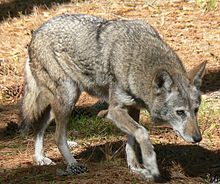
Red Wolf

Captive specimen at “Parks at Chehaw”, Albany GA, USA (RED WOLF)


coyote

From Yosemite National Park (COYOTE)

What is the Difference Between Red Wolves and Coyotes?

“Red Wolves and Coyotes are very closely related and in fact share a recent common ancestor.  The two species do hybridize and produce fertile offspring.  It is usually impossible to distinguish between a Coyote – Red Wolf hybrid and a Red Wolf just by looking at it.  Wildlife Biologists that work with the only known wild population of Red Wolves at Alligator River National Wildlife Refuge in North Carolina have to do DNA tests to be sure.

Red Wolves are a critically endangered species with only about 100 individuals existing in the wild in the world, all of them in the Alligator River NWR area of North Carolina.  Coyotes, although not found East of the Mississippi River prior to 1900, are now very common in the wild.

Red Wolves, as a species, are larger in both height and weight.  Coyotes usually weigh between 25 and 35 pounds while Red Wolves usually weigh between 50 and 80 pounds.  Red Wolves are more massive in the head, chest, legs and feet. There can be size overlap between the species.  Some Red Wolves are in fact smaller that some Coyotes.  Coyotes tend to have a longer, narrower, muzzle than Red Wolves do.

Red wolves are mostly brown and buff colored with some black along their backs; there is sometimes a reddish color behind their ears, on their muzzle, and toward the backs of their legs.  However, many Red Wolves can have the same colors as coyotes which tend to be light gray with some black on the tips of their outer hairs.

Red Wolves howls are similar to Coyotes but tend to be of longer duration and lower in pitch.  Coyotes tend to have more yapping intermixed with the howls.  Again, it can be almost impossible to tell the difference in some individuals.

It used to be believed that Coyotes didn’t hunt in packs like wolves but pack hunting coyotes have now been observed in the wild.

The Eastern Coyote is different from the Western Coyote in size, genetics and behavior.  This is due to interbreeding with wolves.  Eastern Coyotes have wolf genes and therefore are taking on wolf characteristics.  This happened when the wolf population in the Eastern United States was hunted almost to extinction and had dwindled to a small enough size that they would breed with Coyotes instead of chasing them off or killing them.

Red Wolves howls are similar to Coyotes but tend to be of longer duration and lower in pitch.  Coyotes tend to have more yapping intermixed with the howls.  Again, it can be almost impossible to tell the difference in some individuals.

If you are anywhere in Eastern North America, outside of coastal North Carolina, and observe a large wolf-like animal, it is almost certainly an Eastern Coyote or possibly a Gray Wolf  that someone had as a pet and dumped in the wild.”


**Special thanks to Chattanooga Arboretum Nature Center for providing this information!  http://www.chattanooganaturecenter.org/www/docs/133.251/

Read Full Post »


Bend Bulletin: June 23, 2014

 — Three years into a state program to help counties contending with wolves, the focus has been on preventing attacks on livestock.

“I think the program was set up with the intention that prevention is the preferred model,” said Jason Barber, who oversees the grant program for the Oregon Department of Agriculture. “. Kind of a no-brainer, you’d want to prevent the depredation if you can.”

Depredation is when wolves attack livestock, such as cattle or sheep. Money from the wolf grant program helps pay for efforts such as removing cattle bones that could attract wolves, installing flagging along fence lines to spook wolves, and patrolling rangeland by horseback or on ATVs.

State-sponsored hunts helped lead to the elimination of wolves in Oregon, with the last bounty paid out in the late 1940s. But since the late 2000s, wolves have been making a comeback, having moved in from Idaho where the U.S. Fish and Wildlife Service reintroduced wolves nearly 20 years ago.

The latest Oregon Department of Fish and Wildlife wolf count, which the agency released at the end of last year, has at least 64 wolves in the state. Most are in the northeast corner, but they are expanding their territories. Through 2013, there had been 75 animals, either livestock or domestic animals, killed by wolves since the wolves started returning to Oregon.

The prevention money in the state grant program comes with a use-by date, Jan. 31 of the year after the state issues the grant. If the county doesn’t use the money by then, it has to give it back. Such was the case last year when Crook County gave $3,000 back after a cattle bone removal project didn’t come together in time. This year’s grants include a new $3,000 grant for Crook County to try the project again.

The grants also include compensation money, which goes to ranchers whose livestock has been killed or injured by wolves or has gone missing and was likely taken by a wolf. According to state records, $296,620 total has been given out for prevention, compensation and some smaller administrative costs in the three years of the wolf grant program. Of that, $71,653 was for livestock that had either been attacked or injured or had gone missing probably because of a wolf. That’s 24 percent of the grants. Another $178,150, or 60 percent, went to wolf attack prevention projects.

Although he is glad the state helps ranchers cover the cost of livestock lost to wolves, Todd Nash, an Enterprise rancher and wolf committee chairman for the Oregon Cattlemen’s Association, said it’s not a lasting solution.

“Compensation is a Band-Aid fix,” he said. “It will never be acceptable to livestock producers to have wolves kill their livestock, but it does help.”

Sally Mackler, state carnivore representative for Predator Defense, said she would rather see that state wolf money all go to projects aimed at preventing attacks on livestock, rather than for compensation.

“I think that would be a better use of that money,” she said. The Eugene-based group advocates for predators, such as wolves.

Mark Lane, 42, a rancher from Morrow, said he thinks the state should compensate livestock producers like him for animals lost to wolves. He’s in the process of figuring out how to collect some of the money himself, having had wolves from the Umatilla River pack attack one of his cows earlier this month.

He said he is hopeful he’ll be able to save the 3-year-old pregnant cow that had been grazing on private land near Pendleton when attacked.

“I’m just a small producer,” Lane said. “I don’t have many animals, (so) every one I lose … hurts me big time.”

Separate from the state wolf grant program, the Oregon Department of Fish and Wildlife runs its own wolf program. For the two-year funding cycle spanning 2013 to 2015, the program’s budget is $641,004, according to the agency. The budget covers wolf-monitoring programs, response to livestock attacks, equipment needs and the pay for two full-time wolf-management workers.

“That’s collaring, that’s everything,” said Meg Kenagy, an agency spokeswoman in Salem.

Scientists with ODFW have been affixing GPS collars to wolves since the animals started returning to the state from Idaho. Tracking them allows scientists to understand their behavior and habits. The ODFW also offers a warning system, in which it will call or text ranchers when wolves are detected near livestock.

A GPS collar led to fame for one wolf as the device enabled scientists to record his remarkable journey in recent years. Known as OR-7, the seventh wolf collared in Oregon, the gray wolf traveled thousands of miles from Northeast Oregon into California.

Scientists said OR-7 probably was looking for a mate and this spring found one. He now has pups with her, the beginnings of a new pack, in the southern Cascades between Klamath Falls and Medford.”


**Special thanks to Dylan Darling, Idaho Statesman, for providing this information!  http://www.idahostatesman.com/2014/06/23/3249894/oregon-wolf-money-focused-on-preventing.html?sp=/99/103/


Read Full Post »