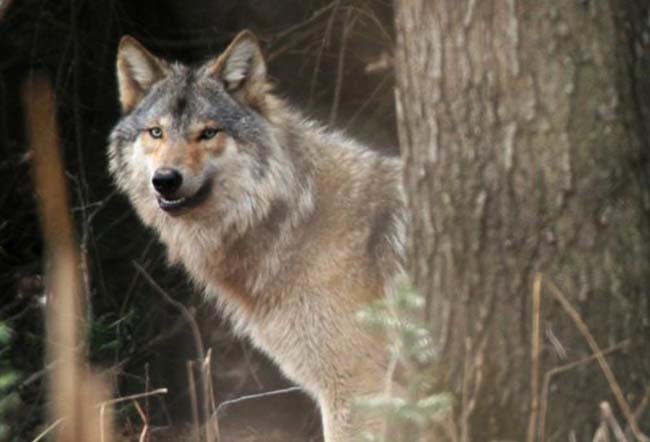
“On June 1st, Washington ranchers began turning out their cows and calves onto summer grazing lands. Some of those lands overlap with territory home to Washington’s recovering wolves. And that’s where you’ll find livestock under the watchful eye of range riders co-sponsored by Conservation Northwest.
This year we’re collaborating with even more cattle operations on the ground in wolf country to protect livestock and wolves.
Working with the Washington Department of Fish & Wildlife (WDFW) and four ranchers from the Methow and Teanaway valleys, the Wenatchee area and Stevens County in northeast Washington, we’ll have at least six riders patrolling grazing allotments this season. For the first time, they’ll be covering the territory of five confirmed wolf packs on horse and ATV working to minimize wolf-livestock conflict.
Range riders work long, hard days in tough conditions, covering thousands of miles a season to make sure the cattle are calm and healthy and keep them away from wolves, the location of whom is often provided confidentially by WDFW through GPS and radio collar data.
Because of the difficult and specialized work, each rider can cost up to $20,000 plus gas and expenses for the five-month grazing season. To sign up with WDFW to participate in the program, ranchers must typically put up half that cost to receive a state match.
That’s where Conservation Northwest comes in.
As an incentive to participate in the program and put non-lethal predator management tools to work, with the help of generous donors we contribute as much as $10,000 a season to eligible ranchers for each range rider, greatly limiting their out-of-pocket costs.
“We hope this program spurs ranchers to do a practice that they did for hundreds of years, but when wolves were gone from the landscape there was no need,” said Jay Kehne, Conservation Northwest’s Okanogan County outreach associate. “There are incentives for doing this, you’re going to keep more weight on the cows and you’re going to lose fewer cows. Having a range rider is worthwhile for the ranchers because it’s going to save them money in the end.”
And with the range riders work resulting in wolves causing less problems for cattlemen, there’s less call to resolve wolf-livestock conflict by lethal management.
This is our third year organizing the range rider program in Eastern Washington, and we’re proud of what the range riders, cattlemen, state biologists and conflict specialists, and Conservation Northwest staff have accomplished.
Even as wolf populations have rebounded, last summer ranchers reported an increase in the number of cows returning from the summer spent grazing in wolf habitat, as much as 100 percent in some cases. And the valuable weight those cows have maintained is up as result of limited interaction with wolves and more stress-free time spent resting and feeding. As last year’s range rider program came to a close, one of the ranchers we partner with, John Dawson, was quoted in a Spokesman-Review article saying “we’ve lost nothing to wolves.”
The program’s success hasn’t just been seen by the ranchers participating, other livestock owners are beginning to take notice as well.
“The success the Dawsons have had has gone a long way to helping promote nonlethal means and proactive measures to reduce conflict,” said Jack Field, the Washington Cattlemen’s Association’s executive vice president. We hope that continues to be the case and these modern cowboys and cowgirls catch on.
Much has been said about Washington’s recovering wolves in policy debates, newspaper comments and public meetings in recent years. But it’s only through public acceptance in the communities living, working and recreating in wolf country that we’ll see their complete and sustained recovery in our state for the long term.
That’s why we’re out there working one-on-one with ranchers, building partnerships with WDFW, and proving that time-tested non-lethal management tools like range riders (and fladry too) can have real results protecting both cattle and these iconic native predators.
Conservation Northwest is thrilled to see this program succeeding, and hopeful the benefits will be spread even wider this summer with more riders out on the range.””
**Special thanks to “Conservation Northwest” for providing this information!
http://www.conservationnw.org/news/updates/range-riders-update
 The Wolf Preservation Blog