
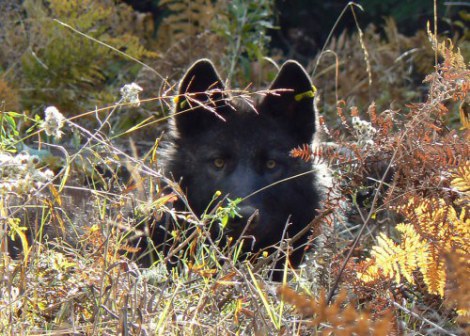
Photo courtesy of “Howling for Justice.”
“Eastern Oregon Wolves Could Be Removed From State’s Endangered Species Act
OPB | Sept. 16, 2014 2:21 p.m. | Portland
Gray wolf populations are on the rise in Oregon, but that may not necessarily be good news for the animals.
The Statesman Journal reports that the state may have enough potential wolf couples in 2015 for the minimum requirements to delist the animal.
“We were told in the beginning that when wolves first came to the county, we were waiting for that day,” said Todd Nash, wolf committee chairman for the Oregon Cattleman Association, in an interview with the newspaper.
According to Oregon’s Endangered Species Act, the state Department of Fish and Wildlife must verify four breeding pairs in eastern Oregon for three consecutive years.
In 2012, there were six pairs and last year the organization located four pairs. It’s predicted that 2014’s count won’t be complete until early next year, but early reports show more than four couples.
By removing wolves from the state’s endangered species list, ranchers would be permitted to use lethal force to defend their animals in more situations.
According to ODFW , shooting a wolf is considered a misdemeanor, which carries a maximum penalty of $6,250 fine and a year in jail.
http://www.opb.org/news/blog/newsblog/eastern-oregon-wolves-could-be-removed-from-states-endangered-species-act/
===
Anyone who’s read the Oregon wolf “management plan” could see this coming a mile away. There was major push-back against “the plan” in 2010. The number of breeding pairs needed, to reach delisting, was ridiculously low. Here’s part of what Oregon’s wolf plan states:
Oregon Wolf Conservation and Management Plan
Wolves may be considered for statewide delisting once the population reaches four breeding
pairs for three consecutive years in eastern Oregon.1
Four breeding pairs are considered the minimum conservation population objective, also described as Phase 1. The Plan calls for managing wolves in western Oregon as if the species remains listed until the western Oregon wolf population reaches four breeding pairs. This means, for example, that a landowner would be required to obtain a permit to address depredation problems using injurious harassment.
While the wolf remains listed as a state endangered species the following will be allowed: Wolves may be harassed (e.g. shouting, firing a shot in the air) to distract a wolf from a livestock operation or area of human activity.
Harassment that causes injury to a wolf (e.g., rubber bullets or bean bag projectiles) may be employed to prevent depredation, but only with a permit.
Wolves may be relocated to resolve an immediate localized problem from an area of human activity (e.g., wolf inadvertently caught in a trap) to suitable habitat. Relocation will be done by ODFW or Wildlife Services personnel but will not occur with wolves known or suspected to have depredated livestock or pets.
Livestock producers who witness a wolf ‘in the act’ of attacking livestock on public or private land must have a permit before taking any action that would cause harm to the wolf.
Once federally delisted, wolves involved in chronic depredation may be killed by ODFW or Wildlife Services personnel. However, non lethal methods will be emphasized and employed first in appropriate circumstances.
Once the wolf is delisted, more options are available to address wolf-livestock conflict. While
there are five to seven breeding pairs, livestock producers may kill a wolf involved in chronic
depredation with a permit. Five to seven breeding pairs is considered Phase 2.
Seven breeding pairs for three consecutive years in eastern or western Oregon is considered the management objective, or Phase 3. Under Phase 3 a limited controlled hunt could be allowed to decrease chronic depredation or reduce pressure on wild ungulate populations.
The Plan provides wildlife managers with adaptive management strategies to address wolf predation problems on wild ungulates if confirmed wolf predation leads to declines in localized herds.
In the unlikely event that a person is attacked by a wolf, the Plan describes the circumstances under which Oregon’s criminal code and federal ESA would allow harassing, harming or killing of wolves where necessary to avoid imminent, grave injury. Such an incident must be reported to law enforcement officials.
A strong information and education program is proposed to ensure anyone with an interest in wolves is able to learn more about the species and stay informed about wildlife management activities.
Several research projects are identified as necessary for future success of long-term wolf conservation and management. Monitoring and radio-collaring wolves are listed as critical components of the Plan both for conservation and communication with Oregonians.
An economic analysis provides updated estimates of costs and benefits associated with wolves in Oregon and wolf conservation and management.
Finally, the Plan requires annual reporting to the Commission on program implementation.
http://www.dfw.state.or.us/Wolves/docs/Oregon_Wolf_Conservation_and_Management_Plan_2010.pdf
===
This was posted in June 2010 on Howling for Justice, written by wolf advocate Katie, a Oregon resident, explaining why the plan was insufficient and should be changed.
Help Change Oregon’s Wolf Management Plan, PLEASE COMMENT BY JUNE 30th
June 21, 201o
“Wolves may be considered for statewide delisting once the population reaches four breeding pairs for three consecutive years in eastern Oregon…. The plan calls for managing wolves in western Oregon as if the species remains listed until the western Oregon wolf population reaches four breeding pairs.”
This means when there are four packs in eastern Oregon and four in western Oregon, wolves will be stripped of ESA protection statewide.
The average gray wolf pack size is about 8 wolves. If packs in Oregon follow the norm, then roughly 64 wolves will be present when they are delisted. A recent study suggests Oregon could support up to 2200 wolves and still maintain a healthy ecosystem. I don’t know about you, but 64 wolves doesn’t sound like recovered to me.
READ MORE: http://howlingforjustice.wordpress.com/2010/06/21/help-change-oregons-wolf-management-plan-please-comment-by-june-30/
===
So it’s come to this. Oregon, one of the friendliest of wolf states, may soon subject Eastern Oregon wolves to delisting because of the state’s weak management plan. This is the defining statement in their “plan”. “Seven breeding pairs for three consecutive years in eastern or western Oregon is considered the management objective, or Phase 3. Under Phase 3 a limited controlled hunt could be allowed to decrease chronic depredation or reduce pressure on wild ungulate populations.”
Howling for Justice does not support managing wolves. Wolves are self-regulating and do not need to be “managed” Managing wolves is a catch phrase for the lead up to eventually hunting and killing them, as you can see by the statement above, quoted from Oregon’s wolf management plan. IMO, management includes continually harassing wolves through collaring, counting their numbers, treating them as though they are terrorists, needing to be watched every second. Wolf management plans are driven by agribusiness and unfortunately state fish and game agencies bow to that pressure. Ranchers lose thousands of livestock annually to non-predation, yet tiny wolf/livestock issues get headlines.
In 2010, Oregon ranchers lost 51, 200 calves and cows to non-predation. Yes, 51,200 and those numbers come from NASS ( National Agricultural Statistics Service). At the time, two members of the Imnaha pack, including the alpha male, father of OR7, were under a kill order for supposedly killing a few cattle. But ranchers lost thousands and thousands of cows that year to digestive problems, respiratory problems, metabolic problems, mastitis, lameness/injury, other diseases, weather related issues, calving problems, poisoning and theft. 51.200 to be exact. Can everyone see how ridiculous it is that ranchers complain wolves affect their bottom line when in fact it’s non-predation that takes a toll on their business. And remember ranchers are compensated for every confirmed wolf kill but aren’t reimbursed for non-predation deaths. To put this all in perspective, concerning predation losses for all predators in the lower 48 in 2010, including coyotes, mountain lions, bobcats, dogs, vultures, wolves, bears. other predators and unknown predators, “coyotes and
dogs caused the majority of cattle and calf predator losses….”. NASS
Wolf predation is a red herring and an excuse to kill wolves, period. How could 14 wolf predations in 2010, blamed on the Imnaha Pack, have any effect on Oregon ranching’s bottom line, compared to the 51,200 cows and calves lost to non-predation? It would laughable if it wasn’t so deadly serious for wolves.
I know ranching is going to be pushing hard for delisting Eastern Washington wolves in the coming months, sadly because the Oregon Wolf Management Plan falls far short. It should be revisited and revised to allow Oregon wolves to continue to grow and prosper.”
**S
Eastern Oregon Wolves Could Be Removed From State’s Endangered Species Act
OPB | Sept. 16, 2014 2:21 p.m. | Portland
Gray wolf populations are on the rise in Oregon, but that may not necessarily be good news for the animals.
The Statesman Journal reports that the state may have enough potential wolf couples in 2015 for the minimum requirements to delist the animal.
“We were told in the beginning that when wolves first came to the county, we were waiting for that day,” said Todd Nash, wolf committee chairman for the Oregon Cattleman Association, in an interview with the newspaper.
According to Oregon’s Endangered Species Act, the state Department of Fish and Wildlife must verify four breeding pairs in eastern Oregon for three consecutive years.
In 2012, there were six pairs and last year the organization located four pairs. It’s predicted that 2014’s count won’t be complete until early next year, but early reports show more than four couples.
By removing wolves from the state’s endangered species list, ranchers would be permitted to use lethal force to defend their animals in more situations.
According to ODFW , shooting a wolf is considered a misdemeanor, which carries a maximum penalty of $6,250 fine and a year in jail.
http://www.opb.org/news/blog/newsblog/eastern-oregon-wolves-could-be-removed-from-states-endangered-species-act/
===
Anyone who’s read the Oregon wolf “management plan” could see this coming a mile away. There was major push-back against “the plan” in 2010. The number of breeding pairs needed, to reach delisting, was ridiculously low. Here’s part of what Oregon’s wolf plan states:
Oregon Wolf Conservation and Management Plan
Wolves may be considered for statewide delisting once the population reaches four breeding
pairs for three consecutive years in eastern Oregon.1
Four breeding pairs are considered the minimum conservation population objective, also described as Phase 1. The Plan calls for managing wolves in western Oregon as if the species remains listed until the western Oregon wolf population reaches four breeding pairs. This means, for example, that a landowner would be required to obtain a permit to address depredation problems using injurious harassment.
While the wolf remains listed as a state endangered species the following will be allowed: Wolves may be harassed (e.g. shouting, firing a shot in the air) to distract a wolf from a livestock operation or area of human activity.
Harassment that causes injury to a wolf (e.g., rubber bullets or bean bag projectiles) may be employed to prevent depredation, but only with a permit.
Wolves may be relocated to resolve an immediate localized problem from an area of human activity (e.g., wolf inadvertently caught in a trap) to suitable habitat. Relocation will be done by ODFW or Wildlife Services personnel but will not occur with wolves known or suspected to have depredated livestock or pets.
Livestock producers who witness a wolf ‘in the act’ of attacking livestock on public or private land must have a permit before taking any action that would cause harm to the wolf.
Once federally delisted, wolves involved in chronic depredation may be killed by ODFW or Wildlife Services personnel. However, non lethal methods will be emphasized and employed first in appropriate circumstances.
Once the wolf is delisted, more options are available to address wolf-livestock conflict. While
there are five to seven breeding pairs, livestock producers may kill a wolf involved in chronic
depredation with a permit. Five to seven breeding pairs is considered Phase 2.
Seven breeding pairs for three consecutive years in eastern or western Oregon is considered the management objective, or Phase 3. Under Phase 3 a limited controlled hunt could be allowed to decrease chronic depredation or reduce pressure on wild ungulate populations.
The Plan provides wildlife managers with adaptive management strategies to address wolf predation problems on wild ungulates if confirmed wolf predation leads to declines in localized herds.
In the unlikely event that a person is attacked by a wolf, the Plan describes the circumstances under which Oregon’s criminal code and federal ESA would allow harassing, harming or killing of wolves where necessary to avoid imminent, grave injury. Such an incident must be reported to law enforcement officials.
A strong information and education program is proposed to ensure anyone with an interest in wolves is able to learn more about the species and stay informed about wildlife management activities.
Several research projects are identified as necessary for future success of long-term wolf conservation and management. Monitoring and radio-collaring wolves are listed as critical components of the Plan both for conservation and communication with Oregonians.
An economic analysis provides updated estimates of costs and benefits associated with wolves in Oregon and wolf conservation and management.
Finally, the Plan requires annual reporting to the Commission on program implementation.
http://www.dfw.state.or.us/Wolves/docs/Oregon_Wolf_Conservation_and_Management_Plan_2010.pdf
===
This was posted in June 2010 on Howling for Justice, written by wolf advocate Katie, a Oregon resident, explaining why the plan was insufficient and should be changed.
Help Change Oregon’s Wolf Management Plan, PLEASE COMMENT BY JUNE 30th
June 21, 201o
“Wolves may be considered for statewide delisting once the population reaches four breeding pairs for three consecutive years in eastern Oregon…. The plan calls for managing wolves in western Oregon as if the species remains listed until the western Oregon wolf population reaches four breeding pairs.”
This means when there are four packs in eastern Oregon and four in western Oregon, wolves will be stripped of ESA protection statewide.
The average gray wolf pack size is about 8 wolves. If packs in Oregon follow the norm, then roughly 64 wolves will be present when they are delisted. A recent study suggests Oregon could support up to 2200 wolves and still maintain a healthy ecosystem. I don’t know about you, but 64 wolves doesn’t sound like recovered to me.
READ MORE: http://howlingforjustice.wordpress.com/2010/06/21/help-change-oregons-wolf-management-plan-please-comment-by-june-30/
===
So it’s come to this. Oregon, one of the friendliest of wolf states, may soon subject Eastern Oregon wolves to delisting because of the state’s weak management plan. This is the defining statement in their “plan”. “Seven breeding pairs for three consecutive years in eastern or western Oregon is considered the management objective, or Phase 3. Under Phase 3 a limited controlled hunt could be allowed to decrease chronic depredation or reduce pressure on wild ungulate populations.”
Howling for Justice does not support managing wolves. Wolves are self-regulating and do not need to be “managed” Managing wolves is a catch phrase for the lead up to eventually hunting and killing them, as you can see by the statement above, quoted from Oregon’s wolf management plan. IMO, management includes continually harassing wolves through collaring, counting their numbers, treating them as though they are terrorists, needing to be watched every second. Wolf management plans are driven by agribusiness and unfortunately state fish and game agencies bow to that pressure. Ranchers lose thousands of livestock annually to non-predation, yet tiny wolf/livestock issues get headlines.
In 2010, Oregon ranchers lost 51, 200 calves and cows to non-predation. Yes, 51,200 and those numbers come from NASS ( National Agricultural Statistics Service). At the time, two members of the Imnaha pack, including the alpha male, father of OR7, were under a kill order for supposedly killing a few cattle. But ranchers lost thousands and thousands of cows that year to digestive problems, respiratory problems, metabolic problems, mastitis, lameness/injury, other diseases, weather related issues, calving problems, poisoning and theft. 51.200 to be exact. Can everyone see how ridiculous it is that ranchers complain wolves affect their bottom line when in fact it’s non-predation that takes a toll on their business. And remember ranchers are compensated for every confirmed wolf kill but aren’t reimbursed for non-predation deaths. To put this all in perspective, concerning predation losses for all predators in the lower 48 in 2010, including coyotes, mountain lions, bobcats, dogs, vultures, wolves, bears. other predators and unknown predators, “coyotes and
dogs caused the majority of cattle and calf predator losses….”. NASS
Wolf predation is a red herring and an excuse to kill wolves, period. How could 14 wolf predations in 2010, blamed on the Imnaha Pack, have any effect on Oregon ranching’s bottom line, compared to the 51,200 cows and calves lost to non-predation? It would laughable if it wasn’t so deadly serious for wolves.
I know ranching is going to be pushing hard for delisting Eastern Washington wolves in the coming months, sadly because the Oregon Wolf Management Plan falls far short. It should be revisited and revised to allow Oregon wolves to continue to grow and prosper.”
**Special thanks to Howling for Justice for providing this information! (http://howlingforjustice.wordpress.com/2014/09/18/eastern-oregon-wolves-could-be-facing-delisting-in-2015/)
Read Full Post »

 The Wolf Preservation Blog