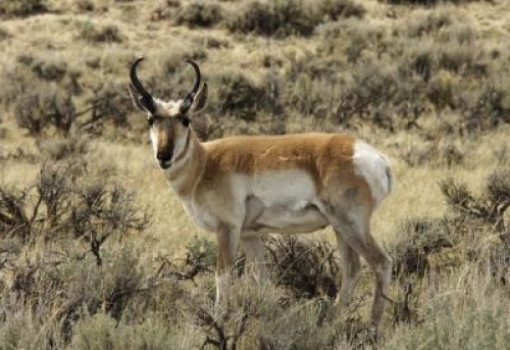
Yellowstone pronghorn populations directly benefit from the presence of wolves, a new Wildlife Conservation Society study says.
Credit: Julie Larsen Maher/Wildlife Conservation Society
MY FELLOW WOLF PRESERVATIONISTS, HAVE YOU EVER COME ACROSS AN ANTI-WOLF EXTREMIST WHO THINKS THEY KNOW EVERYTHING ABOUT WILDLIFE AND SWEAR UP AND DOWN THAT WOLVES ARE DECIMATING THEIR THE WILDLIFE? I know you have!
One such person is Bruce “Buckshot” Hemming, an author, native hunter, and possesses quite a large ego. If you’ve ever spoken or attempted to debate with him, you know this man resorts to foul language, insults, name calling, and even threats. Claiming to have over forty years of experience in the outdoors, his articles spout off skewed statistics, feedback from other wolf haters, and how effects of predation on wildlife “isn’t rocket science.” Well apparently for you Mr. Buckshot, it is rocket science for you. Leaving out the full story on predation, impacts of hunters, disease, and weather on prey numbers, bias opinions, misrepresented so called facts, he truly is passionate about what he represents. I will not share his website or book information, as he doesn’t deserve anymore public credit of his work.
I will however share one of his quotes and my rebuttal afterwards:
“Survival of pronghorn fawns was 22.2% in 2002 and 41.7% in 2003. Coyotes (Canis latrans) accounted for 50% of documented fawn death.” (guess what Bruce, previous removal of wolves off the endangered species list resulted in an unintended decline in the pronghorn. Wolves don’t typically hunt pronghorn but reduced the coyote population that do typically hunt them, therefore pronghorn fawns have higher survival rates when wolves are present in the ecosystem. His articles certainly do not focus on this fact about positive impacts that wolves have on the pronghorn. In a three year study, in areas where wolves were abundant, 34 percent of pronghorn fawns survived compared to 10% when they weren’t present. In addition, he fails to mentioned what percentage of hunting, disease, and weather affect pronghorn numbers.)
The following article was provided by Division of Fish and Wildlife, Minnesota Department of Natural Resources in 2009. It describes more of how things are not cut so black and white with predation, as Mr. Buckshot believes. It’s also an important reminder that we often don’t understand ecosystems nearly as well as we think we do, and that our efforts to manipulate them can have unexpected consequences, a concept Mr. Buckshot does not possess.
ENJOY THE ARTICLE BELOW!
“Is a robust wolf population responsible for waning deer harvests by hunters the last couple years?
Comments from some deer hunters in northern Minnesota following the 2009 deer season seem to
indicate that may be the case, but there is overwhelming scientific evidence that wolves alone have little
impact on the deer population in Minnesota. Winter severity, hunter harvest, and maturation of forest
habitat are all factors that contribute significantly to deer numbers in northern Minnesota. On a local
level hunter success may be affected by selection of an effective hunting area in relation to deer home
range use, seasonal movements of deer due to migration from summer to winter range, and reduced deer
densities in surrounding areas from increased harvest efforts. Overall, deer numbers in Minnesota
forests are a result of direct management through hunter harvest and are influenced by the high
reproductive potential of deer during mild years or the detrimental effects of severe winters.
There’s no question wolves in Minnesota rely on white- tailed deer as their primary prey source.
Based on research in Minnesota indicating that wolves require 15-19 adult- sized deer biomass equivalent per year (per wol
f), an estimated population of 3,000 wolves in Minnesota take approximately 45,000 to 57,000 deer per year.
Wolves also prey on moose in portions of the Superior National Forest and the Boundary Water Canoe Area in Minnesota
where deer tend to be less abundant. Wolves supplement their diet seasonally with smaller prey like beaver and snowshoe hare. These contributions to their diet are likely biologically significant during brief, specific times of the year, but
overall, they’re relatively minor compared to deer in most parts of the wolves’ range. Considering an
annual population estimate of 450,000 deer residing within all of Minnesota’s wolf range, the annual estimate of
45,000-57,000 deer taken by wolves, represents about 10-13% of that deer population. Minnesota Department of Natural Resources (MNDNR) wildlife researchers recently completed a comprehensive 15-year study of white-tailed deer that included monitoring the movements, survival, and specific causes of mortality of about 450 radio-collared, female white
tailed deer on four study areas…mostly does at least one year old, but including many fawns, even newborns, beginning at
several hours to about 7 days old. At the same time the researchers similarly monitored about 55
radio collared wolves from 7 to 8 packs with established territories covering the deer study areas.
Researchers learned a great deal from the data generated from this long term study. The long-term MN DNR
study concentrated on female deer (about 450 during the course of the study) , because there are more of them in the population, and due to their reproductive potential, they have a greater impact on population dynamics than the males. During the 15-year study, the annual mortality rate of female deer (not including newborns) attributable to wolf predation, ranged from 4% to 22%. The highest rate was observed in 1996 during the severe winter of 1995-1996, but most typically, the mortality rate of does attributable to wolf predation was closer to 5-10%. Additionally, what the data have shown is that the reason white-tailed deer can thrive, despite wolf predation and hunter harvests, is their strong population performance (survival capacity and reproductive success). The annual average age of females was 5.1 to 7.2 years old, and approximately 13% of the does were 10.5 to 18.5 years old. In the forest zone, on average, does live a lot longer than managers and researchers had ever thought. Coupled with that, the pregnancy rates are very high, 90% in yearlings, and 95-100% in does from 2.5 years old up to at least 15.5 years. Of the pregnant does, even the older ones, are mostly still having twins. Interestingly, the median age of survival of these deer is 0.8 years old, but in most cases, there is another fawn to add to the population. Following the challenges of the fawns’ first
(30 December 2009)
winter, there is typically an annual recruitment into the population of at least 35%. Consequently, even
after the significant challenges of the first year to the survival of the fawns, a high number are still added to the population.
U. S. Geological Survey (USGS) researchers studied the impact of predators on newborn fawns in northeastern Minnesota during two springs in the early 1990s. They had a rather limited sample size, but reported that predation by black bears and wolves were the primary causes of mortality (50% each) of newborn fawns. A similar study conducted by MN DNR researchers in springs 2000 and 2001, as part of the larger deer study in north-central Minnesota, documented, during these two fawning seasons that black bears, bobcats, and wolves accounted for 20.5%, 17.9%, and 3.9% of the mortality, respectively. However, two additional categories, “unknown predator” and “unknown cause” were assigned to 23.1% and 10.3%, respectively, of the fawn mortalities. These two categories were based on the evidence that was present/absent, which affected whether researchers could definitively assign a cause. Regardless, in the MN DNR study with a greater sample size, and where deer densities (and densities of newborn fawns, specifically) were notably higher than in northeastern Minnesota, the impact of wolves on fawn mortality was markedly less, but certainly, wolves may have been responsible for a portion of the fawn deaths assigned to “unknown predator.” Wolves are not particularly effective hunters of white-tailed deer. Despite the fact that deer outnumber wolves in Minnesota’s forest zone by some 150 : 1 (450,000 deer : 3,000 wolves), wolves must range and search widely over large pack territories (20 to 214 mi) to obtain the number of
deer they require to sustain their numbers over time. Indeed, studies have shown that most of their hunting
attempts are brief and unsuccessful, typically lasting a matter of only a few minutes. And so, as has been thoroughly documented scientifically and shared with the public , wolves live a “feast or famine” existence, eating little for up to two weeks at a time. Wolves end up surviving primarily on the most vulnerable individuals in the deer population,
such as very young, old, sick, injured, or nutritionally compromised deer, because those are the ones they can catch.
The result being, that under certain conditions, the impacts on the deer population are most likely compensatory rather than additive. That is, many of the deer that wolves kill likely would have died from other causes, such as starvation or
disease.
In conclusion, within Minnesota’s wolf range, the current wolf population relies on a relatively small
portion (10-13%) of the deer population to sustain itself annually. That and the rather extraordinary
population performance of white-tailed deer in most of northern Minnesota, dependent largely on a high
capacity for survival (particularly after one year of age) and high reproductive success, allow deer to thrive.”
Contact:
Dan Stark
Wolf Specialist
Division of Fish and Wildlife, Minnesota Department of Natural Resources
500 Lafayette RD, Box #20
St. Paul, MN 55155-4020
651-259-5175 dan.stark@state.mn.us
 The Wolf Preservation Blog
Again science shows what a complex environment we live in and when you interfere with it as hunters etc. do then it goes haywire.
Regards, Oliver Craig.