Feeds:
Posts
Comments

Archive for the ‘Facts and Figures’ Category


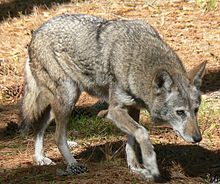
Red Wolf

Captive specimen at “Parks at Chehaw”, Albany GA, USA (RED WOLF)


coyote

From Yosemite National Park (COYOTE)

What is the Difference Between Red Wolves and Coyotes?

“Red Wolves and Coyotes are very closely related and in fact share a recent common ancestor.  The two species do hybridize and produce fertile offspring.  It is usually impossible to distinguish between a Coyote – Red Wolf hybrid and a Red Wolf just by looking at it.  Wildlife Biologists that work with the only known wild population of Red Wolves at Alligator River National Wildlife Refuge in North Carolina have to do DNA tests to be sure.

Red Wolves are a critically endangered species with only about 100 individuals existing in the wild in the world, all of them in the Alligator River NWR area of North Carolina.  Coyotes, although not found East of the Mississippi River prior to 1900, are now very common in the wild.

Red Wolves, as a species, are larger in both height and weight.  Coyotes usually weigh between 25 and 35 pounds while Red Wolves usually weigh between 50 and 80 pounds.  Red Wolves are more massive in the head, chest, legs and feet. There can be size overlap between the species.  Some Red Wolves are in fact smaller that some Coyotes.  Coyotes tend to have a longer, narrower, muzzle than Red Wolves do.

Red wolves are mostly brown and buff colored with some black along their backs; there is sometimes a reddish color behind their ears, on their muzzle, and toward the backs of their legs.  However, many Red Wolves can have the same colors as coyotes which tend to be light gray with some black on the tips of their outer hairs.

Red Wolves howls are similar to Coyotes but tend to be of longer duration and lower in pitch.  Coyotes tend to have more yapping intermixed with the howls.  Again, it can be almost impossible to tell the difference in some individuals.

It used to be believed that Coyotes didn’t hunt in packs like wolves but pack hunting coyotes have now been observed in the wild.

The Eastern Coyote is different from the Western Coyote in size, genetics and behavior.  This is due to interbreeding with wolves.  Eastern Coyotes have wolf genes and therefore are taking on wolf characteristics.  This happened when the wolf population in the Eastern United States was hunted almost to extinction and had dwindled to a small enough size that they would breed with Coyotes instead of chasing them off or killing them.

Red Wolves howls are similar to Coyotes but tend to be of longer duration and lower in pitch.  Coyotes tend to have more yapping intermixed with the howls.  Again, it can be almost impossible to tell the difference in some individuals.

If you are anywhere in Eastern North America, outside of coastal North Carolina, and observe a large wolf-like animal, it is almost certainly an Eastern Coyote or possibly a Gray Wolf  that someone had as a pet and dumped in the wild.”


**Special thanks to Chattanooga Arboretum Nature Center for providing this information!  http://www.chattanooganaturecenter.org/www/docs/133.251/

Read Full Post »


March 5th, 2014

“Many hunter organizations like to promote the idea that hunters were the first and most important conservation advocates. They rest on their laurels of early hunter/wildlife activist like Teddy Roosevelt, and George Bird Grinnell who, among other things, were founding members of the Boone and Crocket Club. But in addition to being hunter advocates, these men were also staunch proponents of national parks and other areas off limits to hunting. Teddy Roosevelt help to establish the first wildlife refuges to protect birds from feather hunters, and he was instrumental in the creation of numerous national parks including the Grand Canyon.  Grinnell was equally active in promoting the creation of national parks like Glacier as well as a staunch advocate for protection of wildlife in places like Yellowstone. Other later hunter/wildlands advocates like Aldo Leopold and Olaus Murie helped to promote wilderness designation and a land ethic as well as a more enlightened attitude about predators.

Unfortunately, though there are definitely still hunters and anglers who put conservation and wildlands protection ahead of their own recreational pursuits, far more of the hunter/angler community is increasingly hostile to wildlife protection and wildlands advocacy.  Perhaps the majority of hunters were always this way, but at least the philosophical leaders in the past were well known advocates of wildlands and wildlife.

Nowhere is this change in attitude among hunter organizations and leadership more evident than the deafening silence of hunters when it comes to predator management.  Throughout the West, state wildlife agencies are increasing their war on predators with the apparent blessings of hunters, without a discouraging word from any identified hunter organization. Rather the charge for killing predators is being led by groups like the Rocky Mountain Elk Foundation,  and others who are not only lobbying for more predator killing, but providing funding for such activities to state wildlife agencies.

For instance, in Nebraska which has a fledging population of cougars (an estimated 20) the state wildlife agency has already embarked on a hunting season to “control” cougar numbers.  Similarly in South Dakota, where there are no more than 170 cougars, the state has adopted very aggressive and liberal hunting regulations to reduce the state’s cougar population.

But the worst examples of an almost maniacal persecution of predators are related to wolf policies throughout the country. In Alaska, always known for its Neanderthal predator policies, the state continues to promote killing of wolves adjacent to national parks. Just this week the state wiped out a pack of eleven wolves that were part of a long term research project in the Yukon Charley National Preserve. Alaska also regularly shoots wolves from the air, and also sometimes includes grizzly and black bears in its predator slaughter programs.

In the lower 48 states since wolves were delisted from the federal Endangered Species Act and management was turned over to the state wildlife agencies more than 2700 wolves have been killed.

This does not include the 3435 additional wolves killed in the past ten years by Wildlife Services, a federal predator control agency, in both the Rockies and Midwest.  Most of this killing was done while wolves were listed as endangered.

As an example of the persecutory mentality of state wildlife agencies, one need not look any further than Idaho, where hunters/trappers, along with federal and state agencies killed 67 wolves this past year  in the Lolo Pass area on the Montana/Idaho border, including some 23 from a Wildlife Service’s helicopter gun ship. The goal of the predator persecution program is to reduce predation on elk. However, even the agency’s own analysis shows that the major factor in elk number decline has been habitat quality declines due to forest recovery after major wildfires which has reduced the availability of shrubs and grasses central to elk diet. In other word, with or without predators the Lolo Pass area would not be supporting the number of elk that the area once supported after the fires. Idaho also hired a trapper to kill wolves in the Frank Church/River of No Return Wilderness to increase elk numbers there.

Idaho hunters are permitted to obtain five hunting and five trapping tags a year, and few parts of the state have any quota or limits. Idaho Governor Butch Otter recently outlined a new state budget allotting $2 million dollars for the killing of wolves—even though the same budget cuts funding for state schools.

Other states are no better than Idaho. Montana has a generous wolf six month long season. Recent legislation in the Montana legislature increased the number of wolves a hunter can kill to five and allows for the use of electronic predator calls and removes any requirement to wear hunter orange outside of the regular elk and deer seasons. And lest you think that only right wing Republican politicians’ support more killing, this legislation was not opposed by one Democratic Montana legislator, and it was signed into law by Democratic Governor Steve Bullock because he said Montana Dept of Fish, Wildlife and Parks supported the bill.

Wyoming has wolves listed as a predator with no closed season or limit nor even a requirement for a license outside of a “trophy” wolf zone in Northwest Wyoming.

The Rocky Mountain West is known for its backward politics and lack of ethics when it comes to hunting, but even more “progressive” states like Minnesota and Wisconsin have cow-towed to the hunter anti predator hostility. Minnesota allows the use of snares, traps, and other barbaric methods to capture and kill wolves. At the end of the first trapping/hunting season in 2012/2013, the state’s hunters had killed more than 400 wolves.

Though wolves are the target species that gets the most attention, nearly all states have rabid attitudes towards predators in general. So in the eastern United States where wolves are still absent, state wildlife agencies aggressively allow the killing of coyotes, bears and other predators. For instance, Vermont, a state that in my view has undeserved reputation for progressive policies, coyotes can be killed throughout the year without any limits.

These policies are promoted for a very small segment of society. About six percent of Americans hunt, yet state wildlife agencies routinely ignore the desires of the non-hunting public. Hunting is permitted on a majority of US Public lands including 50% of wildlife “refuges as well as nearly all national forests, all Bureau of Land Management lands, and even a few national parks. In other words, the hunting minority dominates public lands wildlife policies.

Most state agencies have a mandate to manage wildlife as a public trust for all citizens, yet they clearly serve only a small minority. Part of this is tradition, hunters and anglers have controlled state wildlife management for decades. Part of it is that most funding for these state agencies comes from the sale of licenses and tags. And part is the worldview that dominates these agencies which sees their role as “managers” of wildlife, and in their view, improving upon nature.

None of these states manage predators for their ecological role in ecosystem health. Despite a growing evidence that top predators are critical to maintaining ecosystem function due to their influence upon prey behavior, distribution and numbers, I know of no state that even recognizes this ecological role, much less expends much effort to educate hunters and the public about it. (I hasten to add that many of the biologists working for these state agencies, particularly those with an expertise about predators, do not necessarily support the predator killing policies and are equally appalled and dismayed as I am by their agency practices.)

Worse yet for predators, there is new research that suggests that killing predators actually can increase conflicts between humans and these species. One cougar study in Washington has documented that as predator populations were declining, complaints rose. There are good reasons for this observation. Hunting and trapping is indiscriminate. These activities remove many animals from the population which are adjusted to the human presence and avoid, for instance, preying on livestock. But hunting and trapping not only opens up productive territories to animals who may not be familiar with the local prey distribution thus more likely to attack livestock, but hunting/trapping tends to skew predator populations to younger age classes. Younger animals are less skillful at capturing prey, and again more likely to attack livestock. A population of young animals can also result in larger litter size and survival requiring more food to feed hungry growing youngsters—and may even lead to an increase in predation on wild prey—having the exact opposite effect that hunters desire.

Yet these findings are routinely ignored by state wildlife agencies. For instance, despite the fact that elk numbers in Montana have risen from 89,000 animals in 1992 several years before wolf reintroductions to an estimated 140,000-150,000 animals today, Montana Department of Fish, Wildlife and Parks does almost nothing to counter the impression and regular misinformation put forth by hunter advocacy groups like the Rocky Mountain Elk Foundation or the Montana Sportsmen for Fish and Wildlife that wolves are “destroying” Montana’s elk herds.

I have attended public hearings on wolves and other predator issues, and I have yet to see a single hunter group support less carnivore killing.  So where are the conservation hunters? Why are they so silent in the face of outrage? Where is the courage to stand up and say current state wildlife agencies policies are a throw-back to the last century and do not represent anything approaching a modern understanding of the important role of predators in our ecosystems?

As I watch state after state adopting archaic policies, I am convinced that state agencies are incapable of managing predators as a legitimate and valued member of the ecological community. Their persecutory policies reflect an unethical and out of date attitude that is not in keeping with modern scientific understanding of the important role that predators play in our world.

It is apparent from evidence across the country that state wildlife agencies are incapable of managing predators for ecosystem health or even with apparent ethical considerations.  Bowing to the pressure from many hunter organizations and individual hunters, state wildlife agencies have become killing machines and predator killing advocates.

Most people at least tolerant the killing of animals that eaten for food, though almost everyone believes that unnecessary suffering should be avoided. But few people actually eat the predators they kill, and often the animals are merely killed and left on the killing fields. Yet though many state agencies and some hunter organizations promote the idea that wanton waste of wildlife and unnecessary killing and suffering of animals is ethically wrong, they conveniently ignore such ideas when it comes to predators, allowing them to be wounded and left to die in the field, as well as permitted to suffer in traps.  Is this ethical treatment of wildlife? I think not.

Unfortunately unless conservation minded hunters speak up, these state agencies as well as federal agencies like Wildlife Services will continue their killing agenda uninhibited. I’m waiting for the next generation of Teddy Roosevelts, Aldo Leopolds and Olaus Muries to come out of the wood work. Unless they do, I’m afraid that ignorance and intolerant attitudes will prevail and our lands and the predators that are an important part of the evolutionary processes that created our wildlife heritage will continue to be eroded.”

**Special thanks to   ecologist and former hunting guide with a degree in wildlife biology, for providing this information (http://www.thewildlifenews.com/2014/03/05/whither-the-hunterconservationist/)

Read Full Post »


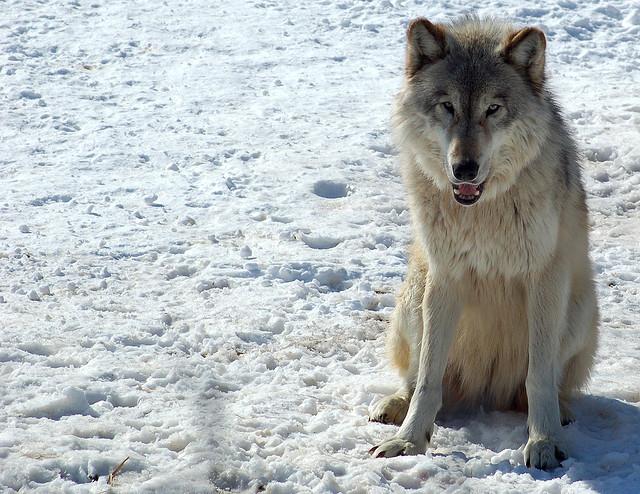
Big Snow Wolf


Photo courtesy of Derek Bakken

“This week’s legislative hearing on wolf management by the Minnesota Department of Natural Resources roamed all over the landscape, topically and philosophically, but for me the most interesting portions centered on “depredation conflicts.”

That’s a wildlife manager’s term for losses of livestock and pets, and you will recall that reducing those losses has been a significant rationale for the sport trapping and hunting seasons inaugurated in the fall of 2012.

But are the seasons working? In a solid three hours of testimony, I didn’t hear a single indication that the killing of 562 wolves by sportsmen, and another 430 by government agents and landowners, and who knows how many by poachers, is having an effect at all. Or ever will.

Whether Tuesday’s testimony before the House Committee on Environment and Natural Resources will have any effect on state policy is equally dubious; it was an “informational hearing” only, and no legislation to change course is under consideration. An effort last year to suspend the hunt for rethinking went nowhere.

Dan Stark, the large-carnivore specialist who heads the wolf program at DNR, was the department’s main presenter. He told the panel that, in fact, the incidence of verified wolf depredation in 2013 was significantly lower than in 2012.  But it was probably just the weather:

One explanation could be that we had an extended winter last year. There is some correlation between winter severity and depredation conflicts, so when we have a severe winter, typically the following summer we see fewer conflicts; when we have a mild winter, we typically see higher depredation conflicts.

The numbers on depredation

Here’s the statistical breakdown for both years:

In 2012, which marked not only the beginning of the hunt but also the transfer of intensive government trapping for depredation control from federal authority to the DNR,122 complaints of wolves killing livestock or pets were verified and 295 wolves werekilled in response.

Of these, 262 were trapped by the DNR; 17 were trapped, and 16 shot, by landowners empowered to kill wolves on the basis of losses within the past five years.

In 2013, only 70 complaints were verified and 135 wolves killed.

Of these, 110 were trapped by the DNR; 4 more were trapped and 8 shot by landowners under the five-year rule; another 130 were killed by state-employed trappers in a new  program begun last year.

For comparison purposes, sport trappers and hunters reported taking 413 wolves in 2012 and 149 in 2013, somewhat more than the DNR’s targets of 400 and 132.

The 2012 tally of wolves killed over depredation, Stark said, was the highest in state history. But for 2013, “this level of depredation conflicts and wolves trapped has probably not been observed since the early 1990s.”

Those characterizations drew a pointed rebuttal, after the hearing, from Maureen Hackett, founder of Howling for Wolves.

She provided me with U.S. Department of Agriculture data from the period 1996 through 2011, when the feds were in charge, and the data do show that in six of those 16 years, the numbers of wolves killed for depredation control were smaller than the 135 Stark had cited as a low-water mark in 2013. All six were in the current millennium.

However, the figure of 70 verified depredation complaints for 2013 —65 livestock, mostly calves, and 5 pets —does seem to represent at least a near-record low. Only once from 1996 through 2011 did USDA record a lower total; and the annual average in this period was about 50 percent higher, by my calculation, at 107.

Small losses, proportionally

At this point you may be thinking: Huh—70 animals lost in a year (or 107, take your pick), and this is a big honking problem?

Precisely that point was highlighted by Howard Goldman, senior state director in Minnesota for the Animal Humane Society of the U.S. He pointed out that there are 165,000 calves in Minnesota’s wolf range, which maybe kinda dwarfs a loss of 65 to depredation.

Turning again to my trusty calculator, I find that if Goldman’s calf count is correct, the casualties reported by Stark represent a loss rate of .00039 percent.

Goldman’s testimony prompted a sharp rejoinder from Rep. Tony Cornish, R-Vernon Center, who used to be a DNR conservation officer and investigated complaints about depredating wolves. He said it was “bogus” to rely on the figure of 65 livestock kills because the real losses could be three or four times higher than what investigators can verify.

Which, if true, could mean a loss rate as high as .00157 percent.

The USDA figures supplied by Hackett show that, typically, half to two-thirds of reported depredation kills are verified.

Responding to friendly questions from Rep. Tom Hackbarth, R-Cedar, Stark said that the DNR spent $250,000 on depredation control in 2012, nearly all of it for the trapping.

He also noted that this amount doesn’t include compensation payments for confirmed livestock losses. That’s a program in the state Agriculture Department, and in 2012 it paid out $119,659 on 81 complaints. In fiscal year 2013, the payout was $113,714 on 94 complaints.

Asked by Rep. Jason Isaacson, DFL-Shoreview, if the department was putting any effort into “nonlethal control” — better livestock protections and wolf-deterrent methods that have been shown to work in some situations — Stark said the department is working on a brochure.

Few poaching cases

Rep. Rick Hansen, DFL-South St. Paul, was curious about how much effort has been required of the DNR to address wolf poaching — which I suppose could be considered a form of reverse depredation by humans.

His question brought the DNR’s enforcement chief, Maj. Phil Meier, to the microphone, who said there were six cases in 2012, zero in 2013. Titters from the audience ensued.

Meier was unable to say how the cases were prosecuted or what the penalties were. Hansen observed that with the beginning of sport seasons, the Legislature had lowered the restitution value of poached wolves from $2,000 to $500.

Because non-DNR speakers were held (rigorously) to three-minute time limits on their remarks — just what you want in an informational session — some of the most interesting testimony was cut off just as it was getting started.

For example, there was Adrian Treves of the University of Wisconsin at Madison, a Ph.D. ecologist whose focus is on predator-prey ecology and wolves in particular, and who has been watching closely the resumption of sport trapping and hunting in Minnesota, Wisconsin and Michigan.

‘We just don’t know’

He and colleagues have developed methods of predicting with 91 percent accuracy where depredations will occur, he said, and half of them occur on just 7 percent of the land in Wisconsin. This predictive power has led him to advocate, “as a scientist, for a scientifically designed hunt in Wisconsin which would target specifically livestock depredators.”

Treves was just getting going when his time ran out, but he was called back toward the end of the hearing and asked for his opinion about how sport trapping and hunting affect depredation. His answer was worth the wait:

“We do not have any experimental studies of that question … So the strict scientific answer is, We don’t know.”

It’s not even clear, he said, that “lethal control” programs of intensive trapping in areas of high livestock losses, of the type federal agencies and now the DNR have relied upon in Minnesota, are very effective in reducing depredation.

The best study to date of correlations between federal trapping programs and depredation rates was led by the DNR’s Elizabeth Harper, he said, but “it doesn’t have very strong conclusive results.”

“There are a lot of opinions out there,” he said. “But we just don’t know.”

This is perhaps the point that matters most to Hackett and others who are urging the DNR to consider undertaking efforts to promote nonlethal controls.

“We know a lot about how to kill wolves,” she told me. “The question is whether we can ever learn to live with them.”

**Special thanks to Ron Meador, MinnPost Earth Journal, for providing this information!  (http://www.minnpost.com/earth-journal/2014/01/does-wolf-hunt-reduce-livestock-losses-maybe-not-lawmakers-are-told)

Read Full Post »

gw

George Wuerthner, Author

“WOLF KILLING MAKES MOCKERY OF NORTH AMERICAN MODEL OF WILDLIFE CONSERVATION

Many state wildlife agencies and organizations promote the North American Model of Wildlife Conservation (NAMWC) as a guiding philosophy for management.  There are seven major themes to the model. Despite the promotion of NAMWC, there are many apparent contradictions between the ideal and how wildlife is actually managed by state wildlife agencies.

SEVEN THEMES OF THE NORTH AMERICAN MODEL OF WILDLIFE CONSERVATION

  1. One of the most important ideas articulated by the NAMWC is that wildlife is a public trust and must be managed for all citizens. No one can “own” wildlife.
  2. Commercial hunting of wildlife is prohibited (but not trapping which is one of the obvious contradictions).
  3. Public participation is essential in development of wildlife management policies.
  4. The recognition that many wildlife species are of international importance, therefore, Americans have an obligation and responsibility to manage wildlife as an international heritage.
  5. Science should be used to articulate management policies.
  6. A philosophical and legal ban on wasteful and frivolous killing of wildlife.
  7. Hunting is a legitimate use of wildlife.

There are many good aspects of the NAMWC. However, just as the authors of the Declaration of Independence declared all “men are created equal”, and the United States has not fully lived up to this commendable goal, there are aspects of wildlife management policy that state wildlife agencies advocate that do not live up to the admirable goals of the NAMWC. Nowhere is this more obvious than the attitudes and policies directed towards predators like wolves.

THE INFLUENCE OF HUNTERS ON WILDLIFE POLICY

NAMWC proponents are quick to promote the idea that recreational hunters “saved” wildlife, and are the primary interest group in promoting wildlife conservation.

There is some truth to the assertion. Enlightened hunters like Theodore Roosevelt, George Bird Grinnell, Gifford Pinchot and others joined together to form the Boone and Crockett Club that among other things promoted recreational hunting to counter the destructive effects of market hunting and unrestricted subsistence hunting. They promoted the idea of the “fair chase” and the “trophy” hunt to counter unrestricted hunting. To facilitate such hunting ethics the Boone and Crockett Club promoted restrictions on how many animals could be killed, season of hunting and other changes that once implemented did result in a recovery of so called “game” species like elk and deer.

It should also be noted, however, that these early hunter/conservationists like Grinnell and Roosevelt were also some of the strongest proponents for creation of national parks and wildlife refuges that were closed to hunting. That is a position that is missing today from many hunting organizations and state wildlife agencies who almost uniformly oppose creation of new parks or other preserves if hunting is excluded.

In addition, advocates of the NAMWC argue that since hunters are the major financial supporters of wildlife management, they deserve significant voice in management policy. In fact, most state wildlife agencies, though by law are required to manage wildlife as a public trust for all citizens, tend to make their decisions  that favor species that hunters and fishers value.

Certainly hunters, through their purchase of licenses and tags are also one the major source of funding for state wildlife agencies formerly known as Fish and Game Departments. And state wildlife agencies tend to “dance with the one that brung ya.” In other words, they respond to the opinions of hunters to the exclusion of other wildlife enthusiasts.

However, all taxpayers (which includes hunters of course) in general pay for habitat acquisition, and protection of wildlife through their support of public lands where a significant majority of all wildlife resides as well as payment for programs like the Conservation Reserve Program which promotes habitat protection on private lands. Many environmental laws that ultimately protect and preserve wildlife like the Endangered Species Act, Clean Water Act, and others are supported and funded by the general public.

One of the major weaknesses of the current polities of state agencies is the bias towards huntable wildlife. Some 99% of all other wildlife is ignored and suffers benign neglect, or worse. In many instances, the active management and enhancement of huntable species comes at the expense of other wildlife that are negatively impacted by species of interest to hunters. For instance, wild boars are commonly sustained by state wildlife agencies because hunters like to pursue them. Yet these wild pigs root up vegetation, prey on native species like salamanders, and otherwise degrade native wildlife populations. For this reason the National Park Service seeks to limit or remove wild boars from its lands, all the while state wildlife agencies are thwarting their efforts by transplanting and otherwise seeking to enhance boar hunting opportunities.

STATE WILDLIFE AGENCIES VIOLATE MAIN THEMES OF NAMWC

Clearly, however, many state agencies promote activities that violate these main themes and are detrimental to wildlife in general.  For instance, prairie dogs are regularly blown away by some to see the “red mist” of their blood hanging in the sky. This killing of prairie dogs is ostensibly justified by some to rid the land of “vermin” or animals that conflict with say ranchers or farmers.  Yet numerous studies have documented the importance of prairie dogs in supporting many other wildlife species from blackfooted ferret to burrowing owls.

The stocking of streams and lakes with exotic but popular “game” fish has often harmed native fish species and other wildlife. For instance, the practice of stocking formerly fishless high elevation lakes has been shown to decimate frogs and salamanders residing in those waters.

The transplanting of exotic game species like mountain goats into ranges with no history of the goats has led to overgrazing and impoverishment of alpine flora in some cases.

These are only a few of the examples of policies commonly employed by state wildlife agencies that are detrimental to biodiversity and ecosystem function.

However, perhaps the most significant and obvious conflict between the goals of the NAMWC and actual behavior of state agencies has to do with management of predators, particularly bears, cougars, coyotes and wolves. State wildlife agencies have a financial conflict of interest that makes it impossible for them to manage predators with regards to the wider public values. In most instances, hunters perceive predators as detrimental to hunting—even though there is plenty of evidence that predators seldom depress wildlife populations across the broader landscape. As a result of the funding mechanisms whereby state agencies rely on hunter purchase of hunting tags to maintain operations, these bureaucracies are not going to promote predators in the face of opposition from hunters.

This leads to obvious conflicts with the NAMWC prohibition against the frivolous killing and waste of wildlife.

Given that few hunters actually consume coyotes, wolves, cougars, and except for a few individuals, even bears, it is obviously a “waste” of wildlife to shoot or trap these animals just for “fun.”

Worse, these policies tend to ignore the growing body of evidence that suggests a significant ecological importance for these animals in maintaining ecosystem health. For instance, in some instances, fear of predators will change the behavior of herbivores like elk and deer, forcing them to use different habitat, for instance, avoiding heavy browsing of riparian areas. This in turn has been shown to increase habitat for songbirds and improve aquatic ecosystems for fish.

There are also social effects from the killing of predators. For instance, older and dominant male cougars have large territories they patrol. They will kill young male cougars that trespass in these territories to reduce competition. Thus the death of a dominant male cougar can permit younger less experienced cougars to occupy a territory. Inexperienced cougars are more likely to attack livestock, thus leading to greater human conflicts.

Trapping of predators or other animals is obviously a commercialization of wildlife. Why should a trapper have the exclusive “right” to kill say otter or marten that the rest of society might value alive? Commercial outfitting is perilously close to commercialization of wildlife as well, especially in states where exclusive rights to kill wildlife in specific areas are granted.

Some proponents of hunting and trapping of predators like wolves or bears argue that if these animals are hunted and trapped, they will  garner greater  support among hunters for their persistence. But that is somewhat like arguing that if people could own slaves, they would have more incentive to give food and shelter to people who might otherwise be homeless if free.

DO WE NEED TO REMOVE PREDATOR MANAGEMENT FROM STATE WILDLIFE CONTROL?

One increasingly popular idea is to remove management authority for predators from state wildlife agencies. Some suggest transferring it to other state agencies with less obvious conflict of interest such as environmental or park agencies. Another idea is to change funding mechanisms for state wildlife agencies giving them more general state tax support under the theory that this would provide an incentive for state wildlife agencies to pay attention more to non-hunter concerns. A third option has been to keep management of predators under federal authority by the National Park Service which has a mandate to manage lands and wildlife for more natural conditions.

All of these ideas have their weaknesses and potential flaws. Whether any of these could ultimately alter the way predators are managed by government agencies is questionable. However, we definitely need to challenge the traditional collusion between hunters and state agencies if the NAWMC is realize its full potential for preserving and enhancing all wildlife conservation in the United States.”

**Special thanks to George Wuerthner is an ecologist and former hunting guide with a degree in wildlife biology, for providing this information (http://www.thewildlifenews.com/2013/10/14/north-american-model-of-wildlife-conservation-and-wolves/).

Read Full Post »


Wolves and Willows

“The top photo……from a paper by Ripple and his colleague Robert Beschta, was taken in 1991; the photo below is from 2002 and illustrates the recovery of streamside cottonwoods after just seven years of wolf presence.”…Todd Palmer and Rod Pringle

October 9, 2013

“Wolves are being slaughtered left and right but that’s not enough for the wolf haters. They still  find it necessary to visit this blog and spew their anti wolf dogma. The main talking points are centered around the sub species of wolf reintroduced in 95/96.  The story goes that Occidentalis is the big, bad Canadian wolf who replaced the sweet, loving Irremotus. That of course is BS. Yes, Occidentalis was the sub species reintroduced to Yellowstone and Central Idaho..but the myth that they are super wolves is absolutely ridiculous. Wolves are wolves, apex predators who are vital to healthy Eco-systems.

Unlike human hunters, who kill the strongest and genetically sound animals, wolves select out the weak, sick, old and yes sometimes the young, which  helps control ungulate populations. Wolves don’t hide behind AR-15′s, they go toe to toe with their prey, that’s fair chase. Human hunters use heavy firepower, traps, snares and every sneaky trick in the book to torture, abuse, maim and kill animals.  Trophy hunters have nothing to be proud of. NOTHING! They wouldn’t be such big, brave “hunters” if they were limited to using their bare hands. Fair chase my a@%.

Canus lupis Irremotus are very similar to Canis Lupus Occidentalis, who are a bit heavier but still both sub species are wolves. They live in packs, hunt cooperatively and put family above all else.

“Canis Lupus Irremotus…..This subspecies generally weighs 70–135 pounds (32–61 kg) and stands at 26–32 inches, making it one of the largest subspecies of the gray wolf in existence. It is a lighter colored animal than its southern brethren, the Southern Rocky Mountains wolf, with a coat that includes far more white and less black. In general, the subspecies favors lighter colors, with black mixing in among them”…..Wiki

Occidentalis has always lived on both sides of the Northern Rockies US/Canadian border, since wolves know no boundaries. Anyone who believes otherwise is living in a fantasy world.  The idea that Occidentalis is foreign to American soil is absurd. They’ve been crossing back and forth across that “border” for tens of thousands of years.

The burning question I have for the professors of wolfology is if Irremotus was loved so much, why the hell did their wolf hating forefathers try to wipe them out?  Of course  attempting to reason with the unreasonable is an exercise in futility, so I don’t expect a cogent response to that question.

The other favorite talking point of wolf haters is the Yellowstone elk herd. Wolves are accused of decimating the elk in Yellowstone, when in fact it was the feds who were killing Yellowstone elk for decades, in the wolf’s absence, due to the damage elk were wreaking in the park.

“Once the wolves were gone the elk began to take over. Over the next few years conditions of Yellowstone National Park declined drastically. A team of scientists visiting Yellowstone in 1929 and 1933 reported, “The range was in deplorable conditions when we first saw it, and its deterioration has been progressing steadily since then.” By this time many biologists were worried about eroding land and plants dying off. The elk were multiplying inside the park and deciduous, woody species such as aspen and cottonwood suffered from overgrazing. The park service started trapping and moving the elk and, when that was not effective, killing them. This killing continued for more than 30 years. This method helped the land quality from worsening, but didn’t improve the conditions. At times, people would mention bringing wolves back to Yellowstone to help control the elk population. The Yellowstone managers were not eager to bring back wolves, especially after having so successfully ridding the park of them, so they continued killing elk. In the late 1960s, local hunters began to complain to their congressmen that there were too few elk, and the congressmen threatened to stop funding Yellowstone. Killing elk was given up as a response, and then the population of the elk increased exponentially. With the rapid increase in the number of elk, the condition of the land again went quickly downhill. The destruction of the landscape affected many other animals. With the wolves gone, the population of coyotes increased dramatically, which led to an extreme decrease in the number of pronghorn antelope.However, the increase in the elk population caused the most profound change in the ecosystem of Yellowstone after the wolves were gone.”.…..Wiki

Elk numbers had swelled to over twenty thousand while wolves were away…a very bad thing for Yellowstone. As Aldo Leopold so eloquently states in Thinking Like A Mountain:

“I have lived to see state after state extirpate its wolves. I have watched the face of many a newly wolfless mountain, and seen the south-facing slopes wrinkle with a maze of new deer trails. I have seen every edible bush and seedling browsed, first to anaemic desuetude, and then to death. I have seen every edible tree defoliated to the height of a saddlehorn. Such a mountain looks as if someone had given God a new pruning shears, and forbidden Him all other exercise. In the end the starved bones of the hoped-for deer herd, dead of its own too-much, bleach with the bones of the dead sage, or molder under the high-lined junipers.

“I now suspect that just as a deer herd lives in mortal fear of its wolves, so does a mountain live in mortal fear of its deer. And perhaps with better cause, for while a buck pulled down by wolves can be replaced in two or three years, a range pulled down by too many deer may fail of replacement in as many decades. So also with cows. The cowman who cleans his range of wolves does not realize that he is taking over the wolf’s job of trimming the herd to fit the range. He has not learned to think like a mountain. Hence we have dust-bowls, and rivers washing the future into the sea.”

Do your homework wolf haters and stop parroting talking points drilled into your heads by the hunting and ranching cabal.”

**Special thanks to “Howling for Justice” for providing this information! (http://howlingforjustice.wordpress.com/2013/10/09/more-stupidity-from-the-fringe/)

Read Full Post »


Bull Elk

Photo credit goes to Perry Backus, Ravalli Republic

March/2012

“DARBY – The cow elk captured and collared last year in the southern reaches of the Bitterroot Valley have done their part to create a map for researchers to study the animals’ migratory patterns.

Some of the early results have been surprising.

One elk traveled from the East Fork of the Bitterroot almost to Wise River and back in the course of the year. Others hardly moved at all.

The effort is part of an ongoing three-year Montana Fish, Wildlife and Parks and University of Montana study looking at elk and predator dynamics in the area.

The 44 elk were fitted with GPS collars that recorded their location every two hours. At the end of the year, the collars were designed to fall off the animals’ necks during the second week of January.

When the collars hit the ground, they transmitted a mortality signal that allowed researchers to locate and retrieve the devices.

In some cases that retrieval proved challenging, said lead researcher Kelly Proffitt.

“We had some that dropped off at high elevations, which made it more difficult for us to retrieve them,” Proffitt said. “I was a little surprised that they were that high this time of year, but we are having a little milder winter.”

With the collars collected so far, Proffitt said the most surprising move was the cow elk that traveled to Fish Trap Creek in the Big Hole, which is almost to Wise River.

“We knew that there would be some movement between the Big Hole and (hunting district) 270, but we didn’t know for sure how far they traveled,” she said. “That was more movement than I was expecting to see.”

Most of elk captured in the East Fork that weren’t on the CB Ranch migrated south into the Lost Trail Pass area or into the Big Hole for the summer months.

Only one of the five animals captured on the CB Ranch migrated very far from that property during the summer months.

“The others stayed there pretty much year round,” Proffitt said. “We really weren’t sure what to expect. For the most part, those animals stayed put.”

So far, researchers have only been able to collect three radio collars from elk in the West Fork. None of those migrated into Idaho during any part of the year.

“It’s really hard to say much about the West Fork at this point,” Proffitt said. “Hopefully, we’ll get five or six more radios out in that area later on this year.”

Of the cow elk collared last year, only two died from predation. A mountain lion killed one and it appeared that wolves killed another. Four died from natural causes.

Researchers collared a new contingent of 40 cow elk this winter that will be tracked over the course of this year.

Proffitt said the distribution of the collars was moved a little bit in an effort to fill in some blank spots on the map from this year.

The research team is continuing to collect information about predation on elk calves.

The team captured and tagged 97 elk calves this year.

By late February, 38 of those calves were found dead. Mountain lions had killed 13. Black bear and wolves had each killed four.

There was not enough evidence for researchers to make a call at the kill site for another 11 of the calves that were found dead.

“We saw a small increase in wolf kills in the West Fork as we came into winter,” Proffitt said. “There has been steady predation by lions throughout the study period.”

**Special thanks to PERRY BACKUS – Ravalli Republic, for providing this information!  (http://missoulian.com/news/state-and-regional/results-of-bitterroot-elk-study-surprise-scientists/article_45ebd52c-7231-51c0-b301-6fbbacb5f7e3.html)

Read Full Post »


wolves isyle royale

A pack of gray wolves on Isle Royale National Park in northern Michigan in 2006. (Photo provided by John Vucetich / Michigan Technological University)

From The Detroit News: http://www.detroitnews.com/article/20130924/POLITICS02/309240094#ixzz2g32jxr2b

“Opponents of Michigan’s upcoming wolf hunt say data used to justify the program are skewed by events at one cattle farm in Ontonagon County.

In November, as many as 1,200 hunters will take to three designated areas in the Upper Peninsula for the first sanctioned wolf hunt in roughly half a century. State officials approved the controversial hunt after wolf-livestock incidents increased in recent years. Licenses will go on sale at noon Saturday.

But members of Keep Michigan Wolves Protected, a group that has lobbied against the hunt, say the statistics are bolstered by a single cattle farm near Matchwood owned by John Koski. According to the organization:

■ 73 percent of the 78 wolf-livestock incidents in Area B of the designated wolf hunt zones involved cattle from Koski’s farm between 2010 and 2013.

■ 80 percent of all livestock killed in Area B during that period were from Koski’s farm.

■ 64 percent of all cattle killed by wolves in the Upper Peninsula since 2013 came from Koski’s farm.

Jill Fritz of Keep Michigan Wolves Protected said the statistics paint an inaccurate picture of how bad the wolf situation is in the Upper Peninsula. Koski’s failure to take even basic steps to protect his animals makes that situation look worse, she said.

“(Koski) has basically set up a smorgasbord for predators on his farm — leaving carcasses around, not putting up fencing,” she said. “He’s basically putting out a welcome mat for predators of all kinds.”

Gray wolves had been on the U.S. Fish and Wildlife Service’s endangered species list for almost four decades before they were removed in early 2012. During that span, the population in Michigan grew from a handful to 658.

Gov. Rick Snyder signed Public Act 520 that allowed a wolf hunt — something many state residents felt was necessary to contain the growing wolf population.

Koski could not be reached for comment Tuesday. Michigan Department of Natural Resources officials confirmed there are steps the farmer could take to potentially decrease the number of wolf attacks on his property, but he has done nothing considered illegal.

Brian Roell, a DNR wildlife biologist, said taking Koski’s farm out of the equation would not alter the need for the hunt.

“We’ve had 13 total farms, just since 2010, that have had depredation, just in that management area alone,” he said. The areas designated for the hunt were based on “places where they were having (wolf-livestock) conflict, not the severity of the conflict.””

 jlynch@detroitnews.com
(313) 222-2034


Read Full Post »


Wisconsin Wolf

A collared gray wolf in Wisconsin. Photo courtesy of Michele Woodford.

“The Wisconsin Department of Natural Resources boasts: “We rank first in the country for the highest single year deer harvest on record and are number one for deer harvest over the past decade. All of us work hard to keep it that way.”

Yet, according to a new article, Limited deer hunt may happen in three area communities, deer populations are doing too well in some parts of Wisconsin. Ironically, the state DNR is also keen to “control” (read: kill off) their wolf population through hunting and trapping, in part because wolves prey on deer. How contradictory is that?

Ashwaubenon, Allouez and De Pere considering deer population control measures

A limited deer hunt could take place in 2014 in parts of Allouez, Ashwaubenon and De Pere if local officials decide the population is too big for the area.

The municipalities hope to survey the deer population this winter in response to complaints from residents, who said the animals are damaging gardens and creating traffic hazards in certain neighborhoods. But they’re working slowly with this issue, which could prompt worries about safety, objections from animal-rights groups and other potential roadblocks.

Meanwhile, officials in the communities say they’re hearing from growing numbers of residents who don’t like deer grazing in their gardens, or having large animals darting across residential streets.

“We’ve certainly had more sightings of larger groups this year,” said Rex Mehlberg, Ashwaubenon’s director of parks, recreation and forestry. “People are seeing six, eight, 10 of them at a time. One group was 14 or 15.”

Local officials stress that no decisions have been made about whether they would allow a hunt, and that hunting would not take place in parts of town where people would be at risk. First, they would have to decide if they want to do a count of deer by helicopter this winter. The survey cost, estimated at $2,000, would be shared between the communities and likely would be funded in part through a grant.

De Pere officials are scheduled Oct. 1 to discuss funding for the study, said Parks, Recreation and Forestry Director Marty Kosobucki. he said the city also has discussed setting aside some money in its 2014 budget to clover part of the cost of a survey.

In Northeastern Wisconsin and elsewhere, complaints about deer have grown as communities have sprawled into areas that were once rural. Two Rivers was set to vote Monday night on allowing a limited bow hunt this fall. “

**Special thanks to “Exposing the Big Game,” http://exposingthebiggame.wordpress.com/2013/09/17/wisconsin-1-for-deer-harvest/, for providing this information!

Read Full Post »


Wolfman

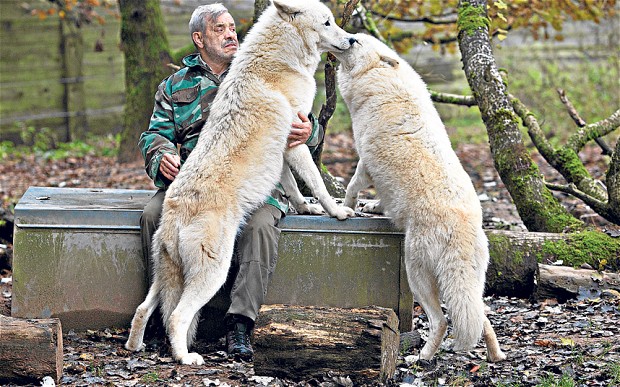
Packing a punch: Werner Freund with members of his wolf family, which includes distinctive white Arctic wolves  Photo: ROGER ALLEN/NORTH DOWNS PICTURE AGENCY

December 10th, 2012:

“The wolf has long been a creature of terror and mystery. With its sleek fur, fangs and spine-chilling howls, it is the stuff of nightmares and fairy tales that end badly. But the animal is making a comeback on mainland Europe, particularly the grey wolf, after centuries of human mistrust that has driven it to the brink of extinction. From the Balkans to the forests near Berlin, and from the heel of Italy to the outskirts of Prague, wolves are roaming wild once more as part of carefully managed programmes to halt their decline. Last month night-vision cameras picked up a pack of grey wolves just 15 miles from the centre of the German capital, moving stealthily through the countryside in pursuit of prey.

For one man, however, the wolf and its return is a cause for celebration rather than fear. Werner Freund, an 80-year-old former German paratrooper, has spent the past 40 years determined to dispel the negative myths that surround the animal. Known as the Wolfman, Freund runs a sanctuary in the small German town of Merzig near the border with Luxembourg, where he walks freely among 29 wolves, wearing an old parachute smock reeking of animal fat and blood. Kevin Costner may have enjoyed a light celluloid foxtrot with them in the Hollywood movie Dances With Wolves, but Werner transforms himself into the alpha male of the pack. “To earn their respect, one must become a wolf, and that is what I am to them – their leader,” he says.

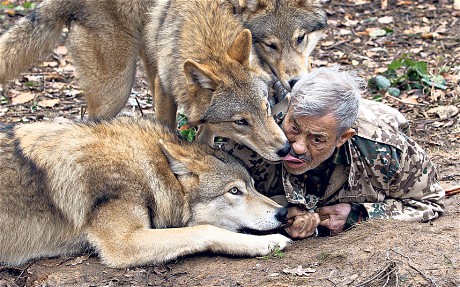
Wolfman 2

‘Wolves are beautiful animals and the person who says they shouldn’t be in
the wild might as well not care about what happens to the elephant on the plains
of Africa’ (NORTH DOWNS PICTURE AGENCY)

Impressed by his dedication and knowledge, animal experts from around the world beat a path to his door, including Monty Roberts, the original “horse whisperer”. The EU asks for his advice on wolf management in those countries where they are making a comeback, and Werner is celebrated in books and documentaries in his homeland.

It’s easy to see why he is so highly regarded. Every day, as dawn breaks over the 25 acres of the Werner Freund Wolfpark, the still air is split by the howling of Arctic, timber, grey and Mongolian wolves – the latest addition to the Freund family.

The wolves smell him before they see him. Then they howl – first one, then another and another – the woodland echoing to a visceral sound that would instill fear in many, but not in Werner. For these are the cries of animals he has devoted his life to. As he approaches the Arctic wolf enclosure, he bays in return and they answer him, tails wagging like labradors about to go walkies. He enters their domain clutching chickens and lamb chunks – breakfast – and is rewarded with affectionate licks. Never mind that their jaws can exert 1,500lb of pressure.

One wolf that has kept its distance finally comes over. It is at least 100lbs in weight and more than six feet high when it rears up on to its hind legs. It is a creature with an air of unmistakable authority, the alpha male of the pack. But when Werner is around, it seems to shrink back, clearly recognising its master.

For Werner there is nothing remotely evil about the wolf. “Fairy tales, that’s what gave them a bad name,” he says gruffly. “Red Riding Hood and all that. These are beautiful animals and the person who says they shouldn’t be in the wild might as well not care about what happens to the elephant on the plains of Africa. We are all enriched by their presence, by the simple fact that they are among us.

“There will always be farm animals taken by them. There will always be ‘incidents’ because of their proximity to man. But truthfully? You are more likely to die from meeting a werewolf than a real one. They don’t want to know about humans. They want to do their own thing.”

Several years ago this small man of modest demeanour and irrepressible enthusiasm walked into the mayor’s office in Merzig to tell him of his plans: a wolf park that would be free to everyone and where the creatures could live out their days as nature intended.

The pitch worked, and now Werner’s wolf park, built on land donated by the local authority, is a major attraction in Merzig. The packs roam in their segregated enclaves in a huge forested area, fed by local slaughterhouses that donate meat, supplemented by the odd deer shot by a hunter, or a roadkill wild boar.

“I battle to strip away the myth of the ‘dangerous wolf’. Look, dogs around the world kill plenty of people a year and bite millions more. Dogs have lost their fear of humans, the wolf hasn’t. I only get close to them because they know me; a stranger couldn’t do what I do.

“Wild wolves are rarely aggressive towards people. If there are attacks, they get big play in the press precisely because they are so rare. No, there is far more danger to wolves from man than the other way around. That is why the release of them into the wild will always have its limitations. There is a limit to habitat and prey, which is why farmers will always lose some sheep to them, and road traffic will take an annual toll on them.”

Werner wasn’t always a wolf man. Born in Germany in 1933, in the same month that Hitler came to power, he grew up in the wolf-denuded countryside near Frankfurt to a family of foresters and shepherds. “I got my love for animals from my mother,” he recalls. “To her all animals were good and so I never had any fear of them. She never told me stories about the big bad wolf.”

He trained as a gardener but in 1950 his love for animals drew him to the zoo in Stuttgart where he became a keeper for the larger predators. As well as wolves, Werner became a great fan of bears and was photographed cuddling a lion, getting up close to a hyena and befriending a puma for the local newspapers.

He had a spell in the border police before switching to the newly formed Bundeswehr (army) of West Germany, where he spent the next 20 years as a career soldier.

The army gave him time off to join expeditions abroad, 15 of them in all, to some of the most remote spots on the planet. On one of them he ingested a parasite from eating raw snake, necessitating an emergency operation to save his eyesight at a London hospital.

In 1962 he married Erika, aka “Mrs Wolfman”, who has been his life partner and passionate supporter of his animal causes. The first wolves they acquired, in the Seventies, were cubs from zoos and animal parks. Most of them were hand-reared by the couple, providing a unique bond that turned them both into the “parents” of the youngsters. “I had to become a wolf to bond with the wolves,” says Werner. “That is the only way to gain their trust.”

As the day began, so it ends. For wolves, darkness is the time for hunting, for killing. Sometimes Werner will dress their meat ration up in the form of a papier mâché sheep that the animals can tear to pieces as if it were real.

He stops at a small enclave next to his log-cabin home, where two female Arctic wolves howl in anticipation at his arrival. They had to be separated from the pack because there were too many females and the alpha male was becoming aggressive towards them.

“They need a man,” says Werner, as they lick his face and scramble for his affection. “They look nice, eh? But never be entirely fooled into thinking these are just big dogs. They are wild animals and always will be.”

**Special thanks to Allan Hall, “The Telegraph,” for providing this information!


“The Telegraph”

Read Full Post »


Dispelling Canadian Wolf Myth

Photo Courtesy Bozeman Daily Chronicle

“Howling for Justice” comments, “I’m reposting an article I wrote back in April of this year. It busts the oft-repeated myth that wolves reintroduced to the US in 95 from Canada, are a larger more aggressive wolf then previously roamed the Northern Rockies. It’s a common mantra spread by the anti-wolf crowd and is not grounded in fact. But hey why bother with pesky facts? They just get in the way of demonizing wolves.

April 12, 2010

If I had a dollar every time I heard the derogatory term “Non-Native Canadian wolf”, I’d be rich.

The myth goes something like this. Wolves reintroduced to Yellowstone and Central Idaho in 1995 were a larger, non-native, more aggressive wolf then the wolves who roamed the Northern Rockies before the Western extermination. This kind of thinking and rhetoric is what fuels wolf hatred in the first place. When nasty rumors and stories get started they develop legs. Pretty soon people are repeating it as if it’s fact. My advice would be to do a little research on the history of wolves and their morphology, instead of repeating rumors and innuendo. But this myth has nothing to do with the search for truth, it’s all about demonizing wolves. Please make it your business to shed light on these fairy tales. The wolves will thank you.

I wonder how many people who make these claims have ever seen a wild wolf? I’ve been lucky to view wild wolves. One of my Malamutes, who passed away several years ago, was bigger and weighed more than any wolf I’ve ever encountered. He was 180 lbs full-grown. He was so tall he could actually eat food right off the kitchen counter. But unlike the wolf his body was stockier. Wolves have long legs, big feet and large heads, their bodies are also longer than dogs. This gives them the appearance of being bigger then they actually are. Wolves in the Northern Rockies weigh on average between 80-110 lbs. Wolves also weigh more when their bellies are full. That’s because after a kill wolves gorge on a meal because they may not eat again for several days. It’s feast or famine for the wolf. Remember, only one in ten wolf hunts is successful. They expend a great deal of energy during the hunt and very often have nothing to show for it.

Did you know 31% of the wolves killed in Montana’s hunt were under a year of age (juveniles) and weighed an average of 62 lbs.  31% were yearlings and weighed about 80 lbs. 62% of wolves killed in Montana’s wolf hunt in 2009 were a year old or under a year of age, in other words, PUPPIES! Shocked? Only 38% of wolves killed in Montana’s hunt were adults, weighing an average 97 lbs. The largest wolf weighed 117 lbs. Again way smaller than my Malamute. The average weight of wolves killed in the Idaho hunt was under a 100 lbs.

There is strong evidence the two subspecies of wolves that roamed the Rocky Mountains north and south of the Canadian border, for tens of thousands of years,  Canis Lupus Occidentalis (The Mackenzie Valley wolf) and Canis Lupus Irremotus (Northern Rocky Mountain wolf) bred with each other and mixed their genes. Some believe the Mackenzie Valley wolves bred the Northern Rocky Mountain wolf out of existence, instead of the government eliminating them.

It’s a specious argument, not grounded in science, to state Canis Lupus Occidentalis is a non-native wolf from Canada that was foisted upon the Northern Rockies region. In fact wolves know no boundaries and regularly cross back and forth between Canada and the US. There is no doubt sub-species exchanged DNA, making it almost impossible to tell how much of one subspecies is contained in another.

The whole idea of numbers of wolf subspecies is debated in the scientific world, ranging from 24 to just 5. The one thing we do know is wolves from different subspecies mate and share their DNA. The truth is, wolves are wolves, with slight variations in height, weight or fur color.

Think how silly the notion is when you consider humans created the boundaries between Canada and the US. To wolves it’s all the same landscape. They do what wolves do, breed, form packs and when they’re old enough strike out on their own, looking for new territory and a mate. It’s really that simple. Wolf thy name is wanderlust.

Wolves have large territories and travel great distances to establish a place for themselves. Does anyone truly believe wolves didn’t freely cross borders before they were exterminated in the West? Invisible lines created by humans have no meaning for wolves. They go as they please, truly free yet horribly persecuted, never knowing why.

Wolves are great wanderers and can travel an average of 25 miles per day while hunting. One Scandinavian wolf, pursued by hunters, traveled 125 miles in 24 hours. Wolves have runners bodies, lean and sleek. David Mech, the wolf biologist once stated “Wolves are fed by their feet.” Covering ground, exploring, seeking new territory, is bound to the wolves’ soul.  One only has to read the tale of wolf 314f, just a year and a half old, who traveled from her home in Montana to a lonely hillside called No Name Ridge in Colorado, where she was found dead under suspicious circumstances. She logged a thousand miles on her GPS collar during her amazing journey. Wolves are great adventurers and travelers.

Do wolf haters think there is some imaginary line at the border between Canada and the US that wolves didn’t dare cross? How ridiculous is that?

Long before the reintroduction, wolves made their way back to the US in the 1970′s and 80′s, dispersing from Canada to Glacier National Park,  They formed the Camas, Wigwam and Magic packs and these packs were not small, some numbering from twenty to thirty wolves. Does this sound like an animal who’s afraid to cross an invisible line they’ve been navigating for thousands of years, long before Canada and the United States were even a thought?

It follows that sub-species of wolves will mix their genes and basically become a combination of both. The myth that wolves reintroduced from Canada are somehow enormous super wolves who never set foot on American soil before reintroduction, is ludicrous. If you don’t believe me listen to experts on the subject, who have worked with wolves for years and understand their morphology.

Carter Niermeyer Interview (Outdoor Idaho) Spring 2009 (Carter Niermeyer was the Idaho Wolf Recovery Coordinator for USFWS from 2000 to 2006)

Q.There are those who say we brought the wrong wolves into Idaho in 1995 and 1996, that they’re bigger wolves than the ones that were here.

CN: I have to support the science again, and specialists in morphology and genetics on wolves indicate that the wolf that was brought down from Canada is the same wolf that lived here previously. And I did some research into books on early wolves that were captured in the Northern Rockies, even as far south as Colorado during the days that wolves were being hunted down in the 1930s; and the body weights were very much the same.

So I feel that this wolf that was brought from Canada is the same species and genetics as the wolves that lived here once upon a time. I think people have to remember that the northern Rockies — we call it the northern Rockies in Idaho and Montana, but actually we’re a southern extension of the northern Rockies out of Canada — and all of those wolves in Canada have the potential and the ability to disperse. I believe what happened over the last 50-60 years is that individual wolves have come from Canada following the Rocky Mountain chain and ended up periodically in places like Montana and Idaho.

Or Mike Jimenez (U.S. Fish and Wildlife Service biologist and Wyoming wolf recovery coordinator)

Jimenez disputed claims that the wolves reintroduced from Canada in the mid-1990s are a larger, more aggressive breed than had historically lived in Wyoming.

While scientists once divided wolves into 24 subspecies, he said more recent DNA evidence shows five subspecies in North America. Further, given the fact that wolves tend to disburse hundreds of miles, he said wolves from Canada likely interbred with Wyoming wolves and vice versa before they were exterminated from the region.

“The idea that those Canadian wolves are different … the argument gets weak,” he said. “Where they transition from one subspecies to the next is totally up for grabs.”

People cling to anti-wolf myths because wolves have become scapegoats for anti-government feelings. Many anti-wolfers believe reintroducing wolves was forced on them even though bringing wolves home to the Northern Rockies was not a rogue scheme dreamed up by a few government biologists. It was supported by many Americans. In fact a poll taken in 1990 found two-thirds of Montanans supported bringing wolves back to the state. Even so, it was a huge battle that waged for decades because the same, small, vocal minority that opposes wolves today were against them then, IE: ranchers, hunters and outfitters.

The feds finally compromised and classified wolves as a non-essential experimental population, which meant they could be shot and killed for agribusiness.

The little known fact is Wildlife Services has been killing wolves for years, along with the wolf hunts in 2009/2010. Still without ESA protection wolves would NEVER have been able to make any kind of comeback. It’s been their saving grace and now sadly they are at the mercy of their enemies once again.

What’s behind the giant Canadian wolf myth that’s passed off as truth? I believe it’s fear of competition. Many hunters don’t want to share the woods or compete with wolves. They liked it when wolves were gone and elk were complacent, standing around all day, munching down aspen trees, never allowing them to get any taller than a few feet. Apparently hunters like lazy, slow elk, ones that are easier to kill.  Since the return of the wolf, elk are no longer complacent, their old nemesis is back and they know it.  I think Carter Niermeyer hit the nail on the head when he said:

“Hunters look at the wolf from many angles and perspectives, too, and I have to emphasize that I’m a hunter. Certainly wolves compete, but I don’t think they’re any excuse for not being a successful hunter. There’s tremendous numbers of game animals available to sportsman and with a little effort and sleuth, you still have great potential to collect a wild animal from hunting. I don’t know what the excuse was before wolves, but it has become the main excuse now for unsuccessful hunters. I mean, there are just so many other issues involved in why hunters are not successful, but the wolf is a lame excuse.”

It’s necessary to spread untruths about wolves to further the agenda of getting rid of them or make excuses for why a particular hunter wasn’t able to “get his elk” during hunting season. I’ve reported over and over that the Rocky Mountain Elk Foundation trumpeted in the their Spring 2009 press release that elk numbers were up 44% nationally since 1984, when the organization was founded. They stated the elk herds in Montana, Colorado and Utah  increased between 50-70 percent.  The Montana’s elk population stood at 150,000 and Idaho at 105,000.  I guess that wasn’t good news to everyone, since it doesn’t fit in with the “wolf is decimating all the elk” argument. Hunters whine that elk numbers may be up in the state but down in some areas. Ummmmmm that’s how nature works. And I hate to break it to the elk hunters but it’s not all about them. Wolf advocates opinions are being ignored. We’ve had to watch in horror as wolves were removed from the Endangered Species List and hunted almost immediately.

This was unforgiveable behavior by the states and certainly didn’t earn any points with wolf supporters about their intent to “manage” wolves fairly.  It’s not a secret there’s a conflict of interest when it comes to state game agencies “managing/killing” predators.  They want to please their customers, the hunters, who demand more game. The saddest part of this story is wolves were brought back only to be used for target practice fifteen years later.

Carter  Niermeyer states:

It’s a little late now, but I wish that when the states assume management of wolves that there could have been some kind of a moratorium where the states took the responsibility and didn’t jump right into a wolf harvest, or a wolf culling, or whatever you want to call it. It would’ve been nice, I think, to establish some credibility with wolf advocates and conservationists, environmentalists and people who appreciate wolves for other values. And just sort of get a handle on things and get a feel for managing the wolf. Because there’s this perception that suddenly we’re going from a listed animal to a hunted animal and I think a lot of the public is having a struggle with coming along with that.

The other thing I wish could happen, too, is there’d be more dialogue between the broad term wolf advocates and the Fish and Game Department and talk about these issues more openly, because the conservation groups have been a close ally in getting wolf recovery moving forward and actually being partners, and now there seems to be this falling out and a relationship that’s deteriorating.

Wolf advocates are rightly upset to see wolves hunted at all, especially freshly off the Endangered Species List.

I wonder how hunters would feel if over 40% of the elk herd was killed in one season. What would they think of a seven month-long elk hunt like the state of Idaho imposed on wolves?

Are Canadians laughing at us when they hear the Canadian super-wolf myth? Does this mean Canadians are superior hunters, who seem to have no trouble bagging game with their Canadian monster wolves roaming the countryside?

The truth is wolves living in the Northern Rockies today are the same wolves that were here before they were exterminated. It’s not about how tall wolves are or how much they weigh or the color of their fur. This myth is grounded in hatred of a species just as it was when they were exterminated the first time around.

Hunters by their very nature are in the business of killing and not all hunters can shoot straight or are ethical. There are people who hunt out of their rigs, while drinking.  Gut shot deer roam the forest during hunting season, leaving blood trails until they finally collapse and die. I’ve seen deer with arrows sticking out of them, barely able to stand.

If anyone has seen Predator Derby pictures of bloody dead coyotes, or dead wolves displayed by their killers with no respect, smiling like they just won the lottery, understand it’s not the wolf that’s the deadliest predator. Wolves kill to survive. The cruelest predator of all is man. No giant wolf myth can compete with that.

HOWL for speaking the truth about wolves.

Pass it on!”

**Special thanks to “Howling for Justice” for providing this information!  http://howlingforjustice.wordpress.com/2010/04/12/dispeling-the-canadian-wolf-myth/

Read Full Post »

Older Posts »