Feeds:
Posts
Comments

Archive for the ‘Facts and Figures’ Category


The following information is provided by “The Wolf Almanac” by Robert Busch (1995 edition).

“According to the U.S. Fish and Wildlife Service, “wolf predation of livestock–sheep, poultry, and cattle–does occur, but it is uncommon enough behavior in the species as a whole to be called aberrant.”

Many studies have shown that ninety-nine percent of all farmers and ranchers in wolf territory will not be bothered by wolves.  Of over 7,000 farmers in northern Minnesota, where over 1,700 wolves inhabit the area, only an average of twenty-five ranchers per year suffered verified predation from wolves between 1975 and 1989.  In Canada, only one percent of 1,608 wolf scats collected in Manitoba’s Riding Mountain National Park contained remnants of livestock. 

In one study in Spain, half of all the “wolf kills” that were investigated were found to be caused by feral dogs.  According to William J. Paul of the U.S. Department of Agriculture, where wolf predation on livestock does occur, “most losses occur in summer when livestock are released to graze in open and wooded pastures.”

In many cases, preventative farming practices would eliminate predation.  The Alberta Fish and Wildlife Division recommends the following animal husbandry practices in wolf habitat:

  • cattlemen should check their herds regularly.
  • only healthy and non-pregnant cows should be sent to pasture.
  • livestock should be removed from pasture as early as possible in the fall.
  • carrion should be buried or removed as soon as possible. (In one Minnesota study by the U.S. and Wildlife Service, 63 percent of 111 farmers surveyed either left dead livestock in place or just dragged it to the edge of the woods.)
  • grazing leases on remote public lands should be phased out.ranchers should keep animals out of remote pastures after dusk and pen them in corrals where they can be watched.

Other measures include the use of  battery-operated flashing highway lights in animals corrals and fladry.  Livestock guard dogs and electric fences have also some potential in reducing predation.  In Ontario, biologists are experimenting with painting sticky substances on the backs of sheep, which seems to deter predators.  The European practice of using shepherds to guard livestock is also worthy of consideration, as is diversionary feeding, or providing alternative food sources.

It is politically crucial that compensation be paid to farmers who do suffer wolf predation.  The existence of compensation schemes goes a long way toward improving ranchers’ attitudes toward wolves.  It is also crucial that payment be prompt;  Portugal, when payments were delayed, farmers took to setting poisoned carcasses on the edges of woods to register their complaint.”

Read Full Post »


“Wolves were probably most misunderstood because they are predators. Predators are animals that hunt and feed on other animals, called prey.  People are beginning to understand that predators have an important place in the world.  They are part of nature’s balancing act.

When predators aren’t around:  Deer herds can grow and grow and grow..  Only bad weather and disease slow down herd growth.  Huge deer herds overeat their food.  As their food disappears, the whole herd begins to starve. 

When predators are around:  By killing some deer, wolves help keep the deer herd smaller.  Smaller herds have more food.  When the number of deer is low, wolves have fewer pups and may also starve.  In this way the deer control the number of wolves.  Hunters, of course, can sometimes replace wolves and control deer numbers. 

Are predators cruel and wicked?  A wolf eating a deer is no different than a human cutting into a steak.  Both are predators.  Neither is “mean or bad.”  They eat to live, except for the act of sport hunting.” 

**Special thanks to Nancy Field and Corliss Karasov of Discovering Wolves, a Nature Activity Book, text copyright 2005 and text copywright 1991 by Dog-Eared Publications for providing this information!

Read Full Post »


The wolf kills to eat.  And it is the wolf’s status as a predator that has resulted in the deaths of thousands of wolves at the hands of humans.  The two prime areas of conflict are the wolf’s status as a habitual predator of big game and as an occasional predator of livestock.

In the United States, federal Animal Damage Control guidelines define predator control as “control…directed toward less desirable species which are depressing populations of more desirable species.” 

CLEARLY MAN HAS DEEMED THAT THE WOLF BE OFFICIALLY CERTIFIED AS “LESS DESIRABLE.”

It is unfortunate that both Canis Lupus and Homo Sapiens sometimes seek the same prey.  It is even more unfortunate that the wolf has often been WRONGLY BLAMED for depleting ungulate populations, populations equally sought by both subsistence and sport hunters.  

Large-scale wolf kills by humans assume that wolves are the primary limiting factor to a hooved game population.  All too often, the wolf is just a convenient and visible scapegoat, the final product of years of prejudice.   And all too often insufficient studies have been undertaken to determine the true role of the wolf in controlling the prey population.

Various studies have shown that in fact wolves my control an ungulate population, extirpate the population, have no effect upon it, increase it, or decrease it.  Other important factors include the prey/predator ratio, habitat loss, overhunting by humans, and the effects of severe winters.

As wildlife biologist Chris McBride has written in The White Lions of Timbavati, “The very fact that any species of predator still exists today is proof that is has evolved in such a way that it cannot seriously limit the numbers of its prey.  If it did, it would have become extinct.”

Overhunting by humans is often a major factor in ungulate declines.  In one study of Alaskan wolves, it was found that humans had killed forty four percent of the Nelchina caribou herd in 1971/1972, a decrease that had previously blamed on wolves.  One year when caribou strayed too close to the city of Yellowknife in the Northwest Territories and were slaughtered by its residents by the hundreds, outsiders immediately blamed wolves for the kills.

It is ironic that many fish and game departments exist to support the hunters and fishermen who fund them through the sale of tags and licenses.  The irony turns to tragedy, though, when these departments kill wolves to appease hunters.

In 1983, the British Columbia Wildlife Branch announced plans to kill eighty percent of wolves in the northeast Peace and Omineca districts in order “to support moose and deer numbers.”  However, the close ties between the department and the hunting lobby quickly became evident.  To fund the wolf kill, the government stated their intention to hold a lottery, first prize being a hunting trip to Zimbabwe.  Despite a government report that the moose and deer numbers had decreased primarily because of loss of habitat, overhunting, and a series of severe winters, the wolf was the one put in the crosshairs.

A more recent Canadian wolf kill was the plan to kill 150 wolves in the Yukon in 1993 in an area adjacent to Kluane National Park.  The purpose of the kill was to support the Aishihik caribou herd, which was declining in number.  After much public pressure, the Yukon government admitted that the slaughter was a “scientific experimentusing living animals.  In early 1993, about seventy wolves were killed, and it was discovered that the wolf population in the area was about forty percent smaller than expected.   Despite this finding, the Yukon goverment planned to continue the killing!  The cost of the initial year of killing was an incredible $2,500 per wolf. 

In the IUCN Manifesto on Wolf Conservation, it states that where wolf kills must be carried out, “the methods must be selective, specific to the problem, highly discriminatory, and have minimal adverse affects on the ecosystem.”  It concludes that “alternative ecosystem management, including alteration of human activities and attitudes and non-lethal methods of wolf management, should be fully considered before lethal wolf reduction is employed.”

According to the World Wildlife Fund of Canada, “the only safe conservation route is to stop large-scale wolf killing programs altogether.”  And as wolf biologist Lu Carbyn has noted, wolf control “has become socially unacceptable.”

**Special thanks to The Wolf Almanac by Robert Busch for providing this information!

Read Full Post »


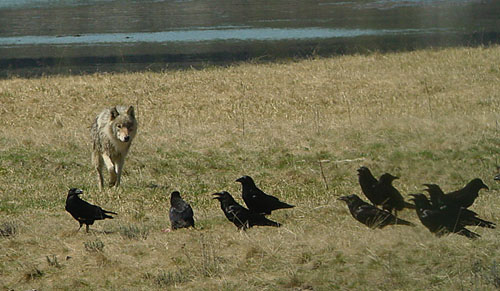
So what do Ravens and Wolves have in common you say?  The following information comes from “The Wolf Almanac,” a celebration of wolves and their world, 1995/1998 by Robert Busch.  He explains the relationship and proves once again one of the many contributions wolves give to the environment.

One of the most fascinating relationships between animals is the one that seems to exist between wolves and ravens.  The raven, scavenger of food of all types, will often follow wolf packs in hopes of morsels of food.  And wolves have learned to watch for circling ravens as a sign of of possible food below.  But there seems to be more than just a symbiosis based on food between the two species; many observations have been made that can only be described as a friendship between the big predator and the wily bird. 

In Arctic Wild, Lois Crisler states her belief that “ravens and wolves just like each other’s company.”  She described one play session between the two species, with the raven diving at the wolves and jumping around just out of reach.  “He played this raven tag for ten minutes at a time.  If the wolves ever tired of it, he sat squawking till they came over to him again.”

L. David Mech, in The Wolves of Isle Royale, described the “peculiar relationship” between a flock of ravens and a large wolf pack, and wrote that wolves and ravens “often seem to play together.”

Read Full Post »


This article was previously written by: Dr. Victor Van Ballenberghe / U.S. Forest Service / Wolf Song of Alaska Advisor

Wolves can be a factor in controlling populations in certain areas BUT not the primary or only factor.  Hunters, disease, weather, and other predators play key roles.

Special thanks is given to “Wolf Song of Alaska” for providing his article.

This page is one of over 1500 pages in our library! Visit our homepage for a full menu of options!


“The following questions and statements represent a brief summary of biological information on wolf ecology and wolf/prey relationships distilled from numerous scientific studies conducted in North America during the past 50 years. I have selected topics that I feel represent some of the key biological issues that impact wolf management. By necessity, this discussion is brief and worded so that those with little technical background can assimilate the information. I have tried to accurately summarize and interpret a large volume of data while adhering to constraints of brevity and simplicity.

1. Can wolves kill any animal they choose?

Numerous studies across North America on virtually every species of wolf prey from the smallest (deer) to the largest (bison) have shown that wolves generally kill only certain kinds of animals. These include young, old, and infirm animals. Generally, animals in their prime (for example, moose aged 1-6) escape predation. However, during deep snow conditions that favor wolves, prime-aged animals may fall prey, but these conditions are uncommon.

These findings have been misinterpreted by some to mean that wolves only kill “sick” animals or that because they generally kill the young, old or infirm wolves can’t impact prey populations. Biologists have never claimed wolves kill only the sick and have stressed that predation on young may impact prey populations.

Studies have also shown that prey animals often escape predation by a variety of methods. An early study of moose and wolves at Isle Royale, Michigan, indicated that during winter only 8% of moose encountered by wolves were killed. The rest outran the wolves or stood their ground and the wolves left. During summer, moose often escape by entering water where wolves aren’t effective. Certain prey, including goats and sheep, inhabit terrain where they are often protected. All prey species have evolved numerous anti-predator adaptations.

2. Do wolves kill in excess of their needs?

Studies have shown that wolves generally consume the animals they kill, often returning to kills over a prolonged period. They also commonly scavenge animals that die or are killed by other predators or humans. On occasion, wolves starve because they cannot find or kill enough prey, or their reproduction is reduced due to food shortage.

During deep snow conditions that occur rarely, wolves may kill more than they consume. They may also kill more young than they consume when young are very abundant, for example in large herds of caribou. However, this “surplus” killing has generally not been shown to have significant effects on prey populations.

3. At what rate do wolves kill prey?

Research has shown that kill rates vary greatly depending on snow depth, prey size, prey abundance, pack size, and many other factors. Wolves rarely kill only one species for extended periods; most packs in Alaska have access to several species. During summer, beaver, fish, berries, and numerous small mammals and birds supplement their diet.

During winter, for wolves that kill only moose, an average-sized pack (6-10) may eat one moose per 4-5 days, but this can vary from about 2-10 days per moose per pack. Some of these animals may be scavenged. Summer data are less reliable and difficult to compare to winter because nutritional needs vary as does prey size (many calves are killed) and composition. However, several studies suggest that summer kill rates are lower than during winter.

For smaller prey, kill rates are necessarily higher. In Minnesota where wolves kill mainly white-tailed deer (also beaver and moose) annual kill rates per wolf have been estimated at 15-19 deer, including summer fawns.

4. What factors control wolf populations?

In Alaska (and elsewhere) wolf populations are mainly controlled by hunting and trapping, prey abundance, and social interactions among wolves. Virtually every pack in Alaska is subject to hunting and trapping, legal and illegal, but the impact of this varies. Some packs are exploited lightly because of their inaccessibility; others are kept at low numbers by hunters and trappers. Some packs have been eliminated by humans.

Generally, wolves on the northern and northwestern arctic coasts are rare and kept at a low density by people. Wolves in southcentral Alaska are heavily exploited but in much of the interior they are not.

Wolves generally declined in the late 1970’s and early 1980’s, apparently in response to decline of moose and caribou that began in the mid-1960’s. As moose and caribou increased in some areas (including the Nelchina basin) wolves were prevented from increasing by hunting and trapping.

5. What impact has land-and-shoot (LAS) wolf hunting had on wolf numbers?

The impact of LAS has varied from place to place. In some areas that are heavily timbered with few lakes or rivers, LAS has been ineffective in reducing wolf numbers. In other areas (including the Nelchina basin) wolves have been kept low by this

practice. Large areas of southcentral including GMU’s 9, 16, 11, and 13, are ideally suited to LAS are northern areas in or near the Brooks Range. It is clear that where the terrain allows hunters to be efficient, LAS has kept wolf numbers lower than they


would have been with hunting and trapping by other methods.

6. Will wolves increase indefinitely if they are not “controlled”?

Because hunting and trapping are generally effective controlling factors, wolves will increase if exploitation stops. However, wolf populations will not increase without limit in the absence of exploitation. For example, after the wolf control in GMU-20A stopped, moose numbers more than tripled but wolf increased to only about their pre-control numbers.

7. What rolls did hunting, weather, food supplies, and predation play in the moose and caribou declines of the 1960’s and 1970’s?

Moose and caribou populations in many areas of Alaska increased during the 1950’s and early 1960’s and declined into the 1970’s. Research suggests that for moose, food supplies declined as populations increased. Deep-snow winters aggravated reduced food conditions and started the moose population declines. Hunting regulation changes did not respond in time and hunting further accelerated the declines as it did for the caribou, especially the Nelchina and Western Arctic herds. For some moose populations (GMU-20A), wolves did not start the declines, but acted after they were well underway to drive moose to lower levels than they would have reached in absence of wolves.

8. Is habitat (food) currently limiting moose and caribou populations in Alaska?

Probably so in portions of southcentral including the lower Susitna valley where large numbers of moose starved in 1989-1990 and the Kenai Peninsula where plant succession has reduced habitat quality since the mid-1970’s. Caribou herds including the Nelchina and Western Arctic herds, are also thought to be approaching the carrying capacity of the ranges.

Probably not in portions of the interior where moose densities are low and food seems abundant.

Maybe in other areas where few data are available on food quantity and quality in relation to moose and caribou numbers. It is difficult to quantify these relationships over vast areas.

9. What about bear predation?

Studies have shown that both black and brown bears (especially the latter) can be efficient predators on young moose calves. In some areas (for example, the Nelchina basin) brown bears were a more significant source of calve mortality than wolves. Bears may also kill adults in the spring and fall when they are more vulnerable.

10. a) Can wolves and bears keep prey densities low for long periods?


b) Can prey increase from low densities if wolves and bears are not reduced by people?


There is evidence that wolves and bears acting together can keep moose at low densities for long periods in places where people have no or little impact on predator numbers. For caribou, it appears that this is not the case; caribou can periodically increase if alternate prey for wolves is scarce and they too fall to low densities. Moose also follow this pattern if bears are absent. At Isle Royale National Park where bears are absent and people do not exploit either wolves or moose, moose have increased periodically and reached high densities without any form of wolf control.

11. Do we need to “control” wolves in order to harvest prey?

Biologists do not dispute the idea that moose populations will produce a higher yield for people if wolves are few or absent. However, people can still hunt and shoot moose if wolves are present as demonstrated in Alaska for many years. As indicated in question 4 (above), hunting and trapping impacts wolf populations in many areas and may keep wolf densities low. Moose abundance may be high in these areas, as it generally is now in southcentral Alaska, and hunting by people may produce high yields. In other areas where wolves and bear reach higher densities it may still be possible for people to hunt, but they may be restricted to bulls only. Moose harvest in many areas of Alaska have increased in recent years without wolf control programs.

12. Does reducing wolf density result in more moose and caribou?

Clearly, wolf control in GMA-20A during 1975-79 resulted in an increase of moose on Tanana flats. This is probably the best known example of a wolf control program in Alaska. However, wolf control in other areas where wolf:moose ratios were higher or where bears were the problem had less success. As discussed above, deep snow, reduced food, hunting or bear predation may be more important than wolf predation in controlling moose numbers. If so, wolf control is not likely to yield benefits.

13. What is the importance of predator/prey ratios?

One of the primary factors in determining the impact of predation on prey numbers is the ratio of predators to prey. If predators are few in relation to prey, predation may have little controlling effect on prey numbers. However, controlling effects may be extreme if there are many predators in relation to prey. For wolves and moose, ratios of less than 1;30 may often result in moose population declines if wolves have little alternate prey. If bears are abundant, they may elevate this ratio considerably. When wolf:moose ratios are 1:60 or higher, predation likely has little effect.

14. Do wolf populations rapidly rebound from control programs?

Wolves have a high reproductive rate and may disperse long distances to fill “voids”. Studies in Alaska have shown that populations may increase rapidly following control programs and pre-control numbers may be reached in 3-4 years. However, wolves in some areas (including the north slope) have not recovered after being reduced to low densities because hunting and trapping removes them as they re-colonize.

15. Is the “balance of nature” a valid concept?

Different definitions of the balance of nature concept have emerged in recent years. If this concept means that wolves and prey exist for long periods at high and stable numbers, then the results of recent studies suggest this is simplistic. Numbers often fluctuate up as well as down and local extinction of prey is possible. However, if the concept means that wolves and prey coexist over time in large areas, clearly this is the case. Wolves and their prey co-evolved over thousands of years with little intervention from humans. Wolves are efficient predators that at certain times under certain conditions may exert powerful controlling effects on prey populations. But, for their part, prey animals have evolved the ability to survive and reproduce. The effects of humans on both wolves and prey and their habitat in the modern world are often the primary factors determining the “balances” that now result.”

Read Full Post »

Wisdom of Wolves


It’s a society where teamwork, loyalty and communication are the norm rather than the exception. Sound like utopia? Actually, it’s already present in nature – in a wolf pack. The wolf pack knows who it is. Those in the pack exist for each other.

Twyman Towery, Ph.D., a professional speaker and consultant who studied the lessons of leadership in nature, has captured them in a book for Simple Truths called Wisdom of Wolves. Twyman shares the parallels between the wolf pack and human behavior…in business life, family life, and personal life.


An excerpt from
Wisdom of Wolves
by Twyman Towery

The attitude of the wolf can be summed up simply: it is a constant visualization of success. The collective wisdom of wolves has been progressively programmed into their genetic makeup throughout the centuries. Wolves have mastered the technique of focusing their energies toward the activities that will lead to the accomplishment of their goals.

Wolves do not aimlessly run around their intended victims, yipping and yapping. They have a strategic plan and execute it through constant communication. When the moment of truth arrives, each understands his role and understands exactly what the pack expects of him.

The wolf does not depend on luck. The cohesion, teamwork and training of the pack determines whether the pack lives or dies.

There is a silly maxim in some organizations that everyone, to be a valuable member, must aspire to be the leader. This is personified by the misguided CEO who says he only hires people who say they want to take his job. Evidently, this is supposed to ensure that the person has ambition, courage, spunk, honesty, drive – whatever. In reality, it is simply a contrived situation, with the interviewee jumping through the boss’s hoops. It sends warnings of competition and one-upmanship throughout the organization rather than signals of cooperation, teamwork and loyalty.

Everyone does not strive to be the leader in the wolf pack. Some are consummate hunters or caregivers or jokesters, but each seems to gravitate to the role he does best. This is not to say there are not challenges to authority, position and status – there are. But each wolf’s role begins emerging from playtime as a pup and refines itself through the rest of its years. The wolf’s attitude is always based upon the question, “What is best for the pack?” This is in marked contrast to us humans, who will often sabotage our organizations, families or businesses, if we do not get what we want.

Wolves are seldom truly threatened by other animals. By constantly engaging their senses and skills, they are practically unassailable. They are masters of planning for the moment of opportunity to present itself, and when it does, they are ready to act.

Because of training, preparation, planning, communication and a preference for action, the wolf’s expectation is always to be victorious. While in actuality this is true only 10 percent of the time or less, the wolf’s attitude is always that success will come – and it does.

(http://store.simpletruths.com/wisdom-of-wolves-with-free-dvd-and-wolf-credo-print-p2190.aspx?cm_mmc=CheetahMail-_-TH-_-01.19.12-_-TWOW-CorpLdr&utm_source=CheetahMail&utm_medium=01.19.12&utm_campaign=TWOWca)

Wisdom of Wolves

Get a free print with this book today!
Shop Now


Read Full Post »


“With the arrival of the first wolf in California since the 1920s, no doubt the California Department of Game and Fish is receiving many comments from the public. The quality of this support, opposition and advice probably varies all over the map (the maps in our heads). Norman Bishop, who played a key role as a Yellowstone Park naturalist educating the public about the wolves that were coming to Yellowstone and then after their arrival until 1997, has compiled a fact-filled piece “What Good are Wolves.” This morning he announced he had sent it to the Director of the California Department of Fish and Game. In the current politically charged and cognitively challenged atmosphere of wolf mythology, the contents of this letter should be shared with the public because summarizes what had been learned in recent years so compactly and lucidly. What good are wolves? Compiled by Norman A. Bishop In 1869, General Phil Sheridan said, “The only good Indians I ever saw were dead.” Others said, “The only good wolf is a dead wolf.” Barry Lopez wrote of an American Pogrom, not only of Native Americans and wolves, but of the bison on which both depended. Between 1850 and 1890, 75 million bison were killed, mostly for their hides; perhaps one or two million wolves. “Before about 1878, cattlemen were more worried about Indians killing their cattle than they were about wolves. As the land filled up with other ranchers, as water rights became an issue, and as the Indians were removed to reservations, however, the wolf became, as related in Barry Lopez’s book, Of Wolves and Men, ‘an object of pathological hatred.’”

 Lopez continues: “(T)he motive for wiping out wolves (as opposed to controlling them) proceeded from misunderstanding, from illusions of what constituted sport, from strident attachment to private property, from ignorance and irrational hatred.” In 1884, Montana set a bounty on wolves; in the next three years, 10,261 wolves were bountied. “In 1887, the bounty was repealed by a legislature dominated by mining interests.” *** “By 1893,… desperate stockmen were reporting losses that were mathematical impossibilities. The effect of this exaggeration was contagious. The Montana sheep industry, which up to this time had lost more animals to bears and mountain lions than to wolves, began to blame its every downward economic trend on the wolf. *** Men in a speculative business like cattle ranching singled out one scapegoat for their financial losses.” Not until wolves were functionally extinct from much of the West did anyone begin to ask, “What good are wolves?” to study wolves, and to report their beneficial effects on their prey species and on the ecosystems where they lived. Adolph Murie realized that wolves selected weaker Dall sheep, “which may be of great importance to the sheep as a species.” His brother, Olaus J.Murie, thought predators may have an important influence during severe winters in reducing elk herds too large for their winter range.

Douglas H. Pimlott pointed out that wolves control their own densities . Yellowstone National Park wolf project leader Douglas W. Smith says that restoration of wolves there has added exponentially to our knowledge of how natural ecosystems work. It has also reminded us that predation is one of the dominant forces in all of nature, present in ecosystems worldwide over millions of years. Bob Crabtree and Jennifer Sheldon note that predation by wolves is important to the integrity of the Yellowstone ecosystem, but we should realize that, before their return to Yellowstone’s northern range, 17 mountain lions there killed 611 elk per year, 60 grizzly bears killed 750 elk calves annually, and 400 coyotes killed between 1100 and 1400 elk per year. P.J. White et al wrote that climate and human harvest account for most of the recent decline of the northern Yellowstone elk herd, coupled with the effects of five predators: wolves, grizzly bears, black bears, cougars, and coyotes. These are parts of a system unique in North America by its completeness.

Joel Berger et al demonstrated “a cascade of ecological events that were triggered by the local extinction of grizzly bears…and wolves from the southern greater Yellowstone ecosystem.” In about 75 years, moose in Grand Teton National Park erupted to five times the population outside, changed willow structure and density, and eliminated neotropical birds; Gray Catbirds and MacGillivray’s Warblers.

Dan Tyers informs us that wolves haven’t eliminated moose from Yellowstone. Instead, burning of tens of thousands of acres of moose habitat in 1988 (mature forests with their subalpine fir) hit the moose population hard, and it won’t recover until the forests mature again. Mark Hebblewhite and Doug Smith documented that wolves change species abundance, community composition, and physical structure of the vegetation, preventing overuse of woody plants like willow, reducing severity of browsing on willows that provide nesting for songbirds. In Banff, songbird diversity and abundance were double in areas of high wolf densities, compared to that of areas with fewer wolves . Fewer browsers lead to more willows, providing habitat for beaver, a keystone species, which in turn create aquatic habitat for other plants and animals. By reducing coyotes,which were consuming 85% of the production of mice in Lamar Valley, restored wolves divert more food to raptors, foxes, and weasels. By concentrating on killing vulnerable calf elk and very old female elk, wolves reduce competition for forage by post-breeding females, and enhance the nutrition of breeding-age females. Wolves promote biological diversity, affecting 20 vertebrate species, and feeding many scavengers (ravens, magpies, pine martens, wolverines, bald eagles, gray jays, golden eagles, three weasel species, mink, lynx, cougar, grizzly bear, chickadees, Clark’s nutcracker, masked shrew and great grey owl). In Yellowstone, grizzly bears prevailed at 85% of encounters over carcasses, and they usurp nearly every kill made by wolves in Pelican Valley from March to October. Some 445 species of beetle scavengers benefit from the largess of wolf-killed prey. In Banff and Yellowstone, no other predator feeds as many other species as do wolves. Wolf-killed elk carcasses enhance local levels of soil nutrients; 20-500% greater nitrogen, phosphorous and potassium. Dan Stahler and his colleagues saw an average of four ravens on carcasses in Lamar Valley pre-wolf. Post-wolf, that increased to 28 average, with as many as 135 seen on one carcass. Eagles seen on carcasses increased from an average of one per four carcasses to four per carcass. P.J. White and Bob Garrott observed that, by lowering elk numbers, wolves may contribute to higher bison numbers; by decreasing coyote populations, result in higher pronghorn numbers. They also said wolves may ameliorate ungulate-caused landscape simplification. Daniel Fortin and others saw that wolves may cause elk to shift habitat, using less aspen, and favoring songbirds that nest in the aspen. Christopher Wilmers and all tell us that hunting by humans does not benefit scavengers the way wolf kills do. Carrion from wolf kills is more dispersed spatially and temporally than that from hunter kills, resulting in three times the species diversity on wolf kills versus hunter kills. Wolves subsidize many scavengers by only partly consuming their prey; they increase the time over which carrion is available, and change the variability in scavenge from a late winter pulse (winterkill) to all winter. They decrease the variability in year-to-year and month to-month carrion availability. Chris Wilmers and Wayne Getz write that wolves buffer the effects of climate change. In mild winters, fewer ungulates die of winterkill, causing loss of carrion for scavengers. Wolves mitigate late-winter reduction in carrion by killing ungulates all year. Mid-sized predators can be destructive in the absence of large keystone predators. In the absence of wolves, pronghorn have been threatened with elimination by coyotes. Wolves have reduced coyotes, and promoted survival of pronghorn fawns. Pronghorn does actually choose the vicinity of wolf dens to give birth, because coyotes avoid those areas, according to Douglas W. Smith. Mark Hebblewhite reviewed the effects of wolves on population dynamics of large-ungulate prey, other effects on mountain ecosystems, sensitivity of wolf-prey systems to top-down and bottom-up management, and how this may be constrained in national park settings. Then he discussed the implications of his research on ecosystem management and long term ranges of variation in ungulate abundance. He cites literature that suggests that the long-term stable state under wolf recovery will be low migrant elk density in western montane ecosystems. Noting that wolves may be a keystone species, without which ungulate densities increase, vegetation communities become overbrowsed, moose and beaver decline, and biodiversity is reduced. But as elk decline, aspen and willow regeneration are enhanced. In this context, wolf predation should be viewed as a critical component of an ecosystem management approach across jurisdictions. Chronic wasting disease could wipe out our elk and deer. Tom Hobbs writes that increasing mortality rates in diseased populations can retard disease transmission and reduce disease prevalence. Reduced lifespan, in turn, can compress the time interval when animals are infectious, thereby reducing the number of infections produced per infected individual. Results from simulations suggest that predation by wolves has the potential to eliminate CWD from an infected elk population. Wildlife veterinarian Mark R. Johnson writes that wolves scavenge carrion, such as aborted bison or elk calves. By eating them, they may reduce the spread of Brucellosis to other bison or elk. Scott Creel and John Winnie, Jr. report that wolves also cause elk to congregate in smaller groups, potentially slowing the spread of diseases that thrive among dense populations of ungulates. John Duffield and others report that restoration of wolves has cost about $30 million, but has produced a $35.5 million annual net benefit to greater Yellowstone area counties, based on increased visitation by wolf watchers. Some 325,000 park visitors saw wolves in 2005. In Lamar Valley alone, 174,252 visitors observed wolves from 2000 to 2009; wolves were seen daily in summers for nine of those ten years. Wolves cause us to examine our values and attitudes. Paul Errington wrote, “Of all the native biological constituents of a northern wilderness scene, I should say that the wolves present the greatest test of human wisdom and good intentions.” Aldo Leopold, father of game management in America, said, “Harmony with land is like harmony with a friend; you cannot cherish his right hand and chop off his left. That is to say, you cannot love game and hate predators; … The land is one organism.” Leopold also pointed out that the first rule of intelligent tinkering with natural ecosystems was to keep all the pieces. Eliminating predators is counter to that advice. Wolves remind us to consider what is ethically and esthetically right in dealing with natural systems. As Leopold wrote in his essay “The Land Ethic,” “A land ethic …does affirm (animals’) right to continued existence…in a natural state.” He concluded, “A thing is right when it tends to preserve the integrity, stability, and beauty of the biotic community. It is wrong when it tends otherwise.” What good are wolves? References cited Berger, Joel , Peter B. Stacey, Lori Bellis, and Matthew P. Johnson. 2001. A mammalian predator-prey imbalance: grizzly bear and wolf extinction affect avian neotropical migrants.

Ecol. Applications 11(4):947-960. Crabtree, Robert L., and Jennifer W. Sheldon. Coyotes and Canid Coexistence in Yellowstone. Pages 127-163 in Clark, Tim W., A. Payton Curlee, Steven C. Minta, and Peter M. Kareiva. 1999. Carnivores in Ecosystems: The Yellowstone Experience. Yale U. Press. 429 pp. Creel, Scott, and J.A. Winnie, Jr. 2005. Responses of elk herd size to fine-scale spatial and temporal variation in the risk of predation by wolves. Animal Behaviour 69:1181-1189. Duffield, J., C. Neher, and D. Patterson. 2006. Wolves and People in Yellowstone: Impacts on the Regional Economy. Department of Mathematical Sciences, The University of Montana. Errington, Paul L. 1967. Of Predation and Life. Iowa State Univ. Press, Ames. 277 p. Fortin, D., H. Beyer, M.S. Boyce, D.W. Smith, T. Duchesne, and J.S. Mao. Wolves influence elk movements: behavior shapes a trophic cascade in Yellowstone National Park. Ecology 86(5):1320-30. Hebblewhite, Mark. 2010. Predator-Prey Management in the National Park Context: Lessons from a Transboundary Wolf, Elk, Moose and Caribou System (Pp. 348-365 in Transactions of the 72nd North American Wildlife and Natural Resources conference. Hebblewhite, Mark, and Douglas W. Smith. 2007. Wolf Community Ecology: Ecosystem Effects of Recovering Wolves in Banff and Yellowstone National Parks in Musiani, M., and P.C. Paquet. The World of Wolves: new perspectives on ecology, behaviour, and policy. U. of Calgary Press. Hobbs, N. Thompson. 2006. A Model Analysis of Effects of Wolf Predation on Prevalence of Chronic Wasting Disease in Elk Populations of Rocky Mountain National Park. Johnson, Mark R. 1992. The Disease Ecology of Brucellosis and Tuberculosis in Potential Relationship to Yellowstone Wolf Populations. Pp. 5-69 to 5-92 in Varley, J.D., and W.G. Brewster, Ed’s. Wolves for Yellowstone? A report to the United States Congress. Volume IV, Research and Analysis. Leopold, Aldo. 1938. Unpublished essay, “Conservation,” on Pp. 145-6 of Round River, 1953.) Leopold, Aldo. 1949. A Sand County Almanac. Oxford University Press. P. 204 and Pp. 224-225. Lopez, Barry H. 1978. Of Wolves and Men. Charles Scribner’s Sons. New York. 308 p. Murie, Adolph. 1944. The Wolves of Mount McKinley. Fauna of the National Parks of the United States. Fauna Series No. 5. USGPO, Washington, D.C. Murie, Olaus J. The Elk of North America. 1951. Stackpole Co., Harrisburg, Pa., and Wildl. Mgmt. Inst., Wash., D.C. 376 pp. Pimlott, Douglas H. 1967. Wolf Predation and Ungulate Populations. Amer. Zool. 7: 267-78. Smith, Douglas W. Personal communication. Stahler, Daniel, Bernd Heinrich, and Douglas Smith. 2002. Common ravens, Corvus corax, preferentially associate with grey wolves, Canis lupus, as a foraging strategy in winter. Animal Behaviour 64:283-290. El Sevier. Tyers, Daniel B. 2003. Winter Ecology of Moose on the Northern Yellowstone Winter Range. Ph.D. Dissertation, MSU, Bozeman. White, P.J., and R.A. Garrott. 2005. Yellowstone’s ungulates after wolves – expectations, realizations, and predictions. Biological Conservation 125:141-52. White, P.J., Robert Garrott, and Lee Eberhardt. 2003. Evaluating the consequences of wolf recovery on northern Yellowstone elk. YCR-NR-2004-02. Wilmers, C.C., and W.M. Getz. 2005. Gray wolves as climate change buffers. PLoS Biology 3 (4):e92. Wilmers, C.C., R.L. Crabtree, D.W. Smith, K.M Murphy, W.M. Getz. 2003. Trophic facilitation by introduced top predators: grey wolf subsidies to scavengers in Yellowstone National Park. Journal of Animal Ecology 72(6):909-16. About the compiler After university work in Botany, Zoology, Forest Recreation, and Wildlife Management, and 4 years as a naval aviator, Norman A. Bishop was a national park ranger for 36 years. He was the principal interpreter of wolves and their restoration at Yellowstone National Park from 1985 to 1997, when he retired to Bozeman. For his educational work on wolves, he received a USDI citation for meritorious service. He also received the National Parks and Conservation Association’s 1988 Stephen T. Mather Award, the Greater Yellowstone Coalition’s 1991 Stewardship Award, and the Wolf Education and Research Center’s 1997 Alpha Award. He led many field courses on wolves for the Yellowstone Association Institute until 2005. He is the greater Yellowstone region field representative for the International Wolf Center. He serves on the boards of the Wolf Recovery Foundation, and Wild Things Unlimited. He is also on the advisory board of Living with Wolves. Norman A. Bishop Bozeman, MT 59715

**Special thanks to The Wildlife News for providing this information (http://www.thewildlifenews.com/2011/12/30/what-good-are-wolves/)

Read Full Post »


  • “You stand a better chance of being struck by lightening than being killed by a wolf.
    In general, wolves fear humans and do not approach them. In fact, very few incidents involving wolves attacking humans have occurred in North America. Those rare occurrences were reportedly caused because wolves associated humans as a source for food like garbage or scraps, or because a wolf was likely reacting to the presence of dogs (McNay 2002). To prevent conflicts with wildlife, people must act responsibly by never feeding or approaching wild animals or take other actions that cause wild animals to lose fear of humans. Learn more about coexisting with carnivores.
  • Wolves and large grazing animals lived side-by-side for tens of thousands of years before the first settlers arrived.
    Recent studies on Yellowstone elk and wolves have found that weather and hunter harvest affect elk declines more than wolf predation. In fact, wolves often enhance prey populations by culling weak and sick animals from the gene pool, leaving only the strongest animals to reproduce. Food availability and weather regulate wolf populations. When their prey is scarce, wolves suffer too. They breed less frequently, have fewer litters, and may even starve to death.
  • Wildlife tourism is a major part of the economic base of the northern Rockies.
    For instance, in the counties around Yellowstone National Park , livestock production accounts for less than 4% of personal income, while tourism-related industries account for more than 50%. Moreover the effect of wolves on the livestock industry as a whole is negligible, with wolves accounting for less than 1% of livestock losses.
  • In portions of the northern Rockies and Southwest, the U.S. Fish and Wildlife Service (FWS) designated wolves as “experimental, nonessential” populations.
    This special designation gave landowners a limited right to kill wolves caught in the act of preying on livestock on private property and increased the ability of FWS to remove or destroy problem wolves. Since 1978, wolves, listed as threatened in Minnesota, have been managed under a special regulation that controls individuals that kill livestock and pets.
  • According to the U.S. Fish and Wildlife Service, very few land use restrictions have proven necessary to facilitate wolf recovery in Montana and Minnesota.
    The service reports that land use restrictions are necessary only if illegal mortality of wolves occurs at high levels.
  • Numerous polls taken throughout the United States consistently demonstrate that more people support wolf recovery than oppose it.
    In fact, a 2002 quantitative summary of human attitudes towards wolves found that 61% of the general population samples had positive attitudes towards wolves.”

    Works Cited: McNay, Mark E. A Case History of Wolf-Human Encounters in Alaska and Canada. 2002. Alaska Department of Fish and Game. Wildlife Technical Bulletin 13

**Special thanks to “Defenders of Wildlife” for providing this information! (http://www.defenders.org/programs_and_policy/wildlife_conservation/imperiled_species/wolves/wolf_facts/index.php)


Read Full Post »


“CASPER, Wyo. – The most highly-efficient predator hunting elk is not the wolf.

A new study of wolves’ elk-hunting abilities finds that Mother Nature didn’t give wolves the best set of tools – and that they would be more successful if they were built more like cats or bears.

It’s also not uncommon for wolves to be mortally wounded by elk hooves and horns, according to the study. One of its co-authors, wildlife ecologist Dan MacNulty, an assistant professor in Utah State University’s Department of Wildland Resources, shares another finding:

“This impression that we have of larger packs being more dangerous in terms of their ability to hunt is incorrect.”

In fact, he found, hunting success levels out with four wolves in a pack. MacNulty says wolves do tend to gather in large packs, but the reasons why are unrelated to food.

“One of those problems is maintaining territories. Bigger packs tend to be more successful at maintaining a territory than are smaller packs.”

MacNulty says he has encountered a general belief that elk are highly vulnerable to wolves – but he has found that’s clearly not true. He explains why wolves target aging animals.

“Those younger, prime-aged individuals are extremely feisty, and they will stand and defend themselves. Very common for elk to simply just confront wolves and run them off.”

The wolves and elk studied were in Yellowstone National Park.

The study, “Nonlinear Effects of Group Size on the Success of Wolves Hunting Elk,” is in the September-October issue of the journal Behavioral Ecology, and is online at beheco.oxfordjournals.org.”

**Special thanks to Deb Courson Smith, Public News Service – WY (http://www.publicnewsservice.org/index.php?%2Fcontent%2Farticle%2F22776-1) for providing this information in the article!

Read Full Post »


Jay Mallonee is a research biologist with a master’s degree in neurobiology/animal behavior. Through

his business of Wolf & Wildlife Studies, he has researched wolves in various states since 1992, along

with a 9-year study of the Fishtrap pack in northwest Montana (Project HOWL). Previous research has

included the documentation of traumatic stress displayed by a wild wolf placed into captivity, and

behavioral studies on rodents, primates, and a variety of cetaceans, such as gray whales and bottlenose

dolphins. Details of his studies can be found at

http://www.wolfandwildlifestudies.com. He also authored the book

Timber – A Perfect Life, that chronicles the profound 16 year journey with his canine companion.

Mallonee is a college professor and has taught a wide range of science classes for Michigan Tech

University, U. C. Santa Barbara, San Francisco State University, and several community colleges.  Below is a revealing article about how no sufficient data supports the wolf hunts!  Click on the link at the bottom to read the rest of his article and special thanks to the multiple sources he uses:


“Abstract

Management agencies have claimed that the recovery and public hunting of wolves is based in science.

A review of their statistics demonstrated that data collection methods did not follow a scientific protocol

which resulted in flawed and often blatantly incorrect data. Consequently, agencies do not know the

total number of wolves in Montana, a major reference point used by wolf managers. Therefore, the

quotas proposed for public wolf hunts are completely arbitrary, and management decisions in general

have not been based on facts. Management methods, and now hunting, contribute to the current

ecological crisis produced by the elimination and manipulation of predator species, which form the top

of food chains. These consumers produce a powerful “top-down” influence throughout ecosystems

which can even determine the surrounding vegetation species. Also reviewed were public attitudes

toward wolves, along with political approaches to solving the “wolf problem.” The total effect of these

processes has produced a wolf management system that lacks scientific perspective and does not utilize

what is known about the wolves’ role in sustaining healthy ecosystems. Instead, the data demonstrates

that management decisions have been based on agenda and propelled by opinion, bigotry, and politic.”  He adds, ”

Ultimately we have the greatest influence on how many deer, elk, wolves, and other predators are

present in our ecosystems. Until the current management paradigm changes, along with public attitude,

there is no permanent solution to the apparent “wolf problem.”

I can appreciate how hard FWP works to

obtain data on wolves and I know they do their best. Their best, however, is not science as they have

claimed.

Future solutions will have to take into account the full range of what science knows about

wolves. Until that happens, agendas, opinions, and politics will guide wolf management over problems

that are either mostly unknown (effects on prey populations) or rarely happen (depredations). This is a

social issue, not a biological one.”

http://www.wolfandwildlifestudies.com/downloads/huntingwolvesinmontana.pdf

Read Full Post »

« Newer Posts - Older Posts »