Youtube user “thewolfpoet” put together this thought provoking, emotional video compiliation titled “The Memory of Wolves.” The artist is Enya performing instrumental music called “The Memory of Trees.” Please follow the link below, watch this memorable video, share with others, and share your thoughts on Wolf Preservation! Think about the hundreds of wolves scheduled to be killed at the expense of political gain.
Archive for the ‘Uncategorized’ Category
“The Memory of Wolves” Video
Posted in Uncategorized, Wolves and educational activities on May 23, 2011| 2 Comments »

Wolf T-Shirt Prize Giveaway!
Posted in Uncategorized on March 31, 2011| 24 Comments »
I greatly appreciate all comments but I can only ship throughout the United States due to high cost of shipping. Thanks for understanding!
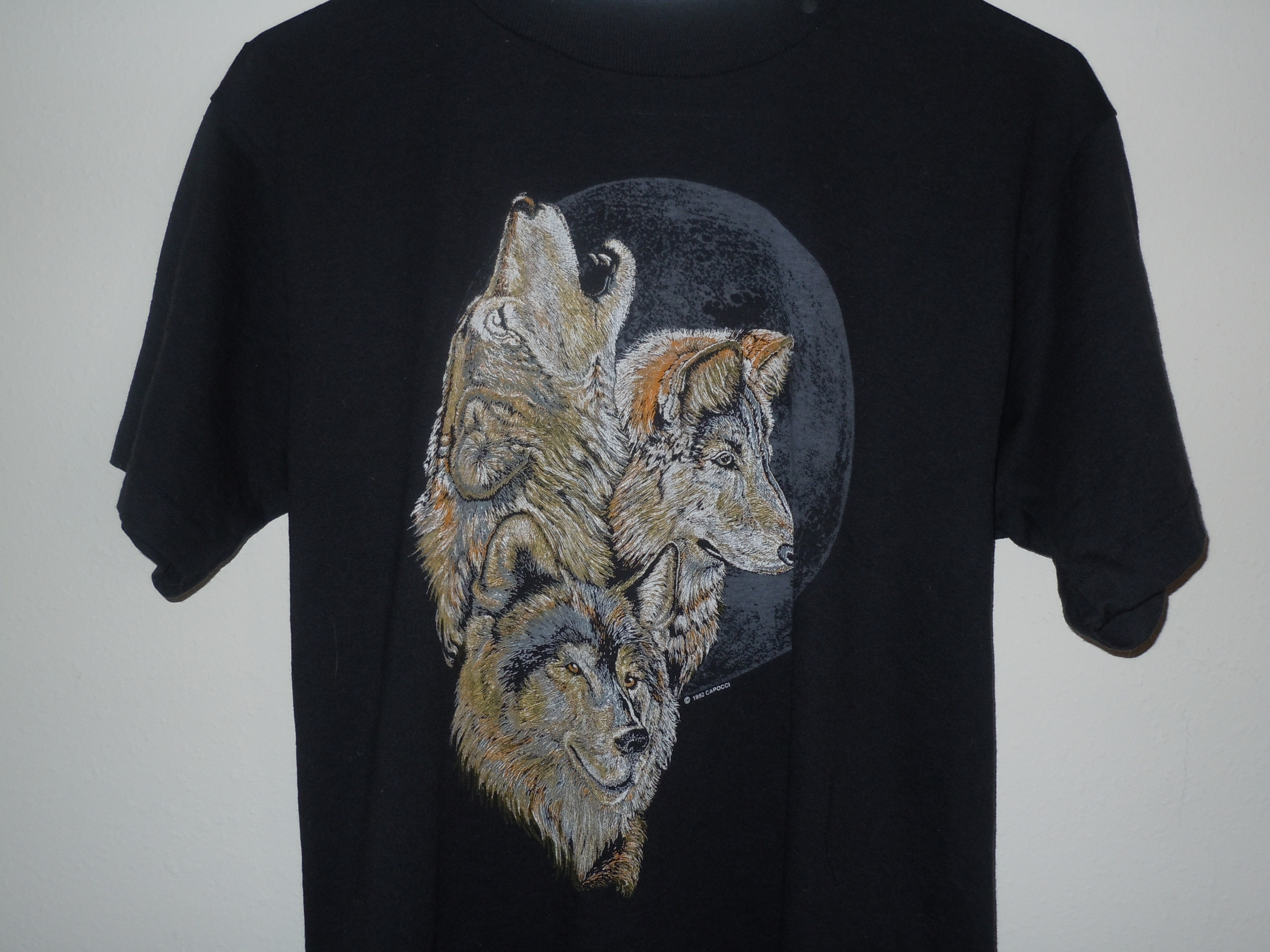
Wolf t-shirt prize giveaway!
Barstool Mountain Myths: Wolves & Elk Numbers Strong Despite Dire Predictions
Posted in Facts and Figures, Wolf Research on March 25, 2011| Leave a Comment »
*Check out this article provided by authors Tory and Meredith Taylor, Wyofile (in depth reporting about Wyoming people, places, and policies) from April 06th, 2009. This gives you some good facts about predator/prey relationships and other causes of Elk decline. Please read and provide your feedback!
While some Wyoming legislators, hunters, and ranchers claim that wolves are decimating the state’s elk herds, analysis of the facts tells a different story. Prior to the reintroduction of wolves into the Greater Yellowstone area during 1995 and 1996, some pessimists predicted that following wolf recovery, Wyoming’s abundant elk herds and popular elk hunting would be things of the past.
In contrast, many wildlife biologists — who had a better grasp of predator-prey relationships — predicted that after wolves recovered, elk distribution and behavior might fluctuate in some herds, but that elk numbers would be largely unaffected. Now, wolf and elk population monitoring studies indicate that the wildlife biologists’ predictions were more accurate than the darker forecasts of the anti-wolf pessimists.
Many things kill Wyoming elk. Human hunters, animal predators, disease, too little or too much precipitation, hard winters, and poor forage all help determine which elk live and which die. Other things — auto-elk collisions, spring floods, lightning, fences, culling of diseased elk, and poaching — also take a toll. The risks to elk seem daunting at times, and the odds of an elk dying of old age are slim.
How many elk are in Wyoming and how many do we want? Through a public process taking into consideration many factors, the Wyoming Game and Fish Department sets objectives for the state elk population. The department weighs factors such as forage availability, winter range, and hunter demand. Other factors with greater weight, such as landowners’ desires and political wishes, are also considered. Game and Fish wildlife biologists annually compare elk populations against the population objectives in order to determine proper management strategies. If elk numbers are declining from the population objective, wildlife managers rummage in their “elk population tool box” for appropriate tools to fix the problem. For example, they may need fewer hunters and more habitat improvement projects. If elk numbers are increasing too much above the herd objective, wildlife managers may increase hunting opportunities by issuing more hunting licenses, lengthening hunting seasons, or instituting hunter access programs that facilitate elk harvest.
Each year Wyoming wildlife biologists collect data from elk herds and elk hunting seasons in order to gauge trends. Elk data from the state’s 35 elk herds and eight management districts are compiled in Wyoming Fish and Game Department annual reports that show the big picture of Wyoming elk populations. Interestingly, the annual reports’ data tell a far different story about Wyoming elk numbers and elk hunting opportunities than is often heard in coffee shops, from bar stools, and at the state legislature.
Nearly three decades of Wyoming elk data taken from the department’s annual reports show that the elk population, number of elk harvested, and elk hunter success rates have steadily increased both before and after wolf reintroduction. During this time, the number of elk hunting licenses sold each year has slightly decreased. This means that Wyoming has more elk today than thirty years ago, with about the same number of hunters killing more elk.
According to the 2008 Game and Fish Annual Report, the 2007 state elk population objective was 83,140 animals. The estimated Wyoming elk population was calculated from only 27 of 35 elk herds at 94,936 animals (population estimates for the other eight herd units are not available in the report or from the department). Even with eight herd units missing from the count, the 2007 Wyoming elk population was 14 percent above the target population objective, according to the annual report.
“The Department continues to manage for a reduction in Wyoming’s elk population,” the report states, noting that “overall, management strategies will continue to focus on decreasing the statewide population. However, some herds are at objective and will be managed for their current numbers.” (WGFD, 2008 Annual Report, p. A-2.)
*Source Wyoming Game and Fish Department Annual Reports.
(1) Statewide elk population was calculated from 27 of 35 elk herds; 8 herd populations unavailable
(2) Statewide elk population was calculated from 29 of 35 elk herds; 6 herd populations unavailable.
(3) Statewide elk population was calculated from 28 of 35 elk herds; 7 herd populations unavailable.
(4) Statewide elk population was calculated from 28 of 35 elk herds; 7 herd populations unavailable.
(5) Statewide elk population was calculated from 27 of 35 elk herds; 8 herd populations unavailable.
Note: 2003-07 elk population estimates are below actual numbers.
Wyoming has never been a state to let science or facts get in the way of culture, custom, and wishful thinking. Our 1880s-era political system is based on a one cow, one vote premise, and change comes hard.
In an e-mail exchange with WyoFile during the 2009 legislative session, Wyoming State Rep. Pat Childers (R-Park), chairman of the Travel, Recreation, and Wildlife Committee, stated his opinion that wolves are bad for elk.
“As for wolves and elks [sic], I have had two reports from the Wyoming Game & Fish presented to me that clearly show that the wolves are impacting the ungulate [sic] of the elk herds,” Childers wrote. “While the populations of those herds have not currently decreased, the study shows that the populations of the herds will soon be reduced to an alarming low level because the loss of ungulate [sic] will result in less animals.”
An “ungulate” is a hoofed mammal; it’s unclear what Chairman Childers thinks it is.
The Game and Fish department’s Absaroka Elk Study that Chairman Childers cites clearly shows that elk numbers have been well above the Clark’s Fork herd objective since 1992, throughout the entire wolf recovery period. What Childers thinks would reduce the elk to alarmingly low levels is not clear, but herd reduction appears to be the intended goal of the Wyoming Game and Fish Department order to manage the elk at or near the herd’s population objective. (Absaroka Elk Ecology Project, 2008 update. WYGFD, UW, and USFWS.)
All elk populations do not respond identically to sharing landscape with wolves, a new report from Montana suggests. Montana Fish, Wildlife and Parks and Montana State University researchers spent the past seven years monitoring elk populations and behavior in southwestern Montana. Their study shows that elk numbers in some areas dropped, mostly due to the loss of elk calves to wolves and grizzly bears. But in other Montana areas, elk numbers increased while hunter-harvests of elk decreased, with little apparent influence by local wolf packs on elk numbers.
“One-size-fits-all explanations of wolf-elk interactions across large landscapes do not seem to exist,” said Justin Gude, chief of Fish, Wildlife and Parks wildlife research in Helena. He noted that the study also found that “calves with higher gamma globulin levels, a possible indicator of superior condition, survived better than those with lower levels, demonstrating that environmental factors are also important contributing factors to predation and survival with Yellowstone elk calves.”
How big a bite do predators take out of elk herds? Since wolf restoration in Greater Yellowstone, some people assumed the wolves would be the main cause of elk calf mortality. So from 2003 to 2005 the U.S. Geological Survey, Yellowstone National Park, and the University of Minnesota conducted an elk calf mortality study to answer the question of who’s eating what. The study showed that wolves accounted for about 12 percent of newborn calf deaths, while grizzly and black bears caused about 69 percent of recorded deaths, and coyotes killed 11 percent. wolf hunting
(Elk Calf Survival and Mortality Following Wolf Restoration to Yellowstone National Park, Shannon M. Barber-Meyer, L. David Mech, and P. J. White,13(3) Yellowstone Science, Summer 2005, p. 37.)
While many current ranchers are from fourth and fifth- generation families, wolves have had an even longer history in the West. (See, “Trophic Cascade: The Case For Wolves,” by Debra Donahue, WyoFile 07/21/2008)
And now there is a new economic constituency for wolves. Winter wolf-watch trips to Yellowstone are transforming Yellowstone into a year-around destination. According to Dr. John Duffield’s research for the University of Montana, wolves are now a tourist magnet annually bringing in at least $35 million directly, or $70 million indirectly through the multiplier effect, to such Yellowstone satellite communities as Cody, Dubois, and Jackson.
Wolf numbers are down this winter in Wyoming because of disease (distemper and mange), inter-pack conflicts, and excessive wolf shootings while the animal was delisted in the state during 2008.
“The number of wolves in Yellowstone National Park declined last year,” a January 2009 Yellowstone National Park news release stated. “It’s the first drop in wolf numbers in the park in three years. The Yellowstone Wolf Project reports the 2008 population at 124 wolves, down 27 percent from the 171 wolves recorded in 2007. The greatest decline occurred on the northern range, the area with the greatest wolf population density. The wolf population there dropped 40 percent, from 94 to 56 wolves.”
However, disease also reduced the population in 2005, when the numbers showed an even greater drop from 171 wolves in 2004, to 118, due to distemper. Sarcoptic mange is also a concern in Yellowstone wolves and has recently been identified in a Jackson-area wolf pack. The number of breeding pairs in the park has declined from 10 to six. This decline brings the wolves to the lowest number of breeding pairs recorded since 2000, when wolves first met the minimum population requirement for delisting.
Where does this leave people who are directly affected by wolves? Outfitter Bud Betts lives in the Dunoir Valley along the Wiggins elk herd migration route. His closest neighbors are elk, grizzly bears, and wolves. Betts says the wolves are doing fine, but the elk are not.
“The elk cow-calf numbers are down closer to herd objective, so we have reduced hunter opportunities. I don’t like the wolf,” he admits, but philosophically adds, “They are here and we have to live with them.”
Wildlife science still takes a back seat to politics in Wyoming. According to an Associated Press article in the February 24, 2009 Casper Star Tribune, Wyoming lawmakers want to test wolves for brucellosis, a bacterial infection best known in Wyoming in cattle and bison, although different forms of the disease can also infect swine, goats, sheep and dogs.
During the 2009 legislative session, Senate File 87, sponsored by Sen. Kit Jennings (R-Natrona) and Rep. Childers, would have required Wyoming Game and Fish to test wolves for the disease.
“[Brucellosis is] not even an issue,” said Mike Jimenez, the U.S. Fish and Wildlife Service’s wolf recovery project director for Wyoming. “No one’s ever really been concerned about it, but for whatever reason, if there is a concern, it’s easy enough to test for it.”
Jimenez said that federal wildlife agents have tested 16 captured or killed Wyoming wolves for the disease, but the results were all negative.
Terry Kreeger, state game and fish department supervisor of veterinary services, said the Sybille, WY research laboratory has tested wolves for brucellosis occasionally, and all results have been negative, he said.
“Given what we know today, we would consider wolves a dead-end host for [bovine brucellosis] bacteria, i.e., they become infected but they are not capable of transmitting it to other animals, even other wolves,” he said. Kreeger said he doesn’t believe wolves are a factor in Wyoming’s brucellosis problem. He said studies have shown that wolves infected with brucellosis do not transmit the disease.
Some Wyoming lawmakers are more practical than others when dealing with wolf management. In 2009 Wyoming Rep. Keith Gingery (R – Jackson/Dubois) introduced House Bill 21 to classify and manage wolves solely as “trophy game” statewide, which would have allowed the wolf to be delisted by the U.S. Fish and Wildlife Service. In the mid-1990′s, state wildlife staff recommended the “trophy animals” classification, but the politically-appointed Wyoming Game and Fish Commission, livestock interests, and most Wyoming politicians flatly rejected the idea.
Instead, politics insisted that Wyoming wolves be classified as both “trophy and predator” throughout most of the state. Predator classification means that the animal can be shot on sight at any time. Trophy game status requires a Wyoming Game and Fish regulation to hunt the animal only with a seasonal license. This dual classification has kept wolf management out of state hands, so in 2008 the wildlife commission voted to support a statewide trophy game management plan. Soon after this decision, the Wyoming Wildlife Federtion, the state’s leading hunting organization, also read the writing on the wall and voted to change its position to now support statewide trophy game management for wolves. HB 21 died this session as lawmakers stuck to their guns and their original dual classification, predator/trophy game plan. The U.S. Wildlife Service has already rejected the plan, and after a lawsuit over the large number of wolves killed in Wyoming last year, the animals have been “relisted.”
“If Wyoming wants to get to the point at which the people of Wyoming, through the Wyoming Game and Fish, manage wolves rather than the Feds,” Gingery said to WyoFile, “then we need to change our proposed wolf plan. The Feds have made it clear that they will not accept a dual status of predator/trophy game. The Feds want Wyoming to adjust their plan to a single status, namely trophy game status, just like Montana and Idaho have already done. This was under the Bush administration, and I highly doubt the Obama administration will lessen that requirement.
“Thus, the option is either drop the dual status or continue to fight in court for the next five years knowing full well that in the end we will lose. The issue that the courts will look at is whether or not the Wyoming plan meets the requirements of the Endangered Species Act, and at this point it does not.”
During the past two decades, wolf recovery and management have dwelt much more in the political and legal realms than in the biology and wildlife management worlds. Endangered species such as wolves and grizzly bears resonate loudly on the states’ rights drum. While we humans navigate the procedures of the state and national management plan process, wolves and elk, predators and prey, continue their delicate dance in Greater Yellowstone, as they have for tens of thousands of years.
Meet and greet for animal lovers raises $47,500 for Humane Society
Posted in Uncategorized on March 23, 2011| 2 Comments »
**Special thanks to Writer Betsy Reason of IndyStar.com for providing this information!
“It was evident from the turnout and dollars brought in at last weekend’s Wine, Wags & Whiskers fundraiser just how much people love animals.
A record 400 guests attended the Humane Society for Hamilton County’s third-annual party. That’s twice as many as last year.
A record $47,500 was brought in nearly doubling last year’s take of $25,000.
“We were absolutely thrilled,” said Rebecca Stevens, the shelter’s executive director.
Besides the greater attendance, Stevens attributed the increase in fundraising dollars to three other factors. Master Jewelers in Indianapolis donated a loose diamond for a raffle — won by Toni VanHorn, 46, Noblesville — that helped raise $2,000. Matching contributions from the shelter’s Board of Directors brought in $6,500. And a silent auction brought in about $4,000 more than last year.
“I couldn’t have asked for better results,” Stevens said.
The gala, which took place at The Mansion at Oak Hill in Carmel, resulted in two adoptions. One was for Penny, the shelter’s longest-standing canine, a 51/2-year-old malamute/Lab mix who has been at the shelter for 21/2 years. Penny, who was on a
leash at the gala, was featured on labels of pinot grigio wine sold to raise money at the event.
Penny and a half-dozen other shelter dogs and some cats were among the guests at the gala, during which folks could sample 30 wines, savor hors d’oeuvres and bid on silent auction items.
Sarah Barker, 23, Noblesville, led another shelter dog, Cadence, a 21/2-year-old pit bull, through the crowd.
“Everybody loves her. She’s a great representative of her breed,” said Barker, who became interested in dog obedience as a 4-H’er. She’s a shelter volunteer who walks dogs about four days a week and owns eight, four of which are retired show dogs.
The shelter currently has 201 dogs and 371 cats in need of homes and relies greatly on the support of volunteers and foster care. Currently, 258 of those animals are in foster care.
Cindy Kernan, 51, who lives in Marion County’s Lawrence Township, started volunteering two years ago. Barker and Kernan are among
200 shelter volunteers.
“It really appealed to me to be part of an organization that really cared for the dogs and how they’re treated,” Kernan said. She walks dogs and helps out with events.
She fostered, then adopted a black pit bull named Naomi.
“I was just going to take her home for a week at Christmas time to give her a treat and make myself feel better that she wasn’t sitting in the shelter over Christmas,” Kernan said.
Naomi has been at Kernan’s house now for the past 15 months.
“Never in a million years . . . (did I think) I would own a pit bull. Now I know why it’s so great to own one. She gives the best kisses, she’s a great dog,” Kernan said. “Sometimes when you tell people you have a pit bull, they don’t know what to say.”
Kernan likes the shelter’s philosophy.
“They try to give every dog a home. When they run out of room, they try to get them out into foster families. They try their best to give the dogs a home. I love being around animals, and they enrich my life so much,” she added.
Guest Velda Boenitz, Noblesville, helped found the shelter in 1984 and was heavily involved in its operation for the first 10 years.
“They’ve come a long way. I think they’ve done a wonderful job,” said Boenitz, who had the former shelter on Cumberland Road constructed in 1991. The current shelter opened in 2007.
Dennis Rosiak, 58, Noblesville, and his wife, Connie, started volunteering at the Cumberland Road shelter.
Connie is a former board member. Dennis helps clean up and has helped with the Pet Tails program that features shelter pets on Channel 19. They both walk dogs.
The Rosiaks, who handle St. Bernard rescues, are fostering a 2-year-old St. Bernard.
“It’s a great cause. There are so many animals coming through the shelter today. We really need to take care of these animals,” said Dennis Rosiak, who’s on the board of the Low Cost Spay Neuter Clinic of Hamilton County, adjacent to the shelter. “All of these things work together.”
Rosiak said it all comes down to one thing: “Pets need homes.”
Musical artist Jennie DeVoe, Indianapolis, has performed all three years because, she said, the cause is close to her heart.
Of the six animals — a Rottweiler shepherd, a shepherd mix, a chow schnauzer, a Scottie dachshund and two cats — that she owns, “every animal is a rescue,” she said. “I’m a huge, huge supporter of the Humane Society.” “
Montana wolf numbers up 8% in 2010, Idaho’s down 16% according to state wildlife agencies
Posted in Facts and Figures on March 19, 2011| Leave a Comment »
The Spokesman-Review released the following article:
“Montana has just announced that at least 566 wolves inhabit the state, according to the 2010 annual wolf conservation and management report released today by Montana Fish, Wildlife & Parks. The report shows Montana’s minimum wolf population increased about 8 percent in 2010, compared to a 4 percent increase last year and an 18 percent increase in 2008. The minimun numbers indicate that wolves have increased to 108 verified packs and 35 breeding pairs.
The U.S. Fish and Wildlife Service followed Montana by posting the complete 2010 Northern Rockies wolf update, which includes the census from Idaho and Wyoming.
The report by Idaho Fish and Game biologists documented a minimum of 705 wolves in 87 packs at the end of 2010. In addition, they documented 22 border packs along boundaries with Montana, Wyoming and Washington. Of the 54 Idaho packs known to have reproduced, 46 qualified as breeding pairs by the end of the year. These reproductive packs produced a minimum of 189 pups in 2010.
For 2009, Idaho reported a minimum population of 843 wolves in 94 packs in the state along wtih 20 documented border packs
Idaho’s decline is at least partly due to the difficulty of monitoring wolves in remote areas of central Idaho, federal officials said.
“I’m certain we could have successfully reduced the wolf population in 2010 if we could have proceeded with our planned, science-based hunting season,” said FWP Director Joe Maurier. “When you look at our management success in 2009, we had a vigorous wolf population at the end of the year and we were still able to control its growth. It’s clear that a management strategy that includes hunting can play an important role in managing wolves in Montana. It is a tool we need and one we’re still trying to get back.”
Last year, FWP joined in a federal lawsuit in defense of the U.S. Fish and Wildlife Service’s 2009 decision to delist wolves in Montana and Idaho, but not in Wyoming. The U.S. District Judge in Missoula, however, reinstated federal protections of wolves in the northern Rocky Mountains on Aug. 5.
The minimum recovery goal for wolves in the northern Rocky Mountains was set at a minimum of 30 breeding pairs—successfully reproducing wolf packs—and a minimum of 300 individual wolves for at least three consecutive years and well distributed throughout the recovery area. The goal was achieved in 2002, and the wolf population has increased every year since.
FWP’s report is part of the annual federal recovery update required by USFWS. The end of 2010 count also estimates that at least 343 wolves inhabited Wyoming, up slightly from 2009. The count in Idaho dropped slightly to 705, likely due to the state’s decision to reel in monitoring efforts in central Idaho’s rugged wilderness areas. Annual reports from Idaho, Wyoming, and information about wolves in Yellowstone National Park and the northern Rockies are available from the USFWS online at http://westerngraywolf.fws.gov.
The northern Rockies’ “metapopulation” is comprised of wolf populations in Montana, Idaho, and Wyoming. Four packs are now verified in Oregon and Washington within the northern Rocky Mountain Distinct Population segment. Today, at least 1,651 wolves in 244 packs, with about 111 breeding pairs, live in the region, where wolves can travel about freely to join existing packs or form new packs. This, combined with wolf populations in Canada and Alaska, assures the genetic diversity of wolves throughout the region.
Each of the three geographic regions of Montana inhabited by wolves showed slight increases in 2010 from 2009:
- northwestern Montana’s population exhibited the greatest increase where the population grew to a minimum of 326 wolves, in 68 verified packs, and 21 breeding pairs. Seven of the packs reside on reservations where they are managed by Tribal authorities.
- western Montana’s population increased slightly to at least 122 wolves in 21 packs, and eight breeding pairs.
- southwestern Montana’s population increased slightly to at least 118 wolves in 19 packs, and six breeding pairs.
About 24 packs occur along Montana’s border with Idaho, 18 of which are included in the Montana estimate. This demonstrates the continued influence of the robust wolf population in Idaho on Montana’s wolf population. Additionally, six packs are shared with Wyoming, four of which are included in Montana’s population.
Compared to Idaho and Wyoming, at 24 percent Montana had the highest rate of known human-caused mortality of wolves in 2010. Officials say that’s due to Montana’s wolf population, as a whole, living on a combination of public and private lands.
Maurier noted, however, that Montana’s wolf population still increased and remains well above recovery goals. “Nearly all of Montana’s wolves live outside national parks,” he said. “That means an intensive management strategy is needed to strike the right balance between wolves and public acceptance. Unfortunately that’s out of our hands, but it’s crystal clear that this species is fully recovered. Montana has made room for wolves and it is our position that Montana must be given the authority to manage them.”
**How accurate do you think these numbers are? Wolf Preservation would like to hear your comments!
Wolves and communication; no need to fear the howl!
Posted in Facts and Figures on March 17, 2011| 2 Comments »
Many of us think of communication only as talking or writing to each other. Those are two ways humans share information every day. How do wolves “converse?” Even though they cannot talk or write, wolves communicate effectively in several ways.
Wolves use body language to convey the rules of the pack. A wolf pack is very organized. Rule number one says that the pack is made up of leaders and followers. The pack leaders are the male parent and the female parent – usually the father and mother of the other pack members. They are likely to be the oldest, largest, strongest and most intelligent wolves in the pack. They are known as the alpha wolves and are usually the only members of the pack to produce pups.
Any wolf can become an alpha. However, to do so, it must find an unoccupied territory and a member of the opposite sex with which to mate. Or, more rarely, it moves into a pack with a missing alpha and takes its place, or perhaps kills another alpha and usurps its mate.
The alpha male and female are dominant, or in charge of the pack. To communicate dominance, the alphas carry their tails high and stand tall. Less dominant wolves exhibit submissive behavior by holding their tails down and often lower their bodies while pawing at the higher ranking wolves.
There are two levels of submissive behavior: active and passive. Active submission is a contact activity in which signs of inferiority are evident such as crouching, muzzle licking and tail tucking. The behaviors typical of active submission are first used by pups to elicit regurgitation in adults. These behaviors are retained into adulthood by subordinate wolves, where they function as a gesture of intimacy and the acceptance of the differentiation of the roles of the wolves that are involved.
Passive submission is shown when a subordinate wolf lays on its side or back, thus exposing the vulnerable ventral side of its chest and abdomen to the more dominant wolf. The subordinate wolf may also abduct its rear leg to allow for anogenital inspection by the dominant wolf. If two wolves have a disagreement, they may show their teeth and growl at each other. Both wolves try to look as fierce as they can. Usually the less dominant wolf, the subordinate one, gives up before a fight begins. To show that it accepts the other wolf’s authority, it rolls over on its back. Reactions to this behavior may range from tolerance (the dominant wolf standing over the submissive wolf) to mortal attack, particularly in the case of a trespassing alien wolf. Following the dominance rules usually keeps the wolves in a pack from fighting among themselves and hurting each other.
Wolves convey much with their bodies. If they are angry, they may stick their ears straight up and bare their teeth. A wolf who is suspicious pulls its ears back and squints. Fear is often shown by flattening the ears against the head. A wolf who wants to play dances and bows playfully.
Wolves have a very good sense of smell about 100 times greater than humans. They use this sense for communication in a variety of ways. Wolves mark their territories with urine and scats, a behavior called scent-marking. When wolves from outside of the pack smell these scents, they know that an area is already occupied. It is likely that pack members can recognize the identity of a packmate by its urine, which is useful when entering a new territory or when packmembers become separated. Dominant animals may scent mark through urination every two minutes. When they do so they raise a leg, this dominant posture utilizes multiple forms of communication and is called a “Raised Leg Urination” or RLU.
Wolves will also use urine to scent mark food caches that have been exhausted. By marking an empty cache, the animal will not waste time digging for food that isn’t there.
Wolves use their sense of smell to communicate through chemical messages. These chemical messages between members of the same species are known as “pherimones.” Sources of pherimones in wolves include glands on the toes, tail, eyes, anus, genitalia and skin. For example, a male is able to identify a female in estrus by compounds (pherimones) present in her urine and copulation will only be attempted during this time.
Of course, their sense of smell also tells them when food or enemies are near.
Have you ever heard a wolf howl? They’re not howling at the moon they are communicating. They call any time of the day, but they are most easily heard in the evening when the wind dies down and wolves are most active. Wolves’ vocalizations can be separated into four categories: barking, whimpering, growling, and howling. Sounds created by the wolf may actually be a combination of sounds such as a bark-howl or growl-bark.
Barking is used as a warning. A mother may bark to her pups because she senses danger, or a bark or bark-howl may be used to show aggression in defense of the pack or territory.
Whimpering may be used by a mother to indicate her willingness to nurse her young. It is also used to indicate “I give up” if they are in a submissive position and another wolf is dominating them.
Growling is used as a warning. A wolf may growl at intruding wolves or predators, or to indicate dominance.
Howling is the one form of communication used by wolves that is intended for long distance. A defensive howl is used to keep the pack together and strangers away, to stand their ground and protect young pups who cannot yet travel from danger, and protect kill sites. A social howl is used to locate one another, rally together and possibly just for fun.
Can you think of ways that humans communicate without using words?
How Do Wolves Say Hello?
Have you seen dogs jump up to greet their owners, bark at strangers or roll over when another dog approaches? Then you already know something about how wolves communicate. Dogs inherited most of their language from their ancestors, the wolves.
Wolves use three different languages:
- Sound – Howls, Barks, Whimpers and Growls.
- Special Scents – Scats, Urine and Pherimones.
- Body Language – Body Positions and Movements and Facial Expressions.
**Special thanks to “International Wolf Center” for providing this information!
Wolf Park Research Projects–Internship Opportunities!
Posted in Uncategorized, Wolves and educational activities on March 17, 2011| Leave a Comment »
Who can do a Research Project?
- College and graduate students
- Teachers on sabbatical or summer/winter break
- Dog behaviorists
- Dog trainers
- Veterinarians and veterinary technicians
- Anyone who has a specific interest in canids
Wolf Park is an excellent place to conduct observational or behavioral research. We can help you design and plan your project, although we cannot help you collect and analyze data. Only interns and practicums may conduct research at Wolf Park. If you are interested in doing research with our animals outside of the internship/practicum program, please contact our managing director.
If you are accepted to either the practicum or internship program and have a research project in mind, in order to make sure that what you have planned is possible and will be approved by Wolf Park, we suggest getting our consent in advance of your arrival. Project proposals and outlines should be sent to Pat Goodmann, c/o Wolf Park, or via email (pat@wolfpark.org). After your project has been approved by Pat, she will get consent from Dr. Klinghammer as well. You are not required to do a research project. Many students simply work and study during their time here. It is a good way to learn about research in a non-threatening environment.
Most of the research at Wolf Park is observational in nature. Students in the past have studied sleeping behavior, eating behavior, howls and other vocalizations, and adult interaction with puppies, to name just a few. Many students will focus on a particular animal and observe its interactions with the other animals. Other study opportunities exist with the foxes, coyotes, and bison.
The small staff has limited time; therefore projects involving the manipulations of the animals and their environment are not permitted. Research projects should be purely based on observation of the wolves, not anything that requires human participation or interaction of any kind. Also, due to time limitations, the staff cannot be an integral part of the actual data collection. Do remember, though, the staff is always available to answer questions. Before attempting long and involved projects, especially those resulting in something important such as a Masters thesis, a visit to Wolf Park is recommended.
*Special thanks to “Wolf Park” for providing this information! Please visit their site at http://www.wolfpark.org/index.html
Should sport hunting of animals be allowed? Wolf Preservation wants to hear your comments!
Posted in Uncategorized on March 5, 2011| 10 Comments »
Wolf Preservation wants your feedback on this subject. Should sport hunting of animals be allowed? Should hunting only be allowed for food? If so, are there any methods of hunting that need to be banned? Or do you have another reason for hunting animals? What are your beliefs on this issue? Please respecfully share your thoughts!
What and how much do wolves eat?
Posted in Facts and Figures on March 5, 2011| Leave a Comment »
Wolves are carnivores, or meat eaters. Gray wolves prey primarily on ungulates – large, hoofed mammals such as white-tailed deer, mule deer, moose, elk, caribou, bison, Dall sheep, musk oxen, and mountain goats. Medium-sized mammals, such as beaver and snowshoe hares, can be an important secondary food source. Occasionally wolves will prey on birds or small mammals such as mice and voles, but these are supplementary to their requirements for large amounts of meat. Wolves have been observed catching fish in places like Alaska and western Canada. They will also kill and eat domestic livestock such as cattle and sheep, and they will consume carrion if no fresh meat is available. Some wolves eat small amounts of fruit, although this is not a significant part of their diet. If prey is abundant, wolves may not consume an entire carcass, or they may leave entire carcasses without eating. This is called “surplus killing” and seems inconsistent with the wolves’ habit of killing because they are hungry. Surplus killing seems to occur when prey are vulnerable and easy to catch – in winter, for instance, when there is deep snow. Since wolves are programmed to kill when possible, they may simply be taking advantage of unusual situations when wild prey are relatively easy to catch They may return later to feed on an unconsumed carcass, or they may leave it to a host of scavengers. Additionally, they may cache food and dig it up at a later time.
Red wolves primarily prey on white-tailed deer, raccoons, rabbits, nutria and other rodents.
Getting enough to eat is a full-time job for a wolf. When wolves catch and kill a large mammal, they will gorge and then rest while the food is being rapidly digested. They will generally consume all but the hide, some of the large bones and skull and the rumen (stomach contents of ungulates) of their prey. Gray wolves can survive on about 2 1/2 pounds of food per wolf per day, but they require about 7 pounds per wolf per day to reproduce successfully. The most a large gray wolf can eat at one time is about 22.5 pounds. Adult wolves can survive for days and even weeks without food if they have to. Growing pups, however, require regular nourishment in order to be strong enough to travel and hunt with the adults by the autumn of their first year. Wolves often rely on food they have cached after a successful hunt in order to see them through lean times.
Red wolves may eat 2 to 5 pounds of food per day when prey is abundant. Because they are smaller than gray wolves, they can consume less at one time than their larger cousins. But like all wolves, eating for red wolves is a matter of “feast” followed by “famine.”
Wolves depend on a variety of large ungulates (hoofed animals) for food. Although studies have been conducted in some areas to determine the actual number of prey killed each year, the results are estimates. For example, an estimate for deer ranges from 15 to 19 adult-sized deer per wolf per year. Given the 2008 estimate of 2922 wolves in Minnesota, for instance, that would equal 43,800 to 58,500 deer killed by wolves. In comparison, hunters killed approximately 260,000 deer in the 2007 deer harvest. Additionally, several thousand deer are killed during collisions with vehicles each year.
*Thanks to the International Wolf Center for providing this information!
 The Wolf Preservation Blog