Feeds:
Posts
Comments

Archive for the ‘Uncategorized’ Category


Geographic Wolf

© MARC MORITSCH/NATIONAL GEOGRAPHIC CREATIVE/CORBIS

By

“Scientists who study canine origins seem to fight about everything: where dogs arose, when this happened, and even the best way to find these answers. But there’s one thing most of them agree on: how dogs became domesticated. Still, it’s taken almost a century to get here, and the details are still emerging.

In 1907, the English scientist Francis Galton suggested that dogs first entered our lives when our ancestors nabbed some wolf pups, brought them back to camp, and raised them as pets. If you’ve ever seen a baby wolf, with its big eyes and oversized ears, the idea doesn’t seem so far-fetched—and, indeed, Galton’s hypothesis reigned for decades. But scientists eventually realized that domestication is a long, messy process that can take hundreds or even thousands of years. These early humans may have started with a cute pup, but they would have ended up with a wild animal.

So what did happen? Most experts now think dogs domesticated themselves. Early humans left piles of discarded carcasses at the edges of their campsites—a veritable feast, the thinking goes, for wolves that dared get close to people. Those wolves survived longer and produced more pups—a process that, generation by generation, yielded ever-bolder animals, until finally a wolf was eating out of a person’s hand. Once our ancestors realized the utility of these animals, they initiated a second, more active phase of domestication, breeding early canines to be better hunters, herders, and guardians.

A massive collaboration that’s trying to figure out where and when dogs emerged (see “Feature: Solving the mystery of dog domestication“) has found some intriguing insights into the second phase of dog domestication. A comparison of thousands of ancient dog and wolf skeletons, for example, has revealed flattening of the dorsal tips of ancient dog vertebrae, suggesting that the animals hauled heavy packs on their backs. The team has also spotted missing pairs of molars near the rear of the jaw in ancient dogs, which may indicate that the animals wore some sort of bridle to pull carts. These services, in addition to dogs’ hunting prowess, may have proved critical for human survival, potentially allowing modern humans to out compete our Neanderthal rivals and even eventually settle down and become farmers.

Now, a study in this week’s issue of Science helps explains how man and dog took the next step to become best friends. Takefumi Kikusui, an animal behaviorist at Azabu University in Sagamihara, Japan, and his colleagues have found that when dogs and humans gaze into each others eyes, both experience a rise in oxytocin—a hormone that has been linked to trust and maternal bonding. The same rise in oxytocin occurs when human mothers and infants stare at each other, suggesting that early dogs may have hijacked this response to better bond with their new human family.

The oxytocin study and the skeletal data from the new collaboration go beyond clarifying the origin of the family pet, says collaboration leader Greger Larson, an evolutionary biologist at the University of Oxford in the United Kingdom. “The more that we know about the process of how dogs became associated with people, the more we learn about the origins of civilization.”

**Special thanks to David Grimm, Online News Editor of Science, for providing this information! (http://news.sciencemag.org/plants-animals/2015/04/how-wolf-became-dog)

Read Full Post »


10:11 a.m. PDT April 15, 2015

“An effort to remove gray wolves from the state endangered species list is moving forward on multiple fronts.

State biologists said Tuesday that wolf numbers are high enough to justify removing them the state list, while Republican lawmakers have introduced a bill to prohibit the Oregon Department of Fish and Wildlife commission from listing wolves as threatened or endangered.

With four breeding pairs in eastern Oregon for three consecutive years and 77 known wolves statewide, ODFW biologists said there is little probability of wolves declining or going extinct.

“Factors related to wolf health all indicate a healthy and growing population,” ODFW wrote in a report released Tuesday. “Significant information exists to justify initiating rulemaking to remove the gray wolf from the Oregon List of Endangered Species.”

The department will present its report to the Fish and Wildlife Commission on April 24 in Bend. The commission will decide whether to start the process of delisting wolves.

“If the Commission does go forward (with rulemaking to delist wolves), then it would go to a full public process,” ODFW communications coordinator Michelle Dennehy said. “They wouldn’t be delisted, if it happened, until later this year.”

Meanwhile, state lawmakers are seeking a more direct route to getting wolves off the list. Legislation authored by Rep.Greg Barreto (R-Cove), Rep. Jodi Hack (R-Salem) and Sen. Bill Hansell (R-Athena) seeks to prohibit ODFW from ever including wolves on the list endangered species list.A hearing on the bill is scheduled for Thursday in the House Committee on Agriculture and Natural Resources.

Groups including the Oregon Cattlemen’s Association have advocated for delisting wolves to make it easier for ranchers to use lethal action to protect livestock. Conversation groups have said that 77 wolves is too small a population to consider them recovered.

Wolves being removed from the state list wouldn’t mean a huge change, Dennehy said.

Wolves in western Oregon are still protected by the federal Endangered Species Act. And even with the delisting, wolves in Oregon would still be managed under the state’s Oregon Wolf Plan, which emphasizes non-lethal control to manage wolves and only allows lethal control in certain circumstances.

“Even with the delisting, we still have a comprehensive wolf plan and still would have protections in place,” Dennehy said.”

The Associated Press contributed to this report.

Zach Urness has been an outdoors writer, photographer and videographer in Oregon for seven years. He is the author of the book “Hiking Southern Oregon” and can be reached at zurness@StatesmanJournal.com or (503) 399-6801. Find him on Facebook at Zach’s Oregon Outdoors or @ZachsORoutdoors on Twitter.

Read Full Post »


Eric MortensonCapital Press

Published: April 10, 2015 2:09PM
“A renowned animal sciences professor says wolves and coyotes shouldn’t be killed without reason, and ranchers should rekindle a cattle herd’s natural predator defense instincts.
Indiscriminate shooting or trapping of wolves and coyotes is a bad idea, and producers should strive for balance in the rangeland ecosystem, says Temple Grandin, the Colorado State University livestock handling and animal welfare expert.

“You may take out the wolf that is leaving the cattle alone,” Grandin said.

“The sensible thing to do is probably in between the rancher who says get rid of all the wolves and the environmentalist who says never take any wolves out,” Grandin said. “You want to take out the animal that’s developed a taste for lamb or beef.”

Grandin, whose insights on animal behavior caused livestock slaughterhouses to adopt calmer and more humane handling methods, expanded on points she made in a February article for Beef Magazine,

Among other things, Grandin believes ranchers can help cattle re-learn predator defense instincts such as bunching up instead of running.

The technique worked for the great bison herds that once roamed the plains, Grandin said. She credited the idea to two presenters at the Society for Range Management’s annual meeting in Sacramento this winter.

“Rekindling the natural herding instinct is not forcing the cattle together,” Grandin wrote in the magazine article. “The principle is to move back and forth in a straight line on the edge of the collective pressure zone” while not entering the herd’s “flight zone.”

Dealing with predators calls for a site-specific approach, Grandin said. “Something that works in one part of the country won’t work somewhere else.”

Grandin said wolves and coyotes usually avoid areas where people are present, and that employing range riders — as many Northeastern Oregon cattle ranchers do — is an effective deterrent. Removing livestock carcasses from grazing areas, a practice called for in Oregon’s wolf management plan, is critical to avoid attracting predators and giving them a taste for livestock, she said.

Individual packs favor specific prey, and “momma wolves” pass that on to their pups, she said.

A wolf pack that eats elk and leaves cattle alone should be tolerated, because it will protect its territory from packs that have other tastes, Grandin said.

“With coyotes, the one eating ground squirrels, you can shoot him – but he’s not the one bothering your livestock,” she said.

A better approach is to remove individual problem animals or a male and female pair that are caught in the act, she said.

“In managing these things, you have to look at the whole system,” Grandin said. “I do go on the premise that cattle are part of the system.”

People have impacted and managed rangeland for eons, dating back to when Native Americans burned grasslands, Grandin said. Critics of grazing don’t understand how human use of the range can be beneficial, she said.

“Responsible family ranchers are part of that system,” she said.

Grandin, who is autistic and has become an activist on that issue in addition to livestock management practices, is one of the few experts cited by both producers and conservation groups.

Her summary of the range management meeting was carried on the Defenders of Wildlife website. The American Farm Bureau Federation presented her the bureau’s Distinguished Service Award at its national convention in January.”

Read Full Post »


For Immediate Release, April 6, 2015

Contact: Andrea Santarsiere, (303) 854-7748, asantarsiere@biologicaldiversity.org

“VICTOR, Idaho— Population numbers released by the state of Idaho late last week showed an increase in wolf numbers from 659 in 2013 to 770 in 2014, suggesting an increased population. Idaho’s estimate, however, is based in large part on extrapolation and belied by a drop in the number of breeding pairs, which has sharply declined since 2009, when wolf hunts were first allowed. Last year Idaho reported just 26 breeding pairs down from 49 in 2009. It’s unknown whether this drop is because Idaho is verifying fewer packs or because breeding pairs have been lost, but either way it suggests a problem in Idaho’s monitoring of what was so recently an endangered species.

“Since 2009 more than 1,300 wolves have been hunted or trapped in Idaho, and another nearly 500 have been lethally removed from Idaho’s landscape,” said Andrea Santarsiere, a staff attorney at the Center for Biological Diversity. “In the face of these astounding numbers, it’s no wonder that Idaho may have experienced a nearly 50 percent drop in breeding pairs.”

Unlike Montana and Wyoming, Idaho does not base its population estimate solely on observation of wolf packs by the state’s biologists, but rather combines direct observations with extrapolated wolf numbers. Idaho’s biologists actually documented only 272 wolves in 43 packs, but the state claims 770 wolves in 104 packs based on hunter reports and an average pack size of 6.5 wolves. There are probably more than 43 packs, but because hunters likely report dispersing wolves or even coyotes and pack size varies considerably, the exact number is unknown. This is why both Montana and Wyoming present a minimum count of just the wolves that they themselves count.

“We don’t think wolves should be hunted at all,” said Santarsiere. “But with such aggressive killing of a species so recently considered endangered, there at least needs to be careful monitoring.”

Gray wolves were protected under the Endangered Species Act after being extirpated from most of the lower 48 states. In 1995 and 1996, the Fish and Wildlife Service reintroduced wolves to Yellowstone National Park and other parts of the northern Rocky Mountains. In 2011 Congress took an unprecedented step to remove the protections of the Act from gray wolves in Idaho and Montana. Since then Idaho has allowed aggressive hunting and trapping of wolves across the state.”

**Special thanks to The Center for Biological Diversity is a national, nonprofit conservation organization with more than 825,000 members and online activists dedicated to the protection of endangered species and wild places, for providing this information!

Read Full Post »


March 26th, 2015

“Two breeding pairs of captive red wolves could have pups in April at Reflection Riding Arboretum and Nature Center in Chattanooga. It’s too early to tell, though, because pregnant wolves don’t show a tell-tale bulging tummy.

“It would be a big neon sign saying, ‘I’m a slower, weaker animal,'” said Taylor Berry, lead naturalist at the nature center on the side of Lookout Mountain. “In the wild, the name of the game is not to be weak.”

If wolf pups are born in Chattanooga — and the timing works perfectly — they could be snuck into a wolf’s den in North Carolina to be raised among the world’s only wild, free-ranging population of red wolves, possibly North America’s most endangered mammal.

Or not. The red wolf, which roamed the Southeast in great numbers before being pushed to near-extinction through hunting and habitat loss, could disappear again from the wild.

North Carolina’s Wildlife Resources Commission wants the federal government to declare the red wolf extinct and end the animal’s reintroduction in five low-lying counties in coastal eastern North Carolina.

Officials from the state commission, which regulates hunting and fishing, say the free-ranging red wolves reduce deer numbers, kill pets and livestock on private property and may not be genetically pure, since red wolves interbreed with coyotes.

“We have had numerous accounts of depredations on livestock and pets,” wildlife commission spokesman Geoff Cantrell said.

Environmentalists rally

Environmentalists have rallied to save the red wolf, saying the end of the reintroduction program could put the species’ very existence in peril.

“That’s what they would essentially be saying: This is a failure,” said Jeremy Hooper, a University of Tennessee at Chattanooga biological and environmental sciences student who’s doing a master’s project on coyote-human interaction in the Atlanta area.

“It’s a big deal. The only place they will exist is in captivity if they’re removed from the wild,” said Hooper, who previously cared for Chattanooga’s wolves as a naturalist at the nature center.

He disputed the North Carolina Wildlife Resources Commission claim that the wolves compete for the same game as human hunters.

In fact, he said, hunting harvest figures show that hunters in North Carolina have taken more deer and turkey where the wild red wolves live, he said.

It may sound counterintuitive, but wolves can help deer populations by taking out the old, weak and sick, and by making them move around, preventing them from overgrazing in one spot. Ecologists call this movement the “ecology of fear,” he said.

“The ecology of fear states … they’ve always got to be on the move,” Hooper said. “There’s definitely benefits of having predators on the landscape.”

One reason North Carolina landowners got upset, Hooper said, was because of a federal judge’s recent ruling that banned shooting coyotes around the wolves. The two are so similar that wolves were being killed.

“That was what originally sparked a lot of [landowner] anger,” he said.

That ruling since has been modified to allow daytime hunting of coyotes on private land with a permit.

For years, Hooper said, there’s been debate about whether red wolves are a distinct species. The red wolves in the recovery program are all descended from 14 wolves found in the wild whose DNA showed the least hybridization with coyotes.

The best way to keep the wild red wolf population going in North Carolina, Hooper said, would be to continue the current practice of releasing sterilized coyotes there. That way, if a wolf breeds with a sterile coyote, no pups result. Meanwhile, the number of wild red wolves should grow.

“On top of that, they have to limit mortality via hunting,” Hooper said. “Which is a major problem: Red wolves keep getting killed.”

Chattanooga’s program

Chattanooga’s two pairs of breeding wolves live in fenced-in enclosures at the nature center. They’ve “tied,” or mated, this year, according to UTC students who took turns observing them. But naturalists can’t tell yet if the females got pregnant.

“We hope we have pups,” Berry said. “You really don’t know until the day before it happens.”

Chattanooga wolf pups could grow up in the wild — provided they’re born at the same time as wolf pups in North Carolina to a mother wolf who has a small litter. Under those conditions, wolf pups from Chattanooga could be put in the wild wolf’s den, so she could raise them.

“It’s called cross-fostering,” Berry said.

That hasn’t happened since the red wolves first came to Chattanooga in the late 1990s.

A litter of five wolves was born in 2007 here, followed by a litter of two in 2011, but they all wound up in captivity.

One male red wolf from Chattanooga was released in 2008, Hooper said, to St. Vincent National Wildlife Refuge, an island in the Florida panhandle near the Apalachicola River. The wolf lived there until 2014, Hooper said, when the animal was relocated to a facility in New York after he and his companion wolf never reproduced.”

Contact staff writer Tim Omarzu at tomarzu@timesfreepress.com or http://www.facebook.com/tim.omarzu or twitter.com/TimOmarzu or 423-757-6651.

**Special thanks to Tim Omarzu (http://www.timesfreepress.com/news/local/story/2015/mar/26/north-carolinwants-end-red-wolf-reintroductip/295305/) for providing this information!

Read Full Post »


wolf face

(photo: AP/National Park Service)

Tuesday, March 03, 2015

Obama supporters, it’s time to begin flooding his office and your representative with letters, phone calls, and sharing this information with everyone you know!

“The U.S. Fish and Wildlife Service (FWS) under President Barack Obama believes it is okay for hunters and ranchers to begin killing gray wolves again, a species that nearly went extinct last century.

FWS filed court documents with a Washington, DC-based court of appeals saying it opposed a federal judge’s decision to restore legal protection for gray wolves in the western Great Lakes region.

The Obama administration is joined by two states, Michigan and Wisconsin, which also objected to U.S. District Judge Beryl Howell’s ruling in December that said the states’ management plans for the wolves don’t do enough to protect the species. Howell’s ruling also applied to the management plan developed by Minnesota. The plans in all three states allow sports hunting; in Michigan and Wisconsin they also permit the trapping of wolves.

FWS spokeswoman Laury Parramore told the Associated Press: “The science clearly shows that wolves are recovered in the Great Lakes region, and we believe the Great Lakes states have clearly demonstrated their ability to effectively manage their wolf populations.”

But Howell believes more needs to be done for the animals.

The judge wrote that the Endangered Species Act (pdf) “offers the broadest possible protections for endangered species by design. This law reflects the commitment by the United States to act as a responsible steward of the Earth’s wildlife, even when such stewardship is inconvenient or difficult for the localities where an endangered or threatened species resides.”

Russ Mason, wildlife division chief of the Michigan Department of Natural Resources, told AP that some sort of controls are needed for farmers to protect their livestock from predator wolves. A coalition of environmental groups has proposed most of the wolves be reclassified from “endangered” to “threatened,” which would allow livestock managers to kill them when they repeatedly attack farm animals. The Humane Society of the United States supports that position as a reasonable “middle ground.”

However, a recent study by at Washington State University determined that the killing of wolves that attack livestock actually brings about an increase in such wolf attacks.

The combined wolf population in Michigan, Minnesota and Wisconsin is about 3,700. The national population is believed to be less than 17,000. Nine states are considered by scientists to be Great Lakes wolves’ territory. Alaska has the largest gray wolf population.

Since 2003, the U.S. government has made four attempts to end protection of the wolves, and each time its effort was overturned in court.

Although FWS has already filed documents with the court, an agency spokesperson said that a final decision on whether to pursue the case has yet to be made by the U.S. Department of Justice.”

-Noel Brinkerhoff, Danny Biederman

**Special thanks to ALLGOV for providing this information! (http://www.allgov.com/news/top-stories/obama-administration-sides-with-hunters-over-protection-of-gray-wolves-150303?news=855838)

Read Full Post »


howling wolf

Increasingly, Americans recognize the wide range of economic and ecological benefits that wolves bring. Photo: iStockphoto

February 18, 2015

“Today, more than 50 world-renowned wildlife biologists and scientists, many of whom have devoted their entire professional careers toward understanding the social and biological issues surrounding wolves in North America, sent a letter to Congress urging members to oppose any efforts to strip federal protections for wolves in the contiguous 48 states. If Congress were to take this adverse action, according to these scientists, it would upend two recent federal court rulings, which criticized the U.S. Fish and Wildlife Service for distorting the “plain meaning” of the standards of the Endangered Species Act and admonished several state wildlife agencies for conducting overreaching and dangerous trophy hunting and trapping programs upon federal delisting.

The scientists, including Rolf Peterson and John Vucetich of Michigan Technological University, and Adrian Treves of University of Wisconsin, Madison, noted that “wolves are absent from most of the United States, with potentially secure populations in only a handful of states (Idaho, Montana, Wyoming, Wisconsin, Minnesota and Michigan). Yet, in those same states, the loss of federal protections resulted in state-sanctioned seasons on wolves at levels designed to reduce their populations to arbitrary goals, which were based on politics but not the best available science.”

Rather than removing wolves’ protections completely, there is a better way forward. A federal downlisting to “threatened” would be a far superior option, allowing “lethal management to resolve wolf-livestock conflicts.” Last month, The HSUS and 21 animal protection and conservation organizations petitioned the U.S. Fish and Wildlife Service to reclassify gray wolves as “threatened” throughout their U.S. range south of Alaska (except the distinct Mexican gray wolf subspecies in the southwest which should remain listed as endangered). It’s the right compromise that balances the national interest in protecting wolves, while providing tools to federal and state agencies to allow selective control of wolves to address livestock and property damage.

This past fall, Michigan voted overwhelmingly against the notion of a trophy hunting season on wolves – in the first ever statewide votes on the issue of wolf hunting. Those votes – in a state with major hunting and agriculture industries – are additional indicators that increasing numbers of Americans recognize the wide range of economic and ecological benefits that wolves bring. More than 14 million people have viewed the documentary, How Wolves Change Rivers, showing how wolves move sedentary deer and elk populations so they don’t overgraze or browse. Wolves remove sick and weak animals, preventing slow starvation, and limiting deer-auto collisions and deer depredation on crops. By modulating prey herds, wolves act as a sort of barrier to chronic wasting disease and other infections that could cost the states millions of dollars to eradicate and in lost hunting license sales. And each year, thousands of wildlife watchers gaze at the world’s most-viewed wolves in the Lamar Valley of Yellowstone, bringing in $35 million to the Yellowstone region annually. In the Great Lakes region, the International Wolf Center in Ely, Minnesota, brings in as much as $3 million each year from wolf watchers.”

**Special thanks to Humane Nation Wayne Pacelle’s Blog (http://blog.humanesociety.org/wayne/2015/02/scientists-letter-wolves-congress.html) for providing this information!

Lawmakers should respond to common sense, sound economics, and robust science. We’ve had enough of fairy tales and fabrications and trumped up public safety charges against wolves. The reality is, they are hugely important in restoring the health of ecosystems and increasing the diversity of species. Wolves have their place, and with only about 5,000 of them in the lower 48 states, they should continue to receive federal protection.

Read Full Post »


running wolves

Published on 2015 · 01 · 21 by Raincoast

EMAIL, CALL OR WRITE YOUR MLA AND TELL THEM TO OPPOSE BC’S WOLF SLAUGHTER

“One. Killing wolves will not improve caribou recovery. Ostensibly to protect caribou, the BC government has been engaging in wolf sterilization experiments and wolf killing for more than a decade. These programs have not resulted in any measurable benefits for caribou (as stated in the BC Wolf Management Plan).  Alberta’s wolf cull, as reported in the Canadian Journal of Zoology in Nov 2014, failed to achieve any improvement in Boreal Woodland Caribou adult female survival, or any improvement in calf survival, and as such had no effect on population dynamics.

Two.  Habitat quality is the most important component of caribou recovery. Since it takes hundreds of years to establish an adequate biomass of tree lichen to sustain mountain caribou populations, deforestation is a major factor in the decline of caribou numbers as well as their failure to recover.  Habitat quality is the most important determinant of the dynamics of populations of large mammalian herbivores and omnivores.

The BC government made the decision decades ago to knowingly destroy critical caribou habitat with logging, access roads, and humans activities.  They fully knew the consequences of their actions.  In the south Selkirk where there are less than 19 caribou, this population is no longer viable and already functionally extinct from the landscape.  Habitat that supports a larger herd needs to be protected from logging and all human activities and the herd needs to be reintroduced.  This is the only way a viable caribou population can persist.  This will require decades.  Killing all the wolves to give the public appearance that the government cares about caribou makes no difference to this population.  It’s already lost.

Three: Wolves are not the only predators of caribou. Wolves eat caribou. So do cougars and sometimes, grizzlies. A 1999 study on the South Selkirk caribou stated “…most adult mortality was attributable to predation, particularly by cougars…”.

Four:  The wolf cull is a slaughter that carries indefensible suffering to wolves.  Caribou and wolves coexisted for thousands of years prior to caribou herds being decimated by habitat loss (in both BC and Alberta). Slaughtering wolves using grossly inhumane methods (i.e. aerial gunning, neck snares and poison) reflects fear and intolerance, at best.  The province is killing wolves now to give the appearance of action for caribou herds that they decimated after decades of conscious choices not to protect caribou habitat. There are no reasonable ecological or economical reasons to kill wolves. And there are clearly no tenable ethical reasons to induce such harm and suffering.

Five: The ends do not justify the means.  Wolf culls involve killing hundreds of wolves, and over the longer term, likely thousands of wolves. In making moral judgments, people tend to regard harm as more serious if it is deliberate rather than unintentional. Both recreational and institutional killing of wolves are rightly viewed as more serious acts than unintentional killing. Similarly, people may regard harm as less significant if done for a seemingly worthwhile purpose. This is a slippery slope. Principled justifications used to sanctify unethical practices that cause harm and suffering are not worthy purposes and are an unethical rationale for killing wolves.”

EMAIL, CALL OR WRITE YOUR MLA & ASK THEM TO OPPOSE THE BC WOLF CULL.

MLA contact info:  www.leg.bc.ca/mla

READ: Your voices against the wolf cull 

Want more context on caribou and wolf mismanagement in BC?  Read Biologist Brad Hill’s blog 

**Special thanks to Raincoast Conservation Foundation for providing this information! (http://www.raincoast.org/2015/01/bc-wolf-hunt/)

Read Full Post »

The Right To Be Wild


mexican wolf

Image of Nina: the last female Mexican Gray Wolf found in the wild. Courtesy of Emily Renn: Grand Canyon Wolf Recovery Project  

“About The Film and our Mission

The Right to be Wild, is a tale of Hope, Struggle, Survival and Determination.  It is the story of the Mexican Gray Wolf; a wolf that is one the Most Endangered Mammals in North America and the most endangered subspecies of Gray Wolf in the World. It is also a story about people who work hard and tirelessly trying to save them.


Mexican gray wolves were completely eradicated from the United States by the mid 20th century, and extremely close to extinction in the wild.

In 1976, they were listed under the endangered species act and protecting the species  became the law. Then, after an agreement was made between the U.S. and Mexico, a trapper hired by the U.S. Fish and Wildlife Service, was sent to Mexico to trap the last known Mexican Gray Wolves in the wild. Five wolves were found and captured in northern Mexico. Only one of those was a female.

Only One female left in the wild and she was already 10 years old!! You can’t get much closer to extinction in the wild than that!

She was named “NINA” by her handlers at the

Endangered Wolf Center in St Louise, Missouri. 

At the time of her capture, she was pregnant and all her pups died after being born in captivity. Fortunately, she later had pups and they all survived.  Three of the five captured wolves, together with a few other Mexican wolves, found in captivity in the U.S and Mexico, became the seven original founders of the Mexican wolf line.

In the effort to keep the species from disappearing off the face of the earth,  a captive breeding program was established, managed by the U.S. Fish and Wildlife Service.

The Mexican Wolf Species Survival Plan was then developed to organize the captive breeding program; a program of the Association of the Zoos and Aquariums.  Finally, after about 20 years of growing the population in captivity, in March 1998, 11 Mexican gray wolves were released into the wild of the Apache National Forest of eastern Arizona.

“It was the first time in over 30 years that those mountains greeted the howls of the wolves and the wolves were able to howl in freedom in the wild.

In the years since then, the U.S. FWS began to slowly reintroduce them back into the wild in eastern Arizona and western New Mexico.

“Because of state and federal bureaucracy, and hostile resistance from some people in the recovery area, the Mexican wolves haven’t been able to quickly thrive and grow in their former habitat, as their cousins in the northern Rockies have. 


As of Jan. 2014, there were only 83 Mexican wolves in the wilda number that is far too small after 16 years of recovery and reintroduction and inbreeding depression is a concern within the current wild population.

The Mexican Gray Wolves desperately need public support – this is vital to the Mexican Gray Wolf program and the wolves’ recovery.  

We believe we can change the faltering return of this magnificent and beautiful animal with your help, by educating and inspiring people to the desperate plight of this important predator and supporting their recovery. This will strengthen the movement to give Mexican wolves the space and freedom they need. By expanding the recovery area and allowing them to disperse naturally in the wild without interference, they will once again grow into a self-sustaining wild population and reduce inbreeding depression.

Conservation organizations and many talented and dedicated people are working tirelessly to educate, inspire and promote wolf recovery to the general public. Currently, the U.S. Fish and Wildlife Service manages the wolf  recovery program, with participation of the Arizona Department of Game and Fish. These agencies need to know that the public cares and supports Mexican Wolf recovery in the wild.


This documentary will tell an important and touching story, not only about these magnificent and beautiful wolves and their struggle to survive but also, the story about the incredible people who dedicate their lives to save them.

“The RIGHT to be Wild,” will give you an inside look at how the U.S. Fish and Wildlife Service wolf recovery team works hands on with the wolves on the ground, in the air and with the captive breeding facilities for the Mexican Wolf.

“The RIGHT to be Wild”  is a very important story to share with the world.

 The film has beautiful, dramatic and compelling footage of wolves, nature and the people involved,  including youth and children in wolf country.

Please help Mexican Wolf Recovery by supporting this documentary “The Right to be Wild.”

Distribution with the film.

Our intention is to show this film at festivals around the world, be distributed by the educational market and air on PBS and other TV channels. Many film festivals around the country are already interested in the film. 

This is great because the more people that see the film, the more awareness and hopefully more interest in joining the effort to help ensure this important conservation project. This will hopefully results in a success story for both wolves and humans. 


What we need to achieve our goal and how the money will be used 

 $35,000 will enable us to pay overhead costs for 5 months specifically in completing the following tasks:

Complete the film in 2015. 
Film winter footage in wolf country, located in the White Mountains of Arizona. The costs will include gas, food, lodging and time away.

Make the official trailer for the film by a professional editor.

Complete editing the film.

Cover the cost for IndieGoGo,

Original Music is one of the most important elements of the finished product, and that can be expensive.
Professional audio editing and color correction. 
 Voice over for the film.  
If we reach above our goal of $35,000, we can do the following:
Cover the cost of an assistant editor  
Networking and outreach to potential donors/investors.
Marketing
Premiere -Film Festivals  submission costs.  
Artwork cover for the DVD and the DVDs themselves. 
If we do not reach our goal, it will difficult to complete the film in 2015.
Other tasks such as voice over, professional audio, color correction and music may have to be limited.
 

 OTHER WAYS YOU CAN HELP

Some of you might want to contribute and for whatever reason can’t do so at this time. We understand. But that doesn’t mean you can’t support us. Here are some ways:

  • Ask folks to get the word out and share this campaign.
  • Use the IndieGoGo share tools!
  • Send us some personal words of encouragement and/or your own ideas!
Information about the “Perks.” 
Some of the items are in limited numbers. First come, first serve.
The Perks will be send out to you, wonderful people and wolf supporters who have donated to this project by May 2015.

The DVD’s of the documentary will be sent out to our supporter/donors in the appropriate categories as the film has its Premier.  This way, you will be able to have the premier at home at the same time.

On the $3000 perk level and $7000 perk level, the DVD’s will be send out once the film is complete as a pre-release and for private viewing only.

 (Distribution, copying and uploading of the documentary The Right to be Wild on any media or private site, is not allowed)

Shipping costs for items going outside the U.S. is not covered. Traveling and lodging are not covered except on the $7000 perk level where we will provide lodging for one night.”

**Special thanks to Indie Gogo for providing this information! (Gohttps://www.indiegogo.com/projects/the-right-to-be-wild)

Read Full Post »


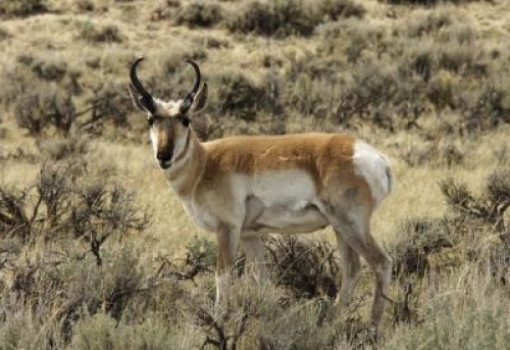
Pronghorn
Yellowstone pronghorn populations directly benefit from the presence of wolves, a new Wildlife Conservation Society study says.
Credit: Julie Larsen Maher/Wildlife Conservation Society
MY FELLOW WOLF PRESERVATIONISTS, HAVE YOU EVER COME ACROSS AN ANTI-WOLF EXTREMIST WHO THINKS THEY KNOW EVERYTHING ABOUT WILDLIFE AND SWEAR UP AND DOWN THAT WOLVES ARE DECIMATING THEIR THE WILDLIFE? I know you have!
One such person is Bruce “Buckshot” Hemming, an author, native hunter, and possesses quite a large ego. If you’ve ever spoken or attempted to debate with him, you know this man resorts to foul language, insults, name calling, and even threats.  Claiming to have over forty years of experience in the outdoors, his articles spout off skewed statistics, feedback from other wolf haters, and how effects of predation on wildlife “isn’t rocket science.”   Well apparently for you Mr. Buckshot, it is rocket science for you.  Leaving out the full story on predation, impacts of hunters, disease, and weather on prey numbers, bias opinions, misrepresented so called facts, he truly is passionate about what he represents.  I will not share his website or book information, as he doesn’t deserve anymore public credit of his work.
I will however share one of his quotes and my rebuttal afterwards:
“Survival of pronghorn fawns was 22.2% in 2002 and 41.7% in 2003. Coyotes (Canis latrans) accounted for 50% of documented fawn death.” (guess what Bruce, previous removal of wolves off the endangered species list resulted in an unintended decline in the pronghorn.  Wolves don’t typically hunt pronghorn but reduced the coyote population that do typically hunt them, therefore pronghorn fawns have higher survival rates when wolves are present in the ecosystem.  His articles certainly do not focus on this fact about positive impacts that wolves have on the pronghorn. In a three year study, in areas where wolves were abundant, 34 percent of pronghorn fawns survived compared to 10% when they weren’t present.  In addition, he fails to mentioned what percentage of hunting, disease, and weather affect pronghorn numbers.)
The following article was provided by Division of Fish and Wildlife, Minnesota Department of Natural Resources in 2009.  It describes more of how things are not cut so black and white with predation, as Mr. Buckshot believes.  It’s also an important reminder that we often don’t understand ecosystems nearly as well as we think we do, and that our efforts to manipulate them can have unexpected consequences, a concept Mr. Buckshot does not possess.
ENJOY THE ARTICLE BELOW!
“Is a robust wolf population responsible for waning deer harvests by hunters the last couple years?
Comments from some deer hunters in northern Minnesota following the 2009 deer season seem to
indicate that may be the case, but there is overwhelming scientific evidence that wolves alone have little
impact on the deer population in Minnesota. Winter severity, hunter harvest, and maturation of forest
habitat are all factors that contribute significantly to deer numbers in northern Minnesota. On a local
level hunter success may be affected by selection of an effective hunting area in relation to deer home
range use, seasonal movements of deer due to migration from summer to winter range, and reduced deer
densities in surrounding areas from increased harvest efforts. Overall, deer numbers in Minnesota
forests are a result of direct management through hunter harvest and are influenced by the high
reproductive potential of deer during mild years or the detrimental effects of severe winters.
There’s no question wolves in Minnesota rely on white- tailed deer as their primary prey source.
Based on research in Minnesota indicating that wolves require 15-19 adult- sized deer biomass equivalent per year (per wol
f), an estimated population of 3,000 wolves in Minnesota take approximately 45,000 to 57,000 deer per year.
Wolves also prey on moose in portions of the Superior National Forest and the Boundary Water Canoe Area in Minnesota
where deer tend to be less abundant. Wolves supplement their diet seasonally with smaller prey like beaver and snowshoe hare. These contributions to their diet are likely biologically significant during brief, specific times of the year, but
overall, they’re relatively minor compared to deer in most parts of the wolves’ range. Considering an
annual population estimate of 450,000 deer residing within all of Minnesota’s wolf range, the annual estimate of
45,000-57,000 deer taken by wolves, represents about 10-13% of that deer population. Minnesota Department of Natural Resources (MNDNR) wildlife researchers recently completed a comprehensive 15-year study of white-tailed deer that included monitoring the movements, survival, and specific causes of mortality of about 450 radio-collared, female white
tailed deer on four study areas…mostly does at least one year old, but including many fawns, even newborns, beginning at
several hours to about 7 days old. At the same time the researchers similarly monitored about 55
radio collared wolves from 7 to 8 packs with established territories covering the deer study areas.
Researchers learned a great deal from the data generated from this long term study. The long-term MN DNR
study concentrated on female deer (about 450 during the course of the study) , because there are more of them in the population, and due to their reproductive potential, they have a greater impact on population dynamics than the males. During the 15-year study, the annual mortality rate of female deer (not including newborns) attributable to wolf predation, ranged from 4% to 22%. The highest rate was observed in 1996 during the severe winter of 1995-1996, but most typically, the mortality rate of does attributable to wolf predation was closer to 5-10%. Additionally, what the data have shown is that the reason white-tailed deer can thrive, despite wolf predation and hunter harvests, is their strong population performance (survival capacity and reproductive success). The annual average age of females was 5.1 to 7.2 years old, and approximately 13% of the does were 10.5 to 18.5 years old. In the forest zone, on average, does live a lot longer than managers and researchers had ever thought. Coupled with that, the pregnancy rates are very high, 90% in yearlings, and 95-100% in does from 2.5 years old up to at least 15.5 years. Of the pregnant does, even the older ones, are mostly still having twins. Interestingly, the median age of survival of these deer is 0.8 years old, but in most cases, there is another fawn to add to the population. Following the challenges of the fawns’ first
(30 December 2009)
winter, there is typically an annual recruitment into the population of at least 35%. Consequently, even
after the significant challenges of the first year to the survival of the fawns, a high number are still added to the population.
U. S. Geological Survey (USGS) researchers studied the impact of predators on newborn fawns in northeastern Minnesota during two springs in the early 1990s. They had a rather limited sample size, but reported that predation by black bears and wolves were the primary causes of mortality (50% each) of newborn fawns. A similar study conducted by MN DNR researchers in springs 2000 and 2001, as part of the larger deer study in north-central Minnesota, documented, during these two fawning seasons that black bears, bobcats, and wolves accounted for 20.5%, 17.9%, and 3.9% of the mortality, respectively. However, two additional categories, “unknown predator” and “unknown cause” were assigned to 23.1% and 10.3%, respectively, of the fawn mortalities. These two categories were based on the evidence that was present/absent, which affected whether researchers could definitively assign a cause. Regardless, in the MN DNR study with a greater sample size, and where deer densities (and densities of newborn fawns, specifically) were notably higher than in northeastern Minnesota, the impact of wolves on fawn mortality was markedly less, but certainly, wolves may have been responsible for a portion of the fawn deaths assigned to “unknown predator.” Wolves are not particularly effective hunters of white-tailed deer. Despite the fact that deer outnumber wolves in Minnesota’s forest zone by some 150 : 1 (450,000 deer : 3,000 wolves), wolves must range and search widely over large pack territories (20 to 214 mi) to obtain the number of
deer they require to sustain their numbers over time. Indeed, studies have shown that most of their hunting
attempts are brief and unsuccessful, typically lasting a matter of only a few minutes. And so, as has been thoroughly documented scientifically and shared with the public , wolves live a “feast or famine” existence, eating little for up to two weeks at a time. Wolves end up surviving primarily on the most vulnerable individuals in the deer population,
such as very young, old, sick, injured, or nutritionally compromised deer, because those are the ones they can catch.
The result being, that under certain conditions, the impacts on the deer population are most likely compensatory rather than additive. That is, many of the deer that wolves kill likely would have died from other causes, such as starvation or
disease.
In conclusion, within Minnesota’s wolf range, the current wolf population relies on a relatively small
portion (10-13%) of the deer population to sustain itself annually.  That and the rather extraordinary
population performance of white-tailed deer in most of northern Minnesota, dependent largely on a high
capacity for survival (particularly after one year of age) and high reproductive success, allow deer to thrive.”
Contact:
Dan Stark
Wolf Specialist
Division of Fish and Wildlife, Minnesota Department of Natural Resources
500 Lafayette RD, Box #20
St. Paul, MN 55155-4020
651-259-5175 dan.stark@state.mn.us

Read Full Post »

« Newer Posts - Older Posts »