Feeds:
Posts
Comments

Archive for the ‘Uncategorized’ Category


Dispelling Canadian Wolf Myth

Photo Courtesy Bozeman Daily Chronicle

“Howling for Justice” comments, “I’m reposting an article I wrote back in April of this year. It busts the oft-repeated myth that wolves reintroduced to the US in 95 from Canada, are a larger more aggressive wolf then previously roamed the Northern Rockies. It’s a common mantra spread by the anti-wolf crowd and is not grounded in fact. But hey why bother with pesky facts? They just get in the way of demonizing wolves.

April 12, 2010

If I had a dollar every time I heard the derogatory term “Non-Native Canadian wolf”, I’d be rich.

The myth goes something like this. Wolves reintroduced to Yellowstone and Central Idaho in 1995 were a larger, non-native, more aggressive wolf then the wolves who roamed the Northern Rockies before the Western extermination. This kind of thinking and rhetoric is what fuels wolf hatred in the first place. When nasty rumors and stories get started they develop legs. Pretty soon people are repeating it as if it’s fact. My advice would be to do a little research on the history of wolves and their morphology, instead of repeating rumors and innuendo. But this myth has nothing to do with the search for truth, it’s all about demonizing wolves. Please make it your business to shed light on these fairy tales. The wolves will thank you.

I wonder how many people who make these claims have ever seen a wild wolf? I’ve been lucky to view wild wolves. One of my Malamutes, who passed away several years ago, was bigger and weighed more than any wolf I’ve ever encountered. He was 180 lbs full-grown. He was so tall he could actually eat food right off the kitchen counter. But unlike the wolf his body was stockier. Wolves have long legs, big feet and large heads, their bodies are also longer than dogs. This gives them the appearance of being bigger then they actually are. Wolves in the Northern Rockies weigh on average between 80-110 lbs. Wolves also weigh more when their bellies are full. That’s because after a kill wolves gorge on a meal because they may not eat again for several days. It’s feast or famine for the wolf. Remember, only one in ten wolf hunts is successful. They expend a great deal of energy during the hunt and very often have nothing to show for it.

Did you know 31% of the wolves killed in Montana’s hunt were under a year of age (juveniles) and weighed an average of 62 lbs.  31% were yearlings and weighed about 80 lbs. 62% of wolves killed in Montana’s wolf hunt in 2009 were a year old or under a year of age, in other words, PUPPIES! Shocked? Only 38% of wolves killed in Montana’s hunt were adults, weighing an average 97 lbs. The largest wolf weighed 117 lbs. Again way smaller than my Malamute. The average weight of wolves killed in the Idaho hunt was under a 100 lbs.

There is strong evidence the two subspecies of wolves that roamed the Rocky Mountains north and south of the Canadian border, for tens of thousands of years,  Canis Lupus Occidentalis (The Mackenzie Valley wolf) and Canis Lupus Irremotus (Northern Rocky Mountain wolf) bred with each other and mixed their genes. Some believe the Mackenzie Valley wolves bred the Northern Rocky Mountain wolf out of existence, instead of the government eliminating them.

It’s a specious argument, not grounded in science, to state Canis Lupus Occidentalis is a non-native wolf from Canada that was foisted upon the Northern Rockies region. In fact wolves know no boundaries and regularly cross back and forth between Canada and the US. There is no doubt sub-species exchanged DNA, making it almost impossible to tell how much of one subspecies is contained in another.

The whole idea of numbers of wolf subspecies is debated in the scientific world, ranging from 24 to just 5. The one thing we do know is wolves from different subspecies mate and share their DNA. The truth is, wolves are wolves, with slight variations in height, weight or fur color.

Think how silly the notion is when you consider humans created the boundaries between Canada and the US. To wolves it’s all the same landscape. They do what wolves do, breed, form packs and when they’re old enough strike out on their own, looking for new territory and a mate. It’s really that simple. Wolf thy name is wanderlust.

Wolves have large territories and travel great distances to establish a place for themselves. Does anyone truly believe wolves didn’t freely cross borders before they were exterminated in the West? Invisible lines created by humans have no meaning for wolves. They go as they please, truly free yet horribly persecuted, never knowing why.

Wolves are great wanderers and can travel an average of 25 miles per day while hunting. One Scandinavian wolf, pursued by hunters, traveled 125 miles in 24 hours. Wolves have runners bodies, lean and sleek. David Mech, the wolf biologist once stated “Wolves are fed by their feet.” Covering ground, exploring, seeking new territory, is bound to the wolves’ soul.  One only has to read the tale of wolf 314f, just a year and a half old, who traveled from her home in Montana to a lonely hillside called No Name Ridge in Colorado, where she was found dead under suspicious circumstances. She logged a thousand miles on her GPS collar during her amazing journey. Wolves are great adventurers and travelers.

Do wolf haters think there is some imaginary line at the border between Canada and the US that wolves didn’t dare cross? How ridiculous is that?

Long before the reintroduction, wolves made their way back to the US in the 1970′s and 80′s, dispersing from Canada to Glacier National Park,  They formed the Camas, Wigwam and Magic packs and these packs were not small, some numbering from twenty to thirty wolves. Does this sound like an animal who’s afraid to cross an invisible line they’ve been navigating for thousands of years, long before Canada and the United States were even a thought?

It follows that sub-species of wolves will mix their genes and basically become a combination of both. The myth that wolves reintroduced from Canada are somehow enormous super wolves who never set foot on American soil before reintroduction, is ludicrous. If you don’t believe me listen to experts on the subject, who have worked with wolves for years and understand their morphology.

Carter Niermeyer Interview (Outdoor Idaho) Spring 2009 (Carter Niermeyer was the Idaho Wolf Recovery Coordinator for USFWS from 2000 to 2006)

Q.There are those who say we brought the wrong wolves into Idaho in 1995 and 1996, that they’re bigger wolves than the ones that were here.

CN: I have to support the science again, and specialists in morphology and genetics on wolves indicate that the wolf that was brought down from Canada is the same wolf that lived here previously. And I did some research into books on early wolves that were captured in the Northern Rockies, even as far south as Colorado during the days that wolves were being hunted down in the 1930s; and the body weights were very much the same.

So I feel that this wolf that was brought from Canada is the same species and genetics as the wolves that lived here once upon a time. I think people have to remember that the northern Rockies — we call it the northern Rockies in Idaho and Montana, but actually we’re a southern extension of the northern Rockies out of Canada — and all of those wolves in Canada have the potential and the ability to disperse. I believe what happened over the last 50-60 years is that individual wolves have come from Canada following the Rocky Mountain chain and ended up periodically in places like Montana and Idaho.

Or Mike Jimenez (U.S. Fish and Wildlife Service biologist and Wyoming wolf recovery coordinator)

Jimenez disputed claims that the wolves reintroduced from Canada in the mid-1990s are a larger, more aggressive breed than had historically lived in Wyoming.

While scientists once divided wolves into 24 subspecies, he said more recent DNA evidence shows five subspecies in North America. Further, given the fact that wolves tend to disburse hundreds of miles, he said wolves from Canada likely interbred with Wyoming wolves and vice versa before they were exterminated from the region.

“The idea that those Canadian wolves are different … the argument gets weak,” he said. “Where they transition from one subspecies to the next is totally up for grabs.”

People cling to anti-wolf myths because wolves have become scapegoats for anti-government feelings. Many anti-wolfers believe reintroducing wolves was forced on them even though bringing wolves home to the Northern Rockies was not a rogue scheme dreamed up by a few government biologists. It was supported by many Americans. In fact a poll taken in 1990 found two-thirds of Montanans supported bringing wolves back to the state. Even so, it was a huge battle that waged for decades because the same, small, vocal minority that opposes wolves today were against them then, IE: ranchers, hunters and outfitters.

The feds finally compromised and classified wolves as a non-essential experimental population, which meant they could be shot and killed for agribusiness.

The little known fact is Wildlife Services has been killing wolves for years, along with the wolf hunts in 2009/2010. Still without ESA protection wolves would NEVER have been able to make any kind of comeback. It’s been their saving grace and now sadly they are at the mercy of their enemies once again.

What’s behind the giant Canadian wolf myth that’s passed off as truth? I believe it’s fear of competition. Many hunters don’t want to share the woods or compete with wolves. They liked it when wolves were gone and elk were complacent, standing around all day, munching down aspen trees, never allowing them to get any taller than a few feet. Apparently hunters like lazy, slow elk, ones that are easier to kill.  Since the return of the wolf, elk are no longer complacent, their old nemesis is back and they know it.  I think Carter Niermeyer hit the nail on the head when he said:

“Hunters look at the wolf from many angles and perspectives, too, and I have to emphasize that I’m a hunter. Certainly wolves compete, but I don’t think they’re any excuse for not being a successful hunter. There’s tremendous numbers of game animals available to sportsman and with a little effort and sleuth, you still have great potential to collect a wild animal from hunting. I don’t know what the excuse was before wolves, but it has become the main excuse now for unsuccessful hunters. I mean, there are just so many other issues involved in why hunters are not successful, but the wolf is a lame excuse.”

It’s necessary to spread untruths about wolves to further the agenda of getting rid of them or make excuses for why a particular hunter wasn’t able to “get his elk” during hunting season. I’ve reported over and over that the Rocky Mountain Elk Foundation trumpeted in the their Spring 2009 press release that elk numbers were up 44% nationally since 1984, when the organization was founded. They stated the elk herds in Montana, Colorado and Utah  increased between 50-70 percent.  The Montana’s elk population stood at 150,000 and Idaho at 105,000.  I guess that wasn’t good news to everyone, since it doesn’t fit in with the “wolf is decimating all the elk” argument. Hunters whine that elk numbers may be up in the state but down in some areas. Ummmmmm that’s how nature works. And I hate to break it to the elk hunters but it’s not all about them. Wolf advocates opinions are being ignored. We’ve had to watch in horror as wolves were removed from the Endangered Species List and hunted almost immediately.

This was unforgiveable behavior by the states and certainly didn’t earn any points with wolf supporters about their intent to “manage” wolves fairly.  It’s not a secret there’s a conflict of interest when it comes to state game agencies “managing/killing” predators.  They want to please their customers, the hunters, who demand more game. The saddest part of this story is wolves were brought back only to be used for target practice fifteen years later.

Carter  Niermeyer states:

It’s a little late now, but I wish that when the states assume management of wolves that there could have been some kind of a moratorium where the states took the responsibility and didn’t jump right into a wolf harvest, or a wolf culling, or whatever you want to call it. It would’ve been nice, I think, to establish some credibility with wolf advocates and conservationists, environmentalists and people who appreciate wolves for other values. And just sort of get a handle on things and get a feel for managing the wolf. Because there’s this perception that suddenly we’re going from a listed animal to a hunted animal and I think a lot of the public is having a struggle with coming along with that.

The other thing I wish could happen, too, is there’d be more dialogue between the broad term wolf advocates and the Fish and Game Department and talk about these issues more openly, because the conservation groups have been a close ally in getting wolf recovery moving forward and actually being partners, and now there seems to be this falling out and a relationship that’s deteriorating.

Wolf advocates are rightly upset to see wolves hunted at all, especially freshly off the Endangered Species List.

I wonder how hunters would feel if over 40% of the elk herd was killed in one season. What would they think of a seven month-long elk hunt like the state of Idaho imposed on wolves?

Are Canadians laughing at us when they hear the Canadian super-wolf myth? Does this mean Canadians are superior hunters, who seem to have no trouble bagging game with their Canadian monster wolves roaming the countryside?

The truth is wolves living in the Northern Rockies today are the same wolves that were here before they were exterminated. It’s not about how tall wolves are or how much they weigh or the color of their fur. This myth is grounded in hatred of a species just as it was when they were exterminated the first time around.

Hunters by their very nature are in the business of killing and not all hunters can shoot straight or are ethical. There are people who hunt out of their rigs, while drinking.  Gut shot deer roam the forest during hunting season, leaving blood trails until they finally collapse and die. I’ve seen deer with arrows sticking out of them, barely able to stand.

If anyone has seen Predator Derby pictures of bloody dead coyotes, or dead wolves displayed by their killers with no respect, smiling like they just won the lottery, understand it’s not the wolf that’s the deadliest predator. Wolves kill to survive. The cruelest predator of all is man. No giant wolf myth can compete with that.

HOWL for speaking the truth about wolves.

Pass it on!”

**Special thanks to “Howling for Justice” for providing this information!  http://howlingforjustice.wordpress.com/2010/04/12/dispeling-the-canadian-wolf-myth/
Read Full Post »


Lion
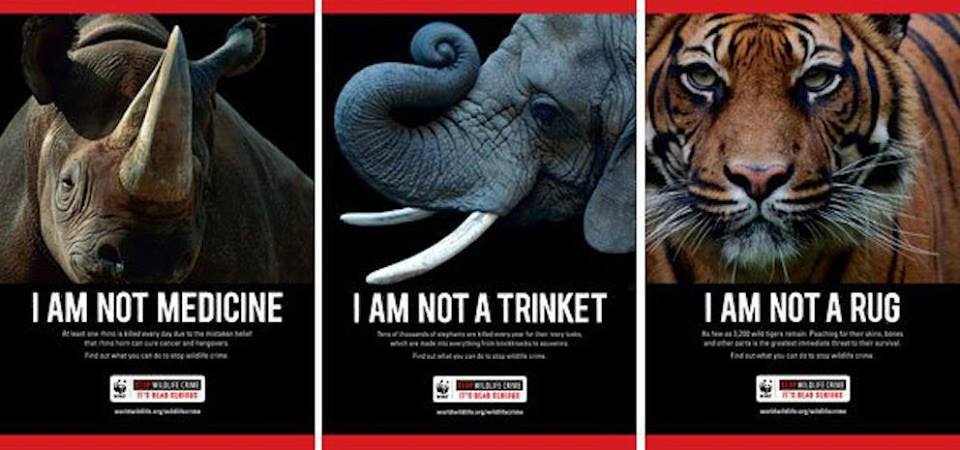
“I don’t often actually ask you to share something, but this is one image I would really love to see reaching millions of people.
Wildlife crime is now the most… urgent threat to three of the world’s best-loved species—elephants, rhinos and tigers. The global value of illegal wildlife trade is between $7.8 and $10 billion per year.
I AM NOT MEDICINE At least one rhino is killed every day due to the mistaken belief that rhino horn can cure diseases. The main market is now in Vietnam where there is a newly emerged belief that rhino horn cures cancer. Rhino horn is also used in other traditional Asian medicine to treat a variety of ailments including fever and various blood disorders. It is also used by wealthy Asian as a cure for hangovers.
I AM NOT A TRINKET Tens of thousands of elephants are killed every year for their ivory tusks. In 1989, the Convention on International Trade in Endangered Species of Wild Fauna and Flora (CITES) banned the international trade in ivory. However, there are still some thriving but unregulated domestic ivory markets in a number of countries, which fuel an illegal international trade.
I AM NOT A RUG Every part of the tiger—from whisker to tail—is traded in illegal wildlife markets. Poaching is the most immediate threat to wild tigers. In relentless demand, their parts are used for traditional medicine, folk remedies, and increasingly as a status symbol among wealthy Asians.”
All information and text from the World Wildlife Fund. Find out more here: http://bit.ly/WH4SMk

Read Full Post »


Raccoon 1

Photo provided by National Geographic

“An Ottawa man is charged with torturing and killing a mother racoon and her baby in a days-long ordeal, the Ottawa Humane Society said Monday.

“We needed to do a postmortem on the raccoons and those indicated there were multiple wounds before the animals were killed,” said Bruce Roney, executive director of the OHS, explaining why it took from the June 11 discovery of the animals’ bodies until late August to press charges.

The man is alleged to have tortured and killed the pair after trapping the mother raccoon June 10. The examination found that both animals were alive while they were beaten.

“We see a lot of terrible things. I’ve been here 24 years and this was just horrific,” said Ottawa humane Society inspector Miriam Smith. When OHS was called to Armstrong’s home in Ottawa south by neighbours who saw the mother trapped in a cage for two days, they discovered a grisly sight. The mother raccoon was found with a barbecue rotisserie rod skewered through its mouth and out the back of its head. And the baby’s body was discovered nearby beaten to death with a hammer.

“This is certainly in the top five worst cases I’ve seen,” said Roney, who has been with OHS for 13 years and was at a loss to explain why the animals had been trapped and tortured.

Roney added that by law, wildlife that is trapped can only be moved one kilometre from the trap site.

“If there is a conflict with wildlife, people need to deal with how they’re getting into the house,” he said. “It’s about wildlife-proofing your house or garbage can. There are products available,” he urged.

Forty-nine-year old Gregory Armstrong faces two counts of causing unnecessary pain, suffering and injury to an animal. He faces a maximum sentence of five years in jail and a lifetime ban on owning animals if convicted.”

“Footloose Montana” adds, “People that abuse animals are a threat to society. Trapping legally allows and perpetuates that threat. Trapped animals experience suffering and are offered no protection in the manner in which they are treated and killed. Because of the photograph, Footloose Montana posted that went viral, of the disrespectful and inhumane treatment of a trapped wolf, Montana requires the immediate killing of trapped wolves. The killing method now for trapped wolves must be by gunshot to eliminate the choking to death some trappers obviously were choosing. Montana Trappers Association rep said, “Some trappers don’t own a gun.”

**Special thanks to Graham Lanktree of Metro Ottawa, http://metronews.ca/news/ottawa/777287/man-charged-with-torturing-killing-mother-and-baby-raccoons/, for providing this information!

Read Full Post »


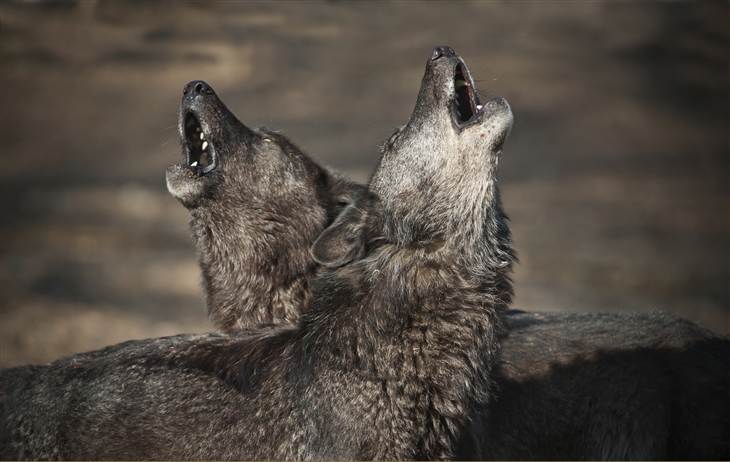
Two Wolves Howling

(Photo by Francesco Mazzini) Researchers found that wolves tend to howl more frequently when a leader or a partner leave the pack, as opposed to a less valued packmate.

“Wolves are skilled and ferocious hunters, but when it it comes to relationships, they’re real softies. When a playmate or partner leaves the pack, the wolves that are left behind will howl and howl and howl.

In a new study, researchers report that wolves will give their leaders and their closest allies a longer and stronger serenade if they leave. Those howls could be sonic breadcrumbs, meant to help a lone wolf find its way back to the pack. They could also be a long-distance message that simply says: “I miss you.”

“What exactly their motivation is, we will never know,” said Friederike Range, an animal behavior researcher at the University of Veterinary Medicine in Vienna and one of the authors of the study in Current Biology. But “there is an emotional response in there, for sure,” she told NBC News.

How much howling? Range and her colleagues have been studying the group dynamics of timber wolves for years. In the newly published study, they observed how nine wolves from two packs living at Austria’s Wolf Science Center changed their howling, depending on which member of the pack was absent from the group.

The researchers took each member of the pack away from the rest for a walk, and counted the howls from the remaining members for 20 minutes.

The howling would begin as soon as the departing wolf went out of sight. Wolves are social animals with a strict hierarchy. So if the wolf was a leader, more howls were recorded. And if the departing wolf was friendly with another member of the pack, its pack buddy sang a lengthy song.

The calls are similar to “children calling for their parents when the parents leave,” David Mech, an adjunct professor at the University of Minnesota who has been studying wolves since the late 1950s, explained in an email to NBC News. “To me it is communication.”

Socially savvy Dogs, the cuddlier relatives of the wolves, also howl. But wolves are more socially savvy, and their howling serves more strategic functions.

Mech, who was not involved with the new study, once observed howling behavior in 15 wild wolves that were separated during a hunt. He described the phenomenon in his 1966 book “The Wolves of Isle Royale.”

“After howling, the pack was then able to assemble again,” he explained. Mack said the newly published study provides “experimental evidence” supporting his view that the wolves’ howls helped them regroup.

Sometimes, wolves howl when they are stressed. Not these wolves. Range’s colleague, Francesco Mazzini, tested the saliva of the howlers for cortisol, a hormone that’s abundant in stressed-out animals. He found a slight increase in cortisol levels when a leader left, but no increase when the wanderer was a “preferred partner.”

Wandering wolves who are leaders will often call back to their pack, but Range’s wards didn’t. While they were out and about, they ignored their packmates and just enjoyed the walk, she said. ”

More about animal communication: 

Francesco Mazzini, Simon Townsend and Zsófia Virányi join Friederike Range as authors of “Wolf Howling Is Mediated by Relationship Quality Rather Than Underlying Emotional Stress,” published online Thursday by Current Biology. The study appears in the Sept. 9 issue of the journal.

**Special thanks to  Nidhi Subbaraman, NBC News, http://www.nbcnews.com/science/lonely-wolf-wolves-howl-when-they-miss-their-friends-6C10963185, for providing this information!

Read Full Post »


White Wolf

Are wolves eating all the elk?

“Answer: There is no shortage of elk where wolves live in the Rocky Mountains.  According to state game agencies, in 2010 in Idaho, Montana and Wyoming, there are 371,000 elk, 21,000 more than the previous year.  In Wyoming, the elk population is actually 50% above management objectives set by the Wyoming Department of Game and Fish.  In Idaho, Montana and Wyoming, there are at most 1,700 wolves, which are far outnumbered by bears and mountain lions.  Certainly, with 371,000 elk and many more deer, there is plenty of prey.

However, in some areas, the success of big game hunters has declined a bit, but not due to a general lack of elk.  With wolves back, elk habits have changed, reverting to behavior honed by time as the two species co-evolved in a predator/prey balance.  Now elk are once again more alert and spend much of their time on the move.  They find security in thick timber and maintain vantage points by spending more time on ridgelines rather than lingering down in open meadows and streambeds.  From the ridges, they can see threats approaching and have many directions to flee.

All these factors lead to heightened challenges for hunters.  Some concerned hunters point to specific herds, claiming that the elk are being decimated but, overall, population trends clearly dismiss that claim.

While only a few elk herds are in decline, local and regional fluctuations of herd populations are normal, according to the historical record.  Population trends are influenced by many factors.  Forest fires, for example, actually benefit elk by creating prime habitat.  When trees burn, verdant meadows, rich in nutritious grasses, replace the dead trees, and elk numbers increase.  But eventually, the trees grow back, thick shade decreases underlying grasses, and the elk population drops again.

Wolves keep the elk gene pool strong.  When wolves hunt, their technique is based not only on strategy, but also on opportunity.  They wear their prey down in a chase, singling out the weak, which are usually the sick, injured, old, or young.  The survivors are most often the healthiest, fastest and strongest elk, which live on to reproduce and perpetuate the best genes of their species.  This predator-prey relationship is good for both the health of the elk, and the health of the land.”

**Special thanks to “Living With Wolves, http://www.livingwithwolves.org/AW_question2.html, for providing the information in this article!

Read Full Post »


three wolves

Do wolves kill for sport?

“Answer: Wolves, like all wild carnivores, do not kill for sport.  They kill to sustain themselves.  Though it is uncommon, “surplus killing” (killing more prey animals than can be immediately consumed) has been observed in many predator species.  If given the opportunity to secure future meals, many animals will sometimes do so.  It is a survival mechanism.  It is this survival tactic that has led to the misplaced notion of “sport killing” arises.  It has nothing to do with sport.  Only people kill for sport.

Surplus killing occurs when prey is at an unusual disadvantage, offering an opportunity to significantly lower both the risk of injury to the predator and the amount of energy required to kill the prey.  It is for this reason that surplus killing by wolves, although rare, occurs more with livestock than it does with wild prey.

Typically, when a pack of wolves kills an elk or a deer, by the time the pack has subdued its prey, the rest of the herd has fled and is no longer in the area.  This is not the case with livestock introduced by humans.  Unlike their wild cousins, livestock have lost much of their survival instinct.  Spending a good amount of their existence fenced in or being herded, their reaction to a predator in their midst is very different from that of wild prey.  Calves and yearling cattle, for instance, flee during the chaos of the chase, but once the wolves have made a kill, rather than continuing to move away from danger, they have been known to stand nearby, watching in curiosity, perhaps unable to comprehend the threat and what might happen next.  Instead of fleeing, as a wild prey animal would, sheep, when confronted with danger, often run in frantic circles, triggering predatory instinct in wolves and increasing the opportunity for multiple kills.

Wolves are further mischaracterized as killing for sport when people happen upon a dead animal or animals, killed by wolves, but the wolves are no longer present.  This leads people to assume that the wolves abandoned their kill and therefore, must have killed for recreation or pleasure.  This is far from the reality.  The fact is that wolves are easily frightened away from their kill by the approach of human beings, whom they regard as a predator and tend to fear.  Wolves may be also chased away by other, larger carnivores, eager to take advantage of an easy meal.  So a presumably abandoned carcass is not what it seems.  In nature, where the margins of survival are narrow, surplus food is not forgotten.  Research shows that wolves return repeatedly, almost always eating the entire carcass.

For wolves, more so than bears and mountain lions, hunting can be very risky work.  Unlike the larger, solitary mountain lion that relies on the element of surprise, ambushing and then quickly overpowering its prey, wolves work together as a pack, chasing their prey and wearing it down, looking for vulnerabilities.  This is very difficult and dangerous, and they are often fatally wounded while hunting, gored by antlers or horns or kicked by a hoof.  80 to 90% of the time, their efforts to make a kill fail.  When they succeed, if any food is left unfinished by wolves, it feeds scavengers or other animals.

Misinterpretation of animal behavior and motives often perpetuate a bad reputation for wolves, but reality does not support the theory that wolves kill for sport.”

**Special thanks to “Living With Wolves, http://www.livingwithwolves.org/index.html, for providing the information in this article!

Read Full Post »


walking wolf

The Fish and Wildlife Service bows to pressure from antigovernment groups, removing the animals’ endangered status

By :

“The US Fish and Wildlife Service’s recent announcement that it is beginning the process for removing gray wolves across the country from the protection of the Endangered Species Act surprised no one. The Fish and Wildlife Service’s mid-1990s reintroduction of gray wolves — a species virtually extirpated in the nineteenth and twentieth centuries — into Yellowstone National Park and central Idaho marked a triumph for conservationists and ranks as one of the most striking fulfillments of the Endangered Species Act. But as I have reported here and here, the wolves quickly met enemies.

By the early 2000s a loose coalition of hunters’ groups, outfitters, and ranchers — along with the many disaffected men embracing militia groups, local “sovereignty” and states rights, particularly rights to use public lands without federal regulation — coalesced around the idea that wolves represented icons of the hated federal government. The wolves, they all-but-screamed, constituted lethal threats to deer and elk, livestock, and ultimately, people. The long, bitter wolf war reached its climax in the summer of 2011, when Congress took the unprecedented act of removing the wolf populations of the Northern Rockies from the endangered species list. In May 2011, the Fish and Wildlife Service, weary of the many problems involved in wolf management (or, rather, public relations management), delisted gray wolves in the Western Great Lakes states, where some 4,400 wolves resided.   Idaho, Montana and Wyoming subsequently initiated hunts and the use of government marksmen to reduce wolf numbers from around 1,700 to a much lower level.

The FWS’s proposed delisting of gray wolves across the country is simply the continuation of the agency’s long retreat in the face of wolf hater intimidation. Still, it’s important to understand how the FWS legitimizes its abandonment of wolves. A close examination of the FWS’ proposed rule change is a case study in the politicization of science. The FWS report excels at cherry picking, choosing certain scientific studies while rejecting others. It’s also an excellent example of bureaucratic hand-waving, simply dismissing long established facts whenever they become inconvenient. The final result is like a weird game of scientific Twister: The FWS bends itself into all sorts of contortions to conform to a political agenda.

Repetitive and often inconsistent, the 215-page proposed rule makes two stunning claims.  First, the FWS says “new information on C. lupus taxonomy” published in 2012 reveals that the gray wolves (C. lupus) do not constitute “either an entire species nor an entire single subspecies.” Simply put, C. lupus “does not represent a valid species under the [Endangered Species] Act”  — and thus cannot be listed as endangered. Having decided that gray wolves are not a valid species, the FWS then deconstructs the category, saying all wolves formerly called gray actually belong to one of three subspecies of wolves and one new species.

The FWS then makes the rather bizarre claims that the agency wasn’t really serious when, back in 1978, it listed gray wolves as endangered across an historical range covering most of the lower 48 states (except Minnesota, where it was listed as “threatened”). Rather, the agency now claims, the 1978 reclassification “was undertaken to ‘most conveniently’ handle a listing that needed to be revised because of changes in our understanding of gray wolf taxonomy, and in recognition of the fact that individual wolves sometimes cross subspecies [geographic] boundaries.” Now, the FWS argues, “this generalized approach to the listing … was misread by some publics as an expression of a larger wolf recovery not required by the Act and never intended by the Service.” Evidently the FWS never really had wolf recovery as a goal.

In place of this unintended “larger wolf recovery,” the FWS in its newly proposed rule lists three subspecies and alludes to one new wolf species, each with a limited population size and a clearly limited range.  Conceptually, deconstructing the gray wolf category constitutes a containment strategy, a way to scientifically legitimize small, remnant wolf populations restricted to finite ranges; wide-ranging wolf dispersal is eliminated as a possibility. This containment appeases politicians, government administrators, businesses, ranchers  and hunters — all those who fear disruption from  wolf recovery.

What the FWS used to call the gray wolves living in Northern Rocky Mountains, — a “Distinct Population Segment” in biology nomenclature —  is now conceptualized as the wolf subspecies,  C. l. occidentalis.  Wolves classified as occidentalis , according to the FWS, “currently occupy nearly the entire historical range of the species.” In what I can only call an act of scientific chutzpah, the FWS therefore argues that these wolves are considered fully recovered. And since they are fully recovered and are occupying their historical range, then any occidentalis  that disperse to Washington, Oregon or Colorado are classified as a non-native species. Although individual states might choose to list them as endangered—Washington and Oregon have done this — they will not qualify as a federally protected Distinct Population Segment of gray wolves. That’s because the FWS no longer considers gray wolves to be a valid species. Nice circular logic, that.

The FWS is also playing this same shell game in the Western Great Lakes states of Minnesota, Michigan, and Wisconsin. Wolves living there formerly were classified as a Distinct Population Segment of gray wolves.  It used to be that if any of these wolves migrated outside these states — say to North and South Dakota — then they received protection by the Endangered Species Act. Now, under the proposed rule change, the wolves in the Western Great Lakes are classified asCanis Iupus nubilus. Although the FWS acknowledges that C. I. nubilus does not occupy all of its historical range — a vast area that once included the Southern Rocky Mountains, the Colorado Plateau, and the coastal ranges of the Pacific Northwest — the agency still makes the case that the subspecies is present in sufficient numbers in the Western Great Lakes and Canada to be considered fully recovered. So it shouldn’t be protected by the ESA, either.

Interestingly, although the FWS considers eastern Canada to be part of the range of C. l. nubilus, it now argues that no wolves of this subspecies ever settled south of Quebec, in New England and upstate New York.  Instead, the FWS says an entirely different wolf species, Canis lycaon, once lived there. No population estimates of Canis lycaon are given; nor does the FWS name areas where packs have been sighted. The FWS does not even propose listing at the present, saying “we must first address outstanding science and policy questions.” It’s not at all clear if real wolves belonging to Canis lycaon exist. But if the Northeast is classified as belonging to the historical range of Canis lycaon, then any gray wolves (C. l. nubilus) that migrate into the region will not be protected by the ESA.  Once again, the FWS proposes creating a new species in order to remove protection for another one.

(If you’re having problem tracking all of these different species and subspecies, don’t feel bad. All of the taxonomical shenanigans seem designed to confuse the public.)

There is one bright spot in this otherwise gloomy picture. One subspecies of the supposedly no longer valid Canis lupis  will receive protection under the proposed rule: the Mexican wolf, or C. l. baileyi.  A tiny remnant population of Mexican wolves — abount 75 — live in eastern Arizona and western New Mexico. Another 250 live in captivity in the US and Mexico awaiting reintroduction to the wild. The FWS wants to maintain the endangered listing for C. l. baileyi, saying it is “in danger of extinction throughout all of its range due to small population size, illegal killing, inbreeding, and the cumulative effect of all threats.” The FWS says its interim goal is to support 100 wolves, at first glance a significant improvement.

But it remains uncertain how — or whether — the FWS proposes to bolster the population of Mexican wolves. In 2011 a subdivision of the FWS tasked with developing a plan for Mexican wolf recovery concluded that the agency would need needed three distinct recovery areas connected by corridors across parts of Arizona, New Mexico, Colorado, Utah, and Texas, with each area to become home for 200 to 350 wolves. The head of the Mexican Wolf Recovery Team immediately came under massive political pressure from state wildlife agencies and the governor of Utah, who made a range of political and economic arguments to curtail the scientists’ recovery plan. Unsurprisingly, the June 7 proposed rule says nothing about what full recovery would entail.

Public Employees for Environmental Responsibility (PEER) has filed a lawsuit against the FWS under the Freedom of Information Act asking for all documents related to the June 7 rule on wolf delisting. PEER executive director Jeff Ruch thinks his group will begin to receive documents by late July. “We’ll post all their dirty laundry on our website,” he says. PEER will thus provide a preview of the documentary record long before the Fish and Wildlife Service completes its year-long rule-making process. If the rule becomes finalized as official policy and gray wolves abolished as a species, conversation organizations will challenge it in court.

Some wolf advocates hope the taxonomical shell game will be so crude and obvious that public outcry over wolf delisting will persuade the Obama administration to withdraw the proposal. Noah Greenwald from the Center of Biological Diversity argues, “ The majority of Americans support protection of endangered species, support protection for wolves. I would like to think the Obama administration is not tone deaf.”

Nabeki of the Howling for Justice blog concurs. She told me: “This may just backfire on them. It’s so transparent to delist wolves in states where they don’t exist. It will open up people’s eyes.”

**Special thanks to James Gibson, http://www.salon.com/2013/06/25/is_the_far_right_driving_gray_wolves_to_extinction_partner/, for providing this information!

Read Full Post »


Wolf Geographic

Photograph by Joel Sartore

“Gray wolves once populated large portions of North America, Europe, and Asia, but were hunted to near extinction.

Wolves are legendary because of their spine-tingling howl, which they use to communicate. A lone wolf howls to attract the attention of his pack, while communal howls may send territorial messages from one pack to another. Some howls are confrontational. Much like barking domestic dogs, wolves may simply begin howling because a nearby wolf has already begun.

Wolves are the largest members of the dog family. Adaptable gray wolves are by far the most common and were once found all over the Northern Hemisphere. But wolves and humans have a long adversarial history. Though they almost never attack humans, wolves are considered one of the animal world’s most fearsome natural villains. They do attack domestic animals, and countless wolves have been shot, trapped, and poisoned because of this tendency.

In the lower 48 states, gray wolves were hunted to near extinction, though some populations survived and others have since been reintroduced. Few gray wolves survive in Europe, though many live in Alaska, Canada, and Asia.

Red wolves live in the southeastern United States, where they are endangered. These animals actually became extinct in the wild in 1980. Scientists established a breeding program with a small number of captive red wolves and have reintroduced the animal to North Carolina. Today, perhaps 100 red wolves survive in the wild.

The maned wolf, a distant relative of the more familiar gray and red wolves, lives in South America. Physically, this animal resembles a large, red fox more than its wolf relatives.

Wolves live and hunt in packs of around six to ten animals. They are known to roam large distances, perhaps 12 miles (20 kilometers) in a single day. These social animals cooperate on their preferred prey—large animals such as deer, elk, and moose. When they are successful, wolves do not eat in moderation. A single animal can consume 20 pounds (9 kilograms) of meat at a sitting. Wolves also eat smaller mammals, birds, fish, lizards, snakes, and fruit.

Wolfpacks are established according to a strict hierarchy, with a dominant male at the top and his mate not far behind. Usually this male and female are the only animals of the pack to breed. All of a pack’s adults help to care for young pups by bringing them food and watching them while others hunt.”

Fast Facts:

Size relative to a 6-ft (2-m) man:

Wolf Size and Human

Type:
Mammal
Diet:
Carnivore
Average life span in the wild:
6 to 8 years
Size:
Head and body, 36 to 63 in (91 to 160 cm); Tail, 13 to 20 in (33 to 51 cm)
Weight:
40 to 175 lbs (18 to 79 kg)
Group name:
Pack
Protection status:
Endangered
 

**Special thanks to National Geographic for providing this information!

Read Full Post »


wolf gang

“How do wolves live together?

Wolves live in groups of between two and twenty (averaging about six to eight) animals.  These groups are called packs.  Each pack of wolves maintains an area, called a territory, which belongs to it and which it defends from other wolves.  Within this territory, the pack hunts, sleeps, plays, and raises pups.  Territories range in size from 50 to 1,000 square miles, depending on how much prey is available.  Packs also vary in size depending on what kind of prey is available.  Wolf packs which hunt deer as a primary source of food will have fewer wolves than packs which hunt bison or moose.  These large animals are harder to catch and kill, and can also feed more wolves once caught.

Wolves have a linear rank order, or hierarchy, which helps keep peace within the pack.  There is a separate line of rank for each sex: one for males and one for females.  At the top of the rank order is the alpha male and female.  The beta male and female are next highest in status.  At the bottom of the rank order is the omega “scapegoat” wolf, which may be either male or female.  In the rank order, each wolf has a set place.  When two wolves from the same pack cross paths, one is always dominant to the other, or higher in status than the other wolf.  The lower-ranking wolf is said to be submissive to the higher-ranking, dominant wolf.

The alpha wolves are not necessarily the strongest, the fastest, or the smartest.  High rank has more to do with attitude and confidence than size or strength.  Dominance also does not favor gender — either the alpha male or the alpha female may be the overall “leader of the pack”.

While dominant wolves generally act more self-confident than lower-ranking ones, wolves do not walk around constantly displaying their status.  They most often adopt a neutral pose, changing their expression towards dominance or submission depending on which other wolves are around.  (A wolf will show dominance to a lower-ranking animal, and submission to a higher-ranking one.)  A wolf displaying dominance stands up tall, looks directly at the other wolf, puts its ears forward, and will lift its tail (usually not much higher than its back, unless it is very excited).  A wolf displaying submission crouches down to look small, lowers or even tucks its tail, looks away from the other wolf, and puts its ears down and back.  This is usually all that happens when two wolves meet: wolves cannot afford to spend all their time fighting, and these subtle displays are all that is needed to maintain social stability.

Wolf communication involves a lot of signals like these.  The postures and facial expressions used will vary in intensity, or strength, depending on the context: an alpha wolf will often simply look hard at a wolf to send it a dominance message, and a submissive wolf will often just look away from a dominant wolf to give the appropriate response.  An excited alpha may give a stronger dominance message, and growl at a lower-ranking wolf or even hold it down.  Stronger submission signals include whining and pawing at the dominant wolf.  Mostly, signals just get louder and stronger the more excited the wolves get, and fighting rarely occurs.

The alpha wolves are not necessarily “in charge” or “leaders of the pack” at every moment.  They may decide where and when to hunt or they may not.  An alpha wolf is not always a leader so much as a wolf who has the right to do whatever it wants, whenever it wants.  Since they have so much social freedom to do what they like, alpha wolves often have more opportunity than lower-ranking wolves to start hunting or to choose a resting place.  The rest of the pack will then often follow and join in.  But when in home range, often younger wolves will take the lead on an outing.

The omega wolf ranks lower than any other wolf.  It usually sleeps away from the other pack members and may not engage in much social behavior, like howling or greeting.  The other wolves may make a “game” of picking on the omega wolf, biting it and driving it away from food.  At other times, the omega may be tolerated or even accepted into group activities.  This wolf may be able to eventually work itself back higher in the rank order or it may eventually choose to leave and form a new pack.

Rank order is not always linear and may be somewhat flexible in certain circumstances.  Puppies and yearlings, for example, have a rank order, but this order may change from month to month, week to week, or even from day to day in the case of young puppies.  (The rank order for adult wolves is usually more stable.)  “Playing” wolves, who are engaging in behaviors such as chasing and running for fun, may “switch” rank temporarily, and a lower-ranking wolf will be allowed to mock-dominate a higher-ranking one.  Some rank orders may be circular, with wolf A dominating wolf B who dominates wolf C who dominates wolf A, but this is rarely permanent.  Also, low-ranking wolves of one gender may be able to dominate high-ranking wolves of the other, without changing their rank in the social order of their respective sex.”

**Special thanks to “Wolf Park, http://www.wolfpark.org/aboutwolves.shtml, for providing this information!

Read Full Post »


Lobo Wolf

Although most humans fear wild animals, there’s evidence that they might be more people-friendly than we think.

“What were you, raised by wolves?”

“Parents usually ask this to cow an unruly child, but actually, when you think about it, the track record of wolf-raised children is pretty good. Mowgli anchored a best-selling book and a Disney movie; Romulus founded Rome. While wild animal encounters don’t always turn out as pleasant as “The Jungle Book,” there are plenty of children and adults that have been saved by wild creatures.

In 2005, a 12-year-old Ethiopian girl was reportedly saved from a group of kidnappers by three lions. Seven men had abducted the girl to try and force her into marrying one of them, and they had beaten her repeatedly. But the lions apparently chased off the men and stood guard over her until the police and her family came.

The case is particularly amazing because lions are well-known potential man-eaters. A 2005 study published in Nature found that lions had killed more than 563 people and injured 308 in Tanzania alone. But in this case, the lions may have been moved to sympathize with the girl because she was crying after being beaten.

“A young girl whimpering could be mistaken for the mewing sound from a lion cub, which in turn could explain why they didn’t eat her,” wildlife expert, Stuart Williams, in 2005, told the Associated Press.

Take heed: If you’re in need of leonine assistance, your best recourse may be to start sobbing uncontrollably.

If you’re looking for more long-term help from the animal kingdom, your better bet might lie with wolves, as Mowgli discovered. Don’t forget that Man’s Best Friend is almost genetically identical to a wolf; that’s why wolves and dogs can interbreed. Wolves do occasionally attack people – especially if they’re starving, habituated to humans or rabid – but despite their fierce portrayal in fairy tales and Liam Neeson movies, wolves actually are more likely to turn tail if they see a person.

“Most people don’t realize this, but wolves are wimps,” Utah State University ecologist and researcher Daniel MacNulty last year told National Geographic.

There are stories of wolves assisting children in the wilds of Russia and India, but these are hard to verify. One of the more famous stories of such wolf children, two girls, Amala and Kamala, was based on a single claim by the reverend who claimed to have discovered the girls.

Wild dogs have also occasionally been reported to take in runaway children, like the feral “Mowgli Boy” of Romania, who allegedly fled an abusive father.

Dolphins might be the most reliably altruistic animals in nature, with accounts of them saving humans stretching back to Greek mythology. There are numerous accounts of dolphins assisting injured podmates, beached whales and humans. A group of dolphins was reported to have circled around four swimmers in New Zealand to keep a great white shark at bay. Another pod protected a California surfer who had just been mauled by a great white.

Other cetaceans have a knack for altruism as well. In 2009, a beluga whale at a Chinese theme-park pushed a foundering freediver to the surface after the human’s legs cramped up.

It’s still unclear what motivates an animal to save a drowning swimmer or protect a girl from kidnappers,or raise a lost child; it seems to defy evolutionary sense. But altruism and cooperation may be just as natural as predation. Some experiments in humans suggest that generosity can induce the same kind of pleasurable reward in the brain that we get from food or sex. And if we’re hard-wired to enjoy being nice, there might be similar setups in brains across the animal kingdom.”

**Special thanks to , http://www.salon.com/2013/04/07/are_wolves_and_lions_mans_best_friends_partner/, for providing this information!

Read Full Post »

« Newer Posts - Older Posts »