Feeds:
Posts
Comments

Archive for the ‘Uncategorized’ Category


The following article is written by Beckie Elgin, Freelance Writer and Author on “Wolves and Writing, Writing inspired by wolves and other sentient beings.”

Please visit her wonderful site and see her articles: http://wolvesandwriting.com/2012/05/29/update-on-journey-and-the-rest-of-the-pack/

“I tend to worry when I don’t hear about Oregon 7. My fears are of poachers, speeding cars, leg-hold traps, and cyanide poisoning. And there are more natural threats too, injury sustained while hunting, disease, or starvation, like the Alaskan wolf whose radio collar tracked his 2,000 mile travels then served to locate his emaciated body beneath a spruce tree.

But Journey is alive and apparently well. The California Department of Fish and Game (CDFG) has devoted a website to him and provides an update on his whereabouts nearly every day. Journey has of late moved south from Modoc County into western Lassen County, near Nevada. While there are still no wolves in this location there are tons more humans. Modoc County boasts the lowest population in the state with just under 10,000 counted in the last census, while Lassen County has over 30,000. More potential for conflict, but on the other hand, perhaps there are more folks who see Oregon 7′s arrival on a positive note.

Oregon Wild is a non-profit that does so much to support wolves and was the group that sponsored the contest that won Journey his name. Their intern, Elizabeth Medford, reported on Journey on the Oregon Wild Wolfpack website last week. She discussed the recent doings of Oregon 7, including his feasting on a deer carcass that may have been killed by a cougar, his consorting with coyotes, and the much shared photo of him taken by a CDFG biologist.

It’s nearly summer and at first glance, it appears the wolf-wars are in a cease fire in celebration of the warm sun, the birth of new creatures, and the sudden greening of our surroundings. The wolf slaughter in Montana has ended after 166 wolves were killed, and Idaho’s season is closed except in the Lolo and Selway units, with 379 wolves already killed. The order to destroy two members of the Northeast Oregon Imnaha wolf pack is still on hold.

However, behind the scenes, much is going on and most of it puts wolves on the chopping block. Plans are finalizing for the first wolf “harvest” in Wisconsin to begin in the fall with a plan that “keeps wolf numbers above the recovery goal.” Wyoming hopes to kill 52 wolves in the flex zone around Yellowstone National Park, meaning any wolf stepping foot out of the park can be legally killed. Wolves in the rest of the state would be classified as predators that could be shot on sight year-round. The owner of the Flat Top Ranch in Idaho allowed his sheep to lamb unguarded in the open fields, and of course, predation occurred. Wildlife Services is now on the hunt, flying over the ranch in their Killer Bee Super Cub, hoping to kill the wolves that did what was natural but what was also preventable.

The news of impending fall hunts and the unnecessary killing of wolves due to the unwillingness of some humans to understand them is discouraging. But I believe our diligent efforts to speak on behalf of the environment and its inhabitants will, in the long run, be heard. Small victories are being won, Journey is still alive and traveling, the first wolf in California for 90 years. And wolf advocates are a committed group, giving up is simply not an option.”

  • Small Photo
  • Small Photo


Beckie Elgin, Freelance Writer

Ashland, Oregon

Beckie Elgin is a writer and an RN living in Southern Oregon. She studied English and Creative Writing at Southern Oregon University, has a degree in Environmental Studies from Simpson College and an ADN in Nursing as well. She graduated with an MFA in Creative Writing from Pacific University in June of 2010. Her father was director of a zoo in Iowa when she was growing up, allowing her to live with wolves and other animals. She is working on a novel about this life, melding fact and fiction to portray the intricate relationships between people and animals, as well as between people and people.

Read Full Post »


“Minnesota will see two wolf seasons this fall, not just one.

In its first hunt since assuming wolf management from the federal government, the Minnesota Department of Natural Resources has proposed an early wolf hunting season that would coincide with the state’s firearms deer season, opening Nov. 3. A late wolf hunting and trapping season would open Nov. 24. It would close Jan. 6, 2013, or whenever a total harvest of 400 wolves in both seasons combined is reached, if that comes sooner.

The first season would be open only in the areas of the state open to rifle deer hunting, which are the northern and central zones. The late season will be open statewide.

The Minnesota Legislature passed a law in its 2012 session requiring that a wolf season begin concurrently with the firearms deer season, but legislators gave the DNR authority to structure the season.

“The first season was at the direction of the Legislature and the governor,” said Steve Merchant, wildlife populations program manager for the DNR. “That one is a given for us. We said all along that we’d like to provide a hunting and trapping season for people who want to take wolves in that dedicated season (after deer hunting).”

Preparations for the state’s first formal wolf season have proceeded with little public opposition, although some residents testified against such a season before the Legislature. In contrast, removing the wolf from protection under the federal Endangered Species Act was fraught with controversy. So-called delisting was first proposed for wolves in the western Great Lakes region in 1998 but has been in and out of court ever since.

So far, no groups have offered a legal challenge to Minnesota’s proposed wolf season.

“In the past we have challenged delisting of wolves, but we have no plans to do that this time. In the same vein, we have no plans to challenge the hunting season,” said Collette Adkins Giese, an attorney for the Center for Biological Diversity.

The DNR is seeking public comments on details of this fall’s proposed seasons. The complete proposal is available on the DNR website at http://www.mndnr.gov/wolves, where comments are being taken through an online survey.

A total of 6,000 licenses would be offered, with 3,600 available in the early season and 2,400 in the late season. Late-season licenses will be further split between hunting and trapping, with a minimum of 600 reserved for trappers. The target harvest quota will be 400 wolves for both seasons combined, and will initially be allocated equally between the early and the late seasons.

Wolf hunting licenses will be $30 for residents and $250 for nonresidents. Nonresidents will be limited to 5 percent of total hunting licenses. Wolf trapping licenses will be $30 (limited to residents only). A lottery will be held to select license recipients. Proof of a current or previous hunting license will be required to apply for a wolf license. The lottery application fee will be $4.

The early hunting-only season will be open only in the northern portions of Minnesota. It will start on Nov. 3, the opening day of firearms deer hunting. It will close either at the end of the respective firearms seasons in the two northern deer zones (Nov. 18 in Zone 1 or Nov. 11 in Zone 2), or when a registered target harvest quota of 200 is reached, whichever comes sooner.

If fewer than 200 wolves are taken during the early season, the remaining portion of the quota will be added to the quota for the later season, said the DNR’s Merchant.

“The DNR is taking a very conservative approach to this first season,” Merchant said. “It’s designed to help us learn about hunter and trapper interest and what kind of hunter and trapper success we’ll have.”

The proposed season is consistent with the goal of the state’s wolf management plan to assure the long term survival of the wolf and address conflicts between wolves and humans, he said.

Merchant said wildlife experts took into account the number of wolves killed in damage-control efforts when setting the harvest number. Typically, about 80 farms have verified wolf depredation complaints each year, according to the DNR. Over the past several years, an average of 170 wolves have been captured or killed each year by federal trappers in response to verified livestock depredation. About 70 wolves have been trapped and killed so far this spring following verified livestock damage complaints, primarily on calves, DNR officials said.

No American Indian bands or tribes in Minnesota have announced wolf hunting seasons. The Fond du Lac Band of Lake Superior Chippewa will not hold a season, said Mike Schrage, wildlife biologist with the Fond du Lac band.

“A lot of band members feel a strong spiritual and/or cultural connection to wolves,” Schrage said. “Part of that spiritual and cultural connection is that wolves are part of the Ojibwe creation story.”

The 1854 Treaty Authority, representing the Bois Forte and Grand Portage bands, also will not hold a wolf season this fall, said Sonny Myers, executive director of the authority.

Nancy Gibson, co-founder of the International Wolf Center, expressed concern that the DNR’s public comment period is being offered only online. But she is pleased with details of the season.

“I think it’s a good, cautious approach. I hope it coincides with some good research and social science,” Gibson said. “This is new for Minnesotans. … I hope we get some questions answered in this first season.”

Wolves were returned to state management in January when they were removed from the federal Endangered Species list. Before their protection under federal law in 1974, wolves were unprotected under state law and the DNR had no wolf management authority. This proposal marks the first regulated harvest season for wolves in state history.

The state has an estimated 3,000 wolves, according to the DNR.

Wolf numbers and their distribution have remained relatively stable for the past 10 years and have been well above the federal wolf recovery population goal since the 1990s.”

Special thanks to Sam Cook, Bemidji Pioneer, for providing this information! (http://www.bemidjipioneer.com/event/article/id/100040173/)

Read Full Post »


George Wuerthner is an ecologist and former hunting guide with a degree in wildlife biology and writes the following:

“I recently attended the wolf hearings held by the Montana Department of Fish, Wildlife and Parks Commission in Helena.

The commission is considering initiation of a trapping season, as well as eliminating quotas on the number of wolves that may be killed. The goal is to significantly reduce the state’s wolf population which currently numbers somewhere in the vicinity of 600 animals.

The commission will make a final decision on the matter by July.

At the hearing I felt like I was witnessing a modern day version of Harper Lee’s famous book To Kill a Mockingbird. In that novel the mockingbird is symbolic of innocence animals and by extension, innocence citizens destroyed by thoughtless and ignorant people.

In Lee’s novel the main character, lawyer Atticus Finch, is one of the few residents of the southern community of Maycomb committed to racial equality and fairness. He agrees to defend a black man (a mockingbird in human society) wrongly accused of raping a poor southern girl. For his efforts both Atticus and his children suffer abuse and ridicule from the community. Worse, in the end, Atticus is unable to overcome the racial prejudice of his community members and win acquittal for the black man who was convicted by public opinion rather than facts.

Even the otherwise descent people of that community were unable to put aside the cultural biases they had grown up with.

In a similar way I believe the wolf has become a symbolic scapegoat for many otherwise descent Montanans who, for whatever reason, cannot overcome the cultural biases against wolves.

I do not want to overstate this analogy. Wolves can and do kill elk and deer as well as livestock. They can sometimes even depress elk and deer populations. Yet for many who testified at the commission hearings, it is clear that killing wolves symbolizes more than just a predator that may occasionally create conflicts with human goals. When one can’t lash out at the real and/or imaginary forces that are creating fear or anger, someone or something else is punished. What was termed in my college animal behavior classes as “displaced” aggression.

In Montana there is displaced aggression being heaped upon the wolf. For some with the most extreme opinions in Montana, the wolf actually represents the distance federal government or worse a UN global plot to subjugate rural America that they fear is controlling their lives. When they kill wolves, they are lashing out at these institutions they fear.

And like the mythical towns people in Maycomb Alabama whose racial prejudice and lynch mob mentally convicted the black man Tom Robinson of imagined crimes based on dubious evidence, the wolf has been convicted and sentenced in the court of public opinion—at least the portion of the public I observed at the hearings.

There is no other way to explain the depth of hatred and fear I witnessed. Any rational examination of the evidence against the wolf would not justify the death penalty that I fear will be imposed by the Commission.

Over and over again I heard many of the same old inaccurate and often exaggerated justifications for wolf reductions. Among them is the assertion that wolves are decimating the state’s elk and deer herds and destroying hunter opportunity.

Yet in 1992 when the state completed its elk management plan, and three years before wolves were reintroduced, there were an estimated 89,000 elk in Montana. By 2007 an article in Montana Outdoors proclaimed there may be as many as 150,000 elk in the state. And a recent communication I had with Fish, Wildlife and Parks biologist put the current number at around 140,000 animals.

Even as I write this commentary, the headlines in today’s papers proclaimed “FWP: Surveys Show Big Game Populations Bouncing Back.”

Any reasonable person looking at those numbers would conclude that the presence of wolves is not a threat to hunting opportunities. Indeed, if I wanted to be as irrational as many of the hunters I heard at the hearing, I could suggest a correlation where the presence of wolves appears to increase elk numbers and hunting opportunities across a state.

Similarly, accusations that wolves are a threat to the state’s livestock industry are equally as dubious. Last year according to the Montana Dept of Livestock, more than 140,000 cattle and sheep died from various causes including poisonous plants, disease, and other factors. Out of these 140,000 animals, wolves were responsible for less than a hundred deaths.

This is not to suggest that the loss of any livestock is not an economic blow to the individual rancher, but can anyone seriously argue that wolves are a universal threat to the livestock industry that justifies state-wide persecution?

And there are many positive benefits to the presence of a large wolf population that were rarely mentioned or acknowledged at the hearing. For instance, temporary or even sustained decrease in elk numbers can lead to a reduction in browsing on riparian vegetation like willows and cottonwood along streams. Healthy riparian areas create more food for beaver. Beaver ponds improve water storage and stream flow, reducing floods—which may be a huge net economic benefit to society.

Healthy and functioning streams also equal more trout and other fish, improving fishing opportunities and of course the bottom line for businesses that depend on serving the fishing public.

Predation by wolves can also reduce the occurrence of diseases that are a potential threat to both livestock and wildlife. For instance, the spread of disease like chronic wasting disease and brucellosis can have economic consequences to the livestock industry as well as elk and deer hunting. Wolves by their presence tend to reduce disease across a herd by dispersing elk and deer as well as by preying on sick animals.

Collectively these positive economic benefits to society and even to the livestock industry may far outnumber any negative costs associated with wolf livestock losses. If we are going to manage wolves so they full fill their ecological function as top predators, one can’t kill the majority of wolves off and expect to maintain these positive ecological benefits.

Even more troubling to me is that Montanans seem to want to use brute force instead of their brains to deal with wolf conflicts. A great deal of recent science on the social ecology of wolves as well as the positive benefits of predators on ecosystems is largely ignored by current management policies.

There is a growing body research that suggests increased persecution of predators is likely to increase, not decrease, human conflicts. Even if you lower the wolf population, you may actually increase the human conflicts.

Widespread and aggressive indiscriminate killing of wolves or any other predator may have unintended consequences. Hunting and trapping tends to skew predator populations towards younger age classes; Younger animals are less skillful hunters. They are the very animals most likely to wander into the backyards of people’s homes or come into a ranch yard to nab a young calf or lamb. Due to their inexperience and lack of hunting skill, younger animals are more inclined to seek out livestock as prey.

In addition, a wolf population suffering from heavy mortality leads to break up of packs where breeding is usually limited to the dominant male and female. Fragmenting the population into many smaller packs can result in more breeding females and often results in a higher survival of pups. In a very short time the population rebounds, prompting endless calls for more persecution.

Predator control can even potentially lead to greater kill of elk and deer. Smaller packs with many pups to feed are unable to guard their kills against other scavengers. When an adult kills an elk or deer, by the time it can carry meat back to the den and return, much of the carcass may be stripped of any remaining meat, leaving that animal no choice but to kill another elk or deer. Smaller packs may in the end also produce more pups—and like teenagers everywhere—the greater food demands of growing pups may lead to the killing of more prey and/or livestock.

And since many wolves co-exist with livestock, the indiscriminate and random removal of wolves by hunting and trapping can actually create a void that may be filled by other wolves that may be more inclined to prey on livestock.

There are definitely conflicts that sometimes arise between wolves and people. However, the intelligent way to respond is through the surgical removal of individual animals or packs and adoption of non-lethal animal husbandry practices.

For instance, after California passed a state-wide ban on use of traps and poison to control predators, Marin County Commissioners voted to replace lethal measures with non-lethal methods. The tax payer funds that previously went to lethal control were used instead to build fences, purchase guard dogs and lambing sheds. In the end there was a reduction in predator losses while at the same time, the county spent less funds than what it had previously spent on lethal predator control. A similar effort in Montana’s own Blackfoot Valley where dead carcasses which serve as an attractant for predators are promptly removed has also lead to a reduction in livestock /predator conflicts.

Such changes in policies demonstrate what is possible when people use their brains instead of their guns.

In the novel to Kill a Mockingbird, the indiscriminate killing of mockingbirds represented the unnecessary and thoughtless destruction of animals and humans based on old biases. The sad truth is that in Montana we are still killing symbolic mockingbirds by our archaic and irrational attitudes towards predators like the wolf.

George Wuerthner is a hunter, former Montana hunting guide and ecologist living in Helena, Montana.”

**Special thanks to http://www.thewildlifenews.com/2012/05/15/to-kill-a-mockingbird-2/ for providing this information!

Read Full Post »


“The truck’s plates say it all: “4WOLVES.” Inside are an Iowa couple who return to the Yellowstone country year after year to be campground hosts in the nation’s first national park. They return for the stunning scenery, for the wide open country that is the Lamar Valley, for herds of elk, for shaggy bison and for wolves.

Today’s Yellowstone is a different place than 1995′s Yellowstone. Biologists and ecologists can see it on the ground. Outdoor educators see it in their businesses. And visitors see it on the roads.

Travel the road from Cooke City into the Lamar Valley and you’ll see it too. At pullouts all up and down the valley will be dozens of people standing, pointing, quietly observing. They are there for Yellowstone’s wolves.

Jim Halfpenny is an outdoor educator who specializes in large carnivores. He lives in Gardiner, Montana, a town on the northern edge of the park and from there, he runs classes in wolf ecology. In 1995, he taught one class. Since that time, he has seen the wolf education business spring to life.

“There were fifty-four classes on wolves taught in the first half of 2000 from eleven different organizations. From an educational standpoint, this has just been monstrous in the way it has developed,” said Halfpenny.

Economically, the story has been extremely bright. In 1992, before wolves were reintroduced into the park, a University of Montana economist named John Duffield co-authored a study entitled “The Economics of Wolf Recovery in Yellowstone National Park.” That study predicted a loss to the hunter/outfitter business on the high end of about $500,000 per year. This would be a direct loss to hunting outfitters due to the fact that a declining elk population due to wolves would mean less elk to hunt, which would mean less clients. On the flip side, the benefits to wolf recovery in terms of tourism dollars, educators, and outfitters who specialized in wildlife observation, not hunting, were predicted in the $7-10 million annual range, a gain many times greater than the loss.

A follow-up study to check the accuracy of the predictions is about a year away from publication, but the preliminary numbers look very similar, said Duffield. People want to see wolves, and they come from all over the world to do so. And they bring money.

For a motel owner who struggles during the dreaded “shoulder-season”-those months between the peak tourist seasons-wolves have been extremely good news. Three years ago, Gerlie Weinstein left her life in New Orleans as an English teacher to come to Cooke City to run a business and watch wildlife. Today, she owns the Alpine Motel in Cooke City.

“My business has increased yearly, and increased from the business that the former owners did,” said Weinstein. “I came here because I watch wildlife and that’s what a lot of my clients do.”

The months of April, October, and November can be hard times for motel owners, but with the addition of wolves into the park, businesses like the Alpine Motel don’t need to close up shop during these times.

“We had our best November and best October ever last fall, that would be people coming to see the wildlife,” she said. “They are coming for the wolves and they are coming for the bears.”

What’s more, the potential is just barely being tapped, according to some observers.

“Over time, I think this is really going to be considered as a world class opportunity for people to see wolves in the wild,” said Rick McIntyre, who works for the National Park Service to provide help educate wolf watchers. In terms of the economic impact, there’s just tremendous potential for local business people. To me that’s just a tremendously positive potential, having the wolves here.”

Halfpenny has made an attempt to quantify and compare the economic returns of wolf watching to elk hunting.

“One exercise that I do in my wolf classes is I put up a blackboard and I have the people go through and make some sort of evaluation of what wolf watching brings into the northern Yellowstone ecosystem in dollars and what hunting brings,” said Halfpenny. “There’s a lot of assumptions in such an exercise, but the bottom line is in the northern (Yellowstone) ecosystem, wolf watching brings in four times what hunting is bringing in.

“We have counted 100,000 visitors as of June of last year that have been out and watched wolves and then you make assumptions about what they spend in the filling station, the restaurants, etcetera, and what the hunters spend,” said Halfpenny. “You know Montana’s own statistics show the average late-hunt hunter spends $39 a day up here.”

Halfpenny figures that wolf watchers spend about $160 per day in the area. And there’s tremendous potential for growth.

“It’s obvious that wolves are one of the most charismatic animals in the world and there’s no end to how many people would like to see a wolf in the wild, so Yellowstone is one of the most unique opportunities in the world where an average person can and does have a real excellent chance of having that experience,” said McIntyre.”

*Special thanks to http://www.yellowstonepark.com/2011/06/yellowstone-wolves-bring-estimated-7-10-million-in-annual-tourism-revenue/ for providing this information!

Read Full Post »


This article seemed appropriate and thanks to Diane Nelson for the idea : )

 Thursday, March 29, 2012

“If you want healthy elk populations, the key is more aggressive killing of predators, especially wolves.

At least that’s the message from the Rocky Mountain Elk Foundation, which announced last week that it will be putting up $50,000 to help fund efforts to kill more wolves. The money would go to the Montana Department of Fish, Wildlife and Parks to help pay U.S. Wildlife Services, the agency contracted to kill wolves when they get into trouble with livestock.

The foundation also said it would ask for donations for the wolf killing, and the money wouldn’t pull from the group’s other conservation efforts. But it’s just the latest effort to blame wolves, which it turns out can be pretty lucrative as a fundraiser.

And the foundation isn’t limiting its ire to wolves.

David Allen, RMEF president, said his group wants fewer black bears, mountain lions, wolves and coyotes. And he said the state needs to look at killing grizzly bears — which remain on the federal Endangered Species List — because they prey on elk calves.

“We can’t have all these predators with little aggressive management and expect to have ample game herds and sell hunting tags and generate revenue that supports (the Montana Department of Fish, Wildlife and Parks) nearly

100 percent,” Allen told the Missoulian newspaper.

What a sad statement from a once-proud conservation organization. But this isn’t Allen’s first time joining the predator-bashing chorus.

For several years now he’s used terms like “annihilation,” “decimation” and “wildlife disaster” when describing elk herds where wolves are found. It’s the same rhetoric I’ve grown accustomed to hearing from kooks on the Internet. The problem is it has no basis in fact — at least according to the elk foundation’s 2011 hunting forecast.

Based on state game agency data, it estimated there are nearly 1.2 million elk in North America. That same forecast blasted animal rights activists saying they had “cherry-picked, manipulated and misrepresented” the numbers in an effort to keep wolves on the ESA perpetually. It also said wolves had “decimated” some of the northern Rockies’ great herds and for hunters to expect “tough hunting” in those areas.

That contradicts statements the foundation made three years ago, when it issued a press release touting its role over 25 years in helping boost elk herds. Allen stated that “growth in elk populations is one measure of our success.” The number of elk in 2009

was 1.03 million across the continent.

I’d say it’s speaking out of both sides of your mouth to pat yourself on the back when elk reach 1 million continent-wide and turn around and blast predators for killing too many elk when we have

1.2 million. In Montana, the herd estimate held steady at 150,000 animals from 2009 to 2011.

I’m sure the foundation would say losses to wolves are localized and in some cases severe. Often, the wolf haters point to the elk herd in northern Yellowstone National Park that migrates into Montana near Gardiner as an example of one that’s suffered from wolves. It’s been reduced from 19,000 animals in 1992 to about 4,100 today.

But that herd was grossly overpopulated. And at more than 4,000 animals, it’s still healthy.

Maybe what the foundation wants are the good old days, when hundreds of elk poured out of the park’s northern boundary into a firing line of hunters. That wasn’t an elk hunt – it was a disgrace.

As anyone who gets out of his or her vehicle and actually hunts knows, Montana has abundant elk. The hunting is a little harder in areas where wolves are. But when isn’t elk hunting tough?

The foundation also left out a major source of predation on elk in Montana — the 2003 Legislature. It mandated that FWP reduce numbers and since then we’ve been pounding elk with second tags, extended seasons and liberal regulations. Where’s the outrage about that over predation?

Clearly, the elk foundation’s use of predator-hating rhetoric is good for the bottom line.

Last month the group boasted of its “record-high membership” and “strong fiscal performance.” The same news release talked about the upcoming predator campaign and said “wolf, bear, lion and coyote populations are well above science-based objectives in many areas.”

When asked, the foundation cited itself as a source. Yet I had no idea the group has the staff biologists to count predator populations and authority to set seasons.

And it’s not like these species aren’t already managed. We’ve been hunting mountain lions and black bears for years. Coyotes can be shot on sight. And grizzly bears, while doing well, remain under federal protection.

Then there’s the hated wolf. We’ve only hunted this predator two years since its reintroduction. It takes time for wildlife professionals to craft a hunt that meets objectives, especially with a new species. To decry this year’s hunt as a failure because we didn’t reach the 220 wolf total quota is ridiculous.

Instead of bashing wolves, the foundation should take pride in their recovery. After all, the only reason wolves can live in the northern Rockies is the abundance of prey – including elk – and the foundation has played an important role in those species larger numbers through habitat acquisition and improvement.

In fairness, the foundation isn’t the only group to get on the wolf gravy train. Who could forget 2009, when Defenders of Wildlife used images of cute wolf puppies while decrying the “slaughter” of wolves in Montana’s first-ever hunt.

But the argument that they did it first doesn’t justify exploiting wolves as a money maker.

I expect a higher standard from the Rocky Mountain Elk Foundation.”

**Special thanks to Reporter Nick Gevock, for providing this information. He may be reached at nick.gevock@mtstandard.com

Read Full Post »


The following information is provided by “The Wolf Almanac” by Robert Busch (1995 edition).

“According to the U.S. Fish and Wildlife Service, “wolf predation of livestock–sheep, poultry, and cattle–does occur, but it is uncommon enough behavior in the species as a whole to be called aberrant.”

Many studies have shown that ninety-nine percent of all farmers and ranchers in wolf territory will not be bothered by wolves.  Of over 7,000 farmers in northern Minnesota, where over 1,700 wolves inhabit the area, only an average of twenty-five ranchers per year suffered verified predation from wolves between 1975 and 1989.  In Canada, only one percent of 1,608 wolf scats collected in Manitoba’s Riding Mountain National Park contained remnants of livestock. 

In one study in Spain, half of all the “wolf kills” that were investigated were found to be caused by feral dogs.  According to William J. Paul of the U.S. Department of Agriculture, where wolf predation on livestock does occur, “most losses occur in summer when livestock are released to graze in open and wooded pastures.”

In many cases, preventative farming practices would eliminate predation.  The Alberta Fish and Wildlife Division recommends the following animal husbandry practices in wolf habitat:

  • cattlemen should check their herds regularly.
  • only healthy and non-pregnant cows should be sent to pasture.
  • livestock should be removed from pasture as early as possible in the fall.
  • carrion should be buried or removed as soon as possible. (In one Minnesota study by the U.S. and Wildlife Service, 63 percent of 111 farmers surveyed either left dead livestock in place or just dragged it to the edge of the woods.)
  • grazing leases on remote public lands should be phased out.ranchers should keep animals out of remote pastures after dusk and pen them in corrals where they can be watched.

Other measures include the use of  battery-operated flashing highway lights in animals corrals and fladry.  Livestock guard dogs and electric fences have also some potential in reducing predation.  In Ontario, biologists are experimenting with painting sticky substances on the backs of sheep, which seems to deter predators.  The European practice of using shepherds to guard livestock is also worthy of consideration, as is diversionary feeding, or providing alternative food sources.

It is politically crucial that compensation be paid to farmers who do suffer wolf predation.  The existence of compensation schemes goes a long way toward improving ranchers’ attitudes toward wolves.  It is also crucial that payment be prompt;  Portugal, when payments were delayed, farmers took to setting poisoned carcasses on the edges of woods to register their complaint.”

Read Full Post »


“Wolves were probably most misunderstood because they are predators. Predators are animals that hunt and feed on other animals, called prey.  People are beginning to understand that predators have an important place in the world.  They are part of nature’s balancing act.

When predators aren’t around:  Deer herds can grow and grow and grow..  Only bad weather and disease slow down herd growth.  Huge deer herds overeat their food.  As their food disappears, the whole herd begins to starve. 

When predators are around:  By killing some deer, wolves help keep the deer herd smaller.  Smaller herds have more food.  When the number of deer is low, wolves have fewer pups and may also starve.  In this way the deer control the number of wolves.  Hunters, of course, can sometimes replace wolves and control deer numbers. 

Are predators cruel and wicked?  A wolf eating a deer is no different than a human cutting into a steak.  Both are predators.  Neither is “mean or bad.”  They eat to live, except for the act of sport hunting.” 

**Special thanks to Nancy Field and Corliss Karasov of Discovering Wolves, a Nature Activity Book, text copyright 2005 and text copywright 1991 by Dog-Eared Publications for providing this information!

Read Full Post »


The wolf kills to eat.  And it is the wolf’s status as a predator that has resulted in the deaths of thousands of wolves at the hands of humans.  The two prime areas of conflict are the wolf’s status as a habitual predator of big game and as an occasional predator of livestock.

In the United States, federal Animal Damage Control guidelines define predator control as “control…directed toward less desirable species which are depressing populations of more desirable species.” 

CLEARLY MAN HAS DEEMED THAT THE WOLF BE OFFICIALLY CERTIFIED AS “LESS DESIRABLE.”

It is unfortunate that both Canis Lupus and Homo Sapiens sometimes seek the same prey.  It is even more unfortunate that the wolf has often been WRONGLY BLAMED for depleting ungulate populations, populations equally sought by both subsistence and sport hunters.  

Large-scale wolf kills by humans assume that wolves are the primary limiting factor to a hooved game population.  All too often, the wolf is just a convenient and visible scapegoat, the final product of years of prejudice.   And all too often insufficient studies have been undertaken to determine the true role of the wolf in controlling the prey population.

Various studies have shown that in fact wolves my control an ungulate population, extirpate the population, have no effect upon it, increase it, or decrease it.  Other important factors include the prey/predator ratio, habitat loss, overhunting by humans, and the effects of severe winters.

As wildlife biologist Chris McBride has written in The White Lions of Timbavati, “The very fact that any species of predator still exists today is proof that is has evolved in such a way that it cannot seriously limit the numbers of its prey.  If it did, it would have become extinct.”

Overhunting by humans is often a major factor in ungulate declines.  In one study of Alaskan wolves, it was found that humans had killed forty four percent of the Nelchina caribou herd in 1971/1972, a decrease that had previously blamed on wolves.  One year when caribou strayed too close to the city of Yellowknife in the Northwest Territories and were slaughtered by its residents by the hundreds, outsiders immediately blamed wolves for the kills.

It is ironic that many fish and game departments exist to support the hunters and fishermen who fund them through the sale of tags and licenses.  The irony turns to tragedy, though, when these departments kill wolves to appease hunters.

In 1983, the British Columbia Wildlife Branch announced plans to kill eighty percent of wolves in the northeast Peace and Omineca districts in order “to support moose and deer numbers.”  However, the close ties between the department and the hunting lobby quickly became evident.  To fund the wolf kill, the government stated their intention to hold a lottery, first prize being a hunting trip to Zimbabwe.  Despite a government report that the moose and deer numbers had decreased primarily because of loss of habitat, overhunting, and a series of severe winters, the wolf was the one put in the crosshairs.

A more recent Canadian wolf kill was the plan to kill 150 wolves in the Yukon in 1993 in an area adjacent to Kluane National Park.  The purpose of the kill was to support the Aishihik caribou herd, which was declining in number.  After much public pressure, the Yukon government admitted that the slaughter was a “scientific experimentusing living animals.  In early 1993, about seventy wolves were killed, and it was discovered that the wolf population in the area was about forty percent smaller than expected.   Despite this finding, the Yukon goverment planned to continue the killing!  The cost of the initial year of killing was an incredible $2,500 per wolf. 

In the IUCN Manifesto on Wolf Conservation, it states that where wolf kills must be carried out, “the methods must be selective, specific to the problem, highly discriminatory, and have minimal adverse affects on the ecosystem.”  It concludes that “alternative ecosystem management, including alteration of human activities and attitudes and non-lethal methods of wolf management, should be fully considered before lethal wolf reduction is employed.”

According to the World Wildlife Fund of Canada, “the only safe conservation route is to stop large-scale wolf killing programs altogether.”  And as wolf biologist Lu Carbyn has noted, wolf control “has become socially unacceptable.”

**Special thanks to The Wolf Almanac by Robert Busch for providing this information!

Read Full Post »


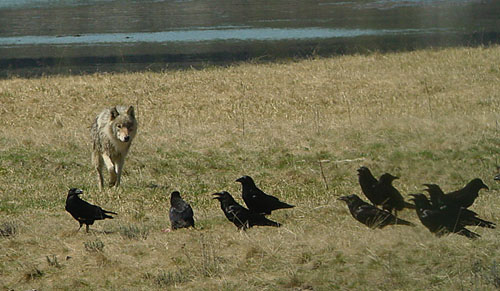
So what do Ravens and Wolves have in common you say?  The following information comes from “The Wolf Almanac,” a celebration of wolves and their world, 1995/1998 by Robert Busch.  He explains the relationship and proves once again one of the many contributions wolves give to the environment.

One of the most fascinating relationships between animals is the one that seems to exist between wolves and ravens.  The raven, scavenger of food of all types, will often follow wolf packs in hopes of morsels of food.  And wolves have learned to watch for circling ravens as a sign of of possible food below.  But there seems to be more than just a symbiosis based on food between the two species; many observations have been made that can only be described as a friendship between the big predator and the wily bird. 

In Arctic Wild, Lois Crisler states her belief that “ravens and wolves just like each other’s company.”  She described one play session between the two species, with the raven diving at the wolves and jumping around just out of reach.  “He played this raven tag for ten minutes at a time.  If the wolves ever tired of it, he sat squawking till they came over to him again.”

L. David Mech, in The Wolves of Isle Royale, described the “peculiar relationship” between a flock of ravens and a large wolf pack, and wrote that wolves and ravens “often seem to play together.”

Read Full Post »


This article was previously written by: Dr. Victor Van Ballenberghe / U.S. Forest Service / Wolf Song of Alaska Advisor

Wolves can be a factor in controlling populations in certain areas BUT not the primary or only factor.  Hunters, disease, weather, and other predators play key roles.

Special thanks is given to “Wolf Song of Alaska” for providing his article.

This page is one of over 1500 pages in our library! Visit our homepage for a full menu of options!


“The following questions and statements represent a brief summary of biological information on wolf ecology and wolf/prey relationships distilled from numerous scientific studies conducted in North America during the past 50 years. I have selected topics that I feel represent some of the key biological issues that impact wolf management. By necessity, this discussion is brief and worded so that those with little technical background can assimilate the information. I have tried to accurately summarize and interpret a large volume of data while adhering to constraints of brevity and simplicity.

1. Can wolves kill any animal they choose?

Numerous studies across North America on virtually every species of wolf prey from the smallest (deer) to the largest (bison) have shown that wolves generally kill only certain kinds of animals. These include young, old, and infirm animals. Generally, animals in their prime (for example, moose aged 1-6) escape predation. However, during deep snow conditions that favor wolves, prime-aged animals may fall prey, but these conditions are uncommon.

These findings have been misinterpreted by some to mean that wolves only kill “sick” animals or that because they generally kill the young, old or infirm wolves can’t impact prey populations. Biologists have never claimed wolves kill only the sick and have stressed that predation on young may impact prey populations.

Studies have also shown that prey animals often escape predation by a variety of methods. An early study of moose and wolves at Isle Royale, Michigan, indicated that during winter only 8% of moose encountered by wolves were killed. The rest outran the wolves or stood their ground and the wolves left. During summer, moose often escape by entering water where wolves aren’t effective. Certain prey, including goats and sheep, inhabit terrain where they are often protected. All prey species have evolved numerous anti-predator adaptations.

2. Do wolves kill in excess of their needs?

Studies have shown that wolves generally consume the animals they kill, often returning to kills over a prolonged period. They also commonly scavenge animals that die or are killed by other predators or humans. On occasion, wolves starve because they cannot find or kill enough prey, or their reproduction is reduced due to food shortage.

During deep snow conditions that occur rarely, wolves may kill more than they consume. They may also kill more young than they consume when young are very abundant, for example in large herds of caribou. However, this “surplus” killing has generally not been shown to have significant effects on prey populations.

3. At what rate do wolves kill prey?

Research has shown that kill rates vary greatly depending on snow depth, prey size, prey abundance, pack size, and many other factors. Wolves rarely kill only one species for extended periods; most packs in Alaska have access to several species. During summer, beaver, fish, berries, and numerous small mammals and birds supplement their diet.

During winter, for wolves that kill only moose, an average-sized pack (6-10) may eat one moose per 4-5 days, but this can vary from about 2-10 days per moose per pack. Some of these animals may be scavenged. Summer data are less reliable and difficult to compare to winter because nutritional needs vary as does prey size (many calves are killed) and composition. However, several studies suggest that summer kill rates are lower than during winter.

For smaller prey, kill rates are necessarily higher. In Minnesota where wolves kill mainly white-tailed deer (also beaver and moose) annual kill rates per wolf have been estimated at 15-19 deer, including summer fawns.

4. What factors control wolf populations?

In Alaska (and elsewhere) wolf populations are mainly controlled by hunting and trapping, prey abundance, and social interactions among wolves. Virtually every pack in Alaska is subject to hunting and trapping, legal and illegal, but the impact of this varies. Some packs are exploited lightly because of their inaccessibility; others are kept at low numbers by hunters and trappers. Some packs have been eliminated by humans.

Generally, wolves on the northern and northwestern arctic coasts are rare and kept at a low density by people. Wolves in southcentral Alaska are heavily exploited but in much of the interior they are not.

Wolves generally declined in the late 1970’s and early 1980’s, apparently in response to decline of moose and caribou that began in the mid-1960’s. As moose and caribou increased in some areas (including the Nelchina basin) wolves were prevented from increasing by hunting and trapping.

5. What impact has land-and-shoot (LAS) wolf hunting had on wolf numbers?

The impact of LAS has varied from place to place. In some areas that are heavily timbered with few lakes or rivers, LAS has been ineffective in reducing wolf numbers. In other areas (including the Nelchina basin) wolves have been kept low by this

practice. Large areas of southcentral including GMU’s 9, 16, 11, and 13, are ideally suited to LAS are northern areas in or near the Brooks Range. It is clear that where the terrain allows hunters to be efficient, LAS has kept wolf numbers lower than they


would have been with hunting and trapping by other methods.

6. Will wolves increase indefinitely if they are not “controlled”?

Because hunting and trapping are generally effective controlling factors, wolves will increase if exploitation stops. However, wolf populations will not increase without limit in the absence of exploitation. For example, after the wolf control in GMU-20A stopped, moose numbers more than tripled but wolf increased to only about their pre-control numbers.

7. What rolls did hunting, weather, food supplies, and predation play in the moose and caribou declines of the 1960’s and 1970’s?

Moose and caribou populations in many areas of Alaska increased during the 1950’s and early 1960’s and declined into the 1970’s. Research suggests that for moose, food supplies declined as populations increased. Deep-snow winters aggravated reduced food conditions and started the moose population declines. Hunting regulation changes did not respond in time and hunting further accelerated the declines as it did for the caribou, especially the Nelchina and Western Arctic herds. For some moose populations (GMU-20A), wolves did not start the declines, but acted after they were well underway to drive moose to lower levels than they would have reached in absence of wolves.

8. Is habitat (food) currently limiting moose and caribou populations in Alaska?

Probably so in portions of southcentral including the lower Susitna valley where large numbers of moose starved in 1989-1990 and the Kenai Peninsula where plant succession has reduced habitat quality since the mid-1970’s. Caribou herds including the Nelchina and Western Arctic herds, are also thought to be approaching the carrying capacity of the ranges.

Probably not in portions of the interior where moose densities are low and food seems abundant.

Maybe in other areas where few data are available on food quantity and quality in relation to moose and caribou numbers. It is difficult to quantify these relationships over vast areas.

9. What about bear predation?

Studies have shown that both black and brown bears (especially the latter) can be efficient predators on young moose calves. In some areas (for example, the Nelchina basin) brown bears were a more significant source of calve mortality than wolves. Bears may also kill adults in the spring and fall when they are more vulnerable.

10. a) Can wolves and bears keep prey densities low for long periods?


b) Can prey increase from low densities if wolves and bears are not reduced by people?


There is evidence that wolves and bears acting together can keep moose at low densities for long periods in places where people have no or little impact on predator numbers. For caribou, it appears that this is not the case; caribou can periodically increase if alternate prey for wolves is scarce and they too fall to low densities. Moose also follow this pattern if bears are absent. At Isle Royale National Park where bears are absent and people do not exploit either wolves or moose, moose have increased periodically and reached high densities without any form of wolf control.

11. Do we need to “control” wolves in order to harvest prey?

Biologists do not dispute the idea that moose populations will produce a higher yield for people if wolves are few or absent. However, people can still hunt and shoot moose if wolves are present as demonstrated in Alaska for many years. As indicated in question 4 (above), hunting and trapping impacts wolf populations in many areas and may keep wolf densities low. Moose abundance may be high in these areas, as it generally is now in southcentral Alaska, and hunting by people may produce high yields. In other areas where wolves and bear reach higher densities it may still be possible for people to hunt, but they may be restricted to bulls only. Moose harvest in many areas of Alaska have increased in recent years without wolf control programs.

12. Does reducing wolf density result in more moose and caribou?

Clearly, wolf control in GMA-20A during 1975-79 resulted in an increase of moose on Tanana flats. This is probably the best known example of a wolf control program in Alaska. However, wolf control in other areas where wolf:moose ratios were higher or where bears were the problem had less success. As discussed above, deep snow, reduced food, hunting or bear predation may be more important than wolf predation in controlling moose numbers. If so, wolf control is not likely to yield benefits.

13. What is the importance of predator/prey ratios?

One of the primary factors in determining the impact of predation on prey numbers is the ratio of predators to prey. If predators are few in relation to prey, predation may have little controlling effect on prey numbers. However, controlling effects may be extreme if there are many predators in relation to prey. For wolves and moose, ratios of less than 1;30 may often result in moose population declines if wolves have little alternate prey. If bears are abundant, they may elevate this ratio considerably. When wolf:moose ratios are 1:60 or higher, predation likely has little effect.

14. Do wolf populations rapidly rebound from control programs?

Wolves have a high reproductive rate and may disperse long distances to fill “voids”. Studies in Alaska have shown that populations may increase rapidly following control programs and pre-control numbers may be reached in 3-4 years. However, wolves in some areas (including the north slope) have not recovered after being reduced to low densities because hunting and trapping removes them as they re-colonize.

15. Is the “balance of nature” a valid concept?

Different definitions of the balance of nature concept have emerged in recent years. If this concept means that wolves and prey exist for long periods at high and stable numbers, then the results of recent studies suggest this is simplistic. Numbers often fluctuate up as well as down and local extinction of prey is possible. However, if the concept means that wolves and prey coexist over time in large areas, clearly this is the case. Wolves and their prey co-evolved over thousands of years with little intervention from humans. Wolves are efficient predators that at certain times under certain conditions may exert powerful controlling effects on prey populations. But, for their part, prey animals have evolved the ability to survive and reproduce. The effects of humans on both wolves and prey and their habitat in the modern world are often the primary factors determining the “balances” that now result.”

Read Full Post »

« Newer Posts - Older Posts »