Feeds:
Posts
Comments

Archive for the ‘Wolf Current Events’ Category


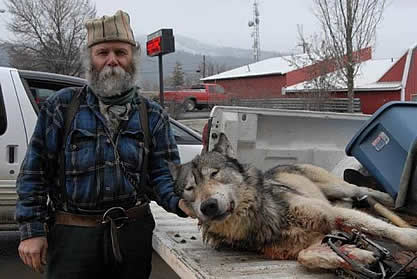
“Photos of dead and maimed wolves have pervaded the Internet in recent weeks, raising tensions in the Northern Rocky Mountains over renewed hunting and trapping of the once federally protected animals. Escalating rancor between hunters and animal rights activists on social media and websites centers on pictures of wolves killed or about to be killed.

Many have text celebrating the fact that Western states are allowing more killing of the predators. Commenting on a Facebook-posted image of two wolves strangled to death by cable snares, an individual who identified himself as Shane Miller wrote last month, “Very nice!! Don’t stop now, you’re just getting started!” A person going by the name Matthew Brown posted the message, “Nice, one down and a BUNCH to go!” in response to a Facebook image of a single wolf choked to death in a snare. Such pictures and commentary have intensified online arguments over the ethics of hunting and trapping wolves. The debate took a threatening turn this week with an anonymous email warning that animal rights advocates will “be the target next.”

In Idaho and Montana, hundreds of the animals have been killed — mostly through hunting — less than a year after being removed from the U.S. endangered species list.

Stripping the wolves of federal protection last spring opened the animals to state wildlife management, including newly licensed hunting and trapping designed to reduce their numbers from levels the states deemed too high.


Since the de-listing last May, Idaho has cut its wolf population by about 40 percent, from roughly 1,000 to about 600 or fewer. Some 260 wolves have been killed in Montana, more than a third of its population, leaving an estimated 650 remaining.

The U.S. Fish and Wildlife Service has also proposed lifting the protected status for another 350 wolves in Wyoming.

The threatening note received by an anti-trapping group based in Missoula, Mont., this week has drawn scrutiny from federal and local law enforcement.

The group says it was likely singled out because it had criticized and widely circulated a snapshot of a smiling trapper posed with a dying wolf whose leg was caught in the metal jaws of a foothold trap on a patch of blood-stained snow.were hunted, trapped and poisoned to near extinction in the lower 48 states by the 1940s under a government-sponsored program.

Decades later, biologists recognized that wolves had an essential role as a predator in mountain ecosystems, leading to protection of the animal under the Endangered Species Act.

Wolves were reintroduced in the mid-1990s over the vehement objections of ranchers and sportsmen, who see the animals as a threat to livestock and big-game animals such as elk and deer.

Environmentalists say the impact of wolves on cattle herds and wildlife is overstated and that the recent removal of federal safeguards could push the wolf back to the brink.

Wolves have long been vilified in the region as a menace, symbolizing for some a distant federal bureaucracy imposing its rules on the West.

“They’re putting us and our way of life out of business,” said Ron Casperson, co-owner of Saddle Springs Trophy Outfitters in Salmon, Idaho. “It makes me sick every day I look at this country. These wolves … I mean, come on.”

State wildlife managers had predicted that such passions would ease once the wolves were de-listed and states gained control. But discourse on the Internet and social networks appears to have grown more hostile.

Some hunters have expressed discomfort at the apparent bloodlust unleashed on the Internet, which they see as tarnishing the reputation of a sport that attracts less than 15 percent of Americans.


“There are two groups — one supports fair chase and ethical hunting, and the other views the reintroduction of wolves and the recovery with venom,” said veteran sportsman Rod Bullis of Helena, Mont.

Idaho Fish and Game Commissioner Gary Power said he was bombarded with letters and emails from people representing extremes on both sides of the debate.

“There are some folks out there stirring the pot: ‘Get rid of government, get rid of this, they shoved it down our throats, kill them all,’ and they are adding to the contentiousness,” he said.

Animal rights activists said they are sickened at the online flurry of pictures depicting wolf kills, and alarmed by comments suggesting a growing desire to shoot, trap and snare wolves.

“Roughly $40 million has been spent on wolf recovery, and now we are witnessing the second extermination of wolves in the West,” said Wendy Keefover, director of carnivore protection for WildEarth Guardians.

Idaho and Montana are required to maintain about 150 wolves per state each year to prevent federal protection from being imposed again.

But Idaho plans to more than double the number of wolves a hunter may take in some areas for the 2012-13 season, raising their bag limit to 10.

Montana is seeking to raise its wolf-hunt quotas, and state wildlife managers are discussing allowing trapping, which is currently illegal there. At least one Montana county is considering a bounty for wolves killed by licensed hunters.

This week’s email threat to the animal advocacy group Footloose Montana raised the acrimony to a new level.

The image posted on its Facebook page was taken from the Trapperman.com website, including text that joked about the wolf being shot and wounded by a passersby after it was caught — “lucky they were not real good shots.”

The photo went viral over the Internet last weekend, and on Monday Footloose Montana received the email threat.

The message said “I would like to donate a gun to your childs (sic) head to make sure you can watch it die slowly so I can have my picture taken with it’s (sic) bleeding dying screaming for mercy body.” Then the email, a copy of which Footloose gave to Reuters, said the recipients would be the next targets.

A Missoula Police Department detective, Sgt. Travis Welsh, confirmed this week that investigators were looking into a “report from a local institution about a malicious email.”

Footloose Executive Director Anja Heister said FBI agents had interviewed a member of her group about the threat, but an FBI spokeswoman declined to comment.

By Tuesday, Trapperman.com, a site whose mission statement declares, “Always keep in mind that we are the true protectors of wildlife and the wild places in which the animals live,” had removed pictures of dead or dying wolves and commentary.”

**Special thanks to By Laura Zuckerman, Reuters, for providing this information!
 

Read Full Post »


by James William Gibson – March 28, 2012

“On March 16, a Friday, a US Forest Service employee from Grangeville, Idaho, laid out his wolf traps. The following Monday, using the name “Pinching,” he posted his story and pictures on http://www.Trapperman.com . “I got a call on Sunday morning from a FS [Forest Service] cop that I know. You got one up here as there was a crowd forming. Several guys had stopped and taken a shot at him already,” wrote Pinching. The big, black male wolf stood in the trap, some 300-350 yards from the road, wounded—the shots left him surrounded by blood-stained snow. Pinching concluded his first post, “Male that went right at 100 pounds. No rub spots on the hide, and he will make me a good wall hanger.” The Trapperman website went wild with comments. “That’s a dandy!! Keep at it,” wrote Watarrat. Otterman asked, “All the gray on that muzzle make a guy wonder how old he is or if it is just part of his black coloring.” Pinching’s picture of the wolf’s paw caught in the trap got special attention. “Is that the MB750 stamped ‘wolf’ on the pan?” asked one man. “Looks to be a perfect pad catch. Congratulations! Pinching confirmed the trap model and commented, “Oh an [sic] by the way, a wolf is a heck of a lot of work to put on a stretcher! Man those things hold on to their hide like no other!” By late March some 117 Idaho wolves had been killed in traps and snares, and another 251 shot. Montana saw 166 killed, for a total of 534 wolves out of an estimated 1150 in the two states. Although Montana’s season ended in February, Idaho is not quite done. Both states have announced plans for increased hunting in the 2012-2013, and discussions are underway among hunting groups and state officials to allow private donations to establish wolf bounties.

As recently as the spring of 2011, gray wolves in the Northern Rockies received protection from he Endangered Species Act. But in April, 2011 Congress passed a rider on a federal appropriations bill removing them. Montana Democratic Senator Jon Tester, facing a 2012 challenge from Republican Congressman Danny Rehberg, wanted to show Democrats hated wolves just as much as Republicans. Conservation groups filed suit in Montana’s federal district court, claiming the delisting represented an unconstitutional infringement by Congress on the judicial branch while it deliberated an ongoing lawsuit over federal wolf protection.

Thus wolves, demonized by the far-right in the Rockies as disease-ridden monsters and icons of the federal government (see my Summer 2011 Journal story, “Cry Wolf”), now face a brutal campaign to radically reduce their numbers so far that extermination can not be ruled out. Idaho’s Governor Butch Otter declared in a March 25 news conference that his state faced a “disaster emergency” from wolves. “We don’t want them here.”

Skirmishing on the web escalates. Footloose Montana, an anti-trapping group, posted the trapped wolf’s pictures on its website, drawing over a 1,000 comments within days. Word spread. Nabeki, founder of Howling for Justice, opined that “This wolf will be the face of the cruelty and ugliness that is the Idaho hunt…Our forests are hiding acts of unspeakable horrors that are being perpetuated on innocent animals.” Protesters called Idaho and Montana tourist bureaus, demanding the hunts end. By Monday, March 26, Trapperman learned that its photos now circulated offsite. The group’s administrator demanded that Footloose Montana remove the photographs.

Footloose staff and board members also received an anonymous death threat in their email: “I would like to donate [sic] a gun to your childs [sic] head to make sure you can watch it die slowly so I can have my picture taken with it’s [sic] bleeding dying screaming for mercy body. YOU WILL BE THE TARGET NEXT BITCHES!” FBI agents and Missoula, Montana police received copies of the threat.

Wolf advocates hope that these pictures will go viral, shaming a nation into facing the torture people inflict on animals and the moral and political failures that promote and legitimize it.”

**Special thanks to “Earth Island Journal” for providing this information!

Read Full Post »


Sunday March 18, 2012 6:34 AM

“To kill or not to kill wolves, that is a question legal, moral and, apparently, spiritual.

Since losing protection under the federal Endangered Species Act in 2011, western wolves have become legal game during seasons in Idaho and Montana. Wolves can be killed based on quotas intended not to harm the viability of the population, estimated regionally at about 1,700 in Idaho, Montana and Wyoming.

Last week, wolf advocates lost an attempt to stop hunting by claiming an amendment added to the 2011 defense bill violated the constitutional separation of powers. The 9th U.S. Circuit Court of Appeals ruled that no constitutional mandates were broken when the amendment introduced by senators John Tester (D-Mont.) and Mike Simpson (R-Idaho) gave their respective states control of wolf management and blocked further judicial review.

The case pitted the Center for Biological Diversity and three other wildlife advocacy groups against the U.S. Department of the Interior and the U.S. Fish and Wildlife Service. Among groups filing briefs in support of the federal government were the National Rifle Association, Safari Club International and the farm bureau federations of Idaho and Montana.

About 4,500 wolves are estimated to be residing in Minnesota, Wisconsin and Michigan, where delisting went into effect in January. A move by Wisconsin legislators toward legalizing controlled wolf hunting in the state has run into a stumbling block, however.

Eleven tribes of the Ojibwe, also known as the Chippewa, in Wisconsin, Minnesota and Michigan oppose a wolf hunt. Their disapproval, filed with the legislature in written testimony, is based on religious principle and a tradition that links the health of the tribe to the state of the wolf population.

Courts have ruled the tribes should have a say in matters such as a wolf hunt on land they control. Should legislators go ahead with a wolf hunting season, an additional complication is that half of the wolves harvested would belong to the tribes under existing agreements.”

**Special thanks to Dave Golowenski , The Columbus Dispatch, for providing this information!

Read Full Post »


Tragic news…They CHANGED THE ENDANGERED SPECIES ACT to make this happen! 

“BILLINGS, Mont. (AP) — A federal appeals court on Wednesday rejected a lawsuit from conservation groups that want to block wolf hunting and trapping that have killed more than 500 of the predators across the Northern Rockies in recent months.

The ruling from a three-judge panel of the 9th U.S. Circuit Court of Appeals said Congress had the right to intervene when it stripped protections from wolves last spring.

Lawmakers stepped in after court rulings kept wolves on the endangered list for years after they reached recovery goals. Wildlife advocates claimed in their lawsuit that Congress violated the Constitution’s separation of powers by interfering with the courts.

But in an opinion authored by Judge Mary Schroeder, the court said Congress was within its rights. Schroder wrote that lawmakers changed the Endangered Species Act to deal with Northern Rockies wolves, and did not directly interfere with the court’s prerogative to decide when the law is being followed.

The amendment marked the first time Congress has forcibly removed a species’ endangered status. It was tacked onto a federal budget bill by Idaho Republican Rep. Mike Simpson and Montana Democratic Sen. Jon Tester.

“This case has made it clear that those who persist in trying to manage wildlife through the courts, in spite of all scientific evidence that this species has recovered, no longer have a defensible position,” Simpson said Wednesday.

Michael Robinson with the Center for Biological Diversity, one of the groups that sued to restore protections, said a Supreme Court appeal was possible but no decision had been made.

“We’re very disappointed and very saddened,” Robinson said. “Hundreds of wolves have been hunted and trapped and snared, and they are essential to their ecosystem.”

He called the congressional budget bill rider that lifted protections “undemocratic” and said that it set a precedent for future political meddling with imperiled wildlife.

Wolves once thrived across North America but were exterminated across most of the continental U.S. by the 1930s, through government sponsored poisoning and bounty programs.

They were put on the endangered list in 1974. Over the last two decades, state and federal agencies have spent more than $100 million on wolf restoration programs across the country.

The Northern Rockies is now home to more than 1,700 wolves in Montana, Idaho and Wyoming and expanding populations in portions of eastern Oregon and Washington. That figure is up slightly from 2010, although Wyoming and Idaho saw slight declines.

In the Northern Rockies wolf hunting is allowed in Montana and Idaho and could resume in Wyoming this fall.

Minnesota, Michigan and Wisconsin also are considering wolf seasons after protections for wolves were lifted in the upper Great Lakes in December.

Wisconsin’s legislature on Wednesday approved a measure to establish a hunting and trapping season that would run from mid-October through the end of February. It still has to be approved by the governor.

There more than 4,400 of the animals in the Great Lakes and a struggling population of several dozen wolves in the Desert Southwest. Alaska, where the animals never went on the endangered list, has an estimated 10,000 wolves.

In parts of Montana, ranchers and local officials frustrated with continuing attacks on livestock have proposed bounties for hunters that kill wolves. Montana wildlife officials said they will consider ways to expand hunting after 166 wolves were killed this season, short of the state’s 220-wolf quota.

Idaho allows trapping. Its 10-month wolf season runs until June and has claimed 353 wolves so far.

Prior lawsuits resulted first in the animals’ reintroduction to the Northern Rockies and then later kept them on the endangered list for a decade after the species reached recovery goal of 300 wolves in three states.

The U.S. Fish and Wildlife Service is monitoring the hunts. But agency officials have said they have no plans to intervene because the states have pledged to manage wolves responsibly.

Federal officials have pledged to step in to restore endangered species protections if wolf numbers drop to less than 100 animals in either Montana or Idaho.

Even without hunting, wolves are shot regularly in the region in response to livestock attacks. Since their reintroduction, more than 1,600 wolves have been shot by government wildlife agents or ranchers.”

**Special thanks to By MATTHEW BROWN | Associated Press for providing this information.

Read Full Post »


Christopher Ketcham

March 13, 2012

The reintroduction of the gray wolf to the Northern Rockies was an ecological success story—until big money, old superstitions, and politics got in the way.

“In April 2001, a U.S. government wildlife trapper named Carter Niemeyer choppered into the mountains of central Idaho to slaughter a pack of wolves whose alpha female was famed for her whiteness. He hung from the open door of the craft with a semiautomatic shotgun, the helicopter racing over the treetops. Then, in a clearing, Niemeyer caught a glimpse of her platinum fur. Among wolf lovers in Idaho, she was called Alabaster, and she was considered a marvel—most wolves are brown or black or gray. People all over the world had praised Alabaster, had written about her, had longed to see her in the flesh. Livestock ranchers in central Idaho, whose sheep and cows graze in wolf country, felt otherwise. They claimed Alabaster and her pack—known as the Whitehawks—threatened the survival of their herds, which in turn threatened the rural economy of the high country. She had to be exterminated. 

When Alabaster appeared in Niemeyer’s sights, a hundred feet below the helicopter, her ears recoiled from the noise and the rotor wash, but she was not afraid. She labored slowly along a ridge, looking, Niemeyer says, “like something out of a fairy tale.” 

Then he shot her. At the time, wolves were considered a rare species in Idaho and across the Northern Rockies, and they were protected under the Endangered Species Act. But they could be targeted for “lethal control” if they made trouble—if they threatened a human being, which almost never happened, or, more commonly, if they were implicated in attacking cattle and sheep. The Whitehawks allegedly had been enjoying a good number of cows and sheep that spring and were said to have killed at least one rancher’s guard dog. 

As a trapper for the U.S. Department of Agriculture and later as a wolf expert for the U.S. Fish and Wildlife Service, Niemeyer was trained to control predators, mostly coyotes and foxes. In 26 years working for the government, he had killed thousands of coyotes. But wolves are a different kind of kill. As predators, they are exquisite. Niemeyer had taken a liking to wolves. He respected them. 

There were four other members of the pack, scattered in the woods. The helicopter circled, flushing them out, and Niemeyer shot them as they ran. When he necropsied Alabaster at the kill site—gutting her, stripping her pelt—he found she was pregnant with nine pups that were two weeks from birth, almost fully formed. He buried each pup.

Canis lupus, the largest of the planet’s wild dogs, once numbered in the hundreds of thousands in the U.S. The creatures are powerful—the largest males, six and half feet from tooth to tail, weigh 140 pounds—and they are agile and cunning. They run in packs of seven to ten animals that consist of a father and mother—the alphas—along with pups and subordinate males and females, unrelated to the family but welcomed in their midst. The wolf is an apex predator, at the top of its food chain, keeping prey from overpopulating, which maintains a balanced ecosystem. 

With European settlement and the decimation of its native prey—buffalo, elk, mule deer—the wolf was bound for destruction. It was now killing for its meals the domesticated sheep and cattle that settlers had ranged across the grasslands and the mountains. Hated for its depredations, the wolf was hunted mercilessly—shot, trapped, poisoned with strychnine, fed glass shards stuffed in bait, its pups asphyxiated by fires set in their dens. By 1935, the gray wolf had disappeared almost entirely from the U.S. 

Decades later, during the high tide of 1970s environmentalism, conservationists began to agitate for a government-sponsored recovery. The evidence suggested that the loss of the wolves had destabilized the ecology of the Northern Rockies. Following the passage of the Endangered Species Act in 1973, the U.S. Fish and Wildlife Service undertook the recovery of the wolf in the region. It wasn’t until 1991, however, that Congress mandated an impact study of wolf reintroduction. By 1994, funding had been approved for Fish and Wildlife biologists to remove 66 gray wolves from Canada, where the animals still numbered in the tens of thousands, and truck them south for release in central Idaho and Yellowstone National Park. 

Niemeyer, now retired in Boise, was among the trappers who traveled to Canada in 1995 to capture and radio-collar the reintroduced wolves. The reintroduction, he told me, had been one of the epic wildlife-recovery stories in U.S. history; in little more than 15 years, the number of wolves in the Northern Rockies had gone from 66 to roughly 1,600. Yet concerns about the threat posed by the wolves to cow, sheep, and elk populations had led to a stark reversal. After spending upward of $40 million studying the animals—then capturing, collaring, tracking, and protecting them—the federal government last year scheduled wolves to be killed in huge numbers across the Northern Rockies. In April 2011, following a series of lawsuits and an unprecedented intervention by Congress, canis lupus was removed from the endangered species list. 

Today, as a result of the delisting, anyone can shoot a wolf—you don’t have to be a government trapper. Wolves can in some circumstances be shot on sight. Niemeyer, who is six foot six inches and giant-shouldered, shot 14 wolves in the course of his government career; the Whitehawks were his last. He maintains a taxidermy studio in his garage and says he’s “not into the warm and fuzzy thing” when it comes to wild animals. “I’m not grossed out by wolves being hunted, trapped, killed,” he says. “I’d skin one today if you brought it to me. What I’m caught up in is honesty. What you have with wolf delisting is half-truths, untruths, hysteria, and just downright craziness.” 


The ranching industry in the American West has been the historic enemy of wolves, so it was fitting that ranchers in Montana and Idaho called for hunting them almost from the moment of their reintroduction. The American Farm Bureau Federation, a nonprofit advocate for farming and ranching interests, had even sued preemptively in 1994 to stop the reintroduction, but a federal court rejected the suit. In 2008, however, Western livestock interests found a sympathetic ear in the Bush administration’s Department of the Interior, which issued what would become the first of multiple orders to remove the wolf from protection under the Endangered Species Act (ESA).

Following a lawsuit filed by 12 conservation groups that challenged the decision, the U.S. District Court in Montana found that the department had “acted arbitrarily in delisting the wolf” and reinstated the act’s protections. Judge Donald Molloy pointed to a glaring discrepancy: Biologists had determined that only with the genetic commingling of the three “distinct population segments” of wolves—in central Idaho, Yellowstone National Park, and northwestern Montana—would the Northern Rocky Mountain wolf have a chance at long-term survival. A 2009 study in BioScience magazine concluded that absent this genetic exchange, the population would be “genetically depleted, small, and ineffective in terms of ecosystem function.” The Interior Department’s own environmental impact study, conducted by the U.S. Fish and Wildlife Service, had come to the same conclusion. Yet the department had removed the Endangered Species Act protections “without any evidence of genetic exchange,” wrote Judge Molloy, who found a “possibility of irreparable harm” if the delisting went unchallenged. 

The matter remained at an impasse until President Barack Obama’s newly appointed interior secretary, Ken Salazar, resurrected the Bush-era delisting plan in April 2009. The decision infuriated pro-wolf conservationists, though it was not unexpected. Salazar, a Colorado Democrat, comes from a family of five generations of ranchers. A new lawsuit was filed by a coalition that included 14 environmental groups, among them the Natural Resources Defense Council, the Sierra Club, the Humane Society, and smaller outfits like the Center for Biological Diversity. While the suit was pending, Idaho and Montana opened a hunting season that resulted in the culling of more than 500 wolves—some 32 percent of the entire Northern Rockies population. A year later, in August 2010, Judge Molloy again ruled in the conservationists’ favor. He determined that the de-listing violated the letter and the spirit of the Endangered Species Act; he found no evidence of genetic exchange among wolf sub-populations. He also ruled that Fish and Wildlife had failed to properly oversee wolf management plans in Idaho and Montana. The judge ordered that year’s wolf hunts to be canceled. 

The ongoing litigation drew the ire of Republican politicians throughout the West. Denny Rehberg, Montana’s lone congressman, presented two bills during 2011 for a legislative delisting of the wolf, including one to “amend the Endangered Species Act of 1973 to provide that Act shall not apply to the gray wolf.” The bills went nowhere, but Rehberg, who was gearing up to challenge Democrat Jon Tester for his U.S. Senate seat in 2012, had sparked a kind of arms race of anti-wolf rhetoric. The Republican governor of Idaho, Butch Otter, announced that he was ordering his state wildlife managers to “relinquish their duty to arrest poachers,” thereby freeing up Idaho hunters to continue shooting wolves. Otter also signed an emergency law that authorized him to declare a statewide “wolf disaster.” Senator Orrin Hatch of Utah unsuccessfully attempted to amend the Endangered Species Act so that it no longer applied to “any gray wolf.” Montana Senator Max Baucus, a Democrat, weighed in with the Delisting Gray Wolves to Restore State Management Act of 2011, which died in committee. Tester floated his own wolf-delisting bill; it also went nowhere. ”

**Special thanks to http://prospect.org/article/wolves-slaughter?fb_ref=.T19eDqMvtC8.like&fb_source=profile_multiline for providing this information.

Read Full Post »


Posted: Feb 25, 2012 3:17 PM by Dennis Bragg (KPAX/KAJ Media Center)

“Conservation groups are blasting Idaho’s decision to kill wolves along the Idaho-Montana border from the air, saying the move is “misguided” and not backed up with scientific evidence.

The Idaho Department of Fish and Game caused a flurry of response from wolf advocated Thursday when it announced it helped fund USDA Wildlife Service’s successful efforts to kill 14 wolves from a helicopter in the Lolo Zone of the Clearwater National Forest.

The state says in the Lolo zone, hunters had killed 11 wolves this year, with another 11 caught by trappers and half-a-dozen killed through “control efforts” last spring. Along with the 14 wolves shot from the air earlier this month that brings the total wolves removed to 42.

In September 2010 Idaho Fish and Game set a target of 40 to 50 wolves to be removed to help maintain healthy elk populations on the Idaho side of the border. Biologists say the wolves are the “primary cause of death” for cow elk and calves under six months old.

Deputy Director Jim Unsworth says the state would “like to see one of Idaho’s premier elk populations recover as much as possible.” But Defenders of Wildlife is blasting the move, and previous occasions where it says the state has killed wolves through aerial gunning.

“It’s wrong to ask American taxpayers to subsidize the pointless killing of wolves in order to boost game populations. The removal of wolves in the Clearwater National Forest runs counter to science-based wildlife management and is an inappropriate use of limited resources that should be aimed at conserving wildlife,” said Suzanne Stone, Northern Rockies representative for the Defenders.

“Hunters and trappers have already killed more than 20 wolves in the area in the last six months, and the season continues until the end of March. There’s no scientific evidence that the ecosystem is out of balance due to the return of wolves and thus no justification for having Wildlife Services kill more wolves to boost elk numbers.”

Defenders of Wildlife worries the state will try a similar approach elsewhere in Idaho.”

**Special thanks to Dennis Bragg (KPAX/KAJ Media Center) for providing this information!

Read Full Post »


Article | February 21, 2012 – 6:30pm | Ashland Current

“Legislation outlining a proposed state wolf hunt is likely to hurt wolf populations while failing to resolve existing conflicts with humans, says a University of Wisconsin-Madison wolf expert.

Senate Bill 411, introduced at the end of January, proposes opening Wisconsin to hunting and trapping gray wolves during an annual season that would extend from Oct. 15 through the end of the following February.

UW-Madison professor Adrian Treves directs the Carnivore Coexistence Laboratory in the Nelson Institute for Environmental Studies.  Treves says the removal of the gray wolf from federal endangered species lists earlier this year is an opportunity to balance responsible and sustainable natural resource management with citizen interests.

“The issue is not simply whether or not to hunt, it is how and where to hunt that are critical,” he writes in a testimony statement to the Senate Committee on Natural Resources and Environmen.

But exposing wolves to such a long season – much longer than comparable species – and across such a broad area risks overharvesting the animals, Treves says. The approach is also unlikely to help control problem wolves, which Treves’ research has shown are a minority of animals in geographically restricted and highly predictable areas.

Treves also believes the proposed hunt will not meet the needs of the majority of Wisconsin citizens. In statewide public opinion surveys, he and his colleagues found that the majority of those polled supported a wolf hunt provided it could be conducted in a way that reduces conflict with humans without jeopardizing the long-term health of the wolf population. The proposed hunt structure meets neither condition, he says.

Pushing forward with the bill as written risks reducing the state population enough to land it back on the federal endangered list and beyond state control, Treves says. “We risk wasting the opportunity for Wisconsin to manage its own wolves without federal intervention,” writes Treves.

“As a species fresh off the endangered species list and a species with very special meaning to many people – including the sovereign tribal nations in our state – this bill should be amended to accord the wolf its due place among Wisconsin’s premier wildlife,” he adds. “I recommend the (Wisconsin Department of Natural Resources) be given the authority to determine a sustainable and publicly acceptable season length and methods of hunting.””

**Special thanks to “Ashland Current” for providing this information!

Read Full Post »


US Fish and Wildlife Service, February 9, 2012

Contacts:  Tom Buckley, (505) 248-6455      Tom_Buckley@fws.gov
Bruce Sitko, (928) 367-4281         bsitko@azgfd.gov

“The National Fish and Wildlife Forensics Laboratory in Ashland, Oregon, has determined that Mexican wolf mp1242 died as the result of a gunshot wound.

On November 23, 2011, Arizona Game and Fish Department (AGFD) personnel on the Mexican Wolf Interagency Field Team (IFT) were contacted by a member of the public who reported seeing an injured Mexican wolf in the Apache-Sitgreaves National Forests south of Big Lake, Ariz. The IFT located and observed the wolf the next day by tracking its radio collar signal. They identified it as mp1242, a young male that was born earlier in 2011 into the Bluestem Pack. After confirming the wolf was injured, the IFT initiated efforts to capture the animal and evaluate its injury.

The IFT captured mp1242 on December 3 and found that it had an injured rear leg and was in poor body condition. In phone consultation with a veterinarian, project personnel attempted to implement life-saving measures en route to the veterinarian office, but the wolf died of its injuries.

“I am disappointed and concerned by this news of another wolf dying due to gunshot wounds,” said Benjamin Tuggle, the U.S. Fish and Wildlife Service’s Southwest Regional Director. “It is hard for me to rationalize the illegal killing of these wolves or any other endangered species.  They are the natural heritage we are hoping to leave to future generations.”

“We are bringing the full weight of the law to bear on these illegal activities and will continue to focus on this impediment to recovery,” said Tuggle.

U.S. Fish and Wildlife Service (Service) law enforcement agents, in collaboration with the AGFD have opened an investigation. All of the Service’s available regional law enforcement resources are being utilized.

A reward of up to $10,000 is being offered for any information leading to the apprehension of the individual or individuals who may be responsible for the death of this wolf. Individuals who have information are urged to contact the U.S. Fish and Wildlife Service, Office of Law Enforcement in Albuquerque, New Mexico at (505) 346-7828 begin_of_the_skype_highlighting              (505) 346-7828      end_of_the_skype_highlighting or in Alpine, Arizona. at (928) 339-4232 begin_of_the_skype_highlighting              (928) 339-4232      end_of_the_skype_highlighting, or AGFD Operation Game Thief hotline at (800) 352-0700 begin_of_the_skype_highlighting              (800) 352-0700      end_of_the_skype_highlighting. Killing a Mexican gray wolf is a violation of the Endangered Species Act, punishable by up to a $100,000 fine and/or up to a year in prison.

Mexican wolf reintroduction is a joint effort by the Service, AGFD, White Mountain Apache Tribe, USDA Forest Service, USDA Animal and Plant Health Inspection Service – Wildlife Services, and other stakeholders, including Graham, Greenlee and Navajo Counties in Arizona.

The mission of the U.S. Fish and Wildlife Service is working with others to conserve, protect and enhance fish, wildlife, plants and their habitats for the continuing benefit of the American people. We are both a leader and trusted partner in fish and wildlife conservation, known for our scientific excellence, stewardship of lands and natural resources, dedicated professionals and commitment to public service.   The U.S. Fish and Wildlife Service works cooperatively with the American public to continue the conservation legacy of America’s great outdoors.   For more information on our work and the people who make it happen, visit www.fws.gov.
******************************************************************************************************************************************
TAKE ACTION TO STOP THE CRIMINALS KILLING WOLVES! Public interest groups and concerned citizens have contributed to a reward, bringing the total amount of money available for information leading to the arrest and conviction of anyone killing a Mexican gray wolf to as much as $59,000. Please help to stop the killers by printing and posting reward posters!”

**Special thanks to “Lobos of the Southwest” for providing this information!http://www.mexicanwolves.org/index.php/news/629/51/Press-Release-Necropsy-Results-Show-Mexican-Wolf-Died-From-Illegal-Gunshot-Reward-Offered-for-Information/d,News2

Read Full Post »


Image

“The number of Mexican gray wolves in Arizona and New Mexico rose in 2011, but more significantly, the number of breeding pairs grew from just two to six.

In all, at least 58 wolves were counted by state and federal biologists in the annual survey, conducted by the U.S. Fish and Wildlife Service and the Arizona Game and Fish Department. A year ago, there were 50 wolves counted and in 2010, there were just 42.

The numbers are especially encouraging because the Wallow Fire burned through several important wolf habitat areas last summer. Officials say the count is a minimum number because some wolves may have been missed in the survey.

“These numbers are an indication of the full-on effort we and our partners … have been putting into this program,” said Benjamin Tuggle, Southwest regional director for the U.S. Fish and Wildlife Service. “We were successful in establishing the initial population of Mexican wolves in the wild, and we are building on that success.”

Wolf advocates cheered the count cautiously, noting that the numbers are still far below the original goals of maintaining more than 100 wolves and 18 breeding pairs by 2006. The advocates say efforts to reintroduce the wolf to the wild has suffered from a lack of a full recovery plan and the small number of wolves released into the wild.

“Eight more wolves in the wild than the previous year is a step back from the edge of extinction,” said Michael Robinson of the Center for Biological Diversity. “And that’s happy news. Of course, six breeding pairs is still perilously low.”

The survey found 32 wolves in six packs on the Arizona side of the recovery area and 26 wolves in six packs on the New Mexico side. There were 18 pups born in 2011 that survived through Dec. 31, helping boost the final population figures.

“Even though these numbers are below the target levels specified in the environmental impact statement developed when the program began, these elements exhibit a cornerstone achievement

in Mexican wolf conservation,” said Larry Voyles, director of the Arizona Game and Fish Department. “This year’s count gives credence to the fact that we are moving in a positive direction.”

Voyles said wolf program specialists estimate that 90 percent of the wolves being tracked by electronic collars were born in the wild.

The gray wolf was all but extinct before the reintroduction program began in 1998. State and federal agencies have released wolves in fits and starts since then and the federal government has repeatedly delayed work on a full recovery plan.

The program has been the target of intense opposition by ranchers who run livestock in the high country of eastern Arizona and western New Mexico. They say the wolves kill cows and sheep and should not be allowed to roam wild.

 Nine wolves are known to have died during the year, including two shot illegally.

Eva Sargent, a gray wolf expert for the group Defenders of Wildlife, said the wolves will never make it if the federal government doesn’t release more animals into the wild.

 “There are wolves eligible for release in Arizona and New Mexico right now, and they are desperately needed,” she said. “Some of these wolves have been specially conditioned to avoid preying on cattle and deserve a chance at life in the wild.”

Voyles said the state will continue to work with land users in an effort to reduce the contact between wolves and livestock and avoid more confrontations.

“Building public tolerance by those who live on the land and must coexist with the wolf is crucial to the success of the Mexican wolf program in Arizona,” he said.

Robinson said the wolves need the support of a full recovery program that acknowledges the value of the predator on the landscape.

“Restoring wolves to the wild helps restore the balance of nature in the Southwest,” he said. “More wolves means stronger and more alert elk and deer, more leftover meals for badgers and bears, and healthier streamsides as elk spend less time eating willow shoots.”

You can read more about how the state conducted the survey and how the information helps its program here.”

**Special thanks to Shaun McKinnon,The Arizona Republic, for providing this information! (http://www.azcentral.com/members/Blog/ShaunMcKinnon/154350)
Friday, February 3, 2012 at 04:05 PM

Read Full Post »


January 25, 2012 12:00 am

Natural predators only one option available to planners.

“ALAMOSA — An examination of wolf reintroduction to the San Luis Valley didn’t come at the prompting of federal wildlife officials.

But they’ll still have to take a look at it, thanks to public comment last year urging the idea be considered as a means of controlling elk herds on the Baca National Wildlife Refuge, where elk have taken a heavy toll on the cottonwoods and willows lining stream banks.

“Right now, it’s a question. You have a lot of elk, a lot of people would say you need a large predator,” said Laurie Shannon, a planning team leader for the U.S. Fish and Wildlife Service. “We may not move forward with it, but right now it’s on the table.”

The mention of wolves takes up only one sentence in a 13-page document laying out the potential management strategies for the Alamosa, Baca and Monte Vista national wildlife refuges.

And it’s not a part of the proposed option favored by the agency.

Still, the possibility of wolf reintroduction drew opposition at a Monday night meeting where possible strategies were unveiled.

Steve Russell said the move would be bad for livestock producers.

“I would like it kicked out regardless of how we merge alternatives,” he said.

Paul Robertson oversees the Nature Conservancy’s Medano-Zapata Ranch, which neighbors the Baca.

‘‘I don’t think ‘C’ is a politically wise decision,’’ he said of the alternative that included the mention of wolves.

 There were no public comments Tuesday in favor of the idea.

Researchers have cited the 1996 reintroduction of wolves to Yellowstone National Park for scattering elk herds and allowing the recovery of riparian shrubs like willows.

 But wolves outside the park’s boundaries have been a controversial topic, arousing opposition from ranchers, hunters and even governors.

Idaho and Montana have established wolf hunting seasons and a proposal to do so in Wyoming is under review.

The use of predators may receive some consideration in how the Great Sand Dunes National Park and Preserve manages its elk herds.

Park officials are conducting a study of bison and big game at the park that is due out at the same time as the management plan for the wildlife refuges.

Then-acting Superintendent Karl Cordova said in November the Park Service had not ruled out considering predators as a means to control the elk herds.”

*Special thanks to The Pueblo Chieftan for providing this information!  (http://www.chieftain.com/news/region/wolves-to-be-considered-for-culling-elk-herds/article_f3bb655c-4719-11e1-9fa5-001871e3ce6c.html)


Read Full Post »

« Newer Posts - Older Posts »