Feeds:
Posts
Comments

Archive for the ‘Wolf Current Events’ Category


Wisconsin Wolf

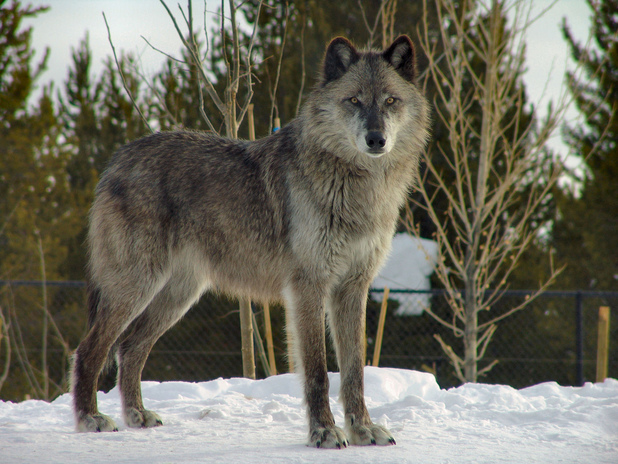
A collared gray wolf in Wisconsin. Photo courtesy of Michele Woodford.

“The Wisconsin Department of Natural Resources boasts: “We rank first in the country for the highest single year deer harvest on record and are number one for deer harvest over the past decade. All of us work hard to keep it that way.”

Yet, according to a new article, Limited deer hunt may happen in three area communities, deer populations are doing too well in some parts of Wisconsin. Ironically, the state DNR is also keen to “control” (read: kill off) their wolf population through hunting and trapping, in part because wolves prey on deer. How contradictory is that?

Ashwaubenon, Allouez and De Pere considering deer population control measures

A limited deer hunt could take place in 2014 in parts of Allouez, Ashwaubenon and De Pere if local officials decide the population is too big for the area.

The municipalities hope to survey the deer population this winter in response to complaints from residents, who said the animals are damaging gardens and creating traffic hazards in certain neighborhoods. But they’re working slowly with this issue, which could prompt worries about safety, objections from animal-rights groups and other potential roadblocks.

Meanwhile, officials in the communities say they’re hearing from growing numbers of residents who don’t like deer grazing in their gardens, or having large animals darting across residential streets.

“We’ve certainly had more sightings of larger groups this year,” said Rex Mehlberg, Ashwaubenon’s director of parks, recreation and forestry. “People are seeing six, eight, 10 of them at a time. One group was 14 or 15.”

Local officials stress that no decisions have been made about whether they would allow a hunt, and that hunting would not take place in parts of town where people would be at risk. First, they would have to decide if they want to do a count of deer by helicopter this winter. The survey cost, estimated at $2,000, would be shared between the communities and likely would be funded in part through a grant.

De Pere officials are scheduled Oct. 1 to discuss funding for the study, said Parks, Recreation and Forestry Director Marty Kosobucki. he said the city also has discussed setting aside some money in its 2014 budget to clover part of the cost of a survey.

In Northeastern Wisconsin and elsewhere, complaints about deer have grown as communities have sprawled into areas that were once rural. Two Rivers was set to vote Monday night on allowing a limited bow hunt this fall. “

**Special thanks to “Exposing the Big Game,” http://exposingthebiggame.wordpress.com/2013/09/17/wisconsin-1-for-deer-harvest/, for providing this information!

Read Full Post »


Idaho Wolf

“There’s something rotten in Michigan — and the stench is coming from one rogue farm in the western portion of the Upper Peninsula. Based on state documents obtained through Michigan’s Freedom of Information Act (FOIA), and an analysis of those documents conducted by the National WolfWatcher Coalition and Keep Michigan Wolves Protected, four-fifths of the livestock killed by wolves in the western management unit (96 animals out of 120) come from this one farm. The documents make plain that the owner of this farm is engaging in unsound, sloppy — and perhaps even criminally inhumane — practices.

The story told in the FOIA documents broke late last month in the Marquette Mining Journal and on Michigan Public Radio. Even though state law already allows the killing of individual wolves threatening livestock or pets, the state senator from this region has shepherded two bills through the Michigan legislature to allow trophy hunting of gray wolves — right after they were Gray Wolf May Lose Endangered Species Status . There are only about 650 wolves in the entire state, and that number is down from the wolf census two years ago.

There are only about 650 wolves in the entire state, and that number is down from the wolf census two years ago.

There were 11 farms that reported wolf problems in the western region of the Upper Peninsula, with most of them having only a single incident. In an investigation conducted this past winter, the Michigan Department of Natural Resources (DNR) found that the owner of that one farm, John Koski, did not live on the farm and did not provide proper care for his cattle, failing even to remove dead animals — allowing their carcasses to attract predators. The state provided three “guard” donkeys to him for free, yet DNR officials found two of them dead, and the third one was in poor condition. Koski also failed to use fencing as a protective mechanism, even though the state also provided that to him at no cost.

Koski was even paid for the livestock “losses” he sustained, pocketing $33,000 of the $40,000 paid out by the wildlife management unit.

It doesn’t take too much deductive reasoning to figure out what’s at work here: proponents of hunting and trapping wolves for trophies and for their pelts used Koski as a poster child for their hunt, citing enormous losses from wolves. What they didn’t tell people was that the vast majority of all incidents involving wolves occurred on one farm, which was clearly exhibiting the worst management practices and inviting predators or other animals onto the farm by leaving rotting animal carcasses around. It essentially amounts to a wolf-baiting situation, and then crying crocodile tears when the wolves show up for a free meal.

The people who want to kill wolves don’t want to admit that their agenda is driven by an irrational hatred and a lack of understanding of wolves. They try to dress up their policy goal of wolf-killing in socially beneficial terms. Specifically, they say the hunt will protect farmers.

The fact is, the state already allows the killing of problem wolves. And the state provides free tools to farmers having wolf conflicts and compensates them for the very infrequent losses that occur. Random killing of wolves in the forests and wilderness won’t do a thing to further mitigate the remote likelihood of a wolf incident. Sound animal husbandry practices are the solution.

Wolves are an economic and ecological boon to the state, driving wildlife-oriented tourism and keeping prey populations in balance, thereby reducing crop losses and automobile collisions involving deer. That’s why The HSUS urges all Michiganders to support two referenda — one to nullify the wolf trophy hunting season set to start in November, and the other to restore the rights of voters to have a say on wildlife management policies and deny the unelected political appointees at the Natural Resources Commission from having all authority to open new hunting and trapping seasons on protected species. To get involved, visit www.keepwolvesprotected.com.”

Pacelle’s most recent Op-Ed was “Sharks Gain Protections in India, Will U.S. Follow Suit?” This article was adapted from “‘Crying Wolf and Pocketing the Cash,” which first appeared as on the HSUS blog A Humane Nation. The views expressed are those of the author and do not necessarily reflect the views of the publisher. This version of the article was originally published on LiveScience.

Read Full Post »


Wolf Ledge

As Montana’s wolf hunt begins, please let this be a reminder how much wolves need our ongoing advocacy.  Please also take a moment to object to these hunts by writing or calling Governor Steve Bullock’s office:  http://governor.mt.gov/contact/default.htm.

“Montana’s general wolf season opens Sunday with much looser rules than in past years, as state wildlife officials ramp up efforts to reduce the predators’ population in response to public pressure over livestock attacks and declines in some elk herds.

Lower license fees, a five-wolf per person bag limit and a longer season top the list of changes put in place for the 2012-2013 season.

Only two areas in the state — near Glacier and Yellowstone national parks — have limits on how many gray wolves can be killed.

Conservation groups have criticized the state’s liberal wolf hunting rules as a threat to their long-term population. But livestock owners and hunters have pushed for even more wolves to be killed, and state officials say they intend to maintain a smaller, but still viable, wolf population.

At the beginning of 2013 Montana had 625 wolves. That was a slight drop from the prior year and the first decline since Canadian wolves were brought to the Northern Rockies in the mid-1990s as a way to bolster the population.

State officials hope to continue driving the population down this year but have not set a target number.

The number of out-of-state hunters buying licenses is up sharply this year, with 370 purchased through this week compared to 55 at the same point last year. That comes after the Legislature reduced out-of-state licenses from $250 to $50.

Almost 6,000 state residents have purchased wolf licenses so far for $19 apiece. That’s roughly in line with last year’s sales figures.

The general rifle season runs through March 15.

Trapping season for wolves starts December 15 and runs through February 28. The two-week archery season for wolves ends Saturday, with two harvested as of Friday.

Last year, hunters in Montana took 128 wolves and trappers 97 for a total harvest of 225 animals.

Gray wolves were taken off the endangered species list for much of the Northern Rockies in 2011.

A pending proposal from the U.S. Fish and Wildlife Service would lift protections across most remaining areas of the Lower 48 states where protections are still in place.”

**Special thanks to “The Associated Press” for providing this information! (http://missoulian.com/news/local/montana-s-wolf-hunting-season-opens-sunday/article_d3691a8a-1d5d-11e3-9dfb-0019bb2963f4.html)

Read Full Post »


sheep wolf

Colorado, Pacific Northwest public sessions terminated!!

“A decision by the U.S. Fish and Wildlife Service to halt public wolf hearings in Colorado, Oregon and Montana  has met with criticism from environmental advocates such as the Defenders of Wildlife.

“We are very disappointed to see the Obama Administration and the Fish and Wildlife Service ignoring wolf supporters in some of the nation’s best remaining, unoccupied wolf habitat,” says Jamie Rappaport Clark, Defenders president.

The federal government is turning its back on Americans who want to see thriving wolf populations restored, adds Clark. “Those who oppose the Service’s premature and short-sighted delisting proposal deserve a chance to voice their concerns. By excluding their voices, the Fish and Wildlife Service is effectively cutting off public debate about the future of wolves in Colorado and the Pacific Northwest,” he argues.

The proposal to strip federal protection of the wolves across most of the U.S. has led to vocal dissent from environmentalists, but ranchers who have sustained  substantial economic losses due to wolf kills – many done as random acts of pack aggression not related to feeding needs – find some relief in the fed’s decision.

On June 6, 2013, FWS proposed to strip the federal protection for gray wolves. If approved, the delisting proposal could preclude any further wolf recovery in Colorado, Utah and other states, Clark believes.

He also predicts that nascent wolf populations in Oregon and Washington would be managed totally by state rather than federal government agencies with “no federal backdrop to prevent state wildlife agencies from significantly reducing wolf numbers in the future.”

He cites a poll taken in Colorado this year showing “very strong support” for wolf restoration in that state. Additional polling is underway to gauge support for wolf recovery in other parts of the West, including Oregon and Washington.”

**Special thanks to T.J. Burnham, “Indiana Prairie Farmer,” for providing this information! 


Read Full Post »


Lion
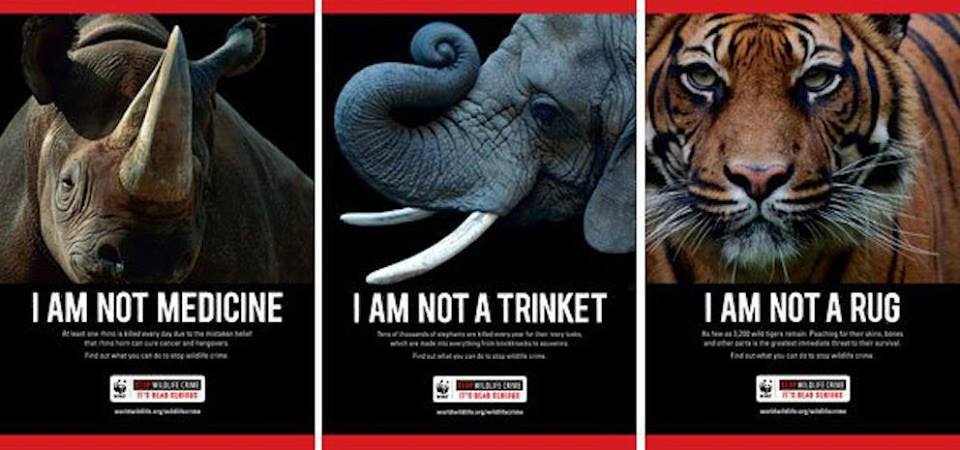
“I don’t often actually ask you to share something, but this is one image I would really love to see reaching millions of people.
Wildlife crime is now the most… urgent threat to three of the world’s best-loved species—elephants, rhinos and tigers. The global value of illegal wildlife trade is between $7.8 and $10 billion per year.
I AM NOT MEDICINE At least one rhino is killed every day due to the mistaken belief that rhino horn can cure diseases. The main market is now in Vietnam where there is a newly emerged belief that rhino horn cures cancer. Rhino horn is also used in other traditional Asian medicine to treat a variety of ailments including fever and various blood disorders. It is also used by wealthy Asian as a cure for hangovers.
I AM NOT A TRINKET Tens of thousands of elephants are killed every year for their ivory tusks. In 1989, the Convention on International Trade in Endangered Species of Wild Fauna and Flora (CITES) banned the international trade in ivory. However, there are still some thriving but unregulated domestic ivory markets in a number of countries, which fuel an illegal international trade.
I AM NOT A RUG Every part of the tiger—from whisker to tail—is traded in illegal wildlife markets. Poaching is the most immediate threat to wild tigers. In relentless demand, their parts are used for traditional medicine, folk remedies, and increasingly as a status symbol among wealthy Asians.”
All information and text from the World Wildlife Fund. Find out more here: http://bit.ly/WH4SMk

Read Full Post »


Wolf Ledge
Photo By Jimmie Jones
Rally For Wolves Washington D.C. Speech given by Laurie Nalani Hall to the group attending.
Through The Eyes Of 06 …
“I love standing on this high ledge, I can see the entire Lamar Valley of Yellowstone National Park from here. This valley is my home, I was born here, and it is the home of my ancestors the famous Agate and Druid Peak Pack. The human’s call us the Royals of the wolves there. I don’t know what the term Royals means, but they are my family and my heritage.
My mother # 472F, taught me how to hunt, cooperate with my pack and care for my siblings. Without her I would have never learned our ways. I worked hard to become all she could want of me, and I was overjoyed when I succeeded. Oh to hear her howls of approval and pride of my efforts was a song to my soul. I love her so; she was so wonderful and wise. My father # 113M, he was so loving and wise. We were called then the Agate pack.
When I came of age I took to wandering around the area of the vast valley. I wanted to see what was behind every bush and under every rock. I did this for a couple of years then one day I ran into a couple of irresistible brothers out wandering as I was. Oh they were so good looking and sweet as any lady wolf could ever find. All my other suitors could not hold a candle to these brothers, they were where I wanted to be, and be with.
I sure put them through their paces to win me, and in spite of their being younger than me, they won my heart. We traveled together and had many an adventure. As nature moves in her seasonal cycles, I became a mother to the most beautiful babies and I had chosen the den of my ancestors to bring them into the world.
From that time to now, our family rules over the Lamar Valley. My daughters and sons have grown and gone their individual ways and that is how it should be. I taught them all I knew and they learned well. My eldest daughters, now grown have families of their own. My sons are off being their own alpha’s and have left the valley to do so.
I have younger children I did not get to teach and show the way to. The one winter I sought after some strange sounds coming from another territory and went to investigate. I was to come upon a human in the forest. I stood and looked at him; humans have always been good to me so I had no fear of him. I came closer and he stood staring at me. Then everything went black.
The beta brother to my mate had gone near here a short time ago and did not come back. We looked and looked for him, we called and called but there was no response. I just could not give up looking for him. I loved him so, and he was the children’s favorite uncle. He loved me and even took the second place in our Alpha team just to be with me and his brother. He was so loving and dedicated to his family. We miss him so much.
After everything went black, I was different. I could see and hear, but it was not as I remembered. My body felt nothing and would not move. Nothing I did could get it to respond. That frightened me. The man took my collar off, and then he carried my body away. I lost track of it after that.
My family came looking for me, they howled for me but when I howled back they could not hear me. I don’t understand what has happened?
Days came and went, and then my alpha mate took the family back home to the valley. They were so sad and confused. They would stop, look back and howl again for me, then continue their journey. Something kept me from them and them me. It was a horrible feeling and loss. I kept trying to reach them, but failed. My mother did not teach me about this part of life. I don’t understand this. I followed them back home and watched them. I no longer could touch or feel them. But I watched and I followed.
My elder daughter took over the yearlings and her other younger siblings. She was always dependable and strong. My beloved mate left the valley alone. He was grieving so deeply and I wanted to let him know I was right here with him but he could not see or hear me.
In a short time, my family broke apart. It hurt my heart to see them divide. They were so lost and confused and scrambling for survival. They were all so dependent on my showing them the way. I worry for them now.
My girls have come of age at such a bad time. They are following nature and seeking their mates and will soon be tending their own pups. Time goes by so fast.  I hope I have taught them enough to carry on without me and be successful with their own families.
So much has changed since that winter day I left the world of the Valley. I don’t understand how I got here or why. I keep re tracing my steps searching for a clue as to what it was that put me here. All I can remember last seeing was the human with a stick in his hands; he was pointing the stick at me. I just looked at him wondering if he was going to play a new stick game with me.
Then I was here.
Humans have never scared or hurt me; they were my neighbors in the valley. They would come and watch me and my family and be so excited when they saw us. It was so much fun then.
I still see many of the human’s that used to visit us. They are still in the valley, but my girls are not all there anymore.  I have two daughters that have returned to her homeland in the valley, and the oldest has had her first puppies. Oh they are so beautiful! They are so small a group I have some concerns of them being able to grow and remain there. So much has changed, so much has been destroyed. I howl and howl for their ability to live in safety and peace. I can only visit them in their memories and their dreams now, it is the only way for me to continue to be with them and guide them. And every time they sleep, I go to them and love them and reassure them I am close by them.
I love standing on this ledge that overlooks our valley. It is our home, it is where we belong. And I love it. My spirit will never leave home.”
**Special thanks to “Legend of Lamar Valley” for providing this information!

Read Full Post »


sheep wolf

© Flickr/Dennis Matheson (Wolf Picture)

“A Polish farmer has discovered a ‘stray puppy’ he had taken in to look after his sheep was actually a wolf.

Zbigniew Pieczyk, 50, from Podlasie, Poland only became aware of his slip-up after he heard the young wolf howling during the night.

“‘I thought it was a sheepdog pup or a German Shepherd,” Metro quotes Pieczyk as saying.

“Then when it started to howl every night I realized I’d made one hell of a mistake and I called the police.”

Sheep are the livestock most commonly killed by wolves in Europe, but luckily for the farmer in question his flock escaped unharmed.

The young wolf has now been returned to the wild.

In February 2013, the French government introduced a ‘National Wolf Plan’ to try and educate wolves not to attack sheep, but the idea was met with mixed reviews.”

**Special thanks to “Digital Spy,” http://www.digitalspy.com/odd/news/a512642/farmer-uses-wolf-to-watch-over-sheep-after-mistaking-it-for-a-dog.html, for providing this information!
Read Full Post »


dog in trap

“With the support of the Ontario government, children ages 12 to 15 will be taught how to cruelly kill wildlife by two hunting and trapping lobby groups.

In a press statement issued Wednesday, the Ontario Federation of Hunters and Anglers (OFAH) and the Ontario Fur Managers Federation (OFMF) ‘congratulated’ the Ontario Ministry of Natural Resources (MNR) on the introduction of a youth trapping program.

“Trapping is considered an activity of significant historical, social, cultural and economic value in Ontario for centuries, and one that results in economic benefits to the communities and individuals,” said Minister of Natural Resources David Orazietti in the statement. “Ontario trappers have worked tirelessly for many years towards a program like this which will guide youth to be safe and responsible trappers.”

This disturbing news begs the question: why are our tax dollars supporting a trade that most residents abhor? Why are we supporting an activity that is wholly dependent on the suffering of innocent wild animals? And why is history being ignored?

The history of trapping in Canada is not a glorious, character-building activity. It led to the extinction of the sea mink; it nearly destroyed beaver populations across the continent; it has ripped apart ecosystems; and it has caused suffering to immeasurable levels.

We ask MPP Orazietti if he has ever held a dying animal in his arms, looked into its eyes and seen the fear, the pain and terror it must experience while in the clutches of a trap. We ask him if he has sat with the growing number of families who have lost pets to the mindless devices. We ask him if, after making this deal, he has any humanity left.

Send a letter to your local MPP and MPP Orazietti to tell them to end this madness. Tell them the truth behind trapping and the fur trade. And tell them that any politician that supports this archaic and cruel activity will never represent you.

Use our form letter below to let your MPP know what you think. MPP and Minister of Natural Resources David Orazietti can be reached by email, phone, fax, or snail mail with these details:”

dorazietti.mpp@liberal.ola.org

Room 202, 2nd Floor
432 Great Northern Road
Sault Ste Marie, Ontario P6B 4Z9

Phone: 705-949-6959
Fax: 705-946-6269

**Special thanks to “The Association for the Protection of Fur Bearing Animals (http://www.furbearerdefenders.com/blogs/blog/63-08-2013/361-ontario-wants-to-teach-kids-to-kill)” for providing this information!

Read Full Post »


arabian wolf

“Although it became well known in 2010 that all dogs originated from wolves in the Middle East instead of Asia, the fear of them is still very ingrained in the people there. It was over 15,000 years ago that the first non-nomadic hunter/gatherer communities began to intervene in the breeding patterns of wolves, thereby turning them into the first domesticated dogs. But this fact has been long forgotten by many in that region.

There are currently two subspecies of the Gray wolf that live in the Middle East. One is the Iranian wolf which is the only wolf species in the world that is not in danger of extinction. They can be found in diminishing numbers throughout Iran, Israel, Turkey, and Saudi Arabia. The other Middle Eastern wolf is the Arabian wolf, which is found in Israel, Iraq, Jordan, Oman, Saudi Arabia, and Yemen, and possibly some parts of the Sinai Peninsula in Eygpt.

Although these wolves are all over the Middle East, there are only two countries that subscribe to the notion that wolves have the right to coexist with man as part of the natural ecosystem. Those two countries are Oman and Israel and they have both given the wolves legal protection. In Israel for example, they have taken extraordinary measures to protect the wolves. Some of these measure include paying for electric fencing, using various species of guard dogs to deter wolves and the government also offers partial compensation for livestock losses. In the country of Oman the wolf population is on the rise. This has been attributed to a hunting ban that was put in place there. Oman has a very strong conservationist stance in comparison to the rest of it’s Middle Eastern neighbors.

As for the rest of the Middle Eastern countries such as in Iran, Jordan, Iraq, Turkey, Syria etc. the wolves are not doing as well. Here they are often looked as a pests that needs to be eradicated. In Saudi Arabia for example, the bodies of wolves can often be seen hanging from billboards as a message. It is widely claimed that many Saudis still kill the wolves as trophies. In other Middle Eastern countries wolves are hunted, poisoned, and run over.

This kind of outlook towards the wolves will not change however until the populations there become better educated. Currently in several of the Middle Eastern countries there are a few environmental organizations that are trying to work with the communities to help them better understand the wolves and their habitats and in turn minimize human and wolf conflicts. Godspeed to these organizations and may there be many more soon.”

**Special thanks to “White Wolf Pack” for providing this information (http://www.whitewolfpack.com/2011/12/only-2-countries-in-middle-east-protect.html)!

Read Full Post »


HUNTER

Wildlife Poachers Immune from Prosecution Contact: Wendy Keefover (303) 819-5229

“Tuscon, AZ. WildEarth Guardians and the New Mexico Wilderness Alliance late last week filed an amended complaint alleging that the U.S. Department of Justice (DOJ) has failed to prosecute individuals who have killed animals protected by the Endangered Species Act (ESA) because of its secretive “McKittrick Policy.” Under this policy, the DOJ will only prosecute cases for the illegal killing of ESA-protected species when it can prove the impossible: the mental state of the killer and that he knew the identity of the species at the time he pulled the trigger. This policy is plainly inconsistent with both the intent of Congress in enacting the ESA’s criminal provisions and with the U.S. Fish and Wildlife Service’s (FWS’s) interpretation of the ESA. In the amended filing, the groups ask the federal court to require that the DOJ “consult” with the FWS on this policy under the provisions of the ESA.
“The McKittrick Policy has become the ‘poacher-protection act,’ with devastating results, especially for exceedingly rare Mexican wolves,” said Wendy Keefover, Director of Carnivore Protection for WildEarth Guardians.
During the tenure of DOJ’s policy, 48 Mexican wolves were illegally shot in the wild.  Only two of these incidents resulted in a federal prosecution for illegal “take” (harm or killing) under ESA. The groups believe that the McKittrick Policy has emboldened individuals who are opposed to the conservation of endangered species to disregard the law, as they know that an illegal shooting will almost certainly not lead to federal prosecution. For the Mexican wolf, the effects of the Policy have been cataclysmic:  illegal shooting is by far the highest source of mortality for the free-roaming Mexican wolf population.
Plaintiffs obtained additional new information since the first filing that shows that both state and federal wildlife officials have been critical of the McKittrick Policy, including then director the U.S. Fish and Wildlife Service, Jamie Rappaport Clark, who wrote that the policy “will result in little to no protection for this Nation’s most critically endangered species,” and former U.S. Attorney for the District of Wyoming, David Freudenthal (who later served as Wyoming’s governor), who stated that the policy should be rescinded because a hunter should never pull a trigger unless the target has been positively identified.
“The McKittrick Policy is a literal get out of jail free card provided by the very agency charged with prosecuting wildlife crimes,” said Judy Calman, Staff Attorney with the New Mexico Wilderness Alliance, “and unfortunately, without enforcement, some endangered species will just be live targets to those who shoot illegally.”
The groups seek to get the policy rescinded as it would send a clear message that shooting Mexican wolves and other federally-protected animals will not be tolerated by the U.S. government.”

**Special thanks to “WildEarth Guardians,” http://www.wildearthguardians.org/site/News2?page=NewsArticle&id=8781&news_iv_ctrl=1194#.Uh06OkbD_IU, for providing this information!

Read Full Post »

« Newer Posts - Older Posts »