Feeds:
Posts
Comments

Archive for the ‘Wolf Legislation’ Category


Minnesota75percent

“If you haven’t already heard, Michigan citizens had their voices snuffed out when it came to a wolf hunt in their state. Over 250,000 residents sent in their signatures to oppose a wolf hunt in their state — that was 150,000 more than they were required for the initiative to be placed on the ballot. Unfortunately, the state turned around and passed a law that gives the Natural Resources Commission the ability to designate animals as game – on its own, with no public input. The state basically told voters that their voices on the ballot wouldn’t matter — if people voted against a wolf hunt, it was just going to show what the general population thought. This isn’t just wrong for the wolves and other wildlife, this is a threat to voters everywhere — when it comes to everything. For the first time in U.S. history, Democracy and public input was silenced.

Michigan residents are now trying for a second ballot measure which would challenge Senate Bill 288, which is the bill that snuffed the public voices the first time.

Minnesota is now trying to pull the same nonsense as Michigan.

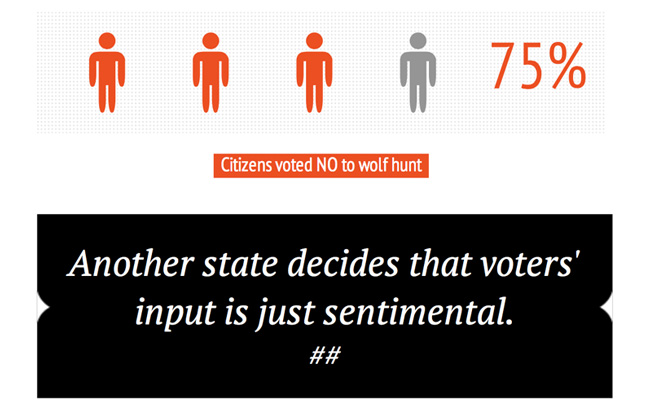
In 2012, Minnesota’s wolves were removed from the Endangered Species Act. The state had long known that wolves in the area would eventually be delisted, and regulated hunting was always in their management plan. However, the DNR was supposed to have a five year moratorium after delisting in order to study the wolf population more closely. This would help determine what toll the legal take of wolves by ranchers would have on the population — without a trophy hunt. Unfortunately, in 2011 when delisting became imminent after the budget bill rider, Minnesota DNR threw out the moratorium. The DNR announced its plans to hold a wolf hunt in a press release, and then held an internet questionnaire asking citizens whether or not they supported the hunt. 75% of citizens voted no. Sound familiar? Yet another state sees that the wolves are a valued and integral part of their culture, but decides that the input is just sentimental. Minnesota killed 413 wolves last season despite several groups trying to stop the hunt.

Those groups were told they could come back this year with new litigation. Sadly, Minnesota too has passed laws that prevent standings in court challenges. Both Howling for Wolves and the Center for Biological Diversity were denied their day in court to protect wolves. It is no longer just about protecting our nation’s wildlife and heritage, but the rights of citizens too.”

**Special thanks to “Project Wolf” for providing this information!  (http://WWW.PROJECTWOLF.ORG .)

Read Full Post »


wolf hunted

**Animal activists say bill denies voters a voice**

“LANSING, Mich. (WOOD) – Michigan lawmakers are looking to shift the power of deciding which animals — including gray wolves — can be hunted from the legislature to the Department of Natural Resources.

The sponsors of  Senate Bill 288 say the issue is about science and believe the Michigan DNR’s  Natural Resources Commission is better suited than the legislature to determine if an animal like a wolf should be placed on the state’s gaming list, meaning it can be hunted.

Animal rights activists, however, disagree.

Once  gray wolves were removed from the endangered species list in 2012,  legislation was passed allowing for them to be hunted in Michigan. The wolf population in Michigan sits at 658, mainly in the Upper Peninsula.

Since then, animal rights organizations like the Humane Society and Keep Michigan Wolves Protected have gathered more than 250,000 signatures to place a referendum on next year’s ballot to repeal part of that law and stop the wolf hunt.

But Senate Bill 288 could override those ballot efforts and pave the way for wolf hunting as early as this fall.

Currently, adding a species to the gaming list has to go through the elected legislature.  SB 288 would give that power exclusively to the Natural Resources Commission — a seven-member, non-elected, governor-appointed panel.

“Basically, the Natural Resources Commission can continue to make these decisions so our wildlife in Michigan is managed based on sound science,” said bill co-sponsor Sen. Dave Hildenbrand (R-Lowell). “We have a lot of data about the population, about disease control, about public safety and there’s a lot of research being done on that for all of our species, all of our game all of our wildlife.”

SB 288 would also, in effect,  allow the NRC to override any ballot challenges put forth through a public referendum that could repeal the hunting of wolves. Animals rights groups say that silences the public’s voice.

“We just turned in more than a quarter-million signatures to the Secretary of State’s Office from Michigan voters saying that they do not want to see wolves hunted and trapped in our state, so in issues like this of great importance to citizens, they want to be able to use their voice to speak up,” State Humane Society Director and Keep Michigan Wolves Protected member Jill Fritz told 24 Hour News 8 in a phone interview.

Hildenbrand said lawmakers are still tweaking SB 288 and plan to remove a controversial $1 million appropriation that would have prevented the public from challenging SB 288 itself later through ballot referendum.

But if SB 288 passes, the NRC will still hold  public hearings. One is already scheduled for next month, during which members will vote on whether or not to hold a wolf hunt.

Even if SB 288 passes, the legislature will still hold the power to remove a species from the gaming list, though they cannot add one, DNR spokesman Ed Golden said. Even if an animal is added to the list, it does not mean they will for absolutely be open to hunt. The NRC will have to hold public hearings first.

Fritz also said there are already laws in place that will not be effected by SB 288 that allow farmers or residents to kill wolves that are actively attacking live stock or pets. This is another reason Keep Michigan Wolves Protects feels it is not necessary to allow an active hunt of wolves.

A vote is expected Thursday. If it passes in the Senate, it will go to the House for a vote. ”

*Special thanks to Marc Thompson, http://www.woodtv.com/dpp/news/michigan/senate-bill-would-give-dnr-hunt-creation-power for providing this information!

Read Full Post »


Gray Wolf Pup

“GRAND RAPIDS, MI — Does a proposed law working through the state Senate put Michigan wolves in danger?

A number of letter writers say the public should have a direct say in protecting wildlife from hunters, and stand in opposition to a bill co-sponsored by Grand Rapids-area state Sens. David Hildenbrand, R-Lowell, and Arlan Meekhof, R-West Olive.

Pat Hartsoe attended a recent hearing in Lansing:

Last week I attended the Senate Committee on Natural Resources, Environment and Great Lakes. I came away feeling marginalized by the thinly-veiled political process I witnessed. Senate Bill 288 (co-sponsored by State Sen. Dave Hildenbrand, R-Lowell) was discussed.

SB 288 would allow the Natural Resources Commission to designate animals as “game species.” This bill was quickly introduced April 9, shortly after 250,000 registered voter signatures were delivered to the Secretary of State office in Lansing. I helped collect those signatures during bitter winter weather. The petition would require a public vote in 2014 on wolf hunting.
One problem with SB 288 is that if the NRC designates an animal a game species, concerned citizens would not be able to reverse this decision with a ballot referendum as they could with legislative decisions. Further, the NRC is an appointed, not elected, group.

Only one member has a science background. Two nationally-recognized scientists from Michigan’s Upper Peninsula with 30 years of wolf research experience were never consulted. After hearing public input, a 5 to 2 vote in favor was quickly taken. The bill moved to the Senate and could become law in less than two weeks.

I see a disturbing pattern developing in Michigan politics. In my opinion, if individuals get involved with legal, organized and timely opposition to an issue, politicians shouldn’t disenfranchise them by passing quickly-crafted and referendum-proof laws.

Think emergency manager. Think right to work. Think keep Michigan wolves protected. I am sorely disappointed by what I witnessed in Lansing.

PAT HARTSOE Grand Rapids

People should vote on hunting issues

In a deliberate attempt to circumvent the constitutional rights of the voters in Michigan, State Sen. Senator Tom Casperson (R-Escanaba) introduced Senate Bill-288 on April 9, 2013. It was approved by a 5 to 2 vote by the Natural Resources, Environment, and Great Lakes Committee and eventually goes to the Governor to be signed into law.

This bill would effectively nullify the efforts of a coalition of over 2,000 conservationists, Native American tribes, scientists and animal welfare interests who turned in more than 255,000 signatures from Michigan voters to place Public Act 520, listing wolves as a game species, to a referendum vote in November 2014.

SB 288 is an obvious attempt to prevent citizens from being able to conduct a constitutionally-guaranteed right to ballot referendum to reverse decisions by the legislature.

In 2006, Michigan voters overwhelmingly rejected a law to allow sport hunting of mourning doves – showing their desire to have the right to vote on wildlife issues. Voters rejected this, casting more votes against shooting doves than they did for any candidate that election. If SB 288 passes, this decisive outcome would be reversed.

SB 288 is a blatant display of political bullying that will put Michigan’s declining wolf population further at risk.

This bill is an extreme power grab by politicians and a deliberate attempt to subvert democracy and silence the voices of Michigan voters.

This type of political maneuvering by our elected officials must be stopped.

HARRY T. EDWARDS Kent City Wolf bill is an abuse of power

A few weeks ago, the Keep Michigan Wolves Protected campaign submitted over 255,000 signatures from registered Michigan voters opposed to sport hunting for wolves. This right to seek a voter referendum on legislation is guaranteed in the Michigan Constitution.

Unfortunately, the politicians in Lansing who most want to see wolves, recently introduced legislation (SB 288) which is exclusively aimed at nullifying this referendum and assuring that Michigan citizens never have a say again in hunting issues. This is not an exaggeration.

The legislation specifically removes all authority of citizens to have a voice about which animals are hunted in Michigan.

Even if you are in favor of hunting wolves, you should be very upset about this abuse of power. Drafting legislation specifically to silence Michigan voters who are following a constitutionally-guaranteed process is a stunning insult to democracy.

Please contact your state senator and state representative immediately and insist that they VOTE NO on SB 288.

TOM LYON New Era

People should decide on wolves

There is a new bill SB288 going through the State Senate this week that will take away all rights of the people of the state to make decisions on any wildlife.

Keep Michigan Wolves Protected collected and submitted 253,000 signatures from people around the state to put the upcoming wolf hunt on the Michigan Ballot in 11/2014. In the meantime, the hunt would be on hold until after the people voted.

Well, Sen. Tom Casperson submitted a bill this last week that would take all rights away from the citizens to have a say on any wildlife issues for all time. It would make the signatures mute, and silence the people and their wishes. This bill will change the constitution of the state and take away peoples voices on any wildlife issues.

He is upset because the wolf hunt which he had submitted, got the brakes put on it by the citizens of the state. So now he is attempting to take away all citizens rights when it comes to wildlife. People need to speak out.

They are changing a law that has been in place since 1908. And ballot proposals in the past that wanted to change our state constitution, were all readily defeated. This bill needs to be stopped. People need to contact their senators and reps……and quickly.  It could be law within eight days.

DOROTHY RODGERS Georgetown Township

Lawmakers not following will of the people

Not surprisingly, once again in our State legislature it appears that there is a “do as I say and not as I do” mentality. I am speaking in regard to SB 288 which is being fast tracked to a vote by State Sen. Tom Casperson R-Escanaba. This bill would sign legislation into law that would circumvent Michigan voter’s right to referendum, and includes a non-related appropriation that prevents the voters from rejecting the measure by referendum.

This bill, this is the good Senator’s response to the 253,000 signatures that were delivered to the Secretary of State in March, asking that another bill he was fast tracking; to allow a wolf hunt in Michigan, be put to Voter referendum in 2014.

Apparently Mr. Casperson, who prides himself on being a “sportsman” has no problem trying to write legislation that takes away Michigan voter rights when he doesn’t get his way. In this case, a trophy wolf hunt. This is truly unsportsmanlike conduct in the highest degree as the Senator has little or no regard for due process, let alone the opinions of 253,000 voters…..which was simply to let us decide whether a wolf hunt would be in the best interest of all of Michigan’s residents.

Regardless of how you feel about hunting, this bill works to undermine our right to referendum and to keep our lawmakers in check. I urge you, call or write your legislators and urge them to vote no on SB288.

MARGO BURIAN Grand Rapids”

**Special thanks to:  MLive/Grand Rapids Press guest opinion The Grand Rapids Press, for providing this information!     

Read Full Post »

wolf down

“Something’s not right in New Mexico. A federal agent with the notorious Wildlife Services agency is under investigation for killing a Mexican gray wolf. Adding to the misery, the government has been keeping this incident from the public.

It’s no surprise that Wildlife Services, part of the U.S. Department of Agriculture, is involved. This highly secretive agency has come under heavy fire over the past year because of the tens of thousands of animals it senselessly kills each year, often in the name of protecting livestock. Its methods are a lethal mix of medieval brutality and high-tech efficiency that include aerial gunning, trapping, deadly gases and poisons.

The agency was the focus of a recent blistering series in the Sacramento Bee that revealed the torturing of coyotes, the death of family pets and golden eagles — all done beneath the public’s radar. Members of Congress called for an investigation.

Help apparently didn’t come quick enough for the wolf in New Mexico.

The Southwest’s endangered Mexican gray wolves — with just three breeding pairs left in the wild — are hanging on by a thread in New Mexico and Arizona. The last thing they need is one of their own gunned down by an employee of the government that’s supposed to be nursing this wild population back to health.

Although the killing happened months ago, the public didn’t hear about it until it was reported in the Albuquerque Journal on Thursday afternoon. Government agencies, not surprisingly, have closed ranks and are refusing to talk about what happened.

Here’s what we’re piecing together: In January, a Wildlife Services employee apparently shot and killed a wolf, possibly a pup, while investigating the death of some livestock. The shooting evidently happened very close to the home range of the San Manteo wolf pack, which just added four pups to its family last year.

What’s more troubling about the latest incident in New Mexico is that the very agency that’s tasked with saving America’s wolves, the U.S. Fish and Wildlife Service, apparently knew about the wolf killing but is refusing to say anything about it.

I can’t say it’s all that shocking. The Fish and Wildlife Service has long taken a lackluster approach to wolf recovery in New Mexico and Arizona.

Fifteen years after Mexican wolves were first reintroduced to the Southwest, there are only 75 wolves in the wild. Wildlife officials predicted in 1998 there would be more than 100 in the wild by 2006. The Fish and Wildlife Service hadn’t released a single wolf into the wild from its captive-breeding facilities in four years before one was finally let out earlier this year — only to be recaptured by government agents three weeks later.

Scientists believe the small Mexican wolf population is suffering from genetic inbreeding, with reduced litter size and pup survivorship.

But the apparent shooting of the wolf in New Mexico in January was more than bureaucratic indifference. It was an act of violence against an animal protected under the Endangered Species Act.

The government has correctly launched an investigation into what happened and we’ll be keen to see the results.

But one thing has already been made clear: By not coming out and talking about this incident publicly, these government agencies have  placed a veil of secrecy over the behavior of one of its own and the management of one of this nation’s flagship endangered species.

For anyone who cares about America’s wildlife, or accountability in their government, that should be unacceptable.”

**Special thanks to Kieran Suckling, Executive Director, Center for Biological Diversity, for providing this information in this article!

Read Full Post »


October 15, 2012

“On the day of the first public wolf hunting and trapping season in the Great Lakes region in more than 40 years, The Humane Society of the United States and The Fund for Animals served notice that they will file suit against the U.S. Fish and Wildlife Service to restore federal protections for Great Lakes wolves under the Endangered Species Act. The groups are also asking the states of Wisconsin and Minnesota to postpone wolf hunting and trapping until the case can be decided on the merits.

The U.S. Fish and Wildlife Service’s most recent decision to delist wolves became effective earlier this year, after multiple previous attempts to delist wolves were struck down by the courts over the course of the last decade.

“The U.S. Fish and Wildlife Service put faith in the state wildlife agencies to responsibly manage wolf populations, but their overzealous and extreme plans to allow for trophy hunting and recreational trapping immediately after de-listing demonstrate that such confidence was unwarranted,” said Wayne Pacelle, president and CEO for The HSUS. “Between Minnesota’s broken promise to wait five years before hunting wolves, and Wisconsin’s reckless plan to trap and shoot hundreds of wolves in the first year, it is painfully clear that federal protection must be reasserted. The states have allowed the most extreme voices to grab hold of wolf management, and the result could be devastating for this species.”

In Minnesota, hunters and trappers can kill as many as 400 of the estimated 3,000 wolves in the state. That is additive to the damage control killing, poaching, and other forms of human-caused mortality.

In Wisconsin, the quota for killing wolves in the state is roughly 24 percent of the estimated wolf population in the state. Including depredations, illegal kills, and vehicle collisions, the human-caused death toll could be more than 50 percent of the wolf population – nearly double the level of human-caused mortality the best available science indicates the population can withstand.

Some lawmakers in Michigan, where livestock owners are already allowed to use lethal means as a first resort when a gray wolf preys upon livestock, are pushing for legislation that would create an open sport hunting season on wolves.

The groups have filed today a 60-day notice of their intent to sue over the rule – as required under the Endangered Species Act. If the agency does not reconsider the delisting rule over the next 60 days, The HSUS and The Fund for Animals will ask a federal court to reinstate federal ESA protection for gray wolves in the western Great Lakes region. Both organizations had hoped that sensible policies would prevail in the states, and also took note of the legal claims filed by other organizations seeking to avert reckless killing of wolves.  Those cases have not resolved several of our concerns favorably for the wolves, leading us to file notice to sue.”

**Special thanks to The Humane Society of the United States for providing this information!  (http://www.humanesociety.org/news/press_releases/2012/10/great-lakes-wolves-suit-101512.html)

Read Full Post »


“Landlord.com” posts the following rules/laws state by state regarding possession of “dangerous animals.”  The chart can be viewed through their website at:  http://www.landlord.com/dangerous-animals-by-state.htm

Please comment regarding your opinion of owning hybrid wolves:

“This chart deals with state laws concerning dangerous or vicious animals.  Note that it is not the animals the state attempts to regulate, but the persons who own, possess, or harbor them.  We distinguish between this sort of regulation and animal bite issues.  Animal bites are not activities, but events, and state laws concerning them set the consequences for these events.  If you are searching for an insight into your state’s laws concerning animal bites, we have set up a separate chart concerning these.  The two sorts of regulations sometimes overlap.


Many states have no rules regarding vicious or dangerous animals, or regulations dealing only with dogs, or dealing only with dogs that prey on livestock.  Most vicious animal laws are directed specifically toward dogs.  If either is so in your state, do not think that there is no regulation at all, or no regulation for anything other than dogs.  For one thing, laws of nuisance and negligence liability still prevail and apply to a person who owns, possesses, or harbors such animals.  For another, many states have devolved such regulation to county or municipal regulation.  It is beyond the scope of a resource such as this to deal with all of these jurisdictions, numbering in the tens of thousands in the United States.  This is why we include a link for each state that will give you contact information for your county and municipal governments.  If you are dealing with an issue regarding an animal you consider dangerous or vicious, your research is not complete until you follow up and contact your local governments and inquire as to ordinances and regulations that may apply.

 Finally, we have included links to the text of statutes in each state that has them, as well as supplying highlights of the state’s regulatory scheme.  This is not done to be pedantic.  Unlike many things, statutes cannot really be summarized, as every word of a statute the force of law, and cannot be omitted or ignored.  You should take the time to read the statute as well as the highlights.”

Read Full Post »


Rob Klavins, Oregon Wild, has a message for you:

‘Wolf news has once again faded from the headlines of the states major papers. But we’re still working hard to protect the Imnaha Pack. Unfortunately anti-wolf interests are hard at work too. Worse yet – the state is listening.

Make sure your elected leaders hear from you!

In news that left us shaking our heads, we learned that the state is going to actively fight the temporary stay of execution for the alpha male and young Imnaha wolf. Despite thousands of calls, letters, and e-mails, ODFW seems hell-bent on killing wolves and doesn’t want to wait for a judge to tell them whether it’s legal or not.

If ODFW is determined to appease anti-wolf interests and Governor Kitzhaber won’t listen to the thousands of Oregonians (and people around the world) who have weighed in over the past few weeks, perhaps he’ll listen to the state legislature.

Please take a moment and contact your state legislators. Let them know that you support wolf recovery. Tell them you don’t want more of your money wasted on fighting to kill endangered wolves.

With anti-wildlife interests expected to continue their attacks on Oregon’s already weak wolf protections in the next legislative session, it’s important that your representatives know that this issue is important to you.

Wolf opponents are well-funded, vocal, and politically powerful. But one thing they don’t have is the support of the majority of Oregonians who value native wildlife. The extermination of Oregon’s wolves in the last century was one or our greatest environmental tragedies. Their recovery has the potential to be one of our greatest success stories. But it’s not going to happen if the state continues to bend to special interests with no interest in meaningful wolf recovery.

Tell your state legislator that it’s time to stop the killing.

For Wolves,

Rob Klavins
Oregon Wild

PS – Wolf opponents know the last kill order catalyzed the Oregon public and hope  they’ll forget about the kill order issued at their request. Kudos to those of you who wrote and had published letters to the editor. Don’t forget to take a moment to contact your state legislator today, but if your letter wasn’t accepted, I hope you’ll try again.”

Read Full Post »


“BILLINGS, Mont. — Wildlife advocates are urging a federal appeals panel to restore endangered species protections for wolves.

The Alliance for the Wild Rockies, WildEarth Guardians and other groups argue the judicial branch needs to “zealously guard” against a move by Congress that lifted protections in defiance of earlier court rulings.

They sued the government after Congress in April approved a budget rider taking wolves off the endangered list in five states.

The filing of their briefs in the case comes as wildlife agencies on Friday reported hunters have killed 11 of the predators since wolf seasons opened in Idaho and Montana last week.

Initial attempts to stop the hunts were denied last month by a three-judge panel of the 9th Circuit Court of Appeals. A November hearing in the case is expected.”

**Special thanks to KTVB.com for providing this information (http://www.ktvb.com/news/Wildlife-groups-ask-court-to-restore-wolf-protections-129546103.html)

Read Full Post »


“HELENA, Mont. (AP) — A federal appeals court on Thursday denied a request by environmental groups to halt wolf hunts that are scheduled to begin next week in Idaho and Montana.

The Ninth Circuit Court of Appeals denied the request by the Alliance for the Wild Rockies and other groups. The groups were seeking to cancel the hunts while the court considers a challenge to congressional action in April that stripped wolves of federal protections in Montana and Idaho, and in parts of Washington, Oregon and Utah.

Earlier this month, U.S. District Judge Donald Molloy in Missoula reluctantly upheld a budget rider that was inserted by Rep. Mike Simpson, R-Idaho, and Sen. Jon Tester, D-Mont. It marked the first time since the passage of the Endangered Species Act in 1973 that Congress forcibly removed protections from a plant or animal.

Molloy ruled that the way Congress went about removing endangered species protections from the Northern Rockies gray wolf undermined the rule of law but did not violate the Constitution. Meanwhile, the environmental groups argued Congress’ actions were unconstitutional because they violated the principle of separation of powers.

“We lost the injunction, we have not lost the case,” Mike Garrity, executive director of the Alliance for the Wild Rockies, said of Thursday’s court ruling. “We will continue to fight to protect the wolves and enforce the separation of powers doctrine in the U.S. Constitution.”

Meanwhile, John Horning, executive director for WildEarth Guardians, one of the groups involved in the case, said, “We are discouraged we didn’t win a stay of execution for wolves, but we are cautiously optimistic that we will win our lawsuit to protect wolves from future persecution.”

Wolf hunts are scheduled to begin Aug. 30 in Idaho and Sept. 3 in Montana. Hunters in Montana will be allowed to shoot as many as 220 gray wolves, reducing the predators’ Montana population by about 25 percent to a minimum of 425 wolves.

In Idaho, where an estimated 1,000 wolves roam, state wildlife managers have declined to name a target for kills for the seven-month hunting season. They say the state will manage wolves so their population remains above 150 animals and 15 breeding pairs, the point where Idaho could attract federal scrutiny for a possible re-listing under the Endangered Species Act.”

*Special thanks to “San Antonio’s Home Page” for providing this information.


Read Full Post »


WOLF PRESERVATION IS OUTRAGED!  

Wolves have been stripped of their legal protections. 

Hunters are locked and loaded.   Traps are set.

Montana, Idaho, Wyoming among states looking to eradicate wolves.

This is not “responsible management” as Idaho Governor “Butch” Otter stated if he plans on wiping out more than 80% of the population.  Wolves have NO protection anymore.    It’s shoot on sight and animals are allowed to sit in painful traps for x72 hours!   Here’s what you need to do:  1. Express outrage toward each state governor and explain you are boycotting their state until they stop this madness (http://gov.idaho.gov/ourgov/contact.html, http://governor.mt.gov/cabinet/contactus.asp, http://governor.wy.gov/contactUs/Pages/default.aspx).  Spread this information to others and have them write to each governor.  Call your local newstation, newspaper, and pull together others for a wolf rally with signs (save wolves, boycott Montana, Idaho, and Wyoming, ect.). 

**Also, please watch the video through the link below and then visit “Friends of Animals” as they are fighting hard in court and through news stations to overturn extinction efforts.  We cannot save all these beloved wolves but we need to act now to save future packs from the same fate! 

Priscilla Feral, president of Friends of Animals: “Removing federal protection and subjecting wolves to more hunting is unconstitutional and unconscionable.”

http://www.cnn.com/video/?/video/us/2011/08/12/jvm.wolves.endangered.list.hln

http://www.friendsofanimals.org/news/2011/august/howling-across-ameri.html

Read Full Post »

« Newer Posts - Older Posts »