Feeds:
Posts
Comments

Archive for the ‘Wolf Preservation Efforts’ Category


Participating in the 2014 Endangered Species Day Youth Art Contest

“We encourage teachers and their young artists in grades K-12 (as well as those in homeschools and youth groups) to participate in the 2014 Saving Endangered Species Youth Art Contest. The contest provides students with an opportunity to learn about endangered species and express their knowledge and support through artwork. All of the basic information you need to participate in the contest is included in the following sections:

Contest Background

Teacher/School Registration

Eligibility

Teacher’s Checklist

Subject Matter

Resources

Judging

Prizes

Ownership

Contest Sponsors


Background

The Saving Endangered Species Youth Art Contest is an integral part of the 9th annual national Endangered Species Day, celebrated on May 16, 2014. Started in 2006 by the United States Congress, Endangered Species Day is a celebration of the nation’s wildlife and wild places.  It recognizes the importance of endangered species and is an occasion to educate the public on how to protect them.

Last year, nearly 2,200 young artists from schools, homeschools, and youth activity and art programs throughout the country participated in the Saving Endangered Species Art Contest. The winners were chosen by a prestigious panel of judges, including artists, educators, photographers, and conservationists.

The contest is organized by the U.S. Fish and Wildlife Service, the Endangered Species Coalition, the Association of Zoos and Aquariums, and the International Child Art Foundation.

Teachers can include the Endangered Species Day Youth Art Contest as a featured activity for Youth Art Month in March 2014.

Teacher/School Registration

To enable us to contact the contest semi-finalists and winners, we ask that you complete an online registration form.

Please complete all fields in the form. Once you submit this information, we will send you an e-mail including a form for you to print out, complete, and attach to each artwork that you are submitting. We require your contact information so that we can contact semi-finalists and winners through you. If you don’t receive our email within an hour, check your spam/junk mailbox.

When you receive the form, please:

1) Print one copy of the form for each artwork that you are submitting for the contest.

2) Fill in complete information for the artist and his/her artwork.

3) Tape the form to the back of the corresponding piece of artwork.

4) Write DO NOT BEND on the envelope to ensure safe delivery!

Eligibility

Students in kindergarten through high school (K-12) are eligible to enter the art contest.

Young artists who are homeschooled and members of youth groups are also eligible to submit their art.

In order to provide a competitive opportunity for as many youths as possible, the grand prize winner is not eligible to win again for three years.

Entries must be postmarked by March 15, 2014.

Teacher Checklist

Please use this checklist to ensure that your students’ artwork is eligible for entry in the art contest:

The contest is open to students in grades K-12 residing in the United States.

☐ Artwork should depict threatened/endangered species that live or migrate within the United States. (Download a list of U.S. threatened/endangered Species.)

☐ Artwork must be the entrant’s original, hand-drawn creation and may not be traced or copied from published photographs or other artists’ works. Students may, however, use photographs or published images as guides.

☐ Entries may be multicolor, black and white, or a single color, using ink, oil or acrylic paint, watercolor, pastel, crayon, or pencil. Techniques may include scratch-board, airbrush, linoleum printing, paper collage, dry brush, crosshatch, pointillism.

☐ Photography, weak pencil and chalk drawings, or computer-generated art are not eligible.

☐ The physical size of submitted artwork must be 8 1/2″ x 11″ or smaller and less than 1/8″ thick.

☐ No lettering, words, signatures, or initials may appear on the front of the artwork.

☐ Entries should not be matted, mounted, laminated, framed, or folded.

☐ Submissions become property of the Endangered Species Coalition and will not be returned. You’re encouraged to make copies of students’ entries before sending.

☐ Entries must be postmarked by March 15, 2014.

☐ You must use the mailing label marked “Do Not Bend” that is included on the entry form.

Subject Matter

Artwork should highlight one or more land- and/or ocean-dwelling species that is currently listed as threatened or endangered and either resides in or migrates to the United States—mammal, bird, reptile, amphibian, fish, plant, and/or invertebrate (e.g., insect, spider, snail, coral, crustacean or clam).

The Saving Endangered Species art contest is a celebration of America’s success and leadership in protecting threatened and endangered species. We strongly encourage students to incorporate a positive perspective in their artwork. For example, their illustrations can portray a species success story: an imperiled species that has recovered thanks to the protections provided by the Endangered Species Act. The Act has been saving plants and animals from extinction for forty years. (See Resources below for lists of success stories.)

Resources

You can download a spreadsheet containing current threatened and endangered species in the United States.

Also visit http://www.nmfs.noaa.gov/pr/species/index.htm for additional information on marine species.

To find success stories in every state, see: http://www.esasuccess.org/ and http://www.fws.gov/endangered/map.

In addition, you’ll find an art instructor’s lesson plan and other educational materials on the Endangered Species Day website: www.EndangeredSpeciesDay.org.  You will also see the winning entries from the 2013 Youth Art Contest.

Judging Criteria

Winners will be chosen in four categories: Grades K-2, Grades 3-5, Grades 6-8 and Grades 9-12. From these, one national winner will be selected in 2014. Initial judging will be conducted by the International Child Art Foundation. The final winners will be chosen by a prestigious panel of judges, including artists, educators, photographers, and conservationists. The art will be judged on the basis of four primary artistic elements:

  • Concept:  How well the work relates to the endangered species theme
  • Composition:  How well the elements of line and form work together
  • Color:  How color enhances the artwork
  • Expression: How imaginatively the work conveys an idea or emotion. Artists may wish to incorporate a specific “story” in their illustrations. For example, they could show the species in its habitat, with someone in the background helping to clean up the area.

Judges pay particular attention to the concept or story that the work of art tells, in choosing the grand prizewinner. We encourage artists to pay attention to the theme of the concept—saving species.

Submission Guidelines

  • The entry must have the name, grade and title on the back of the submission in pencil.
  • Attach a completed entry form with tape or other fixative to the back of artwork. If using glue, please be careful to use one that will not run through and damage the artwork. No paperclips.
  • Entries must be postmarked by March 15, 2014
  • Entries must use the address label included at the end of the online entry form.

Prizes

Winners will be chosen in the four age categories. From these, one grand prize-winner will receive a round-trip flight to Washington, D.C. for him/herself and one guardian to attend a reception in May. (Accommodations will also be provided. Prize is not redeemable for cash. All other expenses are the responsibility of the winner.) In addition, the grand prize-winner will receive a special art lesson from a professional wildlife artist (via Skype) and $50 worth of art supplies of their choice.

Each of the grade category winners (K-2, 3-5, 6-8, 9-12) will receive a special plaque and $25 worth of art supplies.

Second and third place finishers will receive a special certificate, and contest semi-finalists (top 10 in each grade category) will also receive a certificate.

In addition, teachers/parents/youth leaders can download and print a Certificate of Participation (available on Endangered Species Day website) for all contest entrants.

An exhibition of the artwork and other promotions are also planned.

Ownership

All submissions become property of the Endangered Species Coalition. Through submission of artwork, entrants and their legal guardians grant non-exclusive reproduction and publication rights to the works submitted, which will not be returned. Though the Endangered Species Coalition will attempt to treat all submitted work with the utmost care, the Endangered Species Coalition is not responsible for any damage or loss that may occur due to U.S. Postal Service handling. Other contest partners, including U.S. Fish and Wildlife Service, the Association of Zoos and Aquariums, and the International Child Art Foundation will also have permission to use the artwork (with appropriate reference to the Youth Art Contest.)

Contest Partners

U.S. Fish and Wildlife Service

The U.S. Fish and Wildlife Service is the premier government agency dedicated to the conservation, protection, and enhancement of fish, wildlife, and plants, and their habitats. It is the only agency in the federal government whose primary responsibility is management of these important natural resources for the American public. The Service also helps ensure a healthy environment for people through its work benefiting wildlife, and by providing opportunities for Americans to enjoy the outdoors and our shared natural heritage.

www.fws.gov


Endangered Species Coalition

The Endangered Species Coalition is a national network of hundreds of conservation, scientific, education, religious, sporting, outdoor recreation, humane, business and community groups across the country. Through public education, scientific information and citizen participation, we work to protect our nation’s wildlife and wild places. The Endangered Species Coalition is a non-profit, non-partisan coalition working with concerned citizens and decision-makers to protect endangered species and habitat.

www.endangered.org


Association of Zoos and Aquariums

Founded in 1924, the Association of Zoos and Aquariums is a nonprofit organization dedicated to the advancement of zoos and aquariums in the areas of conservation, education, science, and recreation. Look for the AZA logo whenever you visit a zoo or aquarium as your assurance that you are supporting a facility dedicated to providing excellent care for animals, a great experience for you, and a better future for all living things. The AZA is a leader in global wildlife conservation, and your link to helping animals in their native habitats.

www.aza.org


International Child Art Foundation

The International Child Art Foundation has served as the leading art and creativity organization for American children and their international counterparts since 1997. The ICAF employs the power of the arts for the development of creativity and empathy—key attributes of successful learners and leaders in the 21st century. To date, approximately five million children have directly benefitted from the ICAF programs, and more than 110,000 people have participated in the ICAF festivals and exhibitions.”

**Special thanks to the “Endangered Species Coalition” for providing this information! http://www.endangered.org/campaigns/endangered-species-day/saving-endangered-species-youth-art-contest/

Read Full Post »


Wolf Candidate

Photo Courtesy of PR.com

“The Native people consider wolves sacred the same way others consider the Bible sacred. Tax payers are paying hundreds of millions of dollars to kill these animals. By saving the animals, tourism will grow and impact our economy. Tourism expenditures will increase while thousands of jobs will be generated.

Sacramento, CA,  January 02, 2014 –(PR.com)– Stand With Wolves featuring 2014 California Gubernatorial Candidate Dr. Robert Ornelas was produced by Elite TV News and hosted by Krista Rocha from International Hip Hop group The S.O.G. Crew.

U.S. Fish and Wildlife Service hosted a public hearing in Sacramento to collect information on the service’s proposal to de-list the gray wolf (Canis lupus) in the contiguous United States. The hearing was at the Marriott Courtyard Sacramento Cal Expo, Golden State Ballroom, 1782 Tribute Road, Sacramento, CA 95815.

The service proposed removing the Gray Wolf from the endangered Species List.

“It was an honor to be in Sacramento supporting wildlife advocacy. I am a wildlife friendly candidate for Governor of California. We have worked with Native American Indian communities throughout North America and have learned a lot from their culture and beliefs. The Native people consider these animals sacred the same way we consider the bible sacred. Tax payers are paying hundreds of millions of dollars to kill these animals. By saving the animals, tourism will grow and impact our economy. Tourism expenditures will increase while thousands of jobs will be generated,” stated Dr. Robert Ornelas

The Service published a proposed rule on June 13, 2013, to delist the gray wolf. Hearings are part of the Service’s continuing efforts to provide an open and comprehensive public process for the two wolf rules and gave members of the public a forum by which to register their views.

“Hunters, ranchers, poachers and trappers are wiping out these animals with our tax dollars. Asian and European meat markets are coming to the United States with big bucks and are destroying these sacred animals. We invited Dr. Robert Ornelas here to see what we are doing in relations to Native American, economic, moral and ethical causes,” said wildlife advocate Randy Massaro.

Angel Protectors of Animals and Wildlife is a California based, 501c3 and 501c4 non profit animal and wildlife rescue organization (in formation), which raises awareness and changes public policy for both domestic animals and wildlife. Through the use of positive messages, Angel Protectors will change the public’s awareness on the importance of animals in today’s society. This will be achieved in four stages:

-National advertisements and Public Service Announcements
-Lobbying on the local, state and national levels
-The creation of original programming
-The formation of a digital television network, which will be initially launched online, but which will be eventually moved to cable or a satellite service.

Kim Richard has been a wildlife advocate for over 36 years, During her 36 years as a wildlife advocate, Kim has worked with several wildlife organizations, including Worldwide Wildlife Association and Greenpeace. She is a co-founder and board member of a local animal rescue group, Angel Ark Foundation. However, wanting to do more for wildlife than the AAF by-laws allowed, she began forming Angel Protectors of Animals and Wildlife in the spring of 2013. She is still an active member and supporter of Angel Ark Foundation. Her passion and experience make her an effective wildlife advocate. Her practical life experience gives her the ability to her manage the team, set goals, and plan wildlife events that will attract both the public’s and the media’s attention. Her passion to save the nation’s wildlife makes her a formidable advocate.

The mission of the U.S. Fish and Wildlife Service is working with others to conserve, protect, and enhance fish, wildlife, plants, and their habitats for the continuing benefit of the American people. They are both a leader and trusted partner in fish and wildlife conservation, known for our scientific excellence, stewardship of lands and natural resources, dedicated professionals, and commitment to public service.”

**Special thanks to “PR.com” for providing this information!  http://www.pr.com/press-release/535336

Read Full Post »


Isle Royal Single Wolf

Should biologists step in to save Isle Royale’s wolves or let nature take its course?

“A pack of wolves races through a field of unbroken snow, followed by scientists in a small plane buzzing overhead. For more than 60 years, this wild scene has come to life every winter on Michigan’s Isle Royale, the island in Lake Superior that forms the bulk of Isle Royale National Park. But all that may be about to change. After years of inbreeding, Isle Royale’s wolf population, which once approached 50, is down to eight adults and two or three pups, and the Park Service must decide what, if anything, should be done about it.

The roots of today’s dilemma go back to the late 1940s, when three gray wolves from Canada set off across the ice of Lake Superior and walked 15 miles to Isle Royale. The animals arrived to find dinner waiting for them: a population of moose descended from animals believed to have swum to the island a few decades earlier. The natural laboratories of islands have long interested biologists (think of Darwin studying finches in the Galapagos), and the elegant two-step of one prey species interacting with one predator soon caught the notice of researchers. Started in 1958, Isle Royale’s Wolf-Moose Project is now the longest-running study of predator and prey anywhere in the world.

Scientists have worried about wolf inbreeding for years. Yet until recent decades, the waters of Lake Superior between the mainland and the island froze over during most winters, allowing new wolves to find Isle Royale. Starting in the 1970s, steadily rising temperatures began to chip away at lake ice; ice bridges now form roughly once a decade. The chance of new wolves showing up to supplement the gene pool is now very slim. The result is “the most extreme case of inbreeding ever documented in wolves,” according to Rolf Peterson, who began leading the Wolf-Moose Project in the early 1970s. This inbreeding shows up in the animals’ very bones—every wolf skeleton found since 1994 has contained abnormalities. Most crucially, the wolves aren’t reproducing fast enough. No pups were born in 2012, and only two or three were born in 2013.

To date, humans have attempted genetic rescue of only a handful of species. The best known of these is the Florida panther. In 1995, the cat’s numbers hovered between 20 and 30. Fearing it would go extinct, biologists captured eight female cougars in Texas and released them in Florida. By 2010, the number of Florida panthers had roughly tripled. Geneticist Phil Hedrick, who worked on the project, has also measured the level of genetic variation in the Isle Royale wolves. In 1998, he was surprised to find it nearly four times higher than expected, given the number of ancestors the scientists know about. (Those ancestors may include a male and a female from the 1952 introduction of captive-raised wolves from the Detroit Zoo). “It appears that… some wolves crossed to the island undetected and added to the gene pool,” says Hedrick.

How does a wolf sneak onto Isle Royale? Pretty easily. They’re counted only in January and February, when researchers take to the air in small planes about every other day, look for tracks in the snow, and follow those tracks to the wolves. Dozens of gray wolves can be hard to tell apart. Rolf Peterson knows that two radio-collared wolves left the island on the last ice bridge, which formed in 2008. He can also identify two arrivals: a black wolf that showed up in a pack in 1967 and eventually became an alpha male, and an unusually light-colored male, nicknamed Old Gray Guy, that crossed to the island in 1997. Old Gray Guy performed a sort of one-wolf genetic rescue, and today, all eight wolves on the island are his descendants. In a sense, he was almost too successful at mixing up the gene pool. While his fresh infusion of DNA decreased inbreeding at first, now that every wolf on the island carries some of his genes, inbreeding is on the rise again.

Although Peterson hasn’t proposed any specific plans, in a forum held by the National Parks Conservation Association in June, he stated that importing two wolves of the same sex might be sufficient. Still, the question isn’t so much whether genetic rescue will work; it’s whether it should be attempted at all. Peterson believes the main reason to keep the wolf population going is to preserve the island’s ecosystem. To him, that boils down to trees, specifically the balsam fir that moose love to browse on. Peterson believes that a moose population unchecked by wolves could quickly get big enough to mow down every growing balsam fir tree on the island, leading to the trees’ eventual extinction—a change that would cascade down island food webs. He holds out the last two years as evidence for concern. In an average year on Isle Royale, about 10 percent of the moose were killed by wolves. In the last two years that figure dropped to 2 percent, and the moose population has quickly increased.

Although the Wolf-Moose Project has captured the public’s imagination, many experts point out that there’s a bigger picture. Back up and look at the entire last century, they say, and wolves appear as just one species in a revolving carousel of animals that have come and gone. In 1900, the largest animals on Isle Royale were caribou and lynx. These species eventually disappeared, along with smaller residents like coyotes and spruce grouse. In recent years, tricolored bats and a new type of tree frog have shown up. It turns out that compared with other species, wolves and moose have a relatively short history on the island.

The bigger picture also means seeing Isle Royale not just as a national park but also as a federally designated stretch of wilderness. Nearly the entire island is protected under the 1964 Wilderness Act. In the past, environmentalists’ approach to these wildest parts of our country has been a two-word mantra: don’t meddle. At the NPCA forum in June, Kevin Proescholdt, conservation director of the nonprofit Wilderness Watch, described his opposition to genetic rescue: “We should be aware of the slippery slope of manipulation,” he said. “If we intervene now… will we want to continue with additional manipulations?”

The stakes of the Park Service decision go far beyond the fate of eight wolves. When wolves were reintroduced to Yellowstone National Park, officials were correcting a problem created by humans—wolves were native to the park but had been hunted to extinction. Because wolves aren’t native to Isle Royale, performing a genetic rescue would break new ground. “Park Service policies don’t point to a clear course of action on this particular issue, and the best available science is sometimes conflicting,” says Christine Goepfert, program manager in NPCA’s Upper Midwest field office. “It’s a lot to sort through—many people are watching this decision because it could have implications for wildlife management in other national parks.”

The stakes are so high, in fact, that Park Superintendent Phyllis Green says the decision could go all the way to Washington. “It’s my responsibility to determine the right course of action at the park level,” she says. “If those actions alter… policy, then that’s where Park Service Director Jon Jarvis weighs in.” Green says that before making any decision, the park will interview more experts, including scientists who have worked with small populations of red wolves and Mexican wolves. A report on climate change released by the park in November has just added a new element to the complex swirl of data and policy. It forecasts that neither wolves nor moose may be capable of surviving the next century amid warmer temperatures.

In the parlance of biologists, the natural process of change on an island causes a rotating cast of species to “wink in” and later “wink out.” For now, it’s not clear whether the park’s wolves will remain on the glorious stage of Isle Royale for years to come, or whether they will wink out, just like the shooting stars that streak across the park’s inky night sky.”

**Special thanks to Laurie McClellan, http://www.npca.org/news/magazine/all-issues/2014/winter/the-last-wolf.html#.Ur8H6ujuev4.facebook, for providing this information!

Read Full Post »


Coyote saved

Photo courtesy of Patricia Randolph of Portage, a longtime activist for wildlife. madravenspeak@gmail.com or www.wiwildlifeethic.org

Please note:  This article is from 2012 but thought it was a good one to share!

““I cannot tell you how this coyote has turned me upside down.  Wiley is a member of our family.  I feel like I am fighting for the life of my relative!” ~ Rick Hanestad, Dunn County, Wisconsin

It is not often that a hunter calls me, asking for help.  In November, I found an urgent message on my answer machine.  I returned the call immediately.  Rick Hanestad, Nascar All American Series driver, life-long hunter/trapper and hound hunter, was calling me to help him save the life of a coyote.

Rick launched into his story.  His father and uncle farm over 1000 acres in western Dunn County.  In March, 2011, his uncle allowed a neighbor to hunt turkeys on his land.  The DNR promotes coyote killing 24/7 year-round, so that hunter killed a lactating female coyote.  Rick said, “Patricia, I don’t like that.  When I heard a female was shot in the spring, it made me sick to my stomach.”  He and his then 7 year-old daughter and 14 year-old son went looking for her pups.  Three days later they found five crying puppies, their eyes not yet open.  But he was “so scared of the DNR” that he just raked around the den to make sure it was the den of the coyote killed.  When he checked again, then the fifth day since the coyote had been shot, only one pup remained alive, dehydrated and weak.   Rick and his family spent the night dripping fluids down his throat.  They named him Wiley.

Asked what he thought would happen, Rick said, “I figured that at about 6 months he would be so vicious, I would either let him go, or shoot him.”  Did he ever show any aggression to their old male lab, their children, or their horses – to anyone?  “Never. He is such a sweet animal. I trust him absolutely with my 8 year-old daughter.  He is best friends with our dog.”

In November, 2012, a policeman was called out to neighboring land on a deer-stand dispute. Seeing the coyote outside in a pen, the policeman informed Rick’s wife that “the DNR will be out to pick up your coyote.”  (to kill him )

Rick dedicated himself, full-time, to save their family pet.  He called the local warden, the town supervisor, his legislators, and an outdoor radio host in Minnesota.  Hanestad wrote Representative Mursau’s aide,” In our state we have numerous coyotes, but without hunting dogs, who ever sees one?  I would love to take him to things like a biology class at schools or other situations where his extraordinary kindness around people could be shared.”

He continued, “I also found out about an individual that lives about an hour from our home in Ladysmith, WI.  This person (owns) a place that people take their hunting hounds to chase coyotes in an enclosed pen.  Talking with one person that uses the pen I was told that coyotes are chased and, on occasion, tore to pieces by hounds while people watch.  This guy does have a license legal by our state.  I can’t believe it! “   A neighbor’s son had seen a coyote killed by a pack of dogs in that enclosure, with people enjoying the “sport”.

Wisconsin coyotes have been taken legally from our state, for this legalized fenced torture, and required reports have not been made for 10 years.  There has been no DNR oversight.  Former DNR head of special investigations, Tom Solin, told me, a decade ago, that the DNR should not allow coyotes to be used in these enclosures because they cannot climb trees or hide from the dogs.  They get ripped apart on the ground.

Hanestad was looking for a way to get his coyote’s story to the public.  Someone at the DNR gave him my name.   He told me, “They might as well send 5 police officers, because they will not be taking our coyote, they will be taking me.”

All this required is a commonly DNR- issued captive wildlife license.  I made a few calls targeted to captive wildlife DNR personnel, asking if Hanestad has to promise to have this coyote ripped apart by dogs to get the appropriate license.  The next day, Rick called me, joyfully:  “The DNR will sell me Wiley for $24.00, and the cost of the state license, no fine, and I just have to build him a 144 square foot pen.  He would be standing in his own feces.  I am building him an acre.  He is ours!”

Rick says Wiley is the star of his hunting community.  People come to sit in the living room and hear him sing a thousand different songs. “Patricia, the different vocalizations amaze me on a nightly basis.  I’ve heard coyotes numerous times in the wild, but no one can possibly appreciate how beautiful they sound.  My family gets to hear different songs every night.”

Hanestad describes himself as having a deep lineage in hunting. His uncle taught him hunting and trapping from the age of five.  All his teen years he trapped, on average, setting 100 traps on a trap-line.  His average take was “130 coons, 40-50 red foxes, and 15-20 coyotes per season”.  He told me, “I always heard ‘the only good coyote is a dead coyote’.  The coyotes would be snarling in a foothold trap, and I would beat them to death with a stick.  I have killed hundreds of them.  I never thought about it.  I thought of it just like getting rid of weeds.”

And now?  “It makes me sick to my stomach when I think of what I did in the past.”

Does he think other coyotes are just like Wiley?  “Absolutely – they don’t do a thing to harm anybody.”  Why does he think they are so hated?  “Ignorance – it is just ignorance.”  Does it make him rethink all of his assumptions about animals?

“Absolutely.”

Hanestad emailed me, “When the warden and the state wildlife biologist came to visit him, Wiley fell to his back and the biologist scratched his belly.  The biologist stated ‘oh my god; he’s just like a dog’.  That to me was worth its weight in gold because on the spot I changed his opinion of coyotes.”

I asked him how many hard core hunters he thought would be changed by meeting Wiley.  Hanestad replied “20% the first ten minutes – and 100% if they had experienced a week of what I have.  How could they not be changed?”  But he cautioned, “Some people choose to remain ignorant.”

Wiley Coyote, Trickster, power animal, has come to Wisconsin. Wisconsin citizens can no longer tolerate a legislature and DNR who choose ignorance.”

**Special thanks to “Wisconsin Wildlife Ethic-Vote Our Wildlife Wisconsin WE VOW” for providing this information!

http://wiwildlifeethic.org/2013/02/17/wiley-the-coyote-a-wisconsin-hunters-story-of-love-and-transformation/


Read Full Post »


My first tattoo; the howling wolf!

Public Hearing – New Mexico

“This is the ONLY public hearing that will also address the Fish and Wildlife Service’s woefully inadequate proposed rule changes for critically endangered Mexican gray wolves, a subspecies of the gray wolf. Please be sure to study both sets of talking points so that we can better ensure a future for both types of America’s wolves.

Our best chance to secure a future for Mexican gray wolves and stop the reckless delisting of gray wolves will be by showing up in droves at these public hearings and speaking out on behalf of wolves! Even if you would prefer not to testify, your presence will make a huge difference and will show how strongly Americans support wolves! Join us as we gather before the hearing to learn about the proposals, rally with fellow supporters and get tips on how to testify. Then we’ll head to the hearing together and ensure that FWS hears our voices loud and clear!

When:  Friday, October 4th

Where: Embassy Suites, Sierra Ballroom 1000 Woodward Place NE Albuquerque, NM 87102

Pre-hearing event starts at 3:30 pm

RSVP for the Pre-Hearing Event >

Need a ride? Use the password “defenders” to log in to the event at eRideShare.

Want help with your testimony? Check out the talking points below Talking Points on the Gray Wolf Delisting Proposal > Talking Points on the Mexican Gray Wolf Recovery Proposal >

Learn more about how public hearings work and what these events are usually like >


Training Call Tuesday, October 1st 7:30 – 8:30 pm MT Join Defenders staff and fellow wolf supporters for a brief training session in preparation for the hearing. Learn about the ins and outs of a Fish and Wildlife Service public hearing, and how to prepare effective written and oral testimony to present to key decision makers.  During the call participants will:

  • Learn how to craft a compelling and personal testimony;
  • Learn about the rules and details of the hearing;
  • Find out about the activities we have planned for the hearings; and
  • Be able to ask questions about the hearing”

**Special thanks to “Defenders of Wildlife” https://www.defenders.org/national-wolf-emergency/public-hearing-new-mexico, for providing this information!

Read Full Post »


Wolf Ledge

As Montana’s wolf hunt begins, please let this be a reminder how much wolves need our ongoing advocacy.  Please also take a moment to object to these hunts by writing or calling Governor Steve Bullock’s office:  http://governor.mt.gov/contact/default.htm.

“Montana’s general wolf season opens Sunday with much looser rules than in past years, as state wildlife officials ramp up efforts to reduce the predators’ population in response to public pressure over livestock attacks and declines in some elk herds.

Lower license fees, a five-wolf per person bag limit and a longer season top the list of changes put in place for the 2012-2013 season.

Only two areas in the state — near Glacier and Yellowstone national parks — have limits on how many gray wolves can be killed.

Conservation groups have criticized the state’s liberal wolf hunting rules as a threat to their long-term population. But livestock owners and hunters have pushed for even more wolves to be killed, and state officials say they intend to maintain a smaller, but still viable, wolf population.

At the beginning of 2013 Montana had 625 wolves. That was a slight drop from the prior year and the first decline since Canadian wolves were brought to the Northern Rockies in the mid-1990s as a way to bolster the population.

State officials hope to continue driving the population down this year but have not set a target number.

The number of out-of-state hunters buying licenses is up sharply this year, with 370 purchased through this week compared to 55 at the same point last year. That comes after the Legislature reduced out-of-state licenses from $250 to $50.

Almost 6,000 state residents have purchased wolf licenses so far for $19 apiece. That’s roughly in line with last year’s sales figures.

The general rifle season runs through March 15.

Trapping season for wolves starts December 15 and runs through February 28. The two-week archery season for wolves ends Saturday, with two harvested as of Friday.

Last year, hunters in Montana took 128 wolves and trappers 97 for a total harvest of 225 animals.

Gray wolves were taken off the endangered species list for much of the Northern Rockies in 2011.

A pending proposal from the U.S. Fish and Wildlife Service would lift protections across most remaining areas of the Lower 48 states where protections are still in place.”

**Special thanks to “The Associated Press” for providing this information! (http://missoulian.com/news/local/montana-s-wolf-hunting-season-opens-sunday/article_d3691a8a-1d5d-11e3-9dfb-0019bb2963f4.html)

Read Full Post »


Wolfman

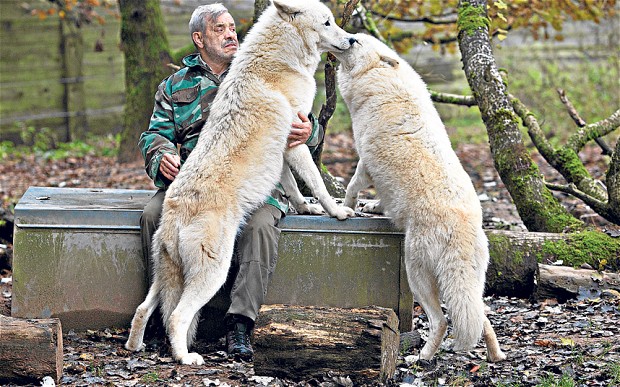
Packing a punch: Werner Freund with members of his wolf family, which includes distinctive white Arctic wolves  Photo: ROGER ALLEN/NORTH DOWNS PICTURE AGENCY

December 10th, 2012:

“The wolf has long been a creature of terror and mystery. With its sleek fur, fangs and spine-chilling howls, it is the stuff of nightmares and fairy tales that end badly. But the animal is making a comeback on mainland Europe, particularly the grey wolf, after centuries of human mistrust that has driven it to the brink of extinction. From the Balkans to the forests near Berlin, and from the heel of Italy to the outskirts of Prague, wolves are roaming wild once more as part of carefully managed programmes to halt their decline. Last month night-vision cameras picked up a pack of grey wolves just 15 miles from the centre of the German capital, moving stealthily through the countryside in pursuit of prey.

For one man, however, the wolf and its return is a cause for celebration rather than fear. Werner Freund, an 80-year-old former German paratrooper, has spent the past 40 years determined to dispel the negative myths that surround the animal. Known as the Wolfman, Freund runs a sanctuary in the small German town of Merzig near the border with Luxembourg, where he walks freely among 29 wolves, wearing an old parachute smock reeking of animal fat and blood. Kevin Costner may have enjoyed a light celluloid foxtrot with them in the Hollywood movie Dances With Wolves, but Werner transforms himself into the alpha male of the pack. “To earn their respect, one must become a wolf, and that is what I am to them – their leader,” he says.

Wolfman 2

‘Wolves are beautiful animals and the person who says they shouldn’t be in
the wild might as well not care about what happens to the elephant on the plains
of Africa’ (NORTH DOWNS PICTURE AGENCY)

Impressed by his dedication and knowledge, animal experts from around the world beat a path to his door, including Monty Roberts, the original “horse whisperer”. The EU asks for his advice on wolf management in those countries where they are making a comeback, and Werner is celebrated in books and documentaries in his homeland.

It’s easy to see why he is so highly regarded. Every day, as dawn breaks over the 25 acres of the Werner Freund Wolfpark, the still air is split by the howling of Arctic, timber, grey and Mongolian wolves – the latest addition to the Freund family.

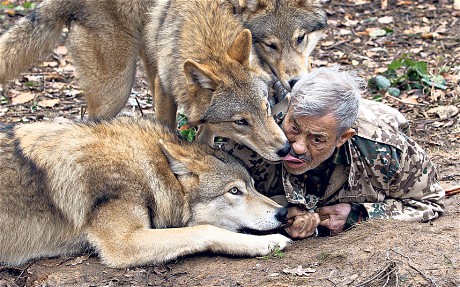
The wolves smell him before they see him. Then they howl – first one, then another and another – the woodland echoing to a visceral sound that would instill fear in many, but not in Werner. For these are the cries of animals he has devoted his life to. As he approaches the Arctic wolf enclosure, he bays in return and they answer him, tails wagging like labradors about to go walkies. He enters their domain clutching chickens and lamb chunks – breakfast – and is rewarded with affectionate licks. Never mind that their jaws can exert 1,500lb of pressure.

One wolf that has kept its distance finally comes over. It is at least 100lbs in weight and more than six feet high when it rears up on to its hind legs. It is a creature with an air of unmistakable authority, the alpha male of the pack. But when Werner is around, it seems to shrink back, clearly recognising its master.

For Werner there is nothing remotely evil about the wolf. “Fairy tales, that’s what gave them a bad name,” he says gruffly. “Red Riding Hood and all that. These are beautiful animals and the person who says they shouldn’t be in the wild might as well not care about what happens to the elephant on the plains of Africa. We are all enriched by their presence, by the simple fact that they are among us.

“There will always be farm animals taken by them. There will always be ‘incidents’ because of their proximity to man. But truthfully? You are more likely to die from meeting a werewolf than a real one. They don’t want to know about humans. They want to do their own thing.”

Several years ago this small man of modest demeanour and irrepressible enthusiasm walked into the mayor’s office in Merzig to tell him of his plans: a wolf park that would be free to everyone and where the creatures could live out their days as nature intended.

The pitch worked, and now Werner’s wolf park, built on land donated by the local authority, is a major attraction in Merzig. The packs roam in their segregated enclaves in a huge forested area, fed by local slaughterhouses that donate meat, supplemented by the odd deer shot by a hunter, or a roadkill wild boar.

“I battle to strip away the myth of the ‘dangerous wolf’. Look, dogs around the world kill plenty of people a year and bite millions more. Dogs have lost their fear of humans, the wolf hasn’t. I only get close to them because they know me; a stranger couldn’t do what I do.

“Wild wolves are rarely aggressive towards people. If there are attacks, they get big play in the press precisely because they are so rare. No, there is far more danger to wolves from man than the other way around. That is why the release of them into the wild will always have its limitations. There is a limit to habitat and prey, which is why farmers will always lose some sheep to them, and road traffic will take an annual toll on them.”

Werner wasn’t always a wolf man. Born in Germany in 1933, in the same month that Hitler came to power, he grew up in the wolf-denuded countryside near Frankfurt to a family of foresters and shepherds. “I got my love for animals from my mother,” he recalls. “To her all animals were good and so I never had any fear of them. She never told me stories about the big bad wolf.”

He trained as a gardener but in 1950 his love for animals drew him to the zoo in Stuttgart where he became a keeper for the larger predators. As well as wolves, Werner became a great fan of bears and was photographed cuddling a lion, getting up close to a hyena and befriending a puma for the local newspapers.

He had a spell in the border police before switching to the newly formed Bundeswehr (army) of West Germany, where he spent the next 20 years as a career soldier.

The army gave him time off to join expeditions abroad, 15 of them in all, to some of the most remote spots on the planet. On one of them he ingested a parasite from eating raw snake, necessitating an emergency operation to save his eyesight at a London hospital.

In 1962 he married Erika, aka “Mrs Wolfman”, who has been his life partner and passionate supporter of his animal causes. The first wolves they acquired, in the Seventies, were cubs from zoos and animal parks. Most of them were hand-reared by the couple, providing a unique bond that turned them both into the “parents” of the youngsters. “I had to become a wolf to bond with the wolves,” says Werner. “That is the only way to gain their trust.”

As the day began, so it ends. For wolves, darkness is the time for hunting, for killing. Sometimes Werner will dress their meat ration up in the form of a papier mâché sheep that the animals can tear to pieces as if it were real.

He stops at a small enclave next to his log-cabin home, where two female Arctic wolves howl in anticipation at his arrival. They had to be separated from the pack because there were too many females and the alpha male was becoming aggressive towards them.

“They need a man,” says Werner, as they lick his face and scramble for his affection. “They look nice, eh? But never be entirely fooled into thinking these are just big dogs. They are wild animals and always will be.”

**Special thanks to Allan Hall, “The Telegraph,” for providing this information!


“The Telegraph”

Read Full Post »


Wolf Ledge
Photo By Jimmie Jones
Rally For Wolves Washington D.C. Speech given by Laurie Nalani Hall to the group attending.
Through The Eyes Of 06 …
“I love standing on this high ledge, I can see the entire Lamar Valley of Yellowstone National Park from here. This valley is my home, I was born here, and it is the home of my ancestors the famous Agate and Druid Peak Pack. The human’s call us the Royals of the wolves there. I don’t know what the term Royals means, but they are my family and my heritage.
My mother # 472F, taught me how to hunt, cooperate with my pack and care for my siblings. Without her I would have never learned our ways. I worked hard to become all she could want of me, and I was overjoyed when I succeeded. Oh to hear her howls of approval and pride of my efforts was a song to my soul. I love her so; she was so wonderful and wise. My father # 113M, he was so loving and wise. We were called then the Agate pack.
When I came of age I took to wandering around the area of the vast valley. I wanted to see what was behind every bush and under every rock. I did this for a couple of years then one day I ran into a couple of irresistible brothers out wandering as I was. Oh they were so good looking and sweet as any lady wolf could ever find. All my other suitors could not hold a candle to these brothers, they were where I wanted to be, and be with.
I sure put them through their paces to win me, and in spite of their being younger than me, they won my heart. We traveled together and had many an adventure. As nature moves in her seasonal cycles, I became a mother to the most beautiful babies and I had chosen the den of my ancestors to bring them into the world.
From that time to now, our family rules over the Lamar Valley. My daughters and sons have grown and gone their individual ways and that is how it should be. I taught them all I knew and they learned well. My eldest daughters, now grown have families of their own. My sons are off being their own alpha’s and have left the valley to do so.
I have younger children I did not get to teach and show the way to. The one winter I sought after some strange sounds coming from another territory and went to investigate. I was to come upon a human in the forest. I stood and looked at him; humans have always been good to me so I had no fear of him. I came closer and he stood staring at me. Then everything went black.
The beta brother to my mate had gone near here a short time ago and did not come back. We looked and looked for him, we called and called but there was no response. I just could not give up looking for him. I loved him so, and he was the children’s favorite uncle. He loved me and even took the second place in our Alpha team just to be with me and his brother. He was so loving and dedicated to his family. We miss him so much.
After everything went black, I was different. I could see and hear, but it was not as I remembered. My body felt nothing and would not move. Nothing I did could get it to respond. That frightened me. The man took my collar off, and then he carried my body away. I lost track of it after that.
My family came looking for me, they howled for me but when I howled back they could not hear me. I don’t understand what has happened?
Days came and went, and then my alpha mate took the family back home to the valley. They were so sad and confused. They would stop, look back and howl again for me, then continue their journey. Something kept me from them and them me. It was a horrible feeling and loss. I kept trying to reach them, but failed. My mother did not teach me about this part of life. I don’t understand this. I followed them back home and watched them. I no longer could touch or feel them. But I watched and I followed.
My elder daughter took over the yearlings and her other younger siblings. She was always dependable and strong. My beloved mate left the valley alone. He was grieving so deeply and I wanted to let him know I was right here with him but he could not see or hear me.
In a short time, my family broke apart. It hurt my heart to see them divide. They were so lost and confused and scrambling for survival. They were all so dependent on my showing them the way. I worry for them now.
My girls have come of age at such a bad time. They are following nature and seeking their mates and will soon be tending their own pups. Time goes by so fast.  I hope I have taught them enough to carry on without me and be successful with their own families.
So much has changed since that winter day I left the world of the Valley. I don’t understand how I got here or why. I keep re tracing my steps searching for a clue as to what it was that put me here. All I can remember last seeing was the human with a stick in his hands; he was pointing the stick at me. I just looked at him wondering if he was going to play a new stick game with me.
Then I was here.
Humans have never scared or hurt me; they were my neighbors in the valley. They would come and watch me and my family and be so excited when they saw us. It was so much fun then.
I still see many of the human’s that used to visit us. They are still in the valley, but my girls are not all there anymore.  I have two daughters that have returned to her homeland in the valley, and the oldest has had her first puppies. Oh they are so beautiful! They are so small a group I have some concerns of them being able to grow and remain there. So much has changed, so much has been destroyed. I howl and howl for their ability to live in safety and peace. I can only visit them in their memories and their dreams now, it is the only way for me to continue to be with them and guide them. And every time they sleep, I go to them and love them and reassure them I am close by them.
I love standing on this ledge that overlooks our valley. It is our home, it is where we belong. And I love it. My spirit will never leave home.”
**Special thanks to “Legend of Lamar Valley” for providing this information!

Read Full Post »


arabian wolf

“Although it became well known in 2010 that all dogs originated from wolves in the Middle East instead of Asia, the fear of them is still very ingrained in the people there. It was over 15,000 years ago that the first non-nomadic hunter/gatherer communities began to intervene in the breeding patterns of wolves, thereby turning them into the first domesticated dogs. But this fact has been long forgotten by many in that region.

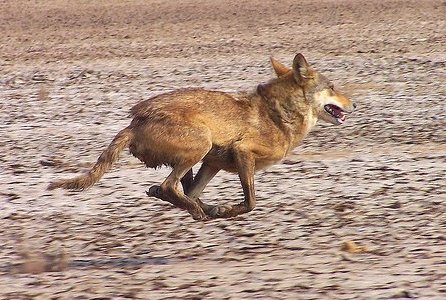
There are currently two subspecies of the Gray wolf that live in the Middle East. One is the Iranian wolf which is the only wolf species in the world that is not in danger of extinction. They can be found in diminishing numbers throughout Iran, Israel, Turkey, and Saudi Arabia. The other Middle Eastern wolf is the Arabian wolf, which is found in Israel, Iraq, Jordan, Oman, Saudi Arabia, and Yemen, and possibly some parts of the Sinai Peninsula in Eygpt.

Although these wolves are all over the Middle East, there are only two countries that subscribe to the notion that wolves have the right to coexist with man as part of the natural ecosystem. Those two countries are Oman and Israel and they have both given the wolves legal protection. In Israel for example, they have taken extraordinary measures to protect the wolves. Some of these measure include paying for electric fencing, using various species of guard dogs to deter wolves and the government also offers partial compensation for livestock losses. In the country of Oman the wolf population is on the rise. This has been attributed to a hunting ban that was put in place there. Oman has a very strong conservationist stance in comparison to the rest of it’s Middle Eastern neighbors.

As for the rest of the Middle Eastern countries such as in Iran, Jordan, Iraq, Turkey, Syria etc. the wolves are not doing as well. Here they are often looked as a pests that needs to be eradicated. In Saudi Arabia for example, the bodies of wolves can often be seen hanging from billboards as a message. It is widely claimed that many Saudis still kill the wolves as trophies. In other Middle Eastern countries wolves are hunted, poisoned, and run over.

This kind of outlook towards the wolves will not change however until the populations there become better educated. Currently in several of the Middle Eastern countries there are a few environmental organizations that are trying to work with the communities to help them better understand the wolves and their habitats and in turn minimize human and wolf conflicts. Godspeed to these organizations and may there be many more soon.”

**Special thanks to “White Wolf Pack” for providing this information (http://www.whitewolfpack.com/2011/12/only-2-countries-in-middle-east-protect.html)!

Read Full Post »


Dog protector

(photo above: Great Pyrenees protecting its flock at the Marcia Barinaga Ranch in Marin County, CA – Keli Hendricks/ProjectCoyote.org )

“In the picturesque community of Marin County California- just North of San Francisco- public controversy over the use of poisons, snares, “denning” (the killing coyote and fox pups in their dens), and other lethal methods led to a majority decision by the Marin County Board of Supervisors to stop contracting with the U.S. Department of Agriculture’s Wildlife Services predator control program in 2000. Instead the Board approved an alternative community-based program to assist ranchers with livestock-predator conflicts known as the Marin County Livestock and Wildlife Protection Program (hereafter MCLWPP), a collaborative effort involving multiple stakeholders from local wildlife protection organizations to ranchers, scientists, and county government officials (Fox 2008).

The MCLWPP initiated cost-sharing to help ranchers install or upgrade fencing and other livestock-protection infrastructure, install predator-deterrents and detectors, and purchase and sustain guard dogs and llamas, coupled with indemnification for any ensuing verified livestock losses to predators.  Improved animal husbandry practices combined with these economic and technological incentives led to its early success (Agocs 2007, Fox 2008). Participants do not give up their rights to kill predators consistent with state and federal laws. Rather than contract with the USDA Wildlife Services (WS) for the provision of personnel to kill coyotes and other wildlife, the county assigns personnel and allocates money to help stock-owners prevent depredations solely through non-lethal means. To qualify for the MCLWPP, ranchers must have 25 or more head of livestock and must utilize at least two non-lethal predation deterrent methods verified through inspection by the office of the Marin County Agricultural Commissioner, thereby becoming eligible for cost-share indemnification for any ensuing losses to predation.

Five years after implementation of the MCLWPP, a research assessment was conducted (Fox 2008) that compared the former Wildlife Services program to the MCLWPP, with regard to rancher satisfaction and preferences, lethality to predators, livestock losses, use of non-lethal predator deterrent techniques, and costs. The study, conducted through a variety of quantitative and qualitative methods, including a comprehensive survey of ranchers who participated in the MCLWPP, documented the non-lethal cost-share program (1) had support from a majority of participating ranchers, (2) was preferred over the USDA Wildlife Service’s traditional predator management program by a majority of participating ranchers, (3) helped to reduce livestock losses, (4) resulted in an increase in the use of non-lethal predation deterrent methods by a majority of participating ranchers, (5) likely reduced the total number of predators killed to protect livestock, (6) reduced the spectrum of species of predators killed to protect livestock, and (7) fewer species of predator were killed.

In 2012, the San Francisco Chronicle (Fimrite 2012) reported that 26 Marin County ranchers participated in the County program[1] utilizing 37 guard dogs, 31 llamas and over 30 miles of fences, to protect 7,630 sheep that were pastured on 14,176 acres. Coyote depredation on sheep in the county, though it fluctuated, declined steadily from 236 in fiscal year 2002-03 to 90 in fiscal year 2010-11 – a 62% reduction – with fourteen ranchers recording no predation losses and only three ranchers losing over ten sheep during the following year. According to Marin Agricultural Commissioner, Stacy Carlsen, who oversees implementation of the non-lethal cost-share program, “losses fell from 5.0 to 2.2 percent while program costs fell by over $50,000. For the first couple of years we couldn’t tell if the loss reductions were a trend or a blip. Now, we can say there’s a definite pattern and livestock losses have decreased significantly.” Carlsen also noted “This innovative model sets a precedent for meeting a wider compass of community needs and values where both agriculture and protection of wildlife are deemed important by the community. The success of our county model has set the trend for the rest of the nation.”

The heart of Marin County’s results-driven program lies in its eschewing of a governmental role in assisting in the destruction of wildlife, which makes the assistance in preventing depredations all the more attractive and ultimately successful. Though some specific methods in the MCLWPP may not prove equally efficacious or even feasible in other environments – for example fencing on federal lease lands that could disrupt wildlife migration corridors – the MCLWPP provides a provides a cost-effective and ecologically beneficial model to address carnivore-livestock conflicts by integrating modern science, ethics, and economics. Such innovative prototyping that incorporates adaptive management strategies provides a template to guide the development of other non-lethal programs across differing landscapes to address the age-old predicament of raising livestock in an environment that includes predators (Fox 2008).

LITERATURE CITED:

Agocs, C.  2007.   Making Peace with Coyote.   Bay Nature (January 1, 2007). Berkeley, CA. Available from: http://baynature.org/articles/making-peace-with-coyote/   (accessed May 5, 2013)

Fimrite, P.  2012.  Ranchers shift from traps to dogs to fight coyotes.  San Francisco Chronicle (P. 1, April 27, 2012). San Francisco, CA. Available from: http://www.sfgate.com/science/article/Ranchers-shift-from-traps-to-dogs-to-fight-coyotes-3514405.php  (accessed May 5, 2013)

Fox, C. H.  2008.  Analysis of the Marin County strategic plan for protection of livestock and wildlife, an alternative to traditional predator control. M.A. thesis, Prescott College, AZ. 120 pp. Larkspur, CA.

Project Coyote is a national non-profit organization based in Marin County, California promoting compassionate conservation and coexistence between people and wildlife through education, science, and advocacy. For more information visit: ProjectCoyote.org


[1] According to Marin County Agricultural Commissioner Stacy Carlsen, all commercial ranches were participating in the MCLWPP as of May 2013.”

Project Coyote
P.O. Box 5007
Larkspur, CA 94977

Read Full Post »

« Newer Posts - Older Posts »