Feeds:
Posts
Comments

Archive for the ‘Wolf Preservation Efforts’ Category


Wolf Walk

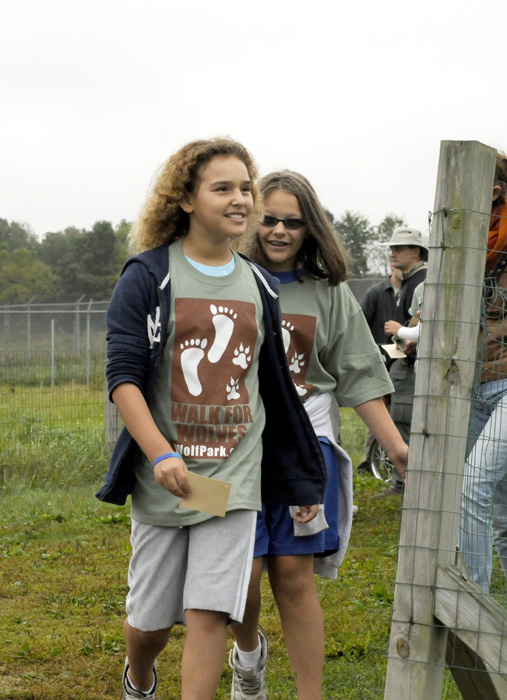
Photo provided by Wolf Park

“Each year, Wolf Park hosts its annual Walk for Wolves event; our largest fundraiser of the year. Wolf Park’s annual grassroots fundraiser event, Walk for Wolves, which was developed as a way to both further involve the community in our mission of research, education and conservation, and as a way to help sustain our facility during the off season. Our supporters form “packs” (1-5 people on a team) to help raise funds for the event.  On the day of the Walk, one of our ambassador wolves leads the way around the loop trail.  Local celebrities host this event; there is live music, food, fun contests and prize giveaways. Every “pack” receives an armband that lets them tour Wolf Park during open hours and come back for Howl Night that evening as our guests.

Area businesses support the Walk for Wolves through corporate sponsorships.  In exchange, the businesses are advertised on the walk t-shirts, posters, on our website, and in our newsletter.  Businesses also support the Walk for Wolves by giving to a matching donations campaign for their employees that participate.  Wolf Park needs your support for Walk for Wolves to help us reach our targeted goal this year. Your help and support can make a huge impact on Wolf Park!

Those interested will form “packs” and become a helping hand in our ability to continue our mission of Research, Education, and Conservation. This opportunity is ideal for you to support Wolf Park’s efforts. All “packs” receive a Walk for Wolves t-shirt if registered by August 31st! Must be present at Bank Night or the Walk for Wolves to pick up your t-shirt (we do not mail them out).

With YOUR help, our ambassador wolves can make a difference!

Download these PDF files and fax, e-mail or mail back to Wolf Park for the Walk for Wolves fundraiser! T-shirt sizes must be turned in to Wolf Park by August 29th!

You can sign up and submit your T-shirt sizes here!

You can register a Pack until 7:00pm EST on Friday, September 20th. All pre-registered Pack members get in free to the event. If you miss the deadline or do not wish to form a Pack, please feel free to join us as a walk-in the day of the event! Adults are $20, kids 5-13 $15, and kids under 5 are free. All Walk participants (including walk-ins) can join us free of charge during our regular open hours at the Park for guided tours from 1-5pm and for Howl Night at 7:30pm on September 21st!

Get your pack together for Wolf Park’s annual sponsor-based fundraiser! Our success depends on everyone joining in on the fun — clubs, school classes, church groups, businesses, organizations, individuals and most of all YOU!

Our success depends on everyone joining in on the fun — clubs, school classes, church groups, businesses, organizations, individuals and most of all YOU! All packs need to fill out a Walk Packet in order to register.

Participants will form Packs and collect donations, and then on the big day come out and present their donations to Wolf Park.  Then we spend the day celebrating wolves, and our commitment to save our natural world.  All morning walkers will stroll around this beautiful, unique park seeing th…e wolves, foxes, coyotes and bison up close and personal — right here in Battle Ground, Indiana. One of our resident wolves will join us for one lap!

Donations are fully tax deductible! Every registered walker will get a Walk for Wolves T-shirt if registered by August 31st! All registered packs will have a chance to win fabulous prizes. ‘Virtual’ participants  will have a chance for some fabulous prizes too!  Packs that raise $1,000 or more will be entered to win a Wolf Park Get A Way Weekend for two! Any individual or Pack that raise $1,000 or more will get to meet a WOLF and have their Pack picture taken by world renown photographer Monty Sloan!

The Walk begins at 9 am on September 21st! All participating walkers will receive FREE ADMISSION to Wolf Park for the remainder of the day, including regular hours from 1:00-5:00 pm and Howl Night 7:30-9:00 pm!”

**Special thanks to Wolf Park, http://wolfpark.org/support/walk/,  for providing this information!

Read Full Post »


Idaho Wolf

Photograph by Jim and Jamie Dutcher, National Geographic.

New method lets scientists ID howling wolves with total accuracy.

“If any gray wolves are howling their discontent with a recent proposal to remove what remains of their U.S. federal protection, scientists can now identify the outspoken.

A new, more sophisticated method for analyzing sound recordings of wild wolf howls can, with absolute accuracy, tell individual wolves apart-and may even help save the old dog, according to a new paper in the journal Bioacoustics.

Study leader Holly Root-Gutteridge and colleagues at Nottingham Trent University in the U.K., working with recordings of wild wolves mostly from Algonquin Provincial Park (map) in Ontario, Canada, also found the technique can distinguish a single animal from a chorus of howlers with 97.4 percent accuracy. The team had previously used the method with captive wolves, but this is the first time it’s worked with wild wolf songs and all the ambient sounds that go with them.

Specifically, the team’s more thorough howl analysis looks at pitch—also considered by previous howl-analyzing tools—but also at amplitude, or the acoustic energy, of recorded howls.

“This is like trying to describe the human voice by saying ‘Sandra has a high voice, and Jane has a high voice,'” said Root-Gutteridge, “then refining it by saying ‘Sandra has a soft-spoken voice, but Jane has a loud voice.’ The highness still matters, but if you add the detail about vocal intensity, you’re less likely to confuse Sandra and Jane.”

What’s more, the technology is able to scrutinize howl recordings and throw out extra, unneeded noises like wind and water that might otherwise confuse the data.

Tracking Wolves a Challenge

These majestic canids—which once roamed most of the northern Rockies of the United States and Canada and the forests along the Great Lakes—nearly went extinct in the early 1960s, when they were considered vermin and all but eradicated by hunters. After the shooting stopped, only about 300 gray wolves remained, skulking through the deep woods of upper Michigan and Minnesota.

With protection under the Endangered Species Act, gray wolves have come back from the brink—one of the biggest success stories in U.S. conservation history. (Related: “Wolf Wars” in National Geographic magazine.)

Though nowhere near the historical estimate of more than 400,000 gray wolves in the United States, now as many as 5,000 live in Michigan, Wisconsin, and Minnesota, with another 7,000 in Alaska. Smaller numbers of reintroduced wolves live in Montana, Idaho, and Wyoming.

But monitoring their populations, which remains a vital part of management, has always been an inexact and labor-intensive science.

Methods include tracking the animals based on pawprints and other marks in the snow, which works quite well-when it snows. GPS collaring lets you know where an individual is, but not with whom it spends its time.

Plus, collars are expensive and collaring requires capturing wolves first-a huge and stressful undertaking for all involved, said Root-Gutteridge. (See an interactive on the return of the wolf.)

Finally, you can play howl recordings to wolves and listen to their replies-which can carry six miles (ten kilometers)-but you can’t identify individuals and don’t know when one animal is repeating itself or when a new howler has joined in.

DNA analysis of scat has its place, but it is costly and requires finding the wolves first.

Wolves Out of the Woods?

Now that the new technique has been shown to succeed with wild animals, the team sees it as a tool to help conserve wolves in their natural habitats. (See more wolf pictures.)

For instance, tracking howls accurately could make future wolf counts and monitoring of individuals much more precise. If plans go forward to fully drop the gray wolf from the U.S. Endangered Species list and let states do as they please regarding hunting, better monitoring could over time help determine if it was too soon to strip away those last protective rules, as many conservationists argue.

The technology could also be put to use with other canids like African wild dogs and Ethiopian wolves, both of which are endangered in their habitats, said Root-Gutteridge.

“If it howls, the code can extract it and we can identify it.””

**Special thanks to Jennifer Holland, http://news.nationalgeographic.com/news/2013/07/130730-wolves-howling-science-animals-environment/, for providing this information! Follow Jennifer S. Holland on Twitter or check out her website at cuttlefishprose.com.

Read Full Post »


National Rally for Wolves

“Never doubt that a small group of thoughtful, committed citizens can change the world: indeed it’s the only thing that ever has. – “Margaret Mead

It is happening. This is your personal invitation to attend:

The National Rally to Protect America’s Wolves! to be held in Washington DC on Saturday, September 7, 2013 from 9AM to 4PM. We will come together in an area adjacent to the Washington Monument on the National Mall, to meet and network with each other, to hear from an impressive and inspirational line-up of speakers and to march peacefully between the Lincoln Memorial and the US Capitol building.

Here’s a link to the official rally website:  http://www.rallyforwolves.org

You can register for the Rally on this website. We will post details of the day’s intinerary, including the excellent speaker line-up, as it evolves. Frequently Asked Questions, regarding getting there, lodging, etc will be posted on the site as well. Please be patient as we fill in the details and answer your questions through the website.

This Rally is for America’s vital and beautiful wolves and other native wildlife under siege. This is our rally, your rally. It is being organized by a small team of grassroots wolf defenders and is open to all wolf and wildlife defenders.

The Rally’s mission is to unite wolf and wildlife defenders from around the country and demonstrate to our nation’s leaders that a respectful and humane majority of American citizens demand federal protection for America’s wolves, under the Endangered Species Act, in every state throughout their historic range.

We are going to Washington to demand that the unethical, cruel and unjust persecution and slaughter of America’s wolves in Idaho, Montana, Wyoming, Minnesota, Wisconsin, Alaska and elsewhere, be brought to an end, now and permanently. Our message is a public appeal for a better America that respects honest science and ecology, that truly reflects the humane and ethical values of the majority; a country where decency, respect and co-existence with America’s wolves and all native wildlife prevails, in every state.

Who’s invited? All wolf, wildlife and earth defenders in every state. Grassroots wolf defender activists. Non-profit groups, large and small, dedicated to defending wolves and other wildlife. All people young and old who love animals, respect ecology and who oppose animal abuse and cruelty wherever it exists. Native people including those who are helping lead the fight to protect America’s wolves. People of faith who are awakening to Creation care. Veterans opposed to violence and animal abuse. Wolf and wildlife defenders from around the world. Everyone with a good heart who wants a better and kinder country based on decency, compassion and respect for America’s wolves and all native wildlife and the wild places they need to survive and thrive.

Bear with us as we create and refine the day’s intinerary, including the wonderful line-up of speakers.

Please come to The National Rally to Protect America’s Wolves! and help spread the word.

Thank you on behalf of America’s vital and beautiful wolves, The National Rally to Protect America’s Wolves!

Register at: http://www.rallyforwolves.org

**SPECIAL THANKS TO PROJECTWOLF, http://rallyforwolves.org/, FOR PROVIDING THIS INFORMATION!

Read Full Post »


fladry_wind

Fladry is a line of rope mounted along the top of a fence, from which are suspended strips of fabric or colored flags that will flap in a breeze, intended to deter wolves from crossing the fence-line.[1] Fladry lines have been used for this purpose for several centuries, traditionally for hunting wolves in Eastern Europe.[1] They are effective temporarily, as the novelty may soon wear off, usually between three to five months, and can be used to protect livestock in small pastures from wolves.[1]

This technique is sometimes also used to alert horses and cattle to the presence of a fence, as the use of smoothwire fences and one strand of electric may not be seen by an animal unfamiliar with a new home.


“GRANTS PASS, Oregon — The Oregon Fish and Wildlife Commission on Friday adopted provisions of a lawsuit settlement that will make Oregon the only state in the West where killing wolves that attack livestock is a last resort.

The rules adopted by the commission amend Oregon’s Wolf Management Plan, along with statutory provisions enacted by the Legislature that will be signed by Gov. John Kitzhaber.

The rules require ranchers to show they have taken non-lethal steps, such as alarm boxes and low strings of fluttering plastic flags known as fladdery, to protect their herds before the state will send out a hunter to kill a wolf. There must also be hard evidence, such as GPS data showing a radio-collared wolf was in the area when a cow was killed, that wolves have attacked four times.

In return, ranchers get new rights to shoot wolves that they see attacking their herd, but only if those non-lethal protections are in place, and attacks have become chronic.

The settlement represents a new level of cooperation between conservation groups and ranchers, who have long fought over restoring wolves in the West, where they were wiped out by bounty hunters in the early part of the 20th century.

Ranchers downplayed the significance of the settlement.

“I don’t think it’s a whole lot different from the wolf plan already being implemented,” said Kate Teisl, executive director of the Oregon Cattlemen’s Association. “Now there’s just more documentation. Ranchers are out there doing all they can to keep their animals alive, including the non-lethal measures.”

But wolf advocates said it was that documentation of non-lethal steps that was groundbreaking.

Rob Klavins of Oregon Wild said the old plan talked about conservation of wolves being a priority, but it was so ambiguous that it was ineffective.

“It’s now up to the Oregon Department of Fish and Wildlife, the livestock industry, and the conservation community to honor the agreements that we have made,” he said. “If we do so, I am optimistic we will continue to see conflicts between wolves and livestock continue to be rare, and the need to kill wolves even rarer still.”

Brett Brownscombe, natural resources adviser to the governor, said making the rules clear was important as Oregon’s wolf population continues to grow, and the Obama administration moves toward lifting federal protections for wolves in areas they have yet to repopulate.

Oregon Wild and other conservation groups had sued the Oregon Department of Fish and Wildlife, claiming that a kill order on the Imnaha pack, the first to establish in Oregon as well as the first to attack livestock, threatened to wipe out the pack. Conservation groups claimed the actions violated the Oregon Endangered Species Act, which still protects wolves in the eastern two thirds of the state, where federal protections have been lifted.

The Imnaha pack only has one more strike against it before a kill order can be imposed, but so far, it has not been linked to an attack.

The Oregon Court of Appeals barred the state from killing wolves for more than a year before the settlement was reached between conservation groups, the Oregon Cattlemen’s Association, and the governor’s office. During that time, the number of wolves in Oregon went up, while the lethal attacks on livestock went down. In Idaho, where the Oregon packs had migrated from, the numbers of lethal livestock attacks went up, along with the numbers of wolves killed, primarily by trophy hunters and trappers.”

**Special thanks to JEFF BARNARD  Associated Press, for providing this information! (http://www.dailyjournal.net/view/story/27bc716ebcfd4046b4ba205ed9310261/OR–Wolf-Settlement/)

Read Full Post »


Expert Nonlethal Methods

Photo by Brian Smith Times News Carter Niemeyer, a Boise-based wolf expert and former wildlife manager, speaks to an audience about wolves in Idaho on Friday at the Stanley Museum. Niemeyer said the best way to reduce wolf killings of cattle and sheep is to promote non-lethal deterrents instead of aerial killing of problem wolves.

“STANLEY • To reduce wolf killings of sheep and cattle in south-central Idaho, reimbursements for lost livestock must be reduced or eliminated, and ranchers must not be able to easily order aerial killings of problem wolves or packs, a prominent Boise-based wolf expert said at a presentation in Stanley.

As long as lethal wolf control comes free of charge and area ranchers are paid for their losses, they won’t adopt voluntary, non-lethal wolf deterrents in an area that saw record-high depredations last year, said Carter Niemeyer, author of “Wolfer” and a former wolf manager and trapper.

“All it takes is a phone call and if you have a legitimate, confirmed loss, those wolves can be killed,” he said after his Friday presentation. “Most ranchers go, ‘Why in the world would I want to scare one away when we can just take care of the problem?’”

Lethal Control Preferred

Lethal control is preferred in Idaho and other states, he said, meaning taxpayers are funding the large cost of killing problem wolves.

“Wildlife services under the United States Department of Agriculture, they won’t hesitate to spend $10,000 or $20,000 on a helicopter to shoot a group of wolves,” he said.

But that’s only a short-term treatment, he said. USDA wildlife services could spend money on non-lethal deterrents — lighting, electric fencing and corrals strung with flags — to protect livestock and not “get into a cycle of killing wolves.”

“What do you get when you kill coyotes and wolves? More coyotes and wolves,” he said.

Idaho officials are applying for federal funding to reimburse ranchers for their wolf depredations in 2012. Half of that money, however, is earmarked for non-lethal deterrents. Whatever amount the state receives, Niemeyer said it would likely be enough for only a “pick-up truck and an employee.”

“There’s no silver bullet, but we’re willing to spend tens of thousands of dollars killing predators,” he said. “Why can’t we look at other methodologies and study the possibilities to do preventative things that don’t require us spending (that money)?”

‘Nation’s Most Polarizing Wildlife Issue’

But the “problem” won’t go away. Like it or not, wolves are here to stay and humans must learn to live alongside the reintroduced species, Niemeyer said during the presentation to a crowd at the Stanley Museum. Niemeyer’s presentation focused on his decades of work with wolves, including his role in helping re-establish the species in the area. He discussed public attitudes toward the predator, and misconceptions about the wolf’s reintroduction, which he called the nation’s most polarizing wildlife issue — ever.

“Wolves are prolific, resilient, they disperse and they are going to be here for a long, long time to come because they like the habitat we’ve provided them,” he said. “… I’m not here to advocate for wolves. I don’t love them. I don’t hate them, but I do recognize they are a native species and I think we’ve got to treat them like that.”

Niemeyer said he is often criticized for his work with the government’s reintroduction of wolves in northwestern regions of the United States. When he speaks publicly about the subject, between 150 and 300 people attend, often with their opinions cemented.

“Most of you people here today probably know how you feel about them,” he said. “I don’t feel like I’ve ever spoken to a crowd and turn you all 180 degrees before you left.”

Niemeyer referenced a chart showing how wolf populations have grown exponentially in the northwest and central Idaho since they were reintroduced.

“Along with this you could also have a graph on tempers, attitudes and opinions that goes right alongside … ,” he said.

Along with those opinions have come rumors about the reason for their presence – to ruin and outlaw big game hunting, take away guns and drive the livestock industry out of the West.

“I’ve heard it all,” he said.

Wildlife, however, react and benefit from wolves’ presence in the area, he said.

“They prey on big game, they create carrion for others to eat and scavenge, they regulate big game herds,” he said. “I think they make big game herds healthy because they were one of the natural predators of these species before settlers came and helped God manage wildlife.”

Wolves aren’t a threat to humans despite cultural mythologies painting them as villains, he said. Only two people in recent memory have been killed by wolves, but those incidents were in Canada and Alaska.

“I have never had a close call with wolves in my life,” Niemeyer said. “I have been surrounded by them dozens of times — packs and pups. I love it. I just sit on a log and think, ‘I wish I had all you here.’”

‘Social Carrying Capacity’

Whereas some biologists are concerned with the biological carrying capacity of an animal, wolves are now measured on a “social carrying capacity” — not how many a landscape will hold, but how many wolves humans will tolerate, he said.

According to Idaho Department of Fish and Game statistics, wolves killed 34 cattle and 79 sheep last year in the southern portions of the Sawtooth Range, including Camas and Blaine counties. Across the state, they killed 90 cattle and 251 sheep. In turn, hunters killed 330 Idaho wolves last year, up from 200 the year before.

From 1987 to 2012, wolves killed an average of 143 sheep and 71 cattle a year across Idaho, Montana and Wyoming, Niemeyer said. In those states, there are 850,000 range ewes and millions of cattle. He displayed United States Department of Agriculture statistics that showed 26 percent of livestock died of respiratory problems while 0.2 percent died of wolf predation.

“Is that a big problem or not? It certainly is if it is you’re cattle and sheep,” he said.”

**Special thanks to Brian Smith, bsmith@magicvalley.com, for providing this information!

Read Full Post »


proposed wolf hunt areas

“LANSING — A group that opposes a gray wolf hunt says it will launch a second ballot petition drive to stop the proposed hunt after its first effort was thwarted by the Legislature.

Keep Michigan Wolves Protected submitted more than 255,000 signatures in March in an effort to overturn a December 2012 state law that allows the hunting and trapping of wolves.

But in May, lawmakers and Gov. Rick Snyder approved a new bill that allows the Michigan Natural Resources Commission to add animals to the list of game species. That action meant Keep Michigan Wolves Protected could still go ahead with a vote on the earlier law, but it would not have the effect of stopping the hunt.

The commission is expected to approve a limited wolf hunt beginning in mid-November when it meets this month.

On Tuesday, Keep Michigan Wolves Protected announced it will launch a second signature drive, this one aimed at the new law.

“This second referendum will preserve the impact of our first referendum that has already been certified for the ballot — ensuring Michigan voters have the right to protect wolves and other wildlife matters,” said Jill Fritz, director of the group.

She said her group won’t be able to collect signatures and get them certified in time to stop the November hunt. Once the proposed repeal of a state law is certified for the ballot, that law is suspended pending the election.

If the new drive is successful, there would be two wolf-related ballot measures on the November 2014 ballot.

Keep Michigan Wolves Protected describes itself as a coalition of conservation groups, animal welfare organizations, Native American tribes, wildlife scientists, veterinarians, hunters, farmers and more than 7,000 citizens.”

**Special thanks to “Detroit Free Press (http://www.freep.com/article/20130702/NEWS06/307020046/wolf-hunt-michigan) for providing this information!

Read Full Post »


Wolf Wolf

“A friend of Footloose Montana, a hunter, rancher and 7th generation Montanan speaks out about trapping and ethics in hunting!

I grew up as a member of a 7 generation pioneer Montana ranching family. We were and still are outdoorsmen and spend every opportunity hiking, fishing and hunting in the Montana outdoors. Hunting was not done to acquire trophies to hang on the wall, or a rug to lay upon the floor, it was an opportunity to help supplement the family’s food larder through the winter Months. My grandfather, with whom I spent uncountable hours with in the forests taught me hunting ethics from the time I could fill a pair of boots and had the strength to keep up with him. As hunters, we followed strict personal rules when it came to taking an animal. Take no more than what was legal and no more than what our family could eat. We relied on our expertise in stalking and getting a close to the animal as possible, and if we could not take an animal cleanly, we passed it by. By cleanly, I mean as close as possible to an instant kill. Watching or having an animal suffer due to our poor hunting ability was unthinkable.

It is my belief that most hunters today still maintain those kinds of ethics as it applies to hunting. But there are a few that display conduct that shames the rest of us. These are what I refer to as Slob hunters, and these are the ones that portray the rest of us with a horrible image to the non-hunting population. The slob hunters are the ones that post stickers all over their trucks with slogans such as “Wolves, smoke a pack a day, or the only good wolf is a dead wolf, etc”. The slob hunters are the same type that knowingly put traps out where the contraption is more likely to capture a domestic animal or pet than it is likely to capture the trapper’s intended victim. These are the same guys that post their rantings and pictures of tortured, suffering animals all over Facebook for all to see. These are the same guys who show their lack of upbringing by waving their arms, making faces at Montana Fish, Wildlife, and Parks commissioner’s meetings while muttering loudly as someone with an opposing view presents their testimony. These are the same guys that who verbally attack others at meetings, within newspapers, or write sick comments on other people’s facebook pages trying to intimidate, all because someone may have a different outlook than their own.

The Slob hunters and trappers are the people that are the biggest threat to hunting in North America. It’s not the non-hunting communities, nor is it the Anti-hunters who threaten the future of hunting. The biggest threat to hunting over all is and will continue to be the slob hunters within the hunting community itself. The Slob hunters are the ones that tear down fences on private land, use Forest service signs and out houses for target practice. These are the guys that run their ATVs off designated roads and trails, tearing up the terrain, these are the guys that gut shoot a rancher’s cow, or horse that happens to be standing out in the middle of a field. These are the guys that feel they need to take semi-automatic rifles into the field with 30 round magazines, along with a few 12 packs of beer in the back seat. These are guys that leave their empty beer cans alongside road ways, or in camping areas for someone else to pick up.

So often I have heard, “Trapping is part of Montana’s heritage and tradition” and to that I must reply, “It may have been a part of our state’s history, but that does NOT mean it needs to be a part of our future!” I detest trapping in all forms, and those that utilize trapping for sport or profit. Sport? What Sport? Trapping, no matter how you look at it is nothing more than blatant cruelty that inflicts needless suffering upon an animal.
The hunting communities should best begin to realize that it’s NOT the non-hunting population or even the Anti-hunting communities that are the biggest threat to hunting in North America. It’s the Slob hunters and trappers within the hunting community itself that is the biggest threat to the hunting tradition.

I strongly believe the majority of the hunters today do care about and maintaining strong conservation values for the land as well as wildlife in general. They believe and follow certain ethics while hunting and the principle of “Fair Chase” is an example.

The Boone and Crocket club defined “Fair Chase” as the ethical, sportsman like, lawful pursuit and taking of any free-ranging wild animal in a manner that does not give the hunter an improper or unfair advantage over such game. Use of any of the following in the taking of game is considered UNFAIR chase:

* Spotting or herding game from the air, then landing, pursuing and shooting those animals
* Herding, pursuing or shooting game from a motor boat or motor vehicle
* Use of illegal electronic devices attracting, locating, or observing game, or for guiding hunters to such game
* Hunting game confined by fences, enclosures, or game transplanted solely for the purpose of commercial shooting
* Taking game illegally or using illegal methods against regulations of the Federal government or any state, province, territory, or tribal lands.
Personally I would add two more to Boone and Crocket’s list and that would be:
* Hunting and shooting of an animal over bait
* Hunting and killing of pregnant animals. What is ETHICAL about that??

We can thank the hunting communities, through their efforts, for the millions of acres of wilderness and wild lands set aside for wildlife. But the hunting community must realize that times are changing and the hunting communities alone can no longer fully support conservation. Our wild lands are constantly under attack by big money organizations, the oil, and livestock industries for example. America is losing its open lands and as the land goes, so does its wildlife. It is IMPERATIVE that both the hunting communities and the non-hunting communities work together and get politics as well as special interests out of our forests. There is absolutely no reason that either side should not be willing to sit down and work together to accomplish our basic mutual goal of preserving wild lands and wildlife for future generations to enjoy.

As I have attended many Fish, Wildlife and Park public and commissioner meetings, I note that the majority of speakers pushing for unethical practices come from the Trophy hunters, the Outfitter association, or domestic livestock associations. We cannot afford to allow these people to continue to dictate policy that will affect the future of our wildlife and wild lands. Its way past the time that Montana Fish, Wildlife and Parks puts aside political agendas and begins to manage, and preserve ALL our wildlife as that department was originally tasked to do. Our future and hunting depends on it.

I support Footloose Montana and applaud this organization’s efforts to eliminate trapping upon public lands.
Thank you!

Steve Clevidence”

Read Full Post »


Isle Royale Wolves

In this Feb. 10, 2006, file photo provided by Michigan Technological University, a pack of gray wolves is shown on Isle Royale National Park in northern Michigan. The wolf population on Isle Royale now down to eight individuals. (AP Photo/Michigan Technological University, John Vucetich)

SHOULD HUMANS INTERVENE??

“ST. PAUL, Minn. — The wolf population on Isle Royale is down to eight individuals and for the first time in 50 years of intense study there is no evidence of reproduction over the winter.

The National Park Service faces a thorny set of choices to either intervene or let nature take its course. A panel of experts Thursday evening will debate the options and explore possible consequences.

Today’s Question: Should humans intervene?

Isle Royale is a unique place — 200 square miles of rugged woods and swamps, rocks and waves. Perched 15 miles from the Minnesota shore in Lake Superior it is effectively isolated from the mainland. For more than 50 years scientists have trekked to this self-contained ecosystem to study the relationship between wolves and moose.

Last year, researchers found only eight wolves — the fewest wolves ever recorded on the island. There are plenty of moose for the wolves to eat. But with all eight wolves being descended from a single female, scientists think the population may be too inbred to reproduce anymore.

In considering what to do next, the National Park Service is investigating three options: the first is to do nothing, let nature take its course. The wolves may or may not die out. The second option is to introduce one or more new wolves to provide fresh genetic material. The third option is to wait until the current population dies out and then introduce a new group of wolves.

The lead researchers in the 55-year-long study, Rolf Peterson and John Vucetich, have published an article in the op-ed page of The New York Times arguing for a swift genetic rescue. They say it is true the island is designated a wilderness, but the human footprint is now evident on Isle Royale and practically everywhere else. They say it is time to place the highest value on ecosystem’s health, even if humans need to intervene to maintain it. And they say a healthy ecosystem depends on having a top predator, such as wolves, to keep everything else in balance.

But other researchers disagree. Dave Mech, a wolf expert with the U.S. Geological Survey, said science will gain the most if we wait and see.

“If we don’t do anything now, we can do something later if it’s necessary.  But if we do something now, we can never undo that,” Mech said. “We have a pure population just doing its thing. And we have 55 years of data on it; why not see what else can happen here?”

A hundred years ago, Isle Royale had a different wildlife population. It had no moose and no wolves. It was home to caribou, coyotes and lynx.

Nancy Gibson, co-founder of the International Wolf Center in Ely, said if interfering with the current wildlife population is up for discussion, broader options should be considered.

“Maybe should we reintroduce caribou? It’s also an ecosystem that doesn’t have bears,” Gibson said. “I also think it’s a little bit interesting that we’re not talking about introducing lynx back to Isle Royale. It’s a very interesting dilemma, and I think we really need to have a vigorous debate on it.”

Tonight’s forum in Minneapolis is the public beginning of that debate. The National Park Service will hear input from scientists and the general public in a decision-making process that will span several months.

Sponsors of the forum are the Sigurd Olson Environmental Institute at Northland College and the National Parks Conservation Association.

Christine Goepfert, the association’s upper Midwest program manager, is concerned whether any human intervention is sustainable. She points out the ice bridges that allowed wolves to travel from the mainland to the island are less likely to form as the climate warms.

“We know it’s unlikely ever again to have a moose and/or wolf make its own way there. Are we always going to have to continuously intervene, and how often,” Goepfert said. “I also wonder how that affects the research, if we’re having to do that. So there’s a lot of unanswered questions in my mind.”

The forum is 7 to 9 p.m. Thursday in the Cowles Auditorium at the University of Minnesota’s Humphrey Institute.”

**Special thanks to  Stephanie Hemphill, Minnesota Public Radio, http://minnesota.publicradio.org/display/web/2013/06/20/environment/isle-royale-wolves?refid=0, for providing this information!

Read Full Post »


Wolf Wolf

“Five Michigan Indian tribes have decided to challenge the state’s decision to hold a wolf hunt in the western UP this coming fall.

As we hear from The Michigan Public Radio Network’s Rick Pluta, they say the wolf hunt violates a treaty.

Specifically, the tribes of the Chippewa Ottawa Resource Authority say the state did not consult with them in a meaningful way before establishing a gray wolf season, and that’s required by a 2007 consent decree.

Aaron Payment leads the Sault Sainte Marie Tribe of Chippewas. He says the wolf is sacred in tribal culture and the hunting season disrespects that.

“The five tribes that are a party to the consent decree are unified that we are going to take some steps, and we’re not exactly sure what that is at this point, but we’re not happy with the outcome,” he says.

Payment says the treaty gives the tribes options including mediating a resolution or going to court.

The state says the tribes were consulted as part of the process that set up a wolf season in the western UP.”


**Special thanks to , WKAR, http://wkar.org/post/american-indian-tribes-challenge-michigan-wolf-hunt, for providing this information!

Read Full Post »


Lobo Wolf
L.A. Times, May 29, 2013 – Activists say the rule that hunters must know they are killing a protected animal allows the Justice Department to abdicate prosecution. (posted 05/30/13)
“Environmental groups are taking the Justice Department to court over a policy that prohibits prosecuting individuals who kill endangered wildlife unless it can be proved that they knew they were targeting a protected animal.
Critics charge that the 15-year-old McKittrick policy provides a loophole that has prevented criminal prosecution of dozens of individuals who killed grizzly bears, highly endangered California condors and whooping cranes as well as 48 federally protected Mexican wolves.
The policy stems from a Montana case in which Chad McKittrick was convicted under the Endangered Species Act for killing a wolf near Yellowstone National Park in 1995. He argued that he was not guilty because he thought he was shooting a wild dog.
McKittrick appealed the conviction and lost, but the Justice Department nonetheless adopted a policy that became the threshold for taking on similar cases: prosecutors must prove that the individual knowingly killed a protected species.
The lawsuit charges that the policy sets a higher burden of proof than previously required, arguing, “The DOJ’s McKittrick policy is a policy that is so extreme that it amounts to a conscious and express abdication of DOJ’s statutory responsibility to prosecute criminal violations of the ESA as general intent crimes.”
WildEarth Guardians and the New Mexico Wilderness Alliance said they intend to file a lawsuit Thursday in U.S. District Court in Arizona, one of the states where Mexican wolves were reintroduced. The Times received an advance copy of the lawsuit.
Federal wildlife managers who are responsible for protecting endangered animals have long criticized the policy as providing a pretext for illegal trophy hunters and activists.
A June 2000 memo from the law enforcement division of the U.S. Fish and Wildlife Service in Wyoming warned, “As soon as word about this policy gets around the West, the ability for the average person to distinguish a grizzly bear from a black bear or a wolf from a coyote will decline sharply. Under this policy a hen mallard is afforded more protection than any of the animals listed as endangered.”
Earlier this year, a man in Texas shot and killed a whooping crane, telling authorities that he thought it was a legally hunted Sandhill crane. He was not charged under the Endangered Species Act but was prosecuted under the Migratory Bird Treaty Act, which carries lesser penalties.
Wendy Keefover of WildEarth Guardians compared the policy to “district attorneys rescinding speeding tickets issued by traffic cops when then speeder claims he or she believed the legal speed limit was greater than what was posted, and that he or she had no intention to break the law.”
The unspoken attitude toward endangered species among some western ranchers is summed up by the expression: “Shoot. Shovel. And shut up,” suggesting that the most efficient way to deal with the unwanted bureaucracy associated with protected species was to quietly remove them.
Mexican wolves have been decimated by illegal shootings, causing the death of more than half of the animals released in the wild since the start of the reintroduction program in 1998.
Forty-eight Mexican wolves have been illegally killed, according to the lawsuit. It notes that the U.S. Fish and Wildlife Service anticipated that illegal shooting and trapping was likely to be a major impediment to recovery of the species, but the agency thought that strong enforcement could discourage the illegal acts.
Wolves are often killed by hunters who say they thought they were shooting at coyotes, which may be shot on sight in most states.
Mistaken identity is also frequently given in mix-ups between black bears and grizzly bears that lead to grizzly deaths.
The Wyoming U.S. Fish and Wildlife Service memo included this example:
In May 1996, a man hunting for black bear in Wyoming shot and killed a collared grizzly bear, an endangered species.
The hunter and three friends moved the bear carcass, destroyed the collar, dug a hole, dumped in the bear, poured lye over it and covered the hole.
When the animal’s remains were recovered, the man said he thought he was shooting at a common black bear.
The U.S. attorney’s office reviewed the case and declined to prosecute it, citing the McKittrick policy.”
**Special thanks to Lobos of the Southwest for providing this information!
This article appeared in the Los Angeles Times on May 29, 2013.

Read Full Post »

« Newer Posts - Older Posts »