Feeds:
Posts
Comments

Archive for the ‘Wolf Preservation Efforts’ Category


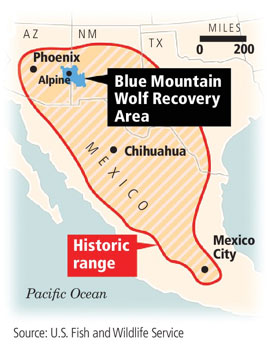
Arizona Map

Wolf-relocation project struggles as lobos fall prey to guns and cars…

By Brandon Loomis The Republic  |  azcentral.com, Sat May 25, 2013 11:25 PM

“ALPINE — A brown-streaked wolf — named Ernesta by her admiring captors — bounded from a crate and onto Arizona soil. She carries in her womb the newest hopes for a rare native species that is struggling to regain a footing in the Southwest.

Her government-sponsored April 25 relocation with her mate, from New Mexico’s Sevilleta National Wildlife Refuge to a mountain south of Alpine, was the first in the state for a captive-bred pair of Mexican gray wolves in more than four years.

The last time a new canine couple sniffed freedom in these mountains, in fall 2008, they didn’t last the winter. Someone shot the female almost immediately, and the male disappeared by February.

“It’s a tough life for wolves in the wild,” Endangered Wolf Center animal-care director Regina Mossotti said after watching the latest pair bolt from their crates last month in the Apache-Sitgreaves National Forests. The Missouri non-profit center is part of a breeding program and has nurtured both of the transplanted wolves at times. Mossotti felt a special kinship with the female she helped raise, and she was a little anxious.

“It’s like seeing a child graduate from high school and go off into the world,” Mossotti said.

There is reason to worry.

Fifteen years after America reintroduced lobos to the Southwest, only 75 ran wild at the end of 2012. Officials celebrated that record high as a small victory, but it’s a tenth of what scientists on a 2005 panel proposed as a recovery goal. Humans have killed dozens of reintroduced wolves, mostly through illegal shootings and vehicle collisions.

As of 2011, the federal, state and tribal agencies involved estimated they had spent about $26 million studying, breeding and restoring Mexican wolves over about 20 years. The U.S. Fish and Wildlife Service paid the biggest share, nearly $17 million. The Arizona Game and Fish Department paid $2.5 million and used another $3 million in federal funds.

Wolf advocates fear the animals’ extinction unless the government increases the frequency of the releases, adopts a population goal and extends the wolf a welcome mat beyond the current recovery area in far eastern Arizona and western New Mexico — perhaps to the Grand Canyon’s North Rim. Those are long-sought wishes that have languished as ranchers and hunters pushed back and the government stuck with a plan that limits wolves to the Blue Mountains.

“The Mexican wolf’s fate really hangs in the balance between the promise that we’ve long heard of scientific management and the reality that we’ve long experienced of politicized management,” said Michael Robinson, New Mexico-based wolf advocate with the Center for Biological Diversity.


Conflict in cattle country

John Hand has raised cattle across the state line in Catron County, N.M., since 1953. He said the Fish and Wildlife Service made a mistake bringing wolves back. It’s ranch country, he said, and the unavoidable conflicts mean the restoration is “doomed to fail.”

Wildlife agents confirmed wolves killed 18 cattle and one mule last year. The previous year’s toll was 20 cattle, a horse and a sheep. An interagency compensation fund helps offset losses.

Although wolves enjoy federal protection as an endangered species, their status here as an experimental population gives ranchers a right to defend cattle. They can legally shoot wolves that are attacking their stock on private land, and can report them to government officials for potential agency-directed trapping or killing after repeated offenses on public lands.

“I don’t want them on (our ranch),” Hand said. “If they come here, it’s not something we’ll tolerate. We’d probably shoot them. Our neighbor shot one not too long ago.”

That means Ernesta and family are endangered in more than just the legal sense.

Since she was relocated near Alpine, Ernesta, also known as F1126, is thought to have whelped an unknown number of pups and nursed them in a wooden denning box inside a fenced enclosure with a 473-foot perimeter. There the animals are getting acclimated and nervously accepting road-kill offerings until early June, when biologists will swing open the gates and leave the wolves to the forest. The pair are the 93rd and 94th captive-reared Mexican wolves released by federal biologists.

If they avoid bullets, bumpers, snakes, lightning and every other hazard that has prematurely killed 92 lobos since their 1998 reintroduction, they will form what biologists are calling the Coronado Pack. They also must avoid killing livestock and keep their distance from homes, or they could face the management actions that have killed another 12.

It’s a big “if” for the Mexican gray wolf, a subspecies of gray wolves that has not rebounded from the brink the way its larger cousins did in the northern Rockies after they were reintroduced in the 1990s. Canadian transplants there have produced thousands of offspring in the Yellowstone and central Idaho wildernesses.

Arizona lacks the vast, roadless forests of the north. Yellowstone National Park alone is half the size of the Mexican wolf’s currently designated recovery zone.

Another difference, according to Mexican wolf recovery coordinator Sherry Barrett, is that the northern wolves were transplanted from the wild and not from captivity. Biologists and veterinarians try to minimize human contact in captivity, but the animals are comparatively naive when released.

The Southwestern lobos also are smaller than their cousins — about 60 to 80 pounds — and are not impervious to elk hooves and antlers.

Then there’s the shooting.

“All of these wolves are relatively accessible,” Barrett said. “Whether it’s malicious or mistaken identity, we do experience regular mortality.”

Illegal shootings — 46 so far and four prosecutions — are an echo of an eradication program earlier in the 20th century, when ranchers and government trackers shot and poisoned Mexican gray wolves almost to extinction.

By the early 1980s, the species was down to seven genetically distinct animals to start a captive breeding program.

From those, dozens of wildlife centers have bred and maintained up to 300 at a time in captivity (currently 258). Attitudes toward wolves softened as ecologists stressed predators’ role in maintaining natural ecosystems, and former Arizona governor and U.S. Interior Secretary Bruce Babbitt oversaw the wolf’s initial return during the Clinton administration.

A controversial return

The return was controversial, especially in the small towns most affected. Travis Udall, an Eagar school superintendent and a hunter, said wolves have struck the deer population and sometimes have struck fear in people.

“We’ve had a couple wolves follow us when we were hunting,” Udall said. “They say it’s curiosity, but it’s kind of unnerving.”

The recovery program generates hard feelings, he said. Locals feel imposed upon in a way they might not if wolves were left to recover or fade on their own.

“It feels forced,” he said.

Arizona has at times been a wary partner in the restoration. The Arizona Game and Fish Department in March said it wanted to hold the line at 100 wild Mexican wolves and remove endangered-species protections. A 1980s plan mentioned 100 as a first target, but wolf allies say that’s only because 100 seemed such a lofty goal from zero.

Managing for both hunters and animals can be tricky, and each release is made in consultation with the state.

“Wolves like to hunt elk and deer,” Game and Fish field team leader Chris Bagnoli said, “but so do people. So we want to make sure we have a good balance of all uses of the landscape.”

It would help, he said, if the program were permitted to spread beyond the Blue Mountains to dilute the local effects. But he said he believes the wolves are slowly breeding success. Their numbers grew by 15 in the last year. “I think we’re progressing,” he said.

Many conservationists hope that a new recovery plan will include two new wolf zones: one north of the Grand Canyon and one in southern Colorado and northern New Mexico. These would help disperse wolves to reduce in-breeding — which reduces litter sizes — and protect against extinction during disease outbreaks.

“All of the science done to date points to the fact that there’s good habitat for wolves and good prey in northern New Mexico, southern Colorado and the Grand Canyon eco-region,” said Eva Sargent, Southwest program director for the non-profit Defenders of Wildlife. “The (Fish and Wildlife) Service really needs to be paving the way for all of that to happen. But instead of paving the way, I can tell you that the recovery team hasn’t met since 2011.”

That year, Utah’s governor and wildlife chief learned that the Fish and Wildlife Service was considering adding southern Utah to the wolf-recovery zone. Utah’s forests could offer spillover habitat for wolves released around the Grand Canyon. They wrote a letter to Washington in protest.

No detailed recovery plan

The program is operating under a 1982 plan that didn’t spell out conditions to meet before removing Endangered Species Act protections. The Fish and Wildlife Service had said it would produce a detailed plan last year, but it hasn’t. Barrett declined to say when it would be completed, and said discussions about potential recovery zones are internal.

The wild population needs more new blood like Ernesta and her pups, Sargent said. But without a science-based plan, the creature faces “extinction by bureaucratic delay.”

Barrett and Arizona officials say there are reasons not to rush releases, especially in family groups. First, the wolves must be monitored together to ensure that they bond and that they are wary of humans. They are conditioned against cattle predation with a nauseating substance fed to them in ground beef. There also has to be a promising, unoccupied range available for a new pack, and by rule the government can only release captive-bred wolves on the Arizona side of the recovery zone.

“We’re learning as we go,” Barrett said.

“It has been very, very slow,” said Phil Hedrick, an Arizona State University conservation biologist and geneticist. He twice served on Mexican wolf recovery planning teams that the Fish and Wildlife Service shut down without writing guidelines or population goals. He fears federal and state biologists have missed their window of opportunity for maximizing genetic diversity.

“The reasons why the numbers haven’t gone up are based on the killing,” Hedrick said, “and lack of active management.”

His last participation was in 2005, when he and other scientists recommended 750 wolves in three distinct populations. After that meeting, silence. The Bush administration never codified that plan and never explained why.

In the meantime, the Coronado Pack is getting the best start possible.

In New Mexico, a veterinarian vaccinated the parents and poured alcohol on their foot pads to help them cool down after a wall of 22 volunteers and agency workers closed in and spooked them into a box where they could be pinned by steel bars and blindfolded for safe transport.

In Arizona, they emerged into daylight just down a gravel road from the ignition point of the massive 2011 Wallow Fire. The largest wildfire in state history torched trees but recharged grass and shrub growth that should feed lots of elk and deer. The elements of a good life are all there.

Now it’s on Ernesta to live or die.”

**Special thanks to By Brandon Loomis The Republic  |  azcentral.com, for providing this information!
Read Full Post »


Gray Wolf Pup

“ALBUQUERQUE, N.M.—Officials confirmed Wednesday that an animal killed by a federal employee in southwestern New Mexico in January was a Mexican gray wolf.

The U.S. Fish and Wildlife Service said genetic tests confirmed it was a small, uncollared female. More tests are under way to determine which pack the wolf was associated with.

In January, an employee with the U.S. Department of Agriculture’s Wildlife Services shot what officials described at the time as a “canine.” The employee reported the shooting because the animal looked like a Mexican wolf after closer inspection.

The wolf was shot from about 250 yards away, officials said.

“Our specialist, at the time, was upset and that’s why he reported it. Still, we’re disappointed that it occurred,” said Carol Bannerman, a spokeswoman at Wildlife Services headquarters.

The Mexican gray wolf was added to the federal endangered species list in 1976. The effort to reintroduce the wolves in New Mexico and Arizona has stumbled due to legal battles, illegal shootings and other problems.

Federal officials have been tightlipped about the January shooting. They have not said what prompted the employee to shoot but implied that he may have thought it was a coyote. The employee was in the Mangas area investigating cattle deaths when the shooting occurred.

Bannerman said the employee remains on the job and the agency is cooperating with the Fish and Wildlife Service.  The case been turned over to the U.S. attorney’s office for review.”

*Special thanks to The Associated Press, http://www.ruidosonews.com/ci_23098618/feds-confirm-employee-killed-mexican-gray-wolf for providing this information!

Read Full Post »


Gray Wolf Pup

“GRAND RAPIDS, MI — Does a proposed law working through the state Senate put Michigan wolves in danger?

A number of letter writers say the public should have a direct say in protecting wildlife from hunters, and stand in opposition to a bill co-sponsored by Grand Rapids-area state Sens. David Hildenbrand, R-Lowell, and Arlan Meekhof, R-West Olive.

Pat Hartsoe attended a recent hearing in Lansing:

Last week I attended the Senate Committee on Natural Resources, Environment and Great Lakes. I came away feeling marginalized by the thinly-veiled political process I witnessed. Senate Bill 288 (co-sponsored by State Sen. Dave Hildenbrand, R-Lowell) was discussed.

SB 288 would allow the Natural Resources Commission to designate animals as “game species.” This bill was quickly introduced April 9, shortly after 250,000 registered voter signatures were delivered to the Secretary of State office in Lansing. I helped collect those signatures during bitter winter weather. The petition would require a public vote in 2014 on wolf hunting.
One problem with SB 288 is that if the NRC designates an animal a game species, concerned citizens would not be able to reverse this decision with a ballot referendum as they could with legislative decisions. Further, the NRC is an appointed, not elected, group.

Only one member has a science background. Two nationally-recognized scientists from Michigan’s Upper Peninsula with 30 years of wolf research experience were never consulted. After hearing public input, a 5 to 2 vote in favor was quickly taken. The bill moved to the Senate and could become law in less than two weeks.

I see a disturbing pattern developing in Michigan politics. In my opinion, if individuals get involved with legal, organized and timely opposition to an issue, politicians shouldn’t disenfranchise them by passing quickly-crafted and referendum-proof laws.

Think emergency manager. Think right to work. Think keep Michigan wolves protected. I am sorely disappointed by what I witnessed in Lansing.

PAT HARTSOE Grand Rapids

People should vote on hunting issues

In a deliberate attempt to circumvent the constitutional rights of the voters in Michigan, State Sen. Senator Tom Casperson (R-Escanaba) introduced Senate Bill-288 on April 9, 2013. It was approved by a 5 to 2 vote by the Natural Resources, Environment, and Great Lakes Committee and eventually goes to the Governor to be signed into law.

This bill would effectively nullify the efforts of a coalition of over 2,000 conservationists, Native American tribes, scientists and animal welfare interests who turned in more than 255,000 signatures from Michigan voters to place Public Act 520, listing wolves as a game species, to a referendum vote in November 2014.

SB 288 is an obvious attempt to prevent citizens from being able to conduct a constitutionally-guaranteed right to ballot referendum to reverse decisions by the legislature.

In 2006, Michigan voters overwhelmingly rejected a law to allow sport hunting of mourning doves – showing their desire to have the right to vote on wildlife issues. Voters rejected this, casting more votes against shooting doves than they did for any candidate that election. If SB 288 passes, this decisive outcome would be reversed.

SB 288 is a blatant display of political bullying that will put Michigan’s declining wolf population further at risk.

This bill is an extreme power grab by politicians and a deliberate attempt to subvert democracy and silence the voices of Michigan voters.

This type of political maneuvering by our elected officials must be stopped.

HARRY T. EDWARDS Kent City Wolf bill is an abuse of power

A few weeks ago, the Keep Michigan Wolves Protected campaign submitted over 255,000 signatures from registered Michigan voters opposed to sport hunting for wolves. This right to seek a voter referendum on legislation is guaranteed in the Michigan Constitution.

Unfortunately, the politicians in Lansing who most want to see wolves, recently introduced legislation (SB 288) which is exclusively aimed at nullifying this referendum and assuring that Michigan citizens never have a say again in hunting issues. This is not an exaggeration.

The legislation specifically removes all authority of citizens to have a voice about which animals are hunted in Michigan.

Even if you are in favor of hunting wolves, you should be very upset about this abuse of power. Drafting legislation specifically to silence Michigan voters who are following a constitutionally-guaranteed process is a stunning insult to democracy.

Please contact your state senator and state representative immediately and insist that they VOTE NO on SB 288.

TOM LYON New Era

People should decide on wolves

There is a new bill SB288 going through the State Senate this week that will take away all rights of the people of the state to make decisions on any wildlife.

Keep Michigan Wolves Protected collected and submitted 253,000 signatures from people around the state to put the upcoming wolf hunt on the Michigan Ballot in 11/2014. In the meantime, the hunt would be on hold until after the people voted.

Well, Sen. Tom Casperson submitted a bill this last week that would take all rights away from the citizens to have a say on any wildlife issues for all time. It would make the signatures mute, and silence the people and their wishes. This bill will change the constitution of the state and take away peoples voices on any wildlife issues.

He is upset because the wolf hunt which he had submitted, got the brakes put on it by the citizens of the state. So now he is attempting to take away all citizens rights when it comes to wildlife. People need to speak out.

They are changing a law that has been in place since 1908. And ballot proposals in the past that wanted to change our state constitution, were all readily defeated. This bill needs to be stopped. People need to contact their senators and reps……and quickly.  It could be law within eight days.

DOROTHY RODGERS Georgetown Township

Lawmakers not following will of the people

Not surprisingly, once again in our State legislature it appears that there is a “do as I say and not as I do” mentality. I am speaking in regard to SB 288 which is being fast tracked to a vote by State Sen. Tom Casperson R-Escanaba. This bill would sign legislation into law that would circumvent Michigan voter’s right to referendum, and includes a non-related appropriation that prevents the voters from rejecting the measure by referendum.

This bill, this is the good Senator’s response to the 253,000 signatures that were delivered to the Secretary of State in March, asking that another bill he was fast tracking; to allow a wolf hunt in Michigan, be put to Voter referendum in 2014.

Apparently Mr. Casperson, who prides himself on being a “sportsman” has no problem trying to write legislation that takes away Michigan voter rights when he doesn’t get his way. In this case, a trophy wolf hunt. This is truly unsportsmanlike conduct in the highest degree as the Senator has little or no regard for due process, let alone the opinions of 253,000 voters…..which was simply to let us decide whether a wolf hunt would be in the best interest of all of Michigan’s residents.

Regardless of how you feel about hunting, this bill works to undermine our right to referendum and to keep our lawmakers in check. I urge you, call or write your legislators and urge them to vote no on SB288.

MARGO BURIAN Grand Rapids”

**Special thanks to:  MLive/Grand Rapids Press guest opinion The Grand Rapids Press, for providing this information!     
Read Full Post »


mexicanwolf

“Common sense writing on Montana wolves, I  thought  it was worth sharing.

Are you listening to their howls Governor Bullock? Wolves are treasured by real Montanans who care about wild places and wilderness. Be bold! Don’t listen to the crazy rhetoric, it’s not grounded in fact.

===

BOLD VISIONS CONSERVATION

This week’s Sunday Sermon Vol. 1  No. 2

Montana Governor Steve Bullock

and the politics of Wolves

 Stephen Capra

 There was a time when I use to think politics really mattered. I remember going to a rally for Senator Eugene McCarthy, as he ran for President in 1968, in Madison Square Garden, the energy and belief could really change our nation, or so I thought.

I really believed that democrats would change our country, by the end of that year our heart had been stolen by too many bullets, to many great leader’s had fallen. I think of that today with the state of affairs in Montana, a state led by ignorance, political pandering and a Governor who fancies himself progressive.

This all comes back to our heart being stolen. In this case it’s not men that have fallen, its wolves. I have watched as Montana shared in the magical return of wolves to Yellowstone, watched as tourists have flocked from around the world, watched in Lamar Valley as you could not estimate the price of cameras in a one-mile stretch, all focused on wolves. Since President Obama sold wolves out and the Endangered Species Act on a rider that ensured another Democrat would get re-elected, Senator Jon Tester, clear thinking shows us that faith in political leaders is very overrated.

Over the past few months the Montana Legislature, seemingly some of the most ill-informed, and job destroying group of people God ever put under one roof, spent the majority of their time trying to find new ways of killing wildlife. Spear-hunting was a hot topic, yes spear-hunting. Of course, new ways to kill, more jobs. Yet, when it came to wolves and bison, this group could not have enough blood on their hands. If it was not so heartbreaking, it would be funny. Listening to Montana Game and Fish talk about “responsibly harvesting” predators, none of it with any science worth discussing.

This is a group designed to kill animals, not protect. New bills are now being introduced. to allow silencers on guns to protect the precious ears of hunters; continuing to allow dead wolf members to be used as traps set to kill the rest of the family; making licenses easier and cheaper. New non-resident permits can be had for $50.

When Governor Bullock panders to the wolf hating bunch, he opens the door to killing more beautiful animals and their family units slaughtered by ignorance and by the ego that demands reelection. If Democrats do not have the guts to stand up for wolves, [by standing up I mean vocally,] publicly, and ignore the stupidity of state Game and Fish departments, there will be shooting in the dens of newborn pups. Introduction of strong and important protections for wolves must happen now and end the shameless pain of trapping once and for all. The Governor is aware that people come from all over the world (meaning serious tourist dollars) to observe wolves.

  The whining rancher scenario is a SNORE.

I believe in wolves, I love bison. I am sick and tired of Democrats that want only their reelection and refuse to acknowledge how important wildlife is to our humanity. I challenge them to causality.

 It amazes me that some people can feel nothing when confronted with wild animals. For me it is so magical, such a spiritual experience. I have seen grizzlies in the wild, wolves and bison. It is a gift; there is more than enough land to share. Throughout our history we have destroyed as a means of growth for man to feel magisterial.

 William Beebe said it so well, “When the last individual of a race of living things breaths no more, another heaven and earth must pass before such a one can begin again.”

 I was inspired in 1968. I look forward to being inspired once again, but my Democratic party and Governors like Bullock must become inspiring, must take chances, and must become a voice for those who cannot speak.

 Don’t be redundant Governor, wolves belong! Be BOLD!

Let your soul heal in the wild spirit that wolves bring to us. Amen!”


**And of course, special thanks goes to Stephen Capra and “Howling for Justice” for providing and sharing the information in this article!

Read Full Post »


Food and Farm-Targeting Wolves

“The resumption of wolf-hunts in Idaho, Montana and Wyoming illustrates why citizens must continue to oppose such unnecessary and senseless slaughters.

The wolf-hunts are predicated upon morally corrupt and inaccurate assumptions about wolf behavior and impacts that is not supported by recent scientific research. State wildlife agencies pander to the lowest common denominator in the hunting community—men who need to booster their own self esteem and release misdirected anger by killing.

Wolf-hunts, as Montana Fish and Game Commission Chairman Bob Ream noted at a public hearing, are in part to relieve hunters’ frustrations—frustration based on inaccurate information, flawed assumptions, and just plain old myths and fears about predators and their role in the world.

Maybe relieving hunter frustration is a good enough justification for wolf-hunts to many people. However, in my view permitting hunts to go forwards without even registering opposition is to acquiesce to ignorance, hatred, and the worse in human motivations. Thankfully a few environmental groups, most notably the Center for Biological Diversity, Wildearth Guardians, Alliance for Wild Rockies and Western Watersheds had the courage and gumption to stand up to ignorance and hatred.

All of the usual justifications given for wolf-hunts are spurious at best. For instance, one rationale given for hunting wolves is to reduce their presumed affects on big game populations. Yet in all three states, elk and deer populations are at or exceed population objectives for most hunting units.

For instance in Wyoming, one of the most vehement anti wolf states in the West, the 2010 elk population was 21,200 animals over state-wide objectives, and this did not include data for six herds, suggesting that elk populations are likely higher. Of the state’s elk herds most were at or above objectives and only 6 percent were below objectives. Similar data is found for Idaho and Montana elk herds as well.

However, you would not know that from the “howls” of hunters who characterize the elk populations as suffering from a wolf induced Armageddon. And Fish and Game departments are loath to counter the false accusations from hunters that wolves are somehow “destroying” hunting throughout the Rockies.

Experience in other parts of the country where wolves have been part of the landscape longer suggests that in the long term, wolves while they may reduce prey populations in certain locales generally do not reduce hunting opportunities across a state or region. Despite the fact that there more than double the number of wolves in Minnesota (3000+) as in the entire Rocky Mountain region, Minnesota hunters experienced the highest deer kills ever in recent years, with Minnesota deer hunters killing over 250,000white-tailed deer during each of those hunting seasons – an approximate five-fold increase in hunter deer take since wolves were listed under the ESA in 1978.

Another claim made by wolf-hunt proponents is that hunting will reduce “conflicts” with livestock owners. Again this assertion is taken as a matter of faith without really looking into the veracity of it. Given the hysteria generated by the livestock industry one might think that the entire western livestock operations were in jeopardy from wolf predation. However, the number of livestock killed annually by wolves is pitifully small, especially by comparison to losses from other more mundane sources like poison plants, lightning and even domestic dogs.

For instance, the FWS reported that 75 cattle and 148 sheep were killed in Idaho during 2010. In Montana the same year 84cattle and 64 sheep were verified as killed by wolves. While any loss may represent a significant financial blow to individual ranchers, the livestock industry as a whole is hardly threatened by wolf predation. And it hardly warrants the exaggerated psychotic response by Congress, state legislators and state wildlife agencies.

In light of the fact that most losses are avoidable by implementation of simple measures of that reduce predator opportunity, persecution of predators like wolves is even more morally suspect. Rapid removal of dead carcasses from rangelands, corralling animals at night, electric fencing, and the use of herders, among other measures, are proven to significantly reduce predator losses—up to 90% in some studies. This suggests that ranchers have the capacity (if not the willingness) to basically make wolf losses a non-issue.

However, since ranchers have traditionally been successful in externalizing many of their costs on to the land and taxpayers, including what should be their responsibility to reduce predator conflicts, I do not expect to see these kinds of measures enacted by the livestock industry any time soon, if ever. Ranchers are so used to being coddled; they have no motivation or incentives to change their practices in order to reduce predator losses. Why should they change animal husbandry practices when they can get the big bad government that they like to despise and disparage to come in and kill predators for them for free and even get environmental groups like Defenders of Wildlife to support paying for predator losses that are entirely avoidable?

But beyond those figures, wolf-hunting ignores a growing body of research that suggests that indiscriminate killing—which hunting is—actually exacerbates livestock/predator conflicts. The mantra of pro wolf-hunting community is that wolves should be “managed” like “other” wildlife. This ignores the findings that suggest that predators are not like other wildlife. They are behaviorally different from say elk and deer. Random killing of predators including bears, mountain lions and wolves creates social chaos that destabilizes predator social structure. Hunting of wolves can skew wolf populations towards younger animals. Younger animals are less skillful hunters. As a consequence, they will be more inclined to kill livestock. Destabilized and small wolf packs also have more difficulty in holding territories and even defending their kills from scavengers and other predators which in end means they are more likely to kill new prey animal.

As a result of these behavioral consequences, persecution of predators through hunting has a self fulfilling feedback mechanism whereby hunters kill more predators, which in turn leads to greater social chaos, and more livestock kills, and results in more demands for hunting as the presumed solution.

Today predator management by so called “professional” wildlife agencies is much more like the old time medical profession where sick people were bled. If they didn’t get better immediately, more blood was let. Finally if the patience died, it was because not enough blood was released from the body. The same illogical reasoning dominates predator management across the country. If killing predators doesn’t cause livestock losses to go down and/or game herds to rise, it must be because we haven’t killed enough predators yet.

Furthermore, most hunting occurs on larger blocks of public lands and most wolves as well as other predators killed by hunters have no relationship to the animals that may be killing livestock on private ranches or taking someone’s pet poodle from the back yard. A number of studies of various predators from cougars to bears show no relationship between hunter kills and a significant reduction in the actual animals considered to be problematic.

Again I hasten to add that most “problematic predators” are created a result of problem behavior by humans—for instance leaving animal carcasses out on the range or failure to keep garbage from bears, etc. and humans are supposed to be the more intelligent species—though if one were to observe predator management across the country it would be easy to doubt such presumptions.

Finally, wolf-hunting ignores yet another recent and growing body of scientific evidence that suggests that top predators have many top down ecological influences upon the landscape and other wildlife. The presence of wolves, for instance, can reduce deer and elk numbers in some places for some time period. But rather than viewing this as a negative as most hunters presume, reduction of prey species like elk can have many positive ecological influences. A reduction of elk herbivory on riparian vegetation can produce more song bird habitat. Wolves can reduce coyote predation on snowshoe hare thus competition for food by lynx, perhaps increasing survival for this endangered species. Wolves have been shown to increase the presence of voles and mice near their dens—a boon for some birds of prey like hawks. These and many other positive effects on the environment are ignored by wolf-hunt proponents and unfortunately by state wildlife management agencies as well who continue to advocate and/or at least not effectively counter old fallacies about predators.

Most state agencies operate under the assumption that production of elk and deer for hunters to shoot should have priority in wildlife management decisions. All state wildlife agencies are by law supposed to manage wildlife as a public trust for all citizens. Yet few challenge the common assumption that elk and deer exist merely for the pleasure of hunters to shoot.

I have no doubt that for many pro wolf-hunt supporters’ predators represent all that is wrong with the world. Declining job prospects, declining economic vitality of their rural communities, changes in social structures and challenges to long-held beliefs are exemplified by the wolf. Killing wolves is symbolic of destroying all those other things that are in bad in the world for which they have no control. They vent this misdirected anger on wolves– that gives them the illusion that they can control something.

Nevertheless, making wolves and other predators scapegoats for the personal failures of individuals or the collective failures of society is not fair to wolves or individuals either. The entire premises upon which western wolf-hunts are based either are the result of inaccurate assumptions about wolf impacts or morally corrupt justifications like relieving hunter anger and frustrations over how their worlds are falling apart.

I applaud the few environmental groups that had the courage to stand up for wolves, and to challenge the old guard that currently controls our collective wildlife heritage. More of us need to stand up against persecution of wildlife to appease the frustrations of disenfranchised rural residents. It is time to have wildlife management based on science, and ecological integrity, not based upon relieving hunter frustrations over the disintegration state of their world.”

For on predator studies and management see http://www.thewildlifenews.com/wp-content/uploads/2011/06/Predator-report.pdf

**Special thanks to George Wuerthner,  an ecologist and former hunting guide with a degree in wildlife biology, for providing this information!

Read Full Post »


Arizona Republic, March 20, 2013 (posted 3/21/13) Letters to the Editor Needed!

By Brandon Loomis

“The Arizona Game and Fish Commission on Wednesday voted to back an effort by Western lawmakers to remove gray wolves from the endangered-species list.

The commission unanimously supported a letter by Sen. Orrin Hatch, R-Utah, and Rep. Cynthia Lummis, R-Wyo., asking the U.S. Fish and Wildlife Service to drop federal protections for wolves nationwide.

That would include Mexican gray wolves, which have struggled to find a foothold in the Southwest since reintroduction in 1998, though the commission reasserted its support for at least 100 “wolves on the ground.”

That’s a number that wolf supporters find unacceptable, and they don’t trust the state to nurse the animals to a fully recovered population.

But Hatch and Lummis, in their March 15 letter to Fish and Wildlife Service Director Dan Ashe, said that wolves are not endangered and that states don’t need federal meddling on the predators’ behalf.

“Unmanaged wolves are devastating to livestock and indigenous wildlife,” they wrote. “Currently, state wildlife officials have their hands tied any time wolves are involved.”

Commission Chairman Jack Husted said wolves in the northern Rocky Mountains — reintroduced in the 1990s, just like Arizona’s — have thrived to the point that they are damaging prey populations such as elk. Idaho, Wyoming and Montana have hosted more than 1,000 wolves between them for years. “We’ve time and again voiced our support for wild wolves on the ground (in Arizona),” Husted said, “but not in unlimited numbers.”

When federal officials released Mexican gray wolves from captive breeding programs into the mountains of eastern Arizona and western New Mexico, they discussed an initial goal of 100 animals.

They were unsure how many might actually be needed to support a perpetual population and left that prescription to be determined in a recovery plan that still has not been completed.

Although federal biologists this year reported a record number of wild Southwestern wolves — 75, split about evenly between the two states — wolf proponents say it’s nowhere near a safe number. They’re awaiting the recovery plan, which could designate new areas for reintroduction, such as the forests around the Grand Canyon.

Gray wolves’ legal status is complicated. Alaska’s plentiful packs have long been state-managed. Wolves brought from Canada to the northern Rockies, like those rebounding naturally in the upper Great Lakes states, have thrived to the point that federal officials have already dropped them from the endangered list.

But any that take up residence outside their official recovery zones — in eastern Utah, for instance — would enjoy full federal protection.

The Southwest’s wolves are physically the smallest North American subspecies and numerically the smallest population, and they remain legally protected from such actions as sport hunting.

Hatch and Lummis seek a blanket removal of federal oversight.

Sandy Bahr, director of the Sierra Club’s Grand Canyon chapter, said the commission would have more credibility in backing that move if the state had ever seriously supported wolf recovery.

“There’s no demonstration of commitment,” she said. Seventy-five animals don’t add up to success, she added. “Common sense tells you these are endangered animals.”

Defenders of Wildlife also condemned the commission’s vote, saying it defies polls that have shown that most Arizonans support wolf recovery.

This article was published in the Arizona Republic.
****************************************************************************************************************
Please write a letter to the editor today, thanking the paper for this article and opposing AZ Game and Fish Commission’s irresponsible position of support for delisting gray wolves nationally.
The letters to the editor page is one of the most widely read, influential parts of the newspaper. One letter from you can reach thousands of people and will also likely be read by decision-makers.  Tips for writing your letter are below, but please write in your own words, from your own experience.

Letter Writing Tips & Talking Points

Below are a few suggestions for ensuring your message gets through clearly-your letter will be most effective if you focus on a few key points, so don’t try to use all of these. If you need additional help or want someone to review your letter before you send it, email it to info@mexicanwolves.org.

Start by thanking paper for publishing this article. This makes your letter immediately relevant and increases its chances of being published.

Convey your outrage that once again the AZ Game and Fish Commission is attempting the undermine the survival of the Southwest’s native Mexican gray wolf. The Commission has a public trust responsibility to protect all of Arizona’s wildlife, especially endangered animals like the lobo. The Commissioners have betrayed that trust by advocating the removal of endangered species protections for wolves in all of the lower 48 states. It’s time they stopped trying to hinder the wolves’ recovery.

Remind readers that, at last count, just 75 Mexican gray wolves, including three breeding pairs, survived in the wild. These native wolves are critically endangered. New releases and additional populations of these wolves are desperately needed for them to thrive. Endangered species protections are critical to their survival. But AZ Game and Fish has consistently tried to undermine the wolves and will continue to do so if lobos become subject to state management.

Tell readers why you support wolves and stress that the majority of Arizona residents support wolves and understand their importance.   Polling done by Research and Polling, Inc. found 77 percent of Arizona respondents support the reintroduction of Mexican gray wolves. The poll also showed strong majority support for giving wolves greater protection under the Endangered Species Act. The Commission’s decision is an affront to the majority of Arizonans who value wolves and welcome the economic and ecosystem benefits they bring.

Convey how urgent it is for people to contact their elected officials in congress now to urge them to oppose national delisting of wolves. As the majority, we can make our voices heard above the commission if we reach out to our members of congress. Arizona letters can specifically thank Representatives Grijalva, Sinema, and Barber for their opposition to national delisting; they can also urge, by name, the other AZ Senators and Representatives who have not yet done so to step forward for wolves. Click here for information about members of Congress.

Talk about your personal connection to wolves and why the issue is important to you. If you’re a grandmother wanting your grandchildren to have the opportunity to hear wolves in the wild, or a hunter who recognizes that wolves make game herds healthier, or a businessperson who knows that wolves have brought millions in ecotourism dollars to Yellowstone, say so.

Describe the ecological benefits of wolves to entire ecosystems and all wildlife. Wildlife biologists believe that Mexican wolves will improve the overall health of the Southwest and its rivers and streams – just as the return of gray wolves to Yellowstone has helped restore balance to its lands and waters. Science has repeatedly demonstrated that wolves are keystone carnivores who help to keep wildlife like elk and deer healthy and bring balance to the lands they inhabit.

Keep your letter brief, between 150-200 words.

Provide your name, address, occupation, and phone number; your full address, occupation, and phone number will not be published, but they are required in order to have your letter published.”

**Special thanks to Brandon Loomis, http://www.mexicanwolves.org/index.php/news/937/51/In-the-News-Arizona-commission-backs-request-to-remove-wolves-from-endangered-list/d,News2) for providing the information in this article!

Read Full Post »


Center for Biological Diversity

For Immediate Release, December 10, 2012

Contact: Michael Robinson, (575) 534-0360

Lawsuit Filed to Protect Mexican Gray Wolf as Endangered Subspecies

Bureaucratic Limbo Threatens 58 Wolves Left in Arizona, New Mexico

“SILVER CITY, N.M.— The Center for Biological Diversity sued the U.S. Fish and Wildlife Service today over the agency’s rejection of a 2009 scientific petition from the Center that sought classification of the Mexican gray wolf as an endangered subspecies or population of gray wolves. Mexican wolves are currently protected as endangered along with all other wolves in the lower 48 states, with the exception of those in the northern Rocky Mountains and Great Lakes region. In filing today’s suit, the Center said specific protection for Mexican wolves is needed to ensure their recovery.

“Mexican wolves are the smallest, most genetically distinct of all gray wolves in North America, uniquely adapted to the dry lands of the Southwest,” said Michael Robinson, the Center’s wolf specialist. “We’re filing our second lawsuit in three weeks on their behalf because these very rare animals are on the razor edge of extinction due to federal mismanagement, persecution and neglect. We don’t want to look back in 10 years and wonder if there was anything else we could have done to save them.”

Both lawsuits aim to help Mexican wolves recover. In November the Center sued the Fish and Wildlife Service to compel it to reform its ongoing wolf-reintroduction program in accordance with recommendations made by its own scientific panel in 2001. More than 10 years ago the agency promised to consider the reforms, and then, in 2007, it renewed this promise to a court; but it has never followed through. In seeking separate recognition of Mexican wolves through today’s lawsuit, the Center hopes to force the agency to implement the reforms and complete a new recovery plan, in the works since as far back as 1995.

“Fish and Wildlife has consistently failed to take action to ensure the survival and recovery of the Southwest’s one-of-a-kind wolves,” said Robinson. “The government’s stubborn refusal to follow the best science on wolf recovery is pushing the last Mexican gray wolves we have left way too close to the cliff of extinction.”

Nearly 15 years after Mexican wolves were first reintroduced to the Southwest, there are only 58 wolves in the wild; it has been four years since a new wolf was released from captive-breeding facilities. Scientists believe Mexican wolves may be suffering from genetic inbreeding, with reduced litter size and pup survivorship.

Following a lawsuit by the Center, reintroduction of Mexican wolves began in 1998. The reintroduction has been hampered by rules that require recapture of wolves who set up territories outside the narrowly defined recovery area and that do not allow release of captive wolves into New Mexico’s Gila National Forest, where there’s extensive suitable habitat. The reintroduction has also been hurt by an out-of-date 1980s recovery plan that does not specify a target for recovery. The Center’s two lawsuits seek to remedy both of these failings by getting the agency to enact reforms and protect Mexican wolves as a specific subpopulation. ”

The Center for Biological Diversity is a national, nonprofit conservation organization with more than 450,000 members and online activists dedicated to the protection of endangered species and wild places.

Read Full Post »


Posted November 13, 2012 in Saving Wildlife and Wild Places

“With wolf hunts underway in Idaho and Montana, we are headed back to court to challenge the latest removal of Endangered Species Act protections from wolves in the state of Wyoming. Wyoming and the U.S. Fish & Wildlife Service left us no choice, as Wyoming’s “wolf management” plan sanctions the complete eradication of wolves in approximately 85% of the state and requires Wyoming to maintain only 100 wolves and 10 breeding pairs in the entire state outside Yellowstone National Park and the Wind River Reservation. Only the northwest corner of Wyoming, in the area surrounding Yellowstone and Grand Teton National Parks, will allow for wolves, but regulated wolf hunting will also take place there.

While it is true that most of the wolves in Wyoming currently reside in that northwestern corner of the state, the Wyoming plan ensures that wolves will never be allowed beyond that imposed boundary – a policy of absolute intolerance for a species that our country just spent the last several decades working to recover. Furthermore, by restricting wolves to the northwest corner and reducing the number of wolves surrounding Yellowstone, Wyoming’s plan compromises the ability of wolves to successfully travel (and exchange DNA) between the Greater Yellowstone Ecosystem and the remaining wolf subpopulations in central Idaho and northwest Montana – a component that has been identified as critical to the survival of the entire Northern Rockies wolf population.

The Wyoming plan is almost identical to an earlier version that the U.S. Fish & Wildlife Service rejected as inadequate to protect wolves – and a federal judge found that it put the continued existence of the wolf in Wyoming “in serious jeopardy.” In fact, the Service spent years insisting that Wyoming needed to develop a credible statewide plan. But, repeatedly, Wyoming refused. And the U.S. Fish & Wildlife Service? Well, instead of keeping Endangered Species Act protections in place for wolves in Wyoming until the state adopted an acceptable management plan, the Service caved in to political pressure and approved a plan that is almost identical to the one they (and a federal court) previously rejected.

Wyoming’s plan takes us back to the exact eradication practices that endangered the wolf in the first place. The Endangered Species Act was created to remedy these very practices, not to reinstate them.  And while we certainly don’t think that wolves will need the protections of the Endangered Species Act forever, we believe that those protections should be in place until states like Wyoming commit to responsible statewide management that will ensure the continued survival of what has been one of our country’s greatest conservation success stories.”

**Special thanks to Sylvia Fallon, NRDC,  http://switchboard.nrdc.org/blogs/sfallon/standing_up_for_wyomings_wolve.html,   for providing this information!!

Read Full Post »


Nancy Jo Dowler, the president of the Timber Wolf Preservation Society, with Comet.

By STEVEN YACCINO

Published: November 1, 2012

“GREENDALE, Wis. — When people like Nancy Jo Dowler started raising wolves here decades ago, the animals were rare in Wisconsin and nearly extinct across the country.

Now the president of the Timber Wolf Preservation Society, Ms. Dowler, 66, cares for five full-grown purebreds. She bottle-fed them as pups and howls with them at passing sirens. The other day she gave one breath mints through a hole in the fence, passing it directly from her lips to his.

Hers seems a fairy tale world compared with the legal dogfights occurring beyond these kennels. Out there, Wisconsin is three weeks into its first wolf-hunting season, sanctioned by the State Legislature in April. Minnesota is scheduled to begin its first registered wolf hunt this weekend.

The legalization of wolf hunting in both states was devised to manage a rebounding wolf population after the federal government stopped listing the species as endangered in the region last year. Both have drawn lawsuits from local and national animal rights groups that fear the undoing of nearly four decades of work to restore a healthy number of wolves.

“We’ve spent a lot as a nation to protect them,” said Wayne Pacelle, president of the Humane Society of the United States, which in October announced a lawsuit against the federal Fish and Wildlife Service to restore protections for wolves. “These plans in Wisconsin and Minnesota are draconian, severe and unwarranted, and we think they may jeopardize the health and viability of this population.”

Since the wolf hunt began last month, at least 42 have been killed in Wisconsin. All told, officials expect 600 wolves will die at the hands of hunters and trappers in the two states before spring.

Wolves were once so numerous in the United States that ranchers and government agencies paid people to kill them. By the time the Endangered Species Act began protecting wolves in 1973, they were nearing extinction in the lower 48 states. Today, wolf numbers have grown to 4,000 and exceeded recovery goals in the western Great Lakes area, according to federal estimates.

But some of those packs have started to cause problems again for ranchers in northern Wisconsin and have cost the state hundreds of thousands of dollars in livestock reimbursement payments, said officials at the Wisconsin Department of Natural Resources. “Without controls, what we’ve seen in the state is a feeling of needing to take it into their own hands for folks that are frustrated,” said Kurt Thiede, head of the wildlife management program for the agency.

After the Wisconsin Legislature approved the wolf hunt, which ends Feb. 28, more than 20,000 people applied for the required license. The state awarded 1,160 permits and capped this year’s harvest at 201 kills, or roughly a quarter of its current wolf population.

In Minnesota, about 3,600 licenses were available to hunt up to 400 wolves, which would reduce the state’s numbers by about 15 percent.

“There ain’t too many people that have one hanging in their living room,” said Timothy Mueller, a hunter from Silver Cliff, Wis. He, like others with a wolf license, was waiting for winter because pelts will be thicker and the snow will make it easier to track the animals.

Yet some hunters who once proudly talked about the rare opportunity would now rather keep their adventures private. A number declined to speak about the controversy because of reported threats made against a hunter who was among the first to register his kill with the state.

“There are a lot of the claims about how easy this is and how this is senseless slaughter,” said Scott Meyer, a lobbyist for the United Sportsmen of Wisconsin. “When you see the terrain and the geographies of everything, you understand that the advantage is toward the wolf.”

Animal rights groups have little sympathy for the hunters. They argue that the state kill quotas do not properly account for other ways that wolves can die, like poaching and vehicular collisions and the killing of the animals by farmers and ranchers protecting their livestock. Those additional causes, they say, could put the animals at risk again.

On Oct. 15, the day Wisconsin’s wolf-hunting season began, two national groups — the Humane Society and the Fund for Animals — filed a 60-day notice of their intent to sue the federal government to restore wolf protections.

In addition, Wisconsin humane groups have filed a lawsuit to prohibit the use of dogs for hunting wolves, calling it cruel. Minnesota advocates also took legal action against their state in an attempt to stop its hunt, which lasts from Nov. 3 to Jan. 31. And Minnesota’s Chippewa tribes have banned wolf hunting and trapping on its reservation lands.

“The whole balance of nature, they don’t want to hear any of that,” said Ms. Dowler, criticizing hunters for killing the animals she has devoted years to protect. “People absolutely love them or they absolutely hate them. There are few people in the middle.”

This article has been revised to reflect the following correction:

Correction: November 3, 2012

A picture caption on Friday with an article about the friction between wolf hunters and those who want to protect the animals misidentified the city in Wisconsin where the Timber Wolf Preservation Society is located. As the article correctly noted, it is in Greendale, not in Glendale.”

*Special thanks to TheNew York Times for providing this information! http://www.nytimes.com/2012/11/02/us/friction-between-wolf-hunters-and-protectors-rises.html?_r=2&goback=.gde_2859887_member_181479466&

Read Full Post »


“Taking aim from a helicopter flying over northeastern Washington state, a marksman last month killed the alpha male of a wolf pack that had repeatedly attacked a rancher’s cattle. The shooting put an end to the so-called Wedge pack, but it did little to quell the controversy over wolves in the state.

The issue has been so explosive that state wildlife officials received death threats and the head of the Fish and Wildlife Commission warned the public at a recent hearing in Olympia on wolves that uniformed and undercover officers were in the room ready to act.

More conflicts between wolves and livestock are inevitable, officials say, as wolves in Washington recover, growing in number more quickly than expected. The animals numbered a handful in 2008, and are now estimated at 80 to 100.

“What are we going to do so we don’t have this again?” asked Steve Pozzanghera, a Washington Department of Fish and Wildlife regional director.

He said officials are trying to be proactive to prevent the need to kill wolves. They plan to collar more wolves this winter to keep better track of them. They plan to ask the Legislature to beef up money to compensate livestock owners whose animals are killed by wolves. And they’re urging livestock operators to sign agreements with the state to share the cost of using a broad range of nonlethal measures to prevent livestock-wolf conflicts.

So far, only one livestock owner has signed an agreement, with four to six others in the hopper, underscoring the challenges the agency faces as it tries to recover the endangered native species while encouraging social tolerance of the wolves by minimizing livestock losses.

“We understand there is some resistance out there,” said Pozzanghera, but the agency is committed to working with ranchers and cattlemen.

“The whole situation is really tragic, most of all because it could have been avoided,” said Jasmine Minbashian, of the nonprofit Conservation Northwest, which supported the decision in the end to kill the wolf pack because the animals had become reliant on livestock.

“If you remove the pack without changing something on the ground, this situation is bound to repeat itself,” she said.

The Stevens County Cattlemen’s Association is urging its roughly 50 members not to sign those agreements. It wants the commission to remove gray wolves from the state endangered list in eastern Washington in the near future.

“Our guys are willing to use these nonlethal methods … The problem is these methods are not always effective,” said the group’s spokeswoman, Jamie Henneman, noting the agreements address only symptoms. “The illness happens to be that we’re oversaturated with wolves.”

Grey wolves are protected as an endangered species throughout Washington state. The animals are federally listed as endangered only in the western two-thirds of the state. Removing the animals from the state endangered list could open the way to future wolf hunting.

While Montana, Idaho and Wyoming have been grappling with wolves in the past decade, Washington has dealt with wolves only in recent years. In 2008, a wolf pack was documented for the first time in 70 years. Now, there are eight confirmed packs, with four others suspected.

The killing of seven members of the Wedge Pack, named for the area they inhabit along the Canadian border near Laurier, has prompted an outcry from some wolf advocates. Some have criticized the owners of the Diamond M ranch for not taking enough nonlethal measures.

“As far as I know, we’ve done everything that they suggested might be effective,” Bill McIrvin said during a recent Olympia hearing. McIrvin is one of the owners of the ranch, where wolves killed or injured at least 17 animals on both private and public land. The ranch employed cowboys, delayed the turnout of their cow-calf pairs until the animals were bigger and quickly removed injured cattle, state officials said.

Wildlife officials say they’re working on new rules to compensate ranchers for losses, including for reduced weight gain or reduced pregnancy rates.

Ranchers who sign onto nonlethal agreements with Fish and Wildlife would have priority for livestock compensation.

Sam Kayser, an Ellensburg cattle rancher, said he signed an agreement with the state because he knows wolves will eventually target his cattle and he wanted help.

“What are the wolves going to eat? They’re going to eat elk. If the elk numbers go short, they’re going to eat my cattle,” said Kayser, whose cattle graze on thousands of acres of private land that he leases in central Washington.

“Fish and Wildlife (department) was trying to be proactive and I was trying to be a little proactive myself,” he added.

The state is sharing the cost of a range rider who stays with the cattle to make sure they don’t become prey to wolves.

Range riders have been used in other states to prevent wolf-livestock conflicts. A pilot project in Stevens County over the summer is testing the concept in this state. Officials have been working with a rancher there and will review the success of that project in coming months to see whether and how it can be duplicated elsewhere.

Kayser says he and other cattlemen saw the conflicts coming.

“If they’re willing to try, I’m willing to try,” Kayser said. “(But) I think it’s putting off the eventuality of what’s going to be.”

**Special thanks to By Nancy Todd, The OregonianThe Oregonian
on October 20, 2012 at  1:32 PM for providing this information!

Read Full Post »

« Newer Posts - Older Posts »