Feeds:
Posts
Comments

Archive for the ‘Wolf Preservation Efforts’ Category


By
Published: March 12, 2012

“Once again, science, religion and politics have become entwined in a thorny public policy debate. This time, however, the discussion is not about abortion, birth control or health insurance mandates.

It’s about wolves.

Specifically, a bill in the Wisconsin Legislature to authorize a hunting season on wolves. The State Senate has approved it, and the Assembly is set to consider the bill on Tuesday.

Hunters approve of the season, and Republicans are all for it, as are some Democrats. Wildlife biologists have a number of criticisms and suggestions about the bill involving how, when and how many wolves should be killed.

But the Great Lakes Indian Fish and Game Commission, which represents 11 tribes of the Ojibwe (also known as the Chippewa, or Anishinaabe) in Wisconsin, Minnesota and Michigan, opposes the hunt on the basis of religious principle and tradition.

In written testimony presented to both legislative houses, James Zorn, the executive administrator of the commission, said, “In the Anishinaabe creation story we are taught that Ma’iingan (wolf) is a brother to Original man.” He continued, “The health and survival of the Anishinaabe people is tied to that of Ma’iingan.” For that reason the tribes are opposed to a public hunt.

Joe Rose Sr., a professor emeritus of Native American studies at Northland College in Ashland, Wis., and an elder of the Bad River Band, said in an interview that he saw a collision of world views. “We don’t have stories like Little Red Riding Hood, or the Three Little Pigs, or the werewolves of Transylvania,” he said. Wolf, or Ma’iingan, is a sacred creature, and so even keeping the population of wolves to minimum levels runs counter to traditional beliefs.

The opposition of the Ojibwe to the hunt may not swing a vote, but it is not a small matter. The Ojibwe have significant rights in lands that were once theirs, lands that, in Wisconsin, amount to about the northern third of the state. That, of course, is where most of Wisconsin’s wolves live.

Peter David, a conservation biologist with the Indian Fish and Game Commission, said that court settlements on treaty rights mean that the tribes must be consulted about decisions like the wolf hunt, and they were not. Also, he said, “the tribes can legally lay claim to half of the biological harvest.” What that could mean for a wolf hunt that the tribes oppose is not clear.

What is clear is that the opposition of the Ojibwe is more like objections to funding for abortions or birth control than it is the calculations of scientists, not in political tone, but in its essence.

All the other arguments center on numbers, practicality and consequences. How much damage do wolves do to livestock? How effective is this kind of hunt in reducing those depredations? How many wolves should be killed?

The original goal, set once it was clear that wolves were coming back in the state, on their own, was 350 wolves. With protection, the wolf population has grown to about 800. Adrian Treves, an associate professor of environmental studies at the University of Wisconsin-Madison, says that the carrying capacity of the state is probably about 1,000.

Dr. Treves has also testified about the bill. He would like to see fixes — for instance, ruling out hunting with dogs. But he sees the issue as one of wildlife management.

Mr. Zorn said in his testimony that for the Ojibwe, “wolf recovery does not hinge primarily upon some minimum number of animals comprising the current wolf population.” Rather, he said, the goal is “the healthiest and most abundant future for our brother and ourselves.”

Mr. Rose put it this way: “We see the wolf as a predictor of our future. And what happens to wolf happens to Anishinaabe.” And, he said, “whether other people see it or not, the same will happen to them.”

**Special thanks to The New York Times http://www.nytimes.com/2012/03/13/science/science-faith-and-politics-clash-over-wolves-in-wisconsin.html?src=tp&smid=fb-share for providing this information!
Read Full Post »


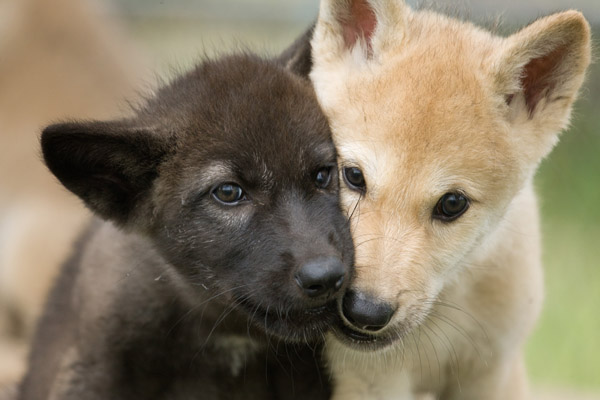
“Wolf Park is pleased to announce that Dharma, of the park’s main pack, has given birth to puppies on April 6, 2012. (Dharma is blocking our view of them at the moment – we will know how many there are when Dharma leaves the den!) The pups’ lineage traces back to Wolf Park’s first female wolf, Cassie. With their birth the Wolf Park wolves’ bloodline has added a new generation. Like all our pups, these will be socialized to humans as well as to wolves; visitors will have opportunities to watch them grow up and become acquainted with their world this summer at Wolf Park. Puppies at Wolf Park are taken out of the den when they are around 10 days old to undergo the socialization process. In order to fully socialize the puppies to humans, the pups have contact with humans 24 hours a day for the first 5 months or so of their lives, for a total of over 2,000 contact hours. For this reason, we have Puppy Mothers that live onsite to help raise the puppies. They work in shifts to provide 24-hour a day human contact. The puppies will also get to spend time socializing with wolves once they about 6 weeks old, so they learn how to be part of a pack as well. Sponsor a Puppy! Click here to adopt one of our newest arrivals! [link sentence to gift shop puppy adoption page] Puppy sponsors will be able to visit their adopted puppy in person! When you schedule your appointment, we will let you know when the puppies tend to be most active, but we cannot guarantee that they will be awake. (Please note that we have very strict guidelines for puppy visits. We do not wake up sleeping puppies, so be aware that your visit may only include you watching your puppy sleep! Your visit may also have to be cut short based on the needs of the puppies or if we are conducting research.) Puppy Sponsors receive all of the benefits of wolf sponsorship, including a yearlong subscription to our newsletter and updates on your sponsored animal.

Puppy Photo Shoots!

Monty Sloan, our world-renowned staff photographer, leads all of our puppy photo shoots. Click here to see examples of his puppy shots. Photo shoots run from 6 pm until either dark or the puppies get tired. Typically shoots last around 2 hours. Please note that we may need to cancel a puppy photo shoot if the puppies are not feeling well. Digestive issues are very common, and are the most frequent reason for having to cancel a shoot.

Availability for these special photography sessions is very limited. The cost of these shoots is $150 per person, with a 2-3 person maximum. To sign up, please call our administrative office at (765)567-2265.

Donate to the Puppies!

Puppies need a lot of care. Help us raise the puppies by purchasing items that they need in our online gift shop or by making a general donation towards their care today!

Name the Puppies!

You can help Wolf Park name the puppies! Send an email with your suggestions (maximum of 5 names per person, please) to puppynames@wolfpark.org. The top names will be chosen by our staff. The final vote will be up to you! The names with the most votes will win and become the names of the new puppies. In May, the public will be invited to vote for the top names, so check back soon!”

**Special thanks to Wolf Park, http://www.wolfpark.org/index.html, for providing this information!
 

Read Full Post »


http://www.scottwalker.org/ 
Why This Is Important

“It hasn’t even been 2 months since Wolves in the Great Lake region were finally removed from the endangered species list and already Wisconsin wants to invite hunters to hunt and trap them. The state assembly didn’t consult with any of the groups that have been historically involved with making these kinds of decisions. One of the groups includes the Ojibwe tribes, and according to a treaty signed by our government with these tribes, they MUST be consulted before these kinds of decisions are made. The Wisconsin State Assembly’s approval of this wolf hunting bill is in direct violation of this treaty. We cannot allow this bill to go through, not only because it violates the rights of the Ojibwe tribes but because the wolves play a critical role in the ecology of the Great Lakes region. It is only recently that we have been able to restore their numbers to a status that is no longer endangered, and having an open hunting season will surely land them right back on the Federal Endangered Species list.

Details from the original New York Times article below as well as a link:

“Less than two months after wolves in the Great Lakes region were removed from the federal endangered species list, the Wisconsin State Assembly approved a bill on Wednesday that would open the way for a wolf hunting and trapping season.

The bill, supported by hunting groups, Republicans and some Democrats, passed by a 69-25 vote. It was opposed by environmental groups and the Great Lakes Indian Fish and Game Commission, which represents Ojibwe tribes in Wisconsin, Michigan and Minnesota. The tribes have significant rights in wildlife management in much of the area where wolves are found and said they were not consulted on the hunting plans as required by a treaty. State wildlife biologists also criticized various elements of the bill.

The measure now goes to Gov. Scott Walker.

A number of Democrats spoke Wednesday against the bill and sought amendments, denouncing it as “very irresponsible and anti-science.” No Republicans spoke for the bill or against the amendments.”

Special thanks to: http://green.blogs.nytimes.com/2012/03/14/wisconsin-assembly-approves-wolf-hunting/?ref=science
Wisconsin Assembly Approves Wolf Hunting, By JAMES GORMAN, March 14, 2012, 5:39 PM for providing this information.

Read Full Post »


“Photos of dead and maimed wolves have pervaded the Internet in recent weeks, raising tensions in the Northern Rocky Mountains over renewed hunting and trapping of the once federally protected animals. Escalating rancor between hunters and animal rights activists on social media and websites centers on pictures of wolves killed or about to be killed.

Many have text celebrating the fact that Western states are allowing more killing of the predators. Commenting on a Facebook-posted image of two wolves strangled to death by cable snares, an individual who identified himself as Shane Miller wrote last month, “Very nice!! Don’t stop now, you’re just getting started!” A person going by the name Matthew Brown posted the message, “Nice, one down and a BUNCH to go!” in response to a Facebook image of a single wolf choked to death in a snare. Such pictures and commentary have intensified online arguments over the ethics of hunting and trapping wolves. The debate took a threatening turn this week with an anonymous email warning that animal rights advocates will “be the target next.”

In Idaho and Montana, hundreds of the animals have been killed — mostly through hunting — less than a year after being removed from the U.S. endangered species list.

Stripping the wolves of federal protection last spring opened the animals to state wildlife management, including newly licensed hunting and trapping designed to reduce their numbers from levels the states deemed too high.


Since the de-listing last May, Idaho has cut its wolf population by about 40 percent, from roughly 1,000 to about 600 or fewer. Some 260 wolves have been killed in Montana, more than a third of its population, leaving an estimated 650 remaining.

The U.S. Fish and Wildlife Service has also proposed lifting the protected status for another 350 wolves in Wyoming.

The threatening note received by an anti-trapping group based in Missoula, Mont., this week has drawn scrutiny from federal and local law enforcement.

The group says it was likely singled out because it had criticized and widely circulated a snapshot of a smiling trapper posed with a dying wolf whose leg was caught in the metal jaws of a foothold trap on a patch of blood-stained snow.were hunted, trapped and poisoned to near extinction in the lower 48 states by the 1940s under a government-sponsored program.

Decades later, biologists recognized that wolves had an essential role as a predator in mountain ecosystems, leading to protection of the animal under the Endangered Species Act.

Wolves were reintroduced in the mid-1990s over the vehement objections of ranchers and sportsmen, who see the animals as a threat to livestock and big-game animals such as elk and deer.

Environmentalists say the impact of wolves on cattle herds and wildlife is overstated and that the recent removal of federal safeguards could push the wolf back to the brink.

Wolves have long been vilified in the region as a menace, symbolizing for some a distant federal bureaucracy imposing its rules on the West.

“They’re putting us and our way of life out of business,” said Ron Casperson, co-owner of Saddle Springs Trophy Outfitters in Salmon, Idaho. “It makes me sick every day I look at this country. These wolves … I mean, come on.”

State wildlife managers had predicted that such passions would ease once the wolves were de-listed and states gained control. But discourse on the Internet and social networks appears to have grown more hostile.

Some hunters have expressed discomfort at the apparent bloodlust unleashed on the Internet, which they see as tarnishing the reputation of a sport that attracts less than 15 percent of Americans.


“There are two groups — one supports fair chase and ethical hunting, and the other views the reintroduction of wolves and the recovery with venom,” said veteran sportsman Rod Bullis of Helena, Mont.

Idaho Fish and Game Commissioner Gary Power said he was bombarded with letters and emails from people representing extremes on both sides of the debate.

“There are some folks out there stirring the pot: ‘Get rid of government, get rid of this, they shoved it down our throats, kill them all,’ and they are adding to the contentiousness,” he said.

Animal rights activists said they are sickened at the online flurry of pictures depicting wolf kills, and alarmed by comments suggesting a growing desire to shoot, trap and snare wolves.

“Roughly $40 million has been spent on wolf recovery, and now we are witnessing the second extermination of wolves in the West,” said Wendy Keefover, director of carnivore protection for WildEarth Guardians.

Idaho and Montana are required to maintain about 150 wolves per state each year to prevent federal protection from being imposed again.

But Idaho plans to more than double the number of wolves a hunter may take in some areas for the 2012-13 season, raising their bag limit to 10.

Montana is seeking to raise its wolf-hunt quotas, and state wildlife managers are discussing allowing trapping, which is currently illegal there. At least one Montana county is considering a bounty for wolves killed by licensed hunters.

This week’s email threat to the animal advocacy group Footloose Montana raised the acrimony to a new level.

The image posted on its Facebook page was taken from the Trapperman.com website, including text that joked about the wolf being shot and wounded by a passersby after it was caught — “lucky they were not real good shots.”

The photo went viral over the Internet last weekend, and on Monday Footloose Montana received the email threat.

The message said “I would like to donate a gun to your childs (sic) head to make sure you can watch it die slowly so I can have my picture taken with it’s (sic) bleeding dying screaming for mercy body.” Then the email, a copy of which Footloose gave to Reuters, said the recipients would be the next targets.

A Missoula Police Department detective, Sgt. Travis Welsh, confirmed this week that investigators were looking into a “report from a local institution about a malicious email.”

Footloose Executive Director Anja Heister said FBI agents had interviewed a member of her group about the threat, but an FBI spokeswoman declined to comment.

By Tuesday, Trapperman.com, a site whose mission statement declares, “Always keep in mind that we are the true protectors of wildlife and the wild places in which the animals live,” had removed pictures of dead or dying wolves and commentary.”

**Special thanks to By Laura Zuckerman, Reuters, for providing this information!


Read Full Post »


The following information is provided by “The Wolf Almanac” by Robert Busch (1995 edition).

“According to the U.S. Fish and Wildlife Service, “wolf predation of livestock–sheep, poultry, and cattle–does occur, but it is uncommon enough behavior in the species as a whole to be called aberrant.”

Many studies have shown that ninety-nine percent of all farmers and ranchers in wolf territory will not be bothered by wolves.  Of over 7,000 farmers in northern Minnesota, where over 1,700 wolves inhabit the area, only an average of twenty-five ranchers per year suffered verified predation from wolves between 1975 and 1989.  In Canada, only one percent of 1,608 wolf scats collected in Manitoba’s Riding Mountain National Park contained remnants of livestock. 

In one study in Spain, half of all the “wolf kills” that were investigated were found to be caused by feral dogs.  According to William J. Paul of the U.S. Department of Agriculture, where wolf predation on livestock does occur, “most losses occur in summer when livestock are released to graze in open and wooded pastures.”

In many cases, preventative farming practices would eliminate predation.  The Alberta Fish and Wildlife Division recommends the following animal husbandry practices in wolf habitat:

  • cattlemen should check their herds regularly.
  • only healthy and non-pregnant cows should be sent to pasture.
  • livestock should be removed from pasture as early as possible in the fall.
  • carrion should be buried or removed as soon as possible. (In one Minnesota study by the U.S. and Wildlife Service, 63 percent of 111 farmers surveyed either left dead livestock in place or just dragged it to the edge of the woods.)
  • grazing leases on remote public lands should be phased out.ranchers should keep animals out of remote pastures after dusk and pen them in corrals where they can be watched.

Other measures include the use of  battery-operated flashing highway lights in animals corrals and fladry.  Livestock guard dogs and electric fences have also some potential in reducing predation.  In Ontario, biologists are experimenting with painting sticky substances on the backs of sheep, which seems to deter predators.  The European practice of using shepherds to guard livestock is also worthy of consideration, as is diversionary feeding, or providing alternative food sources.

It is politically crucial that compensation be paid to farmers who do suffer wolf predation.  The existence of compensation schemes goes a long way toward improving ranchers’ attitudes toward wolves.  It is also crucial that payment be prompt;  Portugal, when payments were delayed, farmers took to setting poisoned carcasses on the edges of woods to register their complaint.”

Read Full Post »


Sunday March 18, 2012 6:34 AM

“To kill or not to kill wolves, that is a question legal, moral and, apparently, spiritual.

Since losing protection under the federal Endangered Species Act in 2011, western wolves have become legal game during seasons in Idaho and Montana. Wolves can be killed based on quotas intended not to harm the viability of the population, estimated regionally at about 1,700 in Idaho, Montana and Wyoming.

Last week, wolf advocates lost an attempt to stop hunting by claiming an amendment added to the 2011 defense bill violated the constitutional separation of powers. The 9th U.S. Circuit Court of Appeals ruled that no constitutional mandates were broken when the amendment introduced by senators John Tester (D-Mont.) and Mike Simpson (R-Idaho) gave their respective states control of wolf management and blocked further judicial review.

The case pitted the Center for Biological Diversity and three other wildlife advocacy groups against the U.S. Department of the Interior and the U.S. Fish and Wildlife Service. Among groups filing briefs in support of the federal government were the National Rifle Association, Safari Club International and the farm bureau federations of Idaho and Montana.

About 4,500 wolves are estimated to be residing in Minnesota, Wisconsin and Michigan, where delisting went into effect in January. A move by Wisconsin legislators toward legalizing controlled wolf hunting in the state has run into a stumbling block, however.

Eleven tribes of the Ojibwe, also known as the Chippewa, in Wisconsin, Minnesota and Michigan oppose a wolf hunt. Their disapproval, filed with the legislature in written testimony, is based on religious principle and a tradition that links the health of the tribe to the state of the wolf population.

Courts have ruled the tribes should have a say in matters such as a wolf hunt on land they control. Should legislators go ahead with a wolf hunting season, an additional complication is that half of the wolves harvested would belong to the tribes under existing agreements.”

**Special thanks to Dave Golowenski , The Columbus Dispatch, for providing this information!

Read Full Post »


February 11th, 2012

“According to the public trust doctrine, states are obligated to ensure a sustainable population of species, including wolves; it is clearly evident that science is just not guiding decision-making in Idaho. 

  • Of the three states in the overall Northern Rockies wolf recovery zone, Idaho has the most suitable wolf habitat. Yet Idaho’s position on wolves is that there should be zero wolves in the state (Idaho plan, 2002, p.4).  In fact, Governor C.L. “Butch” Otter even declared at a statehouse rally, “I’m prepared to bid for that first ticket to shoot a wolf myself.” 
  • Idaho fails to provide the critically objective and verifiable scientific data that is required by federal law when making decisions about the endangered status of animals as well as their management in individual states.
  • Wolves don’t “belong” to just Idaho, either!  The Endangered Species Act represents a decades-old bi-partisan consensus among Americans which asserts that wildlife and ecologies are invaluable and worth protecting. Just as the quality of our air and water cannot be left to the individual States, neither can the continued healthy survival of our vital and endangered wildlife.  Wildlife belongs to America, too.

ACTION ALERT:

“Jeff Thomas” is the Idahoan hunter who apparently “didn’t realize” his wolf tag was no longer valid when he shot and killed a collared male wolf from northeast Oregon’s Imnaha Pack – OR-9, “Journey’s” sibling!   This hunter who “poached” OR-9 was given a mere warning and that is simply not acceptable.  Jeff Thomas should be punished to the fullest extent of the law.
  • Please call Virgil Moore at the Idaho Dept of Fish and Game and tell him what you think of Idaho’s policies – (208) 334-3771     

 OR-9    was a healthy and strong young wolf who posed no threat to livestock or humans. In his memory, we hope you take action on his behalf as well as all those wolves who remain in the line of fire in this state.”

**Special thanks to “WolfWatcher.Org” for providing this information!  (http://wolfwatcher.org/news/all-news/action-alert-justice-for-oregon-wolf-or-9/)

Read Full Post »


Article Last Updated: Wednesday, February 01, 2012 6:53pm

Senses being tapped to keep the predators clear of cattle.

“ALBUQUERQUE – Wildlife managers are running out of options when it comes to helping Mexican gray wolves overcome hurdles that have thwarted reintroduction into their historic range in the Southwest.

Harassment and rubber bullets haven’t worked, so they’re trying something new – a food therapy that has the potential to make the wolves queasy enough to never want anything to do with cattle again.

As in people, the memories associated with eating a bad meal are rooted in the brain stem, triggered any time associated sights and smells pulse their way through the nervous system.

Wildlife managers are trying to tap into that physiological response in the wolves, hoping that feeding them beef laced with an odorless and tasteless medication will make them ill enough to kill their appetite for livestock.

Cattle depredations throughout southwestern New Mexico and southeastern Arizona have served as an Achilles’ heel for the federal government’s efforts to return the wolves.

Conditioned taste aversion – the technical term for what amounts to a simple reaction – is not a silver bullet for boosting the recovery of the Mexican wolf, but some biologists see it as one of few options remaining for getting the program back on track after nearly 14 years of stumbling.

“Just the very fact that the U.S. Fish and Wildlife Service is trying something new ought to send the message that they really are seriously concerned about the ranchers’ concerns,” said Dan Moriarty, a professor and chairman of the psychological sciences department at the University of San Diego.

“We have to find a way to sort of peacefully co-exist,” said Moriarty, who has worked with captive wolves in California. “That’s my hope, that the taste aversion will be one more tool.”

Gray wolves have rebounded from widespread extermination throughout the Northern Rockies and the Great Lakes region. Since being declared endangered in 1974, the wolf population has grown fivefold – to about 6,200 animals wandering parts of 10 states outside Alaska.

After four decades and tens of millions of dollars, the federal government was recently able to remove the animals from the endangered species list in several states.

The case is much different in the Southwest, where the population of the Mexican wolf – a subspecies of the gray wolf – continues to be about 50 despite more than a decade of work. Biologists had hoped to have more than 100 wolves in the wild by 2006.

Due to livestock problems, about 90 wolves and some dependent pups have been removed – in some cases lethally – from the wild since the program began. For about four years, the Fish and Wildlife Service operated under a policy that called for trapping or shooting wolves if they had been involved in at least three cattle depredations.

The agency has since scrapped the policy, and ranchers have all but given up on keeping track of their dead cows and calves.

In the last year, monthly reports from the wolf program show wildlife managers investigated four dozen depredations in Arizona and New Mexico. They determined that wolves were involved in half of the cases.

Caren Cowan, executive director of the New Mexico Cattle Grower’s Association, said ranchers are frustrated.

“You really have no idea how bad it is when a dad calls you and says ‘There’s a wolf in my yard and my kids and my wife are stuck in the house. What can you do to help me?’”

That’s the issue, Cowan said. “These animals are habituated to humans and until we can figure that out, I don’t know what you do.”

Cowan acknowledged, however, that getting wolves to stop preying on livestock would be a huge first step.

Biologists working at a captive breeding center at the Sevilleta National Wildlife Refuge in south-central New Mexico treated six wolves last April and another two in October. The animals were fed baits made up of beef, cow hide and an odorless, tasteless deworming medication that makes the wolves queasy.

Fish and Wildlife Service biologist Susan Dicks said the initial tests appear to be successful, with the wolves not wanting anything to do with the beef baits after their first serving.

The idea is that when wolves smell cattle in the wild, their nervous system and brain stem will kick into gear and override any desire they have to get near the cattle.

“We’re learning as we go, but so far we have seen some good aversions produced,” Dicks said. “Again, it’s impossible to say yet whether this translates to a livestock animal running around on the hoof.”

Wolf releases have been put off for the past year, and it’s unclear whether the agency will have the opportunity to release the treated wolves this year so the taste aversion treatments can be fully tested.

The work done with the Mexican wolves is based on decades of research conducted by Lowell Nicolaus, a retired biology professor from Northern Illinois University. He has seen it work with captive wolves and free-ranging raccoons and crows.

“It just takes one good illness,” said Nicolaus of Butte Falls, Ore. “Their avoidance is going to be expressed wherever they see the food or smell it. It doesn’t depend on when and where they first ate it or when and where they got sick.”

Nicolaus said taste aversion works because it’s an unconscious response, not a threat that wolves can overcome such as being hazed or shot at with rubber bullets.

The other benefit is biologists say wolves that have an aversion to cattle are likely to pass that on to their pups by teaching them hunting habitats that avoid cattle and focus on deer, elk and other native prey. They call that a feeding tradition.

Bill Given, a wildlife biologist who helped the Fish and Wildlife Service with the first batch of wolf treatments at Sevilleta, describes taste aversion as a natural solution that taps into an evolutionary defense mechanism that is common among all animals.

“You can build a great fence or you can have a dog as a shepherd, but none of those things can change the desire to consume the livestock,” he said. “They just make it challenging and then the predator has to work around that barrier.”

To ranchers, the wolves are “killing machines,” Cowan said.

The biologists don’t necessarily disagree.

“There’s no stopping the feeding and the sex drive. All life is about those two things,” Given said, noting that wildlife managers have an opportunity to gain some control through taste aversion.

The next challenge will be proving its value on the range by monitoring wolves that have been treated.

“I think it does have a lot of promise,” Dicks said. “And part of it is we’re willing to try anything to get these animals successfully on the ground without impacting livestock growers.”

*Special thanks to SUSAN MONTOYA BRYAN, 
Associated PressHerald Staff for providing this information! ( http://durangoherald.com/article/20120202/NEWS06/702029970/-1/s)

Read Full Post »


The Film

“From the opening scene, this film takes the audience on an unbelievable journey. Follow world-renowend animal trainer, Andrew Simpson as he travels to one of the coldest places on earth. Together with his Canadian crew and his pack of wolves, he sets out to make the biggest wolf film ever attempted.

 They will live in Siberia in a remote camp for five months where the temperature drops to -60C. You will witness the bond between man and wolf, and the emotional toll this journey takes on everyone.

The footage in this film had never been seen before – there are no computer effects everything you see is real.

Wolves are one of the most misunderstood animals of all time. In this film, you will see them in a new light. It will make you question everything you thought you knew about wolves. You will see an animal that is graceful, caring, affectionate, trusting and capable of expressing all levels of emotion.

You will see one man’s special relationship with a pack of wolves that he raised and lives with everyday. And you will witness his struggle as he wrestle’s with the decision to use this unique bond against them.

Andrew Simpson

Andrew was born and raised in Scotland. Even as a child he was drawn towards nature and was always the kid with a mouse or a frog in his pocket. But he also had a love of adventure. After leaving the Highlands, he travelled around the world several times before settling in Canada.

It was in Canada that all the stars aligned for him. Having a love of animals and a fascination with movies, he finallly found his calling – a professional animal trainer for the industry.

“It’s hard to imaging getting paid for something you love to do everyday, but I do…”

Almost 20 years later, his passion is still just as strong. With his love of nature and the outdoors, and vast film making experience, Andrews talents are in high demand. From the Australian outback to the Greek Islands to Northern China, he is constantly travelling the world, pursuing his dreams, and living life to the fullest.

Although he deals with all species, his speciality is wolves. It is because of this reputation that he was asked to travel to Siberia to make the biggest wolf film ever attempted. Having worked for almost every major Hollywood studio on over 100 productions, Andrew decided it was time to venture in a new direction.

“…What we do with wolves is very specialized, and people the world over are fascinated with them…”

This was the reason for making this film. Andrew wanted to show another side of wolves – a different side from the fairy tales and horror stories normally associated with them.”

*Special thanks to Zenn Media for providing this information! (http://www.wolvesunleashed.com/film.php)

Read Full Post »


VICTORY WOLF PRESERVATIONISTS!!

“The Cynthia Lummis Wolf Rider is out of the spending bill! This is a real victory for wolves and wolf advocates!!

Congress  passed a similar rider last Spring which removed ESA protections from wolves in the Northern Rockies, blocking legal challenges. Now the rider is being litigated as unconstitutional in the Ninth Circuit Court of Appeals.  Because of that rider we have two brutal wolf hunts in Idaho and Montana, with wolves dying daily and an escalation of the brutality, the likes of which most of us have ever witnessed directed at an animal. The Endangered Species Act has been weakened. Maybe Congress didn’t have the stomach for a repeat of that with the 2012 elections looming.

F0r today, wolves in Wyoming, Minnesota, Wisconsin and Michigan are safe. It’s not often we can  bring good news, lets savor it and live to fight another day!

What made the cut?

Wolves”

Special thanks to “Wolf Warriors” for providing this information! (http://howlingforjustice.wordpress.com/2011/12/16/its-final-lummis-wolf-delisting-rider-out/)

Read Full Post »

« Newer Posts - Older Posts »