Feeds:
Posts
Comments

Archive for the ‘Wolf Preservation Efforts’ Category


“We petition the obama administration to:

Halt wolf hunts pending 9th District Court of Appeals decision and scientific research to confirm wolf recovery data.

Due to a 2011 budget rider (Sec. 1713), gray wolves lost federal protection under the ESA. It orders the Interior Secretary to reissue the final delisting rule published in 2009. Articles written by scientists in independent peer-reviewed journals criticized the 2009 rule for complying more with political expediency instead of best available science. This is regarded as a particularly egregious affront to the voice of the majority and to fair representation in our country. The rider circumvents the District Court’s ruling in Defenders of Wildlife, 729 F.Supp.2d 1207, and was designed to direct the outcome of a pending case without amending the underlying statute involved. We join the Union of Concerned Scientists in denouncing this action.”

Please follow the link below and sign this petition!

https://wwws.whitehouse.gov/petitions/!/petition/halt-wolf-hunts-pending-9th-district-court-appeals-decision-and-scientific-research-confirm-wolf/7g0bsswr

Read Full Post »


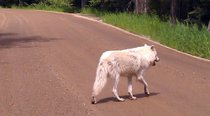
“When Mark Earls saw a shaggy, white wolf crossing a road in North Idaho’s Hoodoo Valley, he pulled out his cellphone to snap a picture of it. “What boggled him was that the wolf didn’t run away,” said his wife, Chelsea. “It didn’t appear to be afraid of him.” The wolf escaped from Wolf People, which operates a retail store on U.S. Highway 95 near Cocolalla, Idaho, and keeps captive wolves for viewing and filming, according to the Idaho Department of Fish and Game. The wolf apparently got out by digging underneath the fence, said Chip Corsi, Fish and Game’s regional manager. By some neighbors’ accounts, it has been seen in the area since June, acting like a stray dog. A captive wolf on the lam is a concern because it’s used to being around people. “It’s a habituated Canis lupus and it’s potentially dangerous,” Corsi said. “This thing either needs to go back into captivity or it needs to be euthanized.” Fish and Game officials have told the Bonner County Sheriff’s Department and neighbors in the Hoodoo Valley that it’s OK to shoot the animal on sight. Since it’s not a wild wolf, it’s not regulated under Idaho’s wolf season, which requires hunters to purchase a hunting license and wolf tag. A Fish and Game officer took the wolf’s picture to Wolf People owner Nancy Taylor, who confirmed that the wolf belonged to her, Corsi said. She also said that she had previously reported the wolf as dead, he said. “This was not reported to us like it was supposed to be,” Corsi said. “That’s a problem … I believe she’s required to report escapees pretty quick.” Neighbors said that a Wolf People volunteer had been taking fliers around, advertising a “lost dog” that looked like a wolf. Taylor has a state permit to keep captive wolves, and Wolf People’s website said the facility has 18 wolves. Several white wolves are pictured on the site, including a 135-pound male described as an arctic/timber wolf cross, and a 75-pound male. Some of the wolves are taken to a visitor center at the store on a daily basis, but others are kept in large enclosures at another site near Lake Cocolalla, the website said. Wolf People has been in operation for 21 years, Taylor said Wednesday, but she declined to discuss the incident. “I don’t feel free to comment at this time,” she said. “I can’t comment without knowing the facts, and I haven’t had a chance to investigate the situation.” Teresa Gavin lives in the Hoodoo Valley, about 8 miles southeast of Priest River. The picture of the white wolf was snapped on a road adjacent to her property. She keeps a sharp eye on her 4-year-old twins when they’re playing outside but thinks the wolf poses more danger to her dogs and her horse. “Let’s hope that someone finds him before any harm is done to anyone or their animals,” Gavin said of the wolf. She thinks Wolf People would have had a better chance of getting the animal back alive if the escape had been reported immediately. Chelsea Earls keeps a gun handy when her children are playing outside. She said that she and her husband have been vigilant about predators since a coyote killed the family dog last winter. “It’s not reassuring knowing there’s a wolf around,” she said. “It may be used to people, but it’s still a wild animal.” **Special thanks to Becky Kramer The Spokesman-Review for providing this information.

Michael Heath of Wolf Preservation states, “they have a duty and obligation to safely capture this animal.  Residents should report any sightings to proper authorities and guarantee it’s protection from human threats.  Authorities should properly educate residents regarding factual information about wolves and take pro-active measures to co-exist with them, not to hunt or destroy this important species.”

Read Full Post »


“They think we’ve gone away…… ………the governor’s offices and the tourist departments, that is. They predicted, and said as much, that our phone calls would die down, our interest would wane, and we would eventually give up on the wolves and let them have their massacre in peace. They don’t know us wolf sisters and brothers very well at all…….. Let’s all vow to call at least twice a week: GOVERNOR ‘BUTCHER’ OTTER (IDAHO) – 208-334-2100, GOVERNOR BRIAN SCHWEITZER (MONTANA) 405-444-3111, GOVERNOR MATT MEAD (WYOMING)  307-777-7434.   LET US TELL THEM WE WILL CONTINUE TO HAVE AN ECONOMIC AND TOURIST BOYCOTT OF THEIR STATES UNLESS AND UNTIL THEY CALL OFF THE WOLF HUNTS AND STOP PERSECUTING WOLVES!!! COMPLAIN, TOO, ABOUT INDIVIDUALS POSTING HOW THEY WANT TO BRUTALIZE WOLVES AND TELL THEM OF YOUR OBJECTIONS TO THIS NASTY BOW HUNTING AND THE UNDUE SUFFERING THAT CAUSES; THESE HUNTERS ARE TAKING SHOTS THAT THEY KNOW ARE NOT IMMEDIATELY LETHAL. TELL THEM THE SUFFERING OF BOW HUNTING AND TRAPPING IS EQUIVALENT TO ANIMAL ABUSE! Caution, Otter’s secretary likes to fight and some have hired professional public relations people to talk you down on this subject!! Keep howling!”

**Special thanks to Linda Camac, creater of this bulletin from the cause:  “Good Wolf” for providing this information!

Read Full Post »


“The resumption of wolf-hunts in Idaho, Montana and Wyoming illustrates why citizens must continue to oppose such unnecessary and senseless slaughters.

The wolf-hunts are predicated upon morally corrupt and inaccurate assumptions about wolf behavior and impacts that are not supported by recent scientific research.  State wildlife agencies pander to the lowest common denominator in the hunting community—men who need to bolster their own self esteem and release misdirected anger by killing.

Wolf-hunts, as Montana Fish and Game Commission Chairman Bob Ream noted at a public hearing, are in part to relieve hunters’ frustrations—frustration based on inaccurate information, flawed assumptions, and just plain old myths and fears about predators and their role in the world.

Maybe relieving hunter frustration is a good enough justification for wolf-hunts to many people. However, in my view permitting hunts to go forward without even registering opposition is to acquiesce to ignorance, hatred, and the worst in human motivations. Thankfully a few environmental groups, most notably the Center for Biodiversity, Wildearth Guardians, Friends of the Clearwater, Alliance for Wild Rockies and Western Watersheds had the courage and gumption to stand up to ignorance and hatred.

All of the usual justifications given for wolf-hunts are spurious at best.  For instance, one rationale given for hunting wolves is to reduce their presumed effects on big game populations. Yet in all three states, elk and deer populations are at or exceed population objectives for most hunting units.

For instance in Wyoming, one of the most vehement anti wolf states in the West, the 2010 elk population was 21,200 animals over state-wide objectives, and this did not include data for six herds, suggesting that elk populations are likely higher. Of the state’s elk herds most were at or above objectives and only 6 percent were below objectives. Similar data are found for Idaho and Montana elk herds as well.

However, you would not know that from the “howls” of hunters who characterize the elk populations as suffering from a wolf induced Armageddon.  And Fish and Game departments are loath to counter the false accusations from hunters that wolves are somehow “destroying” hunting throughout the Rockies.

Experience in other parts of the country where wolves have been part of the landscape longer suggests that in the long term, wolves – while they may reduce prey populations in certain locales – generally do not reduce hunting opportunities across a state or region.  Despite the fact that there more than double the number of wolves in Minnesota (3000+) as in the entire Rocky Mountain region, Minnesota hunters experienced the highest deer kills ever in recent years, with Minnesota deer hunters killing over 250,000 white-tailed deer during each of those hunting seasons – an approximate five-fold increase in hunter deer take since wolves were listed under the ESA in 1978.

Another claim made by wolf-hunt proponents is that hunting will reduce “conflicts” with livestock owners. Again this assertion is taken as a matter of faith without really looking into the veracity of it. Given the hysteria generated by the livestock industry one might think that the entire western livestock operations were in jeopardy from wolf predation.  However, the number of livestock killed annually by wolves is pitifully small, especially by comparison to losses from other more mundane sources like poison plants, lightning and even domestic dogs.

For instance, the FWS reported that 75 cattle and 148 sheep were killed in Idaho during 2010. In Montana the same year 84cattle and 64 sheep were verified as killed by wolves. While any loss may represent a significant financial blow to individual ranchers, the livestock industry as a whole is hardly threatened by wolf predation. And it hardly warrants the exaggerated psychotic response by Congress, state legislators and state wildlife agencies.

In light of the fact that most losses are avoidable by implementation of simple measures of that reduce predator opportunity, persecution of predators like wolves is even more morally suspect. Rapid removal of dead carcasses from rangelands, corralling animals at night, electric fencing, and the use of herders, among other measures, are proven to significantly reduce predator losses—up to 90% in some studies. This suggests that ranchers have the capacity (if not the willingness) to basically make wolf losses a non-issue.

However, since ranchers have traditionally been successful in externalizing many of their costs on to the land and taxpayers, including what should be their responsibility to reduce predator conflicts, I do not expect to see these kinds of measures enacted by the livestock industry any time soon, if ever. Ranchers are so used to being coddled they have no motivation or incentives to change their practices in order to reduce predator losses. Why should they change animal husbandry practices when they can get the big bad government that they like to despise and disparage to come in and kill predators for them for free and even get environmental groups like Defenders of Wildlife to support paying for predator losses that are entirely avoidable?

But beyond those figures, wolf-hunting ignores a growing body of research that suggests that indiscriminate killing—which hunting is—actually exacerbates livestock/predator conflicts. The mantra of pro wolf-hunting community is that wolves should be “managed” like “other” wildlife. This ignores the findings that suggest that predators are not like other wildlife. They are behaviorally different from say elk and deer. Random killing of predators including bears, mountain lions and wolves creates social chaos that destabilizes predator social structure. Hunting of wolves can skew wolf populations towards younger animals. Younger animals are less skillful hunters. As a consequence, they will be more inclined to kill livestock. Destabilized and small wolf packs also have more difficulty in holding territories and even defending their kills from scavengers and other predators which in end means they are more likely to kill new prey animal.

As a result of these behavioral consequences, persecution of predators through hunting has a self fulfilling feedback mechanism whereby hunters kill more predators, which in turn leads to greater social chaos, and more livestock kills, and results in more demands for hunting as the presumed solution.

Today predator management by so called “professional” wildlife agencies is much more like the old time medical profession where sick people were bled.  If they didn’t get better immediately, more blood was let. Finally if the patient died, it was because not enough blood was released from the body. The same illogical reasoning dominates predator management across the country. If killing predators doesn’t cause livestock losses to go down and/or game herds to rise, it must be because we haven’t killed enough predators yet.

Furthermore, most hunting  occurs on larger blocks of public lands and most wolves as well as other predators killed by hunters have no relationship to the animals that may be killing livestock  on private ranches or taking someone’s pet poodle from the back yard. A number of studies of various predators from cougars to bears show no relationship between hunter kills and a significant reduction in the actual animals considered to be problematic.

Again I hasten to add that most “problematic predators” are created a result of problem behavior by humans—for instance leaving animal carcasses out on the range or failure to keep garbage from bears, etc. and humans are supposed to be the more intelligent species—though if one were to observe predator management across the country it would be easy to doubt such presumptions.

Finally, wolf-hunting ignores yet another recent and growing body of scientific evidence that suggests that top predators have many top down ecological influences upon the landscape and other wildlife. The presence of wolves, for instance, can reduce deer and elk numbers in some places for some time period. But rather than viewing this as a negative as most hunters presume, reduction of prey species like elk can have many positive ecological influences. A reduction of elk herbivory on riparian vegetation can produce more song bird habitat. Wolves can reduce coyote predation on snowshoe hare thus competition for food by lynx, perhaps increasing survival for this endangered species. Wolves have been shown to increase the presence of voles and mice near their dens—a boon for some birds of prey like hawks. These and many other positive effects on the environment are ignored by wolf-hunt proponents and unfortunately by state wildlife management agencies as well who continue to advocate and/or at least not effectively counter old fallacies about predators.

Most state agencies operate under the assumption that production of elk and deer for hunters to shoot should have priority in wildlife management decisions. All state wildlife agencies are by law supposed to manage wildlife as a public trust for all citizens.  Yet few challenge the common assumption that elk and deer exist merely for the pleasure of hunters to shoot.

I have no doubt that for many pro wolf-hunt supporters’ predators represent all that is wrong with the world. Declining job prospects, declining economic vitality of their rural communities, changes in social structures and challenges to long-held beliefs are exemplified by the wolf. Killing wolves is symbolic of destroying all those other things that are bad in the world for which they have no control. They vent this misdirected anger on wolves– that gives them the illusion that they can control something.

Nevertheless, making wolves and other predators scapegoats for the personal failures of individuals or the collective failures of society is not fair to wolves or individuals either.  The premises upon which western wolf-hunts are based either are the result of inaccurate assumptions about wolf impacts or morally corrupt justifications like relieving hunter anger and frustrations over how their worlds are falling apart.

I applaud the few environmental groups that had the courage to stand up for wolves, and to challenge the old guard that currently controls our collective wildlife heritage.  More of us need to stand up against persecution of wildlife to appease the frustrations of disenfranchised rural residents. It is time to have wildlife management based on science, and ecological integrity, not based upon relieving hunter frustrations over the disintegrating state of their world. And lastly we need a new ethnics and relationship to wildlife that goes beyond a simple utilitarian view of whether any particular species benefits or harms human in real and/or imaginary ways.”

**Special thanks to George Wuerthner, ecologist and former hunting guide with a degree in wildlife biology, for providing this information!

Read Full Post »

WOLF PRESERVATION IS OUTRAGED!  

Wolves have been stripped of their legal protections. 

Hunters are locked and loaded.   Traps are set.

Montana, Idaho, Wyoming among states looking to eradicate wolves.

This is not “responsible management” as Idaho Governor “Butch” Otter stated if he plans on wiping out more than 80% of the population.  Wolves have NO protection anymore.    It’s shoot on sight and animals are allowed to sit in painful traps for x72 hours!   Here’s what you need to do:  1. Express outrage toward each state governor and explain you are boycotting their state until they stop this madness (http://gov.idaho.gov/ourgov/contact.html, http://governor.mt.gov/cabinet/contactus.asp, http://governor.wy.gov/contactUs/Pages/default.aspx).  Spread this information to others and have them write to each governor.  Call your local newstation, newspaper, and pull together others for a wolf rally with signs (save wolves, boycott Montana, Idaho, and Wyoming, ect.). 

**Also, please watch the video through the link below and then visit “Friends of Animals” as they are fighting hard in court and through news stations to overturn extinction efforts.  We cannot save all these beloved wolves but we need to act now to save future packs from the same fate! 

Priscilla Feral, president of Friends of Animals: “Removing federal protection and subjecting wolves to more hunting is unconstitutional and unconscionable.”

http://www.cnn.com/video/?/video/us/2011/08/12/jvm.wolves.endangered.list.hln

http://www.friendsofanimals.org/news/2011/august/howling-across-ameri.html

Read Full Post »


Finally!  Finally, a bit of positive news for wolves, a bill that doesn’t just compensate ANY livestock owner for a confirmed wolf predation but to those who are implementing non-lethal methods as deterents.   See the story below and share your comments!

Wednesday, August 3rd, 2011:

 John Kitzhaber, Oregon Governor,  signed the state wolf compensation bill Tuesday. It creates a $100,000 fund to pay ranchers who lose livestock to the legally protected wolves.

Aaron Kunz has reaction from those who could benefit from the newly established fund.

The Livestock Compensation and Wolf Co-Existence bill goes into effect right away with Kitzhaber’s signature. The funds will be given to eligible ranchers that lose livestock confirmed predated by wolves.

Eligible ranchers are those who utilize non-lethal methods to deter wolf attacks.

The group is hailing this new law as a demonstration of the state’s commitment to reducing conflicts between wolves and ranchers. 

Suzanne Stone is the conservation group’s northern Rockies representative. She says, “We are really very pleased with the signing of the bill. We worked very hard to get that legislation passed this year and felt it was a very solid compromise that brought both the ranching interests as well as the wildlife interests together.”

Ranchers in Eastern Oregon’s Wallowa County are among those who could benefit from this fund. Cattle rancher Ramona Phillips says it’s a good first step.

*More information can be found in Oregon’s Daily Astorian.

Read Full Post »


THE ALASKA BOARD OF GAME AND GOVERNOR SEAN PURNELL DO NOT BELIEVE IN  HUMANE OR SCIENTIFIC METHODS: After reading this article, go to this link (http://www.adfg.alaska.gov/index.cfm?adfg=contacts.emailus), share your opposition to these tactics against not only bears but other wildlife.  Remember, aerial gunning and poisoning of bears and wolves are horrifying tactics utilized by these anti-wildlife extremists:

“The Alaska Board of Game has approved an “experimental” brown bear snaring program in Unit 16B—similar to the black bear baiting/snaring programs. These bear killing “programs” are no more “experimental” (in the “scientific” sense) than the wolf killings—just more hideous and even less justified.

The State was able to sneak the black bear killing program past the public with a few vague references to “subsistence users” going without moose because of “too many” black bears. So now it’s time to wipe out some grizzly bears—under the guise of an “experiment.”

THE SUBSISTENCE DECEPTION –

The State doesn‘t even bother pretending to be “scientific” anymore—emotion rules all wildlife management. And that most emotional of all the old standbys, “subsistence,” is still being cited by the State to justify killing wild predators—though functional “subsistence” is just about dead and gone.

Even for those few people who actually live right on the land, hunting costs big money these days and requires “job subsistence.” Motor vehicles, equipment and services are the real “subsistence” economy. Living off the land is no longer possible in Alaska. Actual “subsistence” has been destroyed by the policies of the State of Alaska—and yet is still being used as the all-terrain excuse for catering to the commercial-recreational extractors of wildlife. It is the supreme irony that Alaska’s wildlife is being wiped out by an industrial agriculture-based society—but in the name of primal “subsistence.”

ANTISCIENTISTS RULE –

Cleansing Alaska’s game management system of science has facilitated the irrational and illogical practices we see today. With the appointment of an unqualified Cora Campbell as Fish and Game Commissioner—to supervise an untrained former pest exterminator, Corey Rossi—Governor Sean Parnell officially rejected the role of science in wildlife management. But without science the State’s predator control programs are “experimental” only in the sense of doing something to see what happens. There is no accountability to facts, evidence or reason.

ADVICE TO SNARED BEARS: DON’T FIGHT THE WIRE –

The State’s “bear control” programs are even more brutal than the wolf killings. According to High Country News on bear-snaring (“Palin, politics, and Alaska predator control,” Tracy Ross 2-21) “…as soon a bear is caught by the wire, it jerks frantically trying to free itself…the program’s supporters say the snares are not painful as long as the bears don’t struggle for too long…[but] both black bears and grizzlies have been known to maim themselves while gripped by the wire. Black bears reportedly grunt and moan in a way that sounds like a person crying. At least three grizzlies that were accidentally snared had to be euthanized [shot].

“…if a sow with cubs gets caught in a snare, the cubs often go ballistic. When that happens… it’s often safest to shoot the cubs first and then the mother.“

Grizzlies will now be specifically targeted in Unit 16B “in preparation for extending [the program] to other areas in Alaska…” With no moose shortage in 16B, this grisly grizzly killing program is even more senseless than the wolf killing programs.

MASS WILDLIFE KILLINGS BEGET MORE MASS WILDLIFE KILLINGS –

“Intensive predator control” was not the first State-sponsored mass killing of wildlife. The Alaska Department of Fish and Game also presided over a previous period of “intensive” slaughter—it was called a “harvest.” A surge of urban, motorized hunters—flush with pipeline money—were flattered as “subsistence“ users and turned loose on the moose.

After the easily accessible moose and caribou herds were depleted, “intensive predator control” was phased in to distract the public from what had just happened. “Intensive predator control” serves to blame Nature for the inability of the State to protect our wildlife against recreational and commercial predations.

The question of whether killing bears will bring back the game herds has been rendered scientifically impossible to determine because there are no uniform, “baseline” counts of wildlife for comparison. Without science, “intensive predator control“ is an “experiment” only in the sense of finding out just how much gruesome killing the Alaska public will tolerate from it‘s wildlife “stewards.”

The irony is that Alaska has become an “intensive” predator slaughterhouse because it was already an “intensive” wildlife slaughterhouse.”

**Special thanks to Rudy Wittshirk, Alaska Voices / Anchorage Daily News / June 9, 2011

Read Full Post »


“Mexican gray wolves have done what is needed to survive in the wild. They have formed packs, had pups and successfully hunted native prey. Yet, Mexican wolves continue to be the most endangered mammals in North America. Only about 50 wolves survive in the wild today. That’s half of the 100-wolf population target that we expected to reach by 2006. What’s more, the population decreased over the previous five years, going as low as 42 wolves in the wild, before increasing back to 50 in early 2011.

Why? Simply put, the U.S. Fish and Wildlife Service (USFWS) is failing at wolf recovery. If the agency continues on its current path, it will be impossible to attain a wild, self-sustaining population of Mexican gray wolves in the Southwest.

Below are management changes recommended by leading conservation groups and wildlife biologists. These changes would ensure Mexican gray wolves expand and thrive under Endangered Species Protection:

1.  Plan for Recovery
The 1982 recovery plan for the Mexican wolf is out of date and lacks required criteria for recovery and de-listing. The Endangered Species Act requires a full roadmap to recovery for Mexican wolves, which will guide future management decisions. The USFWS needs to complete and adopt a new recovery plan as soon as possible. Recently, a Recovery Planning team of independent scientists was convened to begin a process to develop a new Recovery Plan. This is a great step forward, but it’s still important that we continue to hold the USFWS and other decision-makers accountable for a timely, scientifically valid Recovery Plan that will work for Mexican wolves.  

2.  Actively Reduce Livestock-Wolf Conflicts
Livestock-wolf conflicts are the bane of Mexican wolf recovery. Tools that may work well to reduce livestock-wolf conflicts include:

  • Increased use of temporary electric fencing, range riders, guard dogs and other non-lethal means of preventing livestock predation.
  • Requiring livestock owners to remove dead livestock from public lands or render the carcasses inedible (by applying lime) to prevent wolves from becoming habituated to domestic meat.
  • Permanently retiring grazing allotments when permits are abandoned or voluntarily ceded back to the U.S. Forest Service or other federal land managers.
  • Offering incentives to livestock operators, such as voluntary purchase agreements, to permanently retire grazing allotments within the wolf recovery area, especially in areas of high conflict.

3.   Reclassify Wolves to Ensure Better Management
Despite failing to meet its own objective for the number of Mexican wolves in the recovery area, the U.S. government continues to classify Mexican wolves as an “experimental, nonessential” population. Reclassifying wolves as fully “endangered” or an “experimental, essential” population would necessitate a shift in management philosophy from predator control to conflict prevention and improve progress toward recovery.

4.  Allow Wolves to Leave the Designated Recovery Area
Wolves are prohibited from establishing territories wholly outside of the Blue Range Wolf Recovery Area except where adjacent landowners accept their presence. Wolves that establish territories outside the invisible boundary lines are captured and moved, whether or not they cause conflicts. The constant relocation of wolves disrupts pack social structure and thwarts population growth. Wildlife biologists have found that this provision impedes wolf recovery.

5.  Work to Improve Genetic Integrity
The wild population of Mexican wolves is genetically impoverished, but could be rescued by carefully managed releases of wolves from the captive population. The USFWS needs to work with independent experts to develop and implement a science-based genetic rescue program for the wild population.

6.  Include the U.S. Forest Service in Recovery
The U.S. Forest Service has management authority for the entire Blue Range Wolf Recovery Area and has obligations equal to those of the USFWS under the Endangered Species Act. The Forest Service should adopt and implement conservation policies that resolve livestock-wolf conflicts and promote survival and recovery of Mexican wolves.

7.   Continue to Keep Wolves in the Wild 
The US Fish and Wildlife Service recently ended a management directive called Standard Operating Procedure 13 (SOP 13) that contributed heavily to the failure to achieve the 100-wolf objective for Mexican wolves in the Blue Range Wolf Recovery Area. Under SOP 13, Mexican wolves were killed or removed if they are known or suspected to be involved in three or more incidents of livestock killing in a year. Support the Fish and Wildlife Service in keeping wolves in the wild to avoid the impact removals have on the overall population, the social relations of wolves such as dependent pups, and their genetic value .”

**Special thanks to “Lobos of the Southwest” for providing this information!


Read Full Post »


Only 20-25 Norwegian Wolves remain.  Please sign the petition through the link at bottom and share this article with everyone!

“In Norway the hunt of wolves started February 15, 2011.

Norway has a very small population of wolves – only 20 -25. They are authorized to shoot  8 wolves.

First wolf shot down was a radio-labeled male. He was wounded and first after half an hour the hunters ended his life.

The Norwegian wolves who these days will be hunted down without mercy, are victims of a political sheep trade. Hatred against predators bring the rich world’s extremely poor tolerance to the troublesome nature of relief. It is poor that Norway as one of the world’s richest countries have not really leave room for the wolf.

– The decision to shoot the majority of just 20-25 wolves that live firmly in Norway, the fetus based on feelings and political considerations. It is a fact that the small wolf population does not mean anything for sheep in the Outfield.

The truth about the hunt could be seen on Norwegian TV Tuesday evening. A hunter said: “…I hunt foxes and hares, so we want the wolf away from the woods so we can hunt without wolves in the area…and our dogs can be safe when we take them out into the forest.”

It is a big shame for Norway that lust and money count more than lives.” 

http://www.change.org/petitions/please-help-the-norwegian-wolves

**Special thanks to Anne Holmber of Glumso, Denmark for starting this petition.

Read Full Post »


“The U.S. Fish and Wildlife Service (FWS) has recently announced that gray wolves in the Western Great Lakes region have reecovered from near-extinction–a remarkable conservation success story! Protections provided by the Endangered Species Act allowed these wolves, once nearly stricken from the landscape, to return to healthy levels.


Unfortunately, this proposed change to the Endangered Species Act protections for wolves could also strip crucial protections from still-recovering eastern wolves.

The FWS is contending that wolves in 29 states are a distinct and different species and not protected by the Endangered Species Act. They are proposing removing protections currently in place while they undertake a post de-listing status review of what they contend is a new species of wolves. This would be part of the proposed rule that would de-list wolves in the Western Great Lakes region.

Please ask the FWS to seperate these two proposals and to leave current Endangered Species Act protections in place until the best available science shows that they have recovered. 

Please visit the link below and submit your comment!  Special thanks to “The Endangered Species Coalition” for providing this information.”


http://org2.democracyinaction.org/o/6014/p/salsa/web/common/public/content?content_item_KEY=8863

Read Full Post »

« Newer Posts - Older Posts »