Feeds:
Posts
Comments

Archive for the ‘Wolf Research’ Category


wolf gang

“How do wolves live together?

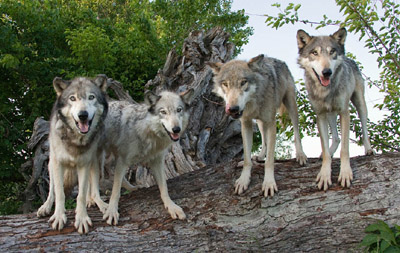
Wolves live in groups of between two and twenty (averaging about six to eight) animals.  These groups are called packs.  Each pack of wolves maintains an area, called a territory, which belongs to it and which it defends from other wolves.  Within this territory, the pack hunts, sleeps, plays, and raises pups.  Territories range in size from 50 to 1,000 square miles, depending on how much prey is available.  Packs also vary in size depending on what kind of prey is available.  Wolf packs which hunt deer as a primary source of food will have fewer wolves than packs which hunt bison or moose.  These large animals are harder to catch and kill, and can also feed more wolves once caught.

Wolves have a linear rank order, or hierarchy, which helps keep peace within the pack.  There is a separate line of rank for each sex: one for males and one for females.  At the top of the rank order is the alpha male and female.  The beta male and female are next highest in status.  At the bottom of the rank order is the omega “scapegoat” wolf, which may be either male or female.  In the rank order, each wolf has a set place.  When two wolves from the same pack cross paths, one is always dominant to the other, or higher in status than the other wolf.  The lower-ranking wolf is said to be submissive to the higher-ranking, dominant wolf.

The alpha wolves are not necessarily the strongest, the fastest, or the smartest.  High rank has more to do with attitude and confidence than size or strength.  Dominance also does not favor gender — either the alpha male or the alpha female may be the overall “leader of the pack”.

While dominant wolves generally act more self-confident than lower-ranking ones, wolves do not walk around constantly displaying their status.  They most often adopt a neutral pose, changing their expression towards dominance or submission depending on which other wolves are around.  (A wolf will show dominance to a lower-ranking animal, and submission to a higher-ranking one.)  A wolf displaying dominance stands up tall, looks directly at the other wolf, puts its ears forward, and will lift its tail (usually not much higher than its back, unless it is very excited).  A wolf displaying submission crouches down to look small, lowers or even tucks its tail, looks away from the other wolf, and puts its ears down and back.  This is usually all that happens when two wolves meet: wolves cannot afford to spend all their time fighting, and these subtle displays are all that is needed to maintain social stability.

Wolf communication involves a lot of signals like these.  The postures and facial expressions used will vary in intensity, or strength, depending on the context: an alpha wolf will often simply look hard at a wolf to send it a dominance message, and a submissive wolf will often just look away from a dominant wolf to give the appropriate response.  An excited alpha may give a stronger dominance message, and growl at a lower-ranking wolf or even hold it down.  Stronger submission signals include whining and pawing at the dominant wolf.  Mostly, signals just get louder and stronger the more excited the wolves get, and fighting rarely occurs.

The alpha wolves are not necessarily “in charge” or “leaders of the pack” at every moment.  They may decide where and when to hunt or they may not.  An alpha wolf is not always a leader so much as a wolf who has the right to do whatever it wants, whenever it wants.  Since they have so much social freedom to do what they like, alpha wolves often have more opportunity than lower-ranking wolves to start hunting or to choose a resting place.  The rest of the pack will then often follow and join in.  But when in home range, often younger wolves will take the lead on an outing.

The omega wolf ranks lower than any other wolf.  It usually sleeps away from the other pack members and may not engage in much social behavior, like howling or greeting.  The other wolves may make a “game” of picking on the omega wolf, biting it and driving it away from food.  At other times, the omega may be tolerated or even accepted into group activities.  This wolf may be able to eventually work itself back higher in the rank order or it may eventually choose to leave and form a new pack.

Rank order is not always linear and may be somewhat flexible in certain circumstances.  Puppies and yearlings, for example, have a rank order, but this order may change from month to month, week to week, or even from day to day in the case of young puppies.  (The rank order for adult wolves is usually more stable.)  “Playing” wolves, who are engaging in behaviors such as chasing and running for fun, may “switch” rank temporarily, and a lower-ranking wolf will be allowed to mock-dominate a higher-ranking one.  Some rank orders may be circular, with wolf A dominating wolf B who dominates wolf C who dominates wolf A, but this is rarely permanent.  Also, low-ranking wolves of one gender may be able to dominate high-ranking wolves of the other, without changing their rank in the social order of their respective sex.”

**Special thanks to “Wolf Park, http://www.wolfpark.org/aboutwolves.shtml, for providing this information!

Read Full Post »


July 11th, 2012

“The Iberian wolf lives in increasingly humanised landscapes, with limited food resources and its presence is not always welcome. But, according to Spanish researchers, food availability plays a secondary role compared to landscape characteristics, which can offer refuge and allow wolves to remain in human-dominated environments in Galicia.

 The habitat of the Iberian wolf (Canis lupus signatus) varies greatly across the Iberian Peninsula and its diet revolves around what is available, ranging from wild animals to domestic waste. In contrast, this predator is able to survive in humanised landscapes where characteristics provide them refuge from humans. “Although the wolf boasts highly adaptable strategies for survival, landscape is the factor we have analysed that best explains their distribution across Galicia,” as explained to SINC by Luis Llaneza, researcher at Asesores en Recursos Naturales (A.RE.NA.) and lead author of the study published in the ‘Diversity and Distributions’ journal. His research has allowed for the analysis of the relative influence of landscape attributes, human presence and food resources and the existence of wolves over an area of 30.000 km2 in the north-west of the Peninsula.

The scientists concentrated on indirect signs of the animal to identify their distribution in Galicia. In total, 1,594 excrement samples were analysed, which were then verified using DNA molecular analysis to locate them in the territory. The results revealed that landscape properties are decisive in terms of animal safety at a level of 48%, whereas the presence of humans (buildings and roads) is influential at a level of 35% and food availability as 17%. Llaneza says that “as long as tolerated by humans, the wolf can be found in any place where there is refuge and food.” According to the scientists’ model, the presence of wolves would increase if there were more semi-wild horses and wild ungulates. As the authors outline, “the amount of semi-wild horses in Galicia could be a key factor determining the presence of wolves in areas where wild prey or other food sources area not so abundant.” A safe refuge for the wolf After studying the effect of altitude, land orography and refuge availability, researchers demonstrated that these mammals require their habitat to be a plant mosaic containing vegetation of more than 50 centimetres in height (bushes and shrubs) to hide in.

“These animals remain in Spain and little by little we are beginning to understand how they survive in human-dominated areas,” says Llaneza. The study reveals that wolves choose high places that are difficult to access, such as areas where vegetation provides refuge from humans. “The density of vegetation allows wolves to go unnoticed by humans”, adds the researcher, who recalls that humans are the known cause of wolf death in 91% of instances. Some 65% of wolves are killed on the road, 20% by poaching and 6% by legal hunting. With the participation of the University of Santiago de Compostela and the Doñana Biological Station (EBD-CSIC), the research team concludes that a set of variables and data analysed explains only 20% of wolf distribution in Galicia. Their next undertaking will be the study of other factors that influence wolf survival in humanised areas, such as the extent to which they are tolerated. More information: Llaneza, L.; López-Bao, J.V.; Sazatornil, V. “Insights into wolf presence in human-dominated landscapes: the relative role of food availability, humans and landscape attributes”. Diversity and distributions 18 (5): 459-469, May 2012. DOI: 10.1111/j.1472-4642.2011.00869x”

Read more at: http://phys.org/news/2012-07-iberian-wolf-humans-refuge-prey.html#jCp

Read Full Post »


“Living With Wolves” sums up the answer to this question nicely (http://www.livingwithwolves.org/index.html)

Do wolves kill for sport?

“Answer: Wolves, like all wild carnivores, do not kill for sport. They kill to sustain themselves. Though it is uncommon, “surplus killing” (killing more prey animals than can be immediately consumed) has been observed in many predator species. If given the opportunity to secure future meals, many animals will sometimes do so. It is a survival mechanism. It is this survival tactic that has led to the misplaced notion of “sport killing” arises. It has nothing to do with sport. Only people kill for sport.

Surplus killing occurs when prey is at an unusual disadvantage, offering an opportunity to significantly lower both the risk of injury to the predator and the amount of energy required to kill the prey. It is for this reason that surplus killing by wolves, although rare, occurs more with livestock than it does with wild prey.

Typically, when a pack of wolves kills an elk or a deer, by the time the pack has subdued its prey, the rest of the herd has fled and is no longer in the area. This is not the case with livestock introduced by humans. Unlike their wild cousins, livestock have lost much of their survival instinct. Spending a good amount of their existence fenced in or being herded, their reaction to a predator in their midst is very different from that of wild prey. Calves and yearling cattle, for instance, flee during the chaos of the chase, but once the wolves have made a kill, rather than continuing to move away from danger, they have been known to stand nearby, watching in curiosity, perhaps unable to comprehend the threat and what might happen next. Instead of fleeing, as a wild prey animal would, sheep, when confronted with danger, often run in frantic circles, triggering predatory instinct in wolves and increasing the opportunity for multiple kills.

Wolves are further mischaracterized as killing for sport when people happen upon a dead animal or animals, killed by wolves, but the wolves are no longer present. This leads people to assume that the wolves abandoned their kill and therefore, must have killed for recreation or pleasure. This is far from the reality. The fact is that wolves are easily frightened away from their kill by the approach of human beings, whom they regard as a predator and tend to fear. Wolves may be also chased away by other, larger carnivores, eager to take advantage of an easy meal. So a presumably abandoned carcass is not what it seems. In nature, where the margins of survival are narrow, surplus food is not forgotten. Research shows that wolves return repeatedly, almost always eating the entire carcass.

For wolves, more so than bears and mountain lions, hunting can be very risky work. Unlike the larger, solitary mountain lion that relies on the element of surprise, ambushing and then quickly overpowering its prey, wolves work together as a pack, chasing their prey and wearing it down, looking for vulnerabilities. This is very difficult and dangerous, and they are often fatally wounded while hunting, gored by antlers or horns or kicked by a hoof. 80 to 90% of the time, their efforts to make a kill fail. When they succeed, if any food is left unfinished by wolves, it feeds scavengers or other animals.

Misinterpretation of animal behavior and motives often perpetuate a bad reputation for wolves, but reality does not support the theory that wolves kill for sport.”

Read Full Post »


Do wolves ever hunt for sport or fun in certain situations?  Wolf Preservation wants to hear your opinion on this controversial issue so please PROVIDE FEEDBACK and thank you! 

Below are some comments from different sides of the issue:

“Wolves traditionally hunt for “SPORT”, often times attacking an animal or group of animals and then walk off and leave most of the meat. The wolf “hunt for sport” pattern has reduced the overall population of elk and deer in Idaho.”(Idaho Deadwood Outfitters)

“I have seen wolves playing with an animal by biting it enough to wound and slow it down, then chase it, knock it down, let it up and repeat over and over. But, most of the time they are hunting for food.”(Randy, retired Police Officer and avid hunter)

“Wolves, like all wild carnivores, do not kill for sport. They kill to sustain themselves. Though it is uncommon, “surplus killing” (killing more prey animals than can be immediately consumed) has been observed in many predator species. If given the opportunity to secure future meals, many animals will sometimes do so. It is a survival mechanism. It is this survival tactic that has led to the misplaced notion of “sport killing” arises. It has nothing to do with sport. Only people kill for sport.” (Living With Wolves, Not for profit corporation)

“Unlike humans, wolves do not kill for sport from a safe distance. However, like humans, wolves do often harvest more food than they can eat in one sitting.”(Oregon Wild)

“They have never seen the trail of death a pack of wolves leaves behind as it kills to teach its pups how to hunt, or just for fun, eating little of the animals whose lives they have just ended.”(Peterson’s Hunting)


Read Full Post »


This article was previously written by: Dr. Victor Van Ballenberghe / U.S. Forest Service / Wolf Song of Alaska Advisor

Wolves can be a factor in controlling populations in certain areas BUT not the primary or only factor.  Hunters, disease, weather, and other predators play key roles.

Special thanks is given to “Wolf Song of Alaska” for providing his article.

This page is one of over 1500 pages in our library! Visit our homepage for a full menu of options!


“The following questions and statements represent a brief summary of biological information on wolf ecology and wolf/prey relationships distilled from numerous scientific studies conducted in North America during the past 50 years. I have selected topics that I feel represent some of the key biological issues that impact wolf management. By necessity, this discussion is brief and worded so that those with little technical background can assimilate the information. I have tried to accurately summarize and interpret a large volume of data while adhering to constraints of brevity and simplicity.

1. Can wolves kill any animal they choose?

Numerous studies across North America on virtually every species of wolf prey from the smallest (deer) to the largest (bison) have shown that wolves generally kill only certain kinds of animals. These include young, old, and infirm animals. Generally, animals in their prime (for example, moose aged 1-6) escape predation. However, during deep snow conditions that favor wolves, prime-aged animals may fall prey, but these conditions are uncommon.

These findings have been misinterpreted by some to mean that wolves only kill “sick” animals or that because they generally kill the young, old or infirm wolves can’t impact prey populations. Biologists have never claimed wolves kill only the sick and have stressed that predation on young may impact prey populations.

Studies have also shown that prey animals often escape predation by a variety of methods. An early study of moose and wolves at Isle Royale, Michigan, indicated that during winter only 8% of moose encountered by wolves were killed. The rest outran the wolves or stood their ground and the wolves left. During summer, moose often escape by entering water where wolves aren’t effective. Certain prey, including goats and sheep, inhabit terrain where they are often protected. All prey species have evolved numerous anti-predator adaptations.

2. Do wolves kill in excess of their needs?

Studies have shown that wolves generally consume the animals they kill, often returning to kills over a prolonged period. They also commonly scavenge animals that die or are killed by other predators or humans. On occasion, wolves starve because they cannot find or kill enough prey, or their reproduction is reduced due to food shortage.

During deep snow conditions that occur rarely, wolves may kill more than they consume. They may also kill more young than they consume when young are very abundant, for example in large herds of caribou. However, this “surplus” killing has generally not been shown to have significant effects on prey populations.

3. At what rate do wolves kill prey?

Research has shown that kill rates vary greatly depending on snow depth, prey size, prey abundance, pack size, and many other factors. Wolves rarely kill only one species for extended periods; most packs in Alaska have access to several species. During summer, beaver, fish, berries, and numerous small mammals and birds supplement their diet.

During winter, for wolves that kill only moose, an average-sized pack (6-10) may eat one moose per 4-5 days, but this can vary from about 2-10 days per moose per pack. Some of these animals may be scavenged. Summer data are less reliable and difficult to compare to winter because nutritional needs vary as does prey size (many calves are killed) and composition. However, several studies suggest that summer kill rates are lower than during winter.

For smaller prey, kill rates are necessarily higher. In Minnesota where wolves kill mainly white-tailed deer (also beaver and moose) annual kill rates per wolf have been estimated at 15-19 deer, including summer fawns.

4. What factors control wolf populations?

In Alaska (and elsewhere) wolf populations are mainly controlled by hunting and trapping, prey abundance, and social interactions among wolves. Virtually every pack in Alaska is subject to hunting and trapping, legal and illegal, but the impact of this varies. Some packs are exploited lightly because of their inaccessibility; others are kept at low numbers by hunters and trappers. Some packs have been eliminated by humans.

Generally, wolves on the northern and northwestern arctic coasts are rare and kept at a low density by people. Wolves in southcentral Alaska are heavily exploited but in much of the interior they are not.

Wolves generally declined in the late 1970’s and early 1980’s, apparently in response to decline of moose and caribou that began in the mid-1960’s. As moose and caribou increased in some areas (including the Nelchina basin) wolves were prevented from increasing by hunting and trapping.

5. What impact has land-and-shoot (LAS) wolf hunting had on wolf numbers?

The impact of LAS has varied from place to place. In some areas that are heavily timbered with few lakes or rivers, LAS has been ineffective in reducing wolf numbers. In other areas (including the Nelchina basin) wolves have been kept low by this

practice. Large areas of southcentral including GMU’s 9, 16, 11, and 13, are ideally suited to LAS are northern areas in or near the Brooks Range. It is clear that where the terrain allows hunters to be efficient, LAS has kept wolf numbers lower than they


would have been with hunting and trapping by other methods.

6. Will wolves increase indefinitely if they are not “controlled”?

Because hunting and trapping are generally effective controlling factors, wolves will increase if exploitation stops. However, wolf populations will not increase without limit in the absence of exploitation. For example, after the wolf control in GMU-20A stopped, moose numbers more than tripled but wolf increased to only about their pre-control numbers.

7. What rolls did hunting, weather, food supplies, and predation play in the moose and caribou declines of the 1960’s and 1970’s?

Moose and caribou populations in many areas of Alaska increased during the 1950’s and early 1960’s and declined into the 1970’s. Research suggests that for moose, food supplies declined as populations increased. Deep-snow winters aggravated reduced food conditions and started the moose population declines. Hunting regulation changes did not respond in time and hunting further accelerated the declines as it did for the caribou, especially the Nelchina and Western Arctic herds. For some moose populations (GMU-20A), wolves did not start the declines, but acted after they were well underway to drive moose to lower levels than they would have reached in absence of wolves.

8. Is habitat (food) currently limiting moose and caribou populations in Alaska?

Probably so in portions of southcentral including the lower Susitna valley where large numbers of moose starved in 1989-1990 and the Kenai Peninsula where plant succession has reduced habitat quality since the mid-1970’s. Caribou herds including the Nelchina and Western Arctic herds, are also thought to be approaching the carrying capacity of the ranges.

Probably not in portions of the interior where moose densities are low and food seems abundant.

Maybe in other areas where few data are available on food quantity and quality in relation to moose and caribou numbers. It is difficult to quantify these relationships over vast areas.

9. What about bear predation?

Studies have shown that both black and brown bears (especially the latter) can be efficient predators on young moose calves. In some areas (for example, the Nelchina basin) brown bears were a more significant source of calve mortality than wolves. Bears may also kill adults in the spring and fall when they are more vulnerable.

10. a) Can wolves and bears keep prey densities low for long periods?


b) Can prey increase from low densities if wolves and bears are not reduced by people?


There is evidence that wolves and bears acting together can keep moose at low densities for long periods in places where people have no or little impact on predator numbers. For caribou, it appears that this is not the case; caribou can periodically increase if alternate prey for wolves is scarce and they too fall to low densities. Moose also follow this pattern if bears are absent. At Isle Royale National Park where bears are absent and people do not exploit either wolves or moose, moose have increased periodically and reached high densities without any form of wolf control.

11. Do we need to “control” wolves in order to harvest prey?

Biologists do not dispute the idea that moose populations will produce a higher yield for people if wolves are few or absent. However, people can still hunt and shoot moose if wolves are present as demonstrated in Alaska for many years. As indicated in question 4 (above), hunting and trapping impacts wolf populations in many areas and may keep wolf densities low. Moose abundance may be high in these areas, as it generally is now in southcentral Alaska, and hunting by people may produce high yields. In other areas where wolves and bear reach higher densities it may still be possible for people to hunt, but they may be restricted to bulls only. Moose harvest in many areas of Alaska have increased in recent years without wolf control programs.

12. Does reducing wolf density result in more moose and caribou?

Clearly, wolf control in GMA-20A during 1975-79 resulted in an increase of moose on Tanana flats. This is probably the best known example of a wolf control program in Alaska. However, wolf control in other areas where wolf:moose ratios were higher or where bears were the problem had less success. As discussed above, deep snow, reduced food, hunting or bear predation may be more important than wolf predation in controlling moose numbers. If so, wolf control is not likely to yield benefits.

13. What is the importance of predator/prey ratios?

One of the primary factors in determining the impact of predation on prey numbers is the ratio of predators to prey. If predators are few in relation to prey, predation may have little controlling effect on prey numbers. However, controlling effects may be extreme if there are many predators in relation to prey. For wolves and moose, ratios of less than 1;30 may often result in moose population declines if wolves have little alternate prey. If bears are abundant, they may elevate this ratio considerably. When wolf:moose ratios are 1:60 or higher, predation likely has little effect.

14. Do wolf populations rapidly rebound from control programs?

Wolves have a high reproductive rate and may disperse long distances to fill “voids”. Studies in Alaska have shown that populations may increase rapidly following control programs and pre-control numbers may be reached in 3-4 years. However, wolves in some areas (including the north slope) have not recovered after being reduced to low densities because hunting and trapping removes them as they re-colonize.

15. Is the “balance of nature” a valid concept?

Different definitions of the balance of nature concept have emerged in recent years. If this concept means that wolves and prey exist for long periods at high and stable numbers, then the results of recent studies suggest this is simplistic. Numbers often fluctuate up as well as down and local extinction of prey is possible. However, if the concept means that wolves and prey coexist over time in large areas, clearly this is the case. Wolves and their prey co-evolved over thousands of years with little intervention from humans. Wolves are efficient predators that at certain times under certain conditions may exert powerful controlling effects on prey populations. But, for their part, prey animals have evolved the ability to survive and reproduce. The effects of humans on both wolves and prey and their habitat in the modern world are often the primary factors determining the “balances” that now result.”

Read Full Post »


Article Last Updated: Wednesday, February 01, 2012 6:53pm

Senses being tapped to keep the predators clear of cattle.

“ALBUQUERQUE – Wildlife managers are running out of options when it comes to helping Mexican gray wolves overcome hurdles that have thwarted reintroduction into their historic range in the Southwest.

Harassment and rubber bullets haven’t worked, so they’re trying something new – a food therapy that has the potential to make the wolves queasy enough to never want anything to do with cattle again.

As in people, the memories associated with eating a bad meal are rooted in the brain stem, triggered any time associated sights and smells pulse their way through the nervous system.

Wildlife managers are trying to tap into that physiological response in the wolves, hoping that feeding them beef laced with an odorless and tasteless medication will make them ill enough to kill their appetite for livestock.

Cattle depredations throughout southwestern New Mexico and southeastern Arizona have served as an Achilles’ heel for the federal government’s efforts to return the wolves.

Conditioned taste aversion – the technical term for what amounts to a simple reaction – is not a silver bullet for boosting the recovery of the Mexican wolf, but some biologists see it as one of few options remaining for getting the program back on track after nearly 14 years of stumbling.

“Just the very fact that the U.S. Fish and Wildlife Service is trying something new ought to send the message that they really are seriously concerned about the ranchers’ concerns,” said Dan Moriarty, a professor and chairman of the psychological sciences department at the University of San Diego.

“We have to find a way to sort of peacefully co-exist,” said Moriarty, who has worked with captive wolves in California. “That’s my hope, that the taste aversion will be one more tool.”

Gray wolves have rebounded from widespread extermination throughout the Northern Rockies and the Great Lakes region. Since being declared endangered in 1974, the wolf population has grown fivefold – to about 6,200 animals wandering parts of 10 states outside Alaska.

After four decades and tens of millions of dollars, the federal government was recently able to remove the animals from the endangered species list in several states.

The case is much different in the Southwest, where the population of the Mexican wolf – a subspecies of the gray wolf – continues to be about 50 despite more than a decade of work. Biologists had hoped to have more than 100 wolves in the wild by 2006.

Due to livestock problems, about 90 wolves and some dependent pups have been removed – in some cases lethally – from the wild since the program began. For about four years, the Fish and Wildlife Service operated under a policy that called for trapping or shooting wolves if they had been involved in at least three cattle depredations.

The agency has since scrapped the policy, and ranchers have all but given up on keeping track of their dead cows and calves.

In the last year, monthly reports from the wolf program show wildlife managers investigated four dozen depredations in Arizona and New Mexico. They determined that wolves were involved in half of the cases.

Caren Cowan, executive director of the New Mexico Cattle Grower’s Association, said ranchers are frustrated.

“You really have no idea how bad it is when a dad calls you and says ‘There’s a wolf in my yard and my kids and my wife are stuck in the house. What can you do to help me?’”

That’s the issue, Cowan said. “These animals are habituated to humans and until we can figure that out, I don’t know what you do.”

Cowan acknowledged, however, that getting wolves to stop preying on livestock would be a huge first step.

Biologists working at a captive breeding center at the Sevilleta National Wildlife Refuge in south-central New Mexico treated six wolves last April and another two in October. The animals were fed baits made up of beef, cow hide and an odorless, tasteless deworming medication that makes the wolves queasy.

Fish and Wildlife Service biologist Susan Dicks said the initial tests appear to be successful, with the wolves not wanting anything to do with the beef baits after their first serving.

The idea is that when wolves smell cattle in the wild, their nervous system and brain stem will kick into gear and override any desire they have to get near the cattle.

“We’re learning as we go, but so far we have seen some good aversions produced,” Dicks said. “Again, it’s impossible to say yet whether this translates to a livestock animal running around on the hoof.”

Wolf releases have been put off for the past year, and it’s unclear whether the agency will have the opportunity to release the treated wolves this year so the taste aversion treatments can be fully tested.

The work done with the Mexican wolves is based on decades of research conducted by Lowell Nicolaus, a retired biology professor from Northern Illinois University. He has seen it work with captive wolves and free-ranging raccoons and crows.

“It just takes one good illness,” said Nicolaus of Butte Falls, Ore. “Their avoidance is going to be expressed wherever they see the food or smell it. It doesn’t depend on when and where they first ate it or when and where they got sick.”

Nicolaus said taste aversion works because it’s an unconscious response, not a threat that wolves can overcome such as being hazed or shot at with rubber bullets.

The other benefit is biologists say wolves that have an aversion to cattle are likely to pass that on to their pups by teaching them hunting habitats that avoid cattle and focus on deer, elk and other native prey. They call that a feeding tradition.

Bill Given, a wildlife biologist who helped the Fish and Wildlife Service with the first batch of wolf treatments at Sevilleta, describes taste aversion as a natural solution that taps into an evolutionary defense mechanism that is common among all animals.

“You can build a great fence or you can have a dog as a shepherd, but none of those things can change the desire to consume the livestock,” he said. “They just make it challenging and then the predator has to work around that barrier.”

To ranchers, the wolves are “killing machines,” Cowan said.

The biologists don’t necessarily disagree.

“There’s no stopping the feeding and the sex drive. All life is about those two things,” Given said, noting that wildlife managers have an opportunity to gain some control through taste aversion.

The next challenge will be proving its value on the range by monitoring wolves that have been treated.

“I think it does have a lot of promise,” Dicks said. “And part of it is we’re willing to try anything to get these animals successfully on the ground without impacting livestock growers.”

*Special thanks to SUSAN MONTOYA BRYAN, 
Associated PressHerald Staff for providing this information! ( http://durangoherald.com/article/20120202/NEWS06/702029970/-1/s)

Read Full Post »


The Film

“From the opening scene, this film takes the audience on an unbelievable journey. Follow world-renowend animal trainer, Andrew Simpson as he travels to one of the coldest places on earth. Together with his Canadian crew and his pack of wolves, he sets out to make the biggest wolf film ever attempted.

 They will live in Siberia in a remote camp for five months where the temperature drops to -60C. You will witness the bond between man and wolf, and the emotional toll this journey takes on everyone.

The footage in this film had never been seen before – there are no computer effects everything you see is real.

Wolves are one of the most misunderstood animals of all time. In this film, you will see them in a new light. It will make you question everything you thought you knew about wolves. You will see an animal that is graceful, caring, affectionate, trusting and capable of expressing all levels of emotion.

You will see one man’s special relationship with a pack of wolves that he raised and lives with everyday. And you will witness his struggle as he wrestle’s with the decision to use this unique bond against them.

Andrew Simpson

Andrew was born and raised in Scotland. Even as a child he was drawn towards nature and was always the kid with a mouse or a frog in his pocket. But he also had a love of adventure. After leaving the Highlands, he travelled around the world several times before settling in Canada.

It was in Canada that all the stars aligned for him. Having a love of animals and a fascination with movies, he finallly found his calling – a professional animal trainer for the industry.

“It’s hard to imaging getting paid for something you love to do everyday, but I do…”

Almost 20 years later, his passion is still just as strong. With his love of nature and the outdoors, and vast film making experience, Andrews talents are in high demand. From the Australian outback to the Greek Islands to Northern China, he is constantly travelling the world, pursuing his dreams, and living life to the fullest.

Although he deals with all species, his speciality is wolves. It is because of this reputation that he was asked to travel to Siberia to make the biggest wolf film ever attempted. Having worked for almost every major Hollywood studio on over 100 productions, Andrew decided it was time to venture in a new direction.

“…What we do with wolves is very specialized, and people the world over are fascinated with them…”

This was the reason for making this film. Andrew wanted to show another side of wolves – a different side from the fairy tales and horror stories normally associated with them.”

*Special thanks to Zenn Media for providing this information! (http://www.wolvesunleashed.com/film.php)

Read Full Post »


Jay Mallonee is a research biologist with a master’s degree in neurobiology/animal behavior. Through

his business of Wolf & Wildlife Studies, he has researched wolves in various states since 1992, along

with a 9-year study of the Fishtrap pack in northwest Montana (Project HOWL). Previous research has

included the documentation of traumatic stress displayed by a wild wolf placed into captivity, and

behavioral studies on rodents, primates, and a variety of cetaceans, such as gray whales and bottlenose

dolphins. Details of his studies can be found at

http://www.wolfandwildlifestudies.com. He also authored the book

Timber – A Perfect Life, that chronicles the profound 16 year journey with his canine companion.

Mallonee is a college professor and has taught a wide range of science classes for Michigan Tech

University, U. C. Santa Barbara, San Francisco State University, and several community colleges.  Below is a revealing article about how no sufficient data supports the wolf hunts!  Click on the link at the bottom to read the rest of his article and special thanks to the multiple sources he uses:


“Abstract

Management agencies have claimed that the recovery and public hunting of wolves is based in science.

A review of their statistics demonstrated that data collection methods did not follow a scientific protocol

which resulted in flawed and often blatantly incorrect data. Consequently, agencies do not know the

total number of wolves in Montana, a major reference point used by wolf managers. Therefore, the

quotas proposed for public wolf hunts are completely arbitrary, and management decisions in general

have not been based on facts. Management methods, and now hunting, contribute to the current

ecological crisis produced by the elimination and manipulation of predator species, which form the top

of food chains. These consumers produce a powerful “top-down” influence throughout ecosystems

which can even determine the surrounding vegetation species. Also reviewed were public attitudes

toward wolves, along with political approaches to solving the “wolf problem.” The total effect of these

processes has produced a wolf management system that lacks scientific perspective and does not utilize

what is known about the wolves’ role in sustaining healthy ecosystems. Instead, the data demonstrates

that management decisions have been based on agenda and propelled by opinion, bigotry, and politic.”  He adds, ”

Ultimately we have the greatest influence on how many deer, elk, wolves, and other predators are

present in our ecosystems. Until the current management paradigm changes, along with public attitude,

there is no permanent solution to the apparent “wolf problem.”

I can appreciate how hard FWP works to

obtain data on wolves and I know they do their best. Their best, however, is not science as they have

claimed.

Future solutions will have to take into account the full range of what science knows about

wolves. Until that happens, agendas, opinions, and politics will guide wolf management over problems

that are either mostly unknown (effects on prey populations) or rarely happen (depredations). This is a

social issue, not a biological one.”

http://www.wolfandwildlifestudies.com/downloads/huntingwolvesinmontana.pdf

Read Full Post »


Please visit the link below and vote “no” to delisting wolves! Also, please comment why.
(http://www.uppermichiganssource.com/news/story.aspx?id=617187)

The Daily Pulse on Fox Up is running this poll. Thank you to UpperMichigansSource.Com for providing the information below.

“At a time when gray wolves have been removed from the endangered species list in the Upper Peninsula, there is now a proposal to expand that policy nationwide.

A member of Congress is proposing legislation to remove federal protections of gray wolves across the country.

Michigan Republican Candice Miller introduced the bill this week. Miller says congressional action is needed because environmentalists’ lawsuits repeatedly have blocked regulators from keeping wolf numbers under control.

Tonight in the Daily Pulse, we’re wondering: Do you believe gray wolves should be delisted nationally? Yes or no.”

Read Full Post »


*Check out this article provided by authors Tory and Meredith Taylor, Wyofile (in depth reporting about Wyoming people, places, and policies) from April 06th, 2009.  This gives you some good facts about predator/prey relationships and other causes of Elk decline.  Please read and provide your feedback!

While some Wyoming legislators, hunters, and ranchers claim that wolves are decimating the state’s elk herds, analysis of the facts tells a different story. Prior to the reintroduction of wolves into the Greater Yellowstone area during 1995 and 1996, some pessimists predicted that following wolf recovery, Wyoming’s abundant elk herds and popular elk hunting would be things of the past.

In contrast, many wildlife biologists — who had a better grasp of predator-prey relationships — predicted that after wolves recovered, elk distribution and behavior might fluctuate in some herds, but that elk numbers would be largely unaffected. Now, wolf and elk population monitoring studies indicate that the wildlife biologists’ predictions were more accurate than the darker forecasts of the anti-wolf pessimists.

Many things kill Wyoming elk. Human hunters, animal predators, disease, too little or too much precipitation, hard winters, and poor forage all help determine which elk live and which die. Other things — auto-elk collisions, spring floods, lightning, fences, culling of diseased elk, and poaching — also take a toll. The risks to elk seem daunting at times, and the odds of an elk dying of old age are slim.

How many elk are in Wyoming and how many do we want? Through a public process taking into consideration many factors, the Wyoming Game and Fish Department sets objectives for the state elk population. The department weighs factors such as forage availability, winter range, and hunter demand. Other factors with greater weight, such as landowners’ desires and political wishes, are also considered. Game and Fish wildlife biologists annually compare elk populations against the population objectives in order to determine proper management strategies. If elk numbers are declining from the population objective, wildlife managers rummage in their “elk population tool box” for appropriate tools to fix the problem. For example, they may need fewer hunters and more habitat improvement projects. If elk numbers are increasing too much above the herd objective, wildlife managers may increase hunting opportunities by issuing more hunting licenses, lengthening hunting seasons, or instituting hunter access programs that facilitate elk harvest.

Each year Wyoming wildlife biologists collect data from elk herds and elk hunting seasons in order to gauge trends. Elk data from the state’s 35 elk herds and eight management districts are compiled in Wyoming Fish and Game Department annual reports that show the big picture of Wyoming elk populations. Interestingly, the annual reports’ data tell a far different story about Wyoming elk numbers and elk hunting opportunities than is often heard in coffee shops, from bar stools, and at the state legislature.

Nearly three decades of Wyoming elk data taken from the department’s annual reports show that the elk population, number of elk harvested, and elk hunter success rates have steadily increased both before and after wolf reintroduction. During this time, the number of elk hunting licenses sold each year has slightly decreased. This means that Wyoming has more elk today than thirty years ago, with about the same number of hunters killing more elk.

According to the 2008 Game and Fish Annual Report, the 2007 state elk population objective was 83,140 animals. The estimated Wyoming elk population was calculated from only 27 of 35 elk herds at 94,936 animals (population estimates for the other eight herd units are not available in the report or from the department). Even with eight herd units missing from the count, the 2007 Wyoming elk population was 14 percent above the target population objective, according to the annual report.

“The Department continues to manage for a reduction in Wyoming’s elk population,” the report states, noting that “overall, management strategies will continue to focus on decreasing the statewide population. However, some herds are at objective and will be managed for their current numbers.” (WGFD, 2008 Annual Report, p. A-2.)

*Source Wyoming Game and Fish Department Annual Reports.
(1) Statewide elk population was calculated from 27 of 35 elk herds; 8 herd populations unavailable
(2) Statewide elk population was calculated from 29 of 35 elk herds; 6 herd populations unavailable.
(3) Statewide elk population was calculated from 28 of 35 elk herds; 7 herd populations unavailable.
(4) Statewide elk population was calculated from 28 of 35 elk herds; 7 herd populations unavailable.
(5) Statewide elk population was calculated from 27 of 35 elk herds; 8 herd populations unavailable.
Note: 2003-07 elk population estimates are below actual numbers.

Wyoming has never been a state to let science or facts get in the way of culture, custom, and wishful thinking. Our 1880s-era political system is based on a one cow, one vote premise, and change comes hard.

In an e-mail exchange with WyoFile during the 2009 legislative session, Wyoming State Rep. Pat Childers (R-Park), chairman of the Travel, Recreation, and Wildlife Committee, stated his opinion that wolves are bad for elk.

“As for wolves and elks [sic], I have had two reports from the Wyoming Game & Fish presented to me that clearly show that the wolves are impacting the ungulate [sic] of the elk herds,” Childers wrote. “While the populations of those herds have not currently decreased, the study shows that the populations of the herds will soon be reduced to an alarming low level because the loss of ungulate [sic] will result in less animals.”

An “ungulate” is a hoofed mammal; it’s unclear what Chairman Childers thinks it is.

The Game and Fish department’s Absaroka Elk Study that Chairman Childers cites clearly shows that elk numbers have been well above the Clark’s Fork herd objective since 1992, throughout the entire wolf recovery period. What Childers thinks would reduce the elk to alarmingly low levels is not clear, but herd reduction appears to be the intended goal of the Wyoming Game and Fish Department order to manage the elk at or near the herd’s population objective. (Absaroka Elk Ecology Project, 2008 update. WYGFD, UW, and USFWS.)

All elk populations do not respond identically to sharing landscape with wolves, a new report from Montana suggests. Montana Fish, Wildlife and Parks and Montana State University researchers spent the past seven years monitoring elk populations and behavior in southwestern Montana. Their study shows that elk numbers in some areas dropped, mostly due to the loss of elk calves to wolves and grizzly bears. But in other Montana areas, elk numbers increased while hunter-harvests of elk decreased, with little apparent influence by local wolf packs on elk numbers.

“One-size-fits-all explanations of wolf-elk interactions across large landscapes do not seem to exist,” said Justin Gude, chief of Fish, Wildlife and Parks wildlife research in Helena. He noted that the study also found that “calves with higher gamma globulin levels, a possible indicator of superior condition, survived better than those with lower levels, demonstrating that environmental factors are also important contributing factors to predation and survival with Yellowstone elk calves.”

How big a bite do predators take out of elk herds? Since wolf restoration in Greater Yellowstone, some people assumed the wolves would be the main cause of elk calf mortality. So from 2003 to 2005 the U.S. Geological Survey, Yellowstone National Park, and the University of Minnesota conducted an elk calf mortality study to answer the question of who’s eating what. The study showed that wolves accounted for about 12 percent of newborn calf deaths, while grizzly and black bears caused about 69 percent of recorded deaths, and coyotes killed 11 percent. wolf hunting

(Elk Calf Survival and Mortality Following Wolf Restoration to Yellowstone National Park, Shannon M. Barber-Meyer, L. David Mech, and P. J. White,13(3) Yellowstone Science, Summer 2005, p. 37.)

While many current ranchers are from fourth and fifth- generation families, wolves have had an even longer history in the West. (See, “Trophic Cascade: The Case For Wolves,” by Debra Donahue, WyoFile 07/21/2008)

And now there is a new economic constituency for wolves. Winter wolf-watch trips to Yellowstone are transforming Yellowstone into a year-around destination. According to Dr. John Duffield’s research for the University of Montana, wolves are now a tourist magnet annually bringing in at least $35 million directly, or $70 million indirectly through the multiplier effect, to such Yellowstone satellite communities as Cody, Dubois, and Jackson.

Wolf numbers are down this winter in Wyoming because of disease (distemper and mange), inter-pack conflicts, and excessive wolf shootings while the animal was delisted in the state during 2008.

“The number of wolves in Yellowstone National Park declined last year,” a January 2009 Yellowstone National Park news release stated. “It’s the first drop in wolf numbers in the park in three years. The Yellowstone Wolf Project reports the 2008 population at 124 wolves, down 27 percent from the 171 wolves recorded in 2007. The greatest decline occurred on the northern range, the area with the greatest wolf population density. The wolf population there dropped 40 percent, from 94 to 56 wolves.”

However, disease also reduced the population in 2005, when the numbers showed an even greater drop from 171 wolves in 2004, to 118, due to distemper. Sarcoptic mange is also a concern in Yellowstone wolves and has recently been identified in a Jackson-area wolf pack. The number of breeding pairs in the park has declined from 10 to six. This decline brings the wolves to the lowest number of breeding pairs recorded since 2000, when wolves first met the minimum population requirement for delisting.

Where does this leave people who are directly affected by wolves? Outfitter Bud Betts lives in the Dunoir Valley along the Wiggins elk herd migration route. His closest neighbors are elk, grizzly bears, and wolves. Betts says the wolves are doing fine, but the elk are not.

“The elk cow-calf numbers are down closer to herd objective, so we have reduced hunter opportunities. I don’t like the wolf,” he admits, but philosophically adds, “They are here and we have to live with them.”

Wildlife science still takes a back seat to politics in Wyoming. According to an Associated Press article in the February 24, 2009 Casper Star Tribune, Wyoming lawmakers want to test wolves for brucellosis, a bacterial infection best known in Wyoming in cattle and bison, although different forms of the disease can also infect swine, goats, sheep and dogs.

During the 2009 legislative session, Senate File 87, sponsored by Sen. Kit Jennings (R-Natrona) and Rep. Childers, would have required Wyoming Game and Fish to test wolves for the disease.

“[Brucellosis is] not even an issue,” said Mike Jimenez, the U.S. Fish and Wildlife Service’s wolf recovery project director for Wyoming. “No one’s ever really been concerned about it, but for whatever reason, if there is a concern, it’s easy enough to test for it.”

Jimenez said that federal wildlife agents have tested 16 captured or killed Wyoming wolves for the disease, but the results were all negative.

Terry Kreeger, state game and fish department supervisor of veterinary services, said the Sybille, WY research laboratory has tested wolves for brucellosis occasionally, and all results have been negative, he said.

“Given what we know today, we would consider wolves a dead-end host for [bovine brucellosis] bacteria, i.e., they become infected but they are not capable of transmitting it to other animals, even other wolves,” he said. Kreeger said he doesn’t believe wolves are a factor in Wyoming’s brucellosis problem. He said studies have shown that wolves infected with brucellosis do not transmit the disease.

Some Wyoming lawmakers are more practical than others when dealing with wolf management. In 2009 Wyoming Rep. Keith Gingery (R – Jackson/Dubois) introduced House Bill 21 to classify and manage wolves solely as “trophy game” statewide, which would have allowed the wolf to be delisted by the U.S. Fish and Wildlife Service. In the mid-1990′s, state wildlife staff recommended the “trophy animals” classification, but the politically-appointed Wyoming Game and Fish Commission, livestock interests, and most Wyoming politicians flatly rejected the idea.

Instead, politics insisted that Wyoming wolves be classified as both “trophy and predator” throughout most of the state. Predator classification means that the animal can be shot on sight at any time. Trophy game status requires a Wyoming Game and Fish regulation to hunt the animal only with a seasonal license. This dual classification has kept wolf management out of state hands, so in 2008 the wildlife commission voted to support a statewide trophy game management plan. Soon after this decision, the Wyoming Wildlife Federtion, the state’s leading hunting organization, also read the writing on the wall and voted to change its position to now support statewide trophy game management for wolves. HB 21 died this session as lawmakers stuck to their guns and their original dual classification, predator/trophy game plan. The U.S. Wildlife Service has already rejected the plan, and after a lawsuit over the large number of wolves killed in Wyoming last year, the animals have been “relisted.”

“If Wyoming wants to get to the point at which the people of Wyoming, through the Wyoming Game and Fish, manage wolves rather than the Feds,” Gingery said to WyoFile, “then we need to change our proposed wolf plan. The Feds have made it clear that they will not accept a dual status of predator/trophy game. The Feds want Wyoming to adjust their plan to a single status, namely trophy game status, just like Montana and Idaho have already done. This was under the Bush administration, and I highly doubt the Obama administration will lessen that requirement.

“Thus, the option is either drop the dual status or continue to fight in court for the next five years knowing full well that in the end we will lose. The issue that the courts will look at is whether or not the Wyoming plan meets the requirements of the Endangered Species Act, and at this point it does not.”

During the past two decades, wolf recovery and management have dwelt much more in the political and legal realms than in the biology and wildlife management worlds. Endangered species such as wolves and grizzly bears resonate loudly on the states’ rights drum. While we humans navigate the procedures of the state and national management plan process, wolves and elk, predators and prey, continue their delicate dance in Greater Yellowstone, as they have for tens of thousands of years.

Read Full Post »
« Newer Posts - Older Posts »