Feeds:
Posts
Comments

Expert Nonlethal Methods

Photo by Brian Smith Times News Carter Niemeyer, a Boise-based wolf expert and former wildlife manager, speaks to an audience about wolves in Idaho on Friday at the Stanley Museum. Niemeyer said the best way to reduce wolf killings of cattle and sheep is to promote non-lethal deterrents instead of aerial killing of problem wolves.

“STANLEY • To reduce wolf killings of sheep and cattle in south-central Idaho, reimbursements for lost livestock must be reduced or eliminated, and ranchers must not be able to easily order aerial killings of problem wolves or packs, a prominent Boise-based wolf expert said at a presentation in Stanley.

As long as lethal wolf control comes free of charge and area ranchers are paid for their losses, they won’t adopt voluntary, non-lethal wolf deterrents in an area that saw record-high depredations last year, said Carter Niemeyer, author of “Wolfer” and a former wolf manager and trapper.

“All it takes is a phone call and if you have a legitimate, confirmed loss, those wolves can be killed,” he said after his Friday presentation. “Most ranchers go, ‘Why in the world would I want to scare one away when we can just take care of the problem?’”

Lethal Control Preferred

Lethal control is preferred in Idaho and other states, he said, meaning taxpayers are funding the large cost of killing problem wolves.

“Wildlife services under the United States Department of Agriculture, they won’t hesitate to spend $10,000 or $20,000 on a helicopter to shoot a group of wolves,” he said.

But that’s only a short-term treatment, he said. USDA wildlife services could spend money on non-lethal deterrents — lighting, electric fencing and corrals strung with flags — to protect livestock and not “get into a cycle of killing wolves.”

“What do you get when you kill coyotes and wolves? More coyotes and wolves,” he said.

Idaho officials are applying for federal funding to reimburse ranchers for their wolf depredations in 2012. Half of that money, however, is earmarked for non-lethal deterrents. Whatever amount the state receives, Niemeyer said it would likely be enough for only a “pick-up truck and an employee.”

“There’s no silver bullet, but we’re willing to spend tens of thousands of dollars killing predators,” he said. “Why can’t we look at other methodologies and study the possibilities to do preventative things that don’t require us spending (that money)?”

‘Nation’s Most Polarizing Wildlife Issue’

But the “problem” won’t go away. Like it or not, wolves are here to stay and humans must learn to live alongside the reintroduced species, Niemeyer said during the presentation to a crowd at the Stanley Museum. Niemeyer’s presentation focused on his decades of work with wolves, including his role in helping re-establish the species in the area. He discussed public attitudes toward the predator, and misconceptions about the wolf’s reintroduction, which he called the nation’s most polarizing wildlife issue — ever.

“Wolves are prolific, resilient, they disperse and they are going to be here for a long, long time to come because they like the habitat we’ve provided them,” he said. “… I’m not here to advocate for wolves. I don’t love them. I don’t hate them, but I do recognize they are a native species and I think we’ve got to treat them like that.”

Niemeyer said he is often criticized for his work with the government’s reintroduction of wolves in northwestern regions of the United States. When he speaks publicly about the subject, between 150 and 300 people attend, often with their opinions cemented.

“Most of you people here today probably know how you feel about them,” he said. “I don’t feel like I’ve ever spoken to a crowd and turn you all 180 degrees before you left.”

Niemeyer referenced a chart showing how wolf populations have grown exponentially in the northwest and central Idaho since they were reintroduced.

“Along with this you could also have a graph on tempers, attitudes and opinions that goes right alongside … ,” he said.

Along with those opinions have come rumors about the reason for their presence – to ruin and outlaw big game hunting, take away guns and drive the livestock industry out of the West.

“I’ve heard it all,” he said.

Wildlife, however, react and benefit from wolves’ presence in the area, he said.

“They prey on big game, they create carrion for others to eat and scavenge, they regulate big game herds,” he said. “I think they make big game herds healthy because they were one of the natural predators of these species before settlers came and helped God manage wildlife.”

Wolves aren’t a threat to humans despite cultural mythologies painting them as villains, he said. Only two people in recent memory have been killed by wolves, but those incidents were in Canada and Alaska.

“I have never had a close call with wolves in my life,” Niemeyer said. “I have been surrounded by them dozens of times — packs and pups. I love it. I just sit on a log and think, ‘I wish I had all you here.’”

‘Social Carrying Capacity’

Whereas some biologists are concerned with the biological carrying capacity of an animal, wolves are now measured on a “social carrying capacity” — not how many a landscape will hold, but how many wolves humans will tolerate, he said.

According to Idaho Department of Fish and Game statistics, wolves killed 34 cattle and 79 sheep last year in the southern portions of the Sawtooth Range, including Camas and Blaine counties. Across the state, they killed 90 cattle and 251 sheep. In turn, hunters killed 330 Idaho wolves last year, up from 200 the year before.

From 1987 to 2012, wolves killed an average of 143 sheep and 71 cattle a year across Idaho, Montana and Wyoming, Niemeyer said. In those states, there are 850,000 range ewes and millions of cattle. He displayed United States Department of Agriculture statistics that showed 26 percent of livestock died of respiratory problems while 0.2 percent died of wolf predation.

“Is that a big problem or not? It certainly is if it is you’re cattle and sheep,” he said.”

**Special thanks to Brian Smith, bsmith@magicvalley.com, for providing this information!


proposed wolf hunt areas

“LANSING — A group that opposes a gray wolf hunt says it will launch a second ballot petition drive to stop the proposed hunt after its first effort was thwarted by the Legislature.

Keep Michigan Wolves Protected submitted more than 255,000 signatures in March in an effort to overturn a December 2012 state law that allows the hunting and trapping of wolves.

But in May, lawmakers and Gov. Rick Snyder approved a new bill that allows the Michigan Natural Resources Commission to add animals to the list of game species. That action meant Keep Michigan Wolves Protected could still go ahead with a vote on the earlier law, but it would not have the effect of stopping the hunt.

The commission is expected to approve a limited wolf hunt beginning in mid-November when it meets this month.

On Tuesday, Keep Michigan Wolves Protected announced it will launch a second signature drive, this one aimed at the new law.

“This second referendum will preserve the impact of our first referendum that has already been certified for the ballot — ensuring Michigan voters have the right to protect wolves and other wildlife matters,” said Jill Fritz, director of the group.

She said her group won’t be able to collect signatures and get them certified in time to stop the November hunt. Once the proposed repeal of a state law is certified for the ballot, that law is suspended pending the election.

If the new drive is successful, there would be two wolf-related ballot measures on the November 2014 ballot.

Keep Michigan Wolves Protected describes itself as a coalition of conservation groups, animal welfare organizations, Native American tribes, wildlife scientists, veterinarians, hunters, farmers and more than 7,000 citizens.”

**Special thanks to “Detroit Free Press (http://www.freep.com/article/20130702/NEWS06/307020046/wolf-hunt-michigan) for providing this information!


Wolf Wolf

“A friend of Footloose Montana, a hunter, rancher and 7th generation Montanan speaks out about trapping and ethics in hunting!

I grew up as a member of a 7 generation pioneer Montana ranching family. We were and still are outdoorsmen and spend every opportunity hiking, fishing and hunting in the Montana outdoors. Hunting was not done to acquire trophies to hang on the wall, or a rug to lay upon the floor, it was an opportunity to help supplement the family’s food larder through the winter Months. My grandfather, with whom I spent uncountable hours with in the forests taught me hunting ethics from the time I could fill a pair of boots and had the strength to keep up with him. As hunters, we followed strict personal rules when it came to taking an animal. Take no more than what was legal and no more than what our family could eat. We relied on our expertise in stalking and getting a close to the animal as possible, and if we could not take an animal cleanly, we passed it by. By cleanly, I mean as close as possible to an instant kill. Watching or having an animal suffer due to our poor hunting ability was unthinkable.

It is my belief that most hunters today still maintain those kinds of ethics as it applies to hunting. But there are a few that display conduct that shames the rest of us. These are what I refer to as Slob hunters, and these are the ones that portray the rest of us with a horrible image to the non-hunting population. The slob hunters are the ones that post stickers all over their trucks with slogans such as “Wolves, smoke a pack a day, or the only good wolf is a dead wolf, etc”. The slob hunters are the same type that knowingly put traps out where the contraption is more likely to capture a domestic animal or pet than it is likely to capture the trapper’s intended victim. These are the same guys that post their rantings and pictures of tortured, suffering animals all over Facebook for all to see. These are the same guys who show their lack of upbringing by waving their arms, making faces at Montana Fish, Wildlife, and Parks commissioner’s meetings while muttering loudly as someone with an opposing view presents their testimony. These are the same guys that who verbally attack others at meetings, within newspapers, or write sick comments on other people’s facebook pages trying to intimidate, all because someone may have a different outlook than their own.

The Slob hunters and trappers are the people that are the biggest threat to hunting in North America. It’s not the non-hunting communities, nor is it the Anti-hunters who threaten the future of hunting. The biggest threat to hunting over all is and will continue to be the slob hunters within the hunting community itself. The Slob hunters are the ones that tear down fences on private land, use Forest service signs and out houses for target practice. These are the guys that run their ATVs off designated roads and trails, tearing up the terrain, these are the guys that gut shoot a rancher’s cow, or horse that happens to be standing out in the middle of a field. These are the guys that feel they need to take semi-automatic rifles into the field with 30 round magazines, along with a few 12 packs of beer in the back seat. These are guys that leave their empty beer cans alongside road ways, or in camping areas for someone else to pick up.

So often I have heard, “Trapping is part of Montana’s heritage and tradition” and to that I must reply, “It may have been a part of our state’s history, but that does NOT mean it needs to be a part of our future!” I detest trapping in all forms, and those that utilize trapping for sport or profit. Sport? What Sport? Trapping, no matter how you look at it is nothing more than blatant cruelty that inflicts needless suffering upon an animal.
The hunting communities should best begin to realize that it’s NOT the non-hunting population or even the Anti-hunting communities that are the biggest threat to hunting in North America. It’s the Slob hunters and trappers within the hunting community itself that is the biggest threat to the hunting tradition.

I strongly believe the majority of the hunters today do care about and maintaining strong conservation values for the land as well as wildlife in general. They believe and follow certain ethics while hunting and the principle of “Fair Chase” is an example.

The Boone and Crocket club defined “Fair Chase” as the ethical, sportsman like, lawful pursuit and taking of any free-ranging wild animal in a manner that does not give the hunter an improper or unfair advantage over such game. Use of any of the following in the taking of game is considered UNFAIR chase:

* Spotting or herding game from the air, then landing, pursuing and shooting those animals
* Herding, pursuing or shooting game from a motor boat or motor vehicle
* Use of illegal electronic devices attracting, locating, or observing game, or for guiding hunters to such game
* Hunting game confined by fences, enclosures, or game transplanted solely for the purpose of commercial shooting
* Taking game illegally or using illegal methods against regulations of the Federal government or any state, province, territory, or tribal lands.
Personally I would add two more to Boone and Crocket’s list and that would be:
* Hunting and shooting of an animal over bait
* Hunting and killing of pregnant animals. What is ETHICAL about that??

We can thank the hunting communities, through their efforts, for the millions of acres of wilderness and wild lands set aside for wildlife. But the hunting community must realize that times are changing and the hunting communities alone can no longer fully support conservation. Our wild lands are constantly under attack by big money organizations, the oil, and livestock industries for example. America is losing its open lands and as the land goes, so does its wildlife. It is IMPERATIVE that both the hunting communities and the non-hunting communities work together and get politics as well as special interests out of our forests. There is absolutely no reason that either side should not be willing to sit down and work together to accomplish our basic mutual goal of preserving wild lands and wildlife for future generations to enjoy.

As I have attended many Fish, Wildlife and Park public and commissioner meetings, I note that the majority of speakers pushing for unethical practices come from the Trophy hunters, the Outfitter association, or domestic livestock associations. We cannot afford to allow these people to continue to dictate policy that will affect the future of our wildlife and wild lands. Its way past the time that Montana Fish, Wildlife and Parks puts aside political agendas and begins to manage, and preserve ALL our wildlife as that department was originally tasked to do. Our future and hunting depends on it.

I support Footloose Montana and applaud this organization’s efforts to eliminate trapping upon public lands.
Thank you!

Steve Clevidence”


walking wolf

The Fish and Wildlife Service bows to pressure from antigovernment groups, removing the animals’ endangered status

By :

“The US Fish and Wildlife Service’s recent announcement that it is beginning the process for removing gray wolves across the country from the protection of the Endangered Species Act surprised no one. The Fish and Wildlife Service’s mid-1990s reintroduction of gray wolves — a species virtually extirpated in the nineteenth and twentieth centuries — into Yellowstone National Park and central Idaho marked a triumph for conservationists and ranks as one of the most striking fulfillments of the Endangered Species Act. But as I have reported here and here, the wolves quickly met enemies.

By the early 2000s a loose coalition of hunters’ groups, outfitters, and ranchers — along with the many disaffected men embracing militia groups, local “sovereignty” and states rights, particularly rights to use public lands without federal regulation — coalesced around the idea that wolves represented icons of the hated federal government. The wolves, they all-but-screamed, constituted lethal threats to deer and elk, livestock, and ultimately, people. The long, bitter wolf war reached its climax in the summer of 2011, when Congress took the unprecedented act of removing the wolf populations of the Northern Rockies from the endangered species list. In May 2011, the Fish and Wildlife Service, weary of the many problems involved in wolf management (or, rather, public relations management), delisted gray wolves in the Western Great Lakes states, where some 4,400 wolves resided.   Idaho, Montana and Wyoming subsequently initiated hunts and the use of government marksmen to reduce wolf numbers from around 1,700 to a much lower level.

The FWS’s proposed delisting of gray wolves across the country is simply the continuation of the agency’s long retreat in the face of wolf hater intimidation. Still, it’s important to understand how the FWS legitimizes its abandonment of wolves. A close examination of the FWS’ proposed rule change is a case study in the politicization of science. The FWS report excels at cherry picking, choosing certain scientific studies while rejecting others. It’s also an excellent example of bureaucratic hand-waving, simply dismissing long established facts whenever they become inconvenient. The final result is like a weird game of scientific Twister: The FWS bends itself into all sorts of contortions to conform to a political agenda.

Repetitive and often inconsistent, the 215-page proposed rule makes two stunning claims.  First, the FWS says “new information on C. lupus taxonomy” published in 2012 reveals that the gray wolves (C. lupus) do not constitute “either an entire species nor an entire single subspecies.” Simply put, C. lupus “does not represent a valid species under the [Endangered Species] Act”  — and thus cannot be listed as endangered. Having decided that gray wolves are not a valid species, the FWS then deconstructs the category, saying all wolves formerly called gray actually belong to one of three subspecies of wolves and one new species.

The FWS then makes the rather bizarre claims that the agency wasn’t really serious when, back in 1978, it listed gray wolves as endangered across an historical range covering most of the lower 48 states (except Minnesota, where it was listed as “threatened”). Rather, the agency now claims, the 1978 reclassification “was undertaken to ‘most conveniently’ handle a listing that needed to be revised because of changes in our understanding of gray wolf taxonomy, and in recognition of the fact that individual wolves sometimes cross subspecies [geographic] boundaries.” Now, the FWS argues, “this generalized approach to the listing … was misread by some publics as an expression of a larger wolf recovery not required by the Act and never intended by the Service.” Evidently the FWS never really had wolf recovery as a goal.

In place of this unintended “larger wolf recovery,” the FWS in its newly proposed rule lists three subspecies and alludes to one new wolf species, each with a limited population size and a clearly limited range.  Conceptually, deconstructing the gray wolf category constitutes a containment strategy, a way to scientifically legitimize small, remnant wolf populations restricted to finite ranges; wide-ranging wolf dispersal is eliminated as a possibility. This containment appeases politicians, government administrators, businesses, ranchers  and hunters — all those who fear disruption from  wolf recovery.

What the FWS used to call the gray wolves living in Northern Rocky Mountains, — a “Distinct Population Segment” in biology nomenclature —  is now conceptualized as the wolf subspecies,  C. l. occidentalis.  Wolves classified as occidentalis , according to the FWS, “currently occupy nearly the entire historical range of the species.” In what I can only call an act of scientific chutzpah, the FWS therefore argues that these wolves are considered fully recovered. And since they are fully recovered and are occupying their historical range, then any occidentalis  that disperse to Washington, Oregon or Colorado are classified as a non-native species. Although individual states might choose to list them as endangered—Washington and Oregon have done this — they will not qualify as a federally protected Distinct Population Segment of gray wolves. That’s because the FWS no longer considers gray wolves to be a valid species. Nice circular logic, that.

The FWS is also playing this same shell game in the Western Great Lakes states of Minnesota, Michigan, and Wisconsin. Wolves living there formerly were classified as a Distinct Population Segment of gray wolves.  It used to be that if any of these wolves migrated outside these states — say to North and South Dakota — then they received protection by the Endangered Species Act. Now, under the proposed rule change, the wolves in the Western Great Lakes are classified asCanis Iupus nubilus. Although the FWS acknowledges that C. I. nubilus does not occupy all of its historical range — a vast area that once included the Southern Rocky Mountains, the Colorado Plateau, and the coastal ranges of the Pacific Northwest — the agency still makes the case that the subspecies is present in sufficient numbers in the Western Great Lakes and Canada to be considered fully recovered. So it shouldn’t be protected by the ESA, either.

Interestingly, although the FWS considers eastern Canada to be part of the range of C. l. nubilus, it now argues that no wolves of this subspecies ever settled south of Quebec, in New England and upstate New York.  Instead, the FWS says an entirely different wolf species, Canis lycaon, once lived there. No population estimates of Canis lycaon are given; nor does the FWS name areas where packs have been sighted. The FWS does not even propose listing at the present, saying “we must first address outstanding science and policy questions.” It’s not at all clear if real wolves belonging to Canis lycaon exist. But if the Northeast is classified as belonging to the historical range of Canis lycaon, then any gray wolves (C. l. nubilus) that migrate into the region will not be protected by the ESA.  Once again, the FWS proposes creating a new species in order to remove protection for another one.

(If you’re having problem tracking all of these different species and subspecies, don’t feel bad. All of the taxonomical shenanigans seem designed to confuse the public.)

There is one bright spot in this otherwise gloomy picture. One subspecies of the supposedly no longer valid Canis lupis  will receive protection under the proposed rule: the Mexican wolf, or C. l. baileyi.  A tiny remnant population of Mexican wolves — abount 75 — live in eastern Arizona and western New Mexico. Another 250 live in captivity in the US and Mexico awaiting reintroduction to the wild. The FWS wants to maintain the endangered listing for C. l. baileyi, saying it is “in danger of extinction throughout all of its range due to small population size, illegal killing, inbreeding, and the cumulative effect of all threats.” The FWS says its interim goal is to support 100 wolves, at first glance a significant improvement.

But it remains uncertain how — or whether — the FWS proposes to bolster the population of Mexican wolves. In 2011 a subdivision of the FWS tasked with developing a plan for Mexican wolf recovery concluded that the agency would need needed three distinct recovery areas connected by corridors across parts of Arizona, New Mexico, Colorado, Utah, and Texas, with each area to become home for 200 to 350 wolves. The head of the Mexican Wolf Recovery Team immediately came under massive political pressure from state wildlife agencies and the governor of Utah, who made a range of political and economic arguments to curtail the scientists’ recovery plan. Unsurprisingly, the June 7 proposed rule says nothing about what full recovery would entail.

Public Employees for Environmental Responsibility (PEER) has filed a lawsuit against the FWS under the Freedom of Information Act asking for all documents related to the June 7 rule on wolf delisting. PEER executive director Jeff Ruch thinks his group will begin to receive documents by late July. “We’ll post all their dirty laundry on our website,” he says. PEER will thus provide a preview of the documentary record long before the Fish and Wildlife Service completes its year-long rule-making process. If the rule becomes finalized as official policy and gray wolves abolished as a species, conversation organizations will challenge it in court.

Some wolf advocates hope the taxonomical shell game will be so crude and obvious that public outcry over wolf delisting will persuade the Obama administration to withdraw the proposal. Noah Greenwald from the Center of Biological Diversity argues, “ The majority of Americans support protection of endangered species, support protection for wolves. I would like to think the Obama administration is not tone deaf.”

Nabeki of the Howling for Justice blog concurs. She told me: “This may just backfire on them. It’s so transparent to delist wolves in states where they don’t exist. It will open up people’s eyes.”

**Special thanks to James Gibson, http://www.salon.com/2013/06/25/is_the_far_right_driving_gray_wolves_to_extinction_partner/, for providing this information!

Isle Royale Wolves

In this Feb. 10, 2006, file photo provided by Michigan Technological University, a pack of gray wolves is shown on Isle Royale National Park in northern Michigan. The wolf population on Isle Royale now down to eight individuals. (AP Photo/Michigan Technological University, John Vucetich)

SHOULD HUMANS INTERVENE??

“ST. PAUL, Minn. — The wolf population on Isle Royale is down to eight individuals and for the first time in 50 years of intense study there is no evidence of reproduction over the winter.

The National Park Service faces a thorny set of choices to either intervene or let nature take its course. A panel of experts Thursday evening will debate the options and explore possible consequences.

Today’s Question: Should humans intervene?

Isle Royale is a unique place — 200 square miles of rugged woods and swamps, rocks and waves. Perched 15 miles from the Minnesota shore in Lake Superior it is effectively isolated from the mainland. For more than 50 years scientists have trekked to this self-contained ecosystem to study the relationship between wolves and moose.

Last year, researchers found only eight wolves — the fewest wolves ever recorded on the island. There are plenty of moose for the wolves to eat. But with all eight wolves being descended from a single female, scientists think the population may be too inbred to reproduce anymore.

In considering what to do next, the National Park Service is investigating three options: the first is to do nothing, let nature take its course. The wolves may or may not die out. The second option is to introduce one or more new wolves to provide fresh genetic material. The third option is to wait until the current population dies out and then introduce a new group of wolves.

The lead researchers in the 55-year-long study, Rolf Peterson and John Vucetich, have published an article in the op-ed page of The New York Times arguing for a swift genetic rescue. They say it is true the island is designated a wilderness, but the human footprint is now evident on Isle Royale and practically everywhere else. They say it is time to place the highest value on ecosystem’s health, even if humans need to intervene to maintain it. And they say a healthy ecosystem depends on having a top predator, such as wolves, to keep everything else in balance.

But other researchers disagree. Dave Mech, a wolf expert with the U.S. Geological Survey, said science will gain the most if we wait and see.

“If we don’t do anything now, we can do something later if it’s necessary.  But if we do something now, we can never undo that,” Mech said. “We have a pure population just doing its thing. And we have 55 years of data on it; why not see what else can happen here?”

A hundred years ago, Isle Royale had a different wildlife population. It had no moose and no wolves. It was home to caribou, coyotes and lynx.

Nancy Gibson, co-founder of the International Wolf Center in Ely, said if interfering with the current wildlife population is up for discussion, broader options should be considered.

“Maybe should we reintroduce caribou? It’s also an ecosystem that doesn’t have bears,” Gibson said. “I also think it’s a little bit interesting that we’re not talking about introducing lynx back to Isle Royale. It’s a very interesting dilemma, and I think we really need to have a vigorous debate on it.”

Tonight’s forum in Minneapolis is the public beginning of that debate. The National Park Service will hear input from scientists and the general public in a decision-making process that will span several months.

Sponsors of the forum are the Sigurd Olson Environmental Institute at Northland College and the National Parks Conservation Association.

Christine Goepfert, the association’s upper Midwest program manager, is concerned whether any human intervention is sustainable. She points out the ice bridges that allowed wolves to travel from the mainland to the island are less likely to form as the climate warms.

“We know it’s unlikely ever again to have a moose and/or wolf make its own way there. Are we always going to have to continuously intervene, and how often,” Goepfert said. “I also wonder how that affects the research, if we’re having to do that. So there’s a lot of unanswered questions in my mind.”

The forum is 7 to 9 p.m. Thursday in the Cowles Auditorium at the University of Minnesota’s Humphrey Institute.”

**Special thanks to  Stephanie Hemphill, Minnesota Public Radio, http://minnesota.publicradio.org/display/web/2013/06/20/environment/isle-royale-wolves?refid=0, for providing this information!


Fiona

Fiona, wolf ambassador at Wolf Park (special thanks to wolf park for providing the picture)

“Research at Wolf Park

Wolf Park prides itself upon being a world-class source of information about the management of socialized (hand-raised) captive wolves. Besides its wealth of husbandry information, Wolf Park has contributed to a large number of research projects.

Wolf Park participates primarily in behavioral research, including cognitive research. The fact that the wolves are hand-raised helps considerably, as this allows and encourages them to exhibit their full range of behavior in front of researchers (and visitors, too!). Wild wolves are generally very difficult to observe for any length of time, as they tend to run away once they become aware of the presence of humans.

Past research projects have included investigations into howling, scent rolling, reproductive behavior, aggression, rank order, human interaction time lengths, pointing, opening apparatuses and feeding patterns.

We currently have 14 wolves and two foxes that are socialized. We also have 9 bison and two coyotes, which are not socialized, but have participated in research. Not all of our animals are able to participate in all types of research. While we have been very successful in getting our animals to participate, we cannot guarantee participation.

Researchers

Interactive Research. Interactive research involves any physical activity with the wolves, either by researchers or by Wolf Park staff. In order for any visitor to enter the wolf enclosures, they must go through our safety training presentation and be cleared for enclosure entry. All visitors that enter the animal enclosures must be accompanied by two trained staff members (one trained staff member for the foxes). Researchers are not required to enter our enclosures. In many situations, it is ideal for our staff to conduct the experiments or set up apparatuses due to their relationships with our animals.

Observational Research. Researchers observing our wolves must be accompanied by a docent at all times. Two types of docents are available: Docents and Wolf Expert Docents.

Docents are usually Wolf Park Interns or Volunteers. Docents have a basic understanding of our animals and their behaviors, but are not always able to answer in-depth questions. The role a Docent is to accompany you, not to field questions.

Wolf Expert Docents are our animal curator staff members, who have years of experience working with wolves and are amongst the top wolf experts in their field. Narration can be provided by Wolf Expert Docents, and they are able to field any questions you may have. Wolf Expert Docents are also ideal for researchers that can conduct their experiments through the fence, such as experiments on howl time duration.

Sample Collection. Wolf Park is able to collect and ship blood samples, fecal samples and fur samples. Pricing is varied based on the extent of activity required, such as requiring our animals to consume a special diet. Please contact us to enquire about other types of sample collection.

All researchers must submit a Research Proposal to Wolf Park, which will be reviewed by our Research Committee. This may be many pages long for cognitive experiments, or just a paragraph if you have a class of university school students that want to observe feedings. The write-up should include an overview of you project, goals, what you would like to do with the animals (if anything). Individual researchers, research teams and classes interested in conducting research at Wolf Park should email their proposals to wolfpark@wolfpark.org or call 756-567-2265 for more information.

Grants. Wolf Park has a limited amount of grant funds available for visiting researchers and school groups. Researchers are highly encouraged to apply. Please contact us at wolfpark@wolfpark.org for more information. Include a copy of your proposal.

Wolf Park’s Research Program goals are to learn more about our animals. We do not test drugs on our animals or allow any research that may cause physical or mental harm.”

**Special thanks to Wolf Park, http://wolfpark.org/,  for providing the information in this article! 


“Many conservationists are furious over a recent proposal by the U.S. Fish and Wildlife service to drop the gray wolf from the endangered species list.

At least one group of conservationists, however, also supports dropping federal protection for wolves. They are the Rocky Mountain Elk Foundation, led by hunter David Allen.

“The recovery has surpassed the agreed upon recovery goals by 500%,” Allen told Business Insider. “It is time to let the states do their job.”

Allen’s controversial stance has alienated some former supporters of the Elk Foundation, who accuse him of turning the conservation group into a pro-hunting lobby. The family of famed wildlife biologist Olaus J. Murie pulled money last year for its annual Elk Foundation award on account of the organization’s “all-out war against wolves,” according to the Montana Pioneer.

Allen insists that he really is looking out for the environment.

The reintroduction of wolves is one of the leading causes for the decline of elk herds in the Rocky Mountain region because it gave a top predator a kind of “amnesty,” Allen argues.

“ln 1995, [Yellowstone elk were] the largest herd in North America,” Allen said. “It’s probably not coincidental that after wolves were reintroduced, the elk population fell from 19,000 to 4,000.”

Allen would like to see the wolf population in the Rocky Mountain region shrink: “We do feel like the number could be managed downward and not threaten the population overall,” he said.

When asked by the Pioneer about the natural predator-prey relations, Allen said: “Natural balance is a Walt Disney movie. It isn’t real.”

The former marketer for NASCAR is not what you might think of today as a conservationist. Allen poses for photos in hunter camo, and the Rocky Mountain Elk Foundation has a page on its site called “The Hunt,” where users can plan their own elk hunts and get game recipes from the “Carnivore’s Corner.”

But he and his cohort maintain that hunters are the original conservationists. They take inspiration from early American hunters and outdoorsmen like Theodore Roosevelt. Founded by three hunters in Montana in 1984, the Rocky Mountain Elk Foundation has acquired 6.3 million acres of land, all of which it has handed over to the public through government agencies.

The proposal to delist gray wolves across the country and return management to the states comes less than two years after populations in Idaho, Montana, Oregon, Washington, and Utah, which cover the Northern Rocky Mountain region, were stripped of Federal protections.

Environmental activists who oppose taking gray wolves off the endangered species list argue that the population has not been restored to its historical range, which once extended across the much of the contiguous United States.

Considered a threat to livestock, the gray wolf was nearly hunted to extinction in the early to mid-20th century. Canadian-born gray wolves were reintroduced to Yellowstone National Park in the mid-1990s and the population has largely recovered due to conservation efforts.

There is a correlation between the rise of wolf populations and decline in elk, but biologists debate whether the gray wolf is responsible.

Allen admits that there are likely many causes for elk’s gradual demise but is convinced that predation is playing its part.

“The wolf is not 100% responsible,” he said. “But when you combine the wolf with two species of bear, mountain lions, and man’s ever-expanding footprint, you get a kind of a perfect storm.”

Allen maintains that he is not trying to eradicate the wolf from the United States, but he is convinced that management should be left up to the states.

“Nobody in their right mind is saying that we should exterminate wolves,” he said.“But we should leave this to the people who live in these states [with wolf populations]. Ultimately they are the ones who have to live with the circumstances and they have to make it work.”

**Special thanks to Robert Ferris, http://www.businessinsider.com/meet-the-man-accused-of-leading-an-all-out-war-on-wolves-2013-6?utm_source=hearst&utm_medium=referral&utm_content=allverticals#Scene_1 for providing this information!


mexicanwolf

“Unlike those of us who simply root for OR-7 from afar, Noah Greenwald chances upon wolves now and then. At the northeastern edge of Yellowstone National Park last week, he watched three gray wolves spar with nervous coyotes, unsuccessfully stalk a bison calf, then swim across the Lamar River.

“They really put on a show,” Greenwald says.

As the endangered species director for the Center for Biological Diversity, Greenwald is a serious wolves’ fan. He has spent 10 years working to give those predators a fighting chance.

Not surprisingly, then, Greenwald is an unsettled critic of the Obama administration’s insistence that wolves no longer need federal protection to ensure their survival.

“This is like kicking a patient out of the hospital when they’re still attached to life-support,” Greenwald says. “We’ve had a lot of success. Wolf numbers are up. But the job of recovery isn’t done yet. Livestock and hunting interests have successfully lobbied to have wolf recovery shut down.”

The Fish and Wildlife Service has concluded that the survival of the nation’s 6,000 gray wolves is best consigned to the states.

And the states — which pull in a great deal more money from hunting licenses than species protection — are cool with that. As Dave Ware, the Washington state game division manager told the Associated Press last September, “We don’t see a real need for continued federal protections when the state protections are there.”

In at least five states, those “protections” include a hunting season. Idaho licensed hunters and trappers to kill 375 wolves in the winter of 2012. And last winter, similarly gleeful “sportsmen” in the state of Minnesota dispatched another 410, according to the St. Paul Pioneer-Press.

The wolf slaughters, as you can see, are not limited to “Game of Thrones.”

As the OR-7 diehards know, Oregon has enjoined those hunting sprees in recent years, but that may soon change.

The Legislature is all hot and bothered about the occasional carnage when one of Oregon’s 46 wolves bumps into one of the state’s 1.28 MILLION cows. The House has already passed a bill which provides conditions for ranchers to obliterate the wolf that preys on livestock.

The Center for Biological Diversity, understandably, objects. As Greenwald notes, fatal wolf attacks on livestock are still rare — less than 10 each year — and the Department of Agriculture compensates the rancher for the spoiled beef.

What’s more, Amaroq Weiss, the center’s wolf expert, argues that fatal wolf attacks have decreased in Wallowa County, where ranchers and state agencies have employed nonlethal prevention tactics, even as those attacks have increased in the hunter’s paradise that is Idaho.

When orphaned pups aren’t taught to kill the pack’s natural prey, elk and deer, Weiss says, they are left no choice but to take down a sluggish cow.

Greenwald doesn’t view wolves as just another ranching nuisance but as an apex predator that shapes its ecosystem. When a wolf pack is keeping the elk and coyotes in check, it’s great news for streamside vegetation — and, thus, for songbirds, beaver and fish — and pronghorn fawns.

All the more reason, then, that we have a national recovery plan for wolves, similar to the one for bald eagles, and reasonable target populations in each region.

In the absence of that, Oregon has a grand statewide “goal” of eight wolf packs. Says Greenwald, “I don’t think you can find a scientist who would say eight wolf packs across the state is sustainable or anywhere near a recovered population.”

Not that Fish and Wildlife is looking for a scientist somewhere behind the locked-and-loaded line of ranchers and elk hunters. At a pivotal moment in wolf recovery, the feds have abandoned it, and the Legislature is re-arming the rural militia.

Let’s hope the news reaches OR-7 before our ultimate lone wolf skirts the edge of cattle country.”

**Special thanks to Steve Duin, http://www.oregonlive.com/news/oregonian/steve_duin/index.ssf/2013/06/steve_duin_so_much_for_wolf_re.html, for providing this information!


Minnesota75percent

“If you haven’t already heard, Michigan citizens had their voices snuffed out when it came to a wolf hunt in their state. Over 250,000 residents sent in their signatures to oppose a wolf hunt in their state — that was 150,000 more than they were required for the initiative to be placed on the ballot. Unfortunately, the state turned around and passed a law that gives the Natural Resources Commission the ability to designate animals as game – on its own, with no public input. The state basically told voters that their voices on the ballot wouldn’t matter — if people voted against a wolf hunt, it was just going to show what the general population thought. This isn’t just wrong for the wolves and other wildlife, this is a threat to voters everywhere — when it comes to everything. For the first time in U.S. history, Democracy and public input was silenced.

Michigan residents are now trying for a second ballot measure which would challenge Senate Bill 288, which is the bill that snuffed the public voices the first time.

Minnesota is now trying to pull the same nonsense as Michigan.

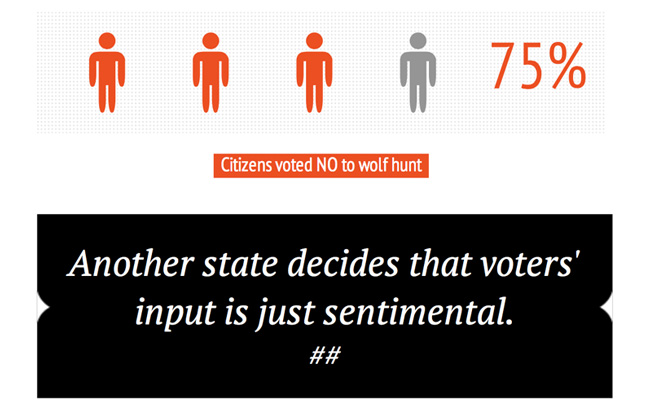
In 2012, Minnesota’s wolves were removed from the Endangered Species Act. The state had long known that wolves in the area would eventually be delisted, and regulated hunting was always in their management plan. However, the DNR was supposed to have a five year moratorium after delisting in order to study the wolf population more closely. This would help determine what toll the legal take of wolves by ranchers would have on the population — without a trophy hunt. Unfortunately, in 2011 when delisting became imminent after the budget bill rider, Minnesota DNR threw out the moratorium. The DNR announced its plans to hold a wolf hunt in a press release, and then held an internet questionnaire asking citizens whether or not they supported the hunt. 75% of citizens voted no. Sound familiar? Yet another state sees that the wolves are a valued and integral part of their culture, but decides that the input is just sentimental. Minnesota killed 413 wolves last season despite several groups trying to stop the hunt.

Those groups were told they could come back this year with new litigation. Sadly, Minnesota too has passed laws that prevent standings in court challenges. Both Howling for Wolves and the Center for Biological Diversity were denied their day in court to protect wolves. It is no longer just about protecting our nation’s wildlife and heritage, but the rights of citizens too.”

**Special thanks to “Project Wolf” for providing this information!  (http://WWW.PROJECTWOLF.ORG .)


wolf

“BILLINGS, Mont. (AP) — The Obama administration on Friday proposed lifting most remaining federal protections for gray wolves across the Lower 48 states, a move that would end four decades of recovery efforts but that some scientists said was premature.

State and federal agencies have spent more than $117 million restoring the predators since they were added to the endangered species list in 1974. Today more than 6,100 wolves roam portions of the Northern Rockies and western Great Lakes.

With Friday’s announcement, the administration signaled it’s ready to move on: The wolf has rebounded from near-extermination, balance has been restored to parts of the ecosystem, and hunters in some states already are free to shoot the animals under state oversight.

But prominent scientists and dozens of lawmakers in Congress want more wolves in more places. They say protections need to remain in force so the animals can expand beyond the portions of 10 states they now occupy.

Lawsuits challenging the administration’s plan are almost certain.

The gray wolf’s historical range stretched across most of North America. By the 1930s, government-sponsored trapping and poisoning left just one small pocket of the animals, in northern Minnesota.

In the past several years, after the Great Lakes population swelled and wolves were reintroduced to the Northern Rockies, protections were lifted in states where the vast majority of the animals now live: Montana, Wyoming, Idaho, Michigan, Wisconsin, Minnesota and portions of Oregon, Washington and Utah.

Under the administration’s plan, protections would remain only for a fledgling population of Mexican gray wolves in the desert Southwest. The proposal will be subject to a public comment period and a final decision made within a year.

While the wolf’s recent resurgence is likely to continue at some level elsewhere — multiple packs roam portions of Washington and Oregon, and individual wolves have been spotted in Colorado, California, Utah, the Dakotas and the Northeast — U.S. Fish and Wildlife Service Director Dan Ashe indicated it’s unrealistic to think the clock can be turned back entirely.

“Science is an important part of this decision, but really the key is the policy question of when is a species recovered,” he said. “Does the wolf have to occupy all the habitat that is available to it in order for it to be recovered? Our answer to that question is no.”

Hunting and agriculture groups wary of the toll wolves have taken on livestock and big game herds welcomed the announcement.

Jack Field, executive vice president of the Washington Cattlemen’s Association and a rancher from Yakima, said he was “ecstatic” over the agency’s announcement and believed it would make his colleagues more willing to accept the presence of wolves on the landscape.

“Folks have to understand that in order to recover wolves, we’re going to have to kill problem wolves,” Field said

Over the past several years, hunters and trappers killed some 1,600 wolves in Montana, Wyoming, Idaho, Minnesota and Wisconsin. Thousands more have been killed over the past two decades by government wildlife agents responding to livestock attacks.

That’s been a relief for ranchers who suffer regular wolf attacks that can kill dozens of livestock in a single night.

Supporters say lifting protections elsewhere will help avoid the animosity seen among many ranchers in the West, who long complained that their hands were tied by rules restricting when wolves could be killed.

Vast additional territory that researchers say is suitable for wolves remains unoccupied. That includes parts of the Pacific Northwest, California, the southern Rocky Mountains and northern New England.

Whether the species’ expansion will continue without a federal shield remains subject to contentious debate.

The former director of the Fish and Wildlife Service under President Bill Clinton said the agency’s proposal “is a far cry from what we envisioned for gray wolf recovery when we embarked on this almost 20 years ago.”

“The service is giving up when the job’s only half-done,” said Jamie Rappaport Clark, who was with the agency when wolves were reintroduced in Idaho and Wyoming in the mid-1990s. She now heads the group Defenders of Wildlife.

Colorado alone has enough space to support up to 1,000 wolves, according to Carlos Carroll of California’s Klamath Center for Conservation Research. He said wildlife officials had “cherry-picked” the available science to suit their goal, and were bowing to political pressure from elected officials across the West who pushed to limit the wolf’s range.

The Center for Biological Diversity on Friday vowed to challenge the government in court if it takes the animals off the endangered species list as planned.

Ashe said Friday’s proposal had been reviewed by top administration officials, including new Interior Secretary Sally Jewell. But he dismissed any claims of interference and said the work that went into the plan was exclusively that of the Fish and Wildlife Service.

Future recovery efforts would focus on a small number of wolves belonging to a subspecies, the Mexican gray wolf. Those occur in Arizona and New Mexico, where a protracted and costly reintroduction plan has stumbled in part due to illegal killings and inbreeding.

The agency is calling for a tenfold increase in the territory where biologists are working to rebuild that population, which now numbers 73 animals. Law enforcement efforts to ward off poaching in the region would be bolstered.

Wherever wolves are found, the primary barrier to expansion isn’t lack of habitat or prey, but human intolerance, said David Mech, a leading wolf expert and senior scientist with the U.S. Geological Survey in St. Paul, Minn.

Even without federal protection, he believes wolves are likely to migrate into several Western states. He added that they already occupy about 80 percent of the territory where they realistically could be expected to thrive, with sufficient prey and isolation from people.

Although Colorado, Utah, Nevada and Northern California might have enough habitat for wolves to thrive, Mech said that might not happen if hunters kill so many Northern Rockies wolves that it reduces the number that would disperse from packs and seek new turf.”

**Special thanks to Associated PressBy MATTHEW BROWN and JOHN FLESHER | Associated Press, for providing this information!