Feeds:
Posts
Comments

“Wolves were probably most misunderstood because they are predators. Predators are animals that hunt and feed on other animals, called prey.  People are beginning to understand that predators have an important place in the world.  They are part of nature’s balancing act.

When predators aren’t around:  Deer herds can grow and grow and grow..  Only bad weather and disease slow down herd growth.  Huge deer herds overeat their food.  As their food disappears, the whole herd begins to starve. 

When predators are around:  By killing some deer, wolves help keep the deer herd smaller.  Smaller herds have more food.  When the number of deer is low, wolves have fewer pups and may also starve.  In this way the deer control the number of wolves.  Hunters, of course, can sometimes replace wolves and control deer numbers. 

Are predators cruel and wicked?  A wolf eating a deer is no different than a human cutting into a steak.  Both are predators.  Neither is “mean or bad.”  They eat to live, except for the act of sport hunting.” 

**Special thanks to Nancy Field and Corliss Karasov of Discovering Wolves, a Nature Activity Book, text copyright 2005 and text copywright 1991 by Dog-Eared Publications for providing this information!


The wolf kills to eat.  And it is the wolf’s status as a predator that has resulted in the deaths of thousands of wolves at the hands of humans.  The two prime areas of conflict are the wolf’s status as a habitual predator of big game and as an occasional predator of livestock.

In the United States, federal Animal Damage Control guidelines define predator control as “control…directed toward less desirable species which are depressing populations of more desirable species.” 

CLEARLY MAN HAS DEEMED THAT THE WOLF BE OFFICIALLY CERTIFIED AS “LESS DESIRABLE.”

It is unfortunate that both Canis Lupus and Homo Sapiens sometimes seek the same prey.  It is even more unfortunate that the wolf has often been WRONGLY BLAMED for depleting ungulate populations, populations equally sought by both subsistence and sport hunters.  

Large-scale wolf kills by humans assume that wolves are the primary limiting factor to a hooved game population.  All too often, the wolf is just a convenient and visible scapegoat, the final product of years of prejudice.   And all too often insufficient studies have been undertaken to determine the true role of the wolf in controlling the prey population.

Various studies have shown that in fact wolves my control an ungulate population, extirpate the population, have no effect upon it, increase it, or decrease it.  Other important factors include the prey/predator ratio, habitat loss, overhunting by humans, and the effects of severe winters.

As wildlife biologist Chris McBride has written in The White Lions of Timbavati, “The very fact that any species of predator still exists today is proof that is has evolved in such a way that it cannot seriously limit the numbers of its prey.  If it did, it would have become extinct.”

Overhunting by humans is often a major factor in ungulate declines.  In one study of Alaskan wolves, it was found that humans had killed forty four percent of the Nelchina caribou herd in 1971/1972, a decrease that had previously blamed on wolves.  One year when caribou strayed too close to the city of Yellowknife in the Northwest Territories and were slaughtered by its residents by the hundreds, outsiders immediately blamed wolves for the kills.

It is ironic that many fish and game departments exist to support the hunters and fishermen who fund them through the sale of tags and licenses.  The irony turns to tragedy, though, when these departments kill wolves to appease hunters.

In 1983, the British Columbia Wildlife Branch announced plans to kill eighty percent of wolves in the northeast Peace and Omineca districts in order “to support moose and deer numbers.”  However, the close ties between the department and the hunting lobby quickly became evident.  To fund the wolf kill, the government stated their intention to hold a lottery, first prize being a hunting trip to Zimbabwe.  Despite a government report that the moose and deer numbers had decreased primarily because of loss of habitat, overhunting, and a series of severe winters, the wolf was the one put in the crosshairs.

A more recent Canadian wolf kill was the plan to kill 150 wolves in the Yukon in 1993 in an area adjacent to Kluane National Park.  The purpose of the kill was to support the Aishihik caribou herd, which was declining in number.  After much public pressure, the Yukon government admitted that the slaughter was a “scientific experimentusing living animals.  In early 1993, about seventy wolves were killed, and it was discovered that the wolf population in the area was about forty percent smaller than expected.   Despite this finding, the Yukon goverment planned to continue the killing!  The cost of the initial year of killing was an incredible $2,500 per wolf. 

In the IUCN Manifesto on Wolf Conservation, it states that where wolf kills must be carried out, “the methods must be selective, specific to the problem, highly discriminatory, and have minimal adverse affects on the ecosystem.”  It concludes that “alternative ecosystem management, including alteration of human activities and attitudes and non-lethal methods of wolf management, should be fully considered before lethal wolf reduction is employed.”

According to the World Wildlife Fund of Canada, “the only safe conservation route is to stop large-scale wolf killing programs altogether.”  And as wolf biologist Lu Carbyn has noted, wolf control “has become socially unacceptable.”

**Special thanks to The Wolf Almanac by Robert Busch for providing this information!


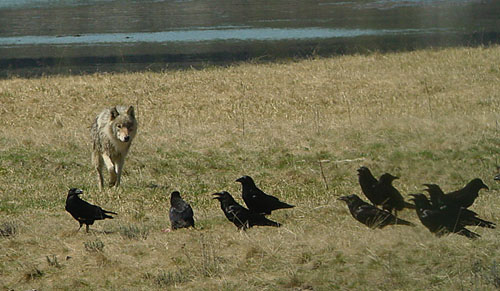
So what do Ravens and Wolves have in common you say?  The following information comes from “The Wolf Almanac,” a celebration of wolves and their world, 1995/1998 by Robert Busch.  He explains the relationship and proves once again one of the many contributions wolves give to the environment.

One of the most fascinating relationships between animals is the one that seems to exist between wolves and ravens.  The raven, scavenger of food of all types, will often follow wolf packs in hopes of morsels of food.  And wolves have learned to watch for circling ravens as a sign of of possible food below.  But there seems to be more than just a symbiosis based on food between the two species; many observations have been made that can only be described as a friendship between the big predator and the wily bird. 

In Arctic Wild, Lois Crisler states her belief that “ravens and wolves just like each other’s company.”  She described one play session between the two species, with the raven diving at the wolves and jumping around just out of reach.  “He played this raven tag for ten minutes at a time.  If the wolves ever tired of it, he sat squawking till they came over to him again.”

L. David Mech, in The Wolves of Isle Royale, described the “peculiar relationship” between a flock of ravens and a large wolf pack, and wrote that wolves and ravens “often seem to play together.”


This article was previously written by: Dr. Victor Van Ballenberghe / U.S. Forest Service / Wolf Song of Alaska Advisor

Wolves can be a factor in controlling populations in certain areas BUT not the primary or only factor.  Hunters, disease, weather, and other predators play key roles.

Special thanks is given to “Wolf Song of Alaska” for providing his article.

This page is one of over 1500 pages in our library! Visit our homepage for a full menu of options!


“The following questions and statements represent a brief summary of biological information on wolf ecology and wolf/prey relationships distilled from numerous scientific studies conducted in North America during the past 50 years. I have selected topics that I feel represent some of the key biological issues that impact wolf management. By necessity, this discussion is brief and worded so that those with little technical background can assimilate the information. I have tried to accurately summarize and interpret a large volume of data while adhering to constraints of brevity and simplicity.

1. Can wolves kill any animal they choose?

Numerous studies across North America on virtually every species of wolf prey from the smallest (deer) to the largest (bison) have shown that wolves generally kill only certain kinds of animals. These include young, old, and infirm animals. Generally, animals in their prime (for example, moose aged 1-6) escape predation. However, during deep snow conditions that favor wolves, prime-aged animals may fall prey, but these conditions are uncommon.

These findings have been misinterpreted by some to mean that wolves only kill “sick” animals or that because they generally kill the young, old or infirm wolves can’t impact prey populations. Biologists have never claimed wolves kill only the sick and have stressed that predation on young may impact prey populations.

Studies have also shown that prey animals often escape predation by a variety of methods. An early study of moose and wolves at Isle Royale, Michigan, indicated that during winter only 8% of moose encountered by wolves were killed. The rest outran the wolves or stood their ground and the wolves left. During summer, moose often escape by entering water where wolves aren’t effective. Certain prey, including goats and sheep, inhabit terrain where they are often protected. All prey species have evolved numerous anti-predator adaptations.

2. Do wolves kill in excess of their needs?

Studies have shown that wolves generally consume the animals they kill, often returning to kills over a prolonged period. They also commonly scavenge animals that die or are killed by other predators or humans. On occasion, wolves starve because they cannot find or kill enough prey, or their reproduction is reduced due to food shortage.

During deep snow conditions that occur rarely, wolves may kill more than they consume. They may also kill more young than they consume when young are very abundant, for example in large herds of caribou. However, this “surplus” killing has generally not been shown to have significant effects on prey populations.

3. At what rate do wolves kill prey?

Research has shown that kill rates vary greatly depending on snow depth, prey size, prey abundance, pack size, and many other factors. Wolves rarely kill only one species for extended periods; most packs in Alaska have access to several species. During summer, beaver, fish, berries, and numerous small mammals and birds supplement their diet.

During winter, for wolves that kill only moose, an average-sized pack (6-10) may eat one moose per 4-5 days, but this can vary from about 2-10 days per moose per pack. Some of these animals may be scavenged. Summer data are less reliable and difficult to compare to winter because nutritional needs vary as does prey size (many calves are killed) and composition. However, several studies suggest that summer kill rates are lower than during winter.

For smaller prey, kill rates are necessarily higher. In Minnesota where wolves kill mainly white-tailed deer (also beaver and moose) annual kill rates per wolf have been estimated at 15-19 deer, including summer fawns.

4. What factors control wolf populations?

In Alaska (and elsewhere) wolf populations are mainly controlled by hunting and trapping, prey abundance, and social interactions among wolves. Virtually every pack in Alaska is subject to hunting and trapping, legal and illegal, but the impact of this varies. Some packs are exploited lightly because of their inaccessibility; others are kept at low numbers by hunters and trappers. Some packs have been eliminated by humans.

Generally, wolves on the northern and northwestern arctic coasts are rare and kept at a low density by people. Wolves in southcentral Alaska are heavily exploited but in much of the interior they are not.

Wolves generally declined in the late 1970’s and early 1980’s, apparently in response to decline of moose and caribou that began in the mid-1960’s. As moose and caribou increased in some areas (including the Nelchina basin) wolves were prevented from increasing by hunting and trapping.

5. What impact has land-and-shoot (LAS) wolf hunting had on wolf numbers?

The impact of LAS has varied from place to place. In some areas that are heavily timbered with few lakes or rivers, LAS has been ineffective in reducing wolf numbers. In other areas (including the Nelchina basin) wolves have been kept low by this

practice. Large areas of southcentral including GMU’s 9, 16, 11, and 13, are ideally suited to LAS are northern areas in or near the Brooks Range. It is clear that where the terrain allows hunters to be efficient, LAS has kept wolf numbers lower than they


would have been with hunting and trapping by other methods.

6. Will wolves increase indefinitely if they are not “controlled”?

Because hunting and trapping are generally effective controlling factors, wolves will increase if exploitation stops. However, wolf populations will not increase without limit in the absence of exploitation. For example, after the wolf control in GMU-20A stopped, moose numbers more than tripled but wolf increased to only about their pre-control numbers.

7. What rolls did hunting, weather, food supplies, and predation play in the moose and caribou declines of the 1960’s and 1970’s?

Moose and caribou populations in many areas of Alaska increased during the 1950’s and early 1960’s and declined into the 1970’s. Research suggests that for moose, food supplies declined as populations increased. Deep-snow winters aggravated reduced food conditions and started the moose population declines. Hunting regulation changes did not respond in time and hunting further accelerated the declines as it did for the caribou, especially the Nelchina and Western Arctic herds. For some moose populations (GMU-20A), wolves did not start the declines, but acted after they were well underway to drive moose to lower levels than they would have reached in absence of wolves.

8. Is habitat (food) currently limiting moose and caribou populations in Alaska?

Probably so in portions of southcentral including the lower Susitna valley where large numbers of moose starved in 1989-1990 and the Kenai Peninsula where plant succession has reduced habitat quality since the mid-1970’s. Caribou herds including the Nelchina and Western Arctic herds, are also thought to be approaching the carrying capacity of the ranges.

Probably not in portions of the interior where moose densities are low and food seems abundant.

Maybe in other areas where few data are available on food quantity and quality in relation to moose and caribou numbers. It is difficult to quantify these relationships over vast areas.

9. What about bear predation?

Studies have shown that both black and brown bears (especially the latter) can be efficient predators on young moose calves. In some areas (for example, the Nelchina basin) brown bears were a more significant source of calve mortality than wolves. Bears may also kill adults in the spring and fall when they are more vulnerable.

10. a) Can wolves and bears keep prey densities low for long periods?


b) Can prey increase from low densities if wolves and bears are not reduced by people?


There is evidence that wolves and bears acting together can keep moose at low densities for long periods in places where people have no or little impact on predator numbers. For caribou, it appears that this is not the case; caribou can periodically increase if alternate prey for wolves is scarce and they too fall to low densities. Moose also follow this pattern if bears are absent. At Isle Royale National Park where bears are absent and people do not exploit either wolves or moose, moose have increased periodically and reached high densities without any form of wolf control.

11. Do we need to “control” wolves in order to harvest prey?

Biologists do not dispute the idea that moose populations will produce a higher yield for people if wolves are few or absent. However, people can still hunt and shoot moose if wolves are present as demonstrated in Alaska for many years. As indicated in question 4 (above), hunting and trapping impacts wolf populations in many areas and may keep wolf densities low. Moose abundance may be high in these areas, as it generally is now in southcentral Alaska, and hunting by people may produce high yields. In other areas where wolves and bear reach higher densities it may still be possible for people to hunt, but they may be restricted to bulls only. Moose harvest in many areas of Alaska have increased in recent years without wolf control programs.

12. Does reducing wolf density result in more moose and caribou?

Clearly, wolf control in GMA-20A during 1975-79 resulted in an increase of moose on Tanana flats. This is probably the best known example of a wolf control program in Alaska. However, wolf control in other areas where wolf:moose ratios were higher or where bears were the problem had less success. As discussed above, deep snow, reduced food, hunting or bear predation may be more important than wolf predation in controlling moose numbers. If so, wolf control is not likely to yield benefits.

13. What is the importance of predator/prey ratios?

One of the primary factors in determining the impact of predation on prey numbers is the ratio of predators to prey. If predators are few in relation to prey, predation may have little controlling effect on prey numbers. However, controlling effects may be extreme if there are many predators in relation to prey. For wolves and moose, ratios of less than 1;30 may often result in moose population declines if wolves have little alternate prey. If bears are abundant, they may elevate this ratio considerably. When wolf:moose ratios are 1:60 or higher, predation likely has little effect.

14. Do wolf populations rapidly rebound from control programs?

Wolves have a high reproductive rate and may disperse long distances to fill “voids”. Studies in Alaska have shown that populations may increase rapidly following control programs and pre-control numbers may be reached in 3-4 years. However, wolves in some areas (including the north slope) have not recovered after being reduced to low densities because hunting and trapping removes them as they re-colonize.

15. Is the “balance of nature” a valid concept?

Different definitions of the balance of nature concept have emerged in recent years. If this concept means that wolves and prey exist for long periods at high and stable numbers, then the results of recent studies suggest this is simplistic. Numbers often fluctuate up as well as down and local extinction of prey is possible. However, if the concept means that wolves and prey coexist over time in large areas, clearly this is the case. Wolves and their prey co-evolved over thousands of years with little intervention from humans. Wolves are efficient predators that at certain times under certain conditions may exert powerful controlling effects on prey populations. But, for their part, prey animals have evolved the ability to survive and reproduce. The effects of humans on both wolves and prey and their habitat in the modern world are often the primary factors determining the “balances” that now result.”


Sunday March 18, 2012 6:34 AM

“To kill or not to kill wolves, that is a question legal, moral and, apparently, spiritual.

Since losing protection under the federal Endangered Species Act in 2011, western wolves have become legal game during seasons in Idaho and Montana. Wolves can be killed based on quotas intended not to harm the viability of the population, estimated regionally at about 1,700 in Idaho, Montana and Wyoming.

Last week, wolf advocates lost an attempt to stop hunting by claiming an amendment added to the 2011 defense bill violated the constitutional separation of powers. The 9th U.S. Circuit Court of Appeals ruled that no constitutional mandates were broken when the amendment introduced by senators John Tester (D-Mont.) and Mike Simpson (R-Idaho) gave their respective states control of wolf management and blocked further judicial review.

The case pitted the Center for Biological Diversity and three other wildlife advocacy groups against the U.S. Department of the Interior and the U.S. Fish and Wildlife Service. Among groups filing briefs in support of the federal government were the National Rifle Association, Safari Club International and the farm bureau federations of Idaho and Montana.

About 4,500 wolves are estimated to be residing in Minnesota, Wisconsin and Michigan, where delisting went into effect in January. A move by Wisconsin legislators toward legalizing controlled wolf hunting in the state has run into a stumbling block, however.

Eleven tribes of the Ojibwe, also known as the Chippewa, in Wisconsin, Minnesota and Michigan oppose a wolf hunt. Their disapproval, filed with the legislature in written testimony, is based on religious principle and a tradition that links the health of the tribe to the state of the wolf population.

Courts have ruled the tribes should have a say in matters such as a wolf hunt on land they control. Should legislators go ahead with a wolf hunting season, an additional complication is that half of the wolves harvested would belong to the tribes under existing agreements.”

**Special thanks to Dave Golowenski , The Columbus Dispatch, for providing this information!


Tragic news…They CHANGED THE ENDANGERED SPECIES ACT to make this happen! 

“BILLINGS, Mont. (AP) — A federal appeals court on Wednesday rejected a lawsuit from conservation groups that want to block wolf hunting and trapping that have killed more than 500 of the predators across the Northern Rockies in recent months.

The ruling from a three-judge panel of the 9th U.S. Circuit Court of Appeals said Congress had the right to intervene when it stripped protections from wolves last spring.

Lawmakers stepped in after court rulings kept wolves on the endangered list for years after they reached recovery goals. Wildlife advocates claimed in their lawsuit that Congress violated the Constitution’s separation of powers by interfering with the courts.

But in an opinion authored by Judge Mary Schroeder, the court said Congress was within its rights. Schroder wrote that lawmakers changed the Endangered Species Act to deal with Northern Rockies wolves, and did not directly interfere with the court’s prerogative to decide when the law is being followed.

The amendment marked the first time Congress has forcibly removed a species’ endangered status. It was tacked onto a federal budget bill by Idaho Republican Rep. Mike Simpson and Montana Democratic Sen. Jon Tester.

“This case has made it clear that those who persist in trying to manage wildlife through the courts, in spite of all scientific evidence that this species has recovered, no longer have a defensible position,” Simpson said Wednesday.

Michael Robinson with the Center for Biological Diversity, one of the groups that sued to restore protections, said a Supreme Court appeal was possible but no decision had been made.

“We’re very disappointed and very saddened,” Robinson said. “Hundreds of wolves have been hunted and trapped and snared, and they are essential to their ecosystem.”

He called the congressional budget bill rider that lifted protections “undemocratic” and said that it set a precedent for future political meddling with imperiled wildlife.

Wolves once thrived across North America but were exterminated across most of the continental U.S. by the 1930s, through government sponsored poisoning and bounty programs.

They were put on the endangered list in 1974. Over the last two decades, state and federal agencies have spent more than $100 million on wolf restoration programs across the country.

The Northern Rockies is now home to more than 1,700 wolves in Montana, Idaho and Wyoming and expanding populations in portions of eastern Oregon and Washington. That figure is up slightly from 2010, although Wyoming and Idaho saw slight declines.

In the Northern Rockies wolf hunting is allowed in Montana and Idaho and could resume in Wyoming this fall.

Minnesota, Michigan and Wisconsin also are considering wolf seasons after protections for wolves were lifted in the upper Great Lakes in December.

Wisconsin’s legislature on Wednesday approved a measure to establish a hunting and trapping season that would run from mid-October through the end of February. It still has to be approved by the governor.

There more than 4,400 of the animals in the Great Lakes and a struggling population of several dozen wolves in the Desert Southwest. Alaska, where the animals never went on the endangered list, has an estimated 10,000 wolves.

In parts of Montana, ranchers and local officials frustrated with continuing attacks on livestock have proposed bounties for hunters that kill wolves. Montana wildlife officials said they will consider ways to expand hunting after 166 wolves were killed this season, short of the state’s 220-wolf quota.

Idaho allows trapping. Its 10-month wolf season runs until June and has claimed 353 wolves so far.

Prior lawsuits resulted first in the animals’ reintroduction to the Northern Rockies and then later kept them on the endangered list for a decade after the species reached recovery goal of 300 wolves in three states.

The U.S. Fish and Wildlife Service is monitoring the hunts. But agency officials have said they have no plans to intervene because the states have pledged to manage wolves responsibly.

Federal officials have pledged to step in to restore endangered species protections if wolf numbers drop to less than 100 animals in either Montana or Idaho.

Even without hunting, wolves are shot regularly in the region in response to livestock attacks. Since their reintroduction, more than 1,600 wolves have been shot by government wildlife agents or ranchers.”

**Special thanks to By MATTHEW BROWN | Associated Press for providing this information.


Christopher Ketcham

March 13, 2012

The reintroduction of the gray wolf to the Northern Rockies was an ecological success story—until big money, old superstitions, and politics got in the way.

“In April 2001, a U.S. government wildlife trapper named Carter Niemeyer choppered into the mountains of central Idaho to slaughter a pack of wolves whose alpha female was famed for her whiteness. He hung from the open door of the craft with a semiautomatic shotgun, the helicopter racing over the treetops. Then, in a clearing, Niemeyer caught a glimpse of her platinum fur. Among wolf lovers in Idaho, she was called Alabaster, and she was considered a marvel—most wolves are brown or black or gray. People all over the world had praised Alabaster, had written about her, had longed to see her in the flesh. Livestock ranchers in central Idaho, whose sheep and cows graze in wolf country, felt otherwise. They claimed Alabaster and her pack—known as the Whitehawks—threatened the survival of their herds, which in turn threatened the rural economy of the high country. She had to be exterminated. 

When Alabaster appeared in Niemeyer’s sights, a hundred feet below the helicopter, her ears recoiled from the noise and the rotor wash, but she was not afraid. She labored slowly along a ridge, looking, Niemeyer says, “like something out of a fairy tale.” 

Then he shot her. At the time, wolves were considered a rare species in Idaho and across the Northern Rockies, and they were protected under the Endangered Species Act. But they could be targeted for “lethal control” if they made trouble—if they threatened a human being, which almost never happened, or, more commonly, if they were implicated in attacking cattle and sheep. The Whitehawks allegedly had been enjoying a good number of cows and sheep that spring and were said to have killed at least one rancher’s guard dog. 

As a trapper for the U.S. Department of Agriculture and later as a wolf expert for the U.S. Fish and Wildlife Service, Niemeyer was trained to control predators, mostly coyotes and foxes. In 26 years working for the government, he had killed thousands of coyotes. But wolves are a different kind of kill. As predators, they are exquisite. Niemeyer had taken a liking to wolves. He respected them. 

There were four other members of the pack, scattered in the woods. The helicopter circled, flushing them out, and Niemeyer shot them as they ran. When he necropsied Alabaster at the kill site—gutting her, stripping her pelt—he found she was pregnant with nine pups that were two weeks from birth, almost fully formed. He buried each pup.

Canis lupus, the largest of the planet’s wild dogs, once numbered in the hundreds of thousands in the U.S. The creatures are powerful—the largest males, six and half feet from tooth to tail, weigh 140 pounds—and they are agile and cunning. They run in packs of seven to ten animals that consist of a father and mother—the alphas—along with pups and subordinate males and females, unrelated to the family but welcomed in their midst. The wolf is an apex predator, at the top of its food chain, keeping prey from overpopulating, which maintains a balanced ecosystem. 

With European settlement and the decimation of its native prey—buffalo, elk, mule deer—the wolf was bound for destruction. It was now killing for its meals the domesticated sheep and cattle that settlers had ranged across the grasslands and the mountains. Hated for its depredations, the wolf was hunted mercilessly—shot, trapped, poisoned with strychnine, fed glass shards stuffed in bait, its pups asphyxiated by fires set in their dens. By 1935, the gray wolf had disappeared almost entirely from the U.S. 

Decades later, during the high tide of 1970s environmentalism, conservationists began to agitate for a government-sponsored recovery. The evidence suggested that the loss of the wolves had destabilized the ecology of the Northern Rockies. Following the passage of the Endangered Species Act in 1973, the U.S. Fish and Wildlife Service undertook the recovery of the wolf in the region. It wasn’t until 1991, however, that Congress mandated an impact study of wolf reintroduction. By 1994, funding had been approved for Fish and Wildlife biologists to remove 66 gray wolves from Canada, where the animals still numbered in the tens of thousands, and truck them south for release in central Idaho and Yellowstone National Park. 

Niemeyer, now retired in Boise, was among the trappers who traveled to Canada in 1995 to capture and radio-collar the reintroduced wolves. The reintroduction, he told me, had been one of the epic wildlife-recovery stories in U.S. history; in little more than 15 years, the number of wolves in the Northern Rockies had gone from 66 to roughly 1,600. Yet concerns about the threat posed by the wolves to cow, sheep, and elk populations had led to a stark reversal. After spending upward of $40 million studying the animals—then capturing, collaring, tracking, and protecting them—the federal government last year scheduled wolves to be killed in huge numbers across the Northern Rockies. In April 2011, following a series of lawsuits and an unprecedented intervention by Congress, canis lupus was removed from the endangered species list. 

Today, as a result of the delisting, anyone can shoot a wolf—you don’t have to be a government trapper. Wolves can in some circumstances be shot on sight. Niemeyer, who is six foot six inches and giant-shouldered, shot 14 wolves in the course of his government career; the Whitehawks were his last. He maintains a taxidermy studio in his garage and says he’s “not into the warm and fuzzy thing” when it comes to wild animals. “I’m not grossed out by wolves being hunted, trapped, killed,” he says. “I’d skin one today if you brought it to me. What I’m caught up in is honesty. What you have with wolf delisting is half-truths, untruths, hysteria, and just downright craziness.” 


The ranching industry in the American West has been the historic enemy of wolves, so it was fitting that ranchers in Montana and Idaho called for hunting them almost from the moment of their reintroduction. The American Farm Bureau Federation, a nonprofit advocate for farming and ranching interests, had even sued preemptively in 1994 to stop the reintroduction, but a federal court rejected the suit. In 2008, however, Western livestock interests found a sympathetic ear in the Bush administration’s Department of the Interior, which issued what would become the first of multiple orders to remove the wolf from protection under the Endangered Species Act (ESA).

Following a lawsuit filed by 12 conservation groups that challenged the decision, the U.S. District Court in Montana found that the department had “acted arbitrarily in delisting the wolf” and reinstated the act’s protections. Judge Donald Molloy pointed to a glaring discrepancy: Biologists had determined that only with the genetic commingling of the three “distinct population segments” of wolves—in central Idaho, Yellowstone National Park, and northwestern Montana—would the Northern Rocky Mountain wolf have a chance at long-term survival. A 2009 study in BioScience magazine concluded that absent this genetic exchange, the population would be “genetically depleted, small, and ineffective in terms of ecosystem function.” The Interior Department’s own environmental impact study, conducted by the U.S. Fish and Wildlife Service, had come to the same conclusion. Yet the department had removed the Endangered Species Act protections “without any evidence of genetic exchange,” wrote Judge Molloy, who found a “possibility of irreparable harm” if the delisting went unchallenged. 

The matter remained at an impasse until President Barack Obama’s newly appointed interior secretary, Ken Salazar, resurrected the Bush-era delisting plan in April 2009. The decision infuriated pro-wolf conservationists, though it was not unexpected. Salazar, a Colorado Democrat, comes from a family of five generations of ranchers. A new lawsuit was filed by a coalition that included 14 environmental groups, among them the Natural Resources Defense Council, the Sierra Club, the Humane Society, and smaller outfits like the Center for Biological Diversity. While the suit was pending, Idaho and Montana opened a hunting season that resulted in the culling of more than 500 wolves—some 32 percent of the entire Northern Rockies population. A year later, in August 2010, Judge Molloy again ruled in the conservationists’ favor. He determined that the de-listing violated the letter and the spirit of the Endangered Species Act; he found no evidence of genetic exchange among wolf sub-populations. He also ruled that Fish and Wildlife had failed to properly oversee wolf management plans in Idaho and Montana. The judge ordered that year’s wolf hunts to be canceled. 

The ongoing litigation drew the ire of Republican politicians throughout the West. Denny Rehberg, Montana’s lone congressman, presented two bills during 2011 for a legislative delisting of the wolf, including one to “amend the Endangered Species Act of 1973 to provide that Act shall not apply to the gray wolf.” The bills went nowhere, but Rehberg, who was gearing up to challenge Democrat Jon Tester for his U.S. Senate seat in 2012, had sparked a kind of arms race of anti-wolf rhetoric. The Republican governor of Idaho, Butch Otter, announced that he was ordering his state wildlife managers to “relinquish their duty to arrest poachers,” thereby freeing up Idaho hunters to continue shooting wolves. Otter also signed an emergency law that authorized him to declare a statewide “wolf disaster.” Senator Orrin Hatch of Utah unsuccessfully attempted to amend the Endangered Species Act so that it no longer applied to “any gray wolf.” Montana Senator Max Baucus, a Democrat, weighed in with the Delisting Gray Wolves to Restore State Management Act of 2011, which died in committee. Tester floated his own wolf-delisting bill; it also went nowhere. ”

**Special thanks to http://prospect.org/article/wolves-slaughter?fb_ref=.T19eDqMvtC8.like&fb_source=profile_multiline for providing this information.


Posted: Feb 25, 2012 3:17 PM by Dennis Bragg (KPAX/KAJ Media Center)

“Conservation groups are blasting Idaho’s decision to kill wolves along the Idaho-Montana border from the air, saying the move is “misguided” and not backed up with scientific evidence.

The Idaho Department of Fish and Game caused a flurry of response from wolf advocated Thursday when it announced it helped fund USDA Wildlife Service’s successful efforts to kill 14 wolves from a helicopter in the Lolo Zone of the Clearwater National Forest.

The state says in the Lolo zone, hunters had killed 11 wolves this year, with another 11 caught by trappers and half-a-dozen killed through “control efforts” last spring. Along with the 14 wolves shot from the air earlier this month that brings the total wolves removed to 42.

In September 2010 Idaho Fish and Game set a target of 40 to 50 wolves to be removed to help maintain healthy elk populations on the Idaho side of the border. Biologists say the wolves are the “primary cause of death” for cow elk and calves under six months old.

Deputy Director Jim Unsworth says the state would “like to see one of Idaho’s premier elk populations recover as much as possible.” But Defenders of Wildlife is blasting the move, and previous occasions where it says the state has killed wolves through aerial gunning.

“It’s wrong to ask American taxpayers to subsidize the pointless killing of wolves in order to boost game populations. The removal of wolves in the Clearwater National Forest runs counter to science-based wildlife management and is an inappropriate use of limited resources that should be aimed at conserving wildlife,” said Suzanne Stone, Northern Rockies representative for the Defenders.

“Hunters and trappers have already killed more than 20 wolves in the area in the last six months, and the season continues until the end of March. There’s no scientific evidence that the ecosystem is out of balance due to the return of wolves and thus no justification for having Wildlife Services kill more wolves to boost elk numbers.”

Defenders of Wildlife worries the state will try a similar approach elsewhere in Idaho.”

**Special thanks to Dennis Bragg (KPAX/KAJ Media Center) for providing this information!


Article | February 21, 2012 – 6:30pm | Ashland Current

“Legislation outlining a proposed state wolf hunt is likely to hurt wolf populations while failing to resolve existing conflicts with humans, says a University of Wisconsin-Madison wolf expert.

Senate Bill 411, introduced at the end of January, proposes opening Wisconsin to hunting and trapping gray wolves during an annual season that would extend from Oct. 15 through the end of the following February.

UW-Madison professor Adrian Treves directs the Carnivore Coexistence Laboratory in the Nelson Institute for Environmental Studies.  Treves says the removal of the gray wolf from federal endangered species lists earlier this year is an opportunity to balance responsible and sustainable natural resource management with citizen interests.

“The issue is not simply whether or not to hunt, it is how and where to hunt that are critical,” he writes in a testimony statement to the Senate Committee on Natural Resources and Environmen.

But exposing wolves to such a long season – much longer than comparable species – and across such a broad area risks overharvesting the animals, Treves says. The approach is also unlikely to help control problem wolves, which Treves’ research has shown are a minority of animals in geographically restricted and highly predictable areas.

Treves also believes the proposed hunt will not meet the needs of the majority of Wisconsin citizens. In statewide public opinion surveys, he and his colleagues found that the majority of those polled supported a wolf hunt provided it could be conducted in a way that reduces conflict with humans without jeopardizing the long-term health of the wolf population. The proposed hunt structure meets neither condition, he says.

Pushing forward with the bill as written risks reducing the state population enough to land it back on the federal endangered list and beyond state control, Treves says. “We risk wasting the opportunity for Wisconsin to manage its own wolves without federal intervention,” writes Treves.

“As a species fresh off the endangered species list and a species with very special meaning to many people – including the sovereign tribal nations in our state – this bill should be amended to accord the wolf its due place among Wisconsin’s premier wildlife,” he adds. “I recommend the (Wisconsin Department of Natural Resources) be given the authority to determine a sustainable and publicly acceptable season length and methods of hunting.””

**Special thanks to “Ashland Current” for providing this information!


February 11th, 2012

“According to the public trust doctrine, states are obligated to ensure a sustainable population of species, including wolves; it is clearly evident that science is just not guiding decision-making in Idaho. 

  • Of the three states in the overall Northern Rockies wolf recovery zone, Idaho has the most suitable wolf habitat. Yet Idaho’s position on wolves is that there should be zero wolves in the state (Idaho plan, 2002, p.4).  In fact, Governor C.L. “Butch” Otter even declared at a statehouse rally, “I’m prepared to bid for that first ticket to shoot a wolf myself.” 
  • Idaho fails to provide the critically objective and verifiable scientific data that is required by federal law when making decisions about the endangered status of animals as well as their management in individual states.
  • Wolves don’t “belong” to just Idaho, either!  The Endangered Species Act represents a decades-old bi-partisan consensus among Americans which asserts that wildlife and ecologies are invaluable and worth protecting. Just as the quality of our air and water cannot be left to the individual States, neither can the continued healthy survival of our vital and endangered wildlife.  Wildlife belongs to America, too.

ACTION ALERT:

“Jeff Thomas” is the Idahoan hunter who apparently “didn’t realize” his wolf tag was no longer valid when he shot and killed a collared male wolf from northeast Oregon’s Imnaha Pack – OR-9, “Journey’s” sibling!   This hunter who “poached” OR-9 was given a mere warning and that is simply not acceptable.  Jeff Thomas should be punished to the fullest extent of the law.
  • Please call Virgil Moore at the Idaho Dept of Fish and Game and tell him what you think of Idaho’s policies – (208) 334-3771     

 OR-9    was a healthy and strong young wolf who posed no threat to livestock or humans. In his memory, we hope you take action on his behalf as well as all those wolves who remain in the line of fire in this state.”

**Special thanks to “WolfWatcher.Org” for providing this information!  (http://wolfwatcher.org/news/all-news/action-alert-justice-for-oregon-wolf-or-9/)