Feeds:
Posts
Comments

mexican wolf

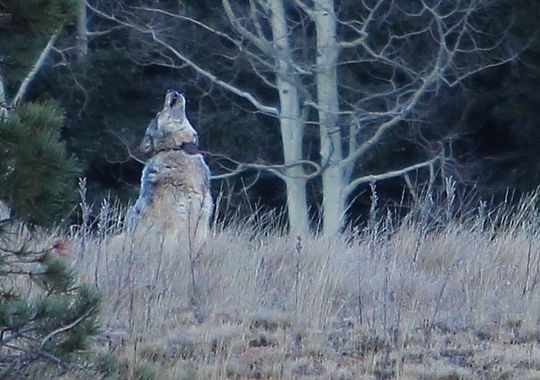
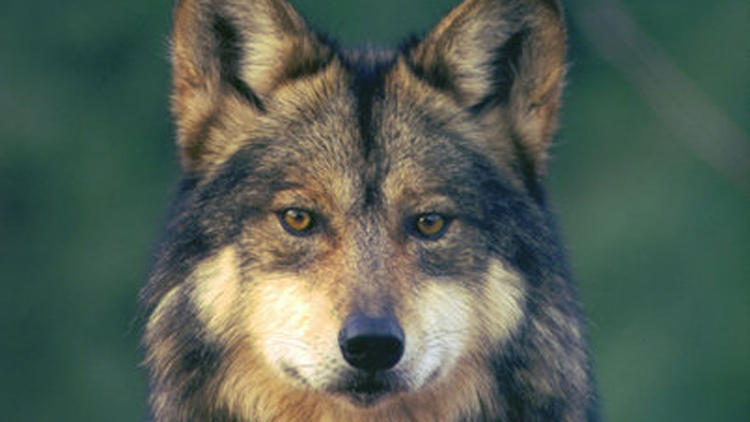
Image of Nina: the last female Mexican Gray Wolf found in the wild. Courtesy of Emily Renn: Grand Canyon Wolf Recovery Project  

“About The Film and our Mission

The Right to be Wild, is a tale of Hope, Struggle, Survival and Determination.  It is the story of the Mexican Gray Wolf; a wolf that is one the Most Endangered Mammals in North America and the most endangered subspecies of Gray Wolf in the World. It is also a story about people who work hard and tirelessly trying to save them.


Mexican gray wolves were completely eradicated from the United States by the mid 20th century, and extremely close to extinction in the wild.

In 1976, they were listed under the endangered species act and protecting the species  became the law. Then, after an agreement was made between the U.S. and Mexico, a trapper hired by the U.S. Fish and Wildlife Service, was sent to Mexico to trap the last known Mexican Gray Wolves in the wild. Five wolves were found and captured in northern Mexico. Only one of those was a female.

Only One female left in the wild and she was already 10 years old!! You can’t get much closer to extinction in the wild than that!

She was named “NINA” by her handlers at the

Endangered Wolf Center in St Louise, Missouri. 

At the time of her capture, she was pregnant and all her pups died after being born in captivity. Fortunately, she later had pups and they all survived.  Three of the five captured wolves, together with a few other Mexican wolves, found in captivity in the U.S and Mexico, became the seven original founders of the Mexican wolf line.

In the effort to keep the species from disappearing off the face of the earth,  a captive breeding program was established, managed by the U.S. Fish and Wildlife Service.

The Mexican Wolf Species Survival Plan was then developed to organize the captive breeding program; a program of the Association of the Zoos and Aquariums.  Finally, after about 20 years of growing the population in captivity, in March 1998, 11 Mexican gray wolves were released into the wild of the Apache National Forest of eastern Arizona.

“It was the first time in over 30 years that those mountains greeted the howls of the wolves and the wolves were able to howl in freedom in the wild.

In the years since then, the U.S. FWS began to slowly reintroduce them back into the wild in eastern Arizona and western New Mexico.

“Because of state and federal bureaucracy, and hostile resistance from some people in the recovery area, the Mexican wolves haven’t been able to quickly thrive and grow in their former habitat, as their cousins in the northern Rockies have. 


As of Jan. 2014, there were only 83 Mexican wolves in the wilda number that is far too small after 16 years of recovery and reintroduction and inbreeding depression is a concern within the current wild population.

The Mexican Gray Wolves desperately need public support – this is vital to the Mexican Gray Wolf program and the wolves’ recovery.  

We believe we can change the faltering return of this magnificent and beautiful animal with your help, by educating and inspiring people to the desperate plight of this important predator and supporting their recovery. This will strengthen the movement to give Mexican wolves the space and freedom they need. By expanding the recovery area and allowing them to disperse naturally in the wild without interference, they will once again grow into a self-sustaining wild population and reduce inbreeding depression.

Conservation organizations and many talented and dedicated people are working tirelessly to educate, inspire and promote wolf recovery to the general public. Currently, the U.S. Fish and Wildlife Service manages the wolf  recovery program, with participation of the Arizona Department of Game and Fish. These agencies need to know that the public cares and supports Mexican Wolf recovery in the wild.


This documentary will tell an important and touching story, not only about these magnificent and beautiful wolves and their struggle to survive but also, the story about the incredible people who dedicate their lives to save them.

“The RIGHT to be Wild,” will give you an inside look at how the U.S. Fish and Wildlife Service wolf recovery team works hands on with the wolves on the ground, in the air and with the captive breeding facilities for the Mexican Wolf.

“The RIGHT to be Wild”  is a very important story to share with the world.

 The film has beautiful, dramatic and compelling footage of wolves, nature and the people involved,  including youth and children in wolf country.

Please help Mexican Wolf Recovery by supporting this documentary “The Right to be Wild.”

Distribution with the film.

Our intention is to show this film at festivals around the world, be distributed by the educational market and air on PBS and other TV channels. Many film festivals around the country are already interested in the film. 

This is great because the more people that see the film, the more awareness and hopefully more interest in joining the effort to help ensure this important conservation project. This will hopefully results in a success story for both wolves and humans. 


What we need to achieve our goal and how the money will be used 

 $35,000 will enable us to pay overhead costs for 5 months specifically in completing the following tasks:

Complete the film in 2015. 
Film winter footage in wolf country, located in the White Mountains of Arizona. The costs will include gas, food, lodging and time away.

Make the official trailer for the film by a professional editor.

Complete editing the film.

Cover the cost for IndieGoGo,

Original Music is one of the most important elements of the finished product, and that can be expensive.
Professional audio editing and color correction. 
 Voice over for the film.  
If we reach above our goal of $35,000, we can do the following:
Cover the cost of an assistant editor  
Networking and outreach to potential donors/investors.
Marketing
Premiere -Film Festivals  submission costs.  
Artwork cover for the DVD and the DVDs themselves. 
If we do not reach our goal, it will difficult to complete the film in 2015.
Other tasks such as voice over, professional audio, color correction and music may have to be limited.
 

 OTHER WAYS YOU CAN HELP

Some of you might want to contribute and for whatever reason can’t do so at this time. We understand. But that doesn’t mean you can’t support us. Here are some ways:

  • Ask folks to get the word out and share this campaign.
  • Use the IndieGoGo share tools!
  • Send us some personal words of encouragement and/or your own ideas!
Information about the “Perks.” 
Some of the items are in limited numbers. First come, first serve.
The Perks will be send out to you, wonderful people and wolf supporters who have donated to this project by May 2015.

The DVD’s of the documentary will be sent out to our supporter/donors in the appropriate categories as the film has its Premier.  This way, you will be able to have the premier at home at the same time.

On the $3000 perk level and $7000 perk level, the DVD’s will be send out once the film is complete as a pre-release and for private viewing only.

 (Distribution, copying and uploading of the documentary The Right to be Wild on any media or private site, is not allowed)

Shipping costs for items going outside the U.S. is not covered. Traveling and lodging are not covered except on the $7000 perk level where we will provide lodging for one night.”

**Special thanks to Indie Gogo for providing this information! (Gohttps://www.indiegogo.com/projects/the-right-to-be-wild)
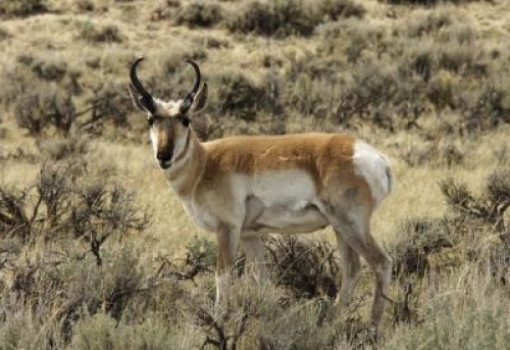
Pronghorn
Yellowstone pronghorn populations directly benefit from the presence of wolves, a new Wildlife Conservation Society study says.
Credit: Julie Larsen Maher/Wildlife Conservation Society
MY FELLOW WOLF PRESERVATIONISTS, HAVE YOU EVER COME ACROSS AN ANTI-WOLF EXTREMIST WHO THINKS THEY KNOW EVERYTHING ABOUT WILDLIFE AND SWEAR UP AND DOWN THAT WOLVES ARE DECIMATING THEIR THE WILDLIFE? I know you have!
One such person is Bruce “Buckshot” Hemming, an author, native hunter, and possesses quite a large ego. If you’ve ever spoken or attempted to debate with him, you know this man resorts to foul language, insults, name calling, and even threats.  Claiming to have over forty years of experience in the outdoors, his articles spout off skewed statistics, feedback from other wolf haters, and how effects of predation on wildlife “isn’t rocket science.”   Well apparently for you Mr. Buckshot, it is rocket science for you.  Leaving out the full story on predation, impacts of hunters, disease, and weather on prey numbers, bias opinions, misrepresented so called facts, he truly is passionate about what he represents.  I will not share his website or book information, as he doesn’t deserve anymore public credit of his work.
I will however share one of his quotes and my rebuttal afterwards:
“Survival of pronghorn fawns was 22.2% in 2002 and 41.7% in 2003. Coyotes (Canis latrans) accounted for 50% of documented fawn death.” (guess what Bruce, previous removal of wolves off the endangered species list resulted in an unintended decline in the pronghorn.  Wolves don’t typically hunt pronghorn but reduced the coyote population that do typically hunt them, therefore pronghorn fawns have higher survival rates when wolves are present in the ecosystem.  His articles certainly do not focus on this fact about positive impacts that wolves have on the pronghorn. In a three year study, in areas where wolves were abundant, 34 percent of pronghorn fawns survived compared to 10% when they weren’t present.  In addition, he fails to mentioned what percentage of hunting, disease, and weather affect pronghorn numbers.)
The following article was provided by Division of Fish and Wildlife, Minnesota Department of Natural Resources in 2009.  It describes more of how things are not cut so black and white with predation, as Mr. Buckshot believes.  It’s also an important reminder that we often don’t understand ecosystems nearly as well as we think we do, and that our efforts to manipulate them can have unexpected consequences, a concept Mr. Buckshot does not possess.
ENJOY THE ARTICLE BELOW!
“Is a robust wolf population responsible for waning deer harvests by hunters the last couple years?
Comments from some deer hunters in northern Minnesota following the 2009 deer season seem to
indicate that may be the case, but there is overwhelming scientific evidence that wolves alone have little
impact on the deer population in Minnesota. Winter severity, hunter harvest, and maturation of forest
habitat are all factors that contribute significantly to deer numbers in northern Minnesota. On a local
level hunter success may be affected by selection of an effective hunting area in relation to deer home
range use, seasonal movements of deer due to migration from summer to winter range, and reduced deer
densities in surrounding areas from increased harvest efforts. Overall, deer numbers in Minnesota
forests are a result of direct management through hunter harvest and are influenced by the high
reproductive potential of deer during mild years or the detrimental effects of severe winters.
There’s no question wolves in Minnesota rely on white- tailed deer as their primary prey source.
Based on research in Minnesota indicating that wolves require 15-19 adult- sized deer biomass equivalent per year (per wol
f), an estimated population of 3,000 wolves in Minnesota take approximately 45,000 to 57,000 deer per year.
Wolves also prey on moose in portions of the Superior National Forest and the Boundary Water Canoe Area in Minnesota
where deer tend to be less abundant. Wolves supplement their diet seasonally with smaller prey like beaver and snowshoe hare. These contributions to their diet are likely biologically significant during brief, specific times of the year, but
overall, they’re relatively minor compared to deer in most parts of the wolves’ range. Considering an
annual population estimate of 450,000 deer residing within all of Minnesota’s wolf range, the annual estimate of
45,000-57,000 deer taken by wolves, represents about 10-13% of that deer population. Minnesota Department of Natural Resources (MNDNR) wildlife researchers recently completed a comprehensive 15-year study of white-tailed deer that included monitoring the movements, survival, and specific causes of mortality of about 450 radio-collared, female white
tailed deer on four study areas…mostly does at least one year old, but including many fawns, even newborns, beginning at
several hours to about 7 days old. At the same time the researchers similarly monitored about 55
radio collared wolves from 7 to 8 packs with established territories covering the deer study areas.
Researchers learned a great deal from the data generated from this long term study. The long-term MN DNR
study concentrated on female deer (about 450 during the course of the study) , because there are more of them in the population, and due to their reproductive potential, they have a greater impact on population dynamics than the males. During the 15-year study, the annual mortality rate of female deer (not including newborns) attributable to wolf predation, ranged from 4% to 22%. The highest rate was observed in 1996 during the severe winter of 1995-1996, but most typically, the mortality rate of does attributable to wolf predation was closer to 5-10%. Additionally, what the data have shown is that the reason white-tailed deer can thrive, despite wolf predation and hunter harvests, is their strong population performance (survival capacity and reproductive success). The annual average age of females was 5.1 to 7.2 years old, and approximately 13% of the does were 10.5 to 18.5 years old. In the forest zone, on average, does live a lot longer than managers and researchers had ever thought. Coupled with that, the pregnancy rates are very high, 90% in yearlings, and 95-100% in does from 2.5 years old up to at least 15.5 years. Of the pregnant does, even the older ones, are mostly still having twins. Interestingly, the median age of survival of these deer is 0.8 years old, but in most cases, there is another fawn to add to the population. Following the challenges of the fawns’ first
(30 December 2009)
winter, there is typically an annual recruitment into the population of at least 35%. Consequently, even
after the significant challenges of the first year to the survival of the fawns, a high number are still added to the population.
U. S. Geological Survey (USGS) researchers studied the impact of predators on newborn fawns in northeastern Minnesota during two springs in the early 1990s. They had a rather limited sample size, but reported that predation by black bears and wolves were the primary causes of mortality (50% each) of newborn fawns. A similar study conducted by MN DNR researchers in springs 2000 and 2001, as part of the larger deer study in north-central Minnesota, documented, during these two fawning seasons that black bears, bobcats, and wolves accounted for 20.5%, 17.9%, and 3.9% of the mortality, respectively. However, two additional categories, “unknown predator” and “unknown cause” were assigned to 23.1% and 10.3%, respectively, of the fawn mortalities. These two categories were based on the evidence that was present/absent, which affected whether researchers could definitively assign a cause. Regardless, in the MN DNR study with a greater sample size, and where deer densities (and densities of newborn fawns, specifically) were notably higher than in northeastern Minnesota, the impact of wolves on fawn mortality was markedly less, but certainly, wolves may have been responsible for a portion of the fawn deaths assigned to “unknown predator.” Wolves are not particularly effective hunters of white-tailed deer. Despite the fact that deer outnumber wolves in Minnesota’s forest zone by some 150 : 1 (450,000 deer : 3,000 wolves), wolves must range and search widely over large pack territories (20 to 214 mi) to obtain the number of
deer they require to sustain their numbers over time. Indeed, studies have shown that most of their hunting
attempts are brief and unsuccessful, typically lasting a matter of only a few minutes. And so, as has been thoroughly documented scientifically and shared with the public , wolves live a “feast or famine” existence, eating little for up to two weeks at a time. Wolves end up surviving primarily on the most vulnerable individuals in the deer population,
such as very young, old, sick, injured, or nutritionally compromised deer, because those are the ones they can catch.
The result being, that under certain conditions, the impacts on the deer population are most likely compensatory rather than additive. That is, many of the deer that wolves kill likely would have died from other causes, such as starvation or
disease.
In conclusion, within Minnesota’s wolf range, the current wolf population relies on a relatively small
portion (10-13%) of the deer population to sustain itself annually.  That and the rather extraordinary
population performance of white-tailed deer in most of northern Minnesota, dependent largely on a high
capacity for survival (particularly after one year of age) and high reproductive success, allow deer to thrive.”
Contact:
Dan Stark
Wolf Specialist
Division of Fish and Wildlife, Minnesota Department of Natural Resources
500 Lafayette RD, Box #20
St. Paul, MN 55155-4020
651-259-5175 dan.stark@state.mn.us

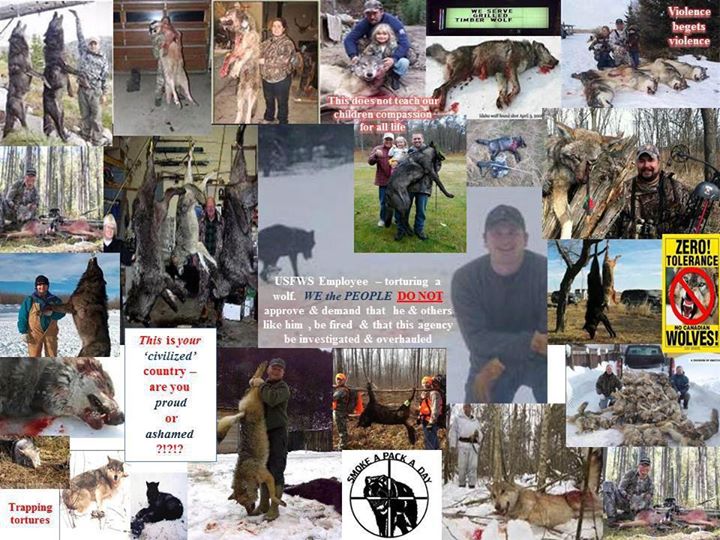
wolf dead pics
photo courtesy of Wolf Liberation Front
PLEASE TAKE ACTION! ..Look at these horrific photos..this is going on DAILY in this supposedly civilized country. They are wiping out an entire species..the ORIGINAL DOG. Follow the instructions below and do something to stop this.

TAKE ACTION! MAKE NOISE! NO COMPROMISE!

Print this image and send with a letter to President Barack Obama
The White House, 1600 Pennsylvania Avenue NW
Washington, DC 20500
Secretary of the Interior Sally Jewell
Department of the Interior, 1849 C Street, N.W.,
Washington DC 20240
Director Daniel Ashe, U.S. Fish and Wildlife Service
1849 C Street NW, Washington, DC 20240

Suggested Text:

Regarding: US Federal Protection for Wolves

While we are all stakeholders in wolf recovery and social acceptance, wolves belong to no one. They are not the property of ranchers, landholders, lobbyists, or politicians. Wolves do not belong to the federal government, nor do they belong to individual states’ Wildlife Departments. Wolves belong to healthy and wilding ecosystems, and to their own packs.

Today, wolves would remain protected under the ESA had it not been for an irresponsible federal budget rider inserted by two self-serving, desperate and backward thinking politicians. Since their delisting, wolves continue to become scapegoats for what is ailing economically depressed rural areas, as well as lazy ranchers unwilling to embrace predator-friendly, new best practices. There are also countless bloodthirsty poachers and trophy hunters far too anxious to pull triggers and set traps to mercilessly kill wolves, not to mention the torturing that takes place…

We have been witness to, seen far too many images of, and heard thousands of stories of wolves being tortured, shot, trapped and bludgeoned. Enough! We are outraged that our tax dollars are footing the bill for Wildlife Services to aerially gun down individual wolves and wolf packs, and for this and other government agencies to shoot and trap wolves. Enough!

Our plea to you is for the RE-listing of Gray Wolves throughout the United States and for the continued protection of Mexican and Red Wolves. All wolves are an integral part of maintaining healthy ecosystems, ungulate herds, and riparian areas. The list does not stop here, but goes on and on.

Stop irresponsible ranching and subsidies. Cease wolf and wildlife killing contests. End trapping, as any form is inhumane. Hold accountable politicians and lobbyists kowtowing to constituents who continue these cruel activities. And most importantly, RE-list the Wolf!

Sincerely,

**Special thanks to Wolf Liberation for providing this information!


Budweiser Wolf

Personally, Wolf Preservation will not be watching the Superbowl for the first time this year, not only because I think cheating is more prevalent now in the NFL, but also this Budweiser commercial painting wolves in a negative light.  Yes, I realize the New England Patriots aren’t the only team who cheats but they are certainly developing a bad reputation of low integrity.  A talented team like that doesn’t need to bend the rules to gain an advantage.

author: Center for Biological Diversity

target: Anheuser-Busch CEO, Thomas W. Sante

“Purposefully demonizing an animal that is part of America’s natural heritage is no way to sell beer.

But that hasn’t stopped Budweiser from crafting a commercial for this year’s Superbowl that intentionally drums up anti-wolf sentiment to try and capitalize on our culture’s outsized fear of wolf attacks.

The ad pits a cute puppy against a snarling, evil-looking wolf. In the ad the puppy is saved from the vicious wolf by the arrival of a team of Clydesdale horses.

Here’s a reality check: 1.2 million dogs are euthanized in shelters in the United States each year while another 1.2 million dogs are hit and killed by cars on America’s roads. By comparison, wolves are a virtually non-existent threat to our furry canine friends, only in very rare instances attacking dogs if they feel threatened or perceive them as competitors. The real threat to both dogs and wolves, as these numbers show and as Budweiser’s cynical attempt to boost sales indicates, is people.

Take action — tell Budweiser to pull its wolf-hating ad, demonizing an endangered species is no way to sell beer.”

http://www.thepetitionsite.com/takeaction/872/023/837/

**Special thanks to “Howling for Justice” for providing this information!  (https://howlingforjustice.wordpress.com/2015/02/01/budweiser-takes-low-road-demonizes-wolves-to-sell-suds/)


yellowstone wolf

Grey Wolf in Yellowstone National Park’s famous Lamar Valley. Image by Jason Williams

“In 1926 the last known wolf was killed within the boundary of Yellowstone National Park and in 1943 the last recorded wolf was killed in Wyoming. After nearly 10,000 years on the landscape, a key species and apex predator was gone. Though a few sightings were reported in the years that followed, it is widely agreed that for all intents and purposes wolves were exterminated from the Greater Yellowstone Ecosystem. The systematic extirpation of wolves was done by all means necessary including trapping, poisoning and shooting. The ideal of a predator free landscape made sense in the context of a culture founded on dominion over the natural world as opposed to living in harmony with it. Ranchers didn’t want to lose cattle, hunters feared the loss of game and most everyone agreed that wolves didn’t have much value.

Even the famous conservationist Aldo Leopold agreed with killing wolves until he realized through his direct observations that wolves were valuable to the natural world and health of the ecosystems in which they live. In one of his often quoted passages Leopold laments, “In those days we had never heard of passing up a chance to kill a wolf. In a second we were pumping lead into the pack, but with more excitement than accuracy; how to aim a steep downhill shot is always confusing. When our rifles were empty, the old wolf was down, and a pup was dragging a leg into impassable side-rocks. We reached the old wolf in time to watch a fierce green fire dying in her eyes. I realized then, and have known ever since, that there was something new to me in those eyes—something known only to her and to the mountain. I was young then, and full of trigger-itch; I thought that because fewer wolves meant more deer, that no wolves would mean hunters’ paradise. But after seeing the green fire die, I sensed that neither the wolf nor the mountain agreed with such a view.”

Leopold’s realization and later observations fueled a passion for conservation and a preservation of a wild world that included the wolf. As a more modern perspective began to influence land management decisions, a movement began to reintroduce wolves back into the Greater Yellowstone Ecosystem. Between 1995 and 1997, the Unites States Fish and Wildlife Service, with the help of the National Park Service, released 31 wolves into Yellowstone National Park. The program was so successful that future planned releases were never carried out. The wolf population increased steadily in Yellowstone and peaked at over 175 wolves in 2003. As the habitat within Yellowstone became saturated and well established packs claimed the best territory, younger wolves began branching out in search of new territory. They moved out of Yellowstone in all directions, including to the south where they found the ideal habitat of Jackson Hole.

After the release of wolves into Yellowstone it became apparent that the wildlife tourism associated with wolves was significant. According to one study (Click here to read), wolf watching in 2005 generated around 35 million dollars in revenue for the three states visited for this purpose (Wyoming, Idaho and Montana). 44% of all visitors surveyed in this study listed the wolf as one of the animals they would most like to see, second only to grizzly bears in terms of visitor interest.

As wolves became more established in Grand Teton National Park and Jackson Hole they also became more visible. Jackson Hole, including Grand Teton and the National Elk Refuge, was becoming known as a wolf watching destination to rival Yellowstone and the famous Lamar Valley. There were even wolf dens and rendezvous sites being established in places that visitors could easily watch from a safe distance in their natural environment. Places like Elk Ranch, Willow Flats and the wide expanses of the National Elk Refuge (in winter) were becoming reliable places to find wolves, often doing something interesting like hunting, chasing coyotes or even playing. By the winter of 2011/12 our guests were seeing wolves on about half of our safaris! Though some guide services had already started offering wolf specific tours in Jackson Hole, we had been waiting until the sightings were more reliable and the packs were more established and predictable. It was after the frequent and reliable sightings in 2012 that we started to design and promote wolf watching which we expected to especially benefit our shoulder seasons like spring, fall and winter when the wolf watching was often the best. All of the tour businesses and wildlife photographers agreed that the combination of more wolves living in accessible places was creating unprecedented wolf watching opportunities in Jackson Hole.

Unfortunately the steady increase in the wolf population also led to the delisting of the wolf from protection under the Endangered Species Act in September of 2012. As an endangered species wolves could not be hunted and even control actions for livestock depredation or other nuisance behaviors were more difficult as they had to be approved by federal agents. The fate of the Wyoming wolf was transferred from the US Fish and Wildlife Service, who banned sport hunting and trapping, to the Wyoming Game and Fish Department, who immediately created a trophy hunting and trapping season (and predator control program) targeting any wolves that roamed outside the National Park boundaries.
According to the Game and Fish 2012 Wolf Report, at the end of 2012 at least 277 wolves in 43 packs roamed the wild country of Northwest Wyoming. That was after the loss of 136 wolves that year including 120 at the hand of people. Of those 66 were legally harvested as either trophy animals (permit required) or predators (no permit required), 43 were killed by state or federal agents, 5 were killed by cars, 4 were poached and 3 the cause was unknown. Not only were there significantly less wolves to watch, they had been taught an important lesson – people were dangerous and to be avoided!

This first hunt devastated the wolf watching and photography industry in Jackson Hole and shattered the potential for this multi-million dollar industry to flourish! That winter the wolves vanished from sight. They started hunting and moving at night and were being especially careful to avoid being spotted by people. That winter (2012/13) our guides and guests only saw wolves twice in the entire season! Their disappointment was palpable and our loss of revenue dramatic. Not only was this an entirely new dimension to the wildlife related tourism industry in Jackson Hole, it also coincided with our slow seasons, a time when valley businesses struggle to make sales, fill hotel rooms, restaurant seats and certainly sell wildlife safaris. It was an amazingly sudden shift and a lesson to be learned about our wild neighbors. They are smart! The wolf packs that we are starting to know didn’t lose that many members to the hunt but they saw enough of their family killed to completely avoid us. This negative conditioning will most certainly have an impact on our ability to watch and photograph these wolves for years to come.

Not only was this 35 million dollar a year activity destroyed during one fall hunt, Wyoming Game and Fish lost over $460,000 administering their wolf program in 2012! According to their records they sold 4,287 wolf tags for $107,136.00 but spent 569,271.31 on their wolf management program! Of those sold only 187 tags were for out of state hunters meaning that the vast majority of the program was for Wyoming residents and would have generated very little ancillary income for other businesses (average spends for in-state users are demonstrated to be significantly lower than out-of-state travelers).

In 2013 the interest in tags was even lower with only 2,152 tags sold generating $61,416.00 and only selling tags to 140 out-of-state hunters. After spending $541,594.86 on wolf management in 2013, the Wyoming Game and Fish lost $480,000 administering this one program! It’s no wonder the Wyoming Game and Fish is struggling financially and faced a 2 million dollar budget deficit in 2013 alone. Since 2009 the department has experienced an inflation adjusted decline of 13% according to their website.
Given these facts wouldn’t it make sense to reevaluate the way we value wildlife. Is the old paradigm broken? The idea that just because an animal is no longer officially threatened means we should immediately start killing again it is short sighted and given the numbers downright stupid. Wolves in today’s world are worth more alive than dead – the numbers don’t lie. By Wyoming Game and Fish following this old land management ethos, they are costing our community millions of dollars, wasting taxpayer money and taking away good paying jobs (not to mention encouraging people to come and take away such a valuable resource). It’s time Wyoming Game and Fish recognize that there is a better way to manage wildlife. One that is more profitable, more scientifically sound and one that requires spending a lot less money.

If you agree please send a message to the Wyoming Game and Fish Department and the Wyoming state legislators and let them know your thoughts. The legislative session is just starting and Wyoming Game and Fish budget discussions will be happening soon. Let’s send a clear message that these policies are bad for business and bad for wildlife!”
Representative Ruth Ann Petroff
Box 2764
Jackson Wyoming 83001
Ruth.Petroff@wyoleg.gov

Andy Schwartz
PO Box 2654
Jackson Wyoming 83001
schwartzhd23@gmail.com

Senator Christensen
220 West Alta
Alta Wyoming 83414
Leland.Christensen@wyoleg.gov

Director of Wyoming Game and Fish
Scott Talbott
5400 Bishop Boulevard
Cheyenne, Wyoming 82006

**Special thanks to “Jackson Hole Wildlife Safaris” for providing this information! (http://jacksonholewildlifesafaris.com/why-wolf-hunting-in-wyoming-is-bad-for-business/)


By On January 3, 2015

About the politics of wolf reintroduction in the Northern Rockies-

“Jim Yuskavitch begins his book with the story of wolf B45, the first Idaho wolf to venture into Oregon. She (B45) was a first generation offspring of the wolves brought down from British Columbia for release in Idaho in 1996. Most of his examples and descriptions early on in the book center on Idaho. Most past books begin with Yellowstone National Park.

As an Idahoan, I enjoyed reading for the first time about the “exploits” of a number of the wolves reintroduced to Idaho. Their stories are as interesting as the many about the individual Yellowstone wolves and wolf pack. I had hoped someone would do this.

Before you are through reading In Wolf Country, he has discussed almost every issue surrounding wolf restoration to the Northern Rockies. Most of these have been topics in The Wildlife News. Our readers will find the book to be a fine companion giving the factual history, the various controversies about the wolves, the players, the politics, and the world view of the ranching and hunting interests that largely dominate the management of the outdoors east of the Cascades and the Sierra Nevada and west of the Missouri River.

The author shows in detail how wolf management is just barely about wolf biology. Instead it deals with people and politics, many of which are guided by beliefs about wolves that include few facts, many errors, and a lot of emotion. I have wondered for years why wolves raise so much hostile emotion in some groups of people. One answer he finds is that the controversy for many on the anti-wolf side is a stand-in for different worldview. Wolf supporters, according to the ideology found in many writings and opinion pieces, value animals over humans. They would push God off his throne ruling over all, but giving  to “man” dominion above all else. Support for predators presumably means hostility to property rights and guns, belief in a overpowerful federal government. Wolves are pretty much a plot to destroy the rural West.

Of course, he is careful to point out that there are ranchers and hunters who do not subscribe to idea that wolves-put-on-ground represents some cosmic battle between good and evil. Many just go along with what they see as the dominant opinion where they live or work. In the rural towns social pressure makes it hard to differ on this subject and often costly for those of their number who have a less emotional view to speak up. An example he uses is the Wallowa County, Oregon unsuccessful attempt by the Barking Mad Farm Bed and Breakfast to get a conditional use permit to expand onto property zoned for agriculture. The application was made into a much larger issue and something to be stopped because the kind of tourism the expansion might generate, it was argued, would bring the wrong kind of people as visitors to the county and give support for wolves. It would threaten priority of ranching there. If I recall correctly, that this dominance of ranching was explicitly stated by opponents of the permit.

He also retells Don Peay’s successful effort in Utah to extract large sums of money from the Utah Legislature to lobby to prevent the federal government from introducing wolves to Utah, something no one was asking the government to do. Peay, who founded Sportsmen for Fish and Wildlife, was also successful getting a Utah ballot proposition passed making it so that it would take a supermajority (2/3) in future for any other ballot proposition to directly change the rules and take of hunters and fishers.

To date, not many books have written about the work in Idaho by the Nez Perce Tribe (Tribal Wolf Recovery Team) which was tasked with managing the reintroduced wolves when the Idaho Legislature rejected doing so, though they claimed that role later. A major task, and one that continues to a lesser degree, was to estimate the number of wolves and wolf packs in Idaho each year and collect information on their whereabouts and habits for the Department of Interior to asses the degree to which the recovery effort had succeeded.

Yuskavitch was able to go on a number of trips to the woods with the Team. His observations were interesting, both of finding the wolf packs, and finding the people who actually feared them in remote and small, Elk City, Idaho. I can testify to the correctness of his observations because at the time I had an in-law who lived there. Observing the fear his girlfriend had of the unseen menace, and how hard it was to abate it, shocked me. She had seen what she thought were wolf tracks on her property. I told her I found something far worse she needed to pay attention to — spotted knapweed just getting started.

This author, like many others, debunks the common idea that wolves are especially dangerous to people. No, it is not the case that they are fixin’ to eat us, but want to eat all the other animals first. He relates his conversation with Utah State University Professor Dan McNulty pointing out that wolves are quite weak for large carnivores; far from being killing machines. Compared to the cougar, for example, they are less muscular, have a weaker bite, have weak legs when it comes to attacking. Their legs are “just sticks,” and they cannot rotate them at the knee. Their claws do not grab or hold.

He has two chapters that are pretty much about hunting; wolf hunting and hunting deer and elk. There is a chapter on the return of wolves to the Pacific Northwest with stories about “Journey,” wolf OR7 and other important Oregon wolves.

He concludes that “Wolves are Here to Stay,” and that hunting wolves actually facilitates their dispersal to places far from their birth.

I have only touched on the many topics of the book which is available in paperback for order on-line. It was released just before the New Year. It is hardly a dull academic tome despite its many facts and analysis of the policy controversy. For the person greatly interested in wolves on the ground in the West, the book should be of intense interest.”

About The Author

Ralph Maughan

Dr. Ralph Maughan is professor emeritus of political science at Idaho State University with specialties in natural resource politics, public opinion, interest groups, political parties, voting and elections. Aside from academic publications, he is author or co-author of three hiking/backpacking guides.

“In Wolf Country,” important new book by Jim Yuskavitch


collared wolf killed

An animal seen north of Grand Canyon on Oct 27, 2014. (Photo Source: Arizona Game and Fish Department)

December 30th, 2014

“A hunter has killed a three-year-old female gray wolf 5 miles east of Beaver, Utah, wildlife officials have confirmed.  The 70-pound animal was wearing a radio collar which indicated it was collared in Cody, Wyoming, in January of 2014.

The hunter called law enforcement officials after noticing the collar.  The hunter says he believed the animal to be a coyote.  Wildlife groups, including the Center for Biological Diversity, are calling for a full investigation, which the US Fish and Wildlife Service says it will conduct.

This is the first documented killing of a gray wolf in Utah since wolves were reintroduced into Idaho and Yellowstone National Park in the mid-1990s.  It is not the first documented sighting of a gray wolf in Utah — a 3-year-old male was found dead in a leg-hold trap in 2006 and another, collared, male was trapped near Morgan in 2002 and returned to Yellowstone.  It is likely that other wolves, as yet undetected, are roaming the state.

For the past two years Utah has offered a $50 bounty on coyotes.  More than 7,000 coyotes were turned in for the reward during the second year of the bounty.

“This is a very sad day for wolf conservation and for Utah. All competent wildlife biologists already know that coyote hunting, including our state bounty program, is ineffective, and therefore a waste of money – and now we see that is is also a threat to other wildlife and to wolf recovery,” said Kirk Robinson, executive director of the Western Wildlife Conservancy, based in Salt Lake City.

It is possible that this animal could be the wolf sighted near the north rim of the Grand Canyon in October, but her identity has not yet been confirmed.  The wolf’s description and the location where she was found — near the southern end of the Tushar Mountains — means she was likely the Grand Canyon wanderer, said Michael Robinson, wolf advocate for the Center for Biological Diversity.

However, other wolves are likely wandering through Utah.  The North Rim of the Grand Canyon is almost 200 miles south of Beaver.  A photo of what appears to be a wolf crossing Highway 14, 70 miles south of Beaver, was taken early in December, and the wolf shot may be the animal in that photograph, said DWR director Greg Sheehan.”

**Special thanks to Wolf Park for providing this information! (http://blog.wolfpark.org/collared-wolf-shot-and-killed-in-utah/)

2014 in review


The WordPress.com stats helper monkeys prepared a 2014 annual report for this blog.

Here’s an excerpt:

The concert hall at the Sydney Opera House holds 2,700 people. This blog was viewed about 13,000 times in 2014. If it were a concert at Sydney Opera House, it would take about 5 sold-out performances for that many people to see it.

Click here to see the complete report.


mexican gray wolf recovery

“Conservation organizations on Wednesday sued the U.S. Fish and Wildlife Service to force it to complete a long overdue, legally required recovery plan for the Mexican gray wolf, the lobo of Southwestern lore.

The lawsuit, filed in U.S. District Court in Arizona, aims to enforce compliance with rules the agency adopted 38 years ago to guide recovery of the federally endangered species driven to near extinction by wolf extermination campaigns of the 19th and 20th centuries.

It asks the court to declare the agency in violation of the Endangered Species Act, and order it to “prepare and implement a scientifically based, legally valid” final recovery plan within a year of the court’s judgment.

The Mexican gray wolf was reintroduced into a small area of eastern Arizona and western New Mexico in 1998 as part of a strategy to reach a population of 100 wolves, including 18 breeding pairs, by 2006.

Today, the population stands at 83 wolves, and five breeding pairs. They are managed under restrictions that do not permit the mobile, clannish hunters to colonize new territory, increasing the likelihood of inbreeding, according to the lawsuit. The restrictions also allow excessive killing and removal of wolves that take livestock, the lawsuit says.

By the agency’s own assessment in a recent draft environmental impact report, the existing population is “considered small, genetically impoverished, and significantly below estimates of viability appearing in the scientific literature.”

Sherry Barrett, the U.S. Fish and Wildlife Service’s Mexican gray wolf recovery coordinator, was unavailable for comment.

Plaintiffs including the Defenders of Wildlife, the Center for Biological Diversity, the Endangered Wolf Center, the Wolf Conservation Center and David R. Parsons, a biologist who served as the agency’s Mexican gray wolf recovery coordinator from 1990 to 1999, accuse the agency of yielding to political pressure from ranchers, hunting groups and state officials in Utah, Arizona and Colorado.

In a letter to former Interior Secretary Ken Salazar in late 2011, for instance, Utah Gov. Gary R. Herbert urged that Colorado and Utah be excluded from what he described as “the Mexican gray wolf equation,” on grounds that those states were not “within its core historic range.”

The agency, in 2013, published documents based on recent genetic research showing that the species scientists know as Canis lupus baileyi ranged as far north as Utah and Nebraska.

“Unfortunately, when confronted with views from various interest groups — particularly livestock industry organizations, state wildlife agencies and the less enlightened hunting organizations – the agency takes a head-in-the-sand approach,” Parsons said in an interview. “What seems to be driving things in this case are the politics surrounding the Mexican gray wolf.”

Since 1982, the agency has convened three different scientific teams to prepare a formal recovery plan for the Mexican gray wolf.

The most recent effort produced a draft recovery plan in 2012 that recommended establishing two additional Mexican gray wolf populations, one in the Grand Canyon and another in the southern Rocky Mountains of New Mexico. The overall goal was to create three self-sustaining sub populations totaling 750 wolves.

The plan also suggested several areas of suitable habitat for reintroduction efforts including land in Arizona, New Mexico, southern Utah and southern Colorado.

That plan, however, was never published, and the recovery team that produced it never reconvened to review the proposal’s viability, according to the lawsuit.

“The agency has caved in to demands of the anti-wolf states,” Noah Greenwald, endangered species director at the Center for Biological Diversity, said. “Meanwhile, decades after it decided to reintroduce it into the wilds, the Mexican gray wolf remains on the precipice of extinction.”


Posted: Wednesday, November 12, 2014 1:15 pm

“Consider this loaded question: Should grizzly bears, wolves and cougars be hunted for sport? Worldwide, given their rarity and declining numbers, should lions, leopards, cheetahs, jaguars and tigers?

Across North America we find ourselves in another big game hunting season. For many the harvest is as much about putting meat in the freezer — a form of modern subsistence — as it is about the profoundly personal act of communing with nature.

From an early age, a lot of us were taught two guiding ethical principles: Don’t take the life of an animal unless you intend to eat it, and, if you do kill, there ought to be a good reason.

As states sanction hunts of iconic predators (grizzlies and black bears, wolves, mountain lions and coyotes), there remains a fact: People will eat little of those animals that they kill.

The search for a rationale in targeting predators must necessarily speak to reasoning beyond the simplistic argument advanced by fish and game departments that selling hunting tags generates revenue.

The issue of whether there’s an underlying moral — and compelling biological — justification for killing predators is taken up by two university professors in a new thought-provoking scientific analysis, “Wolf Hunting and the Ethics of Predator Control,” soon to be included in a new book, “The Oxford Handbook of Animal Studies.”

Author John Vucetich is a well-known Midwest wolf researcher and conservation biologist at Michigan Tech University; Michael P. Nelson is on the faculty at Oregon State University. In their paper they examine why large carnivores — which possess undeniable ecological value — are hunted.

Before we proceed let it be clear that Vucetich and Nelson did not write the paper to advance an anti-hunting agenda. They wanted to determine if any “good reason” for hunting predators exists.

“What counts as an adequate reason to kill a sentient creature?” they ask. “The hunting community has long recognized the value of this question to understanding the conditions under which various kinds of hunting is appropriate.”

Vucetich and Nelson consider the spectrum of societal attitudes toward predator hunting as expressed by trophy hunters, government wildlife managers, those who hunt for food, those who eat no meat and animal rights advocates.

They dissect the premise that predators must be controlled to ensure healthy populations of elk, deer, moose and pronghorn — and even, as is sometimes asserted, to protect people. They test the assertion that the best way of promoting conservation of a species is to place a value on its head and hunt it.

They also scrutinize the attitudes of so-called “wolf haters,” pointing out that unlike hunters of edible big game, whose pursuit seems to make humans more respectful of the animal, many who kill wolves are actually driven by a lack of empathy.

In a statement certain to spark debate, they charge: “Many instances of wolf poaching … are wrong because they are primarily motivated by a hatred of wolves. These instances of poaching qualify as wrongful deaths, if not hate crimes.

“To legalize such killing does not make them any less wrong. Moreover, people who threaten to poach wolves unless wolf killing is legalized are engaging in a kind of ecological blackmail … .”

Vucetich and Nelson also share thoughts about trapping: “A trophy is a kind of prize, memento or symbol of some kind of success. To kill a sentient creature for the purpose of using its body or part of it as a trophy is essentially killing it for fun or as a celebration of violence.

“And although there was once a time when trapping wolves for their pelts might have been a respectable means of making a living because wolf pelts were then a reasonable way to make warm clothing,” they state, “we no longer live in that time.”

Ultimately Vucetich and Nelson conclude that killing predators for sport isn’t justified biologically or on moral and ethical grounds.

They take government agencies and universities to task for not brokering honest discussions about such controversial issues as wolf management and predator control with citizens and students.

So often we do things in our society, they suggest, without bothering to provide the “good reason” for why.

Readers can judge for themselves. A copy of the analysis is attached to the online version of this story.”

**Special thanks to Todd Wilkinson, who has been writing his column here every week for 25 years. He is author of the critically acclaimed book “Last Stand: Ted Turner’s Quest to Save a Troubled Planet.”