Feeds:
Posts
Comments

Alaskan Wolf Pup

Photo courtesy of “Be a Voice for the Gray Wolf”

ALERT!!  I’m asking you all to help contact Alaska Governor Sean Parnell and express your outrage about this.  Feel free to e-mail or call his office.   As emotional as this is, please don’t threaten anyone.  But Alaskan resident or not, we need to continue to make our voices heard on this!  Wolf pups have a high enough mortality rate without trigger happy hunters involved.  In addition, contact your local state representatives, newspaper, and even set up a booth in a library to inform the public so they too can educate others about these horrific acts.  Even if these atrocities can’t be stopped in the short term, WE can educate our youth and work on stopping this in the long run!

PLEASE do not stand by and let this go unnoticed. http://gov.alaska.gov/parnell/contact/email-the-governor.html


by Nicole Rivard, Friends of Animals Correspondent

“Shame on Alaska governor Sean Parnell for allowing the “kill-on-site” policy for wolf pups and bear cubs orphaned by state predator control to continue. Friends of Animals has learned from Rick Steiner, professor and conservation biologist, that despite the wildly popular rescue of wolf pups abandoned in the Kenai fire last week, which was covered on national television news, the State of Alaska announced June 2 that it would not alter its “kill-on-site” policy for newborn wildlife orphaned by the state’s predator control programs across western and northern Alaska.

These pups escaped death because they were rescued by firefighters before the Alaska Department of Fish & Game could get their hands on them, and have been adopted by the Minnesota Zoo instead of being killed.

But the future is bleak for future pups orphaned after the State of Alaska kills their parents.

After killing all of the adult wolves from two wolf packs on the South Alaska Peninsula in their spring 2008 predator control effort, ADFG biologists pulled 14 newborn wolf pups from the two dens, and shot each in the head. Subsequent public outrage led to the adoption of the state’s wolf pup protocol in Nov. 2008, which called for the live collection and placement of orphaned wolf pups in zoos and other facilities.

Then in May 2009, with no public notice, prior to the continuation of the Alaska Peninsula wolf control program, the state adopted a new wolf pup protocol that called for the lethal gassing of wolf pups orphaned by predator control efforts in western and northern Alaska. Although there has never been a reported case of rabies in wolf pups, the rationale the state gave for adopting its new lethal protocol in western and northern Alaska was a purported risk of rabies in wolf pups.

But given the lack of rabies risk, many wildlife advocates feel the new “kill-on-site” protocol was actually adopted for other reasons, including: the current state administration, and its political supporters, harbor an irrational disdain, even hatred, for wolves; in remote areas, without the watchful eye of the news media, the state feels it is more expedient to just kill orphaned pups than to arrange their collection and placement; the state doesn’t want to attract attention to the inhumane consequences of its scientifically unjustified predator control programs by providing an opportunity for news media to cover the live collection and placement of orphaned young; and the state doesn’t want the public to understand that the “hidden” effects of its predator control programs are far greater than just the number of adults killed.

Wolf pups and bear cubs remain dependent on their parents for more than a year, thus parents killed by state predator control or liberalized hunting and trapping regulations also results in the death of dependent cubs and pups, which are not added to the kill count.

A month after the new kill-on-site protocol was adopted, on June 7, 2009, two newborn wolf pups that had been orphaned by the state wolf control effort in the area, were lethally gassed in their dens with carbon monoxide by ADFG biologists. Their carcasses were not collected and tested for rabies, and left to decompose in the den. This was the first, and so far only, time in state history that newborn wildlife has been lethally gassed. This remains state policy today.

In Feb 2014, ADFG was asked to rescind its 2009 (lethal) wolf pup protocol, and revert to its 2008 (non-lethal) protocol, but the agency declined, again citing its concern for rabies in wolf pups. Then, after the rescue of the five Kenai wolf pups last week the state was asked again to apply this non-lethal collect-and-place protocol to the entire state, arguing not only that there has never been a report of rabies in wolf pups, but also that the half dozen reports of rabies in adult wolves in the historical record (the past 70 years) were all from the Arctic. Thus the risk of rabies from wolf pups, or even adult wolves in the rest of Alaska, is exceedingly low.

Despite this argument, ADFG announced yesterday, in a June 1, 2014 email from Division of Wildlife Conservation Director Doug Vincent-Lang, the following: “We stand by our new wolf pup protocol given advice from our vet regarding rabies. Rabies is a serious disease and I trust the advice of my professionals on this issue. It is fortunate that the wolf pups from the Kenai were from a rabies free zone and could be placed.”

The agency did not provide an explanation for why its veterinarians feel rabies in wolf pups presents a risk when there has never been a reported case. Thus, any wolf pups found orphaned by the state’s predator control programs in western and northern Alaska will continue to be lethally gassed. Additionally, in a May 29, 2014 press release, ADFG admitted that its biologists had recently (this spring) killed newborn black bear cubs in its Kuskokwim (GMU 19A) predator control effort.   Apparently there was no effort made to collect-and-place the newborn bear cubs.

Many Alaskans feel that the government killing of healthy newborn bear cubs and wolf pups is inhumane, unethical and unacceptable and Friends of Animals couldn’t agree more. “It takes a troubling, cold-hearted detachment from life to rationalize the killing of innocent newborn animals,” said Steiner. “Is this really what Alaska has come to? The state’s predator control program is bad enough, but to kill innocent weeks-old wolf pups and bear cubs whose parents have just been killed by gunners in helicopters, exposes a callous depravity that should concern us all. “Perhaps ADFG officials should go before an elementary school assembly and explain to the kids why, after their biologists gun down the parents of bear cubs and wolf pups from helicopters, they then order the orphaned pups and cubs to be gassed or shot instead of rescuing and placing them in facilities to live out their tragically altered lives.”


**Special thanks to Nicole Rivard, Friends of Animals Correspondent, for providing this information!  (https://www.thedodo.com/alaska-governor-allows-kill-on-580469041.html)


LEAVE THESE ANIMALS ALONE AND LET MOTHER NATURE DO IT’S JOB.  WOLVES AND ELK BALANCE EACH OTHER JUST FINE WITHOUT INTERFERENCE.

by  on JUNE 2, 2014

“Recently the Montana Dept of Fish, Wildlife and Parks (MDFWP) commission approved a new “Wolf Conservation Stamp”. The purpose of the stamp is ostensibly to get non hunters to pay for wildlife “management”, especially the “management” of wolves.  The stamp would be voluntary.  Despite the fact that I support the idea of non-hunters/anglers paying to support wildlife agencies, I do so only with the condition that the agency changes their entire philosophical approach to wildlife.

In theory the wolf stamp is a good idea. It could demonstrate that keeping wolves alive is more valuable than killing them. And there are ways I could envision how such a wolf stamp might lead to greater appreciation for wolves as a valued part of Montana’s heritage. However, as now presented, I am very skeptical that positive outcomes will result.

The details of this wolf stamp proposal demonstrates to me that MDFWP still has the same unscientific and unethical attitude towards predators as it has always demonstrated. Without a change in its overall philosophy, all this stamp will do is help the Department perpetuate the same old myths and misinformation about predators that it currently dishes out—only wolf supporters will be helping to fund it. According to MDFWP, funding from the stamp would cover the following three areas.

  1.  One third would be made available to Montana livestock owners to help pay for nonlethal ways to protect their animals from predators like wolves, bears and mountain lions.  By keeping both livestock and large carnivores alive, this would be a good deal for ranchers and wolves alike.
  2. Another third would be used to pay for studying wolves, educating the public about wolves, and improving or purchasing suitable wolf habitat.  This would benefit everyone, by increasing our knowledge about wolves, ensuring the public has access to accurate information about wolves, and securing habitat in which wolves and other wildlife can thrive.
  3. The final third would be used to hire additional MDFWP wardens—essentially, wildlife police—in occupied wolf habitat.  This would enhance enforcement of our wildlife management laws as they pertain to wolves and other species, and reduce incidents of poaching, trespassing, wasting animals, unlawful use of or failure to check traps, and other violations.  This is something every Montanan and every American—hunters, non-hunters, property owners, public land users, agency officials, recreationists, and wildlife enthusiasts alike—should encourage and support.

RESPONSE TO PAYING FOR NON-LETHAL MEANS OF LIVESTOCK PROTECTION

One has to ask what is MDFWP thinking. Let’s see, we will help ranchers with non-lethal means of protecting livestock so we can allow hunters and trappers to blow away more wolves? That is essentially what they are suggesting. As long as MDFWP has a vindictive and unethical attitude towards predators, there is no reason to “save” any of them—just so someone else can shoot them. Asking predator supporters to pay ranchers to adopt non-lethal means of protecting livestock is analogous to asking those who cherish clean air to pay for air pollution devices on coal fired power plants.

Ranchers have EXTERNALIZED the cost of their operations through predator control.

Ranchers should pay to protect their own herds—it is part of the cost of doing business—a cost that they have successfully avoided for a century because they were able to get the government to kill off most predators from the landscape. Just as the coal power plants must install pollution control devices or get out of business, ranchers must practice better animal husbandry. It is not the responsibility of wildlife supporters to subsidize their business. Ultimately the additional costs should be borne by those who want to eat beef, just as the users of electricity from coal-fired power plants should pay more per Kilowatt Hour to reduce air pollution from power generation.

The last part of this is that wolves are simply not a big deal for ranchers. Last year in Montana fewer than 60 cattle out of 2.5 million in the state  were killed by wolves. If MDFWP were truly interested in educating the public it would be countering the myth that wolves are “destroying” the livestock industry.

Basically livestock depredation is a non-issue and even giving it credibility by pretending that wolves are somehow a significant cost for ranchers is nothing less than deceptive. I think the real reason MDFWP wants non-hunters to pay for non-lethal livestock protection is to reduce ranchers’ hostility towards the department so that more ranches are left open to hunting, not because MDFWP has any goal of helping wolves.

Worse, the livestock industry has many negative impacts on predators besides simply lethal killing. Every blade of grass consumed by cows is that much less for elk, deer, and other wildlife.  Not to mention that the mere presence of cattle, often socially displaces other wildlife like elk. In effect, there are numerous “costs” to livestock that the ranching industry externalizes.

RESPONSE TO FUNDING WOLF STUDIES AND EDUCATING THE PUBLIC

The second part of the proposal to use stamp funds to study wolves, educate the public about wolves, and purchase suitable wolf habitat I seriously object to the way MDFWP has “educated’ the public about wolves already.

The problem is that MDFWP doesn’t even use the existing scientific information it has available to ecologically and ethically treat predators. So why should I or anyone else believe more studies would result in “better” outcomes.

Although Tom Dickson’s recent piece in Montana Outdoors that provided some more factual information about what wolves were doing and weren’t doing to Montana’s hunting opportunities (wolves are not destroying elk herds), it is a small effort.

Indeed, I fear giving MDFWP more funds to “educate” the public about wolves. They have repeatedly demonstrated that they are unwilling to counter mythology and misinformation. And they will promote the idea that we “need” to “manage” predators. Predators do not “need” management. They need to be left alone. They are perfectly capable of self regulating, primarily because of social intolerance among packs helps to reduce and limit wolf numbers.

Paying MDFWP to “educate” the public about wolves is like handing over more money to the Rocky Mountain Elk Foundation to educate the public about wolves. For those of you who are unfamiliar with RMEF, they promote the idea that wolves are “destroying” elk herds, and “need to be managed like other wildlife.”

If MDFWP were using science, it would be “educating” the public that wolves pose little threat to big game herds as proven by their statistics. For instance, elk numbers have risen in Montana from 89,000 just prior to wolf restoration to 150,000 animals now. Most elk management units are “over objectives”.

They would manage for social stability rather than having kill quotas based on nothing more than the idea that fewer wolves will mean more elk and deer—as if that should be the goal of wildlife management. MDFWP like all agencies has a mission to promote all wildlife not just the ones that hunters like to kill. But the philosophical bias of the agency, like all state wildlife agencies, is grossly skewed towards promoting animals that hunters like to shoot.

Furthermore, MDFWP when it does discuss wolves sees them only as a “problem” instead of educating the public on the many benefits associated with wolves and other predators like a reduction in disease spread in ungulates, reduction in some herbivory pressure in some places due to a reduction in elk numbers and/or changes in habitat use, and changes in predator effects on other species like a reduction in coyotes that in some cases has lead to an increase survival of pronghorn. And these are only a few of the benefits that the department could be extolling.

As far as buying wolf habitat, there is nothing special about wolf habitat. It’s basically anyplace where there is sufficient prey for wolves to eat. You don’t buy “wolf habitat”, you buy wildlife habitat. I have no problem with buying wildlife habitat, and if this stamp only did that, I would support it. But I fear this will be a minor effect of the stamp.

RESPONSE TO HIRING MORE WARDENS AND MANAGEMENT

Finally, the third part of the stamp receipts would go to fund more wardens to enforce wildlife management laws. The problem isn’t with poaching or any other illegal activities. The problem is what is legal. MDFWP legal actions towards predators are archaic, vindictive and unethical. The agency says its new wolf stamp will prevent, among other things suggested, the “wasting” of wildlife? Huh? What is more wasteful than shooting predators just for fun, or worse, out of vengeance?

If the Department were truly interested in avoiding “waste”, it would call for the ethical treatment of wildlife and outlaw the killing of all predators except for very special situations like when an animal that is habituated to humans.

As for poaching, much of the poaching of predators is done because hunters and others believe that wolves are “destroying” hunting opportunities—a perception that MDFWP does little to counter. If MDFWP were doing its job, and using scientific findings to educate hunters, it would at least be saying to hunters that wolves haven’t caused the sky to fall.

DON’T SUPPORT MORE ‘MANAGEMENT” OF WOLVES AND OTHER PREDATORS

We don’t need more management of wolves and other predators. What we need is to leave them alone. There is simply no reason to “manage” predators. The science is clear on this—they have many ecological benefits to ecosystems. The idea that we should manage predators is a throwback to the early days of wildlife management—it’s time for MDFWP and other wildlife agencies to enter the 21st Century and start treating predators as a valued member of the ecological community instead of a “problem” that needs to be solved—usually by killing them.

If a wolf stamp is developed with good sidebars that guarantees a better outcome for wolves than I would be happy to support it. Here’s a couple of ideas that could be the beginning for discussion. MDFWP would eliminate all hunting and trapping of wolves if a certain threshold of annual funding support were generated.  Alternatively, MDFWP would reduce the wolf quota by so many animals for every $100 generated by the wolf stamp. Or to reduce livestock conflicts, Wolf Stamp Funds would go for permanent buyout of grazing permits on public lands in areas inhabited by wolves. These and other concrete changes would definitely benefit wolves, and I could endorse the Wolf Stamp concept. However, at this point in time, as outlined, the terms are too vague and there is too much room for mischief to be done at the expense of wolf supporters.”


**Special thanks to George Wuerthner, 

Montana’s Wolf “conservation” Stamp A Wolf In Sheep’s Clothing 

,  for providing this information!


“STEVENSVILLE – A 2-year-old wolf tracked from Oregon east through Idaho and Montana’s Big Hole Valley has been illegally shot and killed in the Bitterroot Valley, Montana wildlife officials said Thursday.

The male, fitted with a GPS collar in Oregon a year ago, was found dead near a road between Sawmill Saddle and Ambrose Saddle in upper Haacke Creek last Saturday, May 31.

Montana Fish, Wildlife and Parks officials say GPS data provided an estimated time of death between 6 p.m. and 9 p.m. The wolf had arrived in the Bitterroot Valley earlier in May.

The animal’s killing is considered an illegal poaching, according to FWP.

Agency officials asked anyone with information about the incident to call 1-800-847-6668. Callers can remain anonymous and may be eligible for a reward up to $1,000 for providing information that leads to a conviction.

Oregon Department of Fish and Wildlife spokeswoman Michelle Dennehy said that her agency was aware of the wolf’s death, but was leaving the investigation to Montana authorities.

“It was a wolf of the Snake River Pack, which lives on the border with Idaho,” Dennehy said late Thursday. “We designated that one OR18. He was a subadult male when he was collared in March 2013.”

Dennehy said several Oregon wolves have dispersed from their home packs, including OR18. And like OR18, most head east toward Idaho and Montana where larger wolf populations can be found. The Snake River Pack is a relatively new group, having been first identified two years ago.”


**Special thanks to Ravalli Republic, http://ravallirepublic.com/news/local/article_fe3411ce-ed1f-11e3-bd22-001a4bcf887a.html, for providing this information!


Wolf River (Jim Robertson)

Photo courtesy of Jim Robertson

“You can leave a comment for Animal Planet at this number  1-571-262-4899begin_of_the_skype_highlighting 1-571-262-4899 FREE  end_of_the_skype_highlighting – it’s the best way to do so – thank you!

http://www.psychologytoday.com/blog/animal-emotions/201405/wolves-have-razor-sharp-teeth-and-hear-your-beating-heart

Blood sells but it shouldn’t

I’ve written many essays about how media (print and film) often offers sensationalist and thoroughly misleading stories about various nonhuman animals (animals). Now, Animal Planet is guilty of putting forth sensationalist lies about wolves. Concerning gray wolves, Brooks Fahy, Executive Director of Predator Defense, alerted that they’ve recently written: “Razor sharp teeth, killer instincts, and senses so precise they hear your beating heart, and your fear. They’re on the hunt, and now with numbers growing out of control, they’re threatening humans like never before.”

These lies — there have been only two verified accounts of wolves killing humans — are to publicize Anmal Planet’s series called Monster Week and their episode titled “Man-Eating Super Wolves.”

As research is anthrozoology has clearly shown, our relationship with other animals is a complex and challenging affair and the least we should expect — and demand — is that media represent animals as they really are, not as some imagine them to be. And, surely, misleading advertisements and stories about animals should not be used to make money or to induce fear when, indeed, existing data show that they are not dangerous at all. Shameon Animal Planet. Blood and lies should not sell.

PLEASE CONTACT ANIMAL PLANET – to protest their reprehensible misrepresentation of wolves and other animals and please find something else to do when these programs air. THIS IS HORRIFIC AND MISLEADING HYPE!”

YOU CAN CONTACT THEM HERE:
Special thanks to “Exposing the Big Game,” http://exposingthebiggame.wordpress.com/2014/05/22/animal-planet-falsely-portrays-wolves-as-killers-who-threaten-us-as-never-before/, for providing this information!

Wolf Journey

Photo: Courtesy Ann Sydow

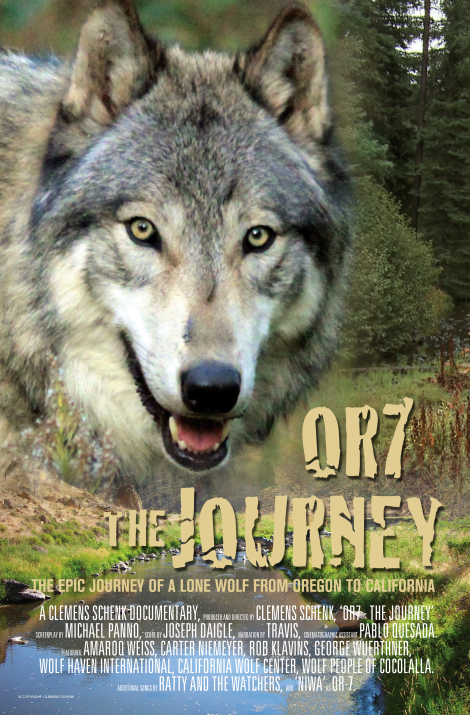
“‘OR7 – The Journey’,  is a mesmerizing new documentary film about one adventurous young wolf, from Northeast Oregon, who struck out for new country and ended up making history.

While the reasons behind the radio-collared wolf OR7′s extensive journey were most likely humble and based on instincts alone, the moment he stepped into the state of California, in the fall of 2011, OR-7 became a worldwide celebrity. He’s the first wild wolf known to make tracks in California in almost 90 years.

This amazing story has been recreated for the big screen by accomplished Oregon filmmaker, Clemens Schenk. While initially intrigued by this one wolf’s story, researching  the film led the producer to discover issues and social attitudes negatively impacting all wild wolves in the U.S. Exposing the shameful way American wildlife agencies are treating wild wolves became a driving force behind the movie. While telling the story of this captivating wolf’s journey, the film is interspersed with thought-provoking interviews and information that will shake the status quo of so-called “wolf management” in America.

OR7 – The Journey promises to be a treat for the eyes that will touch your heart and soul as well. Order your tickets for the world premiere of ‘OR-7 -The Journey’ in Portland, Oregon, on Sunday, May 25th, here:

http://prod3.agileticketing.net/websales/pages/info.aspx?evtinfo=78926%7E5f969332-ec94-41af-822d-5c7ec8f2ca2b&epguid=81b7db1a-39a9-4ae1-99ac-2b415fbbae48&

Starring in the film is Niwa, a captive-born ambassador wolf, named after the wolf advocacy group, the Northern Idaho Wolf Alliance, which also goes by “NIWA.” Clemens Schenk visited the Wolf People wolf education center in Northern Idaho three times throughout 2013,  to spend time filming Niwa running free in a five acre enclosure at the Wolf People compound. Niwa is a big, sociable, fun-loving wolf with a heart of gold, and he had no trouble at all charming Clemens into picking him as the star! Niwa’s petite and princess-like mate, Maiah, has a few cameo moments in the film, as do the rambunctious young Wolf People pups, Mahaway and Cuan.

Wolf People of Cocolalla is the exclusive dealer of the official OR7-The Journey tee shirts and other souvenirs. Check out the Wolf People online  store at http://www.wolfpeople.com/wolfstore/search.php?mode=search&page=1 to order your own OR7 tee-shirt today!

http://www.wolfpeople.com/index.php
http://www.or7themovie.com/

Howls To OR7,

Ann Sydow

Northern Idaho Wolf Alliance”

**Special thanks to “Howling for Justice” for providing this information!  (http://howlingforjustice.wordpress.com/2014/05/22/or7-the-journey-world-premiere-sunday-may-25-2014/)


isle royal snow wolf

Photo courtesy of J. Vucetich

By Ron Meador | 05/01/14

“The annual survey of wolf and moose populations on Isle Royale was published Wednesday, and it’s fair to say the outlook for key elements of the island’s ecological health is not improving.

Major findings from the report:

  • The number of wolves counted in the two-month winter study, which ended March 5, puts the island’s population up by just one wolf — to nine from its historic low point of eight in 2013.
  • It may have reached 11 at some point last year, thanks to the birth of three pups who lived past infancy, but two adults were lost: “Isabelle,” who left the island by ice bridge and was found dead, and another lone wolf who disappeared in unknown circumstances.
  • The nine are now grouped into a West Pack of six and a Chippewa Harbor Group of three, but only the larger is thought capable of reproducing. The smaller consists of an aging female and two middle-aged offspring, one male and one female.
  • Although researchers had reached a firm conclusion that no pups survived infancy in 2012, there was some question about whether there might have been at least one pup in 2011. Now they know, from genetic evidence, that neither year added pups to the population.
  • Because wolves are the only control on the island’s moose (except for starvation), the moose herd has probably risen above 1,000, more than doubling  in the past three years as wolf predation has fallen to just about zero.
  • This is especially bad news for Isle Royale’s balsam fir forest, which had only just begun to reach the capacity for sustained reproduction.
  • Oh — and the beavers are booming, too, also because of the wolves’ decline; the number of colonies has climbed by at least 70 percent since 2010.

In a way, the cover photo of this year’s report tells much of the story within: A single wolf photographed from far above, who is not running with a pack, not sharing a moose kill, but just sitting, maybe waiting, on a field of windswept snow.

Because release of this year’s report was delayed by more than a month past its scheduled appearance — held up by review as managers at Isle Royale National Parkworked toward a decision about what, if anything, to do about the wolves’ decline — some wondered if the news was going to be still worse.

And in terms of one important, highly interesting research development, that may well prove to be the case. But to describe this discovery, we first need a bit of back story.

History shaped by inbreeding

The 65-year history of wolves on Isle Royale, and much of their current predicament, is shaped by inbreeding and a steady downward spiral in genetic diversity and health, consequences of living on a rocky archipelago in Lake Superior, isolated from mainland wolves.

The island’s first known wolves turned up in 1949 or so, and until quite recently it was thought that all wolves on the island were descended from a single female and one or two males. Then in the late 1990s advances in DNA analysis detected, retrospectively, the arrival of a new wolf who came across an ice bridge in 1997 and became famous as Old Grey Guy.

Old Grey Guy’s beneficial contributions to the wolves’ gene pool were substantial, widespread and persistent. Indeed, his injection of fresh genes has served as a practical illustration of how today’s wolves might recover toward their typical numbers of about two dozen if the National Park Service would permit a “genetic rescue.”

Though the details of such a program are unsettled, the basic idea is simple: Round up some mainland wolves and drop them on the island in a mimicry of how things happen in nature, or would happen if it weren’t for a changing climate and the shrinking frequency of ice bridges from Isle Royale to shore.

This approach is strongly favored by the wolf/moose research project’s current and former directors, John Vucetich and Rolf Peterson. But it poses complicated policy and legal questions for the National Park Service, which announced last month that it would hew to a hands-off policy unless the wolves became completely incapable of reproducing, at which point it might reconsider.

Discovery about the wolves’ gene pool

Against that backdrop, the really big revelation in yesterday’s report is a finding that Isle Royale wolves’ gene pool has been freshened frequently, over at least the last 30-plus years, by wolves arriving undetected from the mainland.

This analysis draws on mathematics and a measure of genetic diversity calledheterozygosity, which reflects the number of ancestors that contribute to a wolf’s DNA, or a human’s. Here’s how Vucetich explained it to me:

If both my parents have blue eyes, then my gene pair for the trait of eye color is homozygous, because the pair’s two parts, one from each parent, are identical. But if one parent has brown eyes and one has blue, then my gene pair has mismatched parts and is heterozygous. This diversity is passed from me to my children, with additional matches or mismatches from their mother, and from them to their children, and so on.

Which means that by counting and comparing the number of matched and unmatched gene pairs in a line of humans, or wolves, over generations, you can arrive at a measure of heterozygocity that reflects how many different ancestors were contributing.

Fresh calculations by Phil Hedrick, a wolf geneticist at Arizona State, have shown that at the time of Old Grey Guy’s arrival, Isle Royale wolves had lost about 32 percent of their heterozygocity after not quite five decades of inbreeding. However, the expected loss over such a time period is 82 percent — more than twice as high.

The explanation?

What explains this? One possibility is that wolves avoid breeding with close relatives … but, nah, they’re not that picky. Another is that natural selection works against wolves that are too inbred, which certainly happens, but not on such a short time scale. So, the report says,

The only remaining possible explanation for the slower-than-expected loss in genetic diversity is that wolves have periodically immigrated to Isle Royale on ice bridges that had once been common. In particular, theory suggests that retaining the diversity that the population had would require the population to have received on the order of approximately two migrants every three generations (12-15 years).

That circumstance prompted us to review field notes from the past four decades for the possibility that undetected gene flow had taken place in the past. That review revealed several plausible gene flow events [including a pack of wolves observed in the middle of an ice bridge to the island in 1977, and the known arrival of seven or eight wolves via ice bridge 10 years earlier].

The available evidence suggests that the Isle Royale wolf population had experienced periodic gene flow throughout much of its history. The concern is that gene flow is much less likely now because ice bridges form far less frequently, due to anthropogenic climate change.

To Vucetich, this is the most important finding of the past year’s work, and only in part because it argues, in his view, for a human-engineered genetic rescue.

I suppose it might have that effect, although I can imagine, too, how policymakers could reach an opposite conclusion: If getting to a single genetic rescue a la Old Grey Guy remains difficult for the National Park Service, what about the possibility that to genuinely mimic history, the rescue might have to be repeated again and again?

Vucetich’s perspective

I asked Vucetich why he placed Hedrick’s discovery at the top of his list, and he gave the kind of complex, personal/professional answer that always makes our interviews so rewarding for me:

There’s a certain joy in science when you have certain kinds of revelations or discoveries, and one of those is when you discover something that’s been kind of sitting under your nose all along, but then you share it with a colleague and he looks at it in a way you’ve never looked at it before.

And that discovery then causes you to think about things in another way, and lo and behold, the world is suddenly a little bit different than it was before. And for a scientist, that’s one of the greatest feelings you can experience. …

Prior to this year, we would have said things like, OK, there are fewer ice bridges and that means there’s less opportunity for wolves to come across — but there was still this lurking, unanswered question of whether those bridges were really all that important in the past, and we would have said, well, we think they must have been important, but we don’t really know.

And now we do know.”

**Special thanks to Ron Meador, (http://www.minnpost.com/earth-journal/2014/05/isle-royale-wolves-are-holding-steady-researchers-make-major-new-find?utm_content=buffere87cf&utm_medium=social&utm_source=facebook.com&utm_campaign=buffer), for providing this information!


Speak for wolves

Photo courtesy of “Speak for Wolves.”

Here is the link to watch their video: http://www.youtube.com/watch?v=FX1D33gEzpQ

“On June 28-29 2014, Americans of all-walks-of-life will meet in Arch Park in Gardiner, Montana to tell our elected leaders that we need to reform wildlife management, at both, the state and federal level. Approximately 3000 grey wolves have been killed in the northern Rockies and Great Lakes region since they were delisted from the Endangered Species Act. 

Speak for Wolves: Yellowstone 2014 is about taking an important step towards stopping the wolf slaughter that is currently taking place across the United States. We must take bold measures, however, and address the root-cause(s) of the wolf slaughter, the killing of other predators, as well as bison, wild horses and other members of the animal kingdom. The status quo for wildlife management in America is broken and it must be fixed.

This 2-day celebration of predators and our national heritage will feature prominent speakers, live music, education booths, children’s activities, food/drink vendors, local wildlife photography, screening of wildlife documentaries and more. 

This festival-type event is family-friendly, educational, inspirational and non-confrontational. Alcohol will not be served. Predator-friendly beef, chicken, pork, vegetarian and vegan options will be available for purchase. There is no admission fee. Arch Park is a public venue adjacent to the northwest entrance of Yellowstone National Park (Mammoth Hot Springs). 

The 5 Keys to Reforming Wildlife Management in America are as follows: 

1. Restructuring the way state Fish & Game departments operate: 
Western governors currently appoint agency commissioners, which essentially, tell the state Fish & Game Departments what to do. This is cronyism at its worst. State Fish & Game Departments are mostly funded by the sale of hunting/trapping/fishing licenses. These agencies are bound into serving the interest of “sportsmen” because it’s the hand that feeds them. Modern funding mechanisms, application of the best-available science and genuine public involvement in decision making are sorely lacking in these institutions and it must be addressed. Another option would be to empower the federal government to manage all wildlife on federal public lands. 

2. Removing grazing from all federal public lands: 
The “control” of native wildlife to benefit the livestock industry is ground zero for the badly-broken wildlife management status quo. For more than a century, the livestock industry has single-handedly transformed the once-wild west into a tamed pasture of cows and sheep, resulting in the reduction of native wildlife populations that compete with habitat and forage. It is also well documented the damage that grazing causes when livestock infests federal public wildlands. Livestock are non-native and largely responsible for soil compaction, a decrease in water retention and aquifer recharge, erosion, destruction of wetlands and riparian areas, flooding and a net-loss of biodiversity. Grazing enables invasive plant species to proliferate, which greatly affects the West’s historic fire regime. 

3. Abolishing Wildlife Services: 
Hidden within the US Department of Agriculture, is a rogue agency that is essentially, the wildlife killing-arm of the federal government. This federal tax-payer-supported agency works with the livestock industry to kill native wildlife like wolves, coyotes, black bears, cougars and many other non-predator species. Over the past century, Wildlife Services is responsible for the death of tens-of millions of native wildlife. Methods of killing include trapping, poisoning and aerial gunning. At the very least, the predator-control segment of Wildlife Services must be terminated.

4. Banning trapping/snaring on all federal public lands: 
We must evolve as a society and move away from this barbaric, unethical, cruel and torturous method(s) of killing native wildlife. Leg-hold traps, conibear traps and other devices are indiscriminate killers. Recently, there has been an increase in the number of dogs caught/killed by traps on public lands in states like Idaho. It’s only a matter of time before a child or adult steps into one of these bone-crushing devices. Some states currently require individuals to check their traps once every 72-hours, while other states do not require trappers to check them, at all. 

5. No killing of predators, except for extreme circumstances: 
The best available science suggests that predators, including wolves, are a self-regulating species. In other words, predators don’t overpopulate, nor do they kill for “fun”. Instead, their populations naturally fluctuate, as do prey or ungulate populations. We need to better understand and embrace the trophic cascade effect predators have within ecosystems. Non-lethal measures should be implemented in rare instances where there are actual human/predator conflicts. For example, an aggressive and/or habituated bear may need to be killed after non-lethal measures have failed.

While state fish and game agencies enable the slaughter of America’s wildlife, the best-available science suggests that predators, particularly wolves, play a crucial role across the landscape. 
Known throughout the scientific community as trophic cascade, gray wolves are apex predators whose behavior effects dozens of other species, leading to an increase in biodiversity. Soils, plant communities, other wildlife species, riparian areas and forests are all effected by the presence of wolves.

***Come to Arch Park in Gardiner, Montana June 28-29, 2014. The event is family friendly and will feature prominent speakers, live music, video production crews, education and outreach booths, food and drink vendors and the screening of wildlife documentaries. This is going to be the event of the year in the northern Rockies. Together we can make history and restore our wild national heritage!”

**Special thanks to “Speak for Wolves,” http://www.speakforwolves.org/, for providing this information!


March 5th, 2014

“Many hunter organizations like to promote the idea that hunters were the first and most important conservation advocates. They rest on their laurels of early hunter/wildlife activist like Teddy Roosevelt, and George Bird Grinnell who, among other things, were founding members of the Boone and Crocket Club. But in addition to being hunter advocates, these men were also staunch proponents of national parks and other areas off limits to hunting. Teddy Roosevelt help to establish the first wildlife refuges to protect birds from feather hunters, and he was instrumental in the creation of numerous national parks including the Grand Canyon.  Grinnell was equally active in promoting the creation of national parks like Glacier as well as a staunch advocate for protection of wildlife in places like Yellowstone. Other later hunter/wildlands advocates like Aldo Leopold and Olaus Murie helped to promote wilderness designation and a land ethic as well as a more enlightened attitude about predators.

Unfortunately, though there are definitely still hunters and anglers who put conservation and wildlands protection ahead of their own recreational pursuits, far more of the hunter/angler community is increasingly hostile to wildlife protection and wildlands advocacy.  Perhaps the majority of hunters were always this way, but at least the philosophical leaders in the past were well known advocates of wildlands and wildlife.

Nowhere is this change in attitude among hunter organizations and leadership more evident than the deafening silence of hunters when it comes to predator management.  Throughout the West, state wildlife agencies are increasing their war on predators with the apparent blessings of hunters, without a discouraging word from any identified hunter organization. Rather the charge for killing predators is being led by groups like the Rocky Mountain Elk Foundation,  and others who are not only lobbying for more predator killing, but providing funding for such activities to state wildlife agencies.

For instance, in Nebraska which has a fledging population of cougars (an estimated 20) the state wildlife agency has already embarked on a hunting season to “control” cougar numbers.  Similarly in South Dakota, where there are no more than 170 cougars, the state has adopted very aggressive and liberal hunting regulations to reduce the state’s cougar population.

But the worst examples of an almost maniacal persecution of predators are related to wolf policies throughout the country. In Alaska, always known for its Neanderthal predator policies, the state continues to promote killing of wolves adjacent to national parks. Just this week the state wiped out a pack of eleven wolves that were part of a long term research project in the Yukon Charley National Preserve. Alaska also regularly shoots wolves from the air, and also sometimes includes grizzly and black bears in its predator slaughter programs.

In the lower 48 states since wolves were delisted from the federal Endangered Species Act and management was turned over to the state wildlife agencies more than 2700 wolves have been killed.

This does not include the 3435 additional wolves killed in the past ten years by Wildlife Services, a federal predator control agency, in both the Rockies and Midwest.  Most of this killing was done while wolves were listed as endangered.

As an example of the persecutory mentality of state wildlife agencies, one need not look any further than Idaho, where hunters/trappers, along with federal and state agencies killed 67 wolves this past year  in the Lolo Pass area on the Montana/Idaho border, including some 23 from a Wildlife Service’s helicopter gun ship. The goal of the predator persecution program is to reduce predation on elk. However, even the agency’s own analysis shows that the major factor in elk number decline has been habitat quality declines due to forest recovery after major wildfires which has reduced the availability of shrubs and grasses central to elk diet. In other word, with or without predators the Lolo Pass area would not be supporting the number of elk that the area once supported after the fires. Idaho also hired a trapper to kill wolves in the Frank Church/River of No Return Wilderness to increase elk numbers there.

Idaho hunters are permitted to obtain five hunting and five trapping tags a year, and few parts of the state have any quota or limits. Idaho Governor Butch Otter recently outlined a new state budget allotting $2 million dollars for the killing of wolves—even though the same budget cuts funding for state schools.

Other states are no better than Idaho. Montana has a generous wolf six month long season. Recent legislation in the Montana legislature increased the number of wolves a hunter can kill to five and allows for the use of electronic predator calls and removes any requirement to wear hunter orange outside of the regular elk and deer seasons. And lest you think that only right wing Republican politicians’ support more killing, this legislation was not opposed by one Democratic Montana legislator, and it was signed into law by Democratic Governor Steve Bullock because he said Montana Dept of Fish, Wildlife and Parks supported the bill.

Wyoming has wolves listed as a predator with no closed season or limit nor even a requirement for a license outside of a “trophy” wolf zone in Northwest Wyoming.

The Rocky Mountain West is known for its backward politics and lack of ethics when it comes to hunting, but even more “progressive” states like Minnesota and Wisconsin have cow-towed to the hunter anti predator hostility. Minnesota allows the use of snares, traps, and other barbaric methods to capture and kill wolves. At the end of the first trapping/hunting season in 2012/2013, the state’s hunters had killed more than 400 wolves.

Though wolves are the target species that gets the most attention, nearly all states have rabid attitudes towards predators in general. So in the eastern United States where wolves are still absent, state wildlife agencies aggressively allow the killing of coyotes, bears and other predators. For instance, Vermont, a state that in my view has undeserved reputation for progressive policies, coyotes can be killed throughout the year without any limits.

These policies are promoted for a very small segment of society. About six percent of Americans hunt, yet state wildlife agencies routinely ignore the desires of the non-hunting public. Hunting is permitted on a majority of US Public lands including 50% of wildlife “refuges as well as nearly all national forests, all Bureau of Land Management lands, and even a few national parks. In other words, the hunting minority dominates public lands wildlife policies.

Most state agencies have a mandate to manage wildlife as a public trust for all citizens, yet they clearly serve only a small minority. Part of this is tradition, hunters and anglers have controlled state wildlife management for decades. Part of it is that most funding for these state agencies comes from the sale of licenses and tags. And part is the worldview that dominates these agencies which sees their role as “managers” of wildlife, and in their view, improving upon nature.

None of these states manage predators for their ecological role in ecosystem health. Despite a growing evidence that top predators are critical to maintaining ecosystem function due to their influence upon prey behavior, distribution and numbers, I know of no state that even recognizes this ecological role, much less expends much effort to educate hunters and the public about it. (I hasten to add that many of the biologists working for these state agencies, particularly those with an expertise about predators, do not necessarily support the predator killing policies and are equally appalled and dismayed as I am by their agency practices.)

Worse yet for predators, there is new research that suggests that killing predators actually can increase conflicts between humans and these species. One cougar study in Washington has documented that as predator populations were declining, complaints rose. There are good reasons for this observation. Hunting and trapping is indiscriminate. These activities remove many animals from the population which are adjusted to the human presence and avoid, for instance, preying on livestock. But hunting and trapping not only opens up productive territories to animals who may not be familiar with the local prey distribution thus more likely to attack livestock, but hunting/trapping tends to skew predator populations to younger age classes. Younger animals are less skillful at capturing prey, and again more likely to attack livestock. A population of young animals can also result in larger litter size and survival requiring more food to feed hungry growing youngsters—and may even lead to an increase in predation on wild prey—having the exact opposite effect that hunters desire.

Yet these findings are routinely ignored by state wildlife agencies. For instance, despite the fact that elk numbers in Montana have risen from 89,000 animals in 1992 several years before wolf reintroductions to an estimated 140,000-150,000 animals today, Montana Department of Fish, Wildlife and Parks does almost nothing to counter the impression and regular misinformation put forth by hunter advocacy groups like the Rocky Mountain Elk Foundation or the Montana Sportsmen for Fish and Wildlife that wolves are “destroying” Montana’s elk herds.

I have attended public hearings on wolves and other predator issues, and I have yet to see a single hunter group support less carnivore killing.  So where are the conservation hunters? Why are they so silent in the face of outrage? Where is the courage to stand up and say current state wildlife agencies policies are a throw-back to the last century and do not represent anything approaching a modern understanding of the important role of predators in our ecosystems?

As I watch state after state adopting archaic policies, I am convinced that state agencies are incapable of managing predators as a legitimate and valued member of the ecological community. Their persecutory policies reflect an unethical and out of date attitude that is not in keeping with modern scientific understanding of the important role that predators play in our world.

It is apparent from evidence across the country that state wildlife agencies are incapable of managing predators for ecosystem health or even with apparent ethical considerations.  Bowing to the pressure from many hunter organizations and individual hunters, state wildlife agencies have become killing machines and predator killing advocates.

Most people at least tolerant the killing of animals that eaten for food, though almost everyone believes that unnecessary suffering should be avoided. But few people actually eat the predators they kill, and often the animals are merely killed and left on the killing fields. Yet though many state agencies and some hunter organizations promote the idea that wanton waste of wildlife and unnecessary killing and suffering of animals is ethically wrong, they conveniently ignore such ideas when it comes to predators, allowing them to be wounded and left to die in the field, as well as permitted to suffer in traps.  Is this ethical treatment of wildlife? I think not.

Unfortunately unless conservation minded hunters speak up, these state agencies as well as federal agencies like Wildlife Services will continue their killing agenda uninhibited. I’m waiting for the next generation of Teddy Roosevelts, Aldo Leopolds and Olaus Muries to come out of the wood work. Unless they do, I’m afraid that ignorance and intolerant attitudes will prevail and our lands and the predators that are an important part of the evolutionary processes that created our wildlife heritage will continue to be eroded.”

**Special thanks to   ecologist and former hunting guide with a degree in wildlife biology, for providing this information (http://www.thewildlifenews.com/2014/03/05/whither-the-hunterconservationist/)


Wolf Park wolf copyright

**Photo courtesy of Monty Sloan, Wolf Park

“Wolf Park’s 13th Annual Easter Party
Saturday April 12, 2014
Open 1:00 -5:00 pm

Featuring the Easter Bunny!

You are invited to join Wolf Park on Saturday, April 12th for our 13th annual Easter Party!

There will be egg hunts for kids 1-13 years of age (bring a basket!), and there will also be an egg hunt for the Wolf Park wolves at 2 pm! The Easter Bunny will hop into the wolf enclosure (the wolves will be elsewhere) and will hide Easter eggs for the wolves to find (they will be let back into the enclosure after the Bunny leaves). Come see our wolves get their Easter treats, and get some treats of your own!

Wolves’ egg hunt begins at 2:00 pm sharp!

Egg hunts for children will be held between 3:00-4:00 pm.

Guided tours of the Park will be offered at 1:15, 2:15 3:15, and 4:15, followed by a handling demonstration at 4:30.

Wolf Park closes at 5:00 and the gates re-open at 7 for Howl Night.

SPECIAL ADMISSION:
Adults regular price
Children 13 and under FREE”

**Special thanks to “Wolf Park” for providing this information!  (http://blog.wolfpark.org/?p=968)


Save the Lobo

**Photo courtesy from “Lobos of the Southwest.”

Arizona Daily Sun, March 6, 2014

“Talk about over-reacting.
The last time we visited the topic of endangered Mexican gray wolves in this space was to call for more details of a proposed expansion plan and consultation by federal officials with local communities.
That was back in August, and the U.S. Fish and Wildlife Service did agree to at least one public hearing in Arizona and entered talks with state Game and Fish officials.
But some state lawmakers took the expansion plan as a call to arms, and this winter they have introduced bills seeking not only to hamstring or kill off the recovery program but end the entire federal Endangered Species Act in Arizona.
The last was introduced by Flagstaff Rep. Bob Thorpe, who later withdrew that clause after staff officials said it would compromise tens of millions of dollars in federal aid given to the state for protecting endangered species and habitat restoration under their many cooperative agreements. Those programs include the California condor, black-footed ferret, Chiricahua leopard frog, native fish and other species.
He also took out the part about deporting any animal species in a federal recovery program not “cooperatively implemented” with the state, a direct assault on federal authority over endangered species.
But Thorpe did retain a clause in the bill calling on the federal government to establish a compensation fund for cattle losses, then turn it over to the state to be administered on state terms.
Other bills and resolutions would allow state employees for the first time to kill a problem wolf on public land, cap the number of wolves at 100 and relocate them to Mexico. And when the bills are inevitably challenged in court, another bill calls for a $250,000 litigation fund to be set up to defend them.
If the measures above came in response to hundreds of marauding wolves decimating cattle herds, we’d pay attention. But just the opposite true: There are about 80 wolves in the wild and the number of claims made by ranchers for wolf depredation is minuscule. Most cattle are killed by disease and by predators with much larger populations, such as coyotes or mountain lions. But if a cow is killed, there is a compensation fund in place and one proposal calls on ranchers to be paid extra simply for sharing their leased land with wolves.
Further, public opinion is solidly behind the wolves, not the ranchers. Poll after poll shows most citizens believe there is plenty of room on the national forest for cows and wolves with sensible management.
Does that mean we’re satisfied with the management plan to date and the expansion proposal? On the latter, we feel Fish and Wildlife owes residents of communities in the expansion zone (which extends northward to Interstate 40) some answers to specific questions:
— How often would they anticipate that wolves establishing new territories would roam into suburbs and other settled areas?
— How would wolves interact with pet dogs in particular?
— What tactics and strategies could be employed to keep those human-wolf contacts to a minimum?
These are the issues that lawmakers ought to be focusing on as part of diversifying and preserving Arizona’s wildlife heritage. Wolves are part of that heritage, and they deserve a chance to stay.
Please Act Today to stop these
anti-wolf bills!
You can help by contacting your Arizona House Members and submitting a letter to the editor of the Arizona Daily Sun.
If you don’t live in AZ, you can still help by submitting a letter to the editor.
The letters to the editor page is one of the most widely read, influential parts of the newspaper. One letter from you can reach thousands of people and will also likely be read by decision-makers. Tips and talking points for writing your letter are below, but please write in your own words, from your own experience. These are also good talking points for contacting your legislators.
Letter Writing Tips & Talking Points
  • At last official count, only 37 Mexican gray wolves were found in AZ, and only 83 were found total in the wild, making them critically endangered. We have a moral obligation to do everything we can to ensure their recovery and not push them closer to extinction as these bills aim to do.
  • The proposed legislation will waste taxpayer money on litigation to impede wolf recovery and embarrass the state by attempting to illegally override federal laws that protect endangered species.
  • Polling showed 77% of Arizona voters support the Mexican wolf reintroduction. Legislation to impede wolf recovery is a slap in the face to the majority of voters who want wolves to thrive.
  • People who care about wolves should call on their AZ House members to oppose anti-wolf measures. Information about how to do that is at mexicanwolves.org.
  • Wildlife biologists believe that Mexican wolves will improve the overall health of the Southwest and its rivers and streams – just as the return of gray wolves to Yellowstone has helped restore balance to its lands and waters.
  • Wolves generate economic benefits – a University of Montana study found that visitors who come to see wolves in Yellowstone contribute roughly $35.5 million annually to the regional economy.
  • Wolves once lived throughout Arizona and played a critical role in keeping the balance of nature in place. We need to restore this important animal that has been missing for too long.
  • The livestock industry has a responsibility to share public lands with wolves and other wildlife. Funds are available to help livestock growers implement nonlethal deterrents, better animal husbandry practices, and other innovative tools that minimize conflict.
Make sure you:
  • Thank the paper for publishing the editorial.
  • Do not repeat any negative messages, such as “cows may have been killed by wolves, but…” Remember that those reading your letter will not be looking at the article it responds to, so this is an opportunity to get out positive messages about wolf recovery rather than to argue with the original article.
  • Keep your letter brief, between 150-300 words.
  • Include something about who you are and why you care: E.g. “I am a mother, outdoors person, teacher, business owner, scientific, religious, etc.”
  • Provide your name, address, phone number and address. The paper won’t publish these, but they want to know you are who you say you are.
Please also contact AZ House members directly and tell them politely that you expect them to oppose these bills that embarrass Arizona, waste taxpayer money and fly in the face of overwhelming majority public support for wolf recovery.”
 **Special thanks to Lobos of the Southwest, http://www.mexicanwolves.org/index.php/news/1209/51/Editorial-Anti-Wolf-Bills-Clear-Case-of-Over-Reaction, and Arizona Daily Sun for providing this information!