Feeds:
Posts
Comments

Image


**Photo courtesy of Tim Springer.

Wednesday, March 5, 2014

“”We reached the old wolf in time to watch a fierce green fire dying in her eyes. I realized then and have known ever since that there was something new to me in those eyes, something known only to her and to the mountain. I was young then and full of trigger-itch; I thought that because fewer wolves meant more deer, that no wolves would mean hunters’ paradise. But after seeing the green fire die, I sensed that neither the wolf nor the mountain agreed with such a view.” — Aldo Leopold, 1949

We Americans, in most states at least, have not yet experienced a bear-less, eagle-less, cat- less, wolf-less woods. Germany strove for maximum yields of both timber and game and got neither.”  — Aldo Leopold, 1935

“A thing is right when it tends to preserve the integrity, stability, and beauty of the biotic community. It is wrong when it tends otherwise.” — Aldo Leopold, 1949 

2014: Idaho Fish and Game recently hired a paid a bounty hunter to try and eliminate two packs of wolves in the Frank Church River of No Return Wilderness, one of the largest wilderness areas in the United States. Idaho hunters have organized wolf-killing competitions and killer co-ops to pay trappers to kill wolves. The state legislature and governor declared wolves a “disaster emergency” and have allocated $2 million to killing wolves. More recently the department conducted secretive aerial shootings of wolves from helicopters with no public knowledge or input and spent $30,000 to kill 23 wolves. Idaho Fish and Game is doing this and more in an ongoing effort to appease many ranchers and hunters to protect livestock and maintain artificially high and unhealthy numbers of elk for hunters to shoot at.

One of the cornerstones of our “North American Model of Wildlife Conservation” — which hunters and hunting-based organizations love to tout and claim to support — is that wildlife, all wildlife, be managed based on good, sound science.  That good, sound science shows that the return of wolves to much of the western United States has resulted in significant overall, long-term benefits to wildlife and the habitat that sustains them — including the species we love to hunt. (Check out: “How Wolves Change Rivers.”)

Elk populations are increasing in most of the West. In Idaho, the fish and game department is expanding elk hunting to reduce elk populations while simultaneously killing wolves under the guise of protecting and boosting elk numbers. Where elk populations do appear on the decline there are plenty of factors to consider in addition to wolves: Changes in habitat; the previous existence of artificially high elk populations at levels beyond the viable carrying capacity of the land; lack of mature bulls and low bull-to-cow ratios in herds (often resulting from early season hunting and too much hunting pressure on bull elk) which influences the timing of the rut and breeding behavior, the timing of spring calving, and often results in increased vulnerability of elk calves to predation; influence of other predators including mountain lions, black bears and grizzlies; unanticipated impacts of various hunting regulations and hunting pressure, and changes in behavior and habitat use by elk in the presence of wolves. And more.

Where I hunt, the growing presence of wolves has changed the behavior and habits of elk. Elk bunch up more for safety, and move around more to evade and avoid wolves. They are a lot more wary. I have adapted and adjusted to these changes and have no problem finding elk.This is part of the beauty and value of hunting within wilderness — to adjust, adapt and be part of the landscape; to be, as my friend David Petersen put its, part of the “bedrock workings of nature.”  We render the wilds a diminished abstract when we alter it to suit our own needs and desires and, in the process, make it less healthy and whole. There are those who espouse the virtues of backcountry hunting and yet seem apathetic or supportive towards the destruction of backcountry integrity. Those who understand the wilds know how critically important predators are to the health of the land; to remain silent about the nonscientific, politically-based killing of wolves in the wildest of places is to be complacent towards the degradation of what we claim to cherish.    

Yet hunters, in general, hate and blame wolves for pretty near anything and everything including their own lack of skill, knowledge and effort in hunting elk. Science is shunned and ignored. David Allen, the executive director of the Rocky Mountain Elk Foundation,  a national hunter-based conservation organization, claims wolves are “decimating” elk herds and calls wolves the “worst ecological disaster since the decimation of bison” despite research funded by the organization that shows otherwise. Most of what many hunters claim to know and understand about wolves and wolf and elk interactions is based on myths, lies and half-truths; they rapidly and angrily dismiss logic, facts and science as coming from “anti-hunters,” “wolf-lovers” and “tree-huggers” from “back East.” Most hunter-based conservation organizations and state agencies avoid the topic for fear of being pegged “one of them.” Many actually help perpetuate the lies and half-truths to boost and maintain membership. Some try to come across as reasonable by stating that they think wolves should be managed just like other wildlife, such as elk.  

But wolves are not elk; being a top predator they have altogether different, and self-regulating, reproductive and survival behaviors and strategies. “Other” wildlife, such as elk,  are managed based on science — based on what we know about behavior, ecology, breeding behavior, habitat use and selection and other factors. Wolves are being managed purely based on politics driven by ignorance and hate.  Many hunters and others in Montana, Wyoming and Idaho long advocated for the delisting of wolves from the Endangered Species Act and turning management over to the states. It happened. And now these states — particularly Idaho — are doing what they can to kill as many wolves as possible, science be damned.

Idaho is proving over and over that their state cannot handle the scientific, sustainable management of wolves. No public agency should have the power to decide such things as Idaho Fish and Game is doing with so little public accountability and oversight. They are acting on behalf of a small, but politically-influential segment of our population based on pure politics, lies, myths, misconceptions and half truths about wolves and ignoring what we do know about wolf biology, ecology, behavior and interactions with and impacts to elk.

As an avid and passionate hunter in Montana (who has killed and eaten 26 elk over the years) I am absolutely disgusted that no hunter-based conservation organization — most of which claim to support and defend sound, science-based management of wildlife — are speaking out against this slaughter which is a clear violation of the North American model of wildlife management these organizations claim to uphold. At best, many hunters and hunting-based organizations are remaining silent for fear of being ostracized; at worst, most hunters and hunting organizations are supporting this. More and more I feel like an anti-hunter who hunts. It’s embarrassing, appalling and outrageous.

Even groups I support and respect, including Backcountry Hunters & Anglers, theTheodore Roosevelt Conservation Partnership and National Wildlife Federation are ignoring and avoiding this clear violation of science-based wildlife management and our North American Model of Wildlife Conservation they claim to uphold and defend — I can only assume as to not upset their membership base.

As Aldo Leopold so aptly put it more than 50 years ago: “The sportsman has no leaders to tell him what is wrong. The sporting press no longer represents sport; it has turned billboard for the gadgeteer. Wildlife administrators are too busy producing something to shoot at to worry much about the cultural value of the shooting.”

I am growing increasingly disgusted and angry towards my so-called fellow hunters, and most hunter-based organization, for continually talking “Aldo Leopold” and the “North American Model” out of one side of their mouths while ignoring or even supporting this sort of political, nonscientific “management” of a critical keystone, umbrella wildlife species that plays a critical role in shaping, maintaining and influencing healthy wildlife and wildlife habitat for all species — including the species we love to hunt and the habitat that sustains them.
This is one of the flaws of our current and mostly good system of wildlife management in which states generally have full authority over managing their wildlife. State fish and game departments, such as Idaho Fish and Game, are overseen and controlled by state politicians and game commissioners (who are often ranchers and hunters) appointed by politicians — and the hunting and ranching industries have more influence over state decisions than others. Aldo Leopold, widely considered the “father” of modern wildlife management, warned against such things more than 50 years ago. 

A recent report about the flaws of the North American Model summed it up this way: “The scientists also express concern that the interests of recreational hunters sometimes conflict with conservation principles. For example, they say, wildlife management conducted in the interest of hunters can lead to an overabundance of animals that people like to hunt, such as deer, and the extermination of predators that also provide a vital balance to the ecosystem.”

It needs to change. 

More than half a century ago Leopold wrote: “I personally believed, at least in 1914 when predator control began, that there could not be too much horned game, and that the extirpation of predators was a reasonable price to pay for better big game hunting. Some of us have learned since the tragic error of such a view, and acknowledged our mistake.” 

We still haven’t caught up to Leopold.

If we hunters truly believe in sound, science-based wildlife management, the North American Model of Wildlife Conservation, and the ideas and principles preached and promoted by the likes of Aldo Leopold, then it is time to speak up.”

 
**Special thanks to David Stalling, “From The Wild Side,” for providing this information!  

Wolf Ice Bridge

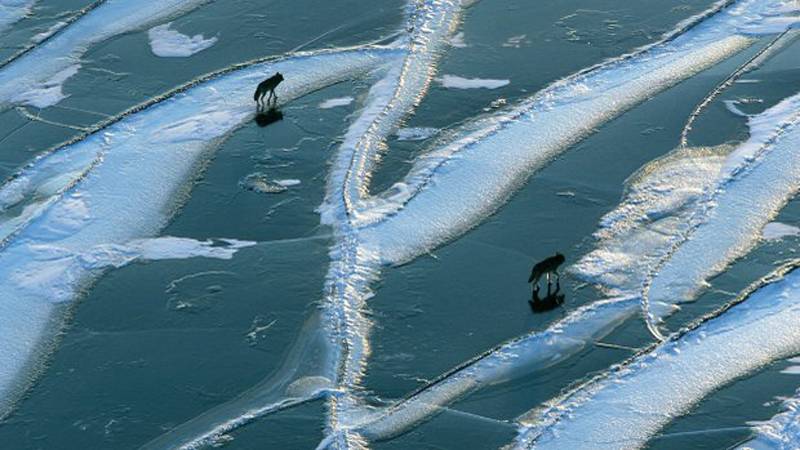
The wolves of Isle Royale National Park have lived in isolation for over four years, but ice bridges caused by an extremely cold winter may change that.     Photo Credit given to Rolf Peterson
THURSDAY, FEBRUARY 20, 2014

A rare ice bridge between Isle Royale National Park and the mainland offers a lifeline to the island’s dwindling wolf pack.

“The Park Service website for Michigan’s Isle Royale National Park describes it as “a rugged, isolated island where wolves… abound.” Rugged and isolated, yes. Wolves abounding? Not quite. Only 8 wolves live on the 133,000-acre island today, down from 24 in 2009, according to Lake Superior Magazine’s Phil Bencomo. The pack’s isolation, and resulting lack of genetic diversity, is causing its decline.

But the deep freezes accompanying this winter have have brought more to the upper Great Lakes that ice caves, it has formed ice bridges between the island and the nearest mainland, around 20 miles away. This is a rare event, not seen since 2008. That time, no new wolves came to the island—in fact, two collared wolves are believed to have to used the bridge leave it. Prior to 2008, the water had remained open since 1997, when an alpha male came to the island via the frozen lake. All the island’s wolves alive today descend from that animal.

Rolf Peterson, a Michigan Technological University researcher who has studied Isle Royale’s wolves and moose for more than 40 years, told Bencomo that he predicts that, by 2040, Lake Superior simply won’t have significant ice cover in the winter.

This might be one of the wolf pack’s last chances to stem its decline—and if temperatures continue to rise as they have this week, the window is quickly closing.

Meanwhile, a major debate is brewing around whether biologists should intercede by introducing new wolves and deepening the genetic pool. Nearly the entire islandis Wilderness with a capital W, and thereby protected by the Wilderness Act, so the short answer is “that’s not legal.”

But here’s the thing: the reason the wolves are suffering is tied directly to the fact that cold winters are exceedingly rare. So, the only way to effectively and sustainably help the island’s wolves is to, basically, reverse climate change. This makes the whole argument over the legal implications of the Wilderness Act rather inconsequential.

Writes Bencomo: “Rolf [Peterson] contends that humans have already significantly impacted Isle Royale through climate change and other influences, so wilderness preservation today requires active human assistance, not merely drawing up park boundaries and stepping away. ‘The 20th century notion of ‘wilderness’ is not immutable.’ He argues that intervention is essential to fulfilling the NPS mission of conservation.”

I expect that we are going to see more and more instances where land managers are stuck between preserving ecosystems (by leaving them alone) and trying to somehow preserve them by helping them adapt to a changing climate.

As Isle Royale’s superintendent Phyllis Green said: “When you get these really large effects that are more indirect, I mean, climate change is so huge, it’s not like a situation where people went in and trapped out a species. You have this very insidious effect that’s going to happen over time to multiple species. So trying to sort out our role in that is why this decision process is taking the time it is.”

**Special thanks to    , for providing this information! http://www.outsideonline.com/outdoor-adventure/the-current/footprint/Why-This-Brutal-Winter-Can-Mean-Good-Things-for-a-Pack-of-Midwest-Wolves.html?utm_source=twitter&utm_medium=social&utm_campaign=tweet

Howls of Outrage


howling wolf

Photo Credit: Tim Fitzharris/Getty

Special thanks to  Michelle Nijhuis  @nijhuism • February 10, 2014, for providing this information!

The U.S. Fish and Wildlife Service relied on shaky science in its effort to boot wolves off the Endangered Species List. Here’s the full story behind the biological brouhaha.

“About 300 wolves live in the nearly 2-million-acre swath of central Ontario forest known as Algonquin Provincial Park. These wolves are bigger and broader than coyotes, but noticeably smaller than the gray wolves of Yellowstone. So how do they fit into the wolf family tree? Scientists don’t agree on the answer—yet it could now affect the fate of every wolf in the United States.

That’s because last June, the U.S. Fish and Wildlife Service proposed removing gray wolves across most of the country from the endangered species list, a move that would leave the animals vulnerable to hunting. To support its proposal, the agency used a contested scientific paper—published, despite critical peer review, in the agency’s own journal—to argue that gray wolves never existed in the eastern United States, so they shouldn’t have been protected there in the first place.

Instead of the gray wolf, the service said, an entirely different species of wolf—the so-called “eastern wolf,” a species whose remnants perhaps survive in Algonquin Park—once inhabited the forests of eastern North America. Canid biologists have argued over the existence of this “lost species” for years. Yet researchers on all sides say that even if the Algonquin wolves are a separate species, that shouldn’t preclude continuing protections for the gray wolf.

On Friday, an independent panel of five leading geneticists and taxonomists came down hard on the agency’s proposal to delist gray wolves, unanimously concluding that the service had not relied on the “best available science.” Individual panel members described “glaring insufficiencies” in the supporting research and said the agency’s conclusions had fundamental flaws.

“What’s most significant,” says Andrew Wetzler, director of land and wildlife programs for the Natural Resources Defense Council (which publishes OnEarth), “is that this is coming from a group of eminent biologists who disagree with each other about the eastern wolf—and even so, they agree that the agency hasn’t properly understood the scientific issues at hand.”

* * *

How did 300 wolves in the Canadian wilderness become central to the debate over protecting their U.S. relations? For years, the Algonquin Park wolves have been something of a scientific mystery. Their coats are typically multicolored, with reddish-brown muzzles and backs that shade from white to black. Visitors from the southeastern U.S. often note their resemblance to red wolves, which are limited to a small reintroduced population in eastern North Carolina.

As biologists began to investigate the relationships among the various North American canids, including Algonquin wolves, red wolves, coyotes, and gray wolves, they collided with one of the most basic—and vexing—questions in their field: what is a species?

“No one definition has as yet satisfied all naturalists,” Charles Darwin himself conceded in On the Origin of Species, adding that “every naturalist knows vaguely what he means when he speaks of a species.” So do the rest of us. We know that hippos are different from canaries, and that bullfrogs are different from giant salamanders. But the more alike the organisms, the trickier the species question becomes, and thanks to our modern understanding of DNA, the scientific disagreements are—if anything—more passionate today than in Darwin’s time.

In 1942, the biologist Ernst Mayr formalized the definition of a species as a group of interbreeding organisms, reproductively isolated from other interbreeding groups. That’s the definition that most of us learned in high-school biology, and it remains useful in many cases. But the advent of cheap, fast DNA analysis has exposed its limits: many apparently distinct species hybridize with one another, and few animals hybridize more enthusiastically than wolves, dogs, and other canids.

Genetic samples from the Algonquin Park wolves contain what appears to be coyote DNA, gray wolf DNA, and even domestic dog DNA, creating what Paul Wilson of Trent University in Ontario, one of the first scientists to study the Algonquin Park population, calls a “canid soup” of genetic material.

Biologists studying North American canids fall generally into two camps. Wilson and several of his colleagues in Canada support what’s sometimes called the “three-species” model: according to their interpretation of the genetic data, coyotes, modern gray wolves, and the eastern wolf are separate species that evolved long ago from an ancient common ancestor. The eastern wolf, they say, may have once ranged throughout eastern North America, and may in fact be the same species as the red wolf.

Other biologists, including canid geneticist Robert Wayne at the University of California-Los Angeles, support a “two-species” model: it posits that only gray wolves and coyotes are distinct species. According to this model, anything else—a red wolf, Algonquin wolf, or the so-called “coywolf” recently spotted in suburbs and cities—is a relatively recent wolf-coyote hybrid.

Wayne describes the debate between supporters of the two models as “long-running but very polite”—and it’s not over yet.

“People on all sides have done some very good work, but it’s an extremely complicated issue,” says T. DeLene Beeland, author of The Secret World of Red Wolves. “It gets at the heart of the species question.”

* * *

Were it not for the U.S. Endangered Species Act, the controversy over the eastern wolf might well have stayed polite. That landmark law is, as it states, intended to protect species, and the murky definition of a species has complicated conservation efforts for jumping mice, pygmy owls, gnatcatchers, pocket gophers, and several other animals. But the debate over wolf taxonomy has become especially fierce.

When the gray wolf was placed on the endangered species list in 1967, it was defined as a single species with a historic range that covered most of the United States, from Florida to Washington state. Hunting, trapping, poisoning, and habitat loss had driven the gray wolf nearly to extinction in the continental United States, and confirmed sightings were rare.

After the species was protected, wolves from western Canada began to venture south, and beginning in 1995, some 41 wolves were reintroduced into Yellowstone National Park. They multiplied rapidly, and for the first time in decades, wolf howls were heard in the park. Today, many consider the Yellowstone wolf reintroduction one of American conservation’s greatest success stories.

In 2011, the Fish and Wildlife Service took the Great Lakes wolf population off the endangered species list. The same year, a controversial act of Congress delisted gray wolf populations in most of the Rocky Mountains, returning responsibility for wolf protection to the states. But wolves are famously energetic travelers, and these wolves didn’t stay put. In recent years, wolves from the northern Rockies have been spotted in Washington, Oregon, and northern California, and are rumored to be ranging into Colorado and Utah. Wolves from the Great Lakes have turned up in Illinois and Iowa.


“The reason why wolves became in endangered in first place is that states allowed people to hunt the hell out of them.”


Outside the northern Rockies and the Great Lakes, wolves are still protected by the Endangered Species Act, so these wanderers have raised delicate political questions. Although some states are willing to work with the federal government on wolf management, others want sole control of any wolves that turn up within their boundaries. And the White House’s slim margin of support in the Senate relies on centrist Democrats from Western states—many of whom support full wolf delisting, in part because some Western ranchers want the right to shoot wolves that menace their livestock.

The U.S. Fish and Wildlife Service, for its part, wants to devote its limited money and resource to conservation of the Mexican wolf, a type of gray wolf that was reintroduced into northern New Mexico and Arizona in 1998 and continues to struggle for survival. “The time has now come for the service to focus its efforts on the recovery of the Mexican wolf,” agency director Dan Ashe said at a public hearing last year in Washington, D.C.

The Fish and Wildlife Service proposed removing the rest of the country’s gray wolves from the federal endangered species list last June, protecting only the Mexican wolf as an endangered subspecies. Any gray wolves that roamed beyond the northern Rockies and the Great Lakes, it announced, would no longer enjoy endangered species protection. The delisting proposal set off a contentious public comment period that was due to end in September, after which the delisting would either be finalized or scrapped.

One part of the agency’s proposal was especially unusual: it argued that its original listing of the gray wolf, back in 1967, had been flawed. In the delisting proposal, the agency not only recognized the eastern wolf as a separate species but also concluded that its existence required a major revision to the historic range map of the gray wolf—making it far smaller than the initial listing had claimed.

Agency director Ashe argued at the hearing in Washington, D.C., last September that there is “no one set formula for how to recover a species.” The law requires only that species be safe from extinction, he said, not restored throughout its historic range, before it can be taken off the endangered species list. The two thriving populations in the Great Lakes and Rocky Mountains, the agency said, were reason enough to delist the gray wolf.

But historic range has long been an important factor in delisting decisions. “If you eliminate the entire East Coast from the gray wolf’s range map, it’s just much easier to argue that wolves are no longer endangered,” says NRDC’s Wetzler.

At the D.C. hearing, Don Barry, who served as an assistant Interior secretary during the Clinton administration, took the microphone to speak for himself and two other former assistant secretaries. Barry recalled that the bald eagle, American pelican, American alligator, and peregrine falcon had been removed from the endangered species list only after returning to suitable habitat throughout most of their historic ranges.

“That is how the Endangered Species Act is supposed to work,” said Barry. By stark contrast, he said, the proposal to delist the gray wolf reflected “a shrunken vision of what recovery should mean.”

* * *

The Fish and Wildlife Service is required to back up its decisions with science, but in this case, the science was hard to come by. When the agency recognizes new species, for instance, it usually relies on the judgment of scientific organizations such as the International Commission of Zoological Nomenclature—which doesn’t recognize the eastern wolf as a separate species. Neither does any similar scientific group.

So instead, the agency relied on a 2012 study by Steven Chambers, a Fish and Wildlife Service staff biologist, and three of his agency colleagues. The Chambers study had already caused controversy: it was published in a recently revived agency journal, not a standard scientific journal. When outside researchers reviewed the paper, the majority had significant criticisms, with one going so far as to say that the study’s argument “is made in an intellectual vacuum.” Although the journal’s editors asked Chambers to respond to the critiques, the revised paper was not resubmitted to reviewers, as it would have been at a standard journal.

In 2012, the agency cited the Chambers paper in a proposal to remove the Great Lakes wolf population from endangered species protection. The agency had to remove the citation after outcry from other scientists in the field and acknowledged at the time that the study “represents neither a scientific consensus nor the majority opinion of researchers on the taxonomy of wolves.”

Two years later, though, the agency once again used the Chambers paper, this time to support the removal of all federal protections for wolves.


When outside researchers reviewed the paper, the majority had significant criticisms, with one going so far as to say that the study’s argument “is made in an intellectual vacuum.”


“There’s a lot wrong with the process that the Fish and Wildlife Service used that led to the development of the Chambers paper, and to its subsequent policy decisions,” says Sylvia Fallon, a senior scientist at NRDC. (Agency officials did not respond to requests for comment on this story.)

Fallon and many other conservationists are also critical of the agency’s review process for the delisting proposal itself. Whenever the agency proposes a change to the status of a species, it is supposed to rely on the “best available science.” To make sure it is doing that, it convenes an independent review panel of experts to critique the agency’s reasoning.

But this past summer, three respected wolf biologists were dropped from the review panel; all of them had signed a letter opposing the designation of the eastern wolf as a distinct species. “We were delisted,” jokes UCLA’s Wayne, one of the excluded scientists. The resulting public outcry forced the agency to extend its comment period and convene a second panel in September. This time, Wayne was on it, along with NRDC’s Fallon. So was one of the leading supporters of the “lost wolf” theory, Trent University’s Paul Wilson.

Despite their continuing disagreement over the provenance of the Algonquin Park wolves, the peer reviewers were unanimous in their verdict on the agency’s science. The proposal was too dependent on the Chambers paper, they said, and the paper’s central argument was far from universally accepted.

Wolf geneticists also disagree with agency’s use of the eastern wolf as support for shrinking the gray wolf’s historic range. The two could easily have existed side by side, they say. In fact, historical accounts from New York State describe two distinct types of wolves—one smaller and more common, the other larger, heavier, and rarer.

* * *

On Friday, when the Fish and Wildlife Service released the review panel’s report, the agency also issued a brief statement extending the comment period on the delisting proposal until late March—after which the agency will decide whether and how to continue with the delisting effort.

With the comment period reopened, conservationists are again arguing that the full, nationwide delisting of the gray wolf is too much, too soon, and not supported by current science. The Northern Rockies population fell 6 percent in the year after Congress removed wolves there from the endangered species list—a drop due largely to the revival of wolf hunting. Idaho Governor Butch Otter is now supporting a billthat would reduce the number of wolves in his state from about 680 to just 150. Advocates fear the same response in other states where wolves lose federal protection.

“The reason why wolves became in endangered in first place is that states allowed people to hunt the hell out of them,” says Bill Snape, a veteran endangered species lawyer who now works for the Center for Biological Diversity. “Why, after years of effort and a lot of success, would we hand the key right back to the entities that got us in hot water in first place?”

Snape acknowledges that “no one wants wolves to stay on the endangered species list forever,” but he points out that the agency could take a more measured approach to delisting, as it has done with other high-profile species.

Whatever path the agency chooses, says NRDC’s Wetzler, it needs to heed the warnings of the expert panel and stick to the science. “It’s not that the agency has bad intentions, or bad scientists. It’s that the idea that gray wolves never existed on the East Coast of the U.S. was a very convenient result—it matched up nicely with their view of wolf recovery and what they wanted to do.

“It’s very easy to get caught up in your own story.”


This article was made possible by the NRDC Science Center Investigative Journalism Fund.


Wolf Pup


(Photo credit given to Joachim S.. Müller/Flickr/Creative Commons License)

February 7, 2014 3:59 PM

“The U.S. Fish and Wildlife Service’s move to strip gray wolves from protection under the Endangered Species Act (ESA) is based on insufficient science, according to a report by an independent panel of scientists. In response to the report, USFWS has again opened public comment on its wolf delisting proposal until March, meaning a bit more delay before gray wolves are potentially removed from the Endangered Species List.

USFWS now expects to make its final decision on delisting the wold by the end of 2014.

In the report, produced by the National Center for Ecological Analysis and Synthesis (NCEAS) at UC Santa Barbara, an independent panel of wildlife biologists from universities, the California Academy of Sciences, and the Natural Resources Defense Council agree unanimously that more study is needed before the wolf is removed from ESA protection.

According to the report, the delisting proposal was based in part on a single October 2012 paper that contends eastern wolves belong to the species Canis lycaon, distinct from gray wolves in the western half of North America belonging to the species Canis lupus. If the eastern part of the wolf’s historic range was occupied by a different species, according to USFWS’ rationale, then Canis lupus now occupies enough of its historic range to be considered recovered. It can thus be removed from ESA protection.

But the 2012 paper, “An Account of the Taxonomy of North American Wolves From Morphological and Genetic Analyses” by biologist Steven M. Chambers and three colleagues, is not universally considered valid by wolf biologists. Scientists on the NCEAS panel pointed out that Chambers et al‘s conclusions were based on a few genetic differences between wolf populations that were potentially valid, but not conclusive.

What’s more, Chambers and his colleagues are all biologists in the employ of USFWS, and their paper was published in the USFWS journal North American Fauna. There’s nothing necessarily nefarious about that: North American Fauna publishes some fine work, and many USFWS biologists are among the best in their fields.

The panel did not reject Chambers et al‘s conclusions outright. Nonetheless, the panel agreed unanimously that Chambers et al did not represent the “best available science,” which is the usual legal standard to which USFWS rulemaking is expected to conform.

The upshot: if it isn’t yet settled that eastern wolves are a distinct species, then it’s not yet settled whether the species to which western wolves belong has recovered over enough of its range to no longer need protection. And without that settled science, USFWS’ delisting is called into question.

Reaction from wolf defenders was swift and jubilant Friday. “The nation’s top wolf scientists today confirmed what we and millions of American’s have been saying for months: The job of wolf recovery is far from complete,” said Noah Greenwald, endangered species director at the Center for Biological Diversity. “This peer review is a major blow to the Obama administration’s highly political effort to prematurely remove protections for wolves.”

“Peer review is an important step in our efforts to assure that the final decision on our proposal to delist the wolf is based on the best available scientific and technical information,” said USFWS Director Dan Ashe. “We thank the National Center for Ecological Analysis and Synthesis for conducting a transparent, objective and well-documented process. We are incorporating the peer review report into the public record for the proposed rulemaking, and accordingly, reopening the public comment period to provide the public with the opportunity for input.”

As mentioned earlier, public comment on the delisting proposal has now been reopened, the third time the comment period has been so extended on the controversial proposal. Members of the public wishing to comment on the wolf delisting now have until March 27, and more information, as well as an online copy of the NCEAS review of the proposal’s science, can be found on the USFWS’s gray wolf recovery page.”

**Special thank to Chris Clarke, a natural history writer and environmental journal, for providing this information!  (http://www.kcet.org/news/redefine/rewild/mammals/scientists-call-bs—-bad-science-that-is—-on-wolf-delisting.html)


TWO GRAY WOLVES IN COLORADO REFUGE.


(Photo credit given to Reuters)

BY LAURA ZUCKERMAN

Sat Feb 8, 2014 12:22am EST

“(Reuters) – The Obama administration used flawed research in devising a plan to strip gray wolves across the continental United States of Endangered Species Act protections, and discounted evidence that failed to support it, a scientific panel said in a report released on Friday.

The U.S. Fish and Wildlife Service said last June said wolves in the lower 48 states no longer faced extinction after decades of recovery efforts and proposed removing them from the U.S. threatened and endangered species list. (Report on wolves: r.reuters.com/quz66v)

Distinct wolf populations in the Northern Rockies and western Great Lakes were already delisted in recent years as their numbers rebounded in those regions.

The administration latest plan renewed a debate between supporters and opponents of wolves, which were hunted, trapped and poisoned to near extinction in the continental United States before coming under federal safeguards in the 1970s.

Ranchers and hunters blame wolves for preying on livestock and big game. Conservationists say the wolf, an apex predator, has helped restore ecosystems strained by an overabundance of wildlife such as elk and deer.

The wildlife service in August placed its nationwide wolf delisting proposal on hold after outcries by critics who claimed the government’s process was slanted toward removing protections.

The agency last year asked the National Center for Ecological Analysis and Synthesis at the University of California at Santa Barbara to appoint a panel of independent scientists to review the delisting plan.

The Fish and Wildlife Service on Friday released the panel’s report, which said the agency failed to use the “best available science,” as required, to conclude nationwide delisting is warranted.

The government also relied on a single publication by the wildlife service that has been refuted by leading wolf experts and geneticists, and rejected data that did not support the plan, according to the report.

“Information contrary to the proposed delisting is discounted whereas that which supports the (plan) are accepted uncritically,” wrote panelist Robert Wayne, a wolf geneticist at

UCLA.

The wildlife service on Monday will reopen the proposal for public comment for 45 days in light of the findings, which the agency is reviewing, said Seth Willey, regional recovery coordinator in Denver. A final decision is expected this year.

Willey said several wolf packs are known to exist in Oregon and Washington state, and wolves have wandered from the Northern Rockies into such states as Colorado.

The proposal in question would leave federal protections in place for the Mexican wolf, a subspecies in Arizona and New Mexico estimated to number in the 80s.

While wolves once roamed across nearly every corner of the continental United States, Willey said the Endangered Species Act does not require re-establishing a species to its full historic range in order to prevent extinction.

The comeback of wolves – which now number in the thousands in the lower 48 – is an “amazing success” tied to the nation’s landmark conservation law, he said.

Conservation groups on Friday hailed the panel’s findings, which are sure to be used to challenge the delisting in court if it happens.

“We’ve known all along there was political motivation behind the delisting proposal, and the panel’s review underlined that,” said Bethany Cotton, wildlife program director for WildEarth Guardians.”

(Reporting by Laura Zuckerman in Salmon, Idaho; Editing by Steve Gorman and Lisa Shumaker)


Big Snow Wolf


Photo courtesy of Derek Bakken

“This week’s legislative hearing on wolf management by the Minnesota Department of Natural Resources roamed all over the landscape, topically and philosophically, but for me the most interesting portions centered on “depredation conflicts.”

That’s a wildlife manager’s term for losses of livestock and pets, and you will recall that reducing those losses has been a significant rationale for the sport trapping and hunting seasons inaugurated in the fall of 2012.

But are the seasons working? In a solid three hours of testimony, I didn’t hear a single indication that the killing of 562 wolves by sportsmen, and another 430 by government agents and landowners, and who knows how many by poachers, is having an effect at all. Or ever will.

Whether Tuesday’s testimony before the House Committee on Environment and Natural Resources will have any effect on state policy is equally dubious; it was an “informational hearing” only, and no legislation to change course is under consideration. An effort last year to suspend the hunt for rethinking went nowhere.

Dan Stark, the large-carnivore specialist who heads the wolf program at DNR, was the department’s main presenter. He told the panel that, in fact, the incidence of verified wolf depredation in 2013 was significantly lower than in 2012.  But it was probably just the weather:

One explanation could be that we had an extended winter last year. There is some correlation between winter severity and depredation conflicts, so when we have a severe winter, typically the following summer we see fewer conflicts; when we have a mild winter, we typically see higher depredation conflicts.

The numbers on depredation

Here’s the statistical breakdown for both years:

In 2012, which marked not only the beginning of the hunt but also the transfer of intensive government trapping for depredation control from federal authority to the DNR,122 complaints of wolves killing livestock or pets were verified and 295 wolves werekilled in response.

Of these, 262 were trapped by the DNR; 17 were trapped, and 16 shot, by landowners empowered to kill wolves on the basis of losses within the past five years.

In 2013, only 70 complaints were verified and 135 wolves killed.

Of these, 110 were trapped by the DNR; 4 more were trapped and 8 shot by landowners under the five-year rule; another 130 were killed by state-employed trappers in a new  program begun last year.

For comparison purposes, sport trappers and hunters reported taking 413 wolves in 2012 and 149 in 2013, somewhat more than the DNR’s targets of 400 and 132.

The 2012 tally of wolves killed over depredation, Stark said, was the highest in state history. But for 2013, “this level of depredation conflicts and wolves trapped has probably not been observed since the early 1990s.”

Those characterizations drew a pointed rebuttal, after the hearing, from Maureen Hackett, founder of Howling for Wolves.

She provided me with U.S. Department of Agriculture data from the period 1996 through 2011, when the feds were in charge, and the data do show that in six of those 16 years, the numbers of wolves killed for depredation control were smaller than the 135 Stark had cited as a low-water mark in 2013. All six were in the current millennium.

However, the figure of 70 verified depredation complaints for 2013 —65 livestock, mostly calves, and 5 pets —does seem to represent at least a near-record low. Only once from 1996 through 2011 did USDA record a lower total; and the annual average in this period was about 50 percent higher, by my calculation, at 107.

Small losses, proportionally

At this point you may be thinking: Huh—70 animals lost in a year (or 107, take your pick), and this is a big honking problem?

Precisely that point was highlighted by Howard Goldman, senior state director in Minnesota for the Animal Humane Society of the U.S. He pointed out that there are 165,000 calves in Minnesota’s wolf range, which maybe kinda dwarfs a loss of 65 to depredation.

Turning again to my trusty calculator, I find that if Goldman’s calf count is correct, the casualties reported by Stark represent a loss rate of .00039 percent.

Goldman’s testimony prompted a sharp rejoinder from Rep. Tony Cornish, R-Vernon Center, who used to be a DNR conservation officer and investigated complaints about depredating wolves. He said it was “bogus” to rely on the figure of 65 livestock kills because the real losses could be three or four times higher than what investigators can verify.

Which, if true, could mean a loss rate as high as .00157 percent.

The USDA figures supplied by Hackett show that, typically, half to two-thirds of reported depredation kills are verified.

Responding to friendly questions from Rep. Tom Hackbarth, R-Cedar, Stark said that the DNR spent $250,000 on depredation control in 2012, nearly all of it for the trapping.

He also noted that this amount doesn’t include compensation payments for confirmed livestock losses. That’s a program in the state Agriculture Department, and in 2012 it paid out $119,659 on 81 complaints. In fiscal year 2013, the payout was $113,714 on 94 complaints.

Asked by Rep. Jason Isaacson, DFL-Shoreview, if the department was putting any effort into “nonlethal control” — better livestock protections and wolf-deterrent methods that have been shown to work in some situations — Stark said the department is working on a brochure.

Few poaching cases

Rep. Rick Hansen, DFL-South St. Paul, was curious about how much effort has been required of the DNR to address wolf poaching — which I suppose could be considered a form of reverse depredation by humans.

His question brought the DNR’s enforcement chief, Maj. Phil Meier, to the microphone, who said there were six cases in 2012, zero in 2013. Titters from the audience ensued.

Meier was unable to say how the cases were prosecuted or what the penalties were. Hansen observed that with the beginning of sport seasons, the Legislature had lowered the restitution value of poached wolves from $2,000 to $500.

Because non-DNR speakers were held (rigorously) to three-minute time limits on their remarks — just what you want in an informational session — some of the most interesting testimony was cut off just as it was getting started.

For example, there was Adrian Treves of the University of Wisconsin at Madison, a Ph.D. ecologist whose focus is on predator-prey ecology and wolves in particular, and who has been watching closely the resumption of sport trapping and hunting in Minnesota, Wisconsin and Michigan.

‘We just don’t know’

He and colleagues have developed methods of predicting with 91 percent accuracy where depredations will occur, he said, and half of them occur on just 7 percent of the land in Wisconsin. This predictive power has led him to advocate, “as a scientist, for a scientifically designed hunt in Wisconsin which would target specifically livestock depredators.”

Treves was just getting going when his time ran out, but he was called back toward the end of the hearing and asked for his opinion about how sport trapping and hunting affect depredation. His answer was worth the wait:

“We do not have any experimental studies of that question … So the strict scientific answer is, We don’t know.”

It’s not even clear, he said, that “lethal control” programs of intensive trapping in areas of high livestock losses, of the type federal agencies and now the DNR have relied upon in Minnesota, are very effective in reducing depredation.

The best study to date of correlations between federal trapping programs and depredation rates was led by the DNR’s Elizabeth Harper, he said, but “it doesn’t have very strong conclusive results.”

“There are a lot of opinions out there,” he said. “But we just don’t know.”

This is perhaps the point that matters most to Hackett and others who are urging the DNR to consider undertaking efforts to promote nonlethal controls.

“We know a lot about how to kill wolves,” she told me. “The question is whether we can ever learn to live with them.”

**Special thanks to Ron Meador, MinnPost Earth Journal, for providing this information!  (http://www.minnpost.com/earth-journal/2014/01/does-wolf-hunt-reduce-livestock-losses-maybe-not-lawmakers-are-told)


Wolf Snare

Photo courtesy of The Association for the Protection of Fur Bearing Animals

01/30/2014

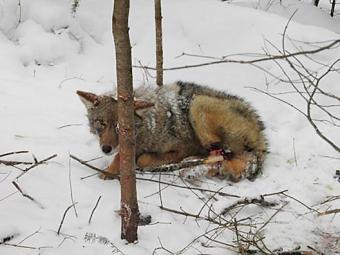
“Last week, about 30 minutes north of Huntsville, Ontario, Paula Tough was on a popular snowmobile trail with a friend, learning how to skijor. Her lead dog began barking and pulling to the side of the trail uncontrollably.

Something was wrong, Paula knew. She took a few steps and saw her: a wolf, laying down, next to a tree, only 10 feet from the trail.

Why was this wolf here? Was something wrong? And she saw it: wire digging in, cutting the flesh of the hind leg of the wolf. A snare had caught her.

Quickly returning to the car with the dogs, Paula grabbed wire cutters she kept for this very purpose. Not only did the cutters prove ineffective, but Paula also recognized that if she simply cut the wire, the wolf would escape and could suffer greatly from an infection of the bone.

“I was standing there trying to figure out what to do,” Paula told APFA. “She was looking at me and I was looking at her and thinking, what am I going to do here? This is horrific, but I can’t walk away, I can’t leave her like this.”

Paula got in her car and went home to get her son, along with blankets, a crate and stronger wire cutters. With the help of her son and a friend, Paula was able to get the wolf safely into a crate. Aspen Valley Wildlife Sanctuary received the wolf and began immediate assessment.

As of this posting, the fate of the wolf is uncertain. She will likely lose her leg – the severity of the cut to nerves and tendons may be irreparable. But that is not necessarily the end: amputation and reintroduction may still be possible. APFA is keeping in contact with Aspen Valley officials and will report more on this situation as it develops.

This serves as yet another example of the horrific, cruel nature of all traps across Canada and our call for immediate changes to regulations.

APFA would like to extend our sincerest gratitude to Paula and Aspen Valley Wildlife Sanctuary for their quick actions to save this wolf’s life. They are true heroes.

A full-length interview with Paula outlining the events, her reactions and what she thinks should happen next will be available in next week’s episode of Defender Radio.

YOU CAN HELP!

Contact your provincial government – MLA in BC or MPP in ON – and ask them to push for immediate changes to trapping regulations in your province.

Here is a sample letter:

Dear ________

I am very concerned about the use of bodygripping traps (leg-hold, Conibear and snare traps) that are used to restrain or kill wildife for the fashion fur trade.

I believe these traps are cruel, dangerous and have no place in a modern society.  Even so-called “certified humane traps” such as leg-holds and snares are indiscriminate machines and can harm and injury non-target animals and our domestic pets.

With ongoing cutbacks to conservation staff, a growing number of people using recreational spaces, unenforceable trap check times and a clear danger to public safety, it is time to overhaul all provincial trapping regulations.

I urge you to please push for the following actions:

  • Prohibition of all bodygripping traps including the leg-hold (YES IT’S STILL LEGAL), Conibear and snare (at least in urban areas and provincial parks).
  • Mandatory signage on all active traplines to warn the general public.
  • Mandatory identification tags for all traps so trappers breaking the law can be held accountable.

Thank you for making the welfare of our wildife and the safety of people and their pets a priority.

Sincerely,”

**Special thanks to “The Association for the Protection Of Fur Bearing Animals” for providing this information!  (http://furbearerdefenders.com/blog/snare-rips-apart-wolfs-leg-in-ontario)


Participating in the 2014 Endangered Species Day Youth Art Contest

“We encourage teachers and their young artists in grades K-12 (as well as those in homeschools and youth groups) to participate in the 2014 Saving Endangered Species Youth Art Contest. The contest provides students with an opportunity to learn about endangered species and express their knowledge and support through artwork. All of the basic information you need to participate in the contest is included in the following sections:

Contest Background

Teacher/School Registration

Eligibility

Teacher’s Checklist

Subject Matter

Resources

Judging

Prizes

Ownership

Contest Sponsors


Background

The Saving Endangered Species Youth Art Contest is an integral part of the 9th annual national Endangered Species Day, celebrated on May 16, 2014. Started in 2006 by the United States Congress, Endangered Species Day is a celebration of the nation’s wildlife and wild places.  It recognizes the importance of endangered species and is an occasion to educate the public on how to protect them.

Last year, nearly 2,200 young artists from schools, homeschools, and youth activity and art programs throughout the country participated in the Saving Endangered Species Art Contest. The winners were chosen by a prestigious panel of judges, including artists, educators, photographers, and conservationists.

The contest is organized by the U.S. Fish and Wildlife Service, the Endangered Species Coalition, the Association of Zoos and Aquariums, and the International Child Art Foundation.

Teachers can include the Endangered Species Day Youth Art Contest as a featured activity for Youth Art Month in March 2014.

Teacher/School Registration

To enable us to contact the contest semi-finalists and winners, we ask that you complete an online registration form.

Please complete all fields in the form. Once you submit this information, we will send you an e-mail including a form for you to print out, complete, and attach to each artwork that you are submitting. We require your contact information so that we can contact semi-finalists and winners through you. If you don’t receive our email within an hour, check your spam/junk mailbox.

When you receive the form, please:

1) Print one copy of the form for each artwork that you are submitting for the contest.

2) Fill in complete information for the artist and his/her artwork.

3) Tape the form to the back of the corresponding piece of artwork.

4) Write DO NOT BEND on the envelope to ensure safe delivery!

Eligibility

Students in kindergarten through high school (K-12) are eligible to enter the art contest.

Young artists who are homeschooled and members of youth groups are also eligible to submit their art.

In order to provide a competitive opportunity for as many youths as possible, the grand prize winner is not eligible to win again for three years.

Entries must be postmarked by March 15, 2014.

Teacher Checklist

Please use this checklist to ensure that your students’ artwork is eligible for entry in the art contest:

The contest is open to students in grades K-12 residing in the United States.

☐ Artwork should depict threatened/endangered species that live or migrate within the United States. (Download a list of U.S. threatened/endangered Species.)

☐ Artwork must be the entrant’s original, hand-drawn creation and may not be traced or copied from published photographs or other artists’ works. Students may, however, use photographs or published images as guides.

☐ Entries may be multicolor, black and white, or a single color, using ink, oil or acrylic paint, watercolor, pastel, crayon, or pencil. Techniques may include scratch-board, airbrush, linoleum printing, paper collage, dry brush, crosshatch, pointillism.

☐ Photography, weak pencil and chalk drawings, or computer-generated art are not eligible.

☐ The physical size of submitted artwork must be 8 1/2″ x 11″ or smaller and less than 1/8″ thick.

☐ No lettering, words, signatures, or initials may appear on the front of the artwork.

☐ Entries should not be matted, mounted, laminated, framed, or folded.

☐ Submissions become property of the Endangered Species Coalition and will not be returned. You’re encouraged to make copies of students’ entries before sending.

☐ Entries must be postmarked by March 15, 2014.

☐ You must use the mailing label marked “Do Not Bend” that is included on the entry form.

Subject Matter

Artwork should highlight one or more land- and/or ocean-dwelling species that is currently listed as threatened or endangered and either resides in or migrates to the United States—mammal, bird, reptile, amphibian, fish, plant, and/or invertebrate (e.g., insect, spider, snail, coral, crustacean or clam).

The Saving Endangered Species art contest is a celebration of America’s success and leadership in protecting threatened and endangered species. We strongly encourage students to incorporate a positive perspective in their artwork. For example, their illustrations can portray a species success story: an imperiled species that has recovered thanks to the protections provided by the Endangered Species Act. The Act has been saving plants and animals from extinction for forty years. (See Resources below for lists of success stories.)

Resources

You can download a spreadsheet containing current threatened and endangered species in the United States.

Also visit http://www.nmfs.noaa.gov/pr/species/index.htm for additional information on marine species.

To find success stories in every state, see: http://www.esasuccess.org/ and http://www.fws.gov/endangered/map.

In addition, you’ll find an art instructor’s lesson plan and other educational materials on the Endangered Species Day website: www.EndangeredSpeciesDay.org.  You will also see the winning entries from the 2013 Youth Art Contest.

Judging Criteria

Winners will be chosen in four categories: Grades K-2, Grades 3-5, Grades 6-8 and Grades 9-12. From these, one national winner will be selected in 2014. Initial judging will be conducted by the International Child Art Foundation. The final winners will be chosen by a prestigious panel of judges, including artists, educators, photographers, and conservationists. The art will be judged on the basis of four primary artistic elements:

  • Concept:  How well the work relates to the endangered species theme
  • Composition:  How well the elements of line and form work together
  • Color:  How color enhances the artwork
  • Expression: How imaginatively the work conveys an idea or emotion. Artists may wish to incorporate a specific “story” in their illustrations. For example, they could show the species in its habitat, with someone in the background helping to clean up the area.

Judges pay particular attention to the concept or story that the work of art tells, in choosing the grand prizewinner. We encourage artists to pay attention to the theme of the concept—saving species.

Submission Guidelines

  • The entry must have the name, grade and title on the back of the submission in pencil.
  • Attach a completed entry form with tape or other fixative to the back of artwork. If using glue, please be careful to use one that will not run through and damage the artwork. No paperclips.
  • Entries must be postmarked by March 15, 2014
  • Entries must use the address label included at the end of the online entry form.

Prizes

Winners will be chosen in the four age categories. From these, one grand prize-winner will receive a round-trip flight to Washington, D.C. for him/herself and one guardian to attend a reception in May. (Accommodations will also be provided. Prize is not redeemable for cash. All other expenses are the responsibility of the winner.) In addition, the grand prize-winner will receive a special art lesson from a professional wildlife artist (via Skype) and $50 worth of art supplies of their choice.

Each of the grade category winners (K-2, 3-5, 6-8, 9-12) will receive a special plaque and $25 worth of art supplies.

Second and third place finishers will receive a special certificate, and contest semi-finalists (top 10 in each grade category) will also receive a certificate.

In addition, teachers/parents/youth leaders can download and print a Certificate of Participation (available on Endangered Species Day website) for all contest entrants.

An exhibition of the artwork and other promotions are also planned.

Ownership

All submissions become property of the Endangered Species Coalition. Through submission of artwork, entrants and their legal guardians grant non-exclusive reproduction and publication rights to the works submitted, which will not be returned. Though the Endangered Species Coalition will attempt to treat all submitted work with the utmost care, the Endangered Species Coalition is not responsible for any damage or loss that may occur due to U.S. Postal Service handling. Other contest partners, including U.S. Fish and Wildlife Service, the Association of Zoos and Aquariums, and the International Child Art Foundation will also have permission to use the artwork (with appropriate reference to the Youth Art Contest.)

Contest Partners

U.S. Fish and Wildlife Service

The U.S. Fish and Wildlife Service is the premier government agency dedicated to the conservation, protection, and enhancement of fish, wildlife, and plants, and their habitats. It is the only agency in the federal government whose primary responsibility is management of these important natural resources for the American public. The Service also helps ensure a healthy environment for people through its work benefiting wildlife, and by providing opportunities for Americans to enjoy the outdoors and our shared natural heritage.

www.fws.gov


Endangered Species Coalition

The Endangered Species Coalition is a national network of hundreds of conservation, scientific, education, religious, sporting, outdoor recreation, humane, business and community groups across the country. Through public education, scientific information and citizen participation, we work to protect our nation’s wildlife and wild places. The Endangered Species Coalition is a non-profit, non-partisan coalition working with concerned citizens and decision-makers to protect endangered species and habitat.

www.endangered.org


Association of Zoos and Aquariums

Founded in 1924, the Association of Zoos and Aquariums is a nonprofit organization dedicated to the advancement of zoos and aquariums in the areas of conservation, education, science, and recreation. Look for the AZA logo whenever you visit a zoo or aquarium as your assurance that you are supporting a facility dedicated to providing excellent care for animals, a great experience for you, and a better future for all living things. The AZA is a leader in global wildlife conservation, and your link to helping animals in their native habitats.

www.aza.org


International Child Art Foundation

The International Child Art Foundation has served as the leading art and creativity organization for American children and their international counterparts since 1997. The ICAF employs the power of the arts for the development of creativity and empathy—key attributes of successful learners and leaders in the 21st century. To date, approximately five million children have directly benefitted from the ICAF programs, and more than 110,000 people have participated in the ICAF festivals and exhibitions.”

**Special thanks to the “Endangered Species Coalition” for providing this information! http://www.endangered.org/campaigns/endangered-species-day/saving-endangered-species-youth-art-contest/


Wolf Candidate

Photo Courtesy of PR.com

“The Native people consider wolves sacred the same way others consider the Bible sacred. Tax payers are paying hundreds of millions of dollars to kill these animals. By saving the animals, tourism will grow and impact our economy. Tourism expenditures will increase while thousands of jobs will be generated.

Sacramento, CA,  January 02, 2014 –(PR.com)– Stand With Wolves featuring 2014 California Gubernatorial Candidate Dr. Robert Ornelas was produced by Elite TV News and hosted by Krista Rocha from International Hip Hop group The S.O.G. Crew.

U.S. Fish and Wildlife Service hosted a public hearing in Sacramento to collect information on the service’s proposal to de-list the gray wolf (Canis lupus) in the contiguous United States. The hearing was at the Marriott Courtyard Sacramento Cal Expo, Golden State Ballroom, 1782 Tribute Road, Sacramento, CA 95815.

The service proposed removing the Gray Wolf from the endangered Species List.

“It was an honor to be in Sacramento supporting wildlife advocacy. I am a wildlife friendly candidate for Governor of California. We have worked with Native American Indian communities throughout North America and have learned a lot from their culture and beliefs. The Native people consider these animals sacred the same way we consider the bible sacred. Tax payers are paying hundreds of millions of dollars to kill these animals. By saving the animals, tourism will grow and impact our economy. Tourism expenditures will increase while thousands of jobs will be generated,” stated Dr. Robert Ornelas

The Service published a proposed rule on June 13, 2013, to delist the gray wolf. Hearings are part of the Service’s continuing efforts to provide an open and comprehensive public process for the two wolf rules and gave members of the public a forum by which to register their views.

“Hunters, ranchers, poachers and trappers are wiping out these animals with our tax dollars. Asian and European meat markets are coming to the United States with big bucks and are destroying these sacred animals. We invited Dr. Robert Ornelas here to see what we are doing in relations to Native American, economic, moral and ethical causes,” said wildlife advocate Randy Massaro.

Angel Protectors of Animals and Wildlife is a California based, 501c3 and 501c4 non profit animal and wildlife rescue organization (in formation), which raises awareness and changes public policy for both domestic animals and wildlife. Through the use of positive messages, Angel Protectors will change the public’s awareness on the importance of animals in today’s society. This will be achieved in four stages:

-National advertisements and Public Service Announcements
-Lobbying on the local, state and national levels
-The creation of original programming
-The formation of a digital television network, which will be initially launched online, but which will be eventually moved to cable or a satellite service.

Kim Richard has been a wildlife advocate for over 36 years, During her 36 years as a wildlife advocate, Kim has worked with several wildlife organizations, including Worldwide Wildlife Association and Greenpeace. She is a co-founder and board member of a local animal rescue group, Angel Ark Foundation. However, wanting to do more for wildlife than the AAF by-laws allowed, she began forming Angel Protectors of Animals and Wildlife in the spring of 2013. She is still an active member and supporter of Angel Ark Foundation. Her passion and experience make her an effective wildlife advocate. Her practical life experience gives her the ability to her manage the team, set goals, and plan wildlife events that will attract both the public’s and the media’s attention. Her passion to save the nation’s wildlife makes her a formidable advocate.

The mission of the U.S. Fish and Wildlife Service is working with others to conserve, protect, and enhance fish, wildlife, plants, and their habitats for the continuing benefit of the American people. They are both a leader and trusted partner in fish and wildlife conservation, known for our scientific excellence, stewardship of lands and natural resources, dedicated professionals, and commitment to public service.”

**Special thanks to “PR.com” for providing this information!  http://www.pr.com/press-release/535336

The Last Wolf?


Isle Royal Single Wolf

Should biologists step in to save Isle Royale’s wolves or let nature take its course?

“A pack of wolves races through a field of unbroken snow, followed by scientists in a small plane buzzing overhead. For more than 60 years, this wild scene has come to life every winter on Michigan’s Isle Royale, the island in Lake Superior that forms the bulk of Isle Royale National Park. But all that may be about to change. After years of inbreeding, Isle Royale’s wolf population, which once approached 50, is down to eight adults and two or three pups, and the Park Service must decide what, if anything, should be done about it.

The roots of today’s dilemma go back to the late 1940s, when three gray wolves from Canada set off across the ice of Lake Superior and walked 15 miles to Isle Royale. The animals arrived to find dinner waiting for them: a population of moose descended from animals believed to have swum to the island a few decades earlier. The natural laboratories of islands have long interested biologists (think of Darwin studying finches in the Galapagos), and the elegant two-step of one prey species interacting with one predator soon caught the notice of researchers. Started in 1958, Isle Royale’s Wolf-Moose Project is now the longest-running study of predator and prey anywhere in the world.

Scientists have worried about wolf inbreeding for years. Yet until recent decades, the waters of Lake Superior between the mainland and the island froze over during most winters, allowing new wolves to find Isle Royale. Starting in the 1970s, steadily rising temperatures began to chip away at lake ice; ice bridges now form roughly once a decade. The chance of new wolves showing up to supplement the gene pool is now very slim. The result is “the most extreme case of inbreeding ever documented in wolves,” according to Rolf Peterson, who began leading the Wolf-Moose Project in the early 1970s. This inbreeding shows up in the animals’ very bones—every wolf skeleton found since 1994 has contained abnormalities. Most crucially, the wolves aren’t reproducing fast enough. No pups were born in 2012, and only two or three were born in 2013.

To date, humans have attempted genetic rescue of only a handful of species. The best known of these is the Florida panther. In 1995, the cat’s numbers hovered between 20 and 30. Fearing it would go extinct, biologists captured eight female cougars in Texas and released them in Florida. By 2010, the number of Florida panthers had roughly tripled. Geneticist Phil Hedrick, who worked on the project, has also measured the level of genetic variation in the Isle Royale wolves. In 1998, he was surprised to find it nearly four times higher than expected, given the number of ancestors the scientists know about. (Those ancestors may include a male and a female from the 1952 introduction of captive-raised wolves from the Detroit Zoo). “It appears that… some wolves crossed to the island undetected and added to the gene pool,” says Hedrick.

How does a wolf sneak onto Isle Royale? Pretty easily. They’re counted only in January and February, when researchers take to the air in small planes about every other day, look for tracks in the snow, and follow those tracks to the wolves. Dozens of gray wolves can be hard to tell apart. Rolf Peterson knows that two radio-collared wolves left the island on the last ice bridge, which formed in 2008. He can also identify two arrivals: a black wolf that showed up in a pack in 1967 and eventually became an alpha male, and an unusually light-colored male, nicknamed Old Gray Guy, that crossed to the island in 1997. Old Gray Guy performed a sort of one-wolf genetic rescue, and today, all eight wolves on the island are his descendants. In a sense, he was almost too successful at mixing up the gene pool. While his fresh infusion of DNA decreased inbreeding at first, now that every wolf on the island carries some of his genes, inbreeding is on the rise again.

Although Peterson hasn’t proposed any specific plans, in a forum held by the National Parks Conservation Association in June, he stated that importing two wolves of the same sex might be sufficient. Still, the question isn’t so much whether genetic rescue will work; it’s whether it should be attempted at all. Peterson believes the main reason to keep the wolf population going is to preserve the island’s ecosystem. To him, that boils down to trees, specifically the balsam fir that moose love to browse on. Peterson believes that a moose population unchecked by wolves could quickly get big enough to mow down every growing balsam fir tree on the island, leading to the trees’ eventual extinction—a change that would cascade down island food webs. He holds out the last two years as evidence for concern. In an average year on Isle Royale, about 10 percent of the moose were killed by wolves. In the last two years that figure dropped to 2 percent, and the moose population has quickly increased.

Although the Wolf-Moose Project has captured the public’s imagination, many experts point out that there’s a bigger picture. Back up and look at the entire last century, they say, and wolves appear as just one species in a revolving carousel of animals that have come and gone. In 1900, the largest animals on Isle Royale were caribou and lynx. These species eventually disappeared, along with smaller residents like coyotes and spruce grouse. In recent years, tricolored bats and a new type of tree frog have shown up. It turns out that compared with other species, wolves and moose have a relatively short history on the island.

The bigger picture also means seeing Isle Royale not just as a national park but also as a federally designated stretch of wilderness. Nearly the entire island is protected under the 1964 Wilderness Act. In the past, environmentalists’ approach to these wildest parts of our country has been a two-word mantra: don’t meddle. At the NPCA forum in June, Kevin Proescholdt, conservation director of the nonprofit Wilderness Watch, described his opposition to genetic rescue: “We should be aware of the slippery slope of manipulation,” he said. “If we intervene now… will we want to continue with additional manipulations?”

The stakes of the Park Service decision go far beyond the fate of eight wolves. When wolves were reintroduced to Yellowstone National Park, officials were correcting a problem created by humans—wolves were native to the park but had been hunted to extinction. Because wolves aren’t native to Isle Royale, performing a genetic rescue would break new ground. “Park Service policies don’t point to a clear course of action on this particular issue, and the best available science is sometimes conflicting,” says Christine Goepfert, program manager in NPCA’s Upper Midwest field office. “It’s a lot to sort through—many people are watching this decision because it could have implications for wildlife management in other national parks.”

The stakes are so high, in fact, that Park Superintendent Phyllis Green says the decision could go all the way to Washington. “It’s my responsibility to determine the right course of action at the park level,” she says. “If those actions alter… policy, then that’s where Park Service Director Jon Jarvis weighs in.” Green says that before making any decision, the park will interview more experts, including scientists who have worked with small populations of red wolves and Mexican wolves. A report on climate change released by the park in November has just added a new element to the complex swirl of data and policy. It forecasts that neither wolves nor moose may be capable of surviving the next century amid warmer temperatures.

In the parlance of biologists, the natural process of change on an island causes a rotating cast of species to “wink in” and later “wink out.” For now, it’s not clear whether the park’s wolves will remain on the glorious stage of Isle Royale for years to come, or whether they will wink out, just like the shooting stars that streak across the park’s inky night sky.”

**Special thanks to Laurie McClellan, http://www.npca.org/news/magazine/all-issues/2014/winter/the-last-wolf.html#.Ur8H6ujuev4.facebook, for providing this information!