Feeds:
Posts
Comments

OLYMPUS DIGITAL CAMERA

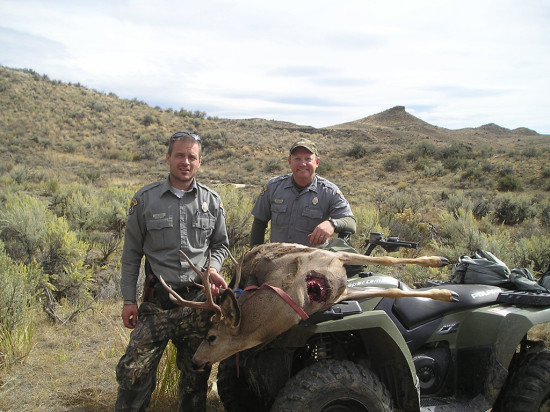
IDAHO FISH AND GAME CONSERVATION OFFICERS COREY TAYLOR (LEFT) AND CRAIG MICKELSON POSE WITH AN POACHED MULE DEER BUCK SEIZED DURING OPERATION BORDER JUMPER. (Photo credit given to MATT O’CONNELL, IDFG)

By Andy Walgamott, on October 9th, 2013

(IDAHO DEPARTMENT OF FISH & GAME)

“An early start to the mule deer hunting season in the wrong state should prove costly to several Oregonians too impatient to wait for opening day or to learn some basic geography. Five individuals now face court appearances and potentially heavy fines for their respective roles in two unrelated poaching incidents.

Acting on tips from the public, Fish and Game conservation officer Craig Mickelson organized a focused enforcement effort (code name: Operation Border Jumper) in the Owyhee desert during the last weekend of September. Using “Bucky,” the stuffed, robotic deer, Mickelson and his team staked out the Succor Creek area in remote Owyhee County, just east of the Oregon/Idaho border and waited – but not for long. In the early morning hours of September 28th, a group of four Oregon “hunters” rolled up the road but failed to see the decoy deer standing just a few feet away. Later that morning, the group came back down the road and spotted the decoy. One of the party exited the truck, firing six shots at the decoy deer. When the shooting stopped, the group was interviewed and 13 citations were issued, including three citations related to an illegal 4 x 4 mule deer buck poached that morning just shortly after the group missed seeing the decoy.

The four men were charged with wildlife violations as follows:

Martine Mills (47) of Cove, Oregon was cited for attempting to take a deer during closed season, attempting to take simulated wildlife, possession/transportation of a closed season deer, hunting without a valid Idaho hunting license and hunting without a valid Idaho deer tag. He was also issued a warning for an open container of alcohol. Thomas Rager (66) of Cove, Oregon was cited for possession/transportation of a closed season deer and hunting without a valid Idaho hunting license.

Justin Cernazanu (29) of Cove, Oregon was cited for possession/transportation of a closed season deer. Eugene Mills (69) of Nyssa, Oregon was cited for hunting without a valid hunting license.

Before daylight the following morning, officers moved five miles south and set up the decoy deer along Idaho’s Palmer Creek. Around mid-morning, they watched as James Hayhurst (65) of Jordan Valley, Oregon encouraged his eight-year-old grandson to shoot at the decoy deer. While the youngster was not charged, Hayhurst was cited for hunting without a valid Idaho hunting license, hunting without a valid Idaho deer tag, attempting to take simulated wildlife and attempting to take a deer during closed season. The rifle used in the case was seized as evidence.

All five suspects will appear in Owyhee County Court in Murphy, Idaho on Monday, October 28th.

Mickelson attributes Operation Border Jumper’s success in large part to the public’s willingness to report suspicious behavior.

“We had reports last year that one or more Oregon groups were slipping into Idaho prior to the mule deer season opener and poaching deer,” Mickelson noted. “We held onto that information and used it this year to bring these individuals to justice.”

Persons with any information about suspected poaching activity are encouraged to call the Citizens against Poaching (CAP) hotline at 1-800-632-5999, twenty-four hours a day. Callers can remain anonymous and cash rewards are often paid for information leading to the successful conclusion of a case.”

**Special thanks to Andy Walgamott, Idaho Fish and Game, for providing this information! (http://nwsportsmanmag.com/headlines/operation-border-jumper-nabs-oregon-hunters-who-allegedly-poached-buck-shot-at-idaho-robodeer/)


Bull Elk

Photo credit goes to Perry Backus, Ravalli Republic

March/2012

“DARBY – The cow elk captured and collared last year in the southern reaches of the Bitterroot Valley have done their part to create a map for researchers to study the animals’ migratory patterns.

Some of the early results have been surprising.

One elk traveled from the East Fork of the Bitterroot almost to Wise River and back in the course of the year. Others hardly moved at all.

The effort is part of an ongoing three-year Montana Fish, Wildlife and Parks and University of Montana study looking at elk and predator dynamics in the area.

The 44 elk were fitted with GPS collars that recorded their location every two hours. At the end of the year, the collars were designed to fall off the animals’ necks during the second week of January.

When the collars hit the ground, they transmitted a mortality signal that allowed researchers to locate and retrieve the devices.

In some cases that retrieval proved challenging, said lead researcher Kelly Proffitt.

“We had some that dropped off at high elevations, which made it more difficult for us to retrieve them,” Proffitt said. “I was a little surprised that they were that high this time of year, but we are having a little milder winter.”

With the collars collected so far, Proffitt said the most surprising move was the cow elk that traveled to Fish Trap Creek in the Big Hole, which is almost to Wise River.

“We knew that there would be some movement between the Big Hole and (hunting district) 270, but we didn’t know for sure how far they traveled,” she said. “That was more movement than I was expecting to see.”

Most of elk captured in the East Fork that weren’t on the CB Ranch migrated south into the Lost Trail Pass area or into the Big Hole for the summer months.

Only one of the five animals captured on the CB Ranch migrated very far from that property during the summer months.

“The others stayed there pretty much year round,” Proffitt said. “We really weren’t sure what to expect. For the most part, those animals stayed put.”

So far, researchers have only been able to collect three radio collars from elk in the West Fork. None of those migrated into Idaho during any part of the year.

“It’s really hard to say much about the West Fork at this point,” Proffitt said. “Hopefully, we’ll get five or six more radios out in that area later on this year.”

Of the cow elk collared last year, only two died from predation. A mountain lion killed one and it appeared that wolves killed another. Four died from natural causes.

Researchers collared a new contingent of 40 cow elk this winter that will be tracked over the course of this year.

Proffitt said the distribution of the collars was moved a little bit in an effort to fill in some blank spots on the map from this year.

The research team is continuing to collect information about predation on elk calves.

The team captured and tagged 97 elk calves this year.

By late February, 38 of those calves were found dead. Mountain lions had killed 13. Black bear and wolves had each killed four.

There was not enough evidence for researchers to make a call at the kill site for another 11 of the calves that were found dead.

“We saw a small increase in wolf kills in the West Fork as we came into winter,” Proffitt said. “There has been steady predation by lions throughout the study period.”

**Special thanks to PERRY BACKUS – Ravalli Republic, for providing this information!  (http://missoulian.com/news/state-and-regional/results-of-bitterroot-elk-study-surprise-scientists/article_45ebd52c-7231-51c0-b301-6fbbacb5f7e3.html)


Wolf Bite

Noah Graham, 16, of Solway, Minn., demonstrates how he reached back and fought off a wolf that had clamped down on his head at a campground near Lake Winnibigoshish. (Photo credit:  Monte Draper, Bemidji Pioneer via AP)

“Tests results show that a wolf that bit a 16-year-old boy’s head at a northern Minnesota campground had severe deformities as well as brain damage, which likely explains the reason for the “unprecedented” freak attack, wildlife specialists said Thursday.

DNA tests results also confirmed that the gray wolf that was trapped and killed two days after the late-night attack is in fact the same wolf that bit the teen. The wolf tested negative for rabies.

All of that is a relief for the family of Noah Graham, the Solway, Minn., teen who was bit last month while lying on the ground, but not inside a tent, at a Chippewa National Forest campground near Lake Winnibigoshish. “We all felt 98 percent sure that was the animal,” Noah’s father, Scott Graham, said Thursday after Department of Natural Resources officials called him with the test results. “My concern was that the wolf was diseased and Noah could contract something. But that wasn’t the case.”

The rare encounter last month was Minnesota’s first documented wild wolf attack on a human that resulted in a significant injury.

The day before the attack, the wolf had been seen in and around the campground, said Dan Stark, the DNR’s large carnivore specialist. “It bit into a tent. Punctured an air mattress. It was standing on a picnic table — things you wouldn’t expect a wild wolf to do. He was never aggressive, and he never approached anybody.

“So why did it bite somebody? Whether it actually knew what it was biting into is probably unlikely. It was biting something on the ground, and it happened to bite into somebody’s head,” Stark said.

Results from the wolf necropsy conducted by the University of Minnesota Veterinary Diagnostic Laboratory show the wolf, estimated to be 1½ years old, suffered from a severe facial deformity, dental abnormalities and brain damage caused by infection. Anibal Armien, university pathologist and veterinarian, said it’s likely the wolf experienced a traumatic injury as a pup and those injuries developed into abnormalities that caused the brain damage.

Those deformities and abnormalities likely hampered its ability to effectively capture wild prey, said Michelle Carstensen, DNR wildlife health program supervisor. The wolf’s stomach contained only fish spines and scales.

The wolf’s problems also likely predisposed it to be less wary of people and human activities than what’s normally observed in healthy wild wolves, Carstensen said.

That “strongly explains” why the animal was behaving the way it was and why it was searching for food around the campground, Stark said. “It’s surprising that a wolf in this condition survived to this point given its reduced ability to survive in the wild.”

Attacking a human is “definitely abnormal and unusual,” Stark said. “Occasionally … we get nuisance complaints of wolves in people’s yards and interactions with pets, but rarely is there any aggression toward people. This kind of thing is unprecedented.”

Stark said there have been two other attacks by wolves in Minnesota but neither resulted in injury. One happened to a logger in the 1970s, and the other was to a rabbit hunter a decade later.

The Solway teen suffered multiple puncture wounds and a laceration to his head that required staples. He also received rabies shots.

“He’s pretty healed up,” his father said while walking through the woods partridge hunting with his two young daughters. “I don’t think [the attack] is going to curb any of our camping or hunting.”

But Noah Graham may find himself looking over his shoulder every now and then when he walks in the woods, his father said.

The teen often walked through the woods in the early morning darkness to his deer stand. “He never used a flashlight,” his father said. “But I don’t think he’ll do that anymore. He’ll probably use a flashlight.”

** Special thanks to Mary Lynn Smith, Star Tribune, for providing this information! (http://www.startribune.com/local/225392642.html)


Wolf-OR7-DFG-Shinn

Photo credit owned by Richard Shinn.


Public Hearing – California

“Our best chance to stop this reckless plan from going through will be by showing up in droves at these public hearings and speaking out on behalf of wolves! Even if you would prefer not to testify, your presence will make a huge difference and will show how strongly Americans support wolves! Join us as we gather before the hearing to learn about the proposals, rally with fellow supporters and get tips on how to testify. Then we’ll head to the hearing together and ensure that FWS hears our voices loud and clear!

Wednesday, October 2nd Clarion Inn, Comstock Room 1401 Arden Way Sacramento, CA 95815 Pre-hearing event starts at 3:30 pm

RSVP for the Pre-Hearing Event >

Need a ride to the event? Use the password “defenders” to log in to the event at eRideShare.

Want help writing your testimony? Check out our talking points to get the basics on the flaws in this proposal to delist gray wolves across most of the U.S. Talking Points on the Gray Wolf Delisting Proposal >

Learn more about how public hearings work and what these events are usually like. What to Expect at the Hearing >
Training Call Monday, September 30th 7:30 to 8:30 pm PT Join Defenders’ staff and fellow wolf supporters for a brief training session in preparation for the hearing. Learn about the ins and outs of a Fish and Wildlife Service public hearing, and how to prepare effective written and oral testimony to present to key decision makers.  During the call participants will:

  • Learn how to craft a compelling and personal testimony;
  • Learn about the rules and details of the hearing;
  • Find out about the activities we have planned for the hearings; and
  • Be able to ask questions about the hearing”

**Special thanks to “Defenders of Wildlife” for providing this information!


My first tattoo; the howling wolf!

Public Hearing – New Mexico

“This is the ONLY public hearing that will also address the Fish and Wildlife Service’s woefully inadequate proposed rule changes for critically endangered Mexican gray wolves, a subspecies of the gray wolf. Please be sure to study both sets of talking points so that we can better ensure a future for both types of America’s wolves.

Our best chance to secure a future for Mexican gray wolves and stop the reckless delisting of gray wolves will be by showing up in droves at these public hearings and speaking out on behalf of wolves! Even if you would prefer not to testify, your presence will make a huge difference and will show how strongly Americans support wolves! Join us as we gather before the hearing to learn about the proposals, rally with fellow supporters and get tips on how to testify. Then we’ll head to the hearing together and ensure that FWS hears our voices loud and clear!

When:  Friday, October 4th

Where: Embassy Suites, Sierra Ballroom 1000 Woodward Place NE Albuquerque, NM 87102

Pre-hearing event starts at 3:30 pm

RSVP for the Pre-Hearing Event >

Need a ride? Use the password “defenders” to log in to the event at eRideShare.

Want help with your testimony? Check out the talking points below Talking Points on the Gray Wolf Delisting Proposal > Talking Points on the Mexican Gray Wolf Recovery Proposal >

Learn more about how public hearings work and what these events are usually like >


Training Call Tuesday, October 1st 7:30 – 8:30 pm MT Join Defenders staff and fellow wolf supporters for a brief training session in preparation for the hearing. Learn about the ins and outs of a Fish and Wildlife Service public hearing, and how to prepare effective written and oral testimony to present to key decision makers.  During the call participants will:

  • Learn how to craft a compelling and personal testimony;
  • Learn about the rules and details of the hearing;
  • Find out about the activities we have planned for the hearings; and
  • Be able to ask questions about the hearing”

**Special thanks to “Defenders of Wildlife” https://www.defenders.org/national-wolf-emergency/public-hearing-new-mexico, for providing this information!


wolves isyle royale

A pack of gray wolves on Isle Royale National Park in northern Michigan in 2006. (Photo provided by John Vucetich / Michigan Technological University)

From The Detroit News: http://www.detroitnews.com/article/20130924/POLITICS02/309240094#ixzz2g32jxr2b

“Opponents of Michigan’s upcoming wolf hunt say data used to justify the program are skewed by events at one cattle farm in Ontonagon County.

In November, as many as 1,200 hunters will take to three designated areas in the Upper Peninsula for the first sanctioned wolf hunt in roughly half a century. State officials approved the controversial hunt after wolf-livestock incidents increased in recent years. Licenses will go on sale at noon Saturday.

But members of Keep Michigan Wolves Protected, a group that has lobbied against the hunt, say the statistics are bolstered by a single cattle farm near Matchwood owned by John Koski. According to the organization:

■ 73 percent of the 78 wolf-livestock incidents in Area B of the designated wolf hunt zones involved cattle from Koski’s farm between 2010 and 2013.

■ 80 percent of all livestock killed in Area B during that period were from Koski’s farm.

■ 64 percent of all cattle killed by wolves in the Upper Peninsula since 2013 came from Koski’s farm.

Jill Fritz of Keep Michigan Wolves Protected said the statistics paint an inaccurate picture of how bad the wolf situation is in the Upper Peninsula. Koski’s failure to take even basic steps to protect his animals makes that situation look worse, she said.

“(Koski) has basically set up a smorgasbord for predators on his farm — leaving carcasses around, not putting up fencing,” she said. “He’s basically putting out a welcome mat for predators of all kinds.”

Gray wolves had been on the U.S. Fish and Wildlife Service’s endangered species list for almost four decades before they were removed in early 2012. During that span, the population in Michigan grew from a handful to 658.

Gov. Rick Snyder signed Public Act 520 that allowed a wolf hunt — something many state residents felt was necessary to contain the growing wolf population.

Koski could not be reached for comment Tuesday. Michigan Department of Natural Resources officials confirmed there are steps the farmer could take to potentially decrease the number of wolf attacks on his property, but he has done nothing considered illegal.

Brian Roell, a DNR wildlife biologist, said taking Koski’s farm out of the equation would not alter the need for the hunt.

“We’ve had 13 total farms, just since 2010, that have had depredation, just in that management area alone,” he said. The areas designated for the hunt were based on “places where they were having (wolf-livestock) conflict, not the severity of the conflict.””

 jlynch@detroitnews.com
(313) 222-2034


Wisconsin Wolf

A collared gray wolf in Wisconsin. Photo courtesy of Michele Woodford.

“The Wisconsin Department of Natural Resources boasts: “We rank first in the country for the highest single year deer harvest on record and are number one for deer harvest over the past decade. All of us work hard to keep it that way.”

Yet, according to a new article, Limited deer hunt may happen in three area communities, deer populations are doing too well in some parts of Wisconsin. Ironically, the state DNR is also keen to “control” (read: kill off) their wolf population through hunting and trapping, in part because wolves prey on deer. How contradictory is that?

Ashwaubenon, Allouez and De Pere considering deer population control measures

A limited deer hunt could take place in 2014 in parts of Allouez, Ashwaubenon and De Pere if local officials decide the population is too big for the area.

The municipalities hope to survey the deer population this winter in response to complaints from residents, who said the animals are damaging gardens and creating traffic hazards in certain neighborhoods. But they’re working slowly with this issue, which could prompt worries about safety, objections from animal-rights groups and other potential roadblocks.

Meanwhile, officials in the communities say they’re hearing from growing numbers of residents who don’t like deer grazing in their gardens, or having large animals darting across residential streets.

“We’ve certainly had more sightings of larger groups this year,” said Rex Mehlberg, Ashwaubenon’s director of parks, recreation and forestry. “People are seeing six, eight, 10 of them at a time. One group was 14 or 15.”

Local officials stress that no decisions have been made about whether they would allow a hunt, and that hunting would not take place in parts of town where people would be at risk. First, they would have to decide if they want to do a count of deer by helicopter this winter. The survey cost, estimated at $2,000, would be shared between the communities and likely would be funded in part through a grant.

De Pere officials are scheduled Oct. 1 to discuss funding for the study, said Parks, Recreation and Forestry Director Marty Kosobucki. he said the city also has discussed setting aside some money in its 2014 budget to clover part of the cost of a survey.

In Northeastern Wisconsin and elsewhere, complaints about deer have grown as communities have sprawled into areas that were once rural. Two Rivers was set to vote Monday night on allowing a limited bow hunt this fall. “

**Special thanks to “Exposing the Big Game,” http://exposingthebiggame.wordpress.com/2013/09/17/wisconsin-1-for-deer-harvest/, for providing this information!


Idaho Wolf

“There’s something rotten in Michigan — and the stench is coming from one rogue farm in the western portion of the Upper Peninsula. Based on state documents obtained through Michigan’s Freedom of Information Act (FOIA), and an analysis of those documents conducted by the National WolfWatcher Coalition and Keep Michigan Wolves Protected, four-fifths of the livestock killed by wolves in the western management unit (96 animals out of 120) come from this one farm. The documents make plain that the owner of this farm is engaging in unsound, sloppy — and perhaps even criminally inhumane — practices.

The story told in the FOIA documents broke late last month in the Marquette Mining Journal and on Michigan Public Radio. Even though state law already allows the killing of individual wolves threatening livestock or pets, the state senator from this region has shepherded two bills through the Michigan legislature to allow trophy hunting of gray wolves — right after they were Gray Wolf May Lose Endangered Species Status . There are only about 650 wolves in the entire state, and that number is down from the wolf census two years ago.

There are only about 650 wolves in the entire state, and that number is down from the wolf census two years ago.

There were 11 farms that reported wolf problems in the western region of the Upper Peninsula, with most of them having only a single incident. In an investigation conducted this past winter, the Michigan Department of Natural Resources (DNR) found that the owner of that one farm, John Koski, did not live on the farm and did not provide proper care for his cattle, failing even to remove dead animals — allowing their carcasses to attract predators. The state provided three “guard” donkeys to him for free, yet DNR officials found two of them dead, and the third one was in poor condition. Koski also failed to use fencing as a protective mechanism, even though the state also provided that to him at no cost.

Koski was even paid for the livestock “losses” he sustained, pocketing $33,000 of the $40,000 paid out by the wildlife management unit.

It doesn’t take too much deductive reasoning to figure out what’s at work here: proponents of hunting and trapping wolves for trophies and for their pelts used Koski as a poster child for their hunt, citing enormous losses from wolves. What they didn’t tell people was that the vast majority of all incidents involving wolves occurred on one farm, which was clearly exhibiting the worst management practices and inviting predators or other animals onto the farm by leaving rotting animal carcasses around. It essentially amounts to a wolf-baiting situation, and then crying crocodile tears when the wolves show up for a free meal.

The people who want to kill wolves don’t want to admit that their agenda is driven by an irrational hatred and a lack of understanding of wolves. They try to dress up their policy goal of wolf-killing in socially beneficial terms. Specifically, they say the hunt will protect farmers.

The fact is, the state already allows the killing of problem wolves. And the state provides free tools to farmers having wolf conflicts and compensates them for the very infrequent losses that occur. Random killing of wolves in the forests and wilderness won’t do a thing to further mitigate the remote likelihood of a wolf incident. Sound animal husbandry practices are the solution.

Wolves are an economic and ecological boon to the state, driving wildlife-oriented tourism and keeping prey populations in balance, thereby reducing crop losses and automobile collisions involving deer. That’s why The HSUS urges all Michiganders to support two referenda — one to nullify the wolf trophy hunting season set to start in November, and the other to restore the rights of voters to have a say on wildlife management policies and deny the unelected political appointees at the Natural Resources Commission from having all authority to open new hunting and trapping seasons on protected species. To get involved, visit www.keepwolvesprotected.com.”

Pacelle’s most recent Op-Ed was “Sharks Gain Protections in India, Will U.S. Follow Suit?” This article was adapted from “‘Crying Wolf and Pocketing the Cash,” which first appeared as on the HSUS blog A Humane Nation. The views expressed are those of the author and do not necessarily reflect the views of the publisher. This version of the article was originally published on LiveScience.


Wolf Ledge

As Montana’s wolf hunt begins, please let this be a reminder how much wolves need our ongoing advocacy.  Please also take a moment to object to these hunts by writing or calling Governor Steve Bullock’s office:  http://governor.mt.gov/contact/default.htm.

“Montana’s general wolf season opens Sunday with much looser rules than in past years, as state wildlife officials ramp up efforts to reduce the predators’ population in response to public pressure over livestock attacks and declines in some elk herds.

Lower license fees, a five-wolf per person bag limit and a longer season top the list of changes put in place for the 2012-2013 season.

Only two areas in the state — near Glacier and Yellowstone national parks — have limits on how many gray wolves can be killed.

Conservation groups have criticized the state’s liberal wolf hunting rules as a threat to their long-term population. But livestock owners and hunters have pushed for even more wolves to be killed, and state officials say they intend to maintain a smaller, but still viable, wolf population.

At the beginning of 2013 Montana had 625 wolves. That was a slight drop from the prior year and the first decline since Canadian wolves were brought to the Northern Rockies in the mid-1990s as a way to bolster the population.

State officials hope to continue driving the population down this year but have not set a target number.

The number of out-of-state hunters buying licenses is up sharply this year, with 370 purchased through this week compared to 55 at the same point last year. That comes after the Legislature reduced out-of-state licenses from $250 to $50.

Almost 6,000 state residents have purchased wolf licenses so far for $19 apiece. That’s roughly in line with last year’s sales figures.

The general rifle season runs through March 15.

Trapping season for wolves starts December 15 and runs through February 28. The two-week archery season for wolves ends Saturday, with two harvested as of Friday.

Last year, hunters in Montana took 128 wolves and trappers 97 for a total harvest of 225 animals.

Gray wolves were taken off the endangered species list for much of the Northern Rockies in 2011.

A pending proposal from the U.S. Fish and Wildlife Service would lift protections across most remaining areas of the Lower 48 states where protections are still in place.”

**Special thanks to “The Associated Press” for providing this information! (http://missoulian.com/news/local/montana-s-wolf-hunting-season-opens-sunday/article_d3691a8a-1d5d-11e3-9dfb-0019bb2963f4.html)


sheep wolf

Colorado, Pacific Northwest public sessions terminated!!

“A decision by the U.S. Fish and Wildlife Service to halt public wolf hearings in Colorado, Oregon and Montana  has met with criticism from environmental advocates such as the Defenders of Wildlife.

“We are very disappointed to see the Obama Administration and the Fish and Wildlife Service ignoring wolf supporters in some of the nation’s best remaining, unoccupied wolf habitat,” says Jamie Rappaport Clark, Defenders president.

The federal government is turning its back on Americans who want to see thriving wolf populations restored, adds Clark. “Those who oppose the Service’s premature and short-sighted delisting proposal deserve a chance to voice their concerns. By excluding their voices, the Fish and Wildlife Service is effectively cutting off public debate about the future of wolves in Colorado and the Pacific Northwest,” he argues.

The proposal to strip federal protection of the wolves across most of the U.S. has led to vocal dissent from environmentalists, but ranchers who have sustained  substantial economic losses due to wolf kills – many done as random acts of pack aggression not related to feeding needs – find some relief in the fed’s decision.

On June 6, 2013, FWS proposed to strip the federal protection for gray wolves. If approved, the delisting proposal could preclude any further wolf recovery in Colorado, Utah and other states, Clark believes.

He also predicts that nascent wolf populations in Oregon and Washington would be managed totally by state rather than federal government agencies with “no federal backdrop to prevent state wildlife agencies from significantly reducing wolf numbers in the future.”

He cites a poll taken in Colorado this year showing “very strong support” for wolf restoration in that state. Additional polling is underway to gauge support for wolf recovery in other parts of the West, including Oregon and Washington.”

**Special thanks to T.J. Burnham, “Indiana Prairie Farmer,” for providing this information!