Feeds:
Posts
Comments

Wolfman

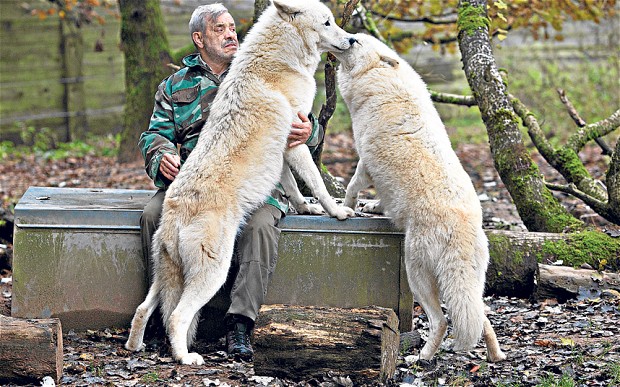
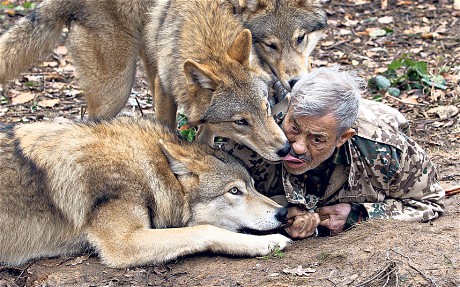
Packing a punch: Werner Freund with members of his wolf family, which includes distinctive white Arctic wolves  Photo: ROGER ALLEN/NORTH DOWNS PICTURE AGENCY

December 10th, 2012:

“The wolf has long been a creature of terror and mystery. With its sleek fur, fangs and spine-chilling howls, it is the stuff of nightmares and fairy tales that end badly. But the animal is making a comeback on mainland Europe, particularly the grey wolf, after centuries of human mistrust that has driven it to the brink of extinction. From the Balkans to the forests near Berlin, and from the heel of Italy to the outskirts of Prague, wolves are roaming wild once more as part of carefully managed programmes to halt their decline. Last month night-vision cameras picked up a pack of grey wolves just 15 miles from the centre of the German capital, moving stealthily through the countryside in pursuit of prey.

For one man, however, the wolf and its return is a cause for celebration rather than fear. Werner Freund, an 80-year-old former German paratrooper, has spent the past 40 years determined to dispel the negative myths that surround the animal. Known as the Wolfman, Freund runs a sanctuary in the small German town of Merzig near the border with Luxembourg, where he walks freely among 29 wolves, wearing an old parachute smock reeking of animal fat and blood. Kevin Costner may have enjoyed a light celluloid foxtrot with them in the Hollywood movie Dances With Wolves, but Werner transforms himself into the alpha male of the pack. “To earn their respect, one must become a wolf, and that is what I am to them – their leader,” he says.
Wolfman 2

‘Wolves are beautiful animals and the person who says they shouldn’t be in
the wild might as well not care about what happens to the elephant on the plains
of Africa’ (NORTH DOWNS PICTURE AGENCY)

Impressed by his dedication and knowledge, animal experts from around the world beat a path to his door, including Monty Roberts, the original “horse whisperer”. The EU asks for his advice on wolf management in those countries where they are making a comeback, and Werner is celebrated in books and documentaries in his homeland.

It’s easy to see why he is so highly regarded. Every day, as dawn breaks over the 25 acres of the Werner Freund Wolfpark, the still air is split by the howling of Arctic, timber, grey and Mongolian wolves – the latest addition to the Freund family.

The wolves smell him before they see him. Then they howl – first one, then another and another – the woodland echoing to a visceral sound that would instill fear in many, but not in Werner. For these are the cries of animals he has devoted his life to. As he approaches the Arctic wolf enclosure, he bays in return and they answer him, tails wagging like labradors about to go walkies. He enters their domain clutching chickens and lamb chunks – breakfast – and is rewarded with affectionate licks. Never mind that their jaws can exert 1,500lb of pressure.

One wolf that has kept its distance finally comes over. It is at least 100lbs in weight and more than six feet high when it rears up on to its hind legs. It is a creature with an air of unmistakable authority, the alpha male of the pack. But when Werner is around, it seems to shrink back, clearly recognising its master.

For Werner there is nothing remotely evil about the wolf. “Fairy tales, that’s what gave them a bad name,” he says gruffly. “Red Riding Hood and all that. These are beautiful animals and the person who says they shouldn’t be in the wild might as well not care about what happens to the elephant on the plains of Africa. We are all enriched by their presence, by the simple fact that they are among us.

“There will always be farm animals taken by them. There will always be ‘incidents’ because of their proximity to man. But truthfully? You are more likely to die from meeting a werewolf than a real one. They don’t want to know about humans. They want to do their own thing.”

Several years ago this small man of modest demeanour and irrepressible enthusiasm walked into the mayor’s office in Merzig to tell him of his plans: a wolf park that would be free to everyone and where the creatures could live out their days as nature intended.

The pitch worked, and now Werner’s wolf park, built on land donated by the local authority, is a major attraction in Merzig. The packs roam in their segregated enclaves in a huge forested area, fed by local slaughterhouses that donate meat, supplemented by the odd deer shot by a hunter, or a roadkill wild boar.

“I battle to strip away the myth of the ‘dangerous wolf’. Look, dogs around the world kill plenty of people a year and bite millions more. Dogs have lost their fear of humans, the wolf hasn’t. I only get close to them because they know me; a stranger couldn’t do what I do.

“Wild wolves are rarely aggressive towards people. If there are attacks, they get big play in the press precisely because they are so rare. No, there is far more danger to wolves from man than the other way around. That is why the release of them into the wild will always have its limitations. There is a limit to habitat and prey, which is why farmers will always lose some sheep to them, and road traffic will take an annual toll on them.”

Werner wasn’t always a wolf man. Born in Germany in 1933, in the same month that Hitler came to power, he grew up in the wolf-denuded countryside near Frankfurt to a family of foresters and shepherds. “I got my love for animals from my mother,” he recalls. “To her all animals were good and so I never had any fear of them. She never told me stories about the big bad wolf.”

He trained as a gardener but in 1950 his love for animals drew him to the zoo in Stuttgart where he became a keeper for the larger predators. As well as wolves, Werner became a great fan of bears and was photographed cuddling a lion, getting up close to a hyena and befriending a puma for the local newspapers.

He had a spell in the border police before switching to the newly formed Bundeswehr (army) of West Germany, where he spent the next 20 years as a career soldier.

The army gave him time off to join expeditions abroad, 15 of them in all, to some of the most remote spots on the planet. On one of them he ingested a parasite from eating raw snake, necessitating an emergency operation to save his eyesight at a London hospital.

In 1962 he married Erika, aka “Mrs Wolfman”, who has been his life partner and passionate supporter of his animal causes. The first wolves they acquired, in the Seventies, were cubs from zoos and animal parks. Most of them were hand-reared by the couple, providing a unique bond that turned them both into the “parents” of the youngsters. “I had to become a wolf to bond with the wolves,” says Werner. “That is the only way to gain their trust.”

As the day began, so it ends. For wolves, darkness is the time for hunting, for killing. Sometimes Werner will dress their meat ration up in the form of a papier mâché sheep that the animals can tear to pieces as if it were real.

He stops at a small enclave next to his log-cabin home, where two female Arctic wolves howl in anticipation at his arrival. They had to be separated from the pack because there were too many females and the alpha male was becoming aggressive towards them.

“They need a man,” says Werner, as they lick his face and scramble for his affection. “They look nice, eh? But never be entirely fooled into thinking these are just big dogs. They are wild animals and always will be.”

**Special thanks to Allan Hall, “The Telegraph,” for providing this information!


“The Telegraph”


Dispelling Canadian Wolf Myth

Photo Courtesy Bozeman Daily Chronicle

“Howling for Justice” comments, “I’m reposting an article I wrote back in April of this year. It busts the oft-repeated myth that wolves reintroduced to the US in 95 from Canada, are a larger more aggressive wolf then previously roamed the Northern Rockies. It’s a common mantra spread by the anti-wolf crowd and is not grounded in fact. But hey why bother with pesky facts? They just get in the way of demonizing wolves.

April 12, 2010

If I had a dollar every time I heard the derogatory term “Non-Native Canadian wolf”, I’d be rich.

The myth goes something like this. Wolves reintroduced to Yellowstone and Central Idaho in 1995 were a larger, non-native, more aggressive wolf then the wolves who roamed the Northern Rockies before the Western extermination. This kind of thinking and rhetoric is what fuels wolf hatred in the first place. When nasty rumors and stories get started they develop legs. Pretty soon people are repeating it as if it’s fact. My advice would be to do a little research on the history of wolves and their morphology, instead of repeating rumors and innuendo. But this myth has nothing to do with the search for truth, it’s all about demonizing wolves. Please make it your business to shed light on these fairy tales. The wolves will thank you.

I wonder how many people who make these claims have ever seen a wild wolf? I’ve been lucky to view wild wolves. One of my Malamutes, who passed away several years ago, was bigger and weighed more than any wolf I’ve ever encountered. He was 180 lbs full-grown. He was so tall he could actually eat food right off the kitchen counter. But unlike the wolf his body was stockier. Wolves have long legs, big feet and large heads, their bodies are also longer than dogs. This gives them the appearance of being bigger then they actually are. Wolves in the Northern Rockies weigh on average between 80-110 lbs. Wolves also weigh more when their bellies are full. That’s because after a kill wolves gorge on a meal because they may not eat again for several days. It’s feast or famine for the wolf. Remember, only one in ten wolf hunts is successful. They expend a great deal of energy during the hunt and very often have nothing to show for it.

Did you know 31% of the wolves killed in Montana’s hunt were under a year of age (juveniles) and weighed an average of 62 lbs.  31% were yearlings and weighed about 80 lbs. 62% of wolves killed in Montana’s wolf hunt in 2009 were a year old or under a year of age, in other words, PUPPIES! Shocked? Only 38% of wolves killed in Montana’s hunt were adults, weighing an average 97 lbs. The largest wolf weighed 117 lbs. Again way smaller than my Malamute. The average weight of wolves killed in the Idaho hunt was under a 100 lbs.

There is strong evidence the two subspecies of wolves that roamed the Rocky Mountains north and south of the Canadian border, for tens of thousands of years,  Canis Lupus Occidentalis (The Mackenzie Valley wolf) and Canis Lupus Irremotus (Northern Rocky Mountain wolf) bred with each other and mixed their genes. Some believe the Mackenzie Valley wolves bred the Northern Rocky Mountain wolf out of existence, instead of the government eliminating them.

It’s a specious argument, not grounded in science, to state Canis Lupus Occidentalis is a non-native wolf from Canada that was foisted upon the Northern Rockies region. In fact wolves know no boundaries and regularly cross back and forth between Canada and the US. There is no doubt sub-species exchanged DNA, making it almost impossible to tell how much of one subspecies is contained in another.

The whole idea of numbers of wolf subspecies is debated in the scientific world, ranging from 24 to just 5. The one thing we do know is wolves from different subspecies mate and share their DNA. The truth is, wolves are wolves, with slight variations in height, weight or fur color.

Think how silly the notion is when you consider humans created the boundaries between Canada and the US. To wolves it’s all the same landscape. They do what wolves do, breed, form packs and when they’re old enough strike out on their own, looking for new territory and a mate. It’s really that simple. Wolf thy name is wanderlust.

Wolves have large territories and travel great distances to establish a place for themselves. Does anyone truly believe wolves didn’t freely cross borders before they were exterminated in the West? Invisible lines created by humans have no meaning for wolves. They go as they please, truly free yet horribly persecuted, never knowing why.

Wolves are great wanderers and can travel an average of 25 miles per day while hunting. One Scandinavian wolf, pursued by hunters, traveled 125 miles in 24 hours. Wolves have runners bodies, lean and sleek. David Mech, the wolf biologist once stated “Wolves are fed by their feet.” Covering ground, exploring, seeking new territory, is bound to the wolves’ soul.  One only has to read the tale of wolf 314f, just a year and a half old, who traveled from her home in Montana to a lonely hillside called No Name Ridge in Colorado, where she was found dead under suspicious circumstances. She logged a thousand miles on her GPS collar during her amazing journey. Wolves are great adventurers and travelers.

Do wolf haters think there is some imaginary line at the border between Canada and the US that wolves didn’t dare cross? How ridiculous is that?

Long before the reintroduction, wolves made their way back to the US in the 1970′s and 80′s, dispersing from Canada to Glacier National Park,  They formed the Camas, Wigwam and Magic packs and these packs were not small, some numbering from twenty to thirty wolves. Does this sound like an animal who’s afraid to cross an invisible line they’ve been navigating for thousands of years, long before Canada and the United States were even a thought?

It follows that sub-species of wolves will mix their genes and basically become a combination of both. The myth that wolves reintroduced from Canada are somehow enormous super wolves who never set foot on American soil before reintroduction, is ludicrous. If you don’t believe me listen to experts on the subject, who have worked with wolves for years and understand their morphology.

Carter Niermeyer Interview (Outdoor Idaho) Spring 2009 (Carter Niermeyer was the Idaho Wolf Recovery Coordinator for USFWS from 2000 to 2006)

Q.There are those who say we brought the wrong wolves into Idaho in 1995 and 1996, that they’re bigger wolves than the ones that were here.

CN: I have to support the science again, and specialists in morphology and genetics on wolves indicate that the wolf that was brought down from Canada is the same wolf that lived here previously. And I did some research into books on early wolves that were captured in the Northern Rockies, even as far south as Colorado during the days that wolves were being hunted down in the 1930s; and the body weights were very much the same.

So I feel that this wolf that was brought from Canada is the same species and genetics as the wolves that lived here once upon a time. I think people have to remember that the northern Rockies — we call it the northern Rockies in Idaho and Montana, but actually we’re a southern extension of the northern Rockies out of Canada — and all of those wolves in Canada have the potential and the ability to disperse. I believe what happened over the last 50-60 years is that individual wolves have come from Canada following the Rocky Mountain chain and ended up periodically in places like Montana and Idaho.

Or Mike Jimenez (U.S. Fish and Wildlife Service biologist and Wyoming wolf recovery coordinator)

Jimenez disputed claims that the wolves reintroduced from Canada in the mid-1990s are a larger, more aggressive breed than had historically lived in Wyoming.

While scientists once divided wolves into 24 subspecies, he said more recent DNA evidence shows five subspecies in North America. Further, given the fact that wolves tend to disburse hundreds of miles, he said wolves from Canada likely interbred with Wyoming wolves and vice versa before they were exterminated from the region.

“The idea that those Canadian wolves are different … the argument gets weak,” he said. “Where they transition from one subspecies to the next is totally up for grabs.”

People cling to anti-wolf myths because wolves have become scapegoats for anti-government feelings. Many anti-wolfers believe reintroducing wolves was forced on them even though bringing wolves home to the Northern Rockies was not a rogue scheme dreamed up by a few government biologists. It was supported by many Americans. In fact a poll taken in 1990 found two-thirds of Montanans supported bringing wolves back to the state. Even so, it was a huge battle that waged for decades because the same, small, vocal minority that opposes wolves today were against them then, IE: ranchers, hunters and outfitters.

The feds finally compromised and classified wolves as a non-essential experimental population, which meant they could be shot and killed for agribusiness.

The little known fact is Wildlife Services has been killing wolves for years, along with the wolf hunts in 2009/2010. Still without ESA protection wolves would NEVER have been able to make any kind of comeback. It’s been their saving grace and now sadly they are at the mercy of their enemies once again.

What’s behind the giant Canadian wolf myth that’s passed off as truth? I believe it’s fear of competition. Many hunters don’t want to share the woods or compete with wolves. They liked it when wolves were gone and elk were complacent, standing around all day, munching down aspen trees, never allowing them to get any taller than a few feet. Apparently hunters like lazy, slow elk, ones that are easier to kill.  Since the return of the wolf, elk are no longer complacent, their old nemesis is back and they know it.  I think Carter Niermeyer hit the nail on the head when he said:

“Hunters look at the wolf from many angles and perspectives, too, and I have to emphasize that I’m a hunter. Certainly wolves compete, but I don’t think they’re any excuse for not being a successful hunter. There’s tremendous numbers of game animals available to sportsman and with a little effort and sleuth, you still have great potential to collect a wild animal from hunting. I don’t know what the excuse was before wolves, but it has become the main excuse now for unsuccessful hunters. I mean, there are just so many other issues involved in why hunters are not successful, but the wolf is a lame excuse.”

It’s necessary to spread untruths about wolves to further the agenda of getting rid of them or make excuses for why a particular hunter wasn’t able to “get his elk” during hunting season. I’ve reported over and over that the Rocky Mountain Elk Foundation trumpeted in the their Spring 2009 press release that elk numbers were up 44% nationally since 1984, when the organization was founded. They stated the elk herds in Montana, Colorado and Utah  increased between 50-70 percent.  The Montana’s elk population stood at 150,000 and Idaho at 105,000.  I guess that wasn’t good news to everyone, since it doesn’t fit in with the “wolf is decimating all the elk” argument. Hunters whine that elk numbers may be up in the state but down in some areas. Ummmmmm that’s how nature works. And I hate to break it to the elk hunters but it’s not all about them. Wolf advocates opinions are being ignored. We’ve had to watch in horror as wolves were removed from the Endangered Species List and hunted almost immediately.

This was unforgiveable behavior by the states and certainly didn’t earn any points with wolf supporters about their intent to “manage” wolves fairly.  It’s not a secret there’s a conflict of interest when it comes to state game agencies “managing/killing” predators.  They want to please their customers, the hunters, who demand more game. The saddest part of this story is wolves were brought back only to be used for target practice fifteen years later.

Carter  Niermeyer states:

It’s a little late now, but I wish that when the states assume management of wolves that there could have been some kind of a moratorium where the states took the responsibility and didn’t jump right into a wolf harvest, or a wolf culling, or whatever you want to call it. It would’ve been nice, I think, to establish some credibility with wolf advocates and conservationists, environmentalists and people who appreciate wolves for other values. And just sort of get a handle on things and get a feel for managing the wolf. Because there’s this perception that suddenly we’re going from a listed animal to a hunted animal and I think a lot of the public is having a struggle with coming along with that.

The other thing I wish could happen, too, is there’d be more dialogue between the broad term wolf advocates and the Fish and Game Department and talk about these issues more openly, because the conservation groups have been a close ally in getting wolf recovery moving forward and actually being partners, and now there seems to be this falling out and a relationship that’s deteriorating.

Wolf advocates are rightly upset to see wolves hunted at all, especially freshly off the Endangered Species List.

I wonder how hunters would feel if over 40% of the elk herd was killed in one season. What would they think of a seven month-long elk hunt like the state of Idaho imposed on wolves?

Are Canadians laughing at us when they hear the Canadian super-wolf myth? Does this mean Canadians are superior hunters, who seem to have no trouble bagging game with their Canadian monster wolves roaming the countryside?

The truth is wolves living in the Northern Rockies today are the same wolves that were here before they were exterminated. It’s not about how tall wolves are or how much they weigh or the color of their fur. This myth is grounded in hatred of a species just as it was when they were exterminated the first time around.

Hunters by their very nature are in the business of killing and not all hunters can shoot straight or are ethical. There are people who hunt out of their rigs, while drinking.  Gut shot deer roam the forest during hunting season, leaving blood trails until they finally collapse and die. I’ve seen deer with arrows sticking out of them, barely able to stand.

If anyone has seen Predator Derby pictures of bloody dead coyotes, or dead wolves displayed by their killers with no respect, smiling like they just won the lottery, understand it’s not the wolf that’s the deadliest predator. Wolves kill to survive. The cruelest predator of all is man. No giant wolf myth can compete with that.

HOWL for speaking the truth about wolves.

Pass it on!”

**Special thanks to “Howling for Justice” for providing this information!  http://howlingforjustice.wordpress.com/2010/04/12/dispeling-the-canadian-wolf-myth/


Lion
“I don’t often actually ask you to share something, but this is one image I would really love to see reaching millions of people.
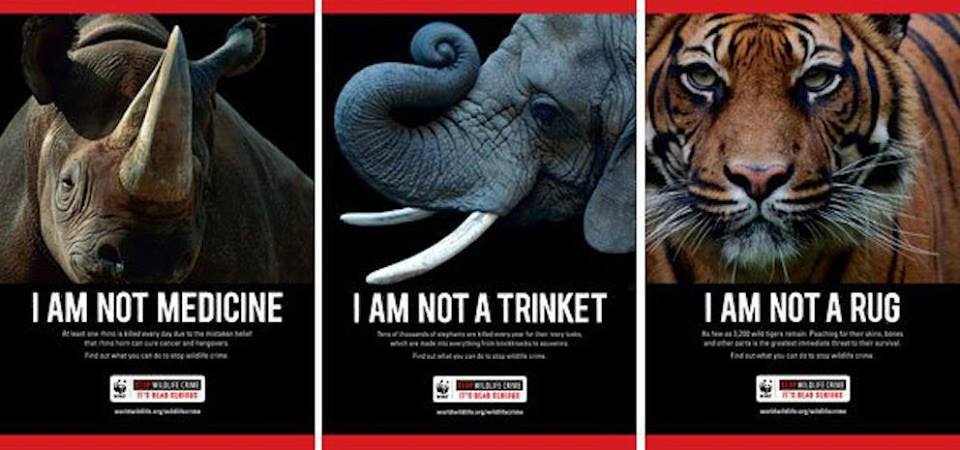
Wildlife crime is now the most… urgent threat to three of the world’s best-loved species—elephants, rhinos and tigers. The global value of illegal wildlife trade is between $7.8 and $10 billion per year.
I AM NOT MEDICINE At least one rhino is killed every day due to the mistaken belief that rhino horn can cure diseases. The main market is now in Vietnam where there is a newly emerged belief that rhino horn cures cancer. Rhino horn is also used in other traditional Asian medicine to treat a variety of ailments including fever and various blood disorders. It is also used by wealthy Asian as a cure for hangovers.
I AM NOT A TRINKET Tens of thousands of elephants are killed every year for their ivory tusks. In 1989, the Convention on International Trade in Endangered Species of Wild Fauna and Flora (CITES) banned the international trade in ivory. However, there are still some thriving but unregulated domestic ivory markets in a number of countries, which fuel an illegal international trade.
I AM NOT A RUG Every part of the tiger—from whisker to tail—is traded in illegal wildlife markets. Poaching is the most immediate threat to wild tigers. In relentless demand, their parts are used for traditional medicine, folk remedies, and increasingly as a status symbol among wealthy Asians.”
All information and text from the World Wildlife Fund. Find out more here: http://bit.ly/WH4SMk

Wolf Ledge
Photo By Jimmie Jones
Rally For Wolves Washington D.C. Speech given by Laurie Nalani Hall to the group attending.
Through The Eyes Of 06 …
“I love standing on this high ledge, I can see the entire Lamar Valley of Yellowstone National Park from here. This valley is my home, I was born here, and it is the home of my ancestors the famous Agate and Druid Peak Pack. The human’s call us the Royals of the wolves there. I don’t know what the term Royals means, but they are my family and my heritage.
My mother # 472F, taught me how to hunt, cooperate with my pack and care for my siblings. Without her I would have never learned our ways. I worked hard to become all she could want of me, and I was overjoyed when I succeeded. Oh to hear her howls of approval and pride of my efforts was a song to my soul. I love her so; she was so wonderful and wise. My father # 113M, he was so loving and wise. We were called then the Agate pack.
When I came of age I took to wandering around the area of the vast valley. I wanted to see what was behind every bush and under every rock. I did this for a couple of years then one day I ran into a couple of irresistible brothers out wandering as I was. Oh they were so good looking and sweet as any lady wolf could ever find. All my other suitors could not hold a candle to these brothers, they were where I wanted to be, and be with.
I sure put them through their paces to win me, and in spite of their being younger than me, they won my heart. We traveled together and had many an adventure. As nature moves in her seasonal cycles, I became a mother to the most beautiful babies and I had chosen the den of my ancestors to bring them into the world.
From that time to now, our family rules over the Lamar Valley. My daughters and sons have grown and gone their individual ways and that is how it should be. I taught them all I knew and they learned well. My eldest daughters, now grown have families of their own. My sons are off being their own alpha’s and have left the valley to do so.
I have younger children I did not get to teach and show the way to. The one winter I sought after some strange sounds coming from another territory and went to investigate. I was to come upon a human in the forest. I stood and looked at him; humans have always been good to me so I had no fear of him. I came closer and he stood staring at me. Then everything went black.
The beta brother to my mate had gone near here a short time ago and did not come back. We looked and looked for him, we called and called but there was no response. I just could not give up looking for him. I loved him so, and he was the children’s favorite uncle. He loved me and even took the second place in our Alpha team just to be with me and his brother. He was so loving and dedicated to his family. We miss him so much.
After everything went black, I was different. I could see and hear, but it was not as I remembered. My body felt nothing and would not move. Nothing I did could get it to respond. That frightened me. The man took my collar off, and then he carried my body away. I lost track of it after that.
My family came looking for me, they howled for me but when I howled back they could not hear me. I don’t understand what has happened?
Days came and went, and then my alpha mate took the family back home to the valley. They were so sad and confused. They would stop, look back and howl again for me, then continue their journey. Something kept me from them and them me. It was a horrible feeling and loss. I kept trying to reach them, but failed. My mother did not teach me about this part of life. I don’t understand this. I followed them back home and watched them. I no longer could touch or feel them. But I watched and I followed.
My elder daughter took over the yearlings and her other younger siblings. She was always dependable and strong. My beloved mate left the valley alone. He was grieving so deeply and I wanted to let him know I was right here with him but he could not see or hear me.
In a short time, my family broke apart. It hurt my heart to see them divide. They were so lost and confused and scrambling for survival. They were all so dependent on my showing them the way. I worry for them now.
My girls have come of age at such a bad time. They are following nature and seeking their mates and will soon be tending their own pups. Time goes by so fast.  I hope I have taught them enough to carry on without me and be successful with their own families.
So much has changed since that winter day I left the world of the Valley. I don’t understand how I got here or why. I keep re tracing my steps searching for a clue as to what it was that put me here. All I can remember last seeing was the human with a stick in his hands; he was pointing the stick at me. I just looked at him wondering if he was going to play a new stick game with me.
Then I was here.
Humans have never scared or hurt me; they were my neighbors in the valley. They would come and watch me and my family and be so excited when they saw us. It was so much fun then.
I still see many of the human’s that used to visit us. They are still in the valley, but my girls are not all there anymore.  I have two daughters that have returned to her homeland in the valley, and the oldest has had her first puppies. Oh they are so beautiful! They are so small a group I have some concerns of them being able to grow and remain there. So much has changed, so much has been destroyed. I howl and howl for their ability to live in safety and peace. I can only visit them in their memories and their dreams now, it is the only way for me to continue to be with them and guide them. And every time they sleep, I go to them and love them and reassure them I am close by them.
I love standing on this ledge that overlooks our valley. It is our home, it is where we belong. And I love it. My spirit will never leave home.”
**Special thanks to “Legend of Lamar Valley” for providing this information!

sheep wolf

© Flickr/Dennis Matheson (Wolf Picture)

“A Polish farmer has discovered a ‘stray puppy’ he had taken in to look after his sheep was actually a wolf.

Zbigniew Pieczyk, 50, from Podlasie, Poland only became aware of his slip-up after he heard the young wolf howling during the night.

“‘I thought it was a sheepdog pup or a German Shepherd,” Metro quotes Pieczyk as saying.

“Then when it started to howl every night I realized I’d made one hell of a mistake and I called the police.”

Sheep are the livestock most commonly killed by wolves in Europe, but luckily for the farmer in question his flock escaped unharmed.

The young wolf has now been returned to the wild.

In February 2013, the French government introduced a ‘National Wolf Plan’ to try and educate wolves not to attack sheep, but the idea was met with mixed reviews.”

**Special thanks to “Digital Spy,” http://www.digitalspy.com/odd/news/a512642/farmer-uses-wolf-to-watch-over-sheep-after-mistaking-it-for-a-dog.html, for providing this information!


snow wolf

“Recently an international group of prominent scientists have signed The Cambridge Declaration on Consciousness. This declaration proclaims their support for the idea that animals are conscious and aware to the degree that humans are. The list of animals includes all mammals, birds, and even the octopus.

The group consisted of cognitive scientists, neuropharmacologists, neurophysiologists, neuroanatomists, and computational neuroscientists. They were all attending the Francis Crick Memorial Conference on Consciousness in Human and Non-Human Animals. The declaration was signed in the presence of Stephen Hawking, and included such signatories as Christof Koch, David Edelman, Edward Boyden, Philip Low, Irene Pepperberg, and many others.

What is important here is the acknowledgement by the scientific community that many nonhuman animals possess conscious states. Because the body of scientific evidence is increasingly showing that most animals are conscious in the same way that we are, we can no longer ignore this fact when it comes to how we treat the animals in our world.

What has also been found is very interesting. It has been shown consciousness can emerge in those animals that are very much unlike humans, including those that evolved along different evolutionary tracks, namely birds and some encephalopods. The group of scientists have stated, “The absence of a neocortex does not appear to preclude an organism from experiencing affective states. Convergent evidence indicates that non-human animals have the neuroanatomical, neurochemical, and neurophysiological substrates of conscious states along with the capacity to exhibit intentional behaviors.”

The following are the observations made that were the reason for the signing of this declaration:

The field of Consciousness research is rapidly evolving. Abundant new techniques and strategies for human and non-human animal research have been developed. Consequently, more data is becoming readily available, and this calls for a periodic reevaluation of previously held preconceptions in this field. Studies of non-human animals have shown that homologous brain circuits correlated with conscious experience and perception can be selectively facilitated and disrupted to assess whether they are in fact necessary for those experiences. Moreover, in humans, new non-invasive techniques are readily available to survey the correlates of consciousness.

The neural substrates of emotions do not appear to be confined to cortical structures. In fact, subcortical neural networks aroused during affective states in humans are also critically important for generating emotional behaviors in animals. Artificial arousal of the same brain regions generates corresponding behavior and feeling states in both humans and non-human animals. Wherever in the brain one evokes instinctual emotional behaviors in non-human animals, many of the ensuing behaviors are consistent with experienced feeling states, including those internal states that are rewarding and punishing.

Deep brain stimulation of these systems in humans can also generate similar affective states. Systems associated with affect are concentrated in subcortical regions where neural homologies abound. Young human and nonhuman animals without neocortices retain these brain-mind functions. Furthermore, neural circuits supporting behavioral/electrophysiological states of attentiveness, sleep and decision making appear to have arisen in evolution as early as the invertebrate radiation, being evident in insects and cephalopod mollusks (octopus, etc.).

Raven with beautiful wings in the down stroke flying over water.

Birds appear to offer, in their behavior, neurophysiology, and neuroanatomy a striking case of parallel evolution of consciousness. Evidence of near human-like levels of consciousness has been most dramatically observed in African grey parrots. Mammalian and avian emotional networks and cognitive microcircuitries appear to be far more homologous than previously thought. Moreover, certain species of birds have been found to exhibit neural sleep patterns similar to those of mammals, including REM sleep and, as was demonstrated in zebra finches, neurophysiological patterns, previously thought to require a mammalian neocortex. Magpies in articular have been shown to exhibit striking similarities to humans, great apes, dolphins, and elephants in studies of mirror self-recognition.

In humans, the effect of certain hallucinogens appears to be associated with a disruption in cortical feed-forward and feedback processing. Pharmacological interventions in non-human animals with compounds known to affect conscious behavior in humans can lead to similar perturbations in behavior in non-human animals. In humans, there is evidence to suggest that awareness is correlated with cortical activity, which does not exclude possible contributions by subcortical or early cortical processing, as in visual awareness. Evidence that human and nonhuman animal emotional feelings arise from homologous subcortical brain networks provide compelling evidence for evolutionarily shared primal affective qualia.”

**Special thanks to “White Wolf Pack”, http://www.whitewolfpack.com/2012/08/scientists-sign-declaration-that.html, for providing this information!


dog in trap

“With the support of the Ontario government, children ages 12 to 15 will be taught how to cruelly kill wildlife by two hunting and trapping lobby groups.

In a press statement issued Wednesday, the Ontario Federation of Hunters and Anglers (OFAH) and the Ontario Fur Managers Federation (OFMF) ‘congratulated’ the Ontario Ministry of Natural Resources (MNR) on the introduction of a youth trapping program.

“Trapping is considered an activity of significant historical, social, cultural and economic value in Ontario for centuries, and one that results in economic benefits to the communities and individuals,” said Minister of Natural Resources David Orazietti in the statement. “Ontario trappers have worked tirelessly for many years towards a program like this which will guide youth to be safe and responsible trappers.”

This disturbing news begs the question: why are our tax dollars supporting a trade that most residents abhor? Why are we supporting an activity that is wholly dependent on the suffering of innocent wild animals? And why is history being ignored?

The history of trapping in Canada is not a glorious, character-building activity. It led to the extinction of the sea mink; it nearly destroyed beaver populations across the continent; it has ripped apart ecosystems; and it has caused suffering to immeasurable levels.

We ask MPP Orazietti if he has ever held a dying animal in his arms, looked into its eyes and seen the fear, the pain and terror it must experience while in the clutches of a trap. We ask him if he has sat with the growing number of families who have lost pets to the mindless devices. We ask him if, after making this deal, he has any humanity left.

Send a letter to your local MPP and MPP Orazietti to tell them to end this madness. Tell them the truth behind trapping and the fur trade. And tell them that any politician that supports this archaic and cruel activity will never represent you.

Use our form letter below to let your MPP know what you think. MPP and Minister of Natural Resources David Orazietti can be reached by email, phone, fax, or snail mail with these details:”

dorazietti.mpp@liberal.ola.org

Room 202, 2nd Floor
432 Great Northern Road
Sault Ste Marie, Ontario P6B 4Z9

Phone: 705-949-6959
Fax: 705-946-6269

**Special thanks to “The Association for the Protection of Fur Bearing Animals (http://www.furbearerdefenders.com/blogs/blog/63-08-2013/361-ontario-wants-to-teach-kids-to-kill)” for providing this information!


arabian wolf

“Although it became well known in 2010 that all dogs originated from wolves in the Middle East instead of Asia, the fear of them is still very ingrained in the people there. It was over 15,000 years ago that the first non-nomadic hunter/gatherer communities began to intervene in the breeding patterns of wolves, thereby turning them into the first domesticated dogs. But this fact has been long forgotten by many in that region.

There are currently two subspecies of the Gray wolf that live in the Middle East. One is the Iranian wolf which is the only wolf species in the world that is not in danger of extinction. They can be found in diminishing numbers throughout Iran, Israel, Turkey, and Saudi Arabia. The other Middle Eastern wolf is the Arabian wolf, which is found in Israel, Iraq, Jordan, Oman, Saudi Arabia, and Yemen, and possibly some parts of the Sinai Peninsula in Eygpt.

Although these wolves are all over the Middle East, there are only two countries that subscribe to the notion that wolves have the right to coexist with man as part of the natural ecosystem. Those two countries are Oman and Israel and they have both given the wolves legal protection. In Israel for example, they have taken extraordinary measures to protect the wolves. Some of these measure include paying for electric fencing, using various species of guard dogs to deter wolves and the government also offers partial compensation for livestock losses. In the country of Oman the wolf population is on the rise. This has been attributed to a hunting ban that was put in place there. Oman has a very strong conservationist stance in comparison to the rest of it’s Middle Eastern neighbors.

As for the rest of the Middle Eastern countries such as in Iran, Jordan, Iraq, Turkey, Syria etc. the wolves are not doing as well. Here they are often looked as a pests that needs to be eradicated. In Saudi Arabia for example, the bodies of wolves can often be seen hanging from billboards as a message. It is widely claimed that many Saudis still kill the wolves as trophies. In other Middle Eastern countries wolves are hunted, poisoned, and run over.

This kind of outlook towards the wolves will not change however until the populations there become better educated. Currently in several of the Middle Eastern countries there are a few environmental organizations that are trying to work with the communities to help them better understand the wolves and their habitats and in turn minimize human and wolf conflicts. Godspeed to these organizations and may there be many more soon.”

**Special thanks to “White Wolf Pack” for providing this information (http://www.whitewolfpack.com/2011/12/only-2-countries-in-middle-east-protect.html)!


Dog protector

(photo above: Great Pyrenees protecting its flock at the Marcia Barinaga Ranch in Marin County, CA – Keli Hendricks/ProjectCoyote.org )

“In the picturesque community of Marin County California- just North of San Francisco- public controversy over the use of poisons, snares, “denning” (the killing coyote and fox pups in their dens), and other lethal methods led to a majority decision by the Marin County Board of Supervisors to stop contracting with the U.S. Department of Agriculture’s Wildlife Services predator control program in 2000. Instead the Board approved an alternative community-based program to assist ranchers with livestock-predator conflicts known as the Marin County Livestock and Wildlife Protection Program (hereafter MCLWPP), a collaborative effort involving multiple stakeholders from local wildlife protection organizations to ranchers, scientists, and county government officials (Fox 2008).

The MCLWPP initiated cost-sharing to help ranchers install or upgrade fencing and other livestock-protection infrastructure, install predator-deterrents and detectors, and purchase and sustain guard dogs and llamas, coupled with indemnification for any ensuing verified livestock losses to predators.  Improved animal husbandry practices combined with these economic and technological incentives led to its early success (Agocs 2007, Fox 2008). Participants do not give up their rights to kill predators consistent with state and federal laws. Rather than contract with the USDA Wildlife Services (WS) for the provision of personnel to kill coyotes and other wildlife, the county assigns personnel and allocates money to help stock-owners prevent depredations solely through non-lethal means. To qualify for the MCLWPP, ranchers must have 25 or more head of livestock and must utilize at least two non-lethal predation deterrent methods verified through inspection by the office of the Marin County Agricultural Commissioner, thereby becoming eligible for cost-share indemnification for any ensuing losses to predation.

Five years after implementation of the MCLWPP, a research assessment was conducted (Fox 2008) that compared the former Wildlife Services program to the MCLWPP, with regard to rancher satisfaction and preferences, lethality to predators, livestock losses, use of non-lethal predator deterrent techniques, and costs. The study, conducted through a variety of quantitative and qualitative methods, including a comprehensive survey of ranchers who participated in the MCLWPP, documented the non-lethal cost-share program (1) had support from a majority of participating ranchers, (2) was preferred over the USDA Wildlife Service’s traditional predator management program by a majority of participating ranchers, (3) helped to reduce livestock losses, (4) resulted in an increase in the use of non-lethal predation deterrent methods by a majority of participating ranchers, (5) likely reduced the total number of predators killed to protect livestock, (6) reduced the spectrum of species of predators killed to protect livestock, and (7) fewer species of predator were killed.

In 2012, the San Francisco Chronicle (Fimrite 2012) reported that 26 Marin County ranchers participated in the County program[1] utilizing 37 guard dogs, 31 llamas and over 30 miles of fences, to protect 7,630 sheep that were pastured on 14,176 acres. Coyote depredation on sheep in the county, though it fluctuated, declined steadily from 236 in fiscal year 2002-03 to 90 in fiscal year 2010-11 – a 62% reduction – with fourteen ranchers recording no predation losses and only three ranchers losing over ten sheep during the following year. According to Marin Agricultural Commissioner, Stacy Carlsen, who oversees implementation of the non-lethal cost-share program, “losses fell from 5.0 to 2.2 percent while program costs fell by over $50,000. For the first couple of years we couldn’t tell if the loss reductions were a trend or a blip. Now, we can say there’s a definite pattern and livestock losses have decreased significantly.” Carlsen also noted “This innovative model sets a precedent for meeting a wider compass of community needs and values where both agriculture and protection of wildlife are deemed important by the community. The success of our county model has set the trend for the rest of the nation.”

The heart of Marin County’s results-driven program lies in its eschewing of a governmental role in assisting in the destruction of wildlife, which makes the assistance in preventing depredations all the more attractive and ultimately successful. Though some specific methods in the MCLWPP may not prove equally efficacious or even feasible in other environments – for example fencing on federal lease lands that could disrupt wildlife migration corridors – the MCLWPP provides a provides a cost-effective and ecologically beneficial model to address carnivore-livestock conflicts by integrating modern science, ethics, and economics. Such innovative prototyping that incorporates adaptive management strategies provides a template to guide the development of other non-lethal programs across differing landscapes to address the age-old predicament of raising livestock in an environment that includes predators (Fox 2008).

LITERATURE CITED:

Agocs, C.  2007.   Making Peace with Coyote.   Bay Nature (January 1, 2007). Berkeley, CA. Available from: http://baynature.org/articles/making-peace-with-coyote/   (accessed May 5, 2013)

Fimrite, P.  2012.  Ranchers shift from traps to dogs to fight coyotes.  San Francisco Chronicle (P. 1, April 27, 2012). San Francisco, CA. Available from: http://www.sfgate.com/science/article/Ranchers-shift-from-traps-to-dogs-to-fight-coyotes-3514405.php  (accessed May 5, 2013)

Fox, C. H.  2008.  Analysis of the Marin County strategic plan for protection of livestock and wildlife, an alternative to traditional predator control. M.A. thesis, Prescott College, AZ. 120 pp. Larkspur, CA.

Project Coyote is a national non-profit organization based in Marin County, California promoting compassionate conservation and coexistence between people and wildlife through education, science, and advocacy. For more information visit: ProjectCoyote.org


[1] According to Marin County Agricultural Commissioner Stacy Carlsen, all commercial ranches were participating in the MCLWPP as of May 2013.”

Project Coyote
P.O. Box 5007
Larkspur, CA 94977

Trap Law

Courtesy              

Gov. Jerry Brown’s dog Sutter puts his paw of approval on AB 789. From left: Jennifer Fearing, California Senior State Director for the Humane Society of the United States; Assembly member Das Williams; and Leslie Villegas, legislative aide to Williams.

“A wildlife trapping bill authored by Assemblymember Das Williams to protect animals from potentially cruel and unusual deaths was signed into law by Governor Jerry Brown this Tuesday.

AB 798, which amends a section of California’s Fish and Game code, imposes new restrictions on a particularly brutal kind of trap — the conibear — and makes it illegal for private nuisance wildlife control operators (NWCOs) to kill the animals they catch with disturbing but previously lawful methods such as drowning, chest crushing, and the injection of chemical solvents like nail polish remover.

“We must take great care with all of our animals,” said Williams. “Even so-called ‘nuisance wildlife’ deserves to be treated humanely. It is time we hold trappers to a higher standard and demand that they end their severely cruel killing practices.”

Supported by 20 different animals rights groups and organizations — but opposed by the California Department of Fish and Wildlife — the bill prohibits the use of body-gripping conibear traps that are bigger than six inches by six inches (unless they’re in water) and mandates the posting of warning signs when they’re set on public land. Domestic dogs and cats, Williams said, are often accidentally killed by conibears.

“We share this planet with wildlife,” Williams said. “Animals cannot speak for themselves so we must speak for them and stop their torturous, slow and painful deaths.”

**Special thanks to Tyler Hayden, http://www.independent.com/news/2013/aug/28/dass-wildlife-trapping-bill-signed-law/, for providing this information!