- How many prey animals do wolves kill per year?
Wolves depend on a variety of large ungulates (hoofed animals) for food. Although studies have been conducted in some areas to determine the actual number of prey killed each year, the results are estimates. For example, an estimate for deer ranges from 15 to 19 adult-sized deer per wolf per year. Given the 2008 estimate of 2922 wolves in Minnesota, for instance, that would equal 43,800 to 58,500 deer killed by wolves. In comparison, hunters killed approximately 260,000 deer in the 2007 deer harvest. Additionally, several thousand deer are killed during collisions with vehicles each year.
- How many wolves are in a pack?
Pack size is highly variable and fluid because of the birth of pups, dispersal, and mortality. Prey availability and size are also factors. Where prey animals are smaller, packs are often small. Where prey is large, the packs may be larger. For example, in Alaska and northwestern Canada some packs reportedly have over 20 members. One pack (Druid Peak pack) in Yellowstone National Park once swelled to over 30 members, but this is highly unusual and not necessarily an advantage. More pack members means more food must be obtained. Wolf packs are generally largest in late autumn when the nearly-grown pups are strong enough to hunt with the adults. Over the winter months, some wolves may disperse to find mates and territories of their own. Others die, and by spring, before the arrival of a new crop of pups, the pack size has often diminished.
Red wolf packs are generally smaller than gray wolf packs and usually have 2 to 8 members, but a pack of 12 has been observed in the wild.
Wolves breed once a year in late winter or early spring depending on where they live. For example, gray wolves in the Western Great Lakes region breed in February to March, while gray wolves in the arctic may breed a few weeks later – in March to April.
Red wolves usually breed in late January or early February.
- What is the gestation (pregnancy) period of a wolf?
The gestation period (length of pregnancy) of gray and red wolves is usually around 63 days.
- How many pups are born in a pack each year?
A mature female wolf comes into estrus once a year. Thus, a breeding pair produces one litter of pups each spring, but in areas of high prey abundance more than one female in a pack may give birth. An average litter size for gray and red wolves is 4 to 6, but sometimes fewer pups are born and sometimes more. Several or all may die if food is not readily available for the fast-growing youngsters. Additionally, other predators and diseases such as distemper and canine parvovirus may kill young pups.
- How much do wolf pups weigh?
Gray and red wolf pups weigh about a pound at birth. The newborns are blind and deaf and depend upon their mother for warmth. In about two weeks, their eyes open, and in three weeks, they emerge from the den and begin to explore their world. Growth is rapid, and by the time the pups are 6 months old, they are almost as big as the adults.
- How much do adult wolves weigh?
Wolves vary greatly in size depending on where they live. The smallest wolves live in the southern parts of the Middle East where the Arabian wolf may weigh no more than 30 pounds. Adult female gray wolves in northern Minnesota weigh between 50 and 85 pounds, and adult males between 70 and 110 pounds. Gray wolves are larger in the northwestern United States, Canada, and Alaska and in Russia where adult males weigh 85 to 115 pounds and occasionally reach 130 pounds. Males generally weigh about 20 percent more than females. Wolves attain their adult height, length and weight in the first one to two years. Most look like adults by late autumn of their first year.
Red wolves are intermediate in size and appearance between a gray wolf and a coyote. Adult female red wolves weigh 40 to 75 pounds, while males weigh from 50 to 85 pounds.
- How long and tall are wolves?
As with weight, a wolf’s length and height are variable in different areas of the world. The figures that follow are commonly used to describe the larger subspecies of wolves in North America, Europe and central Asia. They are not accurate for several of the smaller subspecies in the southern latitudes of the Middle East, for example. The average length (tip of nose to tip of tail) of an adult female gray wolf is 4.5 to 6 feet; adult males average 5 to 6.5 feet. The average height (at the shoulder) of a gray wolf is 26 to 32 inches.
The average length (tip of nose to tip of tail) of an adult red wolf is 4.5 to 5.5 feet. The average height (at the shoulder) of an adult red wolf is about 26 inches.
- How big is a wolf’s track?
The size of a wolf’s track is dependent on the age and size of the wolf, as well as the substrate the track was made in. A good size estimate for a gray wolf’s track size is 4 1/2 inches long by 3 1/2 inches wide. In comparison, a coyote’s track will be closer to 2 1/2 inches long by 1 1/2 inches wide. Only a few breeds of dogs leave tracks longer than 4 inches (Great Danes, St. Bernards, and some bloodhounds). Red wolves have smaller feet than gray wolves.
All wolves have feet superbly adapted to long-distance travel over different types of terrain and through (and over!) snow. The wolf’s blocky feet and long, flexible toes conform to uneven terrain, thus allowing the animal to maintain speed when necessary as well as a tireless, ground-eating trot when traveling.
- How many teeth does an adult wolf have?
Adult gray and red wolves have 42 highly specialized teeth, while adult humans have 32. The canine teeth, or fangs, can be 2 1/2 inches long and are used for puncturing and gripping. The incisors are for nipping small pieces of meat; the carnaissial teeth are like scissors and knives. Wolves use them to sheer flesh away from bones. Molars are for grinding and crushing.
- How strong are wolves’ jaws?
The massive molars and powerful jaws of a wolf are used to crush the bones of its prey. The biting capacity of a wolf is 1,000 to 1,500 pounds of pressure per square inch. The strength of a wolf’s jaws makes it possible to bite through a moose femur in six to eight bites. In comparison, a German shepherd has a biting pressure of 750 pounds per square inch. A human has a much lower biting pressure of 300 pounds per square inch.
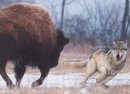
Wolves are carnivores, or meat eaters. Gray wolves prey primarily on ungulates – large, hoofed mammals such as white-tailed deer, mule deer, moose, elk, caribou, bison, Dall sheep, musk oxen, and mountain goats. Medium-sized mammals, such as beaver and snowshoe hares, can be an important secondary food source. Occasionally wolves will prey on birds or small mammals such as mice and voles, but these are supplementary to their requirements for large amounts of meat. Wolves have been observed catching fish in places like Alaska and western Canada. They will also kill and eat domestic livestock such as cattle and sheep, and they will consume carrion if no fresh meat is available. Some wolves eat small amounts of fruit, although this is not a significant part of their diet. If prey is abundant, wolves may not consume an entire carcass, or they may leave entire carcasses without eating. This is called “surplus killing” and seems inconsistent with the wolves’ habit of killing because they are hungry. Surplus killing seems to occur when prey are vulnerable and easy to catch – in winter, for instance, when there is deep snow. Since wolves are programmed to kill when possible, they may simply be taking advantage of unusual situations when wild prey are relatively easy to catch They may return later to feed on an unconsumed carcass, or they may leave it to a host of scavengers. Additionally, they may cache food and dig it up at a later time.
Red wolves primarily prey on white-tailed deer, raccoons, rabbits, nutria and other rodents.
Getting enough to eat is a full-time job for a wolf. When wolves catch and kill a large mammal, they will gorge and then rest while the food is being rapidly digested. They will generally consume all but the hide, some of the large bones and skull and the rumen (stomach contents of ungulates) of their prey. Gray wolves can survive on about 2 1/2 pounds of food per wolf per day, but they require about 7 pounds per wolf per day to reproduce successfully. The most a large gray wolf can eat at one time is about 22.5 pounds. Adult wolves can survive for days and even weeks without food if they have to. Growing pups, however, require regular nourishment in order to be strong enough to travel and hunt with the adults by the autumn of their first year. Wolves often rely on food they have cached after a successful hunt in order to see them through lean times.
Red wolves may eat 2 to 5 pounds of food per day when prey is abundant. Because they are smaller than gray wolves, they can consume less at one time than their larger cousins. But like all wolves, eating for red wolves is a matter of “feast” followed by “famine.”
- How many prey animals do wolves kill per year?
Wolves depend on a variety of large ungulates (hoofed animals) for food. Although studies have been conducted in some areas to determine the actual number of prey killed each year, the results are estimates. For example, an estimate for deer ranges from 15 to 19 adult-sized deer per wolf per year. Given the 2008 estimate of 2922 wolves in Minnesota, for instance, that would equal 43,800 to 58,500 deer killed by wolves. In comparison, hunters killed approximately 260,000 deer in the 2007 deer harvest. Additionally, several thousand deer are killed during collisions with vehicles each year.
It is misleading to say that wolves in the wild live an average of a certain number of years. There are so many variables. Some wolves die soon after they are born, and others are killed or die in early or middle adulthood. Members of the dog family like wolves and domestic dogs can live to be 15 or 16 years old – sometimes even older. Dogs and wolves in captivity have a better shot at making it to a ripe old age because they usually receive routine veterinary care and regular meals. However, wild wolves have a tough life filled with pitfalls (see question #19). Many pups don’t make it through the first winter of their lives. Those that survive the first two years have a pretty good chance of living another two to four years if they can avoid fatal injury and if they can get enough to eat. Some wild wolves do live to be 9 or 10, and there are verified records of a few living into their early teens.
The natural causes of wolf mortality are primarily starvation, which kills mostly pups, and death from other wolves because of territory fights. Diseases such as mange, canine parvovirus and distemper can be killers both in small and recovering populations and in some established populations as well. Evidence suggests, however, that large wolf populations build up a resistance to canine parvovirus. Lyme disease also infects wolves, and heartworm can reduce a wolf’s endurance by restricting blood flow to the lungs. Injuries caused by prey result in some deaths. The large mammals that wolves hunt and kill can inflict mortal injuries with antlers and hooves. Human-caused mortality including legal (hunting and trapping in some locales) and illegal (poaching) activities can be high in some populations. Wolves are sometimes hit by cars in areas where road density is high. Pup mortality rates are highly variable, but approximately 40 to 60% of wolf pups die each year.
Wolves will travel for long distances by trotting at about five miles per hour. They can run at speeds of 36 to 38 miles per hour for short bursts while chasing prey. Although bursts of maximum speed are relatively short, wolves can maintain pursuit of running prey animals for long distances and over rough terrain.
- How far can wolves travel?
Wolves are hunters, and they travel far and wide to locate prey. They may travel 50 miles or more each day in search of food, and they are superbly designed for a life on the move. Because their elbows turn inward, their lean bodies are precisely balanced over their large feet. With their long legs and ground-eating stride, they can travel tirelessly for hours on end with no energy wasted. Dispersing wolves, those leaving packs in search of their own mates, have been known to travel hundreds of miles away from their home territory. Satellite and Global Positioning Satellite (GPS) collars allow researchers to document the truly remarkable travels of wolves.
The howl of the wolf is one of nature’s most evocative and powerful sounds. The haunting chorus of wolves howling is beautiful – or frightening depending on one’s point of view. Wolves howl to communicate with one another. They locate members of their own pack by howling, and they often engage in a group howl before setting off to hunt. The howl is a clear warning to neighboring wolves to stay away.
- Are wolves dangerous to people?
In a word, the general answer is no. Wolves typically avoid people. BUT! There are several well-documented accounts of wild wolves attacking people in North America, and although there were no witnesses, a 2007 inquest determined that a young man killed in northern Saskatchewan in 2005 died as a result of a wolf attack. Accounts of wolves killing people persist in India and in Russia and parts of central Asia. It is a fact that when wild animals become habituated to people, they may lose their fear of humans, especially if they are fed or if they associate humans with providing food. Like any large predator, wolves are perfectly capable of killing people. No one should ever encourage a wolf or any other wild animal to approach, and hikers and campers should take all necessary precautions to prevent mishaps involving wildlife.
*Special Thanks to the International Wolf Center for this wonderful information!
Read Full Post »


 The Wolf Preservation Blog