While this an older story, let’s not forget the positive impacts wolves have in Yellowstone. Take a look and share your comments!
December 30, 2011 By Joshua S Hill
“Fifteen years after wolves were returned to Yellowstone National Park the health of the overall ecosystem is overwhelming and obvious.
This is the observation made by scientists in a new report published in the journal Biological Conservation.
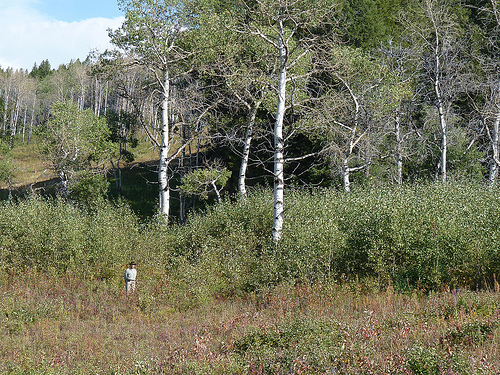
For the first time in 70 years, the young aspen and willow trees are not being eaten before they have a chance to flourish and grow by the elk populations in northern Yellowstone, thanks to the introduction of wolves back into the park. The elk are beginning to decline and are also beginning to fear wolf predation.
As such, trees and shrubs are recovering along some streams, which in turn provide improved habitat for beaver and fish, and provide more food for birds and bears.
“Yellowstone increasingly looks like a different place,” said William Ripple, a professor in the Department of Forest Ecosystems and Society at Oregon State University, and lead author of the study. “These are still the early stages of recovery, and some of this may still take decades. But trees and shrubs are starting to come back and beaver numbers are increasing. The signs are very encouraging.”
The findings released in the report are based on a recent analysis conducted by Oregon State University researchers as well as a review of several other studies.
The report outlines four streams that were studied in the Lamar River basin. 100 percent of the tallest young aspen sprouts were being browsed in 1998, but that number has dropped to just 20 percent in 2010. As a result of the total browsing by elk, the new aspen trees were unable to grow and expand, grinding to a halt in the mid to late 1990s. And all because the wolves weren’t around to snack on the snackers.
This is the observation made by scientists in a new report published in the journal Biological Conservation.
Among the observations in this report:
- Since their reintroduction in 1995-96, the wolf population generally increased until 2003, forcing changes in both elk numbers and behavior due to what researchers call the “ecology of fear.”
- The northern range elk populations decreased from more than 15,000 individuals in the early 1990s to about 6,000 last year, and remaining elk now have different patterns of movement, vigilance, and other traits.
- By 2006, some aspen trees had grown tall enough they were no longer susceptible to browsing by elk, and cottonwood and willow were also beginning to return in places.
- Improved willow growth is providing habitat that allows for a greater diversity and abundance of songbirds such as the common yellowthroat, warbling vireo and song sparrow.
- The number of beaver colonies in the same area increased from one in 1996 to 12 in 2009, with positive impacts on fish habitat.
- Increases in beaver populations have strong implications for riparian hydrology and biodiversity – Wyoming streams with beaver ponds have been found to have 75 times more abundant waterfowl than those without.
- The coyote population decreased with the increase in wolf numbers, potentially allowing more small mammals that provide food for other avian and mammalian predators, such as red foxes, ravens and bald eagles.
Evidence of improved ecosystem health following the return of wolves is “becoming increasingly persuasive,” the scientists said in their report, though they also note that an increasing population of bison is continuing to impact young woody plants in the Lamar Valley.
“The wolves have made a major difference in Yellowstone,” said Robert Beschta, a professor emeritus of forestry at OSU and co-author on the study.
“Whether similar recovery of plant communities can be expected in other areas, especially on public lands outside national parks, is less clear,” Beschta said. “It may be necessary for wolves not only to be present but to have an ecologically effective density, and mechanisms to deal with human and wolf conflicts also need to be improved.”
“Predation and predation risk associated with large predators appear to represent powerful ecological forces,” the researchers concluded in their report, “capable of affecting the interactions of numerous animals and plants, as well as the structure and function of ecosystems.”

