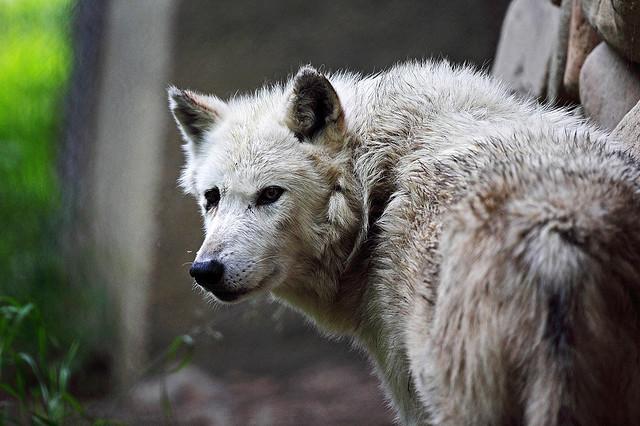
“I was appalled after seeing one-fourth of Minnesota’s wolf population killed in 2012, shortly after federal de-listing from Endangered Species status.
I have three primary concerns in regard to the wolf issue:
- Public input was not acknowledged.
- The Department of Natural Resources (DNR) failed to live up to its promise — as outlined in its Wolf Management Plan — to follow a 5-year wait after federal de-listing.
- We need to be more careful when considering the longevity of the wolf.
In our democracy, prevailing public attitudes usually shape public policy. With the wolf hunt, it is small interest groups of trophy hunters and cattle raisers that are getting their way. In every poll that I have seen, the majority of Minnesotans do not want a wolf hunt. As Sen. Chris Eaten has pointed out, we’ve pumped a lot of money into wolf survival, and as soon as protection is removed that money is down the drain.
The International Wolf Center sponsored a study in 1999 by Stephen Kellert, Ph.D., of Yale University, to measure public attitudes toward wolves in Minnesota; and the DNR published a poll in 2012 to assess public attitudes on wolves. Dr. Kellert’s study concluded:
“The wolf is especially appreciated by Minnesota residents for its nonconsumptive value. By contrast, a majority of both northern and non-northern Minnesota residents remain skeptical about harvesting the animal for either fur or for sport, and are concerned that these forms of consumptive use could result in excessive and unsustainable mortality.”
The DNR’s 2012 poll had similar findings:
“79% of respondents oppose wolf hunting.”
So why aren’t our voices being considered? The majority of Minnesota’s residents value wolves.
‘Primary clients, hunters and trappers’
Last month, I became aware that the DNR feels that its primary clients are hunters/trappers and livestock producers. This was confirmed through an Internal email that the organization Howling for Wolves commissioned through the Data Practices Act. In the email DNR officials state that, “we owe it to our primary clients, hunters and trappers, and to livestock producers as secondary clients, to do what we can to establish a legitimate harvest opportunity now that the wolf is under our management authority.”
Now I understood why the hunt came to fruition so quickly.
Are we really leaving the protection of wolves up to hunters/trappers and cattle producers (the DNR’s primary clients)? It doesn’t look like a sound or logical plan to me. As we have seen in our country’s history, cattlemen and trophy hunters decimated entire wolf populations throughout the lower 48 states. I am confident that history often repeats itself.
Decline of the moose
Elk, moose, bison, caribou and wolves used to occupy most of Minnesota. Based on my knowledge about the DNR’s management of moose in Minnesota and their sudden population decline for reasons outside of our control, there is good reason to believe the wolf population is at stake. This has been evident in the DNR’s management of moose. According to the DNR Moose Management Plan, “Minnesota’s moose (Alces alces) population, currently concentrated in the northeast corner of the state, is facing a decline where the cause is not understood.”
In 2012, there are 4,230 moose; in 2005 there were double that at approximately 8,150 (2012 Aerial Moose Survey.) The balance of life is fragile, and we can’t always rely on mathematical population models to determine success.
In every argument, I believe that one should acknowledge the other side’s position and a solution should be addressed. Without the protection from the law, I fear for the longevity of the wolf. History has shown me that hunters and cattle raisers are not responsible stewards of wolves. I am even more fearful because the agency that is supposed to work without bias has demonstrated its preference in aligning with hunters/trapper and cattlemen.
Poor process
If the DNR had come up with some sound baseline data and research, considered public comment, abided by their wolf management plan, and consulted with tribal nations on the sacredness of wolves, maybe I would have just bit my tongue in opposing the wolf hunt.
For the sake of meeting in the middle, a more sustainable number — like 5 percent, as suggested by one biologist I spoke to during my research — would have been more appropriate.
So the battle goes on. Minnesotans are needed to take action and contact Sen. David Tomassoni, chair of the Environment, Economic Development and Agriculture Committee, and Gov. Mark Dayton to be the voice to help preserve Minnesota’s wolves and the future of our state.
WANT TO ADD YOUR VOICE?
If you’re interested in joining the discussion, add your voice to the Comment section below, or consider writing a Community Voices commentary. For more information about Community Voices, email Susan Albright at salbright@minnpost.com.”
**Special thanks to Nicole Hendrickson, educator and resident of Brooklyn Park, and a volunteer for Howling for Wolves and Northwoods Wolf Alliance. She is an enrolled member of the Sokaogon Ojibwe community (http://www.minnpost.com/community-voices/2013/04/are-we-really-leaving-future-minnesotas-wolves-hunterstrappers-and-livestock).
 The Wolf Preservation Blog
I am extremely upset that my home state of Minnesota should offer such little regard to our friend the wolf. Shame on those in authority! You have not listened to the majority of Minnesotans, but instead you go ahead with your own selfish greed, and that of the hunters, trappers and livestock ranchers. Never mind the time and money that has been put forth to save the wolf, and those wanting to see its beauty remain on the landscape. I find this appalling, and very stressful, and I would expect to see this remedied at once!
I feel exactly the same Donna! The key is education and exposing all of this to everyone. Look for any state pro-wolf agency in Minnesota, ask if you can promote their information (posters, ect), and post the information at different places (bulletin boards at supermarkets, libraries, ect.) You can also send a short letter to your state representatives, even though you may only receive a pre-written response. Re-post this article on your facebook page, share with everyone you know, and encourage them to write a letter or advertise what is going on in Minnesota. You can even set up a booth to share this information at your local library, with their permission. I’ve done it before and got the word out to many people!
It is very sad that a government body is up the backside of ranchers etc.
Regards, Oliver Craig