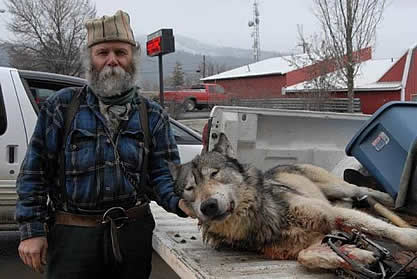
Wolf supporters, as the wolf hunt continues, even when a certain quota is reached, many do not realize how the loss of a pack member effects the rest of their unit. With the loss of any older, more experienced members of a wolf pack, the younger ones struggle to learn about how to hunt. Eventually, this can lead to starvation. I encourage you to share your comments, feedback, and tell me how losing a member of a wolf pack can effect rest of the pack after reading the article below:
November 20th, 2012
“Wolf hunting season has begun in several states, and hundreds of the animals already have been killed. It’s the first time in years that wolves have been legally hunted in Wyoming and Minnesota, and the decision has drawn the ire of many conservationists and some scientists.
Gray wolves have long been a point of contention between ranchers, who see them as pests that eat their livestock, and conservationists, who see the critical part the play in the ecosystem. Recently, as state laws changed and the animals were taken off the federal endangered species list, hunters have taken aim.
About 50 wolves have been killed in Wyoming, where they can be shot on sight without a permit in about 85 percent of the state, according to news reports. Seven of the dead wolves once lived in Yellowstone National Park, where wolves are still protected; they wandered outside the park and were legally shot, Reuters reported. (Scientists put collars on the Yellowstone wolves as part of a park research program.)
Wyoming’s wolf population was estimated at 328 before the hunt. The state’s plan, approved by the U.S. Fish and Wildlife Service, requires that the population of wolves remain above 100 outside Yellowstoneand the Wind River Reservation. That figure is cited by conservationists as dangerously low.
In nearby Idaho, 96 wolves have been killed, according to the Coeur d’Alene Press.
During last year’s hunting season, 545 wolves in Idaho and Montana were killed. This year both states got rid of their statewide quotas, or upper limit on number of kills, according the Center for Biological Diversity. The center, along with the Natural Resources Defense Council and other environmental groups, is suing the U.S. Fish and Wildlife Service, accusing it of failing to adequately protect the animals. Other suits are pending in various states.
Back from the brink?
Wolves were hunted, trapped and poisoned to the brink of extinction in the 20th century, and they rebounded only after being protected under the Endangered Species Acts of the 1960s and subsequently being re-introduced to Yellowstone. Much of the Northern Rockies sub-population of gray wolves lost federal protections last year following a controversial rider placed in U.S. budget legislation.
The wolf hunt in Minnesota is also under way and has met with opposition. The 147 wolves killed in that state are about twice what the Department of Natural Resources expected, according to the Associated Press. The second phase of the hunting season begins Saturday (Nov. 24), during which wolves can be trapped, a technique that conservationists and some hunters call cruel.
Minnesota’s earlier wolf-management plan stated that the animals couldn’t be hunted for five years after being removed from the federal protection provided by the Endangered Species Act — which happened in January, 2012. Instead of opening a formal comment period, the DNR offered only an online survey, according to the Center for Biological Diversity. More than 75 percent of people taking the poll opposed the wolf hunt: Of 7,351 responses, only 1,542 people supported a wolf season. Even so, that five-year waiting period was not upheld.
In Wisconsin, hunters had killed 83 wolves as of Nov. 18, according to the Badger Herald. The hunting season there will run through the end of February unless hunters reach the 116-wolf quota before then.”
**Special thanks to “Live Science” for providing this information! (http://www.livescience.com/24942-wolf-hunt-begins.html)
 The Wolf Preservation Blog
Okay wolf supporters, post feedback to the following question: How can the loss of a pack member affect rest of the wolf pack? Wolf Preservation wants to hear your comments! Go!!
Since wolves, like humans, are social animals, their survival depends on working together as a “family”. Imagine the United States as a whole as a family then kill off the leaders, the decision makers, the providers, the ones who are capable of breeding, and leave only the ones under twelve years of age to attempt to survive by themselves; uneducated, not “street-wise”, and not having any older family members to teach them the important rules of surviving. Like children, young wolves need discipline. Without discipline and rules, life as a society would be unknown. Yes, the remaining group would go on to survive and breed, but they will not have the education of the parents and teachers to mentor them; therefore, they will raise their own children minus the wisdom needed for life.
Wolves will never be totally annihilated. Mass killing can only result in uneducated wolves preying on the very animals that man wishes to preserve.
Love these key items you mentioned Jackie…”family, discipline, rules of surviving.”
[…] Hunters Kill Hundreds of Wolves in US […]